






Cómo usar ROPIVACAINA B.BRAUN 10 MG/ML SOLUCION INYECTABLE EFG
Traducción generada por IA
Este contenido ha sido traducido automáticamente y se ofrece solo con fines informativos. No sustituye la consulta con un profesional sanitario.
Ver originalContenido del prospecto
Introducción
Prospecto: información para el usuario
Ropivacaína B.Braun 10 mg/ml solución inyectable EFG
Ropivacaína, hidrocloruro
Lea todo el prospecto detenidamente antes de empezar a recibir este medicamento, porque contiene información importante para usted.
- Conserve este prospecto, ya que puede tener que volver a leerlo.
- Si tiene alguna duda, consulte a su médico o farmacéutico.
- Si experimenta efectos adversos, consulte a su médico o farmacéutico, incluso si se trata de efectos adversos que no aparecen en este prospecto. Ver sección 4.
Contenido del prospecto
- Qué es Ropivacaína B. Braun y para qué se utiliza
- Qué necesita saber antes de empezar a recibir Ropivacaína B. Braun
- Cómo se le administrará Ropivacaína B. Braun
- Posibles efectos adversos
- Conservación de Ropivacaína B. Braun
- Contenido del envase e información adicional
1. Qué es Ropivacaína B. Braun y para qué se utiliza
El principio activo es hidrocloruro de ropivacaína.
Ropivacaína B. Braun pertenece a un grupo de medicamentos llamados anestésicos locales (medicamentos para insensibilizar).
Ropivacaína B. Braun solución inyectable y para perfusión se utiliza en adultos y adolescentes (mayores de 12 años) para insensibilizar (anestesiar) partes de su cuerpo durante la cirugía, incluyendo la cesárea. Se usa para evitar la aparición de dolor o aliviar el dolor. Puede ser utilizado para
- insensibilizar las partes del cuerpo durante la cirugía, incluido el parto mediante cesárea.
- aliviar el dolor durante el parto, tras la cirugía o después de un accidente.

2. Qué necesita saber antes de empezar a recibir a usar Ropivacaína B. Braun
No se le debe administrar Ropivacaína B. Braun
- Si es alérgico al hidrocloruro de ropivacaína o a cualquiera de los demás componentes de este medicamento (incluidos en la sección 6). Una reacción alérgica puede incluir erupción cutánea, picor, dificultad para respirar o hinchazón del rostro, labios, garganta o lengua.
- Si es alérgico a cualquier otro anestésico local de la misma clase (p.ej. lidocaína o bupivacaína).
- Para inyección en un vaso sanguíneo para insensibilizar una zona específica de su cuerpo, o en el cuello del útero para aliviar el dolor durante el parto.
- Si le han dicho que tiene una disminución del volumen de sangre (hipovolemia).
Si no está seguro de si algo de lo anterior le afecta, hable con su médico antes de que le administren Ropivacaína B. Braun.
Advertencias y precauciones
Consulte a su médico antes de empezar a recibir Ropivacaína B. Braun. Informe a su médico
- Si tiene problemas de corazón, hígado o riñón. Puede que su médico necesite ajustar la dosis de Ropivacaína B. Braun.
- Si le han informado alguna vez de que tiene una enfermedad poco común del pigmento de la sangre llamada "porfiria" o si alguien de su familia la tiene. Puede que su médico tenga que administrarle un medicamento anestésico diferente.
- Si tiene un estado de salud débil debido a una avanzada edad o a otras razones.
- Acerca de cualquier enfermedad o problema médico que tenga o haya tenido en el pasado.
Niños
En niños de hasta 12 años, podrían ser más adecuadas otras concentraciones (2 mg/ml, 5 mg/ml).
Uso de Ropivacaína B. Braun con otros medicamentos
Informe a su médico o farmacéutico si está utilizando, ha utilizado recientemente o podría tener que tomar cualquier otro medicamento.
Esto es especialmente importante con los siguientes medicamentos que pueden hacer que los efectos de Ropivacaína B. Braun sean más potentes:
- otros anestésicos locales (p.ej. lidocaína),
- medicamentos fuertes para el dolor (p.ej. morfina),
- medicamentos utilizados para tratar el latido irregular del corazón (p.ej. amiodarona, mexiletina).
Se debe evitar el uso prolongado de ropivacaína si le están administrando:
- medicamentos utilizados para tratar la depresión (p.ej. fluvoxamina)
- antibióticos utilizados para tratar afecciones producidas por bacterias (p.ej. enoxacina).
Puede que sea adecuado para usted que se le administre Ropivacaína B. Braun aunque esté con estos tratamientos.Su médico necesita saberlo para ser capaz de decidir qué es apropiado para usted.
Embarazo y lactancia
Si está embarazada o en periodo de lactancia, cree que podría estar embarazada o tiene intención de quedarse embarazada, consulte a su médico antes de que le administren este medicamento. Se desconoce si la ropivacaína puede pasar a la leche materna o si puede ser perjudicial para el lactante.
Conducción y uso de máquinas
Ropivacaína B. Braun puede causarle somnolencia y alterar su capacidad de reacción. Después de recibir este medicamento, no debe conducir, utilizar máquinas ni trabajar en situaciones peligrosas hasta el día siguiente.
Ropivacaína B. Braun contiene sodio
Este medicamento contiene 2,7 mg de sodio (componente principal de la sal de mesa/para cocinar) en cada ml. Esto equivale al 0,14% de la ingesta diaria máxima de sodio recomendada para un adulto.
3. Cómo se le administrará Ropivacaína B. Braun
Este medicamento le será administrado por un médico experto o bajo la supervisión de éste.
Ropivacaína B. Braun se le administrará en forma de inyección. La parte del cuerpo donde le será aplicado dependerá del motivo por el que se le administra este medicamento. Su médico le administrará este medicamento en uno de los siguientes lugares:
- La parte del cuerpo que debe ser insensibilizada.
- Cerca de la parte del cuerpo que debe ser insensibilizada.
- En una zona alejada de la parte del cuerpo que debe ser insensibilizada. Ese es el caso si se le administra una inyección o perfusión epidural en la parte media o baja de la espalda cerca de la columna vertebral.
Mientras se le administra Ropivacaína B. Braun, será minuciosamente observado por profesionales sanitarios.
Este medicamento hace que los nervios dejen de poder transmitir los mensajes del dolor hacia el cerebro. Dejará de sentir dolor, calor o frío en el lugar donde se utilice pero puede que todavía sienta otras sensaciones como la presión o el contacto.
Dosificación
Su médico decidirá la dosis de Ropivacaína B. Braun que se le administrará. La dosificación depende de su complexión, edad, y condición física.
Si le administran más Ropivacaína B. Braun de la que deben
Puesto que este medicamento le será administrado por un médico bajo condiciones cuidadosamente controladas, es improbable que se le administre una dosis más alta o se le deje de administrar una dosis.
Los efectos secundarios graves por recibir demasiada Ropivacaína B. Braun requieren un tratamiento especial. Su médico está especializado para actuar en estas situaciones.
Los primeros signos de haber recibido demasiada Ropivacaína B. Braun suelen ser los siguientes:
Si recibe demasiada Ropivacaína B. Braun informe inmediatamentea su médico siexperimentacualquiera de los siguientes efectos adversos:
- Siente vértigo o mareos.
- Entumecimiento de los labios y alrededor de la boca.
- Entumecimiento de la lengua.
- Problemas de audición.
- Problemas con la visión (vista).
Su médico dejará de administrarle este medicamento tan pronto aparezcan estos signos para reducir el riesgo de efectos adversos graves. Esto significa que si le ocurriera cualquiera de ellos o piensa que ha recibido demasiada Ropivacaína B. Braun, debe informar a su médico inmediatamente.
Efectos adversos más graves por estar recibiendo demasiada cantidad de este medicamento son, entre otros, problemas con el habla, espasmos musculares, temblores, convulsiones, ataques, y pérdida de consciencia.
En caso de toxicidad aguda, los profesionales sanitarios adoptarán las acciones correctivas pertinentes de forma inmediata.
Si tiene cualquier otra duda sobre el uso de este medicamento, pregunte a su médico.

4. Posibles efectos adversos
Al igual que todos los medicamentos, este medicamento puede producir efectos adversos, aunque no todas las personas los sufran.
Todos los medicamentos inclusive Ropivacaína B. Braun pueden producir rara vez reacciones alérgicas como la anafilaxia, incluido el shock anafiláctico (pueden afectar hasta 1 persona de cada 1.000).. Debe informar a su médico inmediatamente si experimenta alguno de los siguientes síntomas tras recibir este medicamento:
- aparición súbita de erupción cutánea, picor o urticaria;
- hinchazón de los párpados, cara, labios, lengua, garganta u otras partes del cuerpo;
- dificultades para respirar, jadeos repentinos, mareo;
- una sensación de pérdida de la consciencia.
Otros posibles efectos adversos
Muy frecuentes(pueden afectar a más de 1 persona de cada 10)
- Tensión arterial baja (hipotensión) (puede sentir vértigo o mareo).
- Sentirse enfermo (náuseas).
Frecuentes (pueden afectar hasta 1 persona de cada 10)
- Hormigueo.
- Mareo.
- Sentirse enfermo (vómitos).
- Pulso lento o acelerado (bradicardia, taquicardia).
- Tensión arterial alta (hipertensión).
- Temperatura corporal elevada (fiebre) o escalofríos (tiritonas).
- Dolor de espalda.
- Dolor de cabeza.
- Dificultad para orinar.
Poco frecuentes (pueden afectar hasta 1 persona de cada 100)
- Ansiedad.
- Desmayo.
- Dificultad para respirar.
- Temperatura corporal baja (hipotermia).
- Algunos síntomas pueden ocurrir si la inyección se administra accidentalmente en un vaso sanguíneo o si se administra demasiada Ropivacaína B. Braun (ver arriba también sección "Si le administran más Ropivacaína B. Braun de la que deben"). Son entre otros, convulsiones, ataques, sensación de vértigo o mareo, entumecimiento de los labios y alrededor de la boca, entumecimiento de la lengua, problemas de audición, problemas con la vista, problemas con el habla, músculos rígidos, disminución de la sensibilidad o de las sensaciones en la piel y temblor.
Raras(pueden afectar hasta 1 persona de cada 1000)
- Ataque cardíaco (parada del corazón).
- Latido del corazón irregular (arritmia).
Frecuencia no conocida (no puede estimarse a partir de los datos disponibles)
- Movimientos bruscos (discinesia).
Posibles efectos adversos observados con otros anestésicos locales que podrían también ser producidos por Ropivacaína B.Braun
- Daños en los nervios. Rara vez esto puede producir problemas permanentes.
- El cuerpo entero puede quedar insensibilizado (anestesiado) si se inyecta demasiada Ropivacaína B. Braun en el líquido raquídeo.
Niños
En lactantes y niños, los efectos adversos son los mismos que en adultos excepto la presión arterial baja, que ocurre con menor frecuencia en lactantes y niños (afectan hasta 1 niño de cada 10) y la sensación de enfermedad ocurre con mayor frecuencia en niños (afectan a más de 1 niño de cada 10).
Comunicación de efectos adversos
Si experimenta cualquier tipo de efecto adverso, consulte a su médico o farmacéutico, incluso si se trata de posibles efectos adversos que no aparecen en este prospecto. También puede comunicarlos directamente a través del Sistema Español de Farmacovigilancia de Medicamentos de Uso Humano: www.notificaRAM.es. Mediante la comunicación de efectos adversos usted puede contribuir a proporcionar más información sobre la seguridad de este medicamento.
5. Conservación de Ropivacaína B. Braun
Mantener este medicamento fuera de la vista y del alcance de los niños.
No utilice este medicamento después de la fecha de caducidad que aparece en el envase y en la etiqueta después de “CAD”. La fecha de caducidad es el último día del mes que se indica.
No congelar.
Su médico o farmacéutico son los responsables de la conservación de este medicamento. También son responsables de la correcta eliminación del medicamento no utilizado.
6. Contenido del envase e información adicional
Composición de Ropivacaína B. Braun
El principio activo es hidrocloruro de ropivacaína
1 ml de Ropivacaína B. Braun contiene 10 mg de hidrocloruro de ropivacaína (en forma de hidrocloruro de ropivacaína monohidrato).
1 ampolla de 10 ml de solución inyectable contiene 100 mg de hidrocloruro de ropivacaína (en forma de hidrocloruro de ropivacaína monohidrato).
1 ampolla de 20 ml de solución inyectable contiene 200 mg de hidrocloruro de ropivacaína (en forma de hidrocloruro de ropivacaína monohidrato).
Los demás componentes son cloruro de sodio, ácido clorhídrico al 0,36% (para ajuste del pH) e hidróxido de sodio al 0,4% (para ajuste del pH), y agua para preparaciones inyectables.
Aspecto del producto y contenido del envase
Ropivacaína B. Braun es una solución inyectable transparente e incolora:
- Ropivacaína B. Braun 10 mg/ml solución inyectable está disponible en:
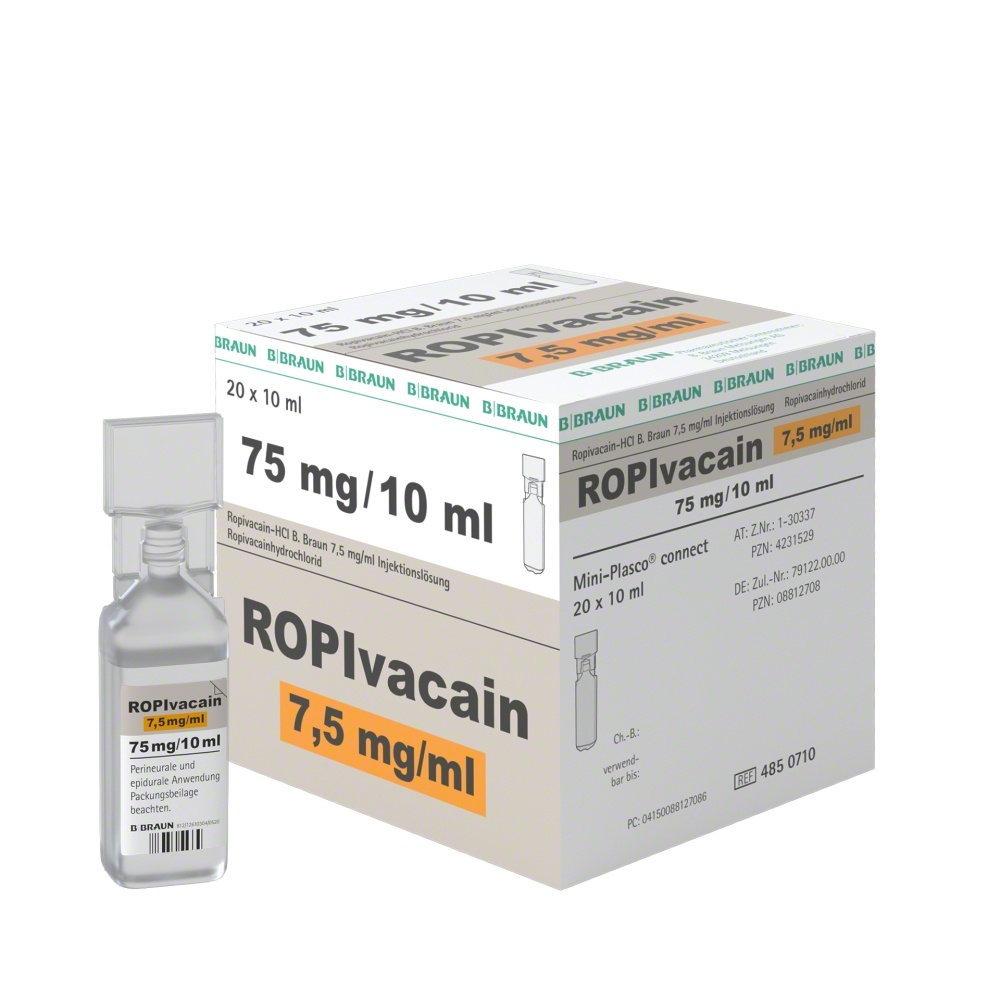
- Ampollas de polietileno de 10 ml en envases de 20.
- Ampollas de polietileno de 20 ml en envases de 20.
Puede que solamente estén comercializados algunos tamaños de envases.
Titular de la autorización de comercialización y responsable de la fabricación
- Braun Melsungen AG
Carl-Braun-Strasse 1 Dirección postal:
34212 Melsungen, Alemania 34209 Melsungen, Alemania
Teléfono: +49/5661/71-0
Fax: +49/5661/71-4567
Este medicamento está autorizado en los estados miembros del Espacio Económico Europeo con los siguientes nombres:
Áustria, Alemania, Luxemburgo: Ropivacain-HCl B. Braun 10 mg/ml Injektionslösung
Dinamarca: Ropivacain B. Braun 10 mg/ml
Finlandia: Ropivacaine B. Braun10 mg/ml injektioneste, liuos
Francia: Ropivacaine B. Braun 10 mg/ml, solution injectable en ampoule
Italia: Ropivacaina B. Braun 10 mg/ml soluzione iniettabile
Suecia: Ropivacaine B. Braun 10 mg/ml injektionsvätska, lösning
Paises Bajos Ropivacaïne HCl B. Braun 10 mg/ml, oplossing voor injectie
Portugal: Ropivacaína B. Braun 10 mg/ml solução injetável
España: Ropivacaina B. Braun 10 mg/ml solución inyectable
Fecha de la última revisión de este prospecto :10/2023.
La información detallada y actualizada de este medicamento está disponible en la página Web de la Agencia Española de Medicamentos y Productos Sanitarios (AEMPS) http://www.aemps.gob.es/
------------------------------------------------------------------------------------------------------------------
Esta información está destinada únicamente a profesionales del sector sanitario:
Forma de administración
Se recomienda una aspiración cuidadosa antes y durante la inyección para prevenir la inyección intravascular. Cuando se va a inyectar una dosis más alta, se aconseja una dosis de prueba de lidocaína con adrenalina (epinefrina). Una inyección intravascular accidental puede reconocerse por un incremento temporal en la frecuencia cardíaca y una inyección intratecal accidental por signos de bloqueo espinal.
El hidrocloruro de ropivacaína se debe inyectar lentamente o en dosis crecientes, a una velocidad de 25‑50 mg/min, mientras se observan constantemente las funciones vitales del paciente y se mantiene contacto verbal con él. Si aparecen síntomas de toxicidad, se debe interrumpir inmediatamente la administración.
Advertencias
Los procedimientos de anestesia regional deberán realizarse siempre en una zona equipada adecuadamente y dotada de personal especializado. Deberán estar disponibles en todo momento los equipos y medicamentos necesarios para la monitorización y la reanimación de emergencia.
Los pacientes a los que se les va a realizar un bloqueo mayor deberán presentar un estado general óptimo y tener accesible una vía intravenosa antes de realizar el procedimiento de bloqueo.
El médico responsable deberá tomar las precauciones necesarias para evitar la inyección intravascular (ver sección 4.2 de la Ficha Técnica) y estar adecuadamente entrenado y familiarizado con el diagnóstico y tratamiento de los efectos adversos, la toxicidad sistémica y otras complicaciones (ver las secciones 4.8 y 4.9 de la Ficha Técnica) tales como la inyección subaracnoidea accidental, que puede provocar un bloqueo espinal alto con apnea e hipotensión. Se han producido convulsiones con mayor frecuencia tras el bloqueo del plexo braquial y el bloqueo epidural. Ello probablemente sea debido a una inyección intravascular accidental o a una absorción rápida desde el lugar de la inyección.
El bloqueo de los troncos nerviosos periféricos puede suponer la administración de un gran volumen de anestésico local en zonas altamente vascularizadas, a menudo cercanas a grandes vasos, en las que existe un mayor riesgo de inyección intravascular y/o de una rápida absorción sistémica, lo que puede dar lugar a concentraciones plasmáticas elevadas.
Los pacientes con hipovolemia debida a cualquier causa pueden desarrollar repentinamente una hipotensión de carácter grave durante la anestesia epidural, independientemente del anestésico local utilizado.
Manipulación
La eliminación del medicamento no utilizado y de todos los materiales que hayan estado en contacto con él, se realizará de acuerdo con la normativa local.
Para un solo uso.
El medicamento debe ser inspeccionado visualmente antes del uso.
Solo se debe utilizar si la solución es transparente e incolora y si el envase y su cierre están intactos
Periodo de validez tras la primera apertura del envase
Desde un punto de vista microbiológico, a menos que el método de apertura excluya el riesgo de contaminación microbiana, el producto se debe utilizar inmediatamente.
Si no se utiliza inmediatamente, los tiempos y las condiciones de conservación durante el uso son responsabilidad del usuario.
Consulte en la Ficha Técnica las instrucciones relativas a las incompatibilidades y toda la información relativa a la prescripción.
-

- País de registro
- Forma farmacéuticaINYECTABLE, 10 mg/ml
- Código ATCN01BB09
- Principio activo
- Requiere recetaSí
- Fabricante
- Esta información es de carácter general y no sustituye la consulta con un profesional sanitario.
- Alternativas a ROPIVACAINA B.BRAUN 10 MG/ML SOLUCION INYECTABLE EFGForma farmacéutica: INYECTABLE, 100 MGPrincipio activo: ropivacaineFabricante: Altan Pharmaceuticals SaRequiere recetaForma farmacéutica: INYECTABLE PERFUSION, 2 mg/mlPrincipio activo: ropivacaineFabricante: Altan Pharmaceuticals SaRequiere recetaForma farmacéutica: INYECTABLE, 75 MGPrincipio activo: ropivacaineFabricante: Altan Pharmaceuticals SaRequiere receta

Médicos online para ROPIVACAINA B.BRAUN 10 MG/ML SOLUCION INYECTABLE EFG
Comenta la dosis, los posibles efectos secundarios, interacciones, contraindicaciones o la revisión de receta de ROPIVACAINA B.BRAUN 10 MG/ML SOLUCION INYECTABLE EFG, sujeto a valoración médica y a la normativa local.



Obtén una receta de ROPIVACAINA B.BRAUN 10 MG/ML SOLUCION INYECTABLE EFG online
Rellena un formulario de 2 minutos
Cuéntanos tus síntomas, historial y el medicamento que necesitas.
Elige un médico o nosotros te asignamos uno
Escoge un especialista o te conectamos con el próximo médico disponible.
El médico revisa tu caso
Normalmente en 30 minutos. Puede hacerte preguntas adicionales por chat.
Recógela en cualquier farmacia
Receta electrónica enviada a tu correo, válida en toda España.
Preguntas frecuentes
ROPIVACAINA B.BRAUN 10 MG/ML SOLUCION INYECTABLE EFG requires receta en España. Puedes confirmarlo con un médico online según tu caso.
El principio activo de ROPIVACAINA B.BRAUN 10 MG/ML SOLUCION INYECTABLE EFG es ropivacaine. Esta información ayuda a identificar medicamentos con la misma composición pero con diferentes nombres comerciales.
ROPIVACAINA B.BRAUN 10 MG/ML SOLUCION INYECTABLE EFG es fabricado por B. Braun Melsungen Ag. La marca y el envase pueden variar según el distribuidor.
Los Médicos de familia, Psiquiatras, Dermatólogos, Cardiólogos, Endocrinólogos, Gastroenterólogos, Neumólogos, Nefrólogos, Reumatólogos, Hematólogos, Infectólogos, Alergólogos, Geriatras, Pediatras, Oncólogos pueden valorar la prescripción de ROPIVACAINA B.BRAUN 10 MG/ML SOLUCION INYECTABLE EFG cuando esté clínicamente indicado. Puedes reservar una videoconsulta para comentar tu caso y las opciones de tratamiento.
España cuenta con una infraestructura sanitaria bien desarrollada en ciudades principales como Madrid, Barcelona, Valencia y Sevilla. Las farmacias están ampliamente disponibles y operan bajo estrictas regulaciones, garantizando el acceso a medicamentos con receta.
Puedes comprar ROPIVACAINA B.BRAUN 10 MG/ML SOLUCION INYECTABLE EFG en Madrid, Barcelona, Sevilla o Valencia en cualquier farmacia local con una receta válida.
Para obtener una receta, puedes utilizar Oladoctor:
Otros medicamentos con el mismo principio activo (ropivacaine) incluyen ROPIVACAINA ALTAN 10 mg/ml SOLUCION INYECTABLE EFG, ROPIVACAINA ALTAN 2 mg/ml SOLUCION PARA PERFUSION EFG, ROPIVACAINA ALTAN 7,5 mg/ml SOLUCION INYECTABLE EFG. Pueden tener diferentes nombres comerciales o formulaciones, pero contienen el mismo componente terapéutico. Consulta siempre con un médico antes de cambiar o iniciar un nuevo medicamento.
