


Ringer Lactado solución para perfusión

Solicitud de receta online
Un médico revisará tu caso y determinará si la prescripción es médicamente apropiada.

Habla con un médico sobre este medicamento
Comenta tus síntomas y las opciones de tratamiento en una consulta online.



Cómo usar RINGER LACTADO GRIFOLS SOLUCION PARA PERFUSION
Contenido del prospecto
- Introducción
- Qué es Ringer Lactado Grifols y para qué se utiliza
- Qué necesita saber antes de empezar a usar Ringer Lactado Grifols
- Cómo usar Ringer Lactado Grifols
- Posibles efectos adversos
- Conservación de Ringer Lactado Grifols
- Contenido del envase e información adicional
Introducción
Prospecto: información para el usuario
Ringer Lactado Grifols Solución para perfusión
Lea todo el prospecto detenidamente antes de empezar a usar este medicamento, porque contiene información importante para usted.
- Conserve este prospecto, ya que puede tener que volver a leerlo.
- Si tiene alguna duda, consulte a su médico o enfermero.
- Si experimenta efectos adversos, consulte a su médico o enfermero, incluso si se trata de efectos adversos que no aparecen en este prospecto. Ver sección 4.
Contenido del prospecto
- Qué es Ringer Lactado Grifols y para qué se utiliza
- Qué necesita saber antes de empezar a usar Ringer Lactado Grifols
- Cómo usar Ringer Lactado Grifols
- Posibles efectos adversos
- Conservación de Ringer Lactado Grifols
- Contenido del envase e información adicional
1. Qué es Ringer Lactado Grifols y para qué se utiliza
Ringer Lactado Grifols pertenece al grupo de medicamentos denominado Soluciones intravenosas que afectan el balance electrolítico – Electrolitos (utilizados para mantener los fluidos corporales en correcto equilibrio).
Ringer Lactado Grifols está indicado en las siguientes situaciones:
- Reposición hidroelectrolítica del fluido extracelular, como en estados de deshidratación con pérdida de electrolitos o intervenciones quirúrgicas.
- Reposición del volumen plasmático a corto plazo en estados de shock hipovolémico (hemorragias, quemaduras y otros problemas que provoquen pérdidas del volumen circulatorio) o hipotensión (descenso de la presión arterial).
- Estados de acidosis metabólica leve o moderada (excepto acidosis láctica).
- Como vehículo para la administración de medicamentos compatibles.

¿No estás seguro de si este medicamento es adecuado para ti?
Comenta tus síntomas y tratamiento con un médico online.
2. Qué necesita saber antes de empezar a usar Ringer Lactado Grifols
No use Ringer Lactado Grifols
- si es alérgico a los principios activos o a alguno de los demás componentes de este medicamento (incluidos en la sección 6)
- en estados de hiperhidratación extracelular o hipervolemia (exceso de fluidos en el cuerpo)
- si padece insuficiencia renal grave con oliguria o anuria (fallo del riñón con disminución o ausencia de orina)
- en caso de fallo cardiaco no compensado
- si su sangre contiene un nivel alto de potasio, sodio, calcio o cloruros
- si tiene alcalosis metabólica
- en caso de acidosis metabólica grave
- si tiene acidosis láctica
- si padece insuficiencia hepatocelular grave (fallo del funcionamiento del hígado) o metabolismo de lactatos deteriorado
- en situaciones de edema general (acumulación excesiva de líquidos) o cirrosis ascítica.
Advertencias y precauciones
Consulte a su médico o enfermero antes de empezar a usar Ringer Lactado Grifols.
- Si el riñón, el corazón y/o los pulmones no le funcionan correctamente, la administración de grandes volúmenes de esta solución debe realizarse bajo estricto control clínico. La administración de grandes volúmenes también precisará una vigilancia especial si es un paciente con liberación no osmótica de vasopresina (hormona antidiurética) (incluido el síndrome de secreción inadecuada de la hormona antidiurética, SIADH), debido al riesgo de hiponatremia hospitalaria (niveles bajos de sodio en sangre durante la hospitalización).
Hiponatremia:
Si es un paciente con liberación no osmótica de vasopresina (p. ej., en presencia de estados críticos, dolor, estrés postoperatorio, infecciones, quemaduras y enfermedades del sistema nervioso central), si padece enfermedades del corazón, el hígado y el riñón, y si está expuesto a agonistas de la vasopresina (ver siguiente subsección) tiene un riesgo especial de sufrir hiponatremia aguda tras la administración de soluciones hipotónicas.
La hiponatremia aguda puede causar una encefalopatía hiponatrémica aguda (edema cerebral) caracterizada por dolor de cabeza, náuseas, convulsiones, letargo y vómitos. Los pacientes con edema cerebral tienen un riesgo especial de sufrir un daño cerebral grave, irreversible y potencialmente mortal.
Los niños, las mujeres en edad fértil y los pacientes con distensibilidad cerebral reducida (p. ej., en caso de meningitis, hemorragia intracraneal y contusión cerebral) tienen un riesgo especial de sufrir edema cerebral grave y potencialmente mortal causado por una hiponatremia aguda.
- Es recomendable que, durante la administración de esta solución, se le realicen regularmente controles de su estado clínico y análisis tanto de sangre como de orina (electrolitos en sangre y orina, equilibrio ácido-base, hematocrito). Se le deberán realizar controles del potasio en sangre si tiene riesgo de padecer hiperpotasemia (niveles altos de potasio en sangre).
Si presenta alguna de las siguientes enfermedades, este medicamento se le administrará con especial precaución y es probable que se le realicen pruebas adicionales para determinar si puede recibir el medicamento:
- Debido a la presencia de sodio: Si tiene la tensión arterial alta (hipertensión), fallo cardíaco, edema en los pulmones o en los tobillos, pies y piernas, preeclampsia (enfermedad que se produce durante el embarazo o el post-parto que cursa con un aumento de la presión arterial), aldosteronismo (enfermedad asociada a un aumento en la secreción de una hormona llamada aldosterona) o tiene la función renal deteriorada u otras condiciones asociadas con la retención de sodio.
- Debido a la presencia de potasio: Si padece enfermedades cardíacas u otros problemas que puedan provocar un aumento del potasio en sangre, como la insuficiencia renal o adrenocortical, la deshidratación aguda o la destrucción masiva de tejidos, como ocurre en grandes quemados.
- Debido a la presencia de calcio: Si tiene la función renal deteriorada o si tiene o ha tenido piedras en el riñón producidas por una acumulación de calcio o enfermedades asociadas con concentraciones elevadas de vitamina D como la sarcoidosis.
- Debido a la presencia de iones lactato: Si la solución Ringer Lactado se administra en grandes cantidades se puede producir una alcalosis metabólica.
- Si presenta insuficiencia grave de potasio. Aunque la solución Ringer Lactado tiene una concentración de potasio similar a la del plasma, ésta es insuficiente para producir un efecto beneficioso en estas situaciones.
- Si el hígado no le funciona correctamente, la solución Ringer Lactado puede no producir su efecto, ya que el metabolismo del lactato puede estar deteriorado.
- Se le deberá administrar la solución Ringer Lactado con precaución si tiene riesgo de padecer edema cerebral o hipertensión intracraneal.
- Si está siendo tratado con corticoides, hormona adrenocorticotrófica o medicamentos digitálicos, la administración de la solución Ringer Lactado se le deberá realizar con precaución (ver sección Uso de otros medicamentos).
Deberá prestarse especial atención en pacientes de edad avanzada, debido a que pueden tener afectadas la función renal, hepática y/o cardiaca.
Debe evitarse la administración continuada en el mismo lugar de inyección debido al riesgo de sufrir tromboflebitis.
Otros medicamentos y Ringer Lactado Grifols
Informe a su médico si está utilizando, ha utilizado recientemente o pudiera tener que utilizar cualquier otro medicamento.
Ciertos medicamentos pueden interaccionar con Ringer Lactado Grifols. En este caso puede resultar necesario cambiar la dosis o interrumpir el tratamiento de alguno de los medicamentos.
En general, se debe evitar la administración conjunta de la solución Ringer Lactado con cualquier medicamento que presente o pueda presentar toxicidad a nivel renal, ya que puede ocasionar retención de líquidos y de electrolitos.
Es importante que informe a su médico si utiliza alguno de los siguientes medicamentos:
- Medicamentos que pueden interaccionar con alguno de los electrolitos presentes en la solución Ringer Lactado:
- Corticoides/esteroides u hormona adrenocorticotrófica
- Carbonato de litio
- Diuréticos ahorradores de potasio (amilorida, espironolactona, triamtereno) solos o en asociación
- Inhibidores del enzima convertidor de angiotensina (IECA) (captopril, enalapril) o antagonistas de los receptores de angiotensina II (candesartán, telmisartán, eprosartrán, irbesartán, losartán, valsartán)
- Tacrolimus y ciclosporina (medicamentos con toxicidad a nivel renal)
- Glucósidos digitálicos cardiotónicos (digoxina, metildigoxina)
- Diuréticos tiazídicos (hidroclorotiazida, altizida, mebutizida, bendroflumetiazida) o vitamina D
- Medicamentos de carácter ácido como los salicilatos y/o barbituratos
- Medicamentos alcalinos como los simpaticomiméticos (efedrina, pseudoefedrina) y/o estimulantes (anfetamina, dexanfetamina)
- Medicamentos que aumentan el efecto de la hormona antidiurética (como clorpropamida, clofibrato, carbamazepina, vincristina, inhibidores selectivos de la recaptación de serotonina, 3,4-metilendioxi-N-metanfetamina, ifosfamida, antipsicóticos, narcóticos, AINE (antiinflamatorios no esteroideos), ciclofosfamida, desmopresina, oxitocina, vasopresina, terlipresina). Estos medicamentos hacen que se reduzca la excreción de agua en orina y que aumente el riesgo de hiponatremia hospitalaria tras recibir un tratamiento insuficientemente equilibrado con soluciones para perfusión intravenosa (ver subsección anterior y secciones 3 y 4)
- Diuréticos en general y antiepilépticos como la oxcarbazepina, los cuales aumentan el riesgo de hiponatremia.
Embarazo y lactancia
Si está embarazada o en periodo de lactancia, cree que podría estar embarazada o tiene intención de quedarse embarazada, consulte a su médico antes de utilizar este medicamento.
Si la administración de la solución Ringer Lactado se realiza de forma correcta y controlada, no deben esperarse efectos adversos durante el embarazo ni durante el período de lactancia.
Este medicamento debe administrarse con especial precaución en mujeres embarazadas durante el parto y se precisará una vigilancia especial del sodio sérico en el caso de que se administre en combinación con oxitocina (ver subsecciones anteriores y sección 4).
Durante el embarazo y la lactancia, debe valorarse la utilización de la solución Ringer Lactado como vehículo para administrar otros medicamentos en función de la naturaleza de éstos.
Conducción y uso de máquinas
No existe ningún indicio de que este medicamento pueda afectar la capacidad de conducir o utilizar máquinas.
3. Cómo usar Ringer Lactado Grifols
Este medicamento se presenta en forma de solución para su administración por vía intravenosa.
Ringer Lactado Grifols se usará en un hospital por el personal sanitario correspondiente.
Su médico le indicará la duración de su tratamiento con Ringer Lactado Grifols.
La dosis puede variarse según criterio médico. El volumen y la velocidad de administración deberán ajustarse a la necesidad clínica de cada paciente en función de la edad, el peso, el cuadro clínico (p. ej., quemaduras, cirugía, lesión en la cabeza, infecciones), del balance de fluido, de electrolitos y del equilibrio ácido-base.
La cantidad de solución necesaria para restaurar el volumen de sangre normal es de 3-4 veces el volumen de sangre perdido.
Dosis diaria recomendada:
- Adultos: entre 500 y 3000 ml por día.
- Niños: - hasta 10 kg de peso: 100 ml por cada kg de peso y día.
- entre 10 y 20 kg de peso: 1000 ml + 50 ml adicionales por cada kg que sobrepase los 10 kg de peso, por día.
- más de 20 kg de peso: 1500 ml + 20 ml adicionales por cada kg que sobrepase los 20 kg de peso, por día.
Puede que le tengan que vigilar el balance hídrico, los electrolitos séricos y el equilibrio ácido-base antes y durante la administración, con especial atención al sodio sérico si presenta un aumento de la liberación no osmótica de vasopresina (SIADH) y si recibe simultáneamente medicación con agonistas de la vasopresina, debido al riesgo de hiponatremia hospitalaria (ver secciones 2 y 4). La vigilancia del sodio sérico es especialmente importante con las soluciones hipotónicas (este medicamento se considera ligeramente hipotónico).
Su médico decidirá sobre la necesidad de un tratamiento simultáneo (ver secciones 2 y 4).
Cuando la solución se utilice como vehículo para administrar otros medicamentos, la dosis y la velocidad de perfusión vendrán definidos por la naturaleza y el régimen posológico del medicamento prescrito.
Si recibe más Ringer Lactado Grifols del que debe
En caso de sobredosis o administración demasiado rápida, podrían aparecer los siguientes síntomas:
- hiperhidratación (edema, hipervolemia), desórdenes en el balance electrolítico y/o inducción de una alcalosis metabólica, especialmente en pacientes con función renal deteriorada. En estos casos, se disminuirá o suspenderá la administración y se recurrirá al tratamiento sintomático. Si la función renal está comprometida, puede ser necesaria la diálisis.
- sobrecarga de agua y sodio con riesgo de edema, particularmente cuando hay una excreción renal de sodio defectuosa.
La administración excesiva de sales de potasio puede conducir al desarrollo de hiperpotasemia, especialmente en pacientes con la función renal deteriorada. Los síntomas incluyen sensación de hormigueo, adormecimiento y/o ardor de manos y pies, debilidad muscular, parálisis, arritmias cardíacas, bloqueo cardíaco, parada cardiaca y confusión mental.
La administración excesiva de sales de calcio puede conducir a hipercalcemia. Los síntomas de hipercalcemia pueden incluir anorexia, náuseas, vómitos, estreñimiento, dolor abdominal, debilidad muscular, alteración mental, polidipsia (sed excesiva), poliuria (volumen excesivo de orina), piedras en el riñón y, en casos graves, arritmias cardíacas y coma, así como gusto a calcio, ardor y vasodilatación periférica. La hipercalcemia asintomática leve se resolverá habitualmente interrumpiendo la administración de calcio y con otros medicamentos contribuidores como vitamina D. Si la hipercalcemia es grave, se requiere tratamiento urgente (como ciclos de diuréticos, hemodiálisis, calcitonina, bisfosfonatos, edetato trisódico).
La administración excesiva de lactato sódico puede conducir a hipopotasemia y alcalosis metabólica. Los síntomas pueden incluir cambio de carácter, cansancio, insuficiencia respiratoria, debilidad muscular y latidos irregulares del corazón. Se puede desarrollar, especialmente en pacientes hipocalcémicos, aumento del tono muscular, espasmos musculares y tetania (hiperexcitabilidad neuromuscular). El tratamiento de la alcalosis metabólica asociada con sobredosis de bicarbonato consiste principalmente en la corrección apropiada del equilibrio de fluido y electrolitos.
Cuando la sobredosis se relaciona con la medicación añadida a la solución perfundida, los signos y síntomas de sobreperfusión pueden relacionarse con la naturaleza de la medicación añadida utilizada. En caso de sobredosificación accidental, se debe interrumpir el tratamiento y observar al paciente por si aparecen los síntomas y signos relacionados con el medicamento administrado. Si es necesario, tomar las medidas sintomáticas y de soporte que sean adecuadas.
En caso de sobredosis o ingestión accidental, consultar al Servicio de Información Toxicológica. Teléfono: 915 620 420.
Si tiene cualquier otra duda sobre el uso de este medicamento, pregunte a su médico o enfermero.

¿Has empezado a tomar el medicamento y tienes preguntas?
Comenta tus síntomas y tratamiento con un médico online.
4. Posibles efectos adversos
Al igual que todos los medicamentos, este medicamento puede producir efectos adversos, aunque no todas las personas los sufran.
Los efectos adversos más comunmente descritos son la hiperhidratación (edemas) y las alteraciones electrolíticas (principalmente después de la administración de un volumen importante de solución Ringer Lactado), así como las reacciones alérgicas.
En pacientes con liberación no osmótica de vasopresina, en pacientes con enfermedades del corazón, el hígado y el riñón, y en pacientes tratados con agonistas de la vasopresina aumenta el riesgo de sufrir hiponatremia aguda tras la administración de soluciones hipotónicas. La hiponatremia hospitalaria puede causar un daño cerebral irreversible y la muerte debido a la aparición de edema cerebral (ver secciones 2 y 3).
Los posibles efectos adversos son:
- Alteraciones electrolíticas, hiponatremia hospitalaria
- Edema cerebral
- Trombosis venosa (coágulos), flebitis (inflamación de la vena) (asociados a la administración intravenosa)
- Congestión nasal, tos, estornudos, dificultad respiratoria durante la administración de la solución, dolor en el pecho con alteración del ritmo cardíaco
- Reacciones alérgicas como urticaria, erupciones en la piel, enrojecimiento de la piel, picor, hinchazón, acumulación de líquido en los tejidos
- Hiperhidratación (edemas)
- Fiebre, infección en el sitio de la inyección, reacción local o dolor local (asociados a la administración intravenosa).
Cuando se utilice la solución Ringer Lactado como vehículo para administrar otros medicamentos, los efectos adversos pueden estar asociados a los medicamentos añadidos a la solución.
En caso de aparición de efectos adversos, deberá interrumpirse la perfusión.
Comunicación de efectos adversos
Si experimenta cualquier tipo de efecto adverso, consulte a su médico o enfermero, incluso si se trata de posibles efectos adversos que no aparecen en este prospecto. También puede comunicarlos directamente a través del Sistema Español de Farmacovigilancia de Medicamentos de Uso Humano: www.notificaRAM.es. Mediante la comunicación de efectos adversos usted puede contribuir a proporcionar más información sobre la seguridad de este medicamento.
5. Conservación de Ringer Lactado Grifols
No requiere condiciones especiales de conservación.
Una vez abierto el envase, la solución deberá utilizarse inmediatamente.
Mantener este medicamento fuera de la vista y del alcance de los niños.
No utilizar este medicamento después de la fecha de caducidad que aparece en el envase.
No utilizar este medicamento si la solución no es transparente o si se observan precipitados.
Los medicamentos no se deben tirar por los desagües ni a la basura. Deposite los envases y los medicamentos que no necesita en el Punto SIGRE (símbolo SIGRE) de la farmacia. En caso de duda pregunte a su farmacéutico cómo deshacerse de los envases y de los medicamentos que no necesita. De esta forma, ayudará a proteger el medio ambiente.
6. Contenido del envase e información adicional
Composición deRinger Lactado Grifols
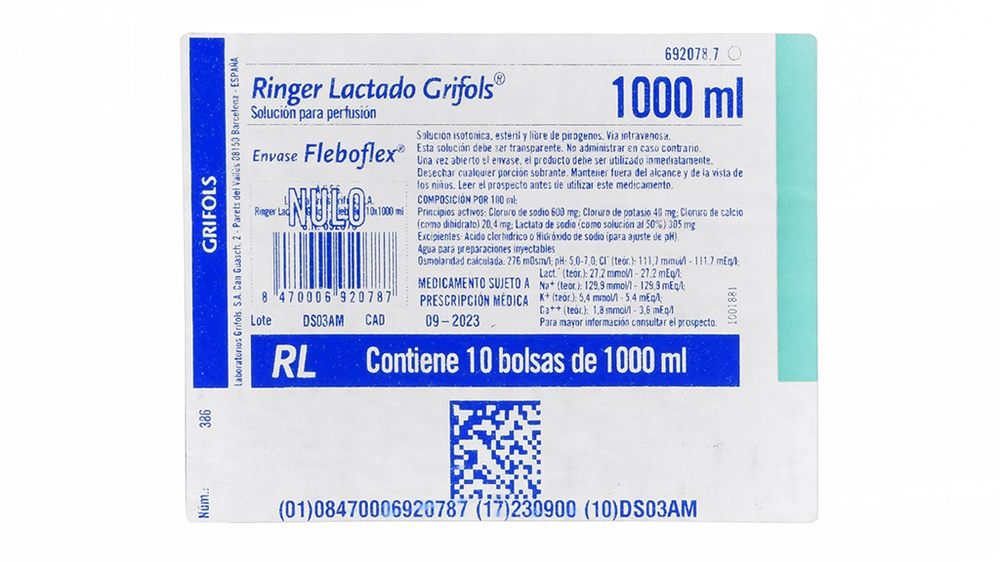
Los principios activos son cloruro de sodio, cloruro de potasio, cloruro de calcio y lactato de sodio. Cada 100 ml de solución contienen 600 mg de cloruro de sodio, 40 mg de cloruro de potasio, 20,4 mg de cloruro de calcio (como dihidrato) y 305 mg de lactato de sodio (como solución al 50%).
Los demás componentes (excipientes) son: ácido clorhídrico o hidróxido de sodio (para ajuste de pH) y agua para preparaciones inyectables.
Aspecto del producto y contenido del envase
Ringer Lactado Grifols es una solución para perfusión transparente e incolora, que se presenta frascos de vidrio de 500 y 1000 ml; y en bolsas flexibles de polipropileno (Fleboflex) de 500 y 1000 ml.
Titular de la autorización de comercialización
LABORATORIOS GRIFOLS, S.A.
Can Guasch, 2
08150 Parets del Vallès, Barcelona (ESPAÑA)
Responsable de la fabricación
LABORATORIOS GRIFOLS, S.A.
Polígono Industrial Autopista. Passeig Fluvial, 24
08150 Parets del Vallès, Barcelona (ESPAÑA)
LABORATORIOS GRIFOLS, S.A.
Polígono Industrial Los Llanos. C/ Marte, 4
30565 Las Torres de Cotillas, Murcia (ESPAÑA)
Fecha de la última revisión de este prospecto:Junio 2018
Otras fuentes de información
La información detallada de este medicamento está disponible en la página web de la Agencia Española de Medicamentos y Productos Sanitarios (AEMPS) (http://www.aemps.gob.es/)
-------------------------------------------------------------------------------------------------------------------------
Esta información está destinada únicamente a profesionales del sector sanitario:
Ringer Lactado Grifols se administrará por perfusión.
El contenido de cada envase de este medicamento es para una sola perfusión. Una vez abierto el envase, la solución debe administrarse inmediatamente y debe desecharse la fracción no utilizada.
La solución debe ser transparente y no contener precipitados. No administrar en caso contrario.
Bolsa Fleboflex:
- Comprobar la ausencia de pequeñas fugas presionando firmemente la bolsa. Si se detectan fugas desechar el producto.
- Para conectar el equipo de perfusión, separar la lengüeta protectora del puerto de infusión, dejando al descubierto la membrana de acceso a la bolsa.
Para administrar la solución y en caso de adición de medicamentos, deberá guardarse la máxima asepsia. Desde un punto de vista microbiológico, cuando la solución se utilice como vehículo de otros medicamentos, se debe utilizar inmediatamente a menos que la dilución se haya realizado en condiciones asépticas controladas y validadas. Si no se utiliza inmediatamente, las condiciones y períodos de conservación durante el uso son responsabilidad del usuario.
Se recomienda consultar tablas de compatibilidades antes de adicionar medicamentos a la solución Ringer Lactado o de administrar simultáneamente con otros medicamentos. Se recomienda consultar el prospecto de los medicamentos adicionados, así como verificar si éstos son solubles y estables en solución acuosa al pH de la solución Ringer Lactado (pH 5,0-7,0).
Cuando se añada medicación compatible a Ringer Lactado Grifols, la solución debe administrarse de inmediato.
No se debe utilizar la solución Ringer Lactado como vehículo para medicamentos que contengan iones capaces de provocar la formación de sales insolubles de calcio.
Se recomienda no mezclar o administrar simultáneamente en el mismo equipo de perfusión solución Ringer Lactado con sangre total o con componentes sanguíneos conservados con un anticoagulante que contenga citrato (como CPD), debido a que los iones calcio presentes en esta solución pueden exceder la capacidad quelante del citrato, pudiéndose producir la formación de coágulos. Estos coágulos podrían perfundir directamente a la circulación y provocar una embolia.
- País de registro
- Forma farmacéuticaINYECTABLE PERFUSION, -
- Código ATCB05BB01
- Precio medio en farmacia21.06 EUR
- Principio activo
- Requiere recetaSí
- Fabricante
- ComposiciónHIDROXIDO DE SODIO (E 524) (c.s. ajuste pH - mg)
- Esta información es de carácter general y no sustituye la consulta con un profesional sanitario.
- Alternativas a RINGER LACTADO GRIFOLS SOLUCION PARA PERFUSIONForma farmacéutica: INYECTABLE, 1361 mgPrincipio activo: electrolytesFabricante: Fresenius Kabi España, S.A.U.Requiere recetaForma farmacéutica: INYECTABLE PERFUSION, 2 % sodio cloruro/ 100 mlPrincipio activo: electrolytesFabricante: Fresenius Kabi España, S.A.U.Requiere recetaForma farmacéutica: INYECTABLE PERFUSION, 33 mg / 30 mg / 860 mgPrincipio activo: electrolytesFabricante: Fresenius Kabi España, S.A.U.Requiere receta
Médicos online para RINGER LACTADO GRIFOLS SOLUCION PARA PERFUSION
Comenta la dosis, los posibles efectos secundarios, interacciones, contraindicaciones o si una receta es apropiada para RINGER LACTADO GRIFOLS SOLUCION PARA PERFUSION, sujeto a valoración médica y a la normativa local.









Preguntas frecuentes
RINGER LACTADO GRIFOLS SOLUCION PARA PERFUSION requiere receta en España. Puedes confirmarlo con un médico online según tu caso.
El principio activo de RINGER LACTADO GRIFOLS SOLUCION PARA PERFUSION es electrolytes. Esta información ayuda a identificar medicamentos con la misma composición pero con diferentes nombres comerciales.
El precio medio en farmacia de RINGER LACTADO GRIFOLS SOLUCION PARA PERFUSION es de aproximadamente 21.06 EUR. Puede variar según el fabricante y la forma farmacéutica.
RINGER LACTADO GRIFOLS SOLUCION PARA PERFUSION es fabricado por Laboratorios Grifols S.A.. La marca y el envase pueden variar según el distribuidor.
Los Médicos de familia, Psiquiatras, Dermatólogos, Cardiólogos, Endocrinólogos, Gastroenterólogos, Neumólogos, Nefrólogos, Reumatólogos, Hematólogos, Infectólogos, Alergólogos, Geriatras, Pediatras, Oncólogos pueden valorar la prescripción de RINGER LACTADO GRIFOLS SOLUCION PARA PERFUSION cuando esté clínicamente indicado. Puedes reservar una videoconsulta para comentar tu caso y las opciones de tratamiento.
La receta la emite un médico tras valorar tu estado de salud. En España, RINGER LACTADO GRIFOLS SOLUCION PARA PERFUSION se dispensa en las farmacias con esa receta médica. Una consulta online no garantiza su emisión: la decisión corresponde siempre al médico.
Para solicitar una valoración puedes usar Oladoctor:
Otros medicamentos con el mismo principio activo (electrolytes) incluyen ACETATO SODICO 1M FRESENIUS KABI CONCENTRADO PARA SOLUCION PARA PERFUSION, APIROSERUM CLORURO SODICO 2% SOLUCIÓN PARA PERFUSION, APIROSERUM SOLUCION RINGER SOLUCION PARA PERFUSION. Pueden tener diferentes nombres comerciales o formulaciones, pero contienen el mismo componente terapéutico. Consulta siempre con un médico antes de cambiar o iniciar un nuevo medicamento.
