



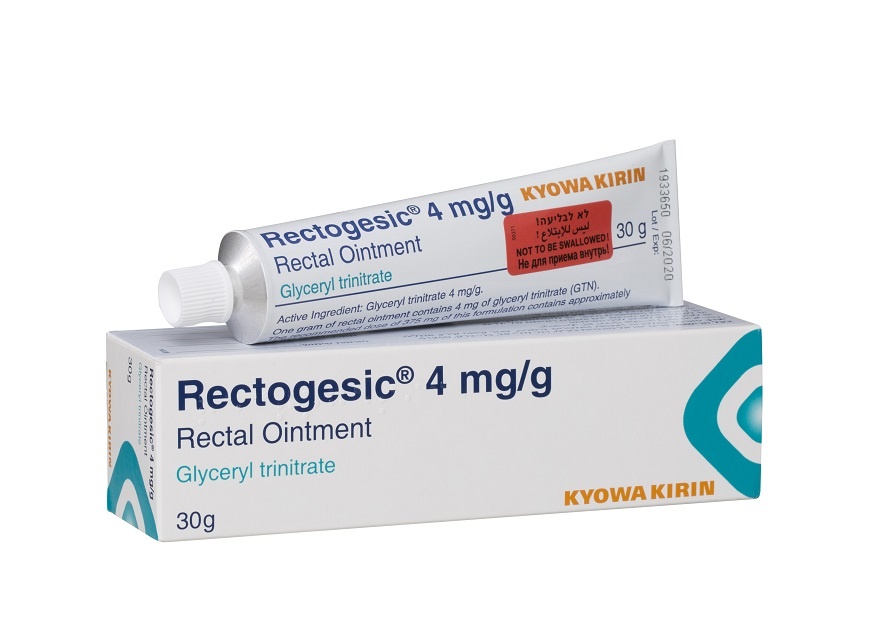
RECTOGESIC 4 mg /G Pomada Rectal

Revisión de receta online
Un médico revisará tu caso y determinará si la prescripción es médicamente apropiada.

Habla con un médico sobre este medicamento
Comenta tus síntomas y las opciones de tratamiento en una consulta online.



Cómo usar RECTOGESIC 4 mg/g POMADA RECTAL
Contenido del prospecto
- Introducción
- Qué es RECTOGESIC y para qué se utiliza
- Qué necesita saber antes de empezar a usar RECTOGESIC
- Cómo usar RECTOGESIC
- Posibles efectos adversos
- Conservación de RECTOGESIC
- Contenido del envase e información adicional
Introducción
PROSPECTO: INFORMACION PARA EL USUARIO
Rectogesic 4 mg/g Pomada Rectal
Trinitrato de glicerilo
Lea todo el prospecto detenidamente antes de empezar a usareste medicamento, porque contiene información importante para usted.
- Conserve este prospecto, ya que puede tener que volver a leerlo.
- Si tiene alguna duda, consulte a su médico o farmacéutico.
- Este medicamento se le ha recetado solamente a usted, y no debe dárselo a otras personas aunque tengan los mismos síntomas que usted, ya que puede perjudicarles.
- Si experimenta efectos adversos, consulte a su médico o farmacéutico, incluso si se trata de efectos adversos que no aparecen en este prospecto. Ver sección 4.
Contenido del prospecto:
- Qué es Rectogesic y para qué se utiliza
- Qué necesita saber antes de empezar a usar Rectogesic
- Cómo usar Rectogesic
- Posibles efectos adversos
- Conservación de Rectogesic
- Contenido del envase e información adicional
1. Qué es RECTOGESIC y para qué se utiliza
Rectogesic es una pomada rectal que contiene como principio activo el trinitrato de glicerilo. El trinitrato de glicerilo pertenece a un grupo de fármacos denominados nitratos orgánicos.
La pomada ayudará a aliviar los síntomas dolorosos causados por las fisuras anales crónicas. Una fisura anal es un desgarro de la piel que recubre el canal anal. La aplicación tópica de trinitrato de glicerilo al canal anal reduce la presión anal y aumenta el flujo sanguíneo, lo que reduce la sensación de dolor.

¿No estás seguro de si este medicamento es adecuado para ti?
Comenta tus síntomas y tratamiento con un médico online.
2. Qué necesita saber antes de empezar a usar RECTOGESIC
No use Rectogesic:
- si es alérgico al trinitrato de glicerilo o a otros medicamentos parecidos
- si es alérgico a cualquiera de los demás componentes de este medicamento (incluidos en la sección 6)
- si tiene la tensión arterial baja
- si padece trastornos del corazón o de los vasos sanguíneos
- si padece glaucoma de ángulo cerrado, una enfermedad en la que la presión interna de los ojos aumenta rápidamente y provoca pérdida de la visión
- si padece migraña o dolores de cabeza recurrentes
- si tiene la presión intracraneal aumentada o la presión craneal alta (por ejemplo, traumatismo craneoencefálico o hemorragia cerebral; una hemorragia provocada por la ruptura de un vaso sanguíneo en el cerebro que puede ser mortal sin el tratamiento médico inmediato. Suele considerarse a la hemorragia cerebral como un tipo de accidente cerebrovascular) o circulación cerebral inadecuada (bajo volumen de circulación sanguínea en el cerebro)
- si padece anemia (bajo contenido de hierro en la sangre)
- si está tomando alguno de los siguientes medicamentos: medicamentos para la disfunción eréctil tales como citrato de sildenafilo, tadalafilo, vardenafilo; medicamentos para la angina o el dolor del corazón, tales como trinitrato de glicerilo (NTG), dinitrato de isosorbida, nitrito amílico o nitrito butílico; medicamentos para la tensión arterial alta o la depresión (antidepresivos tricíclicos), acetilcisteína o alteplasa
Tenga especial cuidado con Rectogesic:
- si padece alguna enfermedad del hígado o de los riñones
- si se le va a administrar heparina, se deberán vigilar de cerca los parámetros de la sangre ya que puede ser necesario modificar la dosis de heparina. Hable con su médico antes de interrumpir el tratamiento con Rectogesic
- si tiene también hemorroides (almorranas) y observa más sangrado que de costumbre, deberá interrumpir el tratamiento con Rectogesic. Hable con su médico sobre este tema
- si padece dolores de cabeza graves al utilizar Rectogesic, informe a su médico. El médico decidirá si usted necesita una cantidad diferente de Rectogesic, o si es necesario interrumpir totalmente el tratamiento
Rectogesic puede bajar la tensión arterial. Al levantarse de una posición tumbada o sentada, deberá hacerlo despacio para evitar mareos. Es más probable que baje la tensión arterial si bebe alcohol durante el tratamiento con Rectogesic.
Niños y adolescentes
Rectogesic no es apropiado para niños y adolescentes menores de 18 años ya que no fue evaluado en pacientes de este grupo de edad.
Toma de Rectogesic con otros medicamentos
Informe a su médico o farmacéutico si está utilizando o ha utilizado recientemente otros medicamentos, incluso los adquiridos sin receta médica.
Los siguientes medicamentos pueden aumentar el efecto para bajar la tensión arterial de Rectogesic.
- Medicamentos para la depresión (antidepresivos tricíclicos)
- Medicamentos para el tratamiento de la disfunción eréctil (impotencia masculina) (citrato de sildenafilo, tadalafilo, vardenafilo)
- Medicamentos para la tensión arterial alta
- Diuréticos
- Tranquilizantes de uso frecuente
- Medicamentos utilizados para el tratamiento de problemas del corazón (dinitrato de isosorbida y nitrito amílico o nitrito butílico)
Otros medicamentos
- La acetilcisteína puede incrementar los efectos de Rectogesic sobre el flujo de sangre
- Pueden disminuir los efectos de la heparina (utilizada para controlar los coágulos sanguíneos) cuando se la utiliza junto con Rectogesic
- Pueden disminuir los efectos de la alteplasa (utilizada para el tratamiento de problemas del corazón) cuando se la utiliza simultáneamente con Rectogesic
- El uso de Rectogesic con dihidroergotamina (utilizada para tratar la migraña) puede aumentar los efectos de la dihidroergotamina y provocar una vasoconstricción coronaria (un estrechamiento de los vasos sanguíneos del corazón que provoca una circulación sanguínea más lenta)
- El ácido acetilsalicílico y los antiinflamatorios no esteroides (determinados tipos de analgésicos) pueden alterar el efecto terapéutico de Rectogesic
Uso de Rectogesic con alcohol
Tenga cuidado con el consumo de alcohol ya que la pomada puede tener un efecto mayor que de costumbre.
Embarazo y lactancia
No debe usar Rectogesic durante el embarazo o la lactancia.
Consulte a su médico o farmacéutico antes de usar un medicamento durante el embarazo o la lactancia.
Conducción y uso de máquinas
No se han realizado estudios sobre la capacidad para conducir y utilizar máquinas con la Pomada Rectal Rectogesic 4 mg/g. Si empieza a sentir mareos o sueño o tiene la visión borrosa cuando empiece a utilizar la pomada, no conduzca ni opere con maquinaria hasta que estos efectos hayan desaparecido.
Rectogesic contiene lanolina y propilenglicol
Este medicamento contiene lanolina (grasa de la lana), puede provocar reacciones locales en la piel (como dermatitis de contacto). Este medicamento también contiene propilenglicol que puede causar irritación en la piel.
3. Cómo usar RECTOGESIC
Método de administración
La Pomada Rectal Rectogesic 4 mg/g es para uso rectal.
Siga exactamente las instrucciones de administración de este medicamento indicadas por su médico. En caso de duda, consulte de nuevo a su médico o farmacéutico. La dosis recomendada es aproximadamente 375 mg de pomada (aproximadamente 1,5 mg de trinitrato de glicerilo) aplicado al canal anal cada 12 horas.
El dedo se puede recubrir, con película plástica o un dedil, antes de aplicar la pomada. Los dediles pueden obtenerse en su farmacia local o en un proveedor de suministros quirúrgicos y la película plástica en un comercio local. El dedo recubierto se coloca al lado de la línea para la dosificación de 2,5 cm, que aparece en el envase exterior, y se extrae una cantidad de pomada equivalente a la longitud de la línea sobre el extremo del dedo con una presión ligera sobre el tubo. Inserte la pomada suavemente en el canal anal con su dedo. El dedo con pomada debe insertarse hasta el primer nudillo (aproximadamente 1 cm) dentro del ano.
Aplique la pomada cada doce horas según las instrucciones de su médico y no sobrepase la dosis indicada. Lávese las manos después de cada utilización y elimine el dedil o película de plástico (no por el desagüe del inodoro).
El tratamiento podrá continuarse hasta que el dolor desaparezca, o hasta un máximo de 8 semanas. Si no se alivia el dolor después de usar Rectogesic, deberá consultar nuevamente con su médico para descartar otra causa del dolor.
Si usa más Rectogesic del que debiera
Si utiliza una cantidad de pomada mayor que lo indicado, es posible que sienta mareos o aturdimiento. También puede sentir ritmo cardiaco rápido o palpitaciones. Si experimenta estos síntomas, limpie el exceso y hable de inmediato con su médico o farmacéutico.
Si olvidó usar Rectogesic
No se aplique una dosis doble para compensar las dosis olvidadas. Aplique la próxima dosis a la hora de costumbre.
Si tiene cualquier otra duda sobre el uso de este medicamento, pregunte a su médico o farmacéutico.

¿Has empezado a tomar el medicamento y tienes preguntas?
Comenta tus síntomas y tratamiento con un médico online.
4. Posibles efectos adversos
Al igual que todos los medicamentos, este medicamento puede producir efectos adversos, aunque no todas las personas los sufran.
Efectos adversos graves:
- Reacción anafilactoide (reacción alérgica, potencialmente mortal con hinchazón de la cara, labios, lengua o garganta, dificultad para respirar, falta de aire o lipotimia). Si experimenta alguno de estos síntomas, suspenda el uso de la pomada y consulte a un médico de inmediato.
- Reacciones alérgicas en la piel (potencialmente graves). Si experimenta alguna reacción alérgica en la piel, suspenda el uso de la pomada y consulte a un médico de inmediato.
Otros efectos adversos:
Muy frecuentes (pueden afectar a más de 1 de cada 10 personas)
- Dolores de cabeza, que pueden llegar a ser graves. Si empieza a sufrir un dolor de cabeza como efecto secundario, límpiese cualquier resto de pomada. Si los dolores de cabeza llegan a ser molestos, consulte a su médico si debe interrumpir el uso del medicamento.
Frecuentes (pueden afectar hasta a 1 de cada 10 personas)
- Mareo
- Náuseas
Poco frecuentes (pueden afectar hasta a 1 de cada 100 personas)
- Diarrea
- Vómitos
- Hemorragia rectal, trastorno rectal
- Malestar anal, picor o quemazón en el canal anal
- Ritmo cardiaco rápido o palpitaciones
Raros (pueden afectar hasta a 1 de cada 1000 personas)
- Mareo al ponerse de pie
Efectos adversos de frecuencia no conocida (la frecuencia no puede estimarse a partir de los datos disponibles)
- Aturdimiento, desmayos
- Tensión arterial baja
- Irritación, sarpullido o dolor en la zona de aplicación
Otros efectos adversos conocidos asociados a los productos de trinitrato de glicerilo (frecuencia desconocida)
- Sofocos
- Angina inestable (dolor de pecho)
- Tensión arterial alta al interrumpir el tratamiento
- Metahemoglobinemia (los síntomas son coloración azulada/morada en la piel y falta de aire)
Comunicación de efectos adversos
Si experimenta cualquier tipo de efecto adverso, consulte a su médico o farmacéutico, incluso si se trata de posibles efectos adversos que no aparecen en este prospecto. También puede comunicarlos directamente a través del Sistema Español de Farmacovigilancia de Medicamentos de Uso Humano: https://www.notificaRAM.es.
Mediante la comunicación de efectos adversos usted puede contribuir a proporcionar más información sobre la seguridad de este medicamento.
5. Conservación de RECTOGESIC
Mantener este medicamento fuera de la vista y del alcance de los niños.
No utilice este medicamento después de la fecha de caducidad que aparece en el tubo y la caja después de CAD. La fecha de caducidad es el último día del mes que se indica.
- No conservar a temperatura superior a 25°C.
- No congelar.
- Mantener el tubo perfectamente cerrado.
Una vez abierto, utilice la pomada en las 8 semanas siguientes.
6. Contenido del envase e información adicional
Composición de Rectogesic
El principio activo es el trinitrato de glicerilo. Un gramo de pomada rectal contiene 4 mg de trinitrato de glicerilo. La dosis normal de 375 mg de Rectogesic contiene aproximadamente 1,5 mg de trinitrato de glicerilo.
Los demás componentes (excipientes) son: propilenglicol, lanolina, sesquioleato de sorbitán, parafina dura y parafina blanda blanca.
Aspecto de Rectogesic y tamaño del envase
Rectogesic es una formulación de pomada rectal opaca, suave y blanquecina que se suministra en tubos de aluminio de 30 g.
Titular de la autorización de comercialización y Responsable de la fabricación.
Titular de la Autorización de Comercialización
Grünenthal Pharma, S.A.
Doctor Zamenhof, 36
28027 Madrid
España
Responsable de la fabricación
PHARBIL Waltrop GmbH
Im Wirrigen 25
45731 Waltrop
Alemania
Fecha de la última revisión de este prospecto:mayo 2015
La información detallada y actualizada de este medicamento está disponible en la página web de la Agencia Española de Medicamentos y Productos Sanitarios (AEMPS) http://www.aemps.gob.es/
- País de registro
- Forma farmacéuticaSEMISOLIDO RECTAL, 4 mg/g
- Código ATCC05AE01
- Precio medio en farmacia64.46 EUR
- Principio activo
- Requiere recetaSí
- Fabricante
- ComposiciónLANOLINA (14,0 Porcentaje peso/peso mg), SORBITAN SESQUIOLEATO (2,0 Porcentaje peso/peso mg)
- Esta información es de carácter general y no sustituye la consulta con un profesional sanitario.
- Alternativas a RECTOGESIC 4 mg/g POMADA RECTALForma farmacéutica: SEMISOLIDO RECTAL, 0,25 mg; 8 mg; 1 mg/gPrincipio activo: FluocinonidaFabricante: Anotaciones Farmaceuticas, S.L.No requiere recetaForma farmacéutica: SEMISOLIDO RECTAL, 0,1 mg/g + 10 mg/g + 20 mg/gPrincipio activo: other preparations, combinationsFabricante: Lacer S.A.No requiere recetaForma farmacéutica: SEMISOLIDO RECTAL, 25 mg; 5 mg; 15 mg; 10 mgPrincipio activo: HidrocortisonaFabricante: Laboratorios Cinfa S.A.Requiere receta
Médicos online para RECTOGESIC 4 mg/g POMADA RECTAL
Comenta la dosis, los posibles efectos secundarios, interacciones, contraindicaciones o la revisión de receta de RECTOGESIC 4 mg/g POMADA RECTAL, sujeto a valoración médica y a la normativa local.









Obtén una receta de RECTOGESIC 4 mg/g POMADA RECTAL online
Rellena un formulario de 2 minutos
Cuéntanos tus síntomas, historial y el medicamento que necesitas.
Elige un médico o nosotros te asignamos uno
Escoge un especialista o te conectamos con el próximo médico disponible.
El médico revisa tu caso
Normalmente en 30 minutos. Puede hacerte preguntas adicionales por chat.
Recógela en cualquier farmacia
Receta electrónica enviada a tu correo, válida en toda España.
Preguntas frecuentes
RECTOGESIC 4 mg/g POMADA RECTAL requiere receta en España. Puedes confirmarlo con un médico online según tu caso.
El principio activo de RECTOGESIC 4 mg/g POMADA RECTAL es Trinitrato de glicerilo. Esta información ayuda a identificar medicamentos con la misma composición pero con diferentes nombres comerciales.
El precio medio en farmacia de RECTOGESIC 4 mg/g POMADA RECTAL es de aproximadamente 64.46 EUR. Puede variar según el fabricante y la forma farmacéutica.
RECTOGESIC 4 mg/g POMADA RECTAL es fabricado por Grünenthal Pharma S.A.. La marca y el envase pueden variar según el distribuidor.
Los Médicos de familia, Psiquiatras, Dermatólogos, Cardiólogos, Endocrinólogos, Gastroenterólogos, Neumólogos, Nefrólogos, Reumatólogos, Hematólogos, Infectólogos, Alergólogos, Geriatras, Pediatras, Oncólogos pueden valorar la prescripción de RECTOGESIC 4 mg/g POMADA RECTAL cuando esté clínicamente indicado. Puedes reservar una videoconsulta para comentar tu caso y las opciones de tratamiento.
España cuenta con una infraestructura sanitaria bien desarrollada en ciudades principales como Madrid, Barcelona, Valencia y Sevilla. Las farmacias están ampliamente disponibles y operan bajo estrictas regulaciones, garantizando el acceso a medicamentos con receta.
Puedes comprar RECTOGESIC 4 mg/g POMADA RECTAL en Madrid, Barcelona, Sevilla o Valencia en cualquier farmacia local con una receta válida.
Para obtener una receta, puedes utilizar Oladoctor:
Otros medicamentos con el mismo principio activo (Trinitrato de glicerilo) incluyen ABRASONE RECTAL, CREMA RECTAL, ANSO POMADA RECTAL, ANTIHEMORROIDAL CINFA POMADA RECTAL. Pueden tener diferentes nombres comerciales o formulaciones, pero contienen el mismo componente terapéutico. Consulta siempre con un médico antes de cambiar o iniciar un nuevo medicamento.
