



RASILEZ 150 mg Comprimidos Recubiertos Con Película

Revisión de receta online
Un médico revisará tu caso y determinará si la prescripción es médicamente apropiada.

Habla con un médico sobre este medicamento
Comenta tus síntomas y las opciones de tratamiento en una consulta online.



Cómo usar RASILEZ 150 mg COMPRIMIDOS RECUBIERTOS CON PELICULA
Contenido del prospecto
- Introducción
- Qué es Rasilez y para qué se utiliza
- Qué necesita saber antes de empezar a tomar Rasilez
- Cómo tomar Rasilez
- Posibles efectos adversos
- Conservación de Rasilez
- Contenido del envase e información adicional
Introducción
Prospecto: información para el usuario
Rasilez 150 mg comprimidos recubiertos con película
Rasilez 300 mg comprimidos recubiertos con película
aliskireno
Lea todo el prospecto detenidamente antes de empezar a tomar este medicamento, porque contiene información importante para usted.
- Conserve este prospecto, ya que puede tener que volver a leerlo.
- Si tiene alguna duda, consulte a su médico o farmacéutico.
- Este medicamento se le ha recetado solamente a usted, y no debe dárselo a otras personas aunque tengan los mismos síntomas que usted, ya que puede perjudicarles.
- Si experimenta efectos adversos, consulte a su médico o farmacéutico, incluso si se trata de efectos adversos que no aparecen en este prospecto. Ver sección 4
Contenido del prospecto
- Qué es Rasilez y para qué se utiliza
- Qué necesita saber antes de empezar a tomar Rasilez
- Cómo tomar Rasilez
- Posibles efectos adversos
- Conservación de Rasilez
- Contenido del envase e información adicional
1. Qué es Rasilez y para qué se utiliza
Este medicamento contiene un principio activo llamado aliskireno. Aliskireno pertenece a una clase de medicamentos llamados inhibidores de la renina. Los inhibidores de la renina reducen la cantidad de angiotensina II que el organismo puede producir. La angiotensina II causa un estrechamiento de los vasos sanguíneos, lo que aumenta la presión arterial. La reducción de los niveles de angiotensina II permite que los vasos sanguíneos se relajen, lo que disminuye la presión arterial.
Esto ayuda a disminuir la presión arterial alta en pacientes adultos. La hipertensión aumenta la carga de trabajo del corazón y de las arterias. Si esto continúa durante mucho tiempo, se pueden dañar los vasos sanguíneos del cerebro, corazón y riñones, lo que puede provocar ictus, insuficiencia cardiaca, infarto de miocardio o insuficiencia renal. La disminución de la presión arterial al nivel normal reduce el riesgo de desarrollar estas enfermedades.

¿No estás seguro de si este medicamento es adecuado para ti?
Comenta tus síntomas y tratamiento con un médico online.
2. Qué necesita saber antes de empezar a tomar Rasilez
No tome Rasilez
- si es alérgico a aliskireno o a alguno de los demás componentes de este medicamento (incluidos en la sección 6). Si cree que puede ser alérgico, consulte a su médico.
- si alguna vez ha experimentado los siguientes tipos de angioedema (dificultad al respirar o tragar, o hinchazón de la cara, manos y pies, ojos, labios y/o lengua):
- angioedema al tomar aliskireno.
- angioedema hereditario.
- angioedema de causa desconocida.
- durante los últimos 6 meses del embarazo o si está dando el pecho, ver sección “Embarazo y lactancia”.
- si está tomando ciclosporina (un medicamento utilizado en trasplantes para prevenir el rechazo de un órgano o para otras enfermedades, p. ej. artritis reumatoide o dermatitis atópica), itraconazol (un medicamento para tratar las infecciones por hongos) o quinidina (un medicamento utilizado para corregir el ritmo cardiaco).
- si tiene diabetes o insuficiencia renal y se lo está tratando con una de las siguientes clases de medicamentos utilizados para el tratamiento de la hipertensión (presión arterial alta):
- un inhibidor de la enzima convertidora de angiotensina como enalapril, lisinopril, ramipril
o
- un antagonista de los receptores de la angiotensina II como valsartán, telmisartán, irbesartán.
- si el paciente es menor de 2 años de edad.
Advertencias y precauciones
Consulte a su médico antes de empezar a tomar Rasilez:
- si está tomando un diurético (un tipo de medicamento para aumentar la cantidad de orina).
- si está tomando alguna de las siguientes clases de medicamentos utilizados para tratar la hipertensión (presión arterial alta):
- un inhibidor de la enzima convertidora de angiotensina como enalapril, lisinopril, ramipril
o
- un antagonista de los receptores de la angiotensina II como valsartán, telmisartán, irbesartán.
- si tiene insuficiencia renal, su médico considerará cuidadosamente si este medicamento es apropiado para usted y puede querer controlarlo cuidadosamente.
- si ya ha experimentado angioedema (dificultad al respirar o tragar, o hinchazón de la cara, manos y pies, ojos, labios y/o lengua). Si esto ocurre, deje de tomar este medicamento y contacte con su médico.
- si tiene una estenosis de la arteria renal (estrechamiento de los vasos sanguíneos de uno o ambos riñones).
- si tiene una insuficiencia cardiaca congestiva grave (un tipo de enfermedad cardiaca en la que el corazón no puede bombear suficiente sangre a todo el cuerpo).
Si tiene diarrea grave y persistente debe dejar de tomar Rasilez.
Puede que su médico le controle la función renal, la presión arterial y los niveles de electrolitos (por ejemplo, potasio) en la sangre a intervalos regulares.
Véase también la sección “No tome Rasilez”.
Niños y adolescentes
Este medicamento no puede usarse en bebés desde recién nacidos hasta menos de 2 años de edad. No debe usarse en niños desde los 2 años hasta menos de 6 años de edad, y no se recomienda para su uso en niños y adolescentes desde los 6 años hasta menos de 18 años de edad. Esto se debe a que no se conocen la seguridad ni los riesgos en esta población.
Personas de edad avanzada
La dosis normal de aliskireno al inicio del tratamiento en los pacientes de edad avanzada de 65 años o más es de 150 mg. En la mayoría de pacientes de 65 años de edad o mayores la dosis de 300 mg de Rasilez no muestra ningún beneficio adicional en la reducción de la presión arterial en comparación con la dosis de 150 mg.
Otros medicamentos y Rasilez
Informe a su médico o farmacéutico si está utilizando, ha utilizado recientemente o pudiera tener que utilizar cualquier otro medicamento.
Su médico puede tener que cambiar su dosis y/o tomar otras precauciones si está usando alguno de los siguientes medicamentos:
- medicamentos que incrementan la cantidad de potasio en su sangre, incluyendo diuréticos ahorradores de potasio y suplementos de potasio.
- furosemida o torasemida, unos medicamentos que pertenecen al grupo de medicamentos conocidos como diuréticos que se utilizan para aumentar la cantidad de orina.
- un antagonista de los receptores de la angiotensina II o un inhibidor de la enzima convertidora
- de angiotensina (ver las secciones “No tome Rasilez” y “Advertencias y precauciones”).
- ketoconazol, un medicamento utilizado para tratar infecciones de hongos.
- verapamilo, un medicamento utilizado para disminuir la tensión arterial, corregir el ritmo cardíaco o tratar una angina de pecho.
- cierto tipo de medicamentos para tratar el dolor llamados medicamentos antiinflamatorios no esteroideos (AINEs).
Toma de Rasilez con alimentos y bebidas
Debe tomar este medicamento bien con una comida ligera o bien sin comida una vez al día, preferiblemente a la misma hora cada día. Debe evitar tomar este medicamento junto con zumo de fruta y/o bebidas que contienen extractos de plantas (incluyendo infusiones), ya que podría reducir la eficacia de este medicamento.
Embarazo y lactancia
Embarazo
No tome este medicamento si está embarazada (ver sección No tome Rasilez). Si se queda embarazada mientras toma este medicamento, deje inmediatamente de tomarlo y consulte a su médico. Si cree que podría estar embarazada o tiene intención de quedarse embarazada, consulte a su médico o farmacéutico antes de utilizar este medicamento. Por lo general, su médico le aconsejará que deje de tomar este medicamento antes de quedarse embarazada y le recomendará tomar otro medicamento antihipertensivo en lugar de este medicamento. No se recomienda utilizarlo al inicio del embarazo y en ningún caso debe administrarse a partir del tercer mes de embarazo ya que puede causar daños graves a su bebé cuando se administra a partir de ese momento.
Lactancia
Informe a su médico si va a iniciar o está en periodo de lactancia puesto que no se recomienda administrar este medicamento a mujeres durante este periodo. Su médico puede decidir administrarle otro tratamiento si quiere dar el pecho.
Conducción y uso de máquinas
Este medicamento puede hacerle sentir mareado y esto puede afectar a su capacidad de concentración. Antes de conducir un vehículo, manejar maquinaria o realizar otras actividades que requieran un cierto grado de concentración, debe asegurarse de que conoce su reacción a los efectos de este medicamento.
3. Cómo tomar Rasilez
Siga exactamente las instrucciones de administración de este medicamento indicadas por su médico. En caso de duda, consulte de nuevo a su médico o farmacéutico.
Las personas hipertensas a menudo no notan ningún síntoma de su problema. Muchos pueden sentirse normales. Es muy importante que tome este medicamento exactamente como le ha indicado su médico para obtener los mejores resultados y reducir el riesgo de efectos adversos. Mantenga las visitas con su médico aunque se encuentre bien.
La dosis normal al inicio del tratamiento es de un comprimido de 150 mg una vez al día. Los efectos reductores sobre la presión arterial aparecen en dos semanas tras el inicio del tratamiento.
Personas de edad avanzada
La dosis normal de aliskireno al inicio del tratamiento es de 150 mg. En la mayoría de los pacientes de 65 años o mayores, la dosis de 300 mg de aliskireno no es más beneficiosa para reducir la presión arterial que la dosis de 150 mg.
Dependiendo de cómo responda al tratamiento, su médico puede subirle la dosis a 300 mg una vez al día. Su médico puede recetar este medicamento junto con otros medicamentos para tratar la hipertensión.
Forma de administración
Tragar el comprimido entero con un poco de agua. Debe tomar este medicamento una vez al día siempre con comida o siempre sin comida, preferiblemente a la misma hora cada día. Debe establecer un horario adecuado para tomar el medicamento de la misma forma cada día, de acuerdo a un patrón regular respecto al tiempo de sus comidas. Debe evitar tomar este medicamento junto con zumo de fruta y/o bebidas que contienen extractos de plantas (incluyendo infusiones). Durante su tratamiento, su médico puede ajustar su dosis dependiendo de la respuesta de su presión arterial.
Si toma más Rasilez del que debe
Si accidentalmente ha tomado demasiados comprimidos de este medicamento, consulte a su médico inmediatamente. Es posible que necesite asistencia médica.
Si olvidó tomar Rasilez
Si olvidó tomar una dosis de este medicamento, tómela en cuanto lo recuerde y luego tome la siguiente dosis a la hora habitual. Sin embargo, si ya casi es hora de tomar la siguiente dosis, tome sólo el siguiente comprimido a la hora habitual. No tome una dosis doble para compensar las dosis olvidadas.

¿Has empezado a tomar el medicamento y tienes preguntas?
Comenta tus síntomas y tratamiento con un médico online.
4. Posibles efectos adversos
Al igual que todos los medicamentos, este medicamento puede producir efectos adversos, aunque no todas las personas los sufran.
Algunos efectos adversos pueden ser graves (frecuencia no conocida):
Algunos pacientes han experimentado estos efectos adversos graves. Si nota alguno de los siguientes efectos adversos, informe a su médico enseguida:
- Reacción alérgica grave con síntomas como erupción, picor, hinchazón de la cara o labios o lengua, dificultad al respirar, mareo.
Posibles efectos adversos:
Frecuentes (pueden afectar hasta 1 de cada 10 personas): Diarrea, dolor en las articulaciones (artralgia), niveles elevados de potasio en sangre, mareo.
Poco frecuentes (pueden afectar hasta 1 de cada 100 personas): Erupción cutánea (esto también puede ser un signo de una reacción alérgica o angioedema – ver a continuación efectos adversos “Raros”), problemas de riñón que incluyen insuficiencia renal aguda (producción de orina seriamente disminuida), hinchazón de manos, tobillos o pies (edema periférico), reacciones cutáneas graves (necrolisis epidérmica tóxica y/o reacciones en la mucosa bucal – enrojecimiento de la piel, ampollas en los labios, ojos o boca, descamación de la piel, fiebre), hipotensión, palpitaciones, tos, picor, erupción con picor (urticaria), aumento de las enzimas hepáticas.
Raros (pueden afectar hasta 1 de cada 1.000 personas): aumento de los niveles de creatinina en sangre, disminución del nivel de hemoglobina en sangre (anemia), disminución del nivel de glóbulos rojos, enrojecimiento de la piel (eritema).
Frecuencia no conocida (la frecuencia no puede estimarse a partir de los datos disponibles): sensación de que todo gira alrededor, nivel bajo de sodio en sangre, dificultad para respirar, náuseas, vomitos, signos de alteración del hígado (náuseas, pérdida de apetito, orina de color oscuro o color amarillento de la piel y ojos).
Si alguno de éstos le afecta gravemente, informe a su médico. Puede que tenga que dejar de tomar Rasilez.
Comunicación de efectos adversos
Si experimenta cualquier tipo de efecto adverso, consulte a su médico o farmacéutico, incluso si se trata de posibles efectos adversos que no aparecen en este prospecto.También puede comunicarlos directamente a través del sistema nacional de notificación incluido en el Apéndice V. Mediante la comunicación de efectos adversos, usted puede contribuir a proporcionar más información sobre la seguridad de este medicamento.
5. Conservación de Rasilez
Mantener este medicamento fuera de la vista y del alcance de los niños.
No utilice este medicamento después de la fecha de caducidad que aparece en el envase y el blister. La fecha de caducidad es el último día del mes que se indica.
No conservar a temperatura superior a 25°C.
Conservar en el embalaje original para protegerlo de la humedad.
Los medicamentos no se deben tirar por los desagües ni a la basura. Pregunte a su farmacéutico cómo deshacerse de los envases y de los medicamentos que ya no necesita. De esta forma ayudará a proteger el medio ambiente.
6. Contenido del envase e información adicional
Composición de Rasilez
- El principio activo es aliskireno (como hemifumarato).
Rasilez 150 mg comprimidos recubiertos con película
- Cada comprimido contiene 150 mg de aliskireno (como hemifumarato). Los demás componentes son crospovidona tipo A, hipromelosa tipo de sustitución 2910 (3 mPa s), estearato de magnesio, macrogol 4000, celulosa microcristalina, povidona K-30, sílice coloidal anhidra, talco, dióxido de titanio (E 171), óxido de hierro negro (E 172), óxido de hierro rojo (E 172).
Rasilez 300 mg comprimidos recubiertos con película
- Cada comprimido contiene 300 mg de aliskireno (como hemifumarato). Los demás componentes son crospovidona tipo A, hipromelosa tipo de sustitución 2910 (3 mPa s), estearato de magnesio, macrogol 4000, celulosa microcristalina, povidona K-30, sílice coloidal anhidra, talco, dióxido de titanio (E 171), óxido de hierro negro (E 172), óxido de hierro rojo (E 172).
Aspecto del producto y contenido del envase
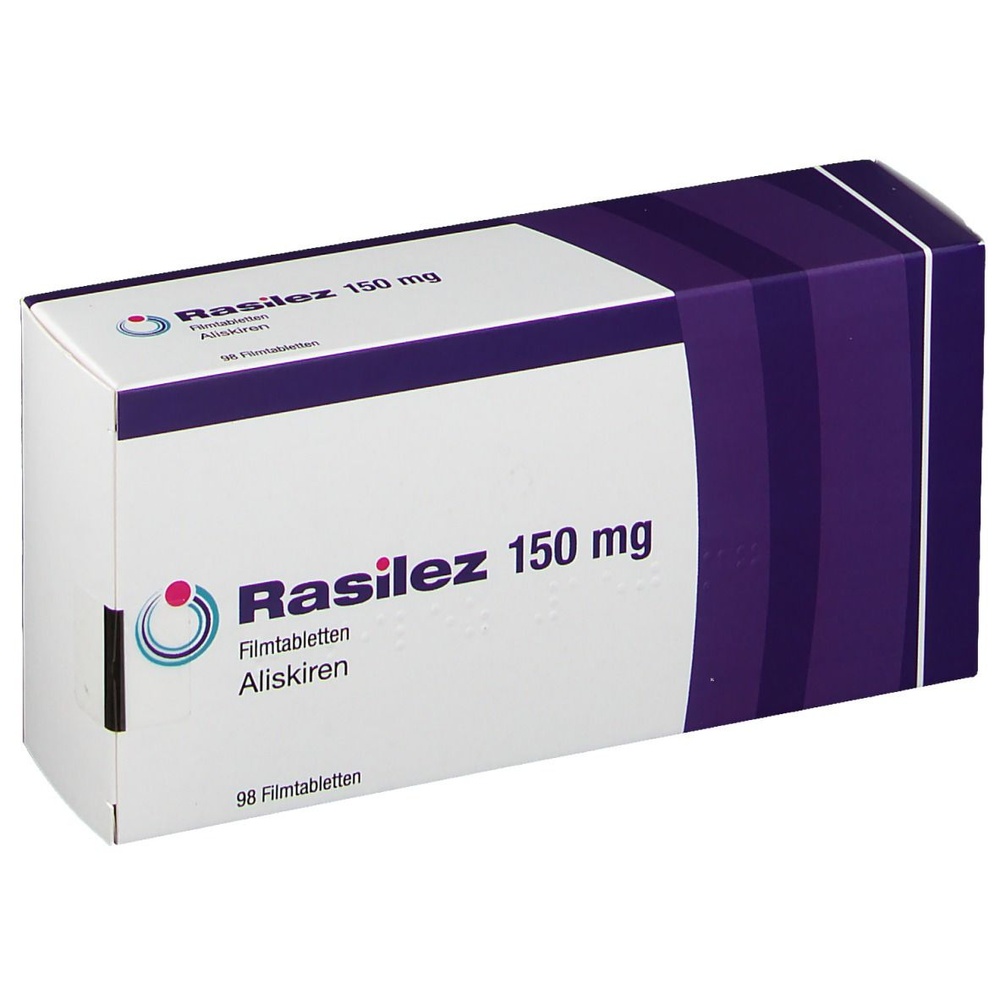
Rasilez 150 mg comprimidos recubiertos con película son comprimidos de color rosa claro, biconvexos, redondos, marcados con “IL” en una cara y “NVR” en la otra.
Rasilez 300 mg comprimidos recubiertos con película son comprimidos de color rojo claro, biconvexos, ovalados, marcados con “IU” en una cara y “NVR” en la otra.
Rasilez 150 mg comprimidos recubiertos con película está disponible en los siguientes envases:
- Envases unitarios que contienen 14, 28, 30, 50, 56, 90 o 98 comprimidos
- Envases unitarios que contienen 56x1 comprimidos en blisters unidosis perforados
- Envases múltiples que contienen 280 (20x14) comprimidos
- Envases múltiples que contienen 98 (2x49x1) comprimidos en blisters unidosis perforados
Rasilez 300 mg comprimidos recubiertos con película está disponible en los siguientes envases:
- Envases unitarios que contienen 14, 28, 30, 50, 56, 90 o 98 comprimidos
- Envases unitarios que contienen 56x1 comprimidos en blisters unidosis perforados
- Envases múltiples que contienen 280 (20x14) comprimidos
- Envases múltiples que contienen 98 (2x49x1) comprimidos en blisters unidosis perforados
Puede que no estén comercializados todos los tamaños de envase.
Titular de la autorización de comercialización
Noden Pharma DAC
D'Olier Chambers
16A D'Olier Street
Dublin 2
Irlanda
Responsable de la fabricación
Delpharm Milano S.R.L.,
Via Carnevale, 1,
Segrate (MI),
20054,
Italia
Fecha de la última revisión de este prospecto 02/2023
Otras fuentes de información
La información detallada de este medicamento está disponible en la página web de la Agencia Europea de Medicamentos: http://www.ema.europa.eu
- País de registro
- Forma farmacéuticaCOMPRIMIDO, 150 mg
- Código ATCC09XA02
- Principio activo
- Requiere recetaSí
- Fabricante
- Esta información es de carácter general y no sustituye la consulta con un profesional sanitario.
- Alternativas a RASILEZ 150 mg COMPRIMIDOS RECUBIERTOS CON PELICULAForma farmacéutica: COMPRIMIDO, 150 mgPrincipio activo: aliskirenFabricante: Noden Pharma Designated Activity CompanyRequiere recetaForma farmacéutica: COMPRIMIDO, 150 mgPrincipio activo: aliskirenFabricante: Noden Pharma Designated Activity CompanyRequiere recetaForma farmacéutica: COMPRIMIDO, 150 mgPrincipio activo: aliskirenFabricante: Noden Pharma Designated Activity CompanyRequiere receta
Médicos online para RASILEZ 150 mg COMPRIMIDOS RECUBIERTOS CON PELICULA
Comenta la dosis, los posibles efectos secundarios, interacciones, contraindicaciones o la revisión de receta de RASILEZ 150 mg COMPRIMIDOS RECUBIERTOS CON PELICULA, sujeto a valoración médica y a la normativa local.
Obtén una receta de RASILEZ 150 mg COMPRIMIDOS RECUBIERTOS CON PELICULA online
Rellena un formulario de 2 minutos
Cuéntanos tus síntomas, historial y el medicamento que necesitas.
Elige un médico o nosotros te asignamos uno
Escoge un especialista o te conectamos con el próximo médico disponible.
El médico revisa tu caso
Normalmente en 30 minutos. Puede hacerte preguntas adicionales por chat.
Recógela en cualquier farmacia
Receta electrónica enviada a tu correo, válida en toda España.
Preguntas frecuentes
RASILEZ 150 mg COMPRIMIDOS RECUBIERTOS CON PELICULA requiere receta en España. Puedes confirmarlo con un médico online según tu caso.
El principio activo de RASILEZ 150 mg COMPRIMIDOS RECUBIERTOS CON PELICULA es aliskiren. Esta información ayuda a identificar medicamentos con la misma composición pero con diferentes nombres comerciales.
RASILEZ 150 mg COMPRIMIDOS RECUBIERTOS CON PELICULA es fabricado por Noden Pharma Designated Activity Company. La marca y el envase pueden variar según el distribuidor.
Los Médicos de familia, Psiquiatras, Dermatólogos, Cardiólogos, Endocrinólogos, Gastroenterólogos, Neumólogos, Nefrólogos, Reumatólogos, Hematólogos, Infectólogos, Alergólogos, Geriatras, Pediatras, Oncólogos pueden valorar la prescripción de RASILEZ 150 mg COMPRIMIDOS RECUBIERTOS CON PELICULA cuando esté clínicamente indicado. Puedes reservar una videoconsulta para comentar tu caso y las opciones de tratamiento.
España cuenta con una infraestructura sanitaria bien desarrollada en ciudades principales como Madrid, Barcelona, Valencia y Sevilla. Las farmacias están ampliamente disponibles y operan bajo estrictas regulaciones, garantizando el acceso a medicamentos con receta.
Puedes comprar RASILEZ 150 mg COMPRIMIDOS RECUBIERTOS CON PELICULA en Madrid, Barcelona, Sevilla o Valencia en cualquier farmacia local con una receta válida.
Para obtener una receta, puedes utilizar Oladoctor:
Otros medicamentos con el mismo principio activo (aliskiren) incluyen RASILEZ 150 mg COMPRIMIDOS RECUBIERTOS CON PELICULA, RASILEZ 150 mg COMPRIMIDOS RECUBIERTOS CON PELICULA, RASILEZ 150 mg COMPRIMIDOS RECUBIERTOS CON PELICULA. Pueden tener diferentes nombres comerciales o formulaciones, pero contienen el mismo componente terapéutico. Consulta siempre con un médico antes de cambiar o iniciar un nuevo medicamento.
