



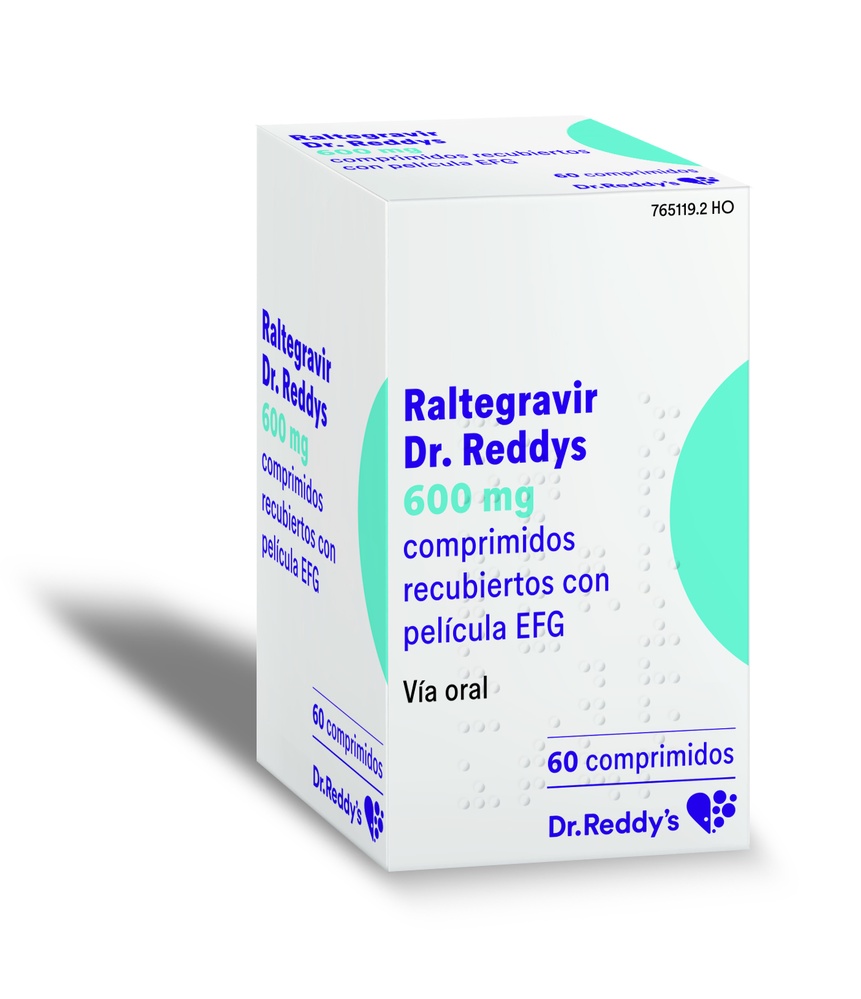
RALTEGRAVIR DR. REDDYS 600 MG COMPRIMIDOS RECUBIERTOS CON PELICULA

Revisión de receta online
Un médico revisará tu caso y determinará si la prescripción es médicamente apropiada.

Habla con un médico sobre este medicamento
Comenta tus síntomas y las opciones de tratamiento en una consulta online.



Cómo usar RALTEGRAVIR DR. REDDYS 600 MG COMPRIMIDOS RECUBIERTOS CON PELICULA EFG
Contenido del prospecto
- Introducción
- Qué es Rategravir Dr. Reddys y para qué se utiliza
- Qué necesita saber antes de empezar a tomar Raltegravir Dr. Reddys
- Cómo tomar Raltegravir Dr. Reddys
- Posibles efectos adversos
- Conservación de Raltegravir Dr. Reddys
- Contenido del envase e información adicional
Introducción
Prospecto: información para el usuario
Raltegravir Dr. Reddys 600 mg comprimidos recubiertos con película EFG
Lea todo el prospecto detenidamente antes de empezar a tomar este medicamento, porque contiene información importante para usted.
Si usted es el padre de un niño que toma Raltegravir Dr. Reddys, por favor lea atentamente esta información con su hijo.
Conserve este prospecto, ya que puede tener que volver a leerlo.
Si tiene alguna duda, consulte a su médico, farmacéutico o enfermero.
Este medicamento se le ha recetado solamente a usted o a su hijo, y no debe dárselo a otras personas aunque tengan los mismos síntomas que usted, ya que puede perjudicarles.
Si experimenta efectos adversos, consulte a su médico, farmacéutico o enfermero, incluso si se trata de efectos adversos que no aparecen en este prospecto. Ver sección 4.
Contenido del prospecto
- Qué es Raltegravir Dr. Reddys y para qué se utiliza
- Qué necesita saber antes de empezar a tomar Raltegravir Dr. Reddys
- Cómo tomar Raltegravir Dr. Reddys
- Posibles efectos adversos
- Conservación de Raltegravir Dr. Reddys
- Contenido del envase e información adicional
1. Qué es Rategravir Dr. Reddys y para qué se utiliza
Qué es Raltegravir Dr. Reddys
Este medicamento contiene el principio activo raltegravir. Raltegravir es un medicamento antiviral que actúa frente al virus de la inmunodeficiencia humana (VIH). Este es el virus que causa el síndrome de inmunodeficiencia adquirida (SIDA).
Cómo actúa Raltegravir Dr. Reddys
El virus produce una enzima llamada integrasa del VIH, la cual ayuda al virus a entrar en las células del organismo y a multiplicarse. Raltegravir impide que esta enzima realice su función. Cuando se utiliza con otros medicamentos, raltegravir puede reducir la cantidad de VIH en sangre (esto se denomina su “carga viral”) e incrementar el recuento de células CD4 (un tipo de glóbulos blancos que tienen un papel importante manteniendo el sistema inmunitario sano para ayudar a combatir la infección). Al reducir la cantidad de VIH en la sangre, puede mejorar el funcionamiento de su sistema inmunitario. Esto significa que su cuerpo puede luchar mejor contra la infección.
Cuando se debe utilizar Raltegravir
Raltegravir Dr. Reddys 600 mg comprimidos recubiertos con película se utiliza para tratar a adultos y pacientes pediátricos con un peso de al menos 40 kg que están infectados con el VIH. Su médico le ha prescrito raltegravir para que le ayude a controlar la infección por el VIH que padece.

¿No estás seguro de si este medicamento es adecuado para ti?
Comenta tus síntomas y tratamiento con un médico online.
2. Qué necesita saber antes de empezar a tomar Raltegravir Dr. Reddys
No tome Raltegravir Dr. Reddys:
si es alérgico a raltegravir o a alguno de los demás componentes de este medicamento (incluidos en la sección 6).
Advertencias y precauciones
Consulte a su médico, farmacéutico o enfermero antes de empezar a tomar raltegravir.
Recuerde que raltegravir no cura la infección por el VIH. Esto significa que puede seguir presentando infecciones u otras enfermedades relacionadas con el VIH. Debe seguir acudiendo a la consulta del médico regularmente mientras toma este medicamento.
Problemas de salud mental
Informe a su médico si tiene antecedentes de depresión o enfermedad mental. Se ha observado depresión, incluyendo pensamientos y conductas suicidas en algunos pacientes mientras tomaban este medicamento, especialmente en pacientes con antecedentes previos de depresión o enfermedad mental.
Problemas óseos
Algunos pacientes que sigan un tratamiento antirretroviral de combinación pueden desarrollar una enfermedad ósea denominada osteonecrosis (muerte del tejido óseo causada por la pérdida de irrigación sanguínea al hueso). La duración del tratamiento antirretroviral de combinación, el uso de corticosteroides, el consumo de alcohol, la reducción grave de la actividad del sistema inmunológico, el aumento del índice de masa corporal, entre otros, pueden ser algunos de los muchos factores de riesgo para desarrollar esta enfermedad. Los signos de osteonecrosis son rigidez articular, molestias y dolor (especialmente en la cadera, rodilla y hombro) y dificultad de movimiento. Si sufre cualquiera de estos síntomas, acuda a su médico.
Problemas hepáticos
Informe a su médico, farmacéutico o enfermero si ha tenido problemas con su hígado con anterioridad, incluidas la hepatitis B o C. Su médico puede evaluar la gravedad de su enfermedad hepática antes de decidir si puede tomar este medicamento.
Infecciones
Si nota algún síntoma de infección, tales como fiebre y/o se encuentra mal, comuníqueselo a su médico, farmacéutico o enfermero inmediatamente. Algunos pacientes con infección por el VIH avanzada y que han sufrido anteriormente infecciones oportunistas pueden presentar signos y síntomas de inflamación a causa de las infecciones anteriores poco después de empezar el tratamiento contra el VIH. Se cree que estos síntomas se deben a la mejora de la respuesta inmunitaria del organismo, que permite al organismo luchar contra infecciones que es posible que ya tuviera pero que no producían síntomas obvios.
Además de las infecciones oportunistas, también pueden aparecer trastornos autoinmunitarios (una afección que ocurre cuando el sistema inmunitario ataca tejido corporal sano) después de que usted haya empezado a tomar medicamentos para el tratamiento de su infección por VIH. Los trastornos autoinmunitarios pueden aparecer muchos meses después del inicio del tratamiento. Si observa cualquier síntoma de infección u otros síntomas como por ejemplo debilidad muscular, debilidad que empieza en las manos y pies y que asciende hacia el tronco del cuerpo, palpitaciones, temblor o hiperactividad, informe a su médico inmediatamente para recibir el tratamiento necesario.
Problemas musculares
Contacte inmediatamente con su médico, farmacéutico o enfermero si nota dolor muscular inexplicado, sensibilidad a la presión o debilidad muscular durante el tratamiento con este medicamento.
Problemas de la piel
Contacte inmediatamente con su médico si presenta una erupción. Se han comunicado reacciones cutáneas graves y potencialmente mortales y reacciones alérgicas en algunos pacientes que toman este medicamento.
Otros medicamentos y Raltegravir Dr. Reddys
Informe a su médico, farmacéutico o enfermero si está tomando, ha tomado recientemente o pudiera tener que tomar cualquier otro medicamento.
Raltegravir Dr. Reddys puede interactuar con otros medicamentos. Informe a su médico, farmacéutico o enfermero si está tomando, ha tomado recientemente o pudiera tener que tomar:
- antiácidos (un medicamento que contrarresta o neutraliza el ácido del estómago y alivia la indigestión y el ardor de estómago)
- sales de hierro (para tratar y prevenir la deficiencia de hierro o la anemia). Debe esperar al menos dos horas entre la toma de sales de hierro y la toma de raltegravir, ya que estos medicamentos pueden reducir la eficacia de raltegravir
- atazanavir (un medicamento antirretroviral)
- rifampicina (un medicamento utilizado para tratar algunas infecciones como la tuberculosis)
- tipranavir/ritonavir (medicamentos antirretrovirales)
Lleve consigo una lista de todos sus medicamentos para mostrársela a su médico y farmacéutico.
Puede pedirle a su médico o farmacéutico que le dé una lista de los medicamentos que interactúan con raltegravir.
No empiece a tomar un medicamento nuevo sin avisar a su médico. Su médico puede decirle si es seguro tomar raltegravir con otros medicamentos.
Toma de Raltegravir Dr. Reddys con alimentos y bebidas
Ver sección 3.
Embarazo y lactancia
Si está embarazada o en periodo de lactancia, cree que podría estar embarazada o tiene intención de quedarse embarazada, consulte a su médico o farmacéutico antes de utilizar este medicamento.
Raltegravir 1.200 mg (dos comprimidos de 600 mg una vez al día) no está recomendado en el embarazo, porque no se ha estudiado en mujeres embarazadas.
No se recomienda que las mujeres que conviven con el VIH den el pecho porque la infección por VIH puede transmitirse al bebé a través de la leche materna.
Si está dando el pecho o piensa en dar el pecho, debe consultar con su médico lo antes posible.
Si está embarazada o en período de lactancia, consulte a su médico, farmacéutico o enfermero antes de utilizar cualquier medicamento.
Conducción y uso de máquinas
No maneje máquinas, conduzca ni monte en bicicleta si se siente mareado después de tomar este medicamento.
Raltegravir Dr. Reddys contiene sodio
Este medicamento contiene menos de 1 mmol de sodio (23 mg) por comprimido; esto es, esencialmente “exento de sodio”.
3. Cómo tomar Raltegravir Dr. Reddys
Siga exactamente las instrucciones de administración de este medicamento indicadas por su médico, farmacéutico o enfermero. En caso de duda, consulte de nuevo a su médico, farmacéutico o enfermero. Raltegravir se debe usar en combinación con otros medicamentos para la infección por el VIH.
Qué cantidad se debe tomar
Adultos, niños y adolescentes que pesen al menos 40 kg
La dosis recomendada es de 1.200 mg tomada como dos comprimidos de 600 mg por vía oral una vez al día.
No masticar, machacar o partir los comprimidos porque puede modificar la cantidad de medicamento dentro de su cuerpo. Puede tomar este medicamento con o sin alimentos o bebidas.
Raltegravir Dr. Reddys está disponible solo en comprimidos de 600 mg. Es posible que haya otras formulaciones y concentraciones de raltegravir disponibles; hable con su médico, farmacéutico o enfermero para obtener más información.
Si toma más Raltegravir Dr. Reddys del que debe
No tome más comprimidos de los que le ha recomendado el médico. Si toma más comprimidos de los recomendados, consulte a su médico.
En caso de sobredosis o ingestión accidental, consulte inmediatamente a su médico o farmacéutico o llame al Servicio de Información Toxicológica, teléfono: 91 562 04 20, indicando el medicamento y la cantidad ingerida.
Si olvidó tomar Raltegravir Dr. Reddys
Si olvida tomar una dosis, tómela tan pronto como se acuerde de que no la ha tomado.
No obstante, si es hora de tomar la dosis siguiente, no tome la dosis olvidada y siga su pauta posológica habitual.
No tome una dosis doble para compensar las dosis olvidadas.
Si interrumpe el tratamiento con Raltegravir Dr. Reddys
Es importante que tome raltegravir exactamente tal como se lo ha dicho su médico. No cambie la dosis ni deje de tomar este medicamento sin consultar primero con su médico, farmacéutico o enfermero. No deje de tomarlo, porque:
Es muy importante que tome todos los medicamentos para el VIH tal como se los han prescrito y en las horas del día correctas. Esto hace que los medicamentos funcionen mejor y también reduce la posibilidad de que dejen de ser capaces de combatir el VIH (a esto se le llama también “resistencia a fármacos”).
- Cuando le queden pocos comprimidos de raltegravir, vaya al médico o a la farmacia para obtener más. El motivo es que es muy importante no quedarse sin medicina, ni siquiera durante unos días. Si deja de tomar el medicamento durante unos días, puede que la cantidad de virus en la sangre aumente y, como consecuencia, que el VIH desarrolle resistencia a raltegravir y la enfermedad sea más difícil de tratar.
Si tiene cualquier otra duda sobre el uso de este medicamento, pregunte a su médico, farmacéutico o enfermero.

¿Has empezado a tomar el medicamento y tienes preguntas?
Comenta tus síntomas y tratamiento con un médico online.
4. Posibles efectos adversos
Al igual que todos los medicamentos, este medicamento puede producir efectos adversos, aunque no todas las personas los sufran.
Efectos adversos graves– estos son poco frecuentes (pueden afectar hasta 1 de cada 100 personas)
Acuda al médico inmediatamente si observa cualquiera de los siguientes efectos adversos:
- infecciones por herpes incluido herpes zoster
- anemia incluida la producida por deficiencia de hierro
- signos y síntomas de infección o inflamación
- trastorno mental
- intento o intención de suicidio
- inflamación de estómago
- inflamación de hígado
- fallo hepático
- erupción de tipo alérgico
- determinados tipos de problemas del riñón
- ingestión del medicamento en cantidades superiores a las recomendadas
Acuda a su médico inmediatamente si observa cualquiera de los efectos adversos citados anteriormente.
Frecuentes:los siguientes efectos adversos pueden afectar hasta 1 de cada 10 personas
- disminución del apetito
- problemas para dormir; sueños extraños; pesadillas; comportamiento anormal; sensación de tristeza profunda y falta de autoestima
- mareos; dolor de cabeza
- Vértigo
- flatulencia o gases; dolor abdominal; diarrea; cantidad excesiva de gas en el estómago o en el intestino; náuseas; vómitos; indigestión; eructos
- determinados tipos de erupción (con mayor frecuencia cuando se usa en combinación con darunavir)
- cansancio, cansancio o debilidad inusuales; fiebre
- valores elevados de los parámetros hepáticos; valores anormales de leucocitos; aumento de los niveles de grasa en sangre; aumento de los niveles de enzimas de las glándulas salivares o del páncreas
Poco frecuentes:los siguientes efectos adversos pueden afectar hasta 1 de cada 100 personas
- infección de las raíces del cabello; gripe; infección de la piel debido a virus; vómitos o diarrea debido a un agente infeccioso; infección del tracto respiratorio superior; acumulación de pus en ganglio linfático
- Verrugas
- dolor en ganglios linfáticos; recuento bajo de los leucocitos responsables de combatir las infecciones; hinchazón de las glándulas del cuello, axilas e ingles
- reacción alérgica
- aumento del apetito; diabetes; elevación del colesterol y lípidos de la sangre; aumento de los niveles de azúcar en la sangre; sed excesiva; pérdida de peso severa; altos niveles de grasa en sangre (tales como colesterol y triglicéridos); trastornos de la grasa corporal
- sensación de angustia; sensación de confusión; estado de ánimo deprimido; cambios en el estado de ánimo; ataque de pánico
- pérdida de memoria; dolor en la mano debido a compresión nerviosa; alteración de la atención; mareo al cambiar de postura de forma rápida; gusto anormal; aumento de la somnolencia; falta de energía; olvidos; cefalea migrañosa; pérdida de sensibilidad, adormecimiento o debilidad de los brazos y/o piernas; hormigueo; somnolencia; dolor de cabeza por tensión; temblores; sueño deficiente
- alteración de la visión
- zumbidos, sonidos agudos, silbidos, pitidos u otros ruidos persistentes en los oídos
- palpitaciones; pulsaciones lentas; latidos cardíacos rápidos o irregulares
- sofocos; aumento de la presión arterial
- voz ruda, áspera o forzada; hemorragia nasal; congestión nasal
- dolor abdominal superior; molestia rectal; estreñimiento; sequedad de boca; ardor de estómago; dolor al tragar; inflamación del páncreas; úlcera o herida en el estómago o en el intestino superior; sangrado en el ano; malestar de estómago; inflamación de las encías; hinchazón, lengua enrojecida y ulcerada
- acumulación de grasa en el hígado
- acné; pérdida o adelgazamiento del cabello; enrojecimiento de la piel; distribución inusual de grasa en el cuerpo, esto puede incluir pérdida de grasa en piernas, brazos y cara e incremento de grasa en el abdomen; sudoración excesiva; sudores nocturnos; engrosamiento y picor de la piel debido a rascado repetido; lesión cutánea; sequedad de la piel
- dolor de las articulaciones; enfermedad articular dolorosa; dolor de espalda; dolor en huesos/músculos; dolorimiento o debilidad muscular; dolor de cuello; dolor en los brazos o las piernas; inflamación de los tendones; disminución de la cantidad de minerales en el hueso
- piedras en el riñón; micción nocturna; quiste renal
- disfunción eréctil; agrandamiento de las mamas en hombres; síntomas menopáusicos
- molestias en el pecho; escalofríos; hinchazón de la cara; sensación de nerviosismo; sensación de malestar generalizado; bulto en el cuello; hinchazón de manos, tobillos o pies; dolor
- número bajo de glóbulos blancos; número bajo de plaquetas en sangre (un tipo de célula que interviene en la coagulación de la sangre); disminución de la función renal en el análisis de sangre; niveles altos de azúcar en sangre; enzimas musculares elevadas en la sangre; azúcar en la orina; glóbulos rojos en la orina; aumento de peso; aumento del perímetro de la cintura; disminución de proteínas de la sangre (albúmina); aumento del tiempo de coagulación de la sangre
Otros efectos adversos en niños y adolescentes
- Hiperactividad
Comunicación de efectos adversos
Si experimenta cualquier tipo de efecto adverso, consulte a su médico o farmacéutico, incluso si se trata de efectos adversos que no aparecen en este prospecto. También puede comunicarlos directamente a través del Sistema Español de Farmacovigilancia de Medicamentos de Uso Humano: https://www.notificaram.es.
Mediante la comunicación de efectos adversos usted puede contribuir a proporcionar más información sobre la seguridad de este medicamento.
5. Conservación de Raltegravir Dr. Reddys
- Mantener este medicamento fuera de la vista y del alcance de los niños.
- No utilice este medicamento después de la fecha de caducidad que aparece en el frasco después de CAD. La fecha de caducidad es el último día del mes que se indica.
- Este medicamento no requiere condiciones especiales de conservación.
Los medicamentos no se deben tirar por los desagües ni a la basura. Deposite los envases y los medicamentos que no necesita en el punto SIGRE de la farmacia. Pregunte a su farmacéutico cómo deshacerse de los envases y de los medicamentos que ya no necesita. De esta forma, ayudará a proteger el medio ambiente.
6. Contenido del envase e información adicional
Composición de Raltegravir Dr. Reddys
El principio activo es raltegravir. Cada comprimido recubierto con película contiene 600 mg de raltegravir (potásico).
Los demás componentes son: celulosa microcristalina, croscarmelosa sódica, carbómeros, estearato de magnesio. Además, el recubrimiento pelicular contiene los siguientes componentes inactivos: macrogoles, talco, dióxido de titanio (E171), monocaprilocaprato de glicerol (tipo I), poli(alcohol vinílico) y óxido de hierro amarillo (E172).
Aspecto del producto y contenido del envase
El comprimido de 600 mg recubierto con película es de forma ovalada, de color amarillo, con la inscripción “C30” grabada en una de las caras y “600” en la otra cara.
Tamaños de envase: envase conteniendo 1 frasco de 60 comprimidos y envases múltiples conteniendo 3 frascos de 60 comprimidos cada uno.
Puede que solamente estén comercializados algunos tamaños de envases.
Titular de la autorización de comercialización y responsable de la fabricación
Titular de la autorización de comercialización
Reddy Pharma Iberia, S.A.
Avda. Josep Tarradellas nº 38
08029 Barcelona
España
Responsable de la fabricación
Coripharma ehf.
Reykjavikurvegur 78
IS -220 Hafnarfjordur
Islandia
Este medicamento está autorizado en los estados miembros del Espacio Económico Europeo con los siguientes nombres:
Nombre del estado miembro | Nombre del medicamento |
Alemania | Raltegravir beta 600 mg Filmtabletten |
España | Raltegravir Dr. Reddys 600 mg comprimidos recubiertos con película EFG |
Italia | Raltegravir Dr. Reddy’s |
Francia | Raltegravir Day Zero |
Fecha de la última revisión de este prospecto:Mayo 2024
La información detallada de este medicamento está disponible en la página web de la Agencia Española de Medicamentos y Productos Sanitarios (AEMPS) http://www.aemps.gob.es/.
- País de registro
- Forma farmacéuticaCOMPRIMIDO, 600 mg
- Código ATCJ05AJ01
- Principio activo
- Requiere recetaSí
- Fabricante
- ComposiciónCROSCARMELOSA SODICA (31,32 mg mg), GLICEROL, MONOCAPRILOCAPRATO DE (1,25 mg mg)
- Esta información es de carácter general y no sustituye la consulta con un profesional sanitario.
- Alternativas a RALTEGRAVIR DR. REDDYS 600 MG COMPRIMIDOS RECUBIERTOS CON PELICULA EFGForma farmacéutica: COMPRIMIDO MASTICABLE, 100 mgPrincipio activo: RaltegravirFabricante: Merck Sharp & Dohme B.V.Requiere recetaForma farmacéutica: COMPRIMIDO MASTICABLE, 25 mgPrincipio activo: RaltegravirFabricante: Merck Sharp & Dohme B.V.Requiere recetaForma farmacéutica: COMPRIMIDO, 60 mgPrincipio activo: RaltegravirFabricante: Merck Sharp & Dohme B.V.Requiere receta
Médicos online para RALTEGRAVIR DR. REDDYS 600 MG COMPRIMIDOS RECUBIERTOS CON PELICULA EFG
Comenta la dosis, los posibles efectos secundarios, interacciones, contraindicaciones o la revisión de receta de RALTEGRAVIR DR. REDDYS 600 MG COMPRIMIDOS RECUBIERTOS CON PELICULA EFG, sujeto a valoración médica y a la normativa local.









Obtén una receta de RALTEGRAVIR DR. REDDYS 600 MG COMPRIMIDOS RECUBIERTOS CON PELICULA EFG online
Rellena un formulario de 2 minutos
Cuéntanos tus síntomas, historial y el medicamento que necesitas.
Elige un médico o nosotros te asignamos uno
Escoge un especialista o te conectamos con el próximo médico disponible.
El médico revisa tu caso
Normalmente en 30 minutos. Puede hacerte preguntas adicionales por chat.
Recógela en cualquier farmacia
Receta electrónica enviada a tu correo, válida en toda España.
Preguntas frecuentes
RALTEGRAVIR DR. REDDYS 600 MG COMPRIMIDOS RECUBIERTOS CON PELICULA EFG requiere receta en España. Puedes confirmarlo con un médico online según tu caso.
El principio activo de RALTEGRAVIR DR. REDDYS 600 MG COMPRIMIDOS RECUBIERTOS CON PELICULA EFG es Raltegravir. Esta información ayuda a identificar medicamentos con la misma composición pero con diferentes nombres comerciales.
RALTEGRAVIR DR. REDDYS 600 MG COMPRIMIDOS RECUBIERTOS CON PELICULA EFG es fabricado por Reddy Pharma Iberia S.A.. La marca y el envase pueden variar según el distribuidor.
Los Médicos de familia, Psiquiatras, Dermatólogos, Cardiólogos, Endocrinólogos, Gastroenterólogos, Neumólogos, Nefrólogos, Reumatólogos, Hematólogos, Infectólogos, Alergólogos, Geriatras, Pediatras, Oncólogos pueden valorar la prescripción de RALTEGRAVIR DR. REDDYS 600 MG COMPRIMIDOS RECUBIERTOS CON PELICULA EFG cuando esté clínicamente indicado. Puedes reservar una videoconsulta para comentar tu caso y las opciones de tratamiento.
España cuenta con una infraestructura sanitaria bien desarrollada en ciudades principales como Madrid, Barcelona, Valencia y Sevilla. Las farmacias están ampliamente disponibles y operan bajo estrictas regulaciones, garantizando el acceso a medicamentos con receta.
Puedes comprar RALTEGRAVIR DR. REDDYS 600 MG COMPRIMIDOS RECUBIERTOS CON PELICULA EFG en Madrid, Barcelona, Sevilla o Valencia en cualquier farmacia local con una receta válida.
Para obtener una receta, puedes utilizar Oladoctor:
Otros medicamentos con el mismo principio activo (Raltegravir) incluyen ISENTRESS 100 MG COMPRIMIDOS MASTICABLES, ISENTRESS 25 MG COMPRIMIDOS MASTICABLES, ISENTRESS 400 MG COMPRIMIDOS RECUBIERTOS CON PELICULA. Pueden tener diferentes nombres comerciales o formulaciones, pero contienen el mismo componente terapéutico. Consulta siempre con un médico antes de cambiar o iniciar un nuevo medicamento.
