



OVESTINON 1 mg /G Crema Vaginal

Revisión de receta online
Un médico revisará tu caso y determinará si la prescripción es médicamente apropiada.

Habla con un médico sobre este medicamento
Comenta tus síntomas y las opciones de tratamiento en una consulta online.



Cómo usar OVESTINON 1 mg/g CREMA VAGINAL
Contenido del prospecto
- Introducción
- Qué es Ovestinon 1 mg/g crema vaginal y para qué se utiliza
- Qué necesita saber antes de empezar a usar Ovestinon 1 mg/g crema vaginal
- Cómo usar Ovestinon 1 mg/g crema vaginal
- Posibles efectos adversos
- Conservación de Ovestinon 1 mg/g crema vaginal
- Contenido del envase e información adicional
Introducción
Prospecto: información para el usuario
Ovestinon 1 mg/g crema vaginal
Estriol
Lea todo el prospecto detenidamente antes de empezar a usar este medicamento,porque contiene información importante para usted.
- Conserve este prospecto, ya que puede tener que volver a leerlo.
- Si tiene alguna duda, consulte a su médico, farmacéutico o enfermero.
- Este medicamento se le ha recetado solamente a usted y no debe dárselo a otras personas, aunque tengan los mismos síntomas que usted, ya que puede perjudicarles.
- Si experimenta efectos adversos, consulte a su médico, farmacéutico o enfermero, incluso si se trata de efectos adversos que no aparecen en este prospecto. Ver sección 4.
Contenido del prospecto
- Qué es Ovestinon 1 mg/g crema vaginal y para qué se utiliza
- Qué necesita saber antes de empezar a usar Ovestinon 1 mg/g crema vaginal
- Cómo usar Ovestinon 1 mg/g crema vaginal
- Posibles efectos adversos
- Conservación de Ovestinon 1 mg/g crema vaginal
- Contenido del envase e información adicional
1. Qué es Ovestinon 1 mg/g crema vaginal y para qué se utiliza
Ovestinon pertenece a un grupo de medicamentos llamado terapia hormonal sustitutiva (THS). Contiene la hormona femenina estriol (estrógeno). Ovestinon se utiliza en mujeres postmenopáusicas que hace por lo menos 12 meses que tuvieron su último período menstrual de forma natural.
Se usa para aliviar los síntomas de la menopausia en la vagina, como la sequedad o irritación. En términos médicos, esto se conoce como «atrofia vaginal». Esta es causada por una caída de los niveles de estrógeno en su organismo. Esto sucede de manera natural después de la menopausia.
Si se extirpan los ovarios quirúrgicamente (ovariectomía) antes de la menopausia, la disminución de la producción de estrógenos se produce muy bruscamente.
La deficiencia de estrógenos durante la menopausia puede causar que la pared vaginal se vuelva delgada y seca (sequedad vaginal). Por ello, la relación sexual puede llegar a ser dolorosa y puede producirse irritación e infecciones vaginales. La deficiencia de estrógenos también puede conducir a síntomas como incontinencia urinaria y cistitis recurrente.
Ovestinon actúa reemplazando el estrógeno que normalmente se produce en los ovarios. Se inserta en su vagina, por lo que la hormona se libera allá donde se necesita. Esto puede aliviar la incomodidad vaginal.
Pueden transcurrir varios días o incluso semanas antes de que observe una mejoría.
Además de los usos mencionados anteriormente, Ovestinon se podría utilizar para:
- ayudar a curar las heridas en mujeres postmenopáusicas que han sufrido cirugía vaginal.
ayudar en el estudio del frotis cervical (Papanicolau) de mujeres postmenopáusicas.

¿No estás seguro de si este medicamento es adecuado para ti?
Comenta tus síntomas y tratamiento con un médico online.
2. Qué necesita saber antes de empezar a usar Ovestinon 1 mg/g crema vaginal
Historial médico y revisiones médicas
El uso de la terapia hormonal de sustitución conlleva riesgos que deben tenerse en cuenta cuando se decide si se empieza el tratamiento, o si se continúa tomándolo.
La experiencia del tratamiento en mujeres con menopausia prematura (debida a un fallo ovárico o a una intervención quirúrgica) es limitada. Si tiene menopausia prematura, consulte a su médico ya que los riesgos del uso de la terapia hormonal de sustitución pueden ser diferentes.
Antes de que empiece (o reinicie) la terapia hormonal de sustitución, su médico le preguntará sobre su historial médico y el de su familia. Puede que su médico decida hacerle una exploración física, que puede incluir un examen de sus mamas y/o una exploración interna, si es necesario.
Una vez haya empezado a tomar Ovestinon, deberá acudir a su médico para hacerse revisiones regulares (al menos una vez al año). En estas revisiones hable con su médico de los beneficios y de los riesgos de continuar con Ovestinon.
Hágase mamografías regularmente, tal y como se lo recomiende su médico.
No use Ovestinon
Si le afecta cualquiera de las siguientes situaciones o tiene dudas acerca de cualquiera de ellas, consulte a su médicoantes de usar Ovestinon.
No use Ovestinon:
- Si es alérgicaa estriol o a alguno de los demás componentes de este medicamento (incluidos en la sección 6).
- Si tiene o ha tenido cáncer de mamao si sospecha que pueda tenerlo.
- Si tiene un cáncer sensible a estrógenos, como el cáncer del tejido que recubre el interior del útero (endometrio), o si sospecha que pueda tenerlo.
- Si tiene cualquier sangrado vaginalinexplicable.
- Si tiene crecimiento excesivo del tejido que recubre el interior del útero(hiperplasia de endometrio) que no está siendo tratado.
- Si tiene o ha tenido un coágulo en una vena(trombosis), en las piernas (trombosis venosa profunda) o en los pulmones (embolismo pulmonar).
- Si tiene un trastorno en la coagulación de la sangre(como deficiencia de proteína C, deficiencia de proteína S o antitrombina).
- Si tiene o ha tenido recientemente una enfermedad causada por coágulos de sangre en las arterias, como infarto de miocardio, accidente cerebrovascularo angina de pecho.
- Si tiene o ha tenido una enfermedad del hígadoy sus pruebas de la función hepática no han vuelto a la normalidad.
- Si tiene un problema raro de la sangre llamado “porfiria” que se transmite en las familias (heredado).
Si mientras está tomando Ovestinon aparecen por primera vez alguna de las condiciones anteriores deje de tomarlo enseguida y consulte a su médico inmediatamente.
Advertencias y precauciones
Consulte a su médico antes de empezar a usar Ovestinon si ha tenido alguno de los siguientes problemas, ya que éstos pueden reaparecer o empeorar durante el tratamiento con Ovestinon. Si es así, debe acudir a su médico de forma más frecuente para hacerse revisiones médicas:
- fibroides dentro del útero
- crecimiento del tejido que recubre el interior del útero fuera del mismo (endometriosis) o antecedentes de crecimiento excesivo del tejido que recubre el útero (hiperplasia de endometrio),aumento del riesgo de desarrollar coágulos de sangre (ver “coágulos de sangre en una vena (trombosis”)),
- aumento del riesgo de desarrollar un cáncer sensible a estrógenos (por ejemplo, que su madre, una hermana o su abuela hayan tenido cáncer de mama)
- tensión arterial elevada
- un trastorno hepático, como un tumor hepático benigno,
- diabetes,
- cálculos biliares,
- migraña o dolores de cabeza intensos,
- enfermedad del sistema inmune que afecta a muchos órganos del cuerpo (lupus eritematoso sistémico, LES),
- epilepsia,
- asma,
- una enfermedad que afecta al tímpano y a la audición (otoesclerosis),
- retención de líquido debido a problemas cardíacos o renales,
- angioedema hereditario y adquirido.
Informe a su médico si padece hepatitis C y está tomando la pauta de medicamentos combinados ombitasvir/paritaprevir/ritonavir, con o sin dasabuvir. La combinación de estos medicamentos con otros medicamentos que contienen estrógenos puede causar aumentos en los resultados de los análisis de sangre de la función hepática (elevaciones de las enzimas hepáticas (ALT)). Actualmente se desconoce el riesgo de que esto ocurra con Ovestinon.
Deje de usar Ovestinon y acuda inmediatamente a su médico
Si nota mientras está tomando terapia hormonal de sustitución:
- cualquiera de las condiciones mencionadas en la sección “No use Ovestinon”,
- coloración amarilla de la piel o del blanco de los ojos (ictericia), que puede ser un signo de una enfermedad hepática,
- hinchazón de la cara, lengua o garganta y dificultad para tragar o urticaria acompañados de dificultad para respirar, que sugieren angioedema,
- un gran aumento de la tensión arterial (los síntomas pueden ser dolor de cabeza, cansancio, mareo),
- dolores de cabeza de tipo migrañoso que aparecen por primera vez,
- si se queda embarazada,
- si presenta signos de tener un coágulo en la sangre, como:
- hinchazón dolorosa y enrojecimiento de las piernas,
- dolor repentino en el pecho,
- dificultad para respirar.
Para más información, ver “coágulos de sangre en una vena (trombosis)”.
Terapia hormonal de sustitución y cáncer
Engrosamiento excesivo del tejido que recubre el interior del útero (hiperplasia de endometrio) y cáncer del tejido que recubre el interior del útero
Tomar THS comprimidos que contienen solo estrógeno durante un tiempo prolongado puede aumentar el riesgo de aparición de cáncer del revestimiento del útero (el endometrio).
No está claro si existe un riesgo similar con el Ovestinon que se usa para tratamientos repetidos o a largo plazo (más de un año). Sin embargo, se ha demostrado que la absorción de Ovestinon en la sangre es muy baja; por lo tanto, la adición de un progestágeno no es necesaria.
Si sangra o se mancha, generalmente no hay nada de qué preocuparse, pero debe programar una cita para ver a su médico. Podría ser una señal de que el endometrio se ha vuelto más grueso.
Para evitar la estimulación endometrial, no debe sobrepasarse la dosis diaria máxima, ni tampoco debe utilizarse esta dosis máxima durante más de unas semanas (máximo 4 semanas).
Los siguientes riesgos afectan a los medicamentos de terapia hormonal sustitutiva (THS) que circulan en la sangre. Sin embargo, Ovestinon es para tratamiento local en la vagina y su absorción en la sangre es muy baja. Es menos probable que las afecciones mencionadas a continuación empeoren o reaparezcan durante el tratamiento con Ovestinon, pero debe consultar a su médico si está preocupada.
Cáncer de mama
Los datos disponibles indican que usar Ovestinon no aumenta el riesgo de cáncer de mama en mujeres que no hayan tenido cáncer de mama en el pasado. No se sabe si Ovestinon puede usarse de forma segura en mujeres que hayan tenido cáncer de mama en el pasado.
Revise sus mamas habitualmente. Acuda a su médico si nota algún cambio como:
- hoyuelos en la piel,
- cambios en el pezón,
- cualquier bulto que pueda ver o palpar.
Además, se le recomienda participar en programas de detección por mamografía cuando se lo ofrezcan.
Cáncer de ovario
El cáncer de ovario es raro: mucho más raro que el cáncer de mama. El uso de THS que contienen estrógeno solo se ha asociado a un riesgo ligeramente mayor de cáncer de ovario.
El riesgo de cáncer de ovario varía con la edad. Por ejemplo, en mujeres de 50 a 54 años que no toman THS, aproximadamente 2 mujeres de cada 2000 serán diagnosticadas de cáncer de ovario durante un periodo de 5 años. Para las mujeres que han estado tomando THS durante 5 años, habrá alrededor de 3 casos por cada 2000 usuarias (es decir, alrededor de 1 caso más).
Efecto de la Terapia Hormonal de Sustitución en el corazón y en la circulación
Coágulos de sangre en una vena
El riesgo de coágulos de sangre en las venases aproximadamente 1,3 a 3 veces mayor en las mujeres que usan terapia hormonal de sustitución que en las que no la usan, especialmente durante el primer año de tratamiento.
Los coágulos de sangre pueden ser graves, y si uno se desplaza hasta los pulmones, puede causar dolor en el pecho, falta de aire, desmayo o incluso la muerte.
La probabilidad de tener un coágulo en las venas aumenta con la edad y si está afectada de alguna de las siguientes situaciones. Informe a su médico si le aplica alguna de estas situaciones:
- no puede andar durante un período de tiempo largo debido a una intervención de cirugía mayor, lesión o enfermedad (ver también la sección 3 “Si necesita someterse a una intervención quirúrgica),
- tiene un sobrepeso importante (IMC>30 kg/m2),
- tiene un problema de coagulación de la sangre que necesita un tratamiento prolongado con un medicamento para evitar coágulos en la sangre,
- si algún familiar cercano ha tenido un coágulo de sangre en la pierna, pulmón u otro órgano,
- tiene lupus eritematoso sistémico (LES),
- tiene cáncer.
Para conocer los signos de la presencia de un coágulo de sangre, ver la sección “Deje de usar Ovestinon y acuda inmediatamente a su médico”.
Comparación
Un promedio de 4 a 7 de cada 1.000 mujeres en la década de edad de 50 años que no estén en tratamiento hormonal sustitutivo, en un período de 5 años podrían tener un coágulo sanguíneo en una vena.En mujeres en la década de edad de 50 años que hayan seguido un tratamiento hormonal sustitutivo solo con estrógeno durante más de 5 años, habrá de 5 a 8 casos de cada 1.000 usuarias (es decir, 1 caso más).
Cardiopatía (infarto de miocardio)
Las mujeres que están tomando solo estrógenos no presentan un mayor riesgo de desarrollar una cardiopatía.
Accidente cerebrovascular
El riesgo de sufrir un accidente cerebrovascular es alrededor de 1,5 veces más elevado en mujeres que utilizan la terapia hormonal de sustitución que en aquellas que no la usan. El número de casos adicionales de accidente cerebrovascular debido al uso de la terapia hormonal de sustitución aumenta con la edad.
Comparación
Un promedio de 8 de cada 1.000 mujeres en la década de edad de 50 años que no estén en tratamiento hormonal sustitutivo, en un período de 5 años podrían tener un accidente cerebrovascular. En mujeres dentro de la misma edad en tratamiento hormonal sustitutivo durante más de 5 años, habrá 11 casos de cada 1.000 usuarias (es decir, 3 casos más).
Otras advertencias
La terapia hormonal de sustitución no previene la pérdida de memoria. Existe algún indicio de un mayor riesgo de pérdida de memoria en las mujeres que comienzan a utilizar la terapia hormonal de sustitución después de la edad de 65 años. Pídale consejo a su médico.
Nota: Ovestinon no es un anticonceptivo y no debe utilizarse como tal. Si hace menos de 12 meses que tuvo su último período menstrual o tiene menos de 50 años, puede que siga necesitando utilizar un método anticonceptivo para no quedarse embarazada. Pídale consejo a su médico.
Otros medicamentos y Ovestinon
Informe a su médico o farmacéutico si está utilizando, ha utilizado recientemente o podría tener que utilizar cualquier otro medicamento incluso los adquiridos sin receta, medicamentos a base de plantas u otros productos naturales.
Algunos medicamentos pueden interferir con el efecto de Ovestinon, u Ovestinon puede interferir con el efecto de otros medicamentos. Esto podría producir un sangrado irregular. Esto ocurre con los siguientes medicamentos:
- Medicamentos para la epilepsia(como fenobarbital, fenitoína y carbamazepina).
- Medicamentos para la tuberculosis(como rifampicina, rifabutina).
- Medicamentos para la infección por VIH(como nevirapina, efavirenz, ritonavir y nelfinavir).
- Medicamentos a base de plantas que contengan Hierba de San Juan(Hypericum Perforatum).
Informe a su médico si padece hepatitis C y está tomando la pauta de medicamentos combinados ombitasvir/paritaprevir/ritonavir, con o sin dasabuvir. La combinación de estos medicamentos con otros medicamentos que contienen estrógenos puede causar aumentos en los resultados de los análisis de sangre de la función hepática (elevaciones de las enzimas hepáticas (ALT)). Actualmente se desconoce el riesgo de que esto ocurra con Ovestinon.
Uso de Ovestinon con alimentos y bebidas
Puede comer y beber normalmente durante el tratamiento con Ovestinon.
Embarazo, lactancia y fertilidad
Si está embarazada o en período de lactancia, cree que podría estar embarazada o tiene intención de quedarse embarazada, consulte a su médico o farmacéutico antes de utilizar este medicamento.
Ovestinon solamente deben utilizarlo las mujeres postmenopáusicas. Si se queda embarazada, deje de tomar Ovestinon y póngase en contacto con su médico.
Si está dando el pecho consulte con su médico antes de utilizar Ovestinon, ya que se excreta por leche materna.
Conducción y uso de máquinas
No se espera que Ovestinon afecte a su capacidad para conducir un vehículo o manejar maquinaria. Sin embargo, las respuestas de cada individuo al medicamento pueden variar.
Pruebas de laboratorio
Si necesita hacerse un análisis de sangre, comunique a su médico o al personal del laboratorio que está utilizando Ovestinon, ya que este medicamento puede alterar los resultados de algunas pruebas.
Información importante sobre algunos de los componentes de Ovestinon
Este medicamento puede producir reacciones locales en la piel (como dermatitis de contacto) porque contiene alcohol cetílico y alcohol estearílico.
3. Cómo usar Ovestinon 1 mg/g crema vaginal
Siga exactamente las instrucciones de administración de este medicamento indicadas por su médico o farmacéutico. En caso de duda, consulte de nuevo a su médico o farmacéutico.
Nunca sobrepase la dosis que le haya recetado su médico.
La dosis recomendada para las molestias vaginales, es una aplicación diaria durante las primeras semanas (máximo 4 semanas) y después la dosis se disminuye gradualmente hasta, por ejemplo, una aplicación dos veces por semana.
Para mejorar la cicatrización de heridas en las mujeres postmenopáusicas sometidas a una cirugía vaginal, la dosis habitual es 1 aplicación diaria durante 2 semanas antes de la cirugía y posteriormente1 aplicación dos veces por semana durante las 2 semanas después de la cirugía.
Para ayudar a evaluar frotis vaginales de mujeres postmenopáusicas la dosis habitual es de 1 aplicación diaria cada día de la semana antes de la prueba.
Su médico podrá interrumpir el tratamiento cada 2-3 meses durante un período de 4 semanas para valorar si es necesario continuar.
Para otras situaciones se puede recetar una dosis diferente.
Instrucciones para la correcta administración del preparado
Use el aplicador para aplicar la crema en la vagina. Es aconsejable hacerlo antes de acostarse.
Una aplicación (aplicador lleno hasta la marca) contiene 0,5 g de Ovestinon crema, que contiene a su vez 0,5 mg de estriol.
- Destape el tubo, invierta el tapón y utilice la punta aguda para abrir el precinto del tubo.
- Enrosque el aplicador en el tubo. Asegúrese de que el émbolo está completamente insertado en el cilindro.
- Apriete el tubo lentamente para que penetre suficiente crema en el aplicador para llenarlo hasta la marca (marca roja, vea las fechas en el dibujo inferior).
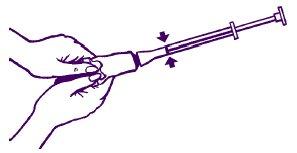
- Desenrosque el aplicador y vuelva a tapar el tubo.
- Para aplicarse la crema, acuéstese e introduzca el extremo del aplicador profundamente en la vagina
- Empuje lentamente el émbolo hasta que se vacíe el aplicador.
- Después de usarlo, saque el émbolo del cilindro pasando el punto de resistencia y lávelo junto con el aplicador en agua jabonosa templada, enjuagando bien a continuación. No use detergentes. Enjuague bien después.
NO PONGA EL APLICADOR EN AGUA CALIENTE O HIRVIENDO.
- El aplicador puede volverse a encajar insertando completamente el émbolo en el cilindro pasando el punto de resistencia.
Deseche el aplicador una vez que el tubo esté vacío.
La dosis máxima (1 aplicación al día) no debe utilizarse durante más de 2‑3 semanas.
Su médico tratará de prescribir la menor dosis para tratar sus síntomas durante el menor tiempo necesario. Si tiene la impresión de que el efecto de Ovestinon es demasiado fuerte o demasiado débil comuníqueselo a su médico.
Si usa más Ovestinon del que debe
En caso de sobredosis o ingestión accidental, consulte inmediatamente a su médico o farmacéutico o llame al Servicio de Información Toxicológica, teléfono 91 562 04 20, indicando el medicamento y la cantidad ingerida.
Si alguien ingiere algo de crema debe consultar a un médico. Los síntomas que pueden aparecer son náuseas y vómitos; en mujeres y niñas también puede producirse sangrado vaginal después de algunos días.
Si olvidó usar Ovestinon
No utilice una dosis doble para compensar las dosis olvidadas.
Si olvida administrarse una dosis, hágalo cuando lo recuerde, a menos que se dé cuenta el mismo día que le toca la siguiente dosis. En este caso, no se la administre y simplemente aplíquese la dosis de ese día de la forma habitual.
Si necesita someterse a una intervención quirúrgica
Si va a someterse a una intervención quirúrgica, comunique al cirujano que está usando Ovestinon. Puede que tenga que dejar de usar Ovestinon de 4 a 6 semanas antes de la operación para reducir el riesgo de un coágulo de sangre (ver sección 2, Coágulos de sangre en una vena). Pregunte a su médico cuando puede empezar a usar Ovestinon de nuevo.
Si tiene cualquier otra duda sobre el uso de este medicamento, pregunte a su médico o farmacéutico.

¿Has empezado a tomar el medicamento y tienes preguntas?
Comenta tus síntomas y tratamiento con un médico online.
4. Posibles efectos adversos
Al igual que todos los medicamentos, este medicamento puede producir efectos adversos, aunque no todas las personas los sufran.
En comparación con mujeres que no usan la terapia hormonal de sustitución, se han comunicado con mayor frecuencia las siguientes enfermedades en mujeres que usan la terapia hormonal de sustitución que circula en la sangre. Estos riesgos afectan menos a los tratamientos administrados por vía vaginal como Ovestinon:
- cáncer de ovario,
- coágulos de sangre en las venas de las piernas o de los pulmones (tromboembolismo venoso),
- accidente cerebrovascular,
- probable pérdida de memoria si se comienza la terapia hormonal de sustitución después de los 65 años.
Ver la sección 2 para obtener más información sobre estos efectos adversos.
Dependiendo de la dosis y la sensibilidad de la paciente, Ovestinon puede producir de forma poco frecuente efectos adversos como:
- hinchazón y aumento de la sensibilidad en las mamas.
- leve sangrado vaginal,
- aumento de la secreción vaginal,
- náuseas,
- retención de líquidos en los tejidos, por lo general marcado por los tobillos o pies hinchados,
- irritación local o prurito,
Y con frecuencia desconocida:
- síntomas pseudogripales.
En la mayor parte de las pacientes, estos efectos adversos desaparecen después de las primeras semanas de tratamiento.
Se han comunicado los siguientes efectos adversos asociados a otras terapias hormonales sustitutivas.
- enfermedades de la vesícula biliar,
- diversos trastornos de la piel:
- pigmentación de la piel, especialmente de la cara o el cuello, conocida como “manchas del embarazo” (cloasma),
- nódulos dolorosos y rojizos en la piel (eritema nodoso),
- erupción cutánea con lesiones o pápulas rojizas en forma de diana (eritema multiforme).
Comunicación de efectos adversos:
Si experimenta cualquier tipo de efecto adverso, consulte a su médico, farmacéutico o enfermero, incluso si se trata de posibles efectos adversos que no aparecen en este prospecto. También puede comunicarlos directamente a través del Sistema Español de Farmacovigilancia de medicamentos de Uso Humano: https://www.notificaram.es. Mediante la comunicación de efectos adversos usted puede contribuir a proporcionar más información sobre la seguridad de este medicamento.
5. Conservación de Ovestinon 1 mg/g crema vaginal
Mantener este medicamento fuera de la vista y del alcance de los niños.
No utilice este medicamento después de la fecha de caducidad que aparece en el envase después de “CAD.”. La fecha de caducidad es el último día del mes que se indica.
Conservar en el envase original.
No conservar a temperatura superior a 25ºC.
No congelar.
Los medicamentos no se deben tirar por los desagües ni a la basura. Deposite los envases y los medicamentos que no necesita en el Punto SIGRE de la farmacia. En caso de duda pregunte a su farmacéutico cómo deshacerse de los envases y de los medicamentos que no necesita. De esta forma, ayudará a proteger el medio ambiente.
6. Contenido del envase e información adicional
Composición de Ovestinon
- El principio activo es estriol. Cada gramo de crema contiene 1 mg (miligramo) de estriol.
- Los demás componentes son octildodecanol, cera de ésteres cetílicos, glicerol (E‑422), alcohol cetílico, alcohol estearílico, polisorbato 60, estearato de sorbitán, ácido láctico, dihidrocloruro de clorhexidina, hidróxido de sodio y agua purificada
Aspecto del producto y contenido del envase
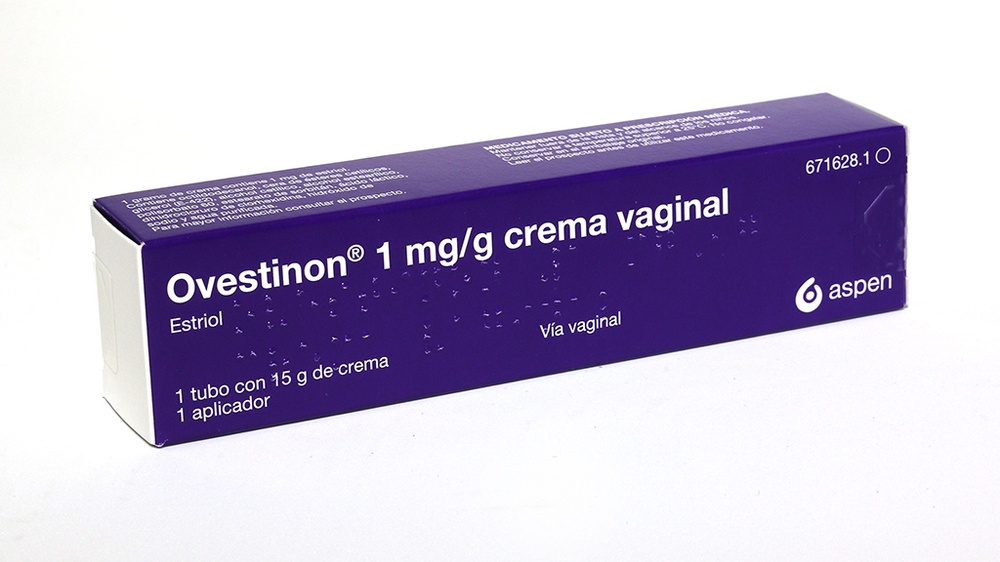
Masa homogénea, suave, de color blanco a casi blanco de consistencia cremosa. Ovestinon crema se presenta en una caja con un tubo con 15 g de crema y un aplicador.
Titular de la autorización de comercialización y responsable de la fabricación
Titular de la autorización de comercialización
ASPEN PHARMA TRADING LTD
3016 Lake Drive
Citywest Business Campus
Dublín 24
Irlanda
Tel: 0034 952010137
Responsable de la fabricación
Aspen Bad Oldesloe GmbH
Industriestrasse 32-36
D-23843 Bad Oldesloe
Alemania
Representante local
Aspen Pharmacare España S.L.
Avenida Diagonal, 512
Planta Interior 1, Oficina 4
08006 Barcelona España
Fecha de la última revisión de este prospecto: marzo 2024.
La información detallada y actualizada de este medicamento está disponible en la página Web de la Agencia Española de Medicamentos y Productos Sanitarios (AEMPS) http://www.aemps.gob.es/
- País de registro
- Forma farmacéuticaSEMISOLIDO VAGINAL, 1 mg estriol/g
- Código ATCG03CA04
- Precio medio en farmacia8.43 EUR
- Principio activo
- Requiere recetaSí
- Fabricante
- ComposiciónSORBITAN MONOESTEARATO (7,6 mg mg), POLISORBATO 60 (32,4 mg mg), ESTEARILICO, ALCOHOL (88,4 mg mg), CETILICO, ALCOHOL (36,7 mg mg), GLICEROL (E 422) (120 mg mg), CERA DE ESTERES CETILICOS (15 mg mg), HIDROXIDO DE SODIO (E 524) (c.s.p. PH 4 - mg)
- Esta información es de carácter general y no sustituye la consulta con un profesional sanitario.
- Alternativas a OVESTINON 1 mg/g CREMA VAGINALForma farmacéutica: SEMISOLIDO VAGINAL, 50 microgramos/gPrincipio activo: EstriolFabricante: Italfarmaco S.A.Requiere recetaForma farmacéutica: OVULO/CAPSULA/COMPRIMIDO VAGINAL, 0,03 mgPrincipio activo: EstriolFabricante: Kern Pharma S.L.Requiere recetaForma farmacéutica: SEMISOLIDO VAGINAL, 50 microgramos/gPrincipio activo: EstriolFabricante: Italfarmaco S.A.Requiere receta
Médicos online para OVESTINON 1 mg/g CREMA VAGINAL
Comenta la dosis, los posibles efectos secundarios, interacciones, contraindicaciones o la revisión de receta de OVESTINON 1 mg/g CREMA VAGINAL, sujeto a valoración médica y a la normativa local.

Obtén una receta de OVESTINON 1 mg/g CREMA VAGINAL online
Rellena un formulario de 2 minutos
Cuéntanos tus síntomas, historial y el medicamento que necesitas.
Elige un médico o nosotros te asignamos uno
Escoge un especialista o te conectamos con el próximo médico disponible.
El médico revisa tu caso
Normalmente en 30 minutos. Puede hacerte preguntas adicionales por chat.
Recógela en cualquier farmacia
Receta electrónica enviada a tu correo, válida en toda España.
Preguntas frecuentes
OVESTINON 1 mg/g CREMA VAGINAL requiere receta en España. Puedes confirmarlo con un médico online según tu caso.
El principio activo de OVESTINON 1 mg/g CREMA VAGINAL es Estriol. Esta información ayuda a identificar medicamentos con la misma composición pero con diferentes nombres comerciales.
El precio medio en farmacia de OVESTINON 1 mg/g CREMA VAGINAL es de aproximadamente 8.43 EUR. Puede variar según el fabricante y la forma farmacéutica.
OVESTINON 1 mg/g CREMA VAGINAL es fabricado por Aspen Pharma Trading Limited. La marca y el envase pueden variar según el distribuidor.
Los Médicos de familia, Psiquiatras, Dermatólogos, Cardiólogos, Endocrinólogos, Gastroenterólogos, Neumólogos, Nefrólogos, Reumatólogos, Hematólogos, Infectólogos, Alergólogos, Geriatras, Pediatras, Oncólogos pueden valorar la prescripción de OVESTINON 1 mg/g CREMA VAGINAL cuando esté clínicamente indicado. Puedes reservar una videoconsulta para comentar tu caso y las opciones de tratamiento.
España cuenta con una infraestructura sanitaria bien desarrollada en ciudades principales como Madrid, Barcelona, Valencia y Sevilla. Las farmacias están ampliamente disponibles y operan bajo estrictas regulaciones, garantizando el acceso a medicamentos con receta.
Puedes comprar OVESTINON 1 mg/g CREMA VAGINAL en Madrid, Barcelona, Sevilla o Valencia en cualquier farmacia local con una receta válida.
Para obtener una receta, puedes utilizar Oladoctor:
Otros medicamentos con el mismo principio activo (Estriol) incluyen BLISSEL 50 microgramos/g GEL VAGINAL, FEMMYN 0,03 MG ÓVULOS, GELISTROL 50 microgramos/g GEL VAGINAL. Pueden tener diferentes nombres comerciales o formulaciones, pero contienen el mismo componente terapéutico. Consulta siempre con un médico antes de cambiar o iniciar un nuevo medicamento.
