



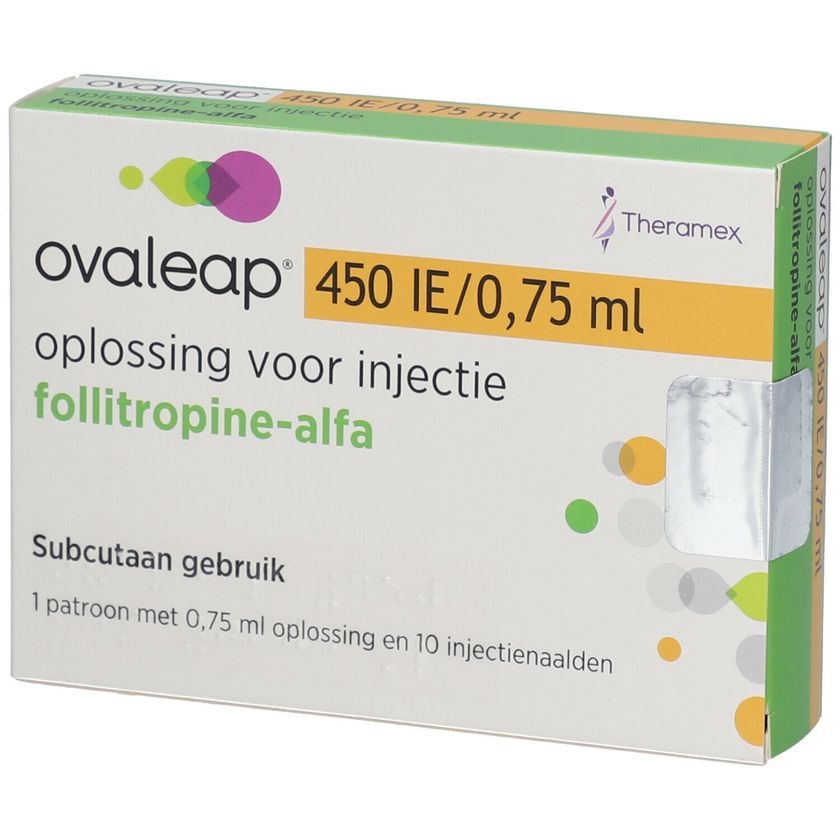
OVALEAP 450 UI/0,75 ml solucion inyectable

Revisión de receta online
Un médico revisará tu caso y determinará si la prescripción es médicamente apropiada.

Habla con un médico sobre este medicamento
Comenta tus síntomas y las opciones de tratamiento en una consulta online.



Cómo usar Ovaleap 450 UI/0,75 ml solucion inyectable
Contenido del prospecto
- Introducción
- Qué es Ovaleap y para qué se utiliza
- Qué necesita saber antes de empezar a usar Ovaleap
- Cómo usar Ovaleap
- Posibles efectos adversos
- Conservación de Ovaleap
- Contenido del envase e información adicional
Introducción
Prospecto: información para el usuario
Ovaleap 300UI/0,5mlsolución inyectable
Ovaleap 450UI/0,75mlsolución inyectable
Ovaleap 900UI/1,5mlsolución inyectable
Folitropina alfa
Lea todo el prospecto detenidamente antes de empezar a usar este medicamento, porque contiene información importante para usted.
- Conserve este prospecto, ya que puede tener que volver a leerlo.
- Si tiene alguna duda, consulte a su médico, farmacéutico o enfermero.
- Este medicamento se le ha recetado solamente a usted, y no debe dárselo a otras personas aunque tengan los mismos síntomas que usted, ya que puede perjudicarles.
- Si experimenta efectos adversos, consulte a su médico, farmacéutico o enfermero, incluso si se trata de efectos adversos que no aparecen en este prospecto.
Contenido del prospecto
- Qué es Ovaleap y para qué se utiliza
- Qué necesita saber antes de empezar a usar Ovaleap
- Cómo usar Ovaleap
- Posibles efectos adversos
- Conservación de Ovaleap
- Contenido del envase e información adicional
1. Qué es Ovaleap y para qué se utiliza
Qué es Ovaleap
Este medicamento contiene el principio activo folitropina alfa, que es casi idéntica a una hormona natural producida por el organismo llamada "hormona foliculoestimulante" (FSH). La FSH es una gonadotropina, un tipo de hormona que juega un papel importante en la fertilidad y la reproducción humanas. En las mujeres, la FSH es necesaria para el crecimiento y desarrollo de las bolsas (folículos) ováricas que contienen los óvulos. En los hombres, la FSH es necesaria para la producción de esperma.
Para qué se utilizaOvaleap
En mujeres adultas, Ovaleap se utiliza:
- para ayudar a la ovulación (liberación de un óvulo maduro del folículo) en mujeres que no pueden ovular y que no han respondido al tratamiento con una sustancia llamada "citrato de clomifeno".
- para ayudar al desarrollo de los folículos en mujeres que se someten a técnicas de reproducción asistida (técnicas que pueden ayudarla a quedarse embarazada), como la "fertilización in vitro", la "transferencia intratubárica de gametos" o la "transferencia intratubárica de cigotos".
- junto con otra substancia llamada "lutropina alfa" (una versión de otra gonadotropina, la "hormona luteinizante" o LH), para ayudar a la ovulación en mujeres cuyo organismo produce cantidades demasiado escasas de FSH y LH.
En hombres adultos, Ovaleap se utiliza:
- en combinación con una sustancia llamada "gonadotropina coriónica humana" (hCG), para ayudar a producir esperma en hombres que son estériles debido a concentraciones bajas de ciertas hormonas.

¿No estás seguro de si este medicamento es adecuado para ti?
Comenta tus síntomas y tratamiento con un médico online.
2. Qué necesita saber antes de empezar a usar Ovaleap
No use Ovaleap:
- si es alérgico a la folitropina alfa, la hormona folículoestimulante (FSH) o a alguno de los demás componentes de este medicamento (incluidos en la sección 6).
- si tiene un tumor en el hipotálamo o en la hipófisis (partes del cerebro).
- si usted es una mujercon:
- ovarios grandes o bolsas de líquido en el interior de los ovarios (quistes ováricos) de origen desconocido.
- hemorragia vaginal inexplicada.
- cáncer de ovario, de útero o de mama.
- alguna afección que normalmente hace que el embarazo sea imposible, como la insuficiencia ovárica (menopausia precoz), tumores fibroides del útero o una malformación de los órganos reproductivos.
- si usted es un hombrecon:
- insuficiencia testicular que no se puede tratar.
No use este medicamento si alguna de las condiciones anteriores le aplica a usted. Si no está seguro, pregunte a su médico o farmacéutico antes de usar este medicamento.
Advertencias y precauciones
Un médico con experiencia en el tratamiento de los trastornos de la fertilidad debe evaluar su fertilidad y la de su pareja antes de iniciar el tratamiento.
Consulte a su médico, farmacéutico o enfermero antes de empezar a usar Ovaleap.
Porfiria
Informe a su médico antes de iniciar el tratamiento, si usted o algún miembro de su familia padece porfiria. Esta es una afección que se puede transmitir de padres a hijos, que consiste en una incapacidad para degradar las porfirinas (compuestos orgánicos).
Informe inmediatamente a su médico si:
- su piel se vuelve frágil y le salen ampollas con facilidad, en especial en las zonas expuestas al sol con frecuencia, y/o
- si tiene dolor de estómago, de brazos o piernas.
Si presenta estos síntomas, su médico puede recomendarle que interrumpa el tratamiento.
Síndrome de hiperestimulación ovárica (SHO)
Si es usted una mujer, este medicamento aumenta el riesgo de que presente un SHO. Esto ocurre cuando sus folículos se desarrollan demasiado y se convierten en quistes de gran tamaño.
Informe inmediatamente a su médico si:
- presenta dolor en la parte baja del abdomen (barriga),
- aumenta de peso rápidamente,
- presenta náuseas o vómitos,
- presenta dificultad para respirar.
Si presenta estos síntomas, su médico podría indicarle que interrumpa el uso de este medicamento (ver también la sección 4, bajo el epígrafe “Efectos adversos graves en mujeres").
Si no ovula y se siguen la dosis y los tiempos de administración recomendados, ese síndrome es menos probable que ocurra. El tratamiento con Ovaleap rara vez causa un síndrome de hiperestimulación ovárica grave, a menos que se administre el medicamento que se usa para la maduración folicular final (que contiene gonadotropina coriónica humana, hCG). En caso de desarrollar SHO, su médico puede no recetarle hCG en este ciclo de tratamiento. Es posible que le aconsejen que se abstenga de realizar el coito o que utilice métodos anticonceptivos de barrera durante al menos 4 días.
Embarazo múltiple
Si usa este medicamento, tiene un riesgo más alto de quedarse embarazada de más de un niño (es decir, "embarazo múltiple", habitualmente gemelos), que si se queda embarazada por concepción natural. El embarazo múltiple puede causar complicaciones médicas para usted y sus bebés. Usted puede reducir el riesgo de embarazo múltiple usando la dosis correcta de este medicamento a las horas correctas. Si se somete a técnicas de reproducción asistida, el riesgo de embarazo múltiple está relacionado con su edad y con la calidad y el número de óvulos fertilizados o embriones que se coloquen en su interior.
Aborto
Si se somete a técnicas de reproducción asistida o a estimulación de sus ovarios para producir óvulos, la probabilidad de tener un aborto es mayor que en el promedio de las mujeres.
Embarazo ectópico
Si se somete a técnicas de reproducción asistida y presenta lesiones en las trompas de Falopio, la probabilidad de tener un embarazo fuera del útero (embarazo ectópico) es mayor que en el promedio de las mujeres.
Anomalías congénitas
Un bebé concebido con técnicas de reproducción asistida puede presentar un riesgo ligeramente mayor de anomalías congénitas que si hubiera sido concebido de manera natural. Esto se podría asociar a los embarazos múltiples o a las características de los padres como, por ejemplo, la edad materna o las características del esperma.
Problemas de coagulación de la sangre (episodios tromboembólicos)
Si usted o algún miembro de su familia ha sufrido alguna vez coágulos de sangre en la pierna o en el pulmón, infarto de miocardio o ictus, informe a su médico. Usted podría tener un riesgo más alto de presentar estos problemas o de que empeorasen con el tratamiento con Ovaleap.
Hombres con niveles altos de FSH en la sangre
Si usted es hombre, unos niveles demasiado altos de FSH natural en la sangre pueden ser un signo de lesión de los testículos. Por lo general, este medicamento no suele ser eficaz en estos casos. Si su médico decide intentar el tratamiento con Ovaleap, es posible que su médico lo controle pidiéndole que se haga un análisis de semen, de 4 a 6 meses después de iniciar el tratamiento.
Niños y adolescentes
Este medicamento no debe utilizarse en niños y adolescentes menores de 18 años de edad.
Otros medicamentos y Ovaleap
Informe a su médico o farmacéutico si está utilizando, ha utilizado recientemente o pudiera tener que utilizar cualquier otro medicamento.
- Si usa Ovaleap con otros medicamentos que ayudan a la ovulación como, por ejemplo, gonadotropina coriónica humana (hCG) o citrato de clomifeno, la respuesta de sus folículos puede verse aumentada.
- Si usa Ovaleap al mismo tiempo que un agonista o un antagonista de la "hormona liberadora de gonadotropinas" (GnRH) (estos medicamentos disminuyen las concentraciones de las hormonas sexuales y detienen la ovulación), puede necesitar una dosis más alta de Ovaleap para producir folículos.
Embarazo y lactancia
No debe usar este medicamento si está embarazada o durante el periodo de lactancia.
Conducción y uso de máquinas
Este medicamento no afecta a su capacidad para conducir y utilizar máquinas.
Ovaleapcontiene sodio, cloruro de benzalconio y alcohol bencílico
Este medicamento contiene menos de 1 mmol de sodio (23 mg) por dosis; esto es, esencialmente “exento de sodio”.
Este medicamento también contiene 0,02 mg por ml de cloruro de benzalconio y 10,0 mg por ml de alcohol bencílico. Consulte a su médico o farmacéutico si tiene enfermedades de hígado o riñón y si está embarazada o en periodo de lactancia. Esto es debido a que se pueden acumular en el organismo grandes cantidades de alcohol bencílico y provocar efectos adversos (acidosis metabólica).
3. Cómo usar Ovaleap
Siga exactamente las instrucciones de administración de este medicamento indicadas por su médico o farmacéutico. En caso de duda, consulte de nuevo a su médico o farmacéutico.
Este medicamento se administra en forma de inyección en el tejido que se encuentra justo por debajo de la piel (inyección subcutánea). Su médico o enfermero le indicará cómo se inyecta el medicamento. Si se autoadministra este medicamento, lea y siga de manera detenida las “Instrucciones de uso” de la pluma.
Cuál es la dosis recomendada
Su médico decidirá qué cantidad de medicamento se administrará y con qué frecuencia. Las dosis que se describen a continuación están expresadas en Unidades Internacionales (UI).
Mujeres
Si no está ovulando y tiene menstruaciones irregulares o no tiene menstruación
- Este medicamento se administra generalmente todos los días.
- Si usted tiene una menstruación irregular, empiece usando este medicamento en los 7 primeros días del ciclo menstrual. Si no tiene menstruación, puede empezar a usar el medicamento cualquier día que le resulte cómodo.
- La dosis inicial de este medicamento suele individualizarse y puede ajustarse de forma escalonada.
- La dosis diaria de este medicamento no debe ser superior a 225 UI.
- Cuando se obtenga la respuesta deseada, se le administrará hCG o "hCG recombinante" (r‑hCG, una hCG fabricada en un laboratorio mediante una técnica especial de ADN). La inyección única será de 250 microgramos de r‑hCG o de 5 000 a 10 000 UI de hCG, 24 a 48 horas después de la última inyección de Ovaleap. El mejor momento para mantener relaciones sexuales es el mismo día de la inyección de hCG y al día siguiente. De manera alternativa, se puede realizar una inseminación intrauterina introduciendo el esperma en la cavidad uterina.
Si su médico no observa la respuesta deseada, la continuación de ese ciclo de tratamiento con Ovaleap debe evaluarse y manejarse conforme a la práctica clínica habitual.
Si se obtiene una respuesta excesiva, se interrumpirá su tratamiento y no le administrarán hCG (ver también la sección 2, bajo el epígrafe "Síndrome de hiperestimulación ovárica (SHO)"). Para el siguiente ciclo, su médico le administrará una dosis de Ovaleap más baja que la del ciclo previo.
Si tiene que desarrollar varios óvulos para su extracción previamente a cualquier técnica de reproducción asistida
- La dosis inicial de este medicamento suele individualizarse y puede ajustarse de forma escalonada hasta un máximo de 450 UI al día.
- El tratamiento continúa hasta que los óvulos se hayan desarrollado hasta el punto deseado. Su médico lo comprobará mediante análisis de sangre y/o ecografías.
- Cuando los óvulos estén listos, se le administrará hCG o r‑hCG. La inyección única será de 250 microgramos de r-hCG o de 5 000 a 10 000 UI de hCG, 24 a 48 horas después de la última inyección de Ovaleap. Esto hace que sus óvulos estén listos para su extracción.
Si se le han diagnosticado niveles muy bajos de hormonas FSH y LH
- La dosis inicial habitual de Ovaleap es de 75 a 150 UI junto con 75 UI de lutropina alfa.
- Usará estos dos medicamentos cada día durante un máximo de 5 semanas.
- La dosis de Ovaleap se puede aumentar cada 7 o 14 días en 37,5 a 75 UI, hasta que se obtenga la respuesta deseada.
- Cuando se obtenga la respuesta deseada, se le administrará hCG o r‑hCG. La inyección única será de 250 microgramos de r‑hCG o de 5 000 a 10 000 UI de hCG, 24 a 48 horas después de las últimas inyecciones de Ovaleap y lutropina alfa. El mejor momento para mantener relaciones sexuales es el mismo día de la inyección de hCG y al día siguiente. De forma alternativa, se puede realizar una inseminación intrauterina u otro procedimiento de reproducción médicamente asistida, a criterio de su médico.
Si su médico no observa una respuesta después de 5 semanas de tratamiento, ese ciclo de tratamiento se debe interrumpir. Para el siguiente ciclo, su médico le administrará una dosis inicial más alta de este medicamento que la anterior.
Si se obtiene una respuesta excesiva, se interrumpirá su tratamiento con Ovaleap y no le administrarán hCG (ver también la sección 2, bajo el epígrafe "Síndrome de hiperestimulación ovárica (SHO)"). Para el siguiente ciclo, su médico le administrará una dosis de Ovaleap más baja que la del ciclo previo.
Hombres
- La dosis habitual de este medicamento es de 150 UI junto con hCG.
- Usted usará estos dos medicamentos tres veces por semana, durante al menos 4 meses.
- Si no ha respondido al tratamiento después de 4 meses, su médico puede sugerirle que siga usando estos dos medicamentos al menos durante 18 meses.
¿Cómo se administran las inyecciones?
Este medicamento se administra en forma de inyección en el tejido que se encuentra justo por debajo de la piel (inyección subcutánea) utilizando la Ovaleap Pen. La Ovaleap Pen es un dispositivo (una "pluma") utilizado para la administración de inyecciones en el tejido que se encuentra justo por debajo de la piel.
Su médico puede sugerirle que aprenda a inyectarse usted mismo este medicamento. Su médico o enfermero le darán instrucciones sobre cómo hacerlo y también puede encontrarlas en las instrucciones de uso por separado de la pluma. No intente autoadministrarse este medicamento si no ha recibido esta formación por parte de su médico o enfermero. La primera inyección de este medicamento se debe administrar siempre en presencia de un médico o enfermero.
Ovaleap solución inyectable en cartuchos se ha diseñado para uso en la Ovaleap Pen. Debe seguir minuciosamente las instrucciones de uso por separado de la Ovaleap Pen. Las instrucciones de uso de la pluma se facilitarán junto con la Ovaleap Pen. No obstante, el adecuado tratamiento de su afección requiere una constante y estrecha colaboración con su médico.
Deseche las agujas utilizadas inmediatamente después de la inyección.
Si usa másOvaleapdel que debe
Se desconocen los efectos de usar una cantidad excesiva de Ovaleap. Sin embargo, se puede esperar que se produzca un síndrome de hiperestimulación ovárica, que se describe en la sección 4 bajo el epígrafe "Efectos adversos graves en mujeres". Sin embargo, este síndrome solo ocurrirá si se administra también hCG (ver también la sección 2, bajo el epígrafe "Síndrome de hiperestimulación ovárica (SHO)").
Si olvidó usarOvaleap
No use una dosis doble para compensar las dosis olvidadas. Consulte a su médico tan pronto como se dé cuenta de que se ha olvidado de tomar una dosis.
Si tiene cualquier otra duda sobre el uso de este medicamento, pregunte a su médico, farmacéutico o enfermero.

¿Has empezado a tomar el medicamento y tienes preguntas?
Comenta tus síntomas y tratamiento con un médico online.
4. Posibles efectos adversos
Al igual que todos los medicamentos, este medicamento puede producir efectos adversos, aunque no todas las personas los sufran.
Efectos adversos importantes
Efectos adversos graves en hombres y en mujeres
- Se han notificado casos muy raros (pueden afectar hasta a 1 de cada 10 000 personas) de reacciones alérgicas como erupción cutánea, zonas de piel elevadas y pruriginosas y reacciones alérgicas graves con debilidad, caída de la presión arterial, dificultad para respirar e hinchazón de la cara. Si cree que está sufriendo este tipo de reacción, debe interrumpir la inyección de Ovaleap y buscar ayuda médica inmediatamente.
Efectos adversos graves en mujeres
- El dolor de estómago, acompañado de náuseas o vómitos, pueden ser síntomas del síndrome de hiperestimulación ovárica (SHO). Esto puede indicar que los ovarios han reaccionado de forma excesiva al tratamiento y se han desarrollado quistes ováricos de gran tamaño (ver también la sección 2, en “Síndrome de hiperestimulación ovárica (SHO)”). Este efecto adverso es frecuente (puede afectar hasta 1 de cada 10 personas).
- El síndrome de hiperestimulación ovárica se puede agravar con ovarios claramente aumentados de tamaño, disminución de la producción de orina, aumento de peso, dificultad para respirar y/o posible acumulación de líquido en el abdomen o en el pecho. Este efecto adverso es poco frecuente (puede afectar hasta 1 de cada 100 personas).
- En casos raros (pueden afectar hasta 1 de cada 1.000 personas), también se pueden producir complicaciones del síndrome de hiperestimulación ovárica como torsión ovárica o coagulación de la sangre.
- En casos muy raros (pueden afectar hasta 1 de cada 10 000 personas) pueden producirse algunas veces complicaciones graves de la coagulación de la sangre (episodios tromboembólicos), a veces independientes del síndrome de hiperestimulación ovárica. Esto podría causar dolor en el pecho, sensación de falta de aire, ictus o infarto de miocardio (ver también la sección 2, en “Problemas de coagulación de la sangre (episodios tromboembólicos)”).
Si observa alguno de los efectos adversos antes mencionados, debe consultar inmediatamente a su médico, quien puede pedirle que interrumpa el tratamiento con Ovaleap.
Otros efectos adversos en mujeres
Muy frecuentes (pueden afectar a más de 1 de cada 10 personas)
- Reacciones locales en la zona de inyección, como dolor, enrojecimiento, hematoma, hinchazón y/o irritación
- Dolor de cabeza
- Bolsas de líquido en el interior de los ovarios (quistes ováricos)
Frecuentes (pueden afectar hasta 1 de cada 10 personas)
- Dolor de estómago
- Flatulencias abdominales
- Retortijones abdominales
- Náuseas
- Vómitos
- Diarrea
Muy raros (pueden afectar hasta 1 de cada 10 000 personas)
- El asma puede empeorar.
Otros efectos adversos en hombres
Muy frecuentes (pueden afectar a más de 1 de cada 10 personas)
- Reacciones locales en la zona de inyección, como dolor, enrojecimiento, hematoma, hinchazón y/o irritación
Frecuentes (pueden afectar hasta 1 de cada 10 personas)
- Hinchazón de las venas por encima y por detrás de los testículos (varicocele)
- Desarrollo de mamas
- Acné
- Aumento de peso
Muy raros (pueden afectar hasta 1 de cada 10 000 personas)
- El asma puede empeorar.
Comunicación de efectos adversos
Si experimenta cualquier tipo de efecto adverso, consulte a su médico, farmacéutico o enfermero, incluso si se trata de posibles efectos adversos que no aparecen en este prospecto. También puede comunicarlos directamente a través del sistema nacional de notificación incluido en el Apéndice V. Mediante la comunicación de efectos adversos usted puede contribuir a proporcionar más información sobre la seguridad de este medicamento.
5. Conservación de Ovaleap
Mantener este medicamento fuera de la vista y del alcance de los niños.
No utilice este medicamento después de la fecha de caducidad que aparece en la etiqueta y en el embalaje exterior después de CAD. La fecha de caducidad es el último día del mes que se indica.
Conservar en nevera (entre 2ºC y 8ºC).
No congelar.
Conservar el cartucho en el embalaje exterior para protegerlo de la luz.
Antes de la apertura y dentro de su periodo de validez, puede extraer este medicamento de la nevera, sin refrigerar de nuevo, hasta un máximo de 3 meses. No conservar a temperatura superior a 25ºC. Debe desechar este medicamento si no se ha utilizado en 3 meses.
Una vez abierto, el cartucho en uso dentro de la pluma puede conservarse durante un periodo máximo de 28 días. No conservar a temperatura superior a 25ºC. Anote la fecha del primer uso en el diario del paciente, que se facilitará con la Ovaleap Pen.
Coloque de nuevo la cápsula de cierre de la pluma en la Ovaleap Pen después de cada inyección para proteger el cartucho de la luz.
No utilice este medicamento si observa que está turbio o contiene partículas.
Los medicamentos no se deben tirar por los desagües. Pregunte a su farmacéutico cómo deshacerse de los envases y de los medicamentos que ya no necesita. De esta forma, ayudará a proteger el medio ambiente.
6. Contenido del envase e información adicional
Composición deOvaleap
- El principio activo es folitropina alfa.Ovaleap 300 UI /0,5 ml: Cada cartucho contiene 300 UI (equivalentes a 22 microgramos) de folitropina alfa en 0,5 ml de solución.Ovaleap 450 UI /0,75 ml: Cada cartucho contiene 450 UI (equivalentes a 33 microgramos) de folitropina alfa en 0,75 de solución.Ovaleap 900 UI /1,5 ml: Cada cartucho contiene 900 UI (equivalentes a 66 microgramos) de folitropina alfa en 1,5 ml de solución.
Cada ml de la solución contiene 600 UI (equivalentes a 44 microgramos) de folitropina alfa.
- Los demás componentes son dihidrogenofosfato de sodio dihidrato, hidróxido de sodio (2 M) (para ajuste del pH), manitol, metionina, polisorbato 20, alcohol bencílico, cloruro de benzalconio y agua para preparaciones inyectables.
Todas las presentaciones mencionadas anteriormente contienen los demás componentes.
Aspecto del producto y contenido del envase
Ovaleap es una solución inyectable (inyección). Ovaleap es una solución transparente e incolora.
Ovaleap 300 UI/0,5 ml se presenta en cajas que contienen 1 cartucho y 10 agujas para inyección.Ovaleap 450 UI/0,75 ml se presenta en cajas que contienen 1 cartucho y 10 agujas para inyección.Ovaleap 900 UI/1,5 ml se presenta en cajas que contienen 1 cartucho y 20 agujas para inyección.
Puede que solamente estén comercializados algunos tamaños de envases.
Titular de la autorización de comercialización
Theramex Ireland Limited
3rd Floor, Kilmore House,
Park Lane, Spencer Dock,
Dublin 1
D01 YE64
Irlanda
Responsable de la fabricación
Merckle GmbH
Graf-Arco-Straße 3
89079 Ulm,
Alemania
Rechon Life Science AB
Soldattorpsvägen 5
216 13 Limhamn
Suecia
Fecha de la última revisión de este prospecto:Abril 2025 La información detallada de este medicamento está disponible en la página web de la Agencia Europea de Medicamentos: http://www.ema.europa.eu. | |
- País de registro
- Forma farmacéuticaINYECTABLE PERFUSION, 600 IU/ml
- Código ATCG03GA05
- Principio activo
- Requiere recetaSí
- Fabricante
- ComposiciónDIHIDROGENOFOSFATO DE SODIO DIHIDRATO (7.8 mg mg), MANITOL (E-421) (5.0 mg mg), POLISORBATO 20 (0.2 mg mg), ALCOHOL BENCILICO (10.0 mg mg), BENZALCONIO, CLORURO DE (0.02 mg mg), HIDROXIDO DE SODIO (E 524) (1.57 mg mg)
- Esta información es de carácter general y no sustituye la consulta con un profesional sanitario.
- Alternativas a Ovaleap 450 UI/0,75 ml solucion inyectableForma farmacéutica: INYECTABLE, 150 UI/ 0,25 ml (11 microgramos/ 0,25 ml)Principio activo: Follitropin alfaFabricante: Gedeon Richter Plc.Requiere recetaForma farmacéutica: INYECTABLE, 150 UI/ 0,25 ml (11 microgramos/ 0,25 ml)Principio activo: Follitropin alfaFabricante: Gedeon Richter Plc.Requiere recetaForma farmacéutica: INYECTABLE, 150UI/0,25 ml (11 microgramos/ 0,25 ml)Principio activo: Follitropin alfaFabricante: Gedeon Richter Plc.Requiere receta
Médicos online para Ovaleap 450 UI/0,75 ml solucion inyectable
Comenta la dosis, los posibles efectos secundarios, interacciones, contraindicaciones o la revisión de receta de Ovaleap 450 UI/0,75 ml solucion inyectable, sujeto a valoración médica y a la normativa local.
Obtén una receta de Ovaleap 450 UI/0,75 ml solucion inyectable online
Rellena un formulario de 2 minutos
Cuéntanos tus síntomas, historial y el medicamento que necesitas.
Elige un médico o nosotros te asignamos uno
Escoge un especialista o te conectamos con el próximo médico disponible.
El médico revisa tu caso
Normalmente en 30 minutos. Puede hacerte preguntas adicionales por chat.
Recógela en cualquier farmacia
Receta electrónica enviada a tu correo, válida en toda España.
Preguntas frecuentes
Ovaleap 450 UI/0,75 ml solucion inyectable requiere receta en España. Puedes confirmarlo con un médico online según tu caso.
El principio activo de Ovaleap 450 UI/0,75 ml solucion inyectable es Follitropin alfa. Esta información ayuda a identificar medicamentos con la misma composición pero con diferentes nombres comerciales.
Ovaleap 450 UI/0,75 ml solucion inyectable es fabricado por Theramex Ireland Limited. La marca y el envase pueden variar según el distribuidor.
Los Médicos de familia, Psiquiatras, Dermatólogos, Cardiólogos, Endocrinólogos, Gastroenterólogos, Neumólogos, Nefrólogos, Reumatólogos, Hematólogos, Infectólogos, Alergólogos, Geriatras, Pediatras, Oncólogos pueden valorar la prescripción de Ovaleap 450 UI/0,75 ml solucion inyectable cuando esté clínicamente indicado. Puedes reservar una videoconsulta para comentar tu caso y las opciones de tratamiento.
España cuenta con una infraestructura sanitaria bien desarrollada en ciudades principales como Madrid, Barcelona, Valencia y Sevilla. Las farmacias están ampliamente disponibles y operan bajo estrictas regulaciones, garantizando el acceso a medicamentos con receta.
Puedes comprar Ovaleap 450 UI/0,75 ml solucion inyectable en Madrid, Barcelona, Sevilla o Valencia en cualquier farmacia local con una receta válida.
Para obtener una receta, puedes utilizar Oladoctor:
Otros medicamentos con el mismo principio activo (Follitropin alfa) incluyen BEMFOLA 150 UI/0,25 ml solucion inyectable en pluma precargada, BEMFOLA 150 UI/0,25 ml solucion inyectable en pluma precargada, BEMFOLA 150UI/0,25ml solucion inyectable en pluma precargada. Pueden tener diferentes nombres comerciales o formulaciones, pero contienen el mismo componente terapéutico. Consulta siempre con un médico antes de cambiar o iniciar un nuevo medicamento.
