



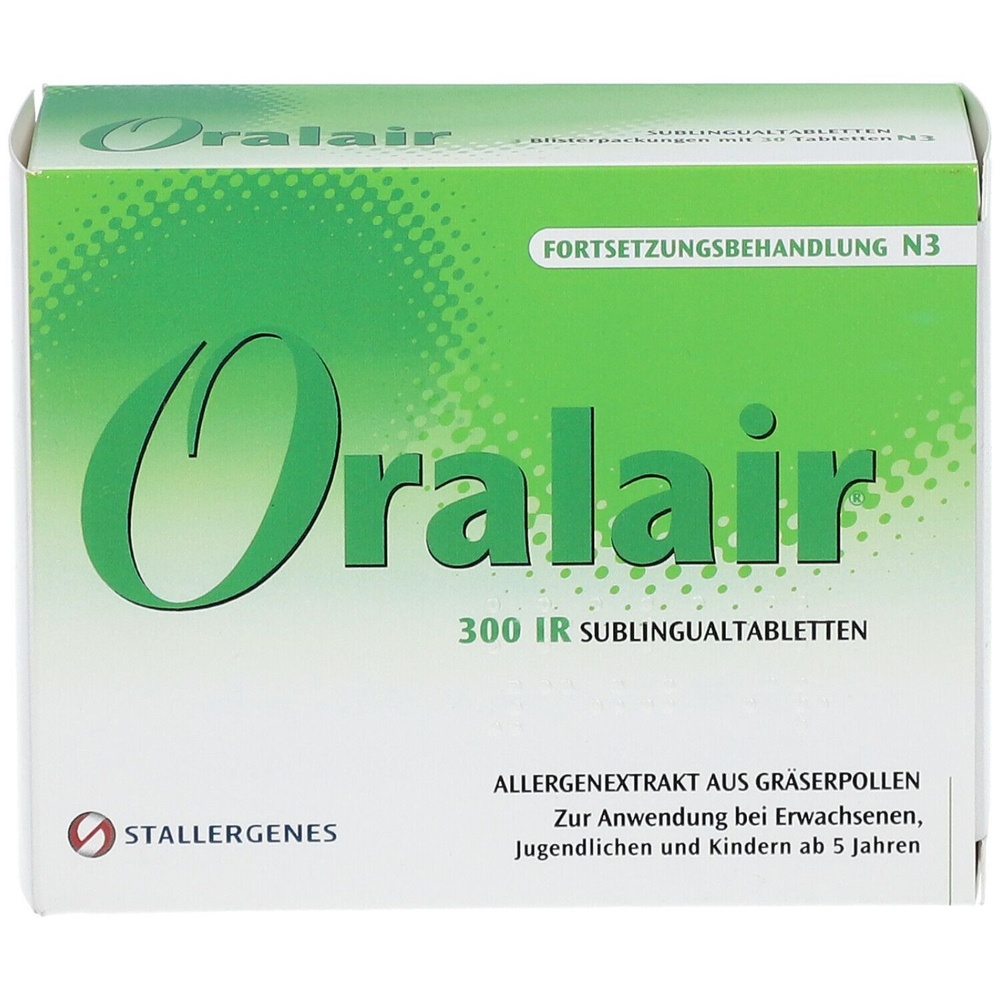
ORALAIR 300 IR Comprimidos Sublinguales

Revisión de receta online
Un médico revisará tu caso y determinará si la prescripción es médicamente apropiada.

Habla con un médico sobre este medicamento
Comenta tus síntomas y las opciones de tratamiento en una consulta online.



Cómo usar ORALAIR 300 IR COMPRIMIDOS SUBLINGUALES
Contenido del prospecto
- Introducción
- Qué es ORALAIR y para qué se utiliza
- Qué necesita saber antes de empezar a tomar ORALAIR
- Cómo tomar ORALAIR
- Posibles efectos adversos
- Conservación de ORALAIR
- Contenido del envase e información adicional
Introducción
Prospecto: información para el usuario
ORALAIR 300IR comprimidos sublinguales
Para uso en adultos, adolescentes y niños mayores de cinco años
Extracto alergénico de polen de gramíneas de:
dáctilo (Dactylis glomerataL.), grama de olor (Anthoxanthum odoratumL.), ballico (Lolium perenneL.), espiguilla (Poa pratensisL.) y fleo de los prados (Phleum pratenseL.)
Lea todo el prospecto detenidamente antes de empezar a tomar este medicamento, porque contiene información importante para usted.
- Conserve este prospecto, ya que puede tener que volver a leerlo.
- Si tiene alguna duda, consulte a su médico o farmacéutico.
- Este medicamento se le ha recetado solamente a usted y no debe dárselo a otras personas aunque tengan los mismos síntomas que usted, ya que puede perjudicarles.
- Si experimenta efectos adversos consulte a su médico o farmacéutico incluso si se trata de efectos adversos que no aparecen en este prospecto. Ver sección 4.
Contenido del prospecto
- Qué es ORALAIR y para qué se utiliza
- Qué necesita saber antes de empezar a tomar ORALAIR
- Cómo tomar ORALAIR
- Posibles efectos adversos
- Conservación de ORALAIR
- Contenido del envase e información adicional
1. Qué es ORALAIR y para qué se utiliza
ORALAIR contiene un extracto alergénico. El tratamiento con ORALAIR está indicado para aumentar la tolerancia inmunológica hacia los pólenes de las gramíneas y, de esta manera, disminuir los síntomas alérgicos.
ORALAIR se usa para el tratamiento de la alergia al polen de las gramíneas, que se caracteriza por rinitis (estornudos, moqueo, picor nasal, congestión nasal) con o sin conjuntivitis (picor de ojos y lagrimeo) en los adultos, adolescentes y niños a partir de cinco años.
Antes de comenzar el tratamiento, la alergia debe ser diagnosticada mediante las pruebas cutáneas o los análisis de sangre apropiados, por un médico especialista con experiencia en el tratamiento de las enfermedades alérgicas.

¿No estás seguro de si este medicamento es adecuado para ti?
Comenta tus síntomas y tratamiento con un médico online.
2. Qué necesita saber antes de empezar a tomar ORALAIR
No tome ORALAIR si:
- Es alérgico a cualquiera de los otros componentes de este medicamento (incluidos en la sección 6);
- Padece asma grave o inestable o ha sufrido exacerbaciones graves de asma en los últimos 3 meses;
- Su volumen espiratorio forzado en un segundo (FEV1) es inferior al 80% según la evaluación de su médico;
- Padece una enfermedad que afecte a su sistema inmunitario, está tomando medicamentos que supriman el sistema inmunitario o si tiene cáncer;
- Padece úlceras o infecciones bucales. Su médico puede recomendarle retrasar el inicio del tratamiento o interrumpirlo hasta que su boca se haya curado.
No empiece a tomar ORALAIR si está embarazada.
Advertencias y precauciones
Consulte a su médico o farmacéutico antes de empezar a tomar ORALAIR si:
- Experimenta síntomas alérgicos graves, como dificultad para tragar o respirar, cambios en su voz, hipotensión (presión sanguínea baja) o sensación de bulto en la garganta. Interrumpa el tratamiento y contacte a su médico de inmediato.
- Ha tenido previamente reacciones alérgicas graves a un medicamento con extractos de alérgenos.
- Sus síntomas de asma empeoran más de lo normal. Interrumpa el tratamiento y contacte a su médico de inmediato.
- Padece de una enfermedad cardiovascular.
- Está tomando un betabloqueante (una clase de fármacos que se suelen recetar para las afecciones cardíacas y presión sanguínea elevada, pero que también están presentes en algunos colirios y pomadas).
- Está siendo tratado por depresión con antidepresivos tricíclicos o inhibidores de la mono amino oxidasa (IMAOs), o por la enfermedad del Parkison con inhibidores de la catecol-O-metiltransferasa (COMT).
- Necesita someterse a una intervención quirúrgica en la boca o a una extracción dental, deberá interrumpir el tratamiento con ORALAIR hasta que esté completamente curado.
- Experimenta persistentemente ardor de estómago o dificultad para tragar. Debería contactar con su médico.
- Padece una enfermedad autoinmune en remisión.
Informe a su médico sobre:
- Cualquier enfermedad reciente que haya podido tener,
- Antecedentes familiares o personales de cualquier enfermedad que pudiera afectar a su sistema inmunitario,
- Si su enfermedad alérgica ha empeorado recientemente.
Si toma medicamentos para el control y/o alivio del asma, no interrumpa el tratamiento del asma sin el consejo de su médico, ya que esto puede empeorar los síntomas del asma. Si padece asma y una infección respiratoria, debe posponer el inicio del tratamiento con ORALAIR hasta que la infección se haya resuelto.
Puede esperar algunas reacciones alérgicas localizadas, de leves a moderadas, durante el tratamiento. Si esas reacciones son graves, hable con su médico para ver si necesita algún medicamento anti-alérgico como antihistamínicos.
Niños y adolescentes
ORALAIR se utiliza para el tratamiento de la rinitis por alergia al polen de las gramíneas con o sin conjuntivitis en adolescentes y niños a partir de los 5 años. ORALAIR no está indicado para su uso en niños menores de 5 años.
Otros medicamentos y ORALAIR
Informe a su médico o farmacéutico si está tomando, ha tomado recientemente o pudiera tener que tomar cualquier otro medicamento, incluyendo medicamentos sin prescripción.
Comunique especialmente a su médico si está tomando ciertos medicamentos antidepresivos (antidepresivos tricíclicos e inhibidores de la monoaminooxidasa (IMAOs).
Si está tomando otros medicamentos para la alergia, como antihistamínicos, medicamentos para el alivio del asma o esteroides, o medicamentos que bloquean una sustancia llamada inmunoglobulina E (IgE), como por ejemplo, omalizumab, hable con su médico si debe seguir tomándolos. Si interrumpe la toma de esos medicamentos para la alergia, puede experimentar más efectos adversos durante el tratamiento con ORALAIR. Se puede utilizar un tratamiento sintomático (por ejemplo antihistamínicos y/o corticosteroides nasales) junto a ORALAIR.
Consulte a su médico o farmacéutico antes de tomar Oralair: si está tomando un betabloqueante (es decir, un tipo de medicamento recetado habitualmente para trastornos del corazón e hipertensión arterial, y también presente en algunos colirios y pomadas oftálmicas), ya que este medicamento puede disminuir la eficacia de la adrenalina usada para tratar reacciones sistémicas graves.
Toma de ORALAIR con alimentos y bebidas
No se deberían ingerir alimentos ni bebidas durante los 5 minutos posteriores a la toma de este medicamento.
Embarazo y lactancia
Embarazo
Si está embarazada, cree que podría estar embarazada o tiene intención de quedarse embarazada, consulte a su médico o farmacéutico antes de utilizar este medicamento.
No hay experiencia sobre el uso de ORALAIR durante el embarazo. Por lo tanto, no debe empezar una inmunoterapia si está embarazada. Si se queda embarazada mientras toma este medicamento, consulte con su médico sobre si es adecuado continuar el tratamiento.
Lactancia
Si está en período de lactancia, consulte a su médico o farmacéutico antes de utilizar este medicamento.
No debe iniciar una inmunoterapia si está en periodo de lactancia.
No hay experiencia sobre el uso de ORALAIR durante la lactancia materna. No se prevén efectos sobre los lactantes que reciben leche materna durante el tratamiento. Si desea amamantar a su bebé mientras está en tratamiento, consulte con su médico para ver si es adecuado para usted continuar el tratamiento.
Conducción y uso de máquinas
No se han observado efectos de ORALAIR sobre la capacidad para conducir o usar máquinas
ORALAIR contiene lactosa
Si su médico le ha indicado que padece una intolerancia a ciertos azúcares, consulte con él antes de tomar este medicamento.
ORALAIR contiene sodio
Este medicamento contiene menos de 1 mmol de sodio (23 mg) por comprimido; esto es, esencialmente “exento de sodio”.
3. Cómo tomar ORALAIR
Siga exactamente las instrucciones de administración de este medicamento indicadas por su médico. En caso de duda, consulte de nuevo a su médico o farmacéutico.
ORALAIR es recetado por médicos con formación y experiencia adecuadas en el tratamiento de las alergias. En la prescripción para niños, el médico tiene la experiencia adecuada en el tratamiento de niños.
Se le aconseja que tome el primer comprimido bajo supervisión médica. Esto le dará la posibilidad de hablar con su médico acerca de las posibles reacciones adversas.
Posología
El tratamiento está compuesto de una fase de inicio (incluido un aumento de la dosis durante tres días) y una fase de mantenimiento del tratamiento. ORALAIR 300 IR está indicado solo para la fase de mantenimiento.
Tome un comprimido de 300 IR una vez al día.
Forma de administración
La primera dosis de ORALAIR debe tomarse bajo supervisión médica. Debe permanecer bajo observación médica al menos media hora después de tomar la primera dosis. Esta es una precaución para controlar su sensibilidad al medicamento. También le dará la oportunidad de hablar con su médico sobre posibles efectos adversos.
Mantenga el comprimido debajo de la lengua hasta que se disuelva completamente (un minuto como mínimo) antes de tragarlo. Se recomienda tomar el comprimido durante el día, con la boca vacía. No coma ni beba durante al menos 5 minutos.
Duración del tratamiento
Tome estos comprimidos, según lo prescrito por su médico, hasta el final del periodo de tratamiento. Comience el tratamiento aproximadamente 4 meses antes del comienzo de la estación polínica y continúelo hasta el final de la misma.
No hay experiencia con ORALAIR en los pacientes mayores de 65 años.
Uso en niños y adolescentes
No hay experiencia con ORALAIR en niños menores de 5 años.
No hay experiencia de más de una estación polínica en niños.
La dosis en adolescentes y niños a partir de 5 años es la misma que en adultos.
Si toma más ORALAIR del que debe
Si toma más ORALAIR del que debiera, puede sufrir síntomas alérgicos, incluso síntomas localizados en la boca y la garganta. Si sufre síntomas intensos, consulte inmediatamente a su médico.
En caso de sobredosis o ingestión accidental, consulte inmediatamente a su médico o farmacéutico o llame al Servicio de Información Toxicológica, teléfono: 91 562 04 20, indicando el medicamento y la cantidad ingerida.
Si olvidó tomar ORALAIR
No tome una dosis doble para compensar las dosis olvidadas.
Si ha interrumpido el tratamiento con ORALAIR durante menos de una semana, puede retomar el tratamiento con la misma dosis.
Si interrumpió el tratamiento durante más de 7 días, consulte a su médico cómo retomar su tratamiento.
Si interrumpe el tratamiento con ORALAIR
Si no completa el tratamiento con ORALAIR, puede que no obtenga un beneficio continuado del tratamiento.
Si tiene cualquier otra duda sobre el uso de este medicamento, pregunte a su médico o farmacéutico.

¿Has empezado a tomar el medicamento y tienes preguntas?
Comenta tus síntomas y tratamiento con un médico online.
4. Posibles efectos adversos
Al igual que todos los medicamentos, este medicamento puede producir efectos adversos, aunque no todas las personas los sufran.
Durante el tratamiento con ORALAIR, usted estará expuesto a sustancias que pueden causar reacciones locales en el lugar de aplicación y/o síntomas que pueden afectar a todo el organismo. Se pueden esperar reacciones locales en el lugar de aplicación tales como picor en la boca e irritación en la garganta. Estas reacciones se producen normalmente al comienzo de la terapia, son transitorias y generalmente disminuyen con el tiempo.
Deje de tomar ORALAIR y póngase inmediatamente en contacto con su médico u hospital si experimenta alguno de los siguientes síntomas:
- Hinchazón rápida de la cara, boca, garganta o piel.
- Dificultad para tragar
- Dificultad para respirar
- Cambios de voz
- Hipotensión (presión arterial baja)
- Sensación de llenado en la garganta (como una hinchazón)
- Urticaria o picazón en la piel
El tratamiento sólo debe reanudarse siguiendo las indicaciones de un médico.
Otros posibles efectos adversos
Muy frecuentes(pueden afectar a más de 1 de cada 10 personas):
- Picor en la boca
- Irritación de la garganta
- Dolor de cabeza
Frecuentes (pueden afectar hasta 1 de cada 10 personas):
- Inflamación en los ojos, picor en los ojos, ojos llorosos
- Picor en los oídos
- Rinitis (congestión nasal, secreción nasal, picor en la nariz, estornudos, molestias en la nariz), congestión de los senos nasales
- Hinchazón o picor en los labios o la lengua, dolor en la lengua
- Trastornos en la boca (como sequedad, hormigueo, adormecimiento, inflamación, dolor, ampollas o hinchazón)
- Trastornos en la garganta (como sequedad, molestias, dolor, ampollas o hinchazón), ronquera, dificultad para tragar
- Inflamación de la boca, nariz y garganta
- Asma, dificultad para respirar
- Tos
- Molestias en el pecho
- Ardor de estómago, malestar de estómago, dolor de estómago, diarrea, vómitos, náuseas
- Enfermedad persistente de la piel caracterizada por sequedad, enrojecimiento y picor, urticaria, picazón
Poco frecuentes (pueden afectar hasta 1 de cada 100 personas):
- Hinchazón de los ojos, enrojecimiento de los ojos, sequedad en los ojos
- Infección de oído, mareo, molestias en el oído
- Ulceración de la boca o la lengua, inflamación del paladar, inflamación de las encías, los labios o la lengua
- Agradamiento de las glándulas salivales, sobreproducción de saliva
- Gusto alterado, eructos
- Sensación de opresión de la garganta, adormecimiento de la garganta, sensación de cuerpo extraño en la garganta
- Sibilancias
- Reacciones alérgicas que transcurren con inflamación de la cara y la garganta, hipersensibilidad
- Ganglios linfáticos hinchados
- Erupciones cutáneas, acné, herpes, lesión de la piel después de rascarse
- Depresión, cansancio, somnolencia
- Enfermedad tipo gripal
Raras (pueden afectar hasta 1 de cada 1.000 personas)
- Hinchazón de la cara, sofoco
- Ansiedad
- Aumento en el recuento de eosinófilos
Frecuencia no conocida (no se puede estimar con los datos disponibles):
Se ha notificado adicionalmente inflamación esofágica.
El número de efectos adversos notificados en un estudio clínico en adultos tratados con ORALAIR durante tres estaciones polínicas consecutivas de gramíneas disminuyó durante el segundo y tercer año.
Efectos adversos en niños y adolescentes
Los siguientes efectos adversos fueron más frecuentes en los niños y adolescentes que recibieron ORALAIR que en los adultos: tos, inflamación de la nariz y la garganta, edema bucal (muy frecuente), síndrome de alergia oral, inflamación de los labios, sensación de nudo en la garganta, inflamación de la lengua, molestia en los oídos (frecuente).
Además también se notificaron las siguientes reacciones adversas en niños y adolescentes: bronquitis, amigdalitis (frecuente), dolor en el pecho (poco frecuente).
Otros efectos adversos observados en adultos, adolescentes y niños(experiencia post-comercialización, frecuencia desconocida):
Empeoramiento del asma, reacciones alérgicas sistémicas.
Comunicación de efectos adversos
Si experimenta cualquier tipo de efecto adverso, consulte a su médico o farmacéutico, incluso si se trata de efectos adversos que no aparecen en este prospecto. También puede comunicarlos directamente a través del Sistema Español de Farmacovigilancia de Medicamentos de Uso Humano: https://www.notificaram.es. Mediante la comunicación de efectos adversos usted puede contribuir a proporcionar más información sobre la seguridad de este medicamento.
5. Conservación de ORALAIR
Mantener este medicamento fuera de la vista y del alcance de los niños.
No utilice este medicamento después de la fecha de caducidad que aparece en el envase después de “CAD” y en el blíster después de “EXP”. La fecha de caducidad es el último día del mes que se indica.
Este medicamento no requiere ninguna temperatura especial de conservación.
Conservar en el embalaje original para protegerlo de la humedad.
Los medicamentos no se deben tirar por los desagües ni a la basura. Deposite los envases y los medicamentos que no necesita en el Punto SIGRE de la farmacia. Pregunte a su farmacéutico cómo deshacerse de los envases y de los medicamentos que no necesita. De esta forma, ayudará a proteger el medio ambiente.
6. Contenido del envase e información adicional
Composición de ORALAIR
- El principio activo es un extracto alergénico del polen de gramíneas de: Dáctilo (Dactylis glomerataL.), grama de olor (Anthoxanthum odoratumL.), ballico (Lolium perenneL.), espiguilla (Poa pratensisL.) y fleo de los prados (Phleum pratenseL.). Un comprimido sublingual contiene 300 IR.
El IR (índice de reactividad) expresa la actividad y se determina en los pacientes sensibilizados mediante una prueba de sensibilidad cutánea.
- Los demás componentes son manitol (E 421), celulosa microcristalina, croscarmelosa sódica, sílice coloidal anhidra, estearato de magnesio y lactosa monohidrato.
Aspectodel productoy contenido del envase
Los comprimidos son de color blanco a beige, ligeramente moteados, grabados con “300” en ambas caras.
Un blíster con 30 comprimidos sublinguales de 300 IR.
Los comprimidos se suministran en blisters (Alu/Alu) compuestos de una película (poliamida/aluminio/cloruro de polivinilo).
Tamaño de los envases: 30 y 90 comprimidos sublinguales.
Puede que solamente estén comercializados algunos tamaños de envases.
Titular de la autorización de comercialización y responsable de la fabricación
STALLERGENES
6 rue Alexis de Tocqueville
92160 ANTONY
Francia
Tel.: 00 33 1 55 59 20 00
Fax: 00 33 1 55 59 21 68
Pueden solicitar más información respecto a este medicamento dirigiéndose al representante local del titular de la autorización de comercialización:
Stallergenes Ibérica S.A.
Llacuna, 22 – 2º 1ª
08005 BARCELONA
Este medicamento está autorizado en los estados miembros del Espacio Económico Europeo con los siguientes nombres:
Austria Oralair 300 IR Sublingualtabletten
Bélgica, Estonia, Alemania, Irlanda, Italia, Letonia, Luxemburgo, Países Bajos, Polonia, Portugal, Rumanía, Eslovaquia
Oralair 300 IR
Bulgaria, República Checa ORALAIR 300 IR
Croacia Oralair 300 IR sublingvalne tablete
Dinamarca, Finlandia, Noruega, Suecia Aitgrys
Francia Oralair 300 IR, comprimé sublingual
Hungría Oralair 300 IR, nyelvalatti tabletta
Lituania ORALAIR 300 IR poliežuvines tabletes
Eslovenia Oralair 300 IR podjezicne tablete
España ORALAIR 300 IR comprimidos sublinguales
Fecha de la última revisión de este prospecto: Diciembre 2023
La información detallada y actualizada de este medicamento está disponible en la página Web de la Agencia Española de Medicamentos y Productos Sanitarios (AEMPS) http://www.aemps.gob.es/
- País de registro
- Forma farmacéuticaCOMPRIMIDO SUBLINGUAL, 300 IR
- Código ATCV01AA02
- Precio medio en farmacia106.84 EUR
- Principio activo
- Requiere recetaSí
- Fabricante
- ComposiciónCROSCARMELOSA SODICA (2,5 mg mg), LACTOSA MONOHIDRATO (C.S PARA 100 mg mg)
- Esta información es de carácter general y no sustituye la consulta con un profesional sanitario.
- Alternativas a ORALAIR 300 IR COMPRIMIDOS SUBLINGUALESForma farmacéutica: COMPRIMIDO BUCODISPERSABLE/LIOTAB, 75.000 SQ-T polen de plantasPrincipio activo: grass pollenFabricante: Alk-Abello A/SRequiere recetaForma farmacéutica: COMPRIMIDO SUBLINGUAL, 100 IR/300 IRPrincipio activo: grass pollenFabricante: StallergenesRequiere recetaForma farmacéutica: COMPRIMIDO BUCODISPERSABLE/LIOTAB, 12 SQ-HDMPrincipio activo: house dust mitesFabricante: Alk-Abello A/SRequiere receta
Médicos online para ORALAIR 300 IR COMPRIMIDOS SUBLINGUALES
Comenta la dosis, los posibles efectos secundarios, interacciones, contraindicaciones o la revisión de receta de ORALAIR 300 IR COMPRIMIDOS SUBLINGUALES, sujeto a valoración médica y a la normativa local.









Obtén una receta de ORALAIR 300 IR COMPRIMIDOS SUBLINGUALES online
Rellena un formulario de 2 minutos
Cuéntanos tus síntomas, historial y el medicamento que necesitas.
Elige un médico o nosotros te asignamos uno
Escoge un especialista o te conectamos con el próximo médico disponible.
El médico revisa tu caso
Normalmente en 30 minutos. Puede hacerte preguntas adicionales por chat.
Recógela en cualquier farmacia
Receta electrónica enviada a tu correo, válida en toda España.
Preguntas frecuentes
ORALAIR 300 IR COMPRIMIDOS SUBLINGUALES requiere receta en España. Puedes confirmarlo con un médico online según tu caso.
El principio activo de ORALAIR 300 IR COMPRIMIDOS SUBLINGUALES es grass pollen. Esta información ayuda a identificar medicamentos con la misma composición pero con diferentes nombres comerciales.
El precio medio en farmacia de ORALAIR 300 IR COMPRIMIDOS SUBLINGUALES es de aproximadamente 106.84 EUR. Puede variar según el fabricante y la forma farmacéutica.
ORALAIR 300 IR COMPRIMIDOS SUBLINGUALES es fabricado por Stallergenes. La marca y el envase pueden variar según el distribuidor.
Los Médicos de familia, Psiquiatras, Dermatólogos, Cardiólogos, Endocrinólogos, Gastroenterólogos, Neumólogos, Nefrólogos, Reumatólogos, Hematólogos, Infectólogos, Alergólogos, Geriatras, Pediatras, Oncólogos pueden valorar la prescripción de ORALAIR 300 IR COMPRIMIDOS SUBLINGUALES cuando esté clínicamente indicado. Puedes reservar una videoconsulta para comentar tu caso y las opciones de tratamiento.
España cuenta con una infraestructura sanitaria bien desarrollada en ciudades principales como Madrid, Barcelona, Valencia y Sevilla. Las farmacias están ampliamente disponibles y operan bajo estrictas regulaciones, garantizando el acceso a medicamentos con receta.
Puedes comprar ORALAIR 300 IR COMPRIMIDOS SUBLINGUALES en Madrid, Barcelona, Sevilla o Valencia en cualquier farmacia local con una receta válida.
Para obtener una receta, puedes utilizar Oladoctor:
Otros medicamentos con el mismo principio activo (grass pollen) incluyen GRAZAX 75000 SQ-T LIOFILIZADO SUBLINGUAL, ORALAIR INICIO 100 IR/300 IR COMPRIMIDOS SUBLINGUALES, ACARIZAX 12 SQ-HDM LIOFILIZADO SUBLINGUAL. Pueden tener diferentes nombres comerciales o formulaciones, pero contienen el mismo componente terapéutico. Consulta siempre con un médico antes de cambiar o iniciar un nuevo medicamento.
