



ORALAIR INICIO 100 IR/300 IR SUBLINGUAL TABLETS

Prescription review online
A doctor will review your case and decide whether a prescription is medically appropriate.

Talk to a doctor about this medicine
Discuss your symptoms and possible next steps in a quick online consultation.



How to use ORALAIR INICIO 100 IR/300 IR SUBLINGUAL TABLETS
Contents of the leaflet
- Introduction
- What is ORALAIR and what is it used for
- What you need to know before taking ORALAIR
- How to take ORALAIR
- Possible side effects
- Storage of ORALAIR
- Container Content and Additional Information
Introduction
Package Leaflet: Information for the User
ORALAIR START 100 IR & 300 IRSublingual Tablets
For use in adults, adolescents, and children over 5 years of age
Allergen extract from grass pollen of:
cocksfoot (Dactylis glomerataL.), sweet vernal grass (Anthoxanthum odoratumL.), perennial ryegrass (Lolium perenneL.), meadow grass (Poa pratensisL.), and timothy grass (Phleum pratenseL.)
Read the entire package leaflet carefully before starting to take this medication, as it contains important information for you.
- Keep this package leaflet, as you may need to read it again.
- If you have any questions, consult your doctor or pharmacist.
- This medication has been prescribed to you only, and you should not give it to others, even if they have the same symptoms as you, as it may harm them.
- If you experience side effects, consult your doctor or pharmacist, even if they are not listed in this package leaflet. See section 4.
Contents of the Package Leaflet
- What is ORALAIR and what is it used for
- What you need to know before taking ORALAIR
- How to take ORALAIR
- Possible side effects
- Storage of ORALAIR
- Contents of the pack and further information
1. What is ORALAIR and what is it used for
ORALAIR contains an allergen extract. Treatment with ORALAIR is indicated to increase immunological tolerance to grass pollen and thus reduce allergic symptoms.
ORALAIR is used for the treatment of grass pollen allergy, characterized by rhinitis (sneezing, runny nose, nasal itching, nasal congestion) with or without conjunctivitis (itchy eyes and tearing) in adults, adolescents, and children from 5 years of age.
Before starting treatment, the allergy must be diagnosed by skin tests or appropriate blood tests by a specialist doctor with experience in the treatment of allergic diseases.

Not sure if this medicine is right for you?
Discuss your symptoms and treatment with a doctor online.
2. What you need to know before taking ORALAIR
Do not take ORALAIR if:
- You are allergic to any of the other components of this medication (listed in section 6);
- You have severe or unstable asthma or have suffered from severe asthma exacerbations in the last 3 months;
- Your forced expiratory volume in one second (FEV1) is less than 80% as assessed by your doctor;
- You have a disease that affects your immune system, are taking immunosuppressive medications, or have cancer;
- You have oral ulcers or infections. Your doctor may recommend delaying the start of treatment or interrupting it until your mouth has healed.
Do not start taking ORALAIR if you are pregnant.
Warnings and precautions
Consult your doctor or pharmacist before starting to take ORALAIR if:
- You experience severe allergic symptoms, such as difficulty swallowing or breathing, changes in your voice, hypotension (low blood pressure), or a sensation of a lump in the throat. Interrupt treatment and contact your doctor immediately.
- You have previously had severe allergic reactions to a medication containing allergen extracts.
- Your asthma symptoms worsen more than usual. Interrupt treatment and contact your doctor immediately.
- You have a cardiovascular disease.
- You are taking a beta-blocker (a class of medications usually prescribed for heart conditions and high blood pressure, but also present in some eye drops and ointments).
- You are being treated for depression with tricyclic antidepressants or monoamine oxidase inhibitors (MAOIs), or for Parkinson's disease with catechol-O-methyltransferase (COMT) inhibitors.
- You need to undergo oral surgery or a dental extraction, you should interrupt treatment with ORALAIR until you are fully healed.
- You persistently experience heartburn or difficulty swallowing. You should contact your doctor.
- You have an autoimmune disease in remission.
Inform your doctor about:
- Any recent illness you may have had,
- Family or personal history of any disease that could affect your immune system,
- If your allergic disease has worsened recently.
If you take medications for asthma control and/or relief, do not stop treatment without your doctor's advice, as this may worsen asthma symptoms. If you have asthma and a respiratory infection, you should postpone the start of treatment with ORALAIR until the infection has resolved.
You may expect some localized allergic reactions, from mild to moderate, during treatment. If these reactions are severe, talk to your doctor to see if you need any anti-allergic medication such as antihistamines.
Children and adolescents
ORALAIR is used for the treatment of grass pollen allergy with or without conjunctivitis in adolescents and children from 5 years of age.
Other medications and ORALAIR
Inform your doctor or pharmacist if you are taking, have recently taken, or may take any other medication, including non-prescription medications.
Especially inform your doctor if you are taking certain antidepressants (tricyclic antidepressants and monoamine oxidase inhibitors (MAOIs).
If you are taking other medications for allergy, such as antihistamines, asthma relief medications, or steroids, or medications that block a substance called immunoglobulin E (IgE), such as omalizumab, talk to your doctor if you should continue taking them. If you stop taking these allergy medications, you may experience more side effects during treatment with ORALAIR. Symptomatic treatment (e.g., antihistamines and/or nasal corticosteroids) can be used along with ORALAIR.
Consult your doctor or pharmacist before taking ORALAIR: if you are taking a beta-blocker (i.e., a type of medication usually prescribed for heart conditions and high blood pressure, and also present in some eye drops and ointments), as this medication may reduce the effectiveness of adrenaline used to treat severe systemic reactions.
Taking ORALAIR with food and drinks
Food and drinks should not be consumed during the 5 minutes following the intake of this medication.
Pregnancy and breastfeeding
Pregnancy
If you are pregnant, think you may be pregnant, or plan to become pregnant, consult your doctor or pharmacist before using this medication.
There is no experience with the use of ORALAIR during pregnancy. Therefore, you should not start immunotherapy if you are pregnant. If you become pregnant while taking this medication, consult your doctor about whether it is appropriate to continue treatment.
Breastfeeding
If you are breastfeeding, consult your doctor or pharmacist before using this medication.
You should not start immunotherapy if you are breastfeeding.
There is no experience with the use of ORALAIR during breastfeeding. No effects on breastfed infants are expected during treatment. If you wish to breastfeed your baby while being treated, consult your doctor to see if it is appropriate for you to continue treatment.
Driving and using machines
No effects of ORALAIR on the ability to drive or use machines have been observed.
ORALAIR contains lactose
If your doctor has told you that you have an intolerance to certain sugars, consult them before taking this medication.
ORALAIR contains sodium
This medication contains less than 1 mmol of sodium (23 mg) per tablet; this is essentially "sodium-free).
3. How to take ORALAIR
Follow the instructions for administration of this medication exactly as indicated by your doctor. In case of doubt, consult your doctor or pharmacist again.
ORALAIR is prescribed by doctors with adequate training and experience in the treatment of allergies. In the prescription for children, the doctor has adequate experience in the treatment of children.
You are advised to take the first tablet under medical supervision. This will give you the opportunity to discuss any possible adverse reactions with your doctor.
Dosage
The treatment consists of an initiation phase (including a dose increase over three days) and a maintenance phase.
Initiation treatment
Treatment with ORALAIR should be started as follows:
Day 1 | 1 tablet of 100 IR |
Day 2 | 2 tablets of 100 IR at the same time |
From day 3 | 1 tablet of 300 IR |
The IR (reactivity index) expresses the activity.
ORALAIR 100 IR is indicated only for the dose increase period and not for maintenance.
Maintenance treatment
The dose is 300 IR (1 tablet) every day until the end of the pollen season.
Method of administration
The first dose of ORALAIR must be taken under medical supervision. You should remain under medical observation for at least half an hour after taking the first dose. This is a precaution to monitor your sensitivity to the medication. It will also give you the opportunity to discuss any possible side effects with your doctor.
Keep the tablet under your tongue until it is completely dissolved (at least 1 minute) before swallowing. On the second day, place two 100 IR tablets simultaneously under your tongue and swallow them after about 1 minute. It is recommended to take the tablet during the day, on an empty stomach. Do not eat or drink for at least 5 minutes.
Duration of treatment
Start treatment approximately 4 months before the start of the pollen season and continue until the end of it.
There is no experience with ORALAIR in patients over 65 years of age.
Use in children and adolescents
There is no experience with ORALAIR in children under 5 years of age.
There is no experience of more than one pollen season in children.
The dose in adolescents and children from 5 years of age is the same as in adults.
If you take more ORALAIR than you should
If you take more ORALAIR than you should, you may experience allergic symptoms, even localized symptoms in the mouth and throat. If you experience severe symptoms, consult your doctor immediately.
In case of overdose or accidental ingestion, consult your doctor or pharmacist immediately or call the Toxicology Information Service, telephone: 91 562 04 20, indicating the medication and the amount ingested.
If you forget to take ORALAIR
Do not take a double dose to make up for forgotten doses.
If you have interrupted treatment with ORALAIR for less than one week, you can resume treatment with the same doses.
If you interrupted treatment for more than 7 days, consult your doctor on how to resume your treatment.
If you stop taking ORALAIR
If you do not complete treatment with ORALAIR, you may not obtain a continued benefit from treatment.
If you have any other questions about the use of this medication, ask your doctor or pharmacist.

Started taking the medicine and have questions?
Discuss your symptoms and treatment with a doctor online.
4. Possible side effects
Like all medications, this medication can cause side effects, although not everyone will experience them.
During treatment with ORALAIR, you will be exposed to substances that can cause local reactions at the site of application and/or symptoms that can affect the whole body. Local reactions at the site of application, such as itching in the mouth and irritation in the throat, can be expected. These reactions usually occur at the start of therapy, are transient, and generally decrease over time.
Stop taking ORALAIR and contact your doctor or hospital immediately if you experience any of the following symptoms:
- Rapid swelling of the face, mouth, throat, or skin.
- Difficulty swallowing
- Difficulty breathing
- Voice changes
- Hypotension (low blood pressure)
- Sensation of fullness in the throat (like a swelling)
- Hives or itching of the skin
Treatment should only be resumed following the instructions of a doctor.
Other possible side effects
Very common (may affect more than 1 in 10 people):
- Itching in the mouth
- Irritation of the throat
- Headache
Common (may affect up to 1 in 10 people):
- Inflammation of the eyes, itching of the eyes, or tearing
- Itching in the ears
- Rhinitis (nasal congestion, nasal discharge, nasal itching, sneezing, nasal discomfort)
- Swelling or itching of the lips or tongue, pain in the tongue
- Disorders of the mouth (such as dryness, tingling, numbness, inflammation, pain, blisters, or swelling)
- Disorders of the throat (such as dryness, discomfort, pain, blisters, or swelling), hoarseness, difficulty swallowing
- Inflammation of the mouth, nose, and throat
- Asthma, difficulty breathing
- Cough
- Chest discomfort
- Heartburn, stomach upset, stomach pain, diarrhea, vomiting, nausea
- Persistent skin disease characterized by dryness, redness, and itching, hives, itching
Uncommon (may affect up to 1 in 100 people):
- Swelling of the eyes, redness of the eyes, dryness of the eyes
- Ear infection, dizziness, ear discomfort
- Ulceration of the mouth or tongue, inflammation of the palate, inflammation of the gums, lips, or tongue
- Enlargement of the salivary glands, excessive saliva production
- Altered taste, belching
- Sensation of pressure in the throat, numbness of the throat, sensation of a foreign body in the throat
- Wheezing
- Allergic reactions that occur with inflammation of the face and throat, hypersensitivity
- Swollen lymph nodes
- Skin rashes, acne, cold sores, skin lesions after scratching
- Depression, fatigue, somnolence
- Flu-like illness
Rare (may affect up to 1 in 1,000 people):
- Swelling of the face, flushing
- Anxiety
- Increased eosinophil count
Frequency not known (cannot be estimated from the available data):
Esophageal inflammation has also been reported.
The number of side effects reported in a clinical study in adults treated with ORALAIR during three consecutive grass pollen seasons decreased during the second and third year.
Side effects in children and adolescents
The following side effects were more frequent in children and adolescents who received ORALAIR than in adults: cough, inflammation of the nose and throat, oral edema (very common), oral allergy syndrome, lip inflammation, sensation of a lump in the throat, tongue inflammation, ear discomfort (common).
Additionally, the following adverse reactions were reported in children and adolescents: bronchitis, tonsillitis (common), chest pain (uncommon).
Other side effects observed in adults, adolescents, and children(post-marketing experience, frequency unknown):
Worsening of asthma, systemic allergic reactions.
Reporting of side effects
If you experience any side effects, consult your doctor or pharmacist, even if they are not listed in this package leaflet. You can also report them directly through the Spanish Pharmacovigilance System for Human Use Medicines: https://www.notificaram.es. By reporting side effects, you can help provide more information on the safety of this medication.
5. Storage of ORALAIR
Keep this medication out of the sight and reach of children.
Do not use this medication after the expiry date stated on the packaging after "CAD" and on the blister after "EXP". The expiry date is the last day of the month indicated.
This medication does not require any special storage temperature.
Store in the original packaging to protect from moisture.
Medications should not be disposed of via wastewater or household waste. Deposit the packaging and any unused medication in the SIGRE collection point at the pharmacy. Ask your pharmacist how to dispose of the packaging and any unused medication. This will help protect the environment.
6. Container Content and Additional Information
Composition of ORALAIR
- The active principle is an allergic extract of grass pollen from:
Dactyl ( Dactylis glomerataL.), sweet vernal grass ( Anthoxanthum odoratumL.), perennial ryegrass ( Lolium perenneL.), meadow grass ( Poa pratensisL.), and timothy grass ( Phleum pratenseL.). One sublingual tablet contains 100 IR or 300 IR.
The IR (reactivity index) expresses the activity and is determined in sensitized patients through a skin sensitivity test.
- The other components are mannitol (E 421), microcrystalline cellulose, sodium croscarmellose, anhydrous colloidal silica, magnesium stearate, and lactose monohydrate.
Appearance of the Product and Container Content
The 100 IR tablets are white to beige in color, slightly speckled, engraved with "100" on both sides.
The 300 IR tablets are white to beige in color, slightly speckled, engraved with "300" on both sides.
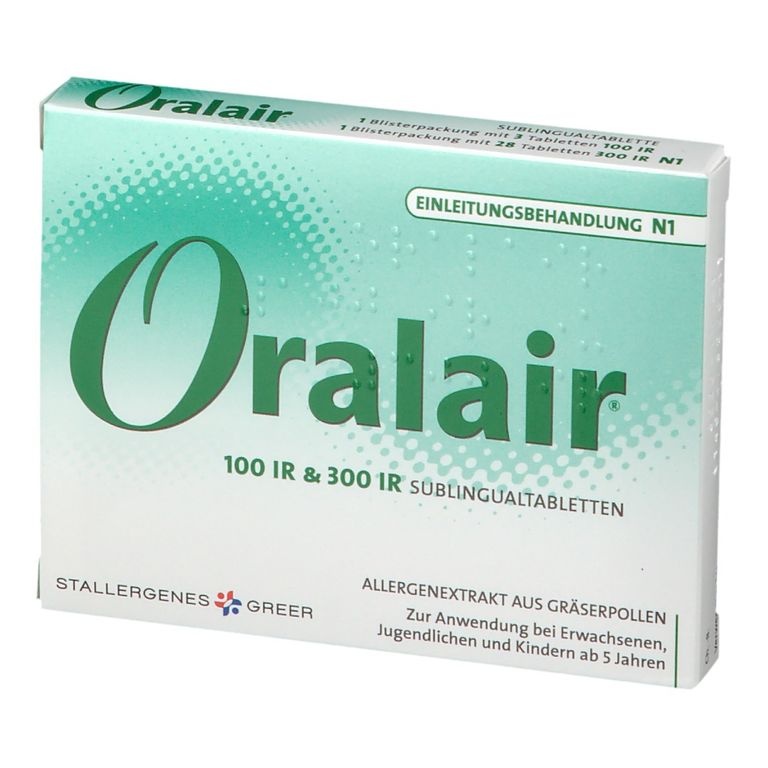
A small blister pack with 3 sublingual tablets of 100 IR and a blister pack with 28 sublingual tablets of 300 IR.
The tablets are supplied in blisters (Alu/Alu) composed of a film (polyamide/aluminum/polyvinyl chloride). The blister cells are numbered.
Container size: 31 sublingual tablets.
Marketing Authorization Holder and Manufacturer
STALLERGENES
6 rue Alexis de Tocqueville
92160 ANTONY
France
Tel.: 00 33 1 55 59 20 00
Fax: 00 33 1 55 59 21 68
You can request more information about this medication by contacting the local representative of the marketing authorization holder:
Stallergenes Ibérica S.A.
Llacuna, 22 – 2º 1ª
08005 BARCELONA
This medication is authorized in the member states of the European Economic Area under the following names:
Austria Oralair 100 IR + 300 IR Sublingualtabletten
Belgium, Estonia, Germany, Ireland, Italy, Latvia, Luxembourg, Netherlands, Poland, Portugal, Romania, Slovakia
Oralair 100 IR & 300 IR
Bulgaria, Czech Republic ORALAIR 100 IR & 300 IR
Croatia Oralair 100 IR i 300 IR sublingvalne tablete
Denmark, Finland, Norway, Sweden Aitgrys
France Oralair 100 IR & 300 IR, comprimé sublingual
Hungary Oralair 100 IR és 300 IR nyelvalatti tabletta
Lithuania ORALAIR 100 IR & 300 IR poliežuvines tabletes
Slovenia Oralair 100 IR in 300 IR podjezicne tablete
Spain ORALAIR INICIO 100 IR/300 IR comprimidos sublinguales
Date of the last revision of this prospectus: October 2023
Detailed and updated information about this medication is available on the website of the Spanish Agency for Medicines and Health Products (AEMPS) http://www.aemps.gob.es/
- Country of registration
- Dosage formSUBLINGUAL TABLET, 100 IR/300 IR
- ATC codeV01AA02
- Average pharmacy price106.84 EUR
- Active substance
- Prescription requiredYes
- Manufacturer
- CompositionCROSCARMELOSA SODICA (2,5 mg mg), LACTOSA MONOHIDRATO (C.S PARA 100 mg mg)
- This information is for reference only and does not constitute medical advice. Always consult a doctor before taking any medication. Oladoctor is not responsible for medical decisions based on this content.
- Alternatives to ORALAIR INICIO 100 IR/300 IR SUBLINGUAL TABLETSDosage form: ORALLY DISINTEGRATING TABLET/LIOTAB, 75,000 SQ-T plant pollenActive substance: grass pollenManufacturer: Alk-Abello A/SPrescription requiredDosage form: SUBLINGUAL TABLET, 300 IRActive substance: grass pollenManufacturer: StallergenesPrescription requiredDosage form: ORALLY DISINTEGRATING TABLET/LIOTAB, 12 SQ-HDMActive substance: house dust mitesManufacturer: Alk-Abello A/SPrescription required
Online doctors for ORALAIR INICIO 100 IR/300 IR SUBLINGUAL TABLETS
Discuss questions about ORALAIR INICIO 100 IR/300 IR SUBLINGUAL TABLETS, including use, safety considerations and prescription review, subject to medical assessment and local regulations.









Get ORALAIR INICIO 100 IR/300 IR SUBLINGUAL TABLETS Prescription Online
Fill in a 2-min form
Tell us your symptoms, history, and what medicine you're requesting.
Pick a doctor or let us assign
Choose a specialist or we'll match you with the next available doctor.
Doctor reviews your case
Usually within 30 minutes. They may ask follow-up questions via chat.
Collect from any pharmacy
Electronic prescription sent to your email — valid across Spain.
Frequently Asked Questions
ORALAIR INICIO 100 IR/300 IR SUBLINGUAL TABLETS requires a prescription in Spain. You can check with a doctor online whether this medicine may be appropriate for your situation.
The active ingredient in ORALAIR INICIO 100 IR/300 IR SUBLINGUAL TABLETS is grass pollen. This information helps identify medicines with the same composition but different brand names.
The average pharmacy price for ORALAIR INICIO 100 IR/300 IR SUBLINGUAL TABLETS is around 106.84 EUR. Prices may vary depending on the manufacturer and dosage form.
ORALAIR INICIO 100 IR/300 IR SUBLINGUAL TABLETS is manufactured by Stallergenes. Pharmacy brands and packaging may differ depending on the distributor.
Doctors such as Family doctors, Psychiatrists, Dermatologists, Cardiologists, Endocrinologists, Gastroenterologists, Pulmonologists, Nephrologists, Rheumatologists, Hematologists, Infectious disease physicians, Allergists, Geriatricians, Paediatricians, Oncologists may assess whether ORALAIR INICIO 100 IR/300 IR SUBLINGUAL TABLETS is appropriate, depending on your situation and local regulations. You can book an online consultation to discuss your symptoms and possible next steps.
Spain has a well-developed healthcare infrastructure across major cities such as Madrid, Barcelona, Valencia, and Seville. Pharmacies are widely available and operate under strict regulations, ensuring access to prescribed medications.
You can buy ORALAIR INICIO 100 IR/300 IR SUBLINGUAL TABLETS in Madrid, Barcelona, Seville, or Valencia at any local pharmacy with a valid prescription.
To obtain a prescription, you can use Oladoctor:
Other medicines with the same active substance (grass pollen) include GRAZAX 75000 SQ-T SUBLINGUAL LYOPHILIZED, ORALAIR 300 IR Sublingual Tablets, ACARIZAX 12 SQ-HDM SUBLINGUAL LYOPHILIZED. These may have different brand names or formulations but contain the same therapeutic ingredient. Always consult a doctor before switching or starting a new medicine.
