



OPTIRAY 320 mg /Ml Solución Inyectable

Revisión de receta online
Un médico revisará tu caso y determinará si la prescripción es médicamente apropiada.

Habla con un médico sobre este medicamento
Comenta tus síntomas y las opciones de tratamiento en una consulta online.



Cómo usar OPTIRAY 320 mg/ml SOLUCION INYECTABLE
Contenido del prospecto
- Introducción
- Qué es Optiray 320 y para qué se utiliza
- Qué necesita saber antes de empezar a usar Optiray 320
- Cómo usar Optiray 320
- Posibles efectos adversos
- Conservación de Optiray 320
- Contenido del envase e información adicional
Introducción
PROSPECTO: INFORMACIÓN PARA EL USUARIO
Optiray 320 mg/ml solución inyectable
Ioversol
Lea todo el prospecto detenidamente antes de empezar a usar el medicamento, porque contiene información importante para usted.
- Conserve este prospecto ya que puede tener que volver a leerlo.
- Si tiene alguna duda, consulte a su médico o farmacéutico.
- Si experimenta efectos adversos, consulte a su médico, incluso si se trata de efectos adversos que no aparecen en este prospecto
Contenido del prospecto
- Qué es Optiray 320 y para qué se utiliza
- Qué necesita saber antes de empezar a usar Optiray 320
- Cómo usar Optiray 320
- Posibles efectos adversos
- Conservación de Optiray 320
- Contenido del envase e información adicional
1. Qué es Optiray 320 y para qué se utiliza
Optiray 320 se utiliza en adultos para diferentes tipos de procedimientos con rayos X, que incluyen:
- imagen de vasos, arterias y venas
- riñones
- TAC
Optiray 320 es un medio de contraste que contiene iodo. El iodo no deja pasar los rayos X permitiendo que los vasos y otros órganos puedan observarse

¿No estás seguro de si este medicamento es adecuado para ti?
Comenta tus síntomas y tratamiento con un médico online.
2. Qué necesita saber antes de empezar a usar Optiray 320
No tome Optiray 320
- si es alérgico a los medios de contraste que contienen yodo o a cualquiera de los demás componentes de este medicamento (incluidos en la sección 6).
- si padece hipertiroidismo clínico.
Advertencias y precauciones
Consulte a su médico antes de usar Optiray 320 si tiene
- asma o ha tenido previamente reacciones alérgicas como náusea, vómitos, presión sanguínea baja, síntomas en la piel
- fallo del corazón, alta presión sanguínea, problemas circulatorios, o tuvo un ictus, y si usted es muy mayor
- diabetes
- enfermedad en riñones o hígado
- problemas en el cerebro
- problemas en la médula ósea, como algunos tipos de cáncer en la sangre conocidos como mieloma múltiple, macroglobulinemia de Waldenström
- algunas anormalidades de las células sanguíneas rojas, conocida como anemia de células falciformes
- tumor de la glándula adrenal, que afecta a la presión de la sangre, conocido como feocromocitoma
- incremento del nivel del aminoácido homocisteina, debido a un metabolismo anormal
- un estudio reciente de la vesícula biliar con medio de contraste
- planificado un estudio de la glándula tiroides usando una sustancia que contenga iodo. Esto se puede posponer ya que Optiray 320 puede influir en los resultados hasta los 16 días.
Con el uso de Optiray se han notificado reacciones cutáneas graves, lo que incluye reacción al fármaco con eosinofilia y síntomas sistémicos (DRESS), síndrome de Stevens-Johnson (SSJ), necrólisis epidérmica tóxica (síndrome de Lyell o NET) y pustulosis exantemática aguda (PEAG), que pueden poner en peligro la vida.
Durante el procedimiento de obtención de imágenes o poco después de este, puede experimentar una alteración cerebral de corta duración denominada encefalopatía. Informe a su médico inmediatamente si experimenta cualquiera de los síntomas relacionados con esta afección descritos en la sección 4.
Niños menores de 18 años
Optiray 320 no está recomendado en este grupo de edad
En caso de exposición (exposición directa o recién nacidos cuyas madres han recibido un medio de contraste yodado durante el embarazo), se deberá evaluar la función tiroidea al nacer y en todos los pacientes pediátricos menores de 3 años dentro del mes siguiente a la exposición.
Uso de Optiray 320 con otros medicamentos
Informe a su médico o radiólogo si está utilizando o ha utilizado recientemente o pudiera utilizar otros medicamentos.
Los siguientes medicamentospueden interaccionar, influir o ser influenciados por Optiray 320:
- metformina: medicina para tratar la diabetes
Su médico medirá la función de sus riñones antes y después del uso de Optiray 320. Dependiendo del nivel de la función de sus riñones, su médico puede considerar interrumpir el uso de metformina entre 48 horas antes y durante la prueba. No debe reanudarse hasta al menos 48 horas más tarde y solo si la función de sus riñones ha vuelto a la normalidad
- interleuquina: medicina para tratar algunos tumores
- algunas medicinas para incrementar la presión sanguíneadebido al estrechamiento de los vasos y para prevenir cualquier riesgo de trastornos nerviosos. Optiray nunca se debe utilizar mientras se utilizan estos medicamentos
- anestésicos generales
Se han notificado efectos adversos con alta frecuencia
- diuréticos:medicamentos que aumentan la producción de orina y disminuyen la presión arterial.
En caso de deshidratación causada por el uso de diuréticos, el uso de medios de contraste yodados puede aumentar el riesgo de insuficiencia renal aguda.
Uso de Optiray 320 con los alimentos y bebidas:
Limite la toma de alimentos antes de la prueba. Por favor, consulte a su doctor ante cualquier duda. Si usted tiene enfermedad renal no limite la toma de líquido ya que puede reducir la función renal.
Embarazo y lactancia
- Embarazo
Consulte a su médico si está embarazada o piensa que pudiera estarlo. Su médico le administrará Optiray durante el embarazo solo si fuera absolutamente necesario, ya que puede dañar al feto.
- Lactancia
Interrumpa la lactancia durante un día después de la inyección, ya que no existe información suficiente relativa a la seguridad. Consúltelo con su médico o especialista en rayos X.
Conducción y uso de máquinas:
No es recomendable la conducción o el uso de máquinas hasta una hora despuésde la inyección. Además, se han notificado síntomas tales como mareo, somnolencia, fatiga y trastornos visuales. Si esto le afecta, no realice ninguna actividad que requiera concentración y una adecuada capacidad de reacción.
Advertencias relacionadas con los excipientes
Este medicamento contiene menos de 1 mmol de sodio (23 mg) por dosis; esto es, esencialmente “exento de sodio”.
3. Cómo usar Optiray 320
El uso de Optiray 320 solodebe realizarse bajo la dirección de un médico especialista enrayos X, quien decidirá la dosis.
Optiray se inyecta en un vaso sanguíneoy se distribuye por el cuerpo a través del torrente sanguíneo. Debe calentarse a la temperatura corporal antes de su uso y después inyectarlo en una o más veces durante el procedimiento de rayos X.
La dosis depende del procedimiento específico y otros factores tales como la salud y la edad.
Se utilizará la menor dosis posible para obtener unas imágenes de rayos X adecuadas.
Si Ud. usa más Optiray 320 del que debiera:
La sobredosis puede ser potencialmente peligrosa y afectar a la respiración, el corazón y el sistema circulatorio. Informe a su médico o especialista en rayos X inmediatamente si usted nota cualquiera de estos síntomas después de recibir Optiray.
Si tiene más preguntas sobre el uso de este medicamento, consulte a su médico o especialista en rayos X.
En caso de sobredosis o ingestión accidental, consulte al Servicio de Información Toxicológica. Teléfono 91 5620420.

¿Has empezado a tomar el medicamento y tienes preguntas?
Comenta tus síntomas y tratamiento con un médico online.
4. Posibles efectos adversos
Al igual que todos los medicamentos, Optiray 240 puede tener efectos adversos, aunque no todas las personas los sufran. Las reacciones adversas asociadas a Optiray son generalmente independientes de la dosis administrada. En la mayoría de los casos son moderadas aunque en raras ocasiones pueden ser graves o amenazantes para la vida.
Informe a su médico inmediatamentesi desarrolla cualquiera de los siguientes signos de efectos adversos graves:
- parada cardiaca o respiratoria
- espasmos en los vasos del corazón o coágulos sanguíneos
- ictus, labios azules, desfallecimiento
- pérdida de memoria
- trastornos del habla
- movimientos repentinos
- ceguera transitoria
- fallo renal agudo
- erupción cutánea, enrojecimiento o ampollas, que pueden convertirse en reacciones cutáneas que podrían poner en peligro la vida, incluida la descamación extensa de la piel (necrólisis epidérmica tóxica) o una reacción al fármaco que provoque erupción, fiebre, inflamación de órganos internos, anomalías hematológicas y enfermedad sistémica (DRESS)
- signos de reacciones alérgicas como:
- shock alérgico
- estrechamiento de vías aéreas
- inflamación de las cuerdas vocales, garganta o lengua
- dificultades respiratorias
- tos, estornudos
- enrojecimiento y/o inflamación de la cara y los ojos
- picor, erupción y habones
Los efectos adversos pueden ocurrir con las siguientes frecuencias:
Muy frecuentes, (aparecen en más de 1 de cada 10 pacientes)
- sensación de calor
Frecuentes, (aparecen hasta 1 de cada 10 pacientes)
- dolor
- náuseas
Poco frecuentes, (aparecen hasta 1 de cada 100 pacientes)
- habones
- enrojecimiento de la piel, picor
- mareos
- cefalea
- alteración del gusto
- sensación anómala, como pinchazos, hormigueos
- vómitos
- estornudos
- presión arterial alta
Raras, (aparecen hasta 1 de cada 1.000 personas)
- desvanecimientos
- vértigo
- visión borrosa
- pulso acelerado
- presión arterial baja
- rubefacción
- espasmos en la laringe
- inflamación y estrechamiento de las vías aéreas, incluyendo estrechamiento de la garganta, sibilancias
- dificultad al respirar
- inflamación del interior de la nariz que causa estornudos y congestión nasal
- tos, irritación de garganta
- boca seca
- erupción
- necesidad urgente de orinar
- inflamación de la cara incluyendo los ojos
- escalofríos
- temblores incontrolables
- sensación de frío
Muy raras, (aparecen en menos de 1 de cada 10.000 pacientes)
- reacciones alérgicas severas
- confusión, ansiedad, inquietud
- pérdida de conciencia, entumecimiento
- parálisis
- somnolencia
- estupor
- trastornos en el habla
- trastornos en el lenguaje
- sensación de tacto reducida o de la sensibilidad
- inflamación alérgica del ojo causando ojos rojos, húmedos y con picor
- sonidos o pitidos en el oído
- latidos irregulares, pulso lento
- dolor en el pecho
- cambios en la actividad del corazón medida usando un ECG
- enfermedad que altera el flujo sanguíneo a través del cerebro
- inflamación venosa, dilatación de los vasos sanguíneos
- acumulación de líquido en los pulmones
- llagas en la garganta
- niveles bajos de oxígeno en sangre
- dolor abdominal
- inflamación de las glándulas salivares y la lengua
- dificultad al tragar, incremento de la salivación
- inflamación severa de las capas profundas de la piel, en la mayoría de casos dolorosa, principalmente en la cara
- incremento del sudor
- espasmos musculares
- fallo renal agudo o función renal anómala
- incontinencia urinaria, sangre en orina, escasa micción
- inflamación del tejido causada por exceso de fluido
- reacciones en el lugar de inyección incluyendo dolor, enrojecimiento, sangrado o degeneración de las células
- sensación de malestar o anormal, cansancio, lentitud
Frecuencia no conocida(no se puede estimar a partir de los datos disponibles)
- reacción alérgica grave
- baja actividad temporal del tiroides
- ataques
- alteraciones cerebrales a corto plazo (encefalopatía), que pueden causar confusión, alucinaciones, alteraciones visuales, ceguera, convulsiones, pérdida de coordinación, pérdida de movimiento en un lado del cuerpo, problemas con el habla y pérdida de conciencia
- desórdenes del movimiento
- pérdida de memoria
- ceguera transitoria
- parada cardiaca, latidos irregulares que comprometen la vida
- latidos extra
- contracciones de la arteria cardiaca, golpeando el corazón
- coloración azul de la piel debida al bajo nivel de oxígeno en sangre
- shock
- coágulos de sangre o espasmos de los vasos sanguíneos
- palidez
- parada respiratoria, asma, estrechamiento de vías aéreas
- reducción de la capacidad para producir sonidos con los órganos vocales
- diarrea
- reacción grave que afecta a la piel, la sangre y los órganos internos (reacción al fármaco con eosinofilia y síntomas sistémicos, también conocida como DRESS, por sus siglas en inglés, o síndrome de hipersensibilidad a fármacos)
- erupción roja, escamosa y generalizada con protuberancias bajo la piel y ampollas, acompañada de fiebre al inicio del tratamiento (pustulosis exantemática generalizada aguda)
- granos rojos (erupciones maculares o papulares)
- reacción que puede poner en peligro la vida, con síntomas gripales y erupción dolorosa/ampollas que afectan a la piel, la boca, los ojos y los genitales (síndrome de Steven-Johnson/necrólisis epidérmica tóxica)
- micción dolorosa, con dificultad o ausencia de micción
- baja actividad temporal del tiroides en recién nacidos
- fiebre
Comunicación de efectos adversos:
Si experimenta cualquier tipo de efecto adverso, consulte a su médico o farmacéutico, incluso si se trata de posibles efectos adversos que no aparecen en este prospecto. También puede comunicarlos directamente a través del Sistema Español de Farmacovigilancia de medicamentos de Uso Humano: https://www.notificaram.es. Mediante la comunicación de efectos adversos usted puede contribuir a proporcionar más información sobre la seguridad de este medicamento.
5. Conservación de Optiray 320
Mantener fuera del alcance y de la vista de los niños.
No utilizar este medicamento después de la fecha de caducidad que está en la etiqueta. La fecha de caducidad se refiere al último día del mes que indica.
Mantener el contenedor dentro de la caja de cartón exterior para protegerlo de la luz. Proteger de los rayos X. No conservar a temperatura superior a 30 ºC. No congelar. Este producto también puede almacenarse a 37 ºC durante un mes, en un calentador de medios de contraste utilizando una corriente circulatoria de aire caliente.
No utilizar Optiray 320 en caso de presentar alteraciones significativas del color.
La eliminación del medicamento no utilizado y de todos los materiales que hayan estado en contacto con él, se realizará de acuerdo con la normativa local.
6. Contenido del envase e información adicional
Composición de Optiray 240
- el principio activo es Ioversol
- los demás componentes son: trometamol, hidrocloruro de trometamol, edetato de calcio y sodio, ácido clorhídrico e hidróxido de sodio (para ajuste de pH) y agua para preparaciones inyectables
Aspecto del producto y contenido del envase
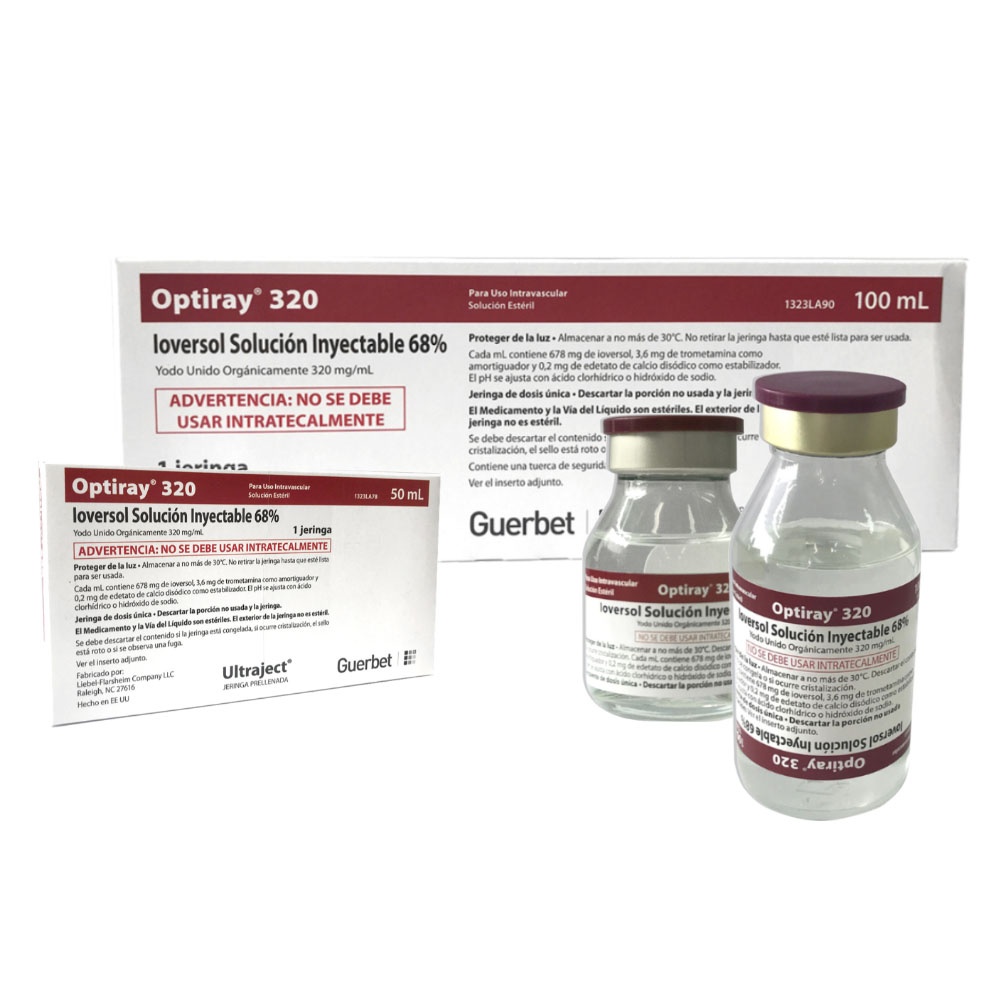
Este producto se suministra en frascos de vidrio incoloro neutro tipo I (Ph. Eur.) sellados con tapón de goma de bromobutilo libres de látex (Ph. Eur.) y con cápsula de aluminio anodizado en monodosis de 50 ó 100 ml.
También se dispone de jeringas precargadas de 50 ml para uso manual, y de jeringas precargadas para uso con autoinyector/bomba de 75, 100 y 125 ml.
Tamaños de envase:
1 y 10 frascos de 50 ml
1, 10 y 12 frascos de 100 ml
Puede que solamente estén comercializados algunos tamaños de envases.
Titular de la autorización de comercialización y responsable de la fabricación
Titular de la autorización de comercialización:
Guerbet
BP 57400
95943 Roissy CdG Cedex, Francia
Responsable de la fabricación:
Guerbet BP 57400
95943 Roissy CdG Cedex France,
situado en Jean Chaptal 16-24, 93600 Aulnay sous Bois, Francia
Para cualquier información sobre esta medicamento, por favor póngase en contacto con el Representante Local del Titular de Autorización:
Laboratorios Farmacéuticos Guerbet, S.A.
Pº de la Castellana, 91, 3ª planta
28046 Madrid
+ (34) 91 504 50 00
Fecha de la última revisión de este prospecto: Noviembre 2023
La información detallada y actualizada de este medicamento está disponible en la página Web de la Agencia Española de Medicamentos y Productos Sanitarios (AEMPS)http://www.aemps.gob.es/
- País de registro
- Forma farmacéuticaINYECTABLE, 320 mg/ml
- Código ATCV08AB07
- Principio activo
- Requiere recetaSí
- Fabricante
- ComposiciónEDETATO DE CALCIO Y SODIO (0,2 mg mg), HIDROXIDO DE SODIO (E 524) (0-1 mg mg)
- Esta información es de carácter general y no sustituye la consulta con un profesional sanitario.
- Alternativas a OPTIRAY 320 mg/ml SOLUCION INYECTABLE
Médicos online para OPTIRAY 320 mg/ml SOLUCION INYECTABLE
Comenta la dosis, los posibles efectos secundarios, interacciones, contraindicaciones o la revisión de receta de OPTIRAY 320 mg/ml SOLUCION INYECTABLE, sujeto a valoración médica y a la normativa local.









Obtén una receta de OPTIRAY 320 mg/ml SOLUCION INYECTABLE online
Rellena un formulario de 2 minutos
Cuéntanos tus síntomas, historial y el medicamento que necesitas.
Elige un médico o nosotros te asignamos uno
Escoge un especialista o te conectamos con el próximo médico disponible.
El médico revisa tu caso
Normalmente en 30 minutos. Puede hacerte preguntas adicionales por chat.
Recógela en cualquier farmacia
Receta electrónica enviada a tu correo, válida en toda España.
Preguntas frecuentes
OPTIRAY 320 mg/ml SOLUCION INYECTABLE requiere receta en España. Puedes confirmarlo con un médico online según tu caso.
El principio activo de OPTIRAY 320 mg/ml SOLUCION INYECTABLE es Ioversol. Esta información ayuda a identificar medicamentos con la misma composición pero con diferentes nombres comerciales.
OPTIRAY 320 mg/ml SOLUCION INYECTABLE es fabricado por Guerbet. La marca y el envase pueden variar según el distribuidor.
Los Médicos de familia, Psiquiatras, Dermatólogos, Cardiólogos, Endocrinólogos, Gastroenterólogos, Neumólogos, Nefrólogos, Reumatólogos, Hematólogos, Infectólogos, Alergólogos, Geriatras, Pediatras, Oncólogos pueden valorar la prescripción de OPTIRAY 320 mg/ml SOLUCION INYECTABLE cuando esté clínicamente indicado. Puedes reservar una videoconsulta para comentar tu caso y las opciones de tratamiento.
España cuenta con una infraestructura sanitaria bien desarrollada en ciudades principales como Madrid, Barcelona, Valencia y Sevilla. Las farmacias están ampliamente disponibles y operan bajo estrictas regulaciones, garantizando el acceso a medicamentos con receta.
Puedes comprar OPTIRAY 320 mg/ml SOLUCION INYECTABLE en Madrid, Barcelona, Sevilla o Valencia en cualquier farmacia local con una receta válida.
Para obtener una receta, puedes utilizar Oladoctor:
Otros medicamentos con el mismo principio activo (Ioversol) incluyen OPTIRAY 300 mg/ml SOLUCION INYECTABLE, OPTIRAY 350 mg/ml SOLUCION INYECTABLE, OPTIRAY ULTRAJECT 300 mg/ml SOLUCION INYECTABLE. Pueden tener diferentes nombres comerciales o formulaciones, pero contienen el mismo componente terapéutico. Consulta siempre con un médico antes de cambiar o iniciar un nuevo medicamento.
