


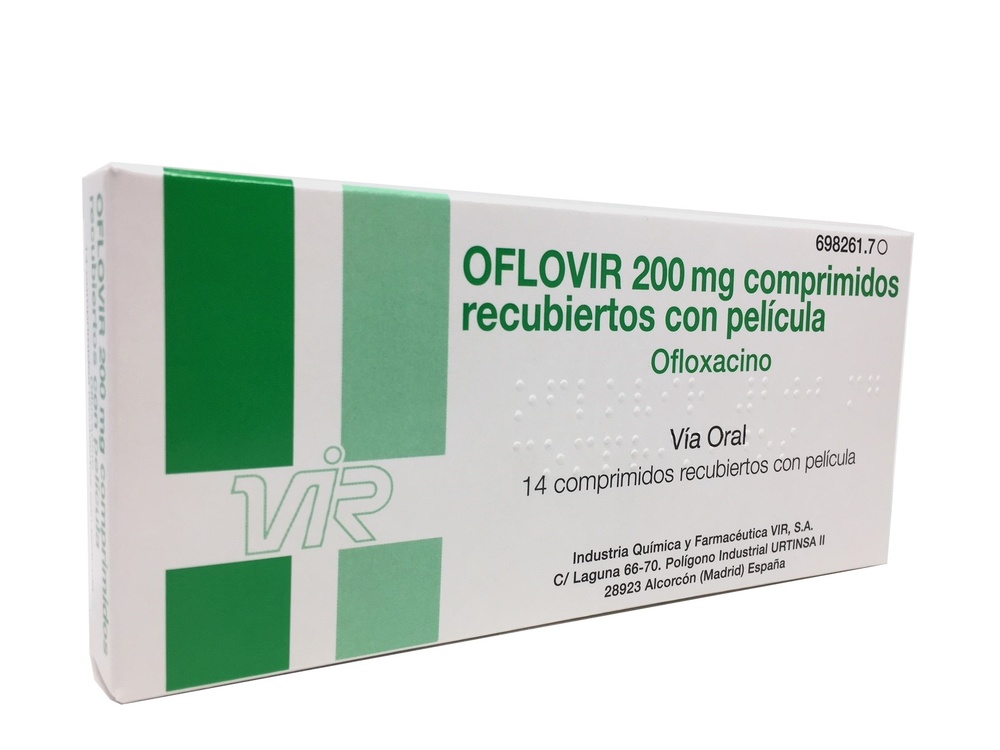
Oflovir 200 mg comprimidos recubiertos con película

Revisión de receta online
Un médico revisará tu caso y determinará si la prescripción es médicamente apropiada.

Habla con un médico sobre este medicamento
Comenta tus síntomas y las opciones de tratamiento en una consulta online.



Cómo usar OFLOVIR 200 mg COMPRIMIDOS RECUBIERTOS CON PELICULA
Contenido del prospecto
- Introducción
- Qué es OFLOVIR y para qué se utiliza
- Qué necesita saber antes de empezar a tomar OFLOVIR
- Cómo tomar OFLOVIR
- Posibles efectos adversos
- Conservación de OFLOVIR
- Contenido del envase e información adicional
- Composición de Oflovir
Introducción
Prospecto: información para el paciente
OFLOVIR 200 mg comprimidos recubiertos con película
Ofloxacino
Lea todo el prospecto detenidamente antes de empezar a tomar este medicamento, porque contiene información importante para usted.
- Conserve este prospecto, ya que puede tener que volver a leerlo.
- Si tiene alguna duda, consulte a su médico o farmacéutico.
- Este medicamento se le ha recetado solamente a usted,y no debe dárselo a otras personas aunque tengan los mismos síntomas que usted, ya que puede perjudicarles.
- Si experimenta efectos adversos, consulte a su médico o farmacéutico, incluso si se trata de efectos adversos que no aparecen en este prospecto. Ver sección 4.
Contenido del prospecto
- Qué es OFLOVIR y para qué se utiliza
- Qué necesita saber antes de empezar a tomar OFLOVIR
- Cómo tomar OFLOVIR
- Posibles efectos adversos
- Conservación de OFLOVIR
- Contenido del envase e información adicional
1. Qué es OFLOVIR y para qué se utiliza
Ofloxacino es un antibiótico que pertenece al grupo de las quinolonas.
Actúa mediante la eliminación de las bacterias que causan las infecciones.
Los antibióticos se utilizan para tratar infecciones bacterianas y no sirven para tratar infecciones víricas como la gripe o el catarro.
Es importante que siga las instrucciones relativas a la dosis, el intervalo de administración y la duración del tratamiento indicadas por su médico.
No guarde ni reutilice este medicamento. Si una vez finalizado el tratamiento le sobra antibiótico, devuélvalo a la farmacia para su correcta eliminación. No debe tirar los medicamentos por el desagüe ni a la basura.
OFLOVIR está indicado en el tratamiento de las siguientes infecciones bacterianas:
- Infecciones del tracto respiratorio, incluyendo neumonía y bronquitis
- Infecciones de piel y tejidos blandos
- Infecciones del tracto urinario
- Infecciones de la próstata
- Infecciones del cuello del útero y de la uretra
- Infección del epididimo (estructura que forma parte del testículo)
- Diarrea del viajero
- Infección del aparato reproductor femenino (Enfermedad pélvica inflamatoria)

¿No estás seguro de si este medicamento es adecuado para ti?
Comenta tus síntomas y tratamiento con un médico online.
2. Qué necesita saber antes de empezar a tomar OFLOVIR
No tome OFLOVIR:
- Si es alérgico a ofloxacino, a otras quinolonas (grupo de antibióticos al que pertenece
ofloxacino) o a cualquiera de los demás componentes de este medicamento (incluidos en la sección 6).
- Si usted presenta episodios de epilepsia o tiene tendencia a presentar ataques epilépticos como consecuencia de algún daño cerebral
- Si usted ha sufrido algún daño o enfermedad en los tendones después de la administración de quinolonas.
- Si el paciente es un niño o joven en edad de crecimiento.
-Si usted está embarazada o en periodo de lactancia (ver apartados “Embarazo y Lactancia”).
Advertencias y precauciones
Antes de empezar a tomar este medicamento
No debe tomar medicamentos antibacterianos que contengan fluoroquinolonas o quinolonas, incluido Oflovir, si ha experimentado alguna reacción adversa grave con anterioridad al tomar una quinolona o fluoroquinolona. Si este es su caso, debe informar a su médico lo antes posible.
Consulte a su médico o farmacéutico antes de empezar a tomar Oflovir:
Si tiene una reacción alérgica (los signos pueden incluir: erupción en la piel, dificultad para tragar o respirar, hinchazón de labios, cara, garganta o lengua) deberá consultar a su médico inmediatamente.
Si usted presenta diarreas intensas, duraderas y/o sanguinolentas manifiestas durante o tras el tratamiento con OFLOVIR, ya que puede deberse a un tipo especial de colitis llamada colitis
pseudomembranosa (una infección de los intestinos que puede producir dolor de estómago, fiebre y diarrea), que puede ser grave. En este caso, deberá consultar a su médico inmediatamente.
Si usted tiene predisposición a padecer ataques epilépticos, causados por una lesión cerebral o porque se encuentra en tratamiento con fármacos antiinflamatorios (como fenbufeno) o teofilina. En estos casos, OFLOVIR sólo se deberá administrar con la máxima precaución.
Si presenta antecedentes de trastornos psicóticos, ya que éstos pueden progresar a pensamientos de autolesionarse o de matarse, incluyendo intentos de suicidio.
Si presenta antecedentes de ritmo cardíaco anormal. Este medicamento debe tomarse con precaución si usted nació o tiene historia familiar de prolongación del intervalo QT (se ve en el ECG, grabación eléctrica de su corazón), tiene desequilibrio electrolítico en sangre (especialmente bajos niveles de potasio o magnesio en sangre), tiene el ritmo cardíaco muy lento (llamado bradicardia), tiene el corazón débil (fallo cardíaco), tiene historial de ataque cardíaco (infarto de miocardio), es mujer o anciano o está tomando otros medicamentos que pueden resultar en cambio anormales en el ECG (ver sección Toma de otros medicamentos).
Si usted tiene historia familiar o propia de deficiencia en la actividad del enzima glucosa-6-fosfato deshidrogenasa (trastorno metabólico congénito o adquirido).
Si padece daño en la función hepática únicamente utilice Oflovir bajo la supervisión de un médico.
Si usted padece insuficiencia renal, ya que su médico tendrá que ajustarle la dosis.
Si está tomando medicamentos para aclarar su sangre (los llamados antagonistas de la vitamina K, por ejemplo, warfarina), su médico debe controlar sus análisis de coagulación (tiempo de protrombina/INR), ya que éstos pueden verse incrementados.
Si es un paciente diabético que toma medicamentos para reducir la glucosa en sangre o insulina. Su médico debe controlarle los niveles de glucosa en sangre.
Durante el tratamiento con este medicamento le recomendamos evitar la exposición a la radiación UV y no exponerse excesivamente a la luz solar, si lo hiciera deberá proteger su piel adecuadamente.
Si usted padece miastenia gravis puede producirse un empeoramiento de su enfermedad, por lo que OFLOVIR debe ser utilizado con precaución.
Si experimenta alguna alteración en su visión o tiene cualquier problema en sus ojos consulte inmediatamente a un oftalmólogo.
Si usted está en tratamiento con OFLOVIR durante un tiempo prolongado, su médico le realizará controles periódicos de la función del riñón, hígado y sangre.
Si le han diagnosticado un aumento de tamaño o un «bulto» de un vaso sanguíneo de gran tamaño (aneurisma aórtico o aneurisma de un vaso de gran tamaño periférico).
Si ha sufrido un episodio previo de disección aórtica (desgarro de la pared de la aorta).
Si se le ha diagnosticado una insuficiencia de la válvula cardíaca (regurgitación de las válvulas cardíacas).
Si tiene antecedentes familiares de aneurisma aórtico o disección aórtica, enfermedad congénita de las válvulas cardíacas u otros factores de riesgo o trastornos predisponentes (p. ej., trastornos del tejido conjuntivo como el síndrome de Marfan o el síndrome vascular de Ehlers-Danlos, o el síndrome de Turner o el síndrome de Sjögren (una enfermedad autoinmune inflamatoria), trastornos vasculares como arteritis de Takayasu, arteritis de células gigantes, enfermedad de Behçet, hipertensión arterial o aterosclerosis conocida, artritis reumatoide (una enfermedad de las articulaciones) o endocarditis (una infección del corazón)).
Si siente un dolor fuerte y repentino en el tórax, abdomen o la espalda, acuda inmediatamente a un servicio de urgencias.
Durante el tratamiento con este medicamento
- En raras ocasiones pueden aparecer dolor e hinchazón en las articulaciones einflamación y la rotura de los tendones.El riesgo es mayor si usted es una persona de edad avanzada (mayor de 60 años), ha recibido un trasplante de órgano, tiene problemas de rión o está en tratamiento con corticosteroides. La inflamación y la rotura se puede producir en las primeras 48 horas de tratamiento e incluso hasta varios meses después de interrumpir el tratamiento con Oflovir. Al primer signo de dolor o inflamación de un tendón (por ejemplo, en el tobillo, la muñeca, el codo, el hombro o la rodilla), deje de tomar oflovir, póngase en contacto con su médico y mantenga enreposo la zona dolorosa.. Evite cualquier ejercicio innecesario, ya que este podría aumentar el riesgo de rotura de un tendón.
- En raras ocasiones, puede experimentar síntomas de lesión en los nervios (neuropatía)como dolor, quemazón, hormigueo, entumecimiento y/o debilidad, en especial en pies y piernas o en manos y brazos. Si esto sucede, deje de tomar oflovir e informe a su médico de forma inmediata para prevenir el desarrollo de un trastorno potencialmente irreversible.
- Si siente un dolor repentino e intenso en el abdomen, el pecho o la espalda, que pueden ser síntomas de disección o aneurisma aórticos, acuda inmediatamente al servicio de urgencias. Puede aumentar el riesgo si está recibiendo un tratamiento con corticoesteroides sistémicos.
- Si empieza a experimentar una aparición repentina de disnea, especialmente cuando se tumba en la cama, o si observa hinchazón en los tobillos, los pies o el abdomen o la aparición de palpitaciones cardíacas (sensación de latido cardíaco rápido o irregular), debe informar a su médico inmediatamente.
Efectos adversos graves incapacitantes, de duración prolongada, y potencialmente irreversibles
Los medicamentos antibacterianos que contienen fluoroquinolonas o quinolonas, incluido Oflovir, se han asociado a efectos adversos muy raros pero graves, algunos de ellos fueron de larga duración (persistentes durante meses o años), incapacitantes o potencialmente irreversibles. Esto incluye dolor en los tendones, los músculos y las articulaciones de las extremidades superiores e inferiores, dificultad para caminar, sensaciones anómalas tales como pinchazos, hormigueo, cosquilleo, entumecimiento o quemazón (parestesia), trastornos sensitivos tales como disminución de la visión, del gusto, del olfato y de la audición, depresión, disminución de la memoria, fatiga intensa y trastornos graves del sueño.
Niños y adolescentes
Los niños y adolescentes en edad de crecimiento no deben tomar este medicamento.
Toma de OFLOVIR con otros medicamentos:
Comunique a su médico o farmacéutico si está tomando, ha tomado recientemente o podría tener que tomar cualquier otro medicamento.
En particular informe a su médico si está tomando alguno de los siguientes medicamentos:
Medicamentos que pueden alterar su ritmo cardíaco: medicamentos que pertenecen al grupo de los anti-arrítmicos (ej. quinidina, hidroquinidina, disopiramida, amiodarona, sotalol, dofetilida, ibutilida), antidepresivos tricíclicos, algunos antibióticos (que pertenecen al grupo de los macrólidos), algunos antipsicóticos.
La toma de estos medicamentos simultáneamente con ofloxacino puede producir una disminución en el efecto de ofloxacino, por este motivo se recomienda no tomarlos durante las dos horas antes y después de la toma de ofloxacino:
- Antiácidos que contengan magnesio o aluminio, sucralfato (utilizado para las úlceras de estómago).
- Medicamentos que contengan hierro o zinc.
- Didanosina.
La toma de estos medicamentos junto con ofloxacino puede producir convulsiones.
- Antiinflamatorios no esteroideos utilizados para disminuir el dolor y la inflamación (fenbufeno) y teofilina, utilizada para tratar problemas respiratorios.
La toma de estos medicamentos con ofloxacino puede aumentar la posibilidad de padecer efectos adversos:
- Medicamentos que se eliminan por excreción tubular renal como probenecid (utilizado para el tratamiento de la gota), cimetidina (utilizado para las úlceras de estómago), furosemida (un diurético) y metotrexato (utilizado para tratar el reumatismo o el cáncer).
Cuando se toman junto con ofloxacino, el efecto de estos medicamentos puede verse aumentado:
- Medicamentos anticoagulantes (derivados cumarínicos), glibenclamida (medicamento para el
tratamiento de la diabetes).
Análisis de orina
La toma de Ofloxacino puede afectar los resultados de algunos análisis de orina. Si le van a realizar un análisis de orina, es importante que informe a su médico que está tomando Oflovir.
Antes de empezar a tomar este medicamento
No debe tomar medicamentos antibacterianos que contengan fluoroquinolonas o quinolonas, incluido oflovir, si ha experimentado alguna reacción adversa grave con anterioridad al tomar una quinolona o una fluoroquinolona. Si este es su caso, debe informar a su médico lo antes posible.
Embarazo, lactancia y fertilidad
Si está embarazada o en periodo de lactancia, cree que podría estar embarazada o tiene intención de quedarse embarazada, consulte a su médico o farmacéutico antes de utilizar este medicamento.
OFLOVIR no se debe tomarse durante el embarazo o en mujeres con riesgo de quedar embarazadas.
Dado que ofloxacino se excreta en la leche, la lactancia debe ser interrumpida durante el
tratamiento con OFLOVIR.
Conducción y uso de máquinas
El tratamiento con OFLOVIR puede alterar su capacidad para conducir o utilizar maquinaria, ya que puede producirse mareo, somnolencia y trastornos visuales. El riesgo aumenta si se ingieren simultáneamente bebidas alcohólicas. Por tanto, no conduzca ni utilice maquinaria peligrosa si se
encuentra en algunas de las situaciones descritas anteriormente.
OFLOVIR contiene lactosa.
Si su médico le ha indicado que padece una intolerancia a ciertos azúcares, consulte con él antes de tomar este medicamento.
3. Cómo tomar OFLOVIR
Siga exactamente las instrucciones de administración de este medicamento indicadas por su médico o farmacéutico. En caso de duda, consulte de nuevo a su médico o farmacéutico.
Recuerde tomar su medicamento.
Los comprimidos de OFLOVIR se toman sin masticar acompañados de suficiente cantidad de líquido (medio vaso ó 1 vaso). La toma se puede realizar en ayunas o bien con las comidas.
Es importante que los intervalos de tiempo entre las tomas sean casi idénticos.
Su médico le indicará la duración de su tratamiento con OFLOVIR según el tipo y la gravedad de su infección. No suspenda el tratamiento antes ya que la infección podría no estar totalmente curada y usted podría enfermar de nuevo.
La dosis depende de la localización y del tipo de infección.
En general se recomienda la siguiente posología:
- Infecciones respiratorias: 200-400 mg dos veces al día
- Infecciones de piel y tejidos blandos: 400 mg dos veces al día
- Infecciones del tracto urinario: 200 mg dos veces al día
- Infecciones de la próstata: 200 mg dos veces al día
- Infecciones del cuello del útero y de la uretra: 200 mg dos veces al día o 400 mg una vez al día
- Infección del epididimo: 200 mg dos veces al día
- Diarrea del viajero: 200 mg dos veces al día
- Infección del aparato reproductor femenino: 400 mg dos veces al día
No exponga su piel directamente al sol o a lámparas de rayos ultravioleta (UVA) mientras esté tomando este medicamento, ya que su piel se hará mucho más sensible al sol y puede quemarse, escocerle o incluso llenarse de ampollas. Si lo hiciera deberá proteger su piel adecuadamente.
Pacientes con problemas de riñón o hígado
Si tiene problemas de hígado o riñón es posible que su médico le paute una dosis menor.
Pacientes de edad avanzada
Se ajustará la dosis en estos pacientes teniendo en cuenta la edad y la función renal y hepática.
Uso en niñosy adolescentes
Oflovir no está indicado para niños o adolescentes.
Si toma más OFLOVIR del que debe
Si usted ha tomado más ofloxacino de lo que debe, consulte inmediatamente a su médico, farmacéutico o llame al Servicio de Información Toxicológica, teléfono: 91 5620420, indicando el medicamento y la cantidad tomada.
Entre los síntomas más importantes que pueden surgir a consecuencia de una administración demasiado elevada de ofloxacino (entre otros) son los síntomas localizados en el sistema nervioso central como, p. ej. desorientación, mareo, obnubilación y convulsiones, así como molestias gastrointestinales como, p. ej., náuseas y lesiones (erosiones (úlcera poco profunda)) de la mucosa gastrointestinal o lesión del estómago o del duodeno cuando es erosionado por los ácidos gástricos o los jugos duodenales.
Si olvidó tomar OFLOVIR
En caso de olvido de una dosis deberá ingerir el comprimido lo más pronto posible continuando el tratamiento de la forma prescrita. Sin embargo, cuando esté próximo a la siguiente toma, es mejor no tomar el comprimido olvidado y tomar el siguiente a la hora prevista.
No tome una dosis doble para compensar las dosis olvidadas.
Si interrumpe el tratamiento con OFLOVIR
Tome Oflovir hasta que su médico le indique que deje el tratamiento. No interrumpa la toma de Oflovir porque se siente mejor. Si lo interrumpe, su infección podría empeorar de nuevo.
Si tiene cualquier otra duda sobre el uso de este medicamento, pregunte a su médico o farmacéutico.

¿Has empezado a tomar el medicamento y tienes preguntas?
Comenta tus síntomas y tratamiento con un médico online.
4. Posibles efectos adversos
Al igual que todos los medicamentos, este medicamento puede producir efectos adversos, aunque no todas las personas los sufran.
Deje de tomar OFLOVIR y acuda al médico o al hospital en caso que:
- Sufra una reacción alérgica. Los signos pueden incluir: erupción cutánea, problemas de deglución o respiración, inflamación de labios, cara, garganta o lengua
- Padezca convulsiones
-Tenga una diarrea con sangre
Informe a su médico si cualquiera de los siguientes efectos adversos se agravara o durara más de unos días:
Poco frecuentes (pueden afectar hasta 1 de cada 100 personas)
- El uso prolongado de ofloxacino se ha asociado con el desarrollo de una superinfección con hongos o bacterias resistentes
- Náuseas, vómitos, diarrea, dolor abdominal
- Dolor de cabeza, mareos agitación, problemas para dormir
- Picores o erupción
- Irritación ocular, vértigo
- Tos, nasofaringitis
Raros (pueden afectar hasta 1 de cada 1.000 personas)
- Reacciones alérgicas desde escozor de ojos, picor de garganta y goteo de la nariz hasta hinchazón de la cara, lengua o garganta con dificultad para tragar y/o respirar
- Reacciones cutáneas (urticaria, sofocos, sudoración excesiva, erupción pustular)
- Pérdida de apetito (anorexia)
- Niveles enzimáticos en hígado elevados
- Daño de la función renal
- Latido cardíaco rápido o colapso debido a la baja presión arterial
- Confusión, somnolencia, sensación persistente de hormigueo o dolor en los pies y/o las manos (parestesias, hiperparestesias), trastornos visuales (visión borrosa, visión doble y visión alterada de los colores), trastornos o pérdida del sentido del gusto y del olfato, trastornos del equilibrio, trastornos del sueño (pesadillas) o reacciones psicóticas (como excitación, ansiedad, depresión o alucinaciones).
- Tendinitis
- Problemas respiratorios (disnea), broncoespasmo
- Inflamación del intestino
- Delirio (estado confusional agudo)
Muy raros (pueden afectar hasta 1 de cada 10.000 personas)
- Colitis pseudomembranosa (infección de los intestinos que puede producir dolor estomacal, fiebre y diarrea)
- Coloración amarillenta de la piel o del blanco de los ojos producida por problemas de hígado o de la sangre; hepatitits o daño hepático grave
-Convulsiones, zumbido en los oídos, pérdida de la audición
- Trastornos de la coordinación, trastornos de la sensibilidad
- Niveles alterados de las células sanguíneas (células rojas, células blancas y plaquetas)
- Ampollas, ulceración de la piel, inflamación de los vasos sanguíneos de la piel (vasculitis) y aumento de la sensibilidad de la piel a la luz
- Reacción alérgica grave que produce dificultad para respirar o mareos
- Dolor en las articulaciones, rotura de tendones
- Daño renal
Frecuencia no conocida (no puede estimarse a partir de los datos disponibles)
- Trastornos psicóticos y depresión con comportamiento de auto-lesionarse incluyendo pensamientos de suicidio o intentos de suicidio
- Cambios en los niveles de glucosa de los pacientes diabéticos
- Problemas de corazón: ritmo cardíaco irregular, alteración del ritmo cardíaco (denominado prolongación del intervalo QT, observado en ECG, actividad eléctrica del corazón)
- Reacciones alérgicas (ej. Síndrome de Stevens-Johnson)
- Ataques de porfiria en pacientes con porfiria (trastornos en los enzimas formadores de sangre)
- Hepatitis
- Trastornos musculares (dolor, debilidad, desgarros)
- Inflamación pulmonar
- Inflamación del riñón
- Inflamación del ojo (uveitis)
- Enrojecimiento de la piel con extensa descamación (dermatitis exfoliativa)
- Pérdida de apetito, coloración amarilla en ojos y piel, orina oscura, prurito o molestias en el estómago (abdomen). Estos pueden ser signos de problemas hepáticos que pueden incluir un fallo mortal del hígado.
La administración de antibióticos que contienen quinolonas y fluoroquinolonas se ha asociado a casos muy raros de reacciones adversas de larga duración (incluso meses o años) o permanentes, tales como inflamación de tendones, rotura de tendones, dolor en las articulaciones, dolor en las extremidades, dificultad para caminar, sensaciones anómalas tales como pinchazos, hormigueo, cosquilleo, quemazón, entumecimiento o dolor (neuropatía), fatiga, disminución de la memoria y concentración, efectos sobre la salud mental (que puede incluir trastornos del sueño, ansiedad, ataques de pánico, depresión e ideación suicida), disminución de la audición, la visión, el gusto y el olfato, en algunos casos con independencia de la presencia de factores de riesgo preexistentes.
Se han notificado casos de aumento de tamaño y debilitamiento o desgarro de la pared aórtica (aneurismas y disecciones), lo que podría producir una rotura y llegar a ser mortal, e insuficiencia de válvulas cardíacas en pacientes que han recibido fluoroquinolonas. Ver también la sección 2.
Comunicación de efectos adversos:
Si experimenta cualquier tipo de efecto adverso, consulte a su médico o, farmacéutico o enfermero, incluso si se trata de posibles efectos adversos que no aparecen en este prospecto. También puede comunicarlos directamente a través del Sistema Español de Farmacovigilancia de Medicamentos de Uso Humano: https://www.notificaram.es. Mediante la comunicación de efectos adversos usted puede contribuir a proporcionar más información sobre la seguridad de este medicamento.
5. Conservación de OFLOVIR
No se requieren condiciones especiales de conservación.
Mantener OFLOVIR fuera de la vista y del alcance de los niños.
No utilice este medicamento después de la fecha de caducidad que aparece en el envase después de CAD. La fecha de caducidad es el último día del mes que se indica.
Los medicamentos no se deben tirar por los desagües ni a la basura. Deposite los envases y los medicamentos que no necesita en el Punto SIGRE de su farmacia habitual. Pregunte a su farmacéutico cómo deshacerse de los envases y de los medicamentos que no necesita. De esta forma, ayudará a proteger el medio ambiente.
6. Contenido del envase e información adicional
Composición de Oflovir
El principio activo es ofloxacino. Cada comprimido contiene 200 mg de ofloxacino.
Los demás componentes (excipientes) son:
Excipientes del núcleo: lactosa, almidón de maíz, carboximetilalmidón sódico de patata, sílice coloidal anhidra, estearato de magnesio, gelatina.
Excipientes de recubrimiento: ftalato de dietilo, hipromelosa, opaspray K-1R-7000 (espíritu metilado industrial, dióxido de titanio (E-171), hidroxipropilcelulosa).
Aspecto del producto y contenido del envase
OFLOVIR se presenta en forma de comprimidos recubiertos, oblongos ranurados y de color blanco para administración oral. Se presentan en envases con 7, y 14 comprimidos.
Titular de la autorización de comercialización y responsable de la fabricación:
INDUSTRIA QUÍMICA Y FARMACÉUTICA VIR, S.A.
C/ Laguna 66-68-70. Polígono Industrial Urtinsa II.
28923 Alcorcón (Madrid)
España
Fecha de la última revisión de este prospecto:junio 2025
La información detallada de este medicamento está disponible en la página web de la Agencia Española de Medicamentos y Productos Sanitarios: http://www.aemps.gob.es/
- País de registro
- Forma farmacéuticaCOMPRIMIDO, 200 mg
- Código ATCJ01MA01
- Precio medio en farmacia5.87 EUR
- Principio activo
- Requiere recetaSí
- Fabricante
- ComposiciónLACTOSA ANHIDRA (85 mg mg), CARBOXIMETILALMIDON SODICO (32,5 mg mg)
- Esta información es de carácter general y no sustituye la consulta con un profesional sanitario.
- Alternativas a OFLOVIR 200 mg COMPRIMIDOS RECUBIERTOS CON PELICULAForma farmacéutica: INYECTABLE PERFUSION, 100 ml con 0,2 g solución de ofloxacinoPrincipio activo: OfloxacinoFabricante: Altan Pharmaceuticals SaRequiere recetaForma farmacéutica: INYECTABLE PERFUSION, 400 mg/250 mlPrincipio activo: moxifloxacinaFabricante: Bayer Hispania S.L.Requiere recetaForma farmacéutica: COMPRIMIDO, 500 MGPrincipio activo: levofloxacinoFabricante: Especialidades Farmaceuticas Centrum S.A.Requiere receta
Médicos online para OFLOVIR 200 mg COMPRIMIDOS RECUBIERTOS CON PELICULA
Comenta la dosis, los posibles efectos secundarios, interacciones, contraindicaciones o la revisión de receta de OFLOVIR 200 mg COMPRIMIDOS RECUBIERTOS CON PELICULA, sujeto a valoración médica y a la normativa local.









Preguntas frecuentes
OFLOVIR 200 mg COMPRIMIDOS RECUBIERTOS CON PELICULA requiere receta en España. Puedes confirmarlo con un médico online según tu caso.
El principio activo de OFLOVIR 200 mg COMPRIMIDOS RECUBIERTOS CON PELICULA es Ofloxacino. Esta información ayuda a identificar medicamentos con la misma composición pero con diferentes nombres comerciales.
El precio medio en farmacia de OFLOVIR 200 mg COMPRIMIDOS RECUBIERTOS CON PELICULA es de aproximadamente 5.87 EUR. Puede variar según el fabricante y la forma farmacéutica.
OFLOVIR 200 mg COMPRIMIDOS RECUBIERTOS CON PELICULA es fabricado por Industria Quimica Y Farmaceutica Vir S.A.. La marca y el envase pueden variar según el distribuidor.
Los Médicos de familia, Psiquiatras, Dermatólogos, Cardiólogos, Endocrinólogos, Gastroenterólogos, Neumólogos, Nefrólogos, Reumatólogos, Hematólogos, Infectólogos, Alergólogos, Geriatras, Pediatras, Oncólogos pueden valorar la prescripción de OFLOVIR 200 mg COMPRIMIDOS RECUBIERTOS CON PELICULA cuando esté clínicamente indicado. Puedes reservar una videoconsulta para comentar tu caso y las opciones de tratamiento.
La receta la emite un médico tras valorar tu estado de salud. En España, OFLOVIR 200 mg COMPRIMIDOS RECUBIERTOS CON PELICULA se dispensa en las farmacias con esa receta médica. Una consulta online no garantiza su emisión: la decisión corresponde siempre al médico.
Para solicitar una valoración puedes usar Oladoctor:
Otros medicamentos con el mismo principio activo (Ofloxacino) incluyen OFLOXACINO ALTAN 2 MG/ML SOLUCION PARA PERFUSION EFG, ACTIRA 400 MG/ 250 ML SOLUCION PARA PERFUSION, ASEY 500 mg COMPRIMIDOS RECUBIERTOS CON PELICULA EFG. Pueden tener diferentes nombres comerciales o formulaciones, pero contienen el mismo componente terapéutico. Consulta siempre con un médico antes de cambiar o iniciar un nuevo medicamento.
