



NIPENT 10 mg Solución Inyectable

Revisión de receta online
Un médico revisará tu caso y determinará si la prescripción es médicamente apropiada.

Habla con un médico sobre este medicamento
Comenta tus síntomas y las opciones de tratamiento en una consulta online.



Cómo usar NIPENT 10 mg POLVO PARA SOLUCION INYECTABLE Y PARA PERFUSION
Contenido del prospecto
- Introducción
- Qué es Nipent y para qué se utiliza
- Qué necesita saber antes de empezar a usar Nipent
- Cómo usar Nipent
- Posibles efectos adversos
- Conservación de Nipent
- Contenido del envase e información adicional
Introducción
Prospecto: información para el usuario
NIPENT® 10 mg
Polvo para solución inyectable y para perfusión
Pentostatina
Lea todo el prospecto detenidamente antes de empezar a usar este medicamento, porque contiene información importante para usted.
- Conserve este prospecto. Puede tener que volver a leerlo.
- Si tiene alguna duda, consulte a su médico o farmacéutico.
- Si experimenta efectos adversos, consulte a su médico o farmacéutico, incluso si se trata de efectos adversos que no aparecen en este prospecto. Ver sección 4.
Contenido del prospecto
- Qué es Nipent y para qué se utiliza
- Qué necesita saber antes de empezar a usar Nipent
- Cómo usar Nipent
- Posibles efectos adversos
- Conservación de Nipent
- Contenido del envase e información adicional
1. Qué es Nipent y para qué se utiliza
Nipent es un medicamento anticanceroso que se emplea para tratar adultos con leucemia de células pilosas, una forma de cáncer que afecta a los linfocitos (células blancas de la sangre para combatir virus y bacterias).

¿No estás seguro de si este medicamento es adecuado para ti?
Comenta tus síntomas y tratamiento con un médico online.
2. Qué necesita saber antes de empezar a usar Nipent
No use Nipent:
- Si usted ha tenido una reacción alérgica a Nipent (pentostatina) or manitol
- Si usted tiene problemas en la función renal (aclaramiento de creatinina <60 ml/min)
- Si usted tiene una infección (temperatura elevada o fiebre, escalofríos o sensación de frío)
Comunique a su médico si alguna de las circunstancias anteriormente citadas le afectan a usted.
Nipent no está recomendado para el empleo en niños.
Tenga especial cuidado con Nipent:
- Si tiene problemas hepáticos
Comunique a su médico si alguna de las circunstancias anteriormente citadas le afectan a usted.
Pruebas
Antes de recibir Nipent la primera vez, sus riñones deben ser examinados para estar seguros que funcionan normalmente. También se le hará un análisis de sangre que se repetirá regularmente a lo largo de su tratamiento con Nipent.
Comente con su médico si después de haber recibido Nipent sufre lo siguiente: confusión, mareos, trastornos del sueño, hormigueo y pinchazos, pérdidas de memoria, tambaleos al andar, temblores, agitaciones, desmayos, dolores de cabeza, ataques epilépticos u otras condiciones del sistema nervioso central.
Otros medicamentos y Nipent
Informe a su médico o farmacéutico si está utilizando o, ha utilizado recientemente o pudiera tener que utilizar otros medicamentos incluso los adquiridos sin receta médica.
Nipent no debería ser usado con:
- fludarabina (otro medicamento para el cáncer)
Comunique a su médico si está tomando los siguientes medicamentos:
- vidarabina (medicamento anti-viral)
- ciclofosfamida, etopósido, carmustina (otros medicamentos anti-cancerosos)
- alopurinol (medicamento empleado en la gota, altos niveles de ácido úrico en el cuerpo causados por ciertos tratamientos para el cáncer y piedras en el riñón)
Embarazo, lactancia y fertilidad
Nipent no se recomienda en el embarazo. Informe a su médico si está embarazada, tratando de quedarse embarazada o en periodo de lactancia.
Si está enedad fértildebería adoptar medidas anticonceptivas apropiadas. Si se queda embarazada, consulte a su médico.
Los hombres no deberían tener hijosdurante el tratamiento y durante un periodo de hasta 6 meses después del tratamiento con Nipent.
Conducción y uso de máquinas
Tras la administración de este medicamento puede sentirse mal o experimentar mareos y tener problemas en la vista. No debe conducir o manejar máquinas si experimenta estos efectos adversos.
Nipent contiene sodio
Este medicamento contiene menos de 23 mg de sodio (1 mmol) por vial; esto es, esencialmente “exento de sodio”.
3. Cómo usar Nipent
Nipent le será administrado bajo la supervisión de un médico especialista en este tipo de
tratamientos.
Dosis
Su médico conocerá exactamente cuánto necesita en función de su altura, peso y estado de salud. La dosis habitual para adultos, incluyendo ancianos, es de 4 mg/m² de superficie de área corporal, una vez cada dos semanas Este medicamento le será administrado en una inyección corta o en una perfusión intravenosa larga en un vena (goteo) durante 20 a 30 minutos.
Antes y después de la administración de Nipent, usted recibirá por medio de una perfusión
intravenosa una solución (glucosa o glucosa salina) para asegurar que el cuerpo se encuentra
lleno de líquido. Esto ayudará al medicamento a llegar al lugar donde sea necesario y reducirá los efectos secundarios.
Duración del tratamiento
Usted será tratado con Nipent hasta que se hayan destruido las células cancerosas. Su médico le realizará una revisión a los 6-12 meses después del comienzo del tratamiento con Nipent para ver si ha respondido a éste.
Si usa más Nipent del que debe
Si recibe una dosis de Nipent superior a la recomendada, órganos importantes (cerebro, hígado, riñón, pulmón) pueden verse afectados, pudiendose desencadenar una condición médica grave. Si experimenta cualquiera de los síntomas que se detallan a continuación, contacte inmediatamente con su médico ya que esto puede que sea una urgencia médica aguda y posiblemente mortal: confusión; somnolencia; convulsiones; pérdida de conciencia por un período de tiempo; dolor, ardor, entumecimiento u hormigueo en las manos o los pies; debilidad en los brazos o las piernas, pérdida de la capacidad para mover los brazos o las piernas, o alteraciones visuales y auditivas (dificultad para concentrarse y tinnitus).
Usted también puede notar: coloración amarillenta de la piel y el blanco de los ojos (ictericia); comezón; dolor en la parte superior derecha del abdomen; sarpullido, fatiga inexplicable y debilidad, o pérdida de apetito. Otros síntomas pueden incluir: necesidad de orinar con frecuencia, especialmente de noche (nicturia); hinchazón de las piernas e hinchazón alrededor de los ojos (retención de líquidos); dificultad para respirar, tos seca y malestar general al respirar o empeoramiento de los síntomas cuando se acueste boca arriba.

¿Has empezado a tomar el medicamento y tienes preguntas?
Comenta tus síntomas y tratamiento con un médico online.
4. Posibles efectos adversos
Al igual que todos los medicamentos, Nipent puede producir efectos adversos, aunque no todas las personas los sufran.
Nipent actúa eliminando las células cancerígenas pero, algunas veces, también elimina células sanguíneas normales, lo cuál puede incrementar el riesgo de sufrir una infección. También puede disminuir el número de plaquetas (necesarias para la coagulación de la sangre). Su médico controlará su estado y le comunicará si esto ocurre. Existen ciertas precauciones que usted deberá tener para reducir el riesgo de infección o sangrado. Si es posible, evite el contacto con personas que tengan infecciones.
- Comunique a su médico inmediatamentesi piensa que tiene una infección o si tiene fiebre, sudores o escalofríos, tos o ronquera, dificultad para respirar, llagas en la boca o en los labios, nariz inflamada y moqueo, dolores en los senos, dolor en la parte inferior de la espalda o en un lado, incapacidad o dificultad urinaria (paso de agua), dolor de cabeza con confusión (encefalitis).
- Comunique a su médico inmediatamentesi experimenta cualquier sangrado anormal, hemorragias nasales o cardenales, deposiciones negras, sangre en la orina o heces, manchas rojas en la piel, llagas en la garganta, ictericia (amarilleamiento de los ojos y de la piel, heces pálidas u orina oscura), reacciones alérgicas (por ejemplo, erupción grave, dificultad al respirar, nariz que moquea, inflamación de la cara, llagas dolorosas en la boca), temblor, espasmos, dolor de pecho grave que puede afectar también a su brazo y al cuello (ataque al corazón).
Consulte con su médico o enfermera en cuanto sea posible si experimenta alguno de los efectos que se enumeran a continuación:
Muy frecuentes (ocurren en más de 1 de cada 10 pacientes)
- dolor de estómago o sensación de estar enfermo
- pérdida de apetito
- diarrea o sangre en las heces
- dolor de cabeza
- tos, nariz que moquea, frio, ronquera o problemas en la respiración
- erupción, problemas o picor en la piel
- dolor muscular, problemas en los huesos o articulaciones
- cansancio, debilidad o dolor,
- fiebre, sudoración o escalofríos
- ictericia
Frecuentes (ocurren en menos de 1 de cada 10 pacientes)
- dolor abdominal, indigestión, sensación de hinchamiento o gases, estreñimiento, cambio de peso
- inflamación de las encías (gingivitis), boca o labios o inflamación de la garganta,
- problemas en los dientes, cambios de sabor, sequedad de boca
- deshidratación
- cambio de humor, agresión, ansiedad, nerviosismo, depresión, sueños extraños, pensamientos extraños, alucinaciones, neurosis
- confusión, pérdida de memoria
- mareos, temblor del cuerpo o de las extremidades, temblores, convulsiones, desmayos
- problemas para dormir o somnolencia
- tambaleos al andar, problemas al hablar, parálisis, inflamación de las membranas que recubren el cerebro, daño nervioso
- erupción, descamación, inflamación, enrojecimiento, infección o picor de la piel
- piel seca, acné, piel grasa, decoloración de la piel, sensibilidad de la piel a la luz
- pérdida de pelo
- ojos secos o alteración en la producción de lágrimas, dolor en los ojos, infecciones en los ojos, sensibilidad a la luz, cambios en la visión y daño en la parte trasera de los ojos (retina)
- zumbidos en los oídos, dolor en los oídos, sordera, problemas de equilibrio, vértigo
- falta de respiración, asma, coágulos de sangre o fluidos en los pulmones, sangrado de la nariz
- latidos del corazón irregulares, lentos o rápidos, cambios en el ECG, presión sanguínea alta o baja, shock
- dolor de pecho, angina, liquido alrededor del corazón, insuficiencia cardiaca, paro cardiaco
- coágulos en la sangre e inflamación de las venas, sangrado
- infecciones como sinusitis, neumonía o bronquitis, abscesos, huesos, piel, infecciones en los riñones o tracto urinario, infecciones por hongos (por ejemplo a través de la boca), herpes
- cáncer de piel u otros tipos de cáncer, leucemia
- problemas después de un trasplante
- agrandamiento del bazo, moratones, agrandamiento de los nódulos linfáticos
- gota, cambios en los electrolitos de la sangre (por ejemplo, sodio, potasio y calcio)
- artritis, problemas en las articulaciones
- problemas en los riñones, dificultad o dolor cuando pasa la orina, fallo renal, piedras en los riñones, incapacidad para vaciar la vejiga
- pérdida del periodo, bultos en el pecho, impotencia
Poco frecuentes (ocurren en menos de 1 de cada 100 pacientes)
- gastroenteritis, infección de la vesícula por Clostridium Difficile
- infecciones de la vejiga (cistitis), CMV (Citomegalovirus), infección fúngica pulmonar
- síndrome de lisis tumoral (incluye productos de degradación de morir las células cancerosas)
- problemas específicos con células rojas sanguíneas (aplasia pura de células rojas y ciertos tipos de anemia), marcas en la piel rojas o moradas debidas al bajo recuento plaquetario
- fallo en trasplante
- ataque al corazón, problemas musculares del corazón, bajos niveles de oxígeno en sangre
- fallo orgánico
- problemas graves en la respiración
Raras (ocurren en menos de 1 de cada 1.000 pacientes)
- enfermedad de Alzheimer (pérdida de memoria, problemas al pensar y hablar)
- ataques epilépticos
- migraña
- enfermedad de Parkinson (pérdida de coordinación, agitación del cuerpo y extremidades)
- inflamación de los párpados
- inflamación del recubrimietno del corazón, reducción en la función del corazón
- infección fúngica del esófago
Muy raras (ocurren en menos de 1 de cada 10.000 pacientes):
- dolor grave en los ojos con pérdida de la visión
Este medicamento puede también causar los siguientes efectos secundarios que su doctor debería controlar:
Muy frecuentes (ocurren en más de 1 de cada 10 pacientes)
- trastornos sanguíneos que afectan a las células rojas de la sangre, células blancas y plaquetas (factores de coagulación).
- cambios en los resultados de la sangre debidos a la función hepática o renal
Frecuentes (ocurren en menos de 1 de cada 10 pacientes)
- piedras en el riñón
- inflamación de las glándulas
- problemas en el corazón y en la circulación
- bazo inflamado
Algunas veces los efectos del Nipent pueden no ocurrir hasta meses o años después del uso del medicamento y, en raros casos, los efectos adversos han sido graves con riesgo mortal.
Estos efectos retrasados pueden incluir el desarrollo de ciertos tipos de cáncer (por ejemplo de la piel y leucemia aguda). Comente estos posibles efectos con su médico.
Comunicación de efectos adversos
Si experimenta cualquier tipo de efecto adverso, consulte a su médico o farmacéutico, incluso si se trata de posibles efectos adversos que no aparecen en este prospecto. También puede comunicarlos directamente a través del Sistema Español de Farmacovigilancia de Medicamentos de Uso Humano: www.notificaRAM.es. Mediante la comunicación de efectos adversos puede usted contribuir a proporcionar más información sobre la seguridad de este medicamento.
5. Conservación de Nipent
Mantener este medicamento fuera de la vista y del alcance de los niños.
No utilice este medicamento después de la fecha de caducidad que aparece en el envase después de “CAD:”. La fecha de caducidad es el último día del mes que se indica.
Conservar en nevera (entre 2°C y 8°C).
Las inyecciones preparadas o las perfusiones deben emplearse inmediatamente, sin embargo, si no es posible se pueden conservar hasta 8 horas a temperatura inferior a 25ºC.
Los medicamentos no se deben tirar por los desagües ni a la basura. Deposite los envases y los medicamentos que no necesita en el Punto SIGRE de la farmacia. En caso de duda pregunte a su farmacéutico cómo deshacerse de los envases y de los medicamentos que no necesita. De esta forma, ayudará a proteger el medio ambiente
6. Contenido del envase e información adicional
Composición de Nipent:
El principio activo es pentostatina. Cada vial de vidrio contiene 10 mg del principio activo.
Los demás componentes (excipientes) son: manitol,hidróxido sódico o ácido clorhídrico.
Aspecto del producto y contenido del envase
Nipent es un polvo blanco que se transforma en una solución añadiendo agua estéril antes de que se administre como una inyección o una perfusión.
Nipent se presenta en viales de dosis única, viales de10 mg acondicionados en estuches de cartón individuales (envases de 1 vial).
El Titular de la autorización de comercialización
Pfizer, S.L.
Avenida de Europa 20B
Parque Empresarial La Moraleja
28108 Alcobendas (Madrid)
España
Responsable de la fabricación es:
Pfizer Service Company BV,
Hoge Wei, 10,
B-1930, Zaventem,
Bélgica
Fecha de la última revisión de este prospecto: 12/2020
La información detallada y actualizada de este medicamento está disponible en la página Web de la Agencia Española de Medicamentos y Productos Sanitarios (AEMPS) http://www.aemps.gob.es/
NIPENT 10 mg polvo para solución inyectable y para perfusión
La siguiente información es solo para médicos o profesionales sanitarios:
Para ser administrado por inyección intravenosa en bolo o por perfusión intravenosa. No administrar por otra vía.
Instrucciones para la preparación y dilución
Cualquier resto del producto o material de desecho debe ser eliminado de acuerdo con las normativas locales.
Los profesionales sanitarios deben referirse a las directrices nacionales o reconocidas para la manipulación de agentes citotóxicos.
Deben seguirse los procedimientos adecuados para el manejo y eliminación de fármacos anticancerosos:
- La reconstitución de Nipent solo debe realizarla personal entrenado en un área específica para citotóxicos.
- Deben emplearse los guantes protectores adecuados.
- Las mujeres embarazadas del personal no deben manipular la preparación del citotóxico.
- Debe tenerse cuidado y seguir las precauciones adecuadas para la eliminación de las jeringas, agujas, etc. utilizadas para reconstituir los fármacos citotóxicos.
- Las superficies contaminadas deben lavarse con agua abundante.
- Cualquier solución restante debe desecharse.
Transferir 5 ml de Agua estéril para inyección al vial que contiene Nipent y mezclar bien hasta la disolución completa. La solución debe ser incolora o amarillo pálido y contendrá 2mg/ml de pentostatina. Los medicamentos parenterales deben inspeccionarse visualmente para detectar partículas de materia y decoloración antes de su administración.
Nipent puede administrarse intravenosamente por inyección en bolus o diluido en un volumen mayor (25 a 50 ml) con glucosa para inyección al 5% (solución de glucosa al 5%) o cloruro sódico para inyección al 0,9% (solución salina al 0,9%). La dilución de todo el contenido del vial reconstituido con 25 ml o 50 ml resulta en una concentración de pentostatina de 0,33 mg/ml o de 0,18 mg/ml respectivamente para las soluciones diluidas.
La solución de Nipent cuando se diluye para perfusión con glucosa para inyección al 5% (solución de glucosa al 5%) o con cloruro sódico para inyección al 0,9% (solución salina al 0,9%) no interacciona con los envases de PVC de perfusión o con los equipos de administración en concentraciones de 0,18 mg/ml a 0,33 mg/ml.
Deben evitarse soluciones ácidas (el pH del polvo reconstituido es de 7.0 to 8.2).
Conservación y periodo de validez:
La solución reconstituida para inyección reconstituida y posteriormente diluida para perfusión debería emplearse en un intervalo no superior a 8 horas y debe conservarse a temperaturas inferiores a 25ºC. Se recomienda la administración inmediatamente después de su reconstitución.
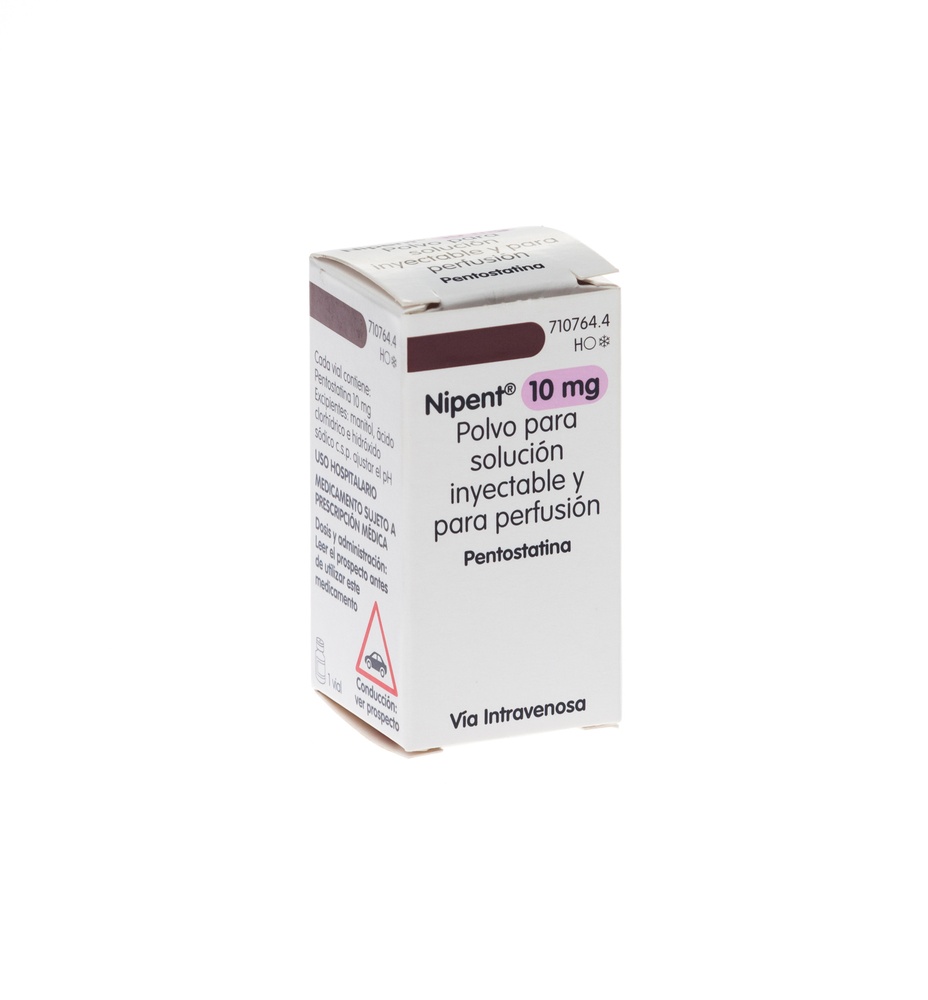
- País de registro
- Forma farmacéuticaINYECTABLE, 10 mg
- Código ATCL01XX08
- Principio activo
- Requiere recetaSí
- Fabricante
- ComposiciónHIDROXIDO DE SODIO (E 524) (0,02 mg mg), MANITOL (E-421) (50,0 mg mg)
- Esta información es de carácter general y no sustituye la consulta con un profesional sanitario.
- Alternativas a NIPENT 10 mg POLVO PARA SOLUCION INYECTABLE Y PARA PERFUSIONForma farmacéutica: CAPSULA, 0.5 mgPrincipio activo: AnagrelidaFabricante: Aurovitas Spain, S.A.U.Requiere recetaForma farmacéutica: CAPSULA, 0.5 mgPrincipio activo: AnagrelidaFabricante: Bluefish Pharmaceuticals Ab (Publ)Requiere recetaForma farmacéutica: CAPSULA, 0.5 mgPrincipio activo: AnagrelidaFabricante: Glenmark Arzneimittel GmbhRequiere receta
Médicos online para NIPENT 10 mg POLVO PARA SOLUCION INYECTABLE Y PARA PERFUSION
Comenta la dosis, los posibles efectos secundarios, interacciones, contraindicaciones o la revisión de receta de NIPENT 10 mg POLVO PARA SOLUCION INYECTABLE Y PARA PERFUSION, sujeto a valoración médica y a la normativa local.
Obtén una receta de NIPENT 10 mg POLVO PARA SOLUCION INYECTABLE Y PARA PERFUSION online
Rellena un formulario de 2 minutos
Cuéntanos tus síntomas, historial y el medicamento que necesitas.
Elige un médico o nosotros te asignamos uno
Escoge un especialista o te conectamos con el próximo médico disponible.
El médico revisa tu caso
Normalmente en 30 minutos. Puede hacerte preguntas adicionales por chat.
Recógela en cualquier farmacia
Receta electrónica enviada a tu correo, válida en toda España.
Preguntas frecuentes
NIPENT 10 mg POLVO PARA SOLUCION INYECTABLE Y PARA PERFUSION requiere receta en España. Puedes confirmarlo con un médico online según tu caso.
El principio activo de NIPENT 10 mg POLVO PARA SOLUCION INYECTABLE Y PARA PERFUSION es Pentostatina. Esta información ayuda a identificar medicamentos con la misma composición pero con diferentes nombres comerciales.
NIPENT 10 mg POLVO PARA SOLUCION INYECTABLE Y PARA PERFUSION es fabricado por Pfizer S.L.. La marca y el envase pueden variar según el distribuidor.
Los Médicos de familia, Psiquiatras, Dermatólogos, Cardiólogos, Endocrinólogos, Gastroenterólogos, Neumólogos, Nefrólogos, Reumatólogos, Hematólogos, Infectólogos, Alergólogos, Geriatras, Pediatras, Oncólogos pueden valorar la prescripción de NIPENT 10 mg POLVO PARA SOLUCION INYECTABLE Y PARA PERFUSION cuando esté clínicamente indicado. Puedes reservar una videoconsulta para comentar tu caso y las opciones de tratamiento.
España cuenta con una infraestructura sanitaria bien desarrollada en ciudades principales como Madrid, Barcelona, Valencia y Sevilla. Las farmacias están ampliamente disponibles y operan bajo estrictas regulaciones, garantizando el acceso a medicamentos con receta.
Puedes comprar NIPENT 10 mg POLVO PARA SOLUCION INYECTABLE Y PARA PERFUSION en Madrid, Barcelona, Sevilla o Valencia en cualquier farmacia local con una receta válida.
Para obtener una receta, puedes utilizar Oladoctor:
Otros medicamentos con el mismo principio activo (Pentostatina) incluyen ANAGRELIDA AUROVITAS 0.5 MG CAPSULAS DURAS EFG, ANAGRELIDA BLUEFISH 0,5 MG CAPSULAS DURAS EFG, ANAGRELIDA GLENMARK 0,5 MG CAPSULAS DURAS EFG. Pueden tener diferentes nombres comerciales o formulaciones, pero contienen el mismo componente terapéutico. Consulta siempre con un médico antes de cambiar o iniciar un nuevo medicamento.
