



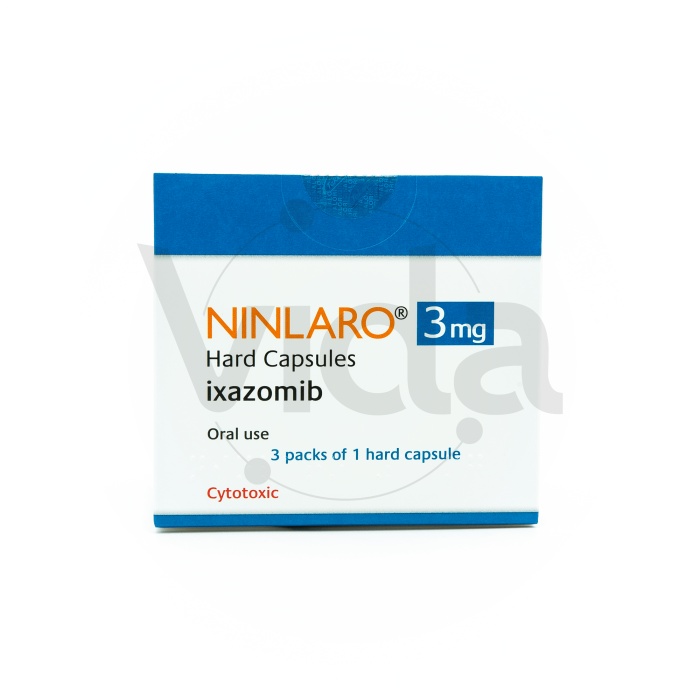
NINLARO 3 mg Hard Capsules

Prescription review online
A doctor will review your case and decide whether a prescription is medically appropriate.

Talk to a doctor about this medicine
Discuss your symptoms and possible next steps in a quick online consultation.



How to use NINLARO 3 mg HARD CAPSULES
Contents of the leaflet
- Introduction
- What is NINLARO and what is it used for
- What you need to know before you take NINLARO
- How to take NINLARO
- Possible side effects
- Storage of NINLARO
- Container Content and Additional Information
Introduction
Package Leaflet: Information for the User
NINLARO 2.3mg hard capsules
NINLARO 3mg hard capsules
NINLARO 4mg hard capsules
ixazomib
Read all of this leaflet carefully before you start taking this medicine because it contains important information for you.
- Keep this leaflet, you may need to read it again.
- If you have any further questions, ask your doctor, pharmacist, or nurse.
- This medicine has been prescribed for you only. Do not pass it on to others. It may harm them, even if their signs of illness are the same as yours.
- If you experience any side effects, talk to your doctor, pharmacist, or nurse. This includes any possible side effects not listed in this leaflet. See section 4.
Contents of the pack
- What is NINLARO and what is it used for
- What you need to know before you take NINLARO
- How to take NINLARO
- Possible side effects
- Storage of NINLARO
- Contents of the pack and further information
1. What is NINLARO and what is it used for
What is NINLARO
NINLARO is an anti-cancer medicine that contains ixazomib, a proteasome inhibitor.
NINLARO is used to treat a type of blood cancer called multiple myeloma. Its active substance, ixazomib, works by blocking the action of proteasomes. Proteasomes are structures inside cells that digest proteins and are important for cell survival. Since multiple myeloma produces large amounts of protein, blocking the action of proteasomes helps destroy cancer cells.
.
What NINLARO is used for
NINLARO is used to treat adults with multiple myeloma. NINLARO is given in combination with lenalidomide and dexamethasone, two medicines used to treat multiple myeloma.
What is multiple myeloma
Multiple myeloma is a blood cancer that affects a type of cell called plasma cells. Plasma cells are blood cells that normally produce proteins to fight infections. People with multiple myeloma have cancerous plasma cells, also called myeloma cells, which can damage bones. The proteins produced by myeloma cells can damage the kidneys. Treatment of multiple myeloma involves destroying myeloma cells and reducing symptoms of the disease.

Not sure if this medicine is right for you?
Discuss your symptoms and treatment with a doctor online.
2. What you need to know before you take NINLARO
Do not take NINLARO:
- if you are allergic to ixazomib or any of the other ingredients of this medicine (listed in section 6).
If you are unsure if this applies to you, talk to your doctor, pharmacist, or nurse before taking NINLARO.
Warnings and precautions
Talk to your doctor, pharmacist, or nurse before starting to take NINLARO or during treatment if:
- you have a history of bleeding disorders
- you have persistent nausea, vomiting, or diarrhea
- you have a history of nerve problems, including numbness or tingling
- you have a history of swelling
- you have a persistent skin rash or a severe skin rash with peeling of the skin and sores in the mouth (Stevens-Johnson syndrome or toxic epidermal necrolysis, see section 4)
- you have or have had liver or kidney problems, as the dose may need to be adjusted
- you have or have had problems with small blood vessels, known as thrombotic microangiopathy or thrombocytopenic purpura. Tell your doctor if you develop fatigue, fever, bruising, bleeding, decreased urine output, swelling, confusion, vision loss, and seizures.
Your doctor will examine you and monitor you closely during treatment. Before starting to take NINLARO and during treatment, you will have blood tests to check that you have enough blood cells.
Children and adolescents
The use of NINLARO is not recommended in children and adolescents under 18 years of age.
Using NINLARO with other medicines
Tell your doctor, pharmacist, or nurse if you are taking, have recently taken, or might take any other medicines. This includes any medicines obtained without a prescription, such as vitamins or herbal medicines. Other medicines may affect the way NINLARO works. In particular, tell your doctor, pharmacist, or nurse if you are taking any of the following medicines: carbamazepine, phenytoin, rifampicin, and St. John's Wort (Hypericum perforatum). These medicines should be avoided as they may reduce the effectiveness of NINLARO.
Pregnancy and breastfeeding
NINLARO is not recommended during pregnancy as it may harm the fetus. Breastfeeding should be discontinued while taking NINLARO.
Avoid becoming pregnant or breastfeeding while being treated with NINLARO. If you are pregnant or breastfeeding, think you may be pregnant, or plan to become pregnant, talk to your doctor or pharmacist before using this medicine.
If you are a woman of childbearing age or a man with reproductive potential, you must use effective contraception during treatment and for 90 days after treatment. Women using a hormonal contraceptive method should also use a barrier method. Tell your doctor immediately if you or your partner becomes pregnant while you are being treated with NINLARO.
Since NINLARO is given in combination with lenalidomide, you must follow the lenalidomide pregnancy prevention program because lenalidomide can be harmful to the fetus.
See the lenalidomide and dexamethasone package leaflets for more information on pregnancy and breastfeeding.
Driving and using machines
NINLARO may affect your ability to drive or use machines. You may feel tired and dizzy while taking NINLARO. Do not drive or use machines if you have these side effects.
3. How to take NINLARO
NINLARO must be prescribed by a doctor with experience in treating multiple myeloma. Always follow exactly the administration instructions given by your doctor or pharmacist.
NINLARO is used with lenalidomide (a medicine that affects the way your immune system works) and dexamethasone (an anti-inflammatory medicine).
NINLARO, lenalidomide, and dexamethasone are taken in 4-week cycles of treatment.
NINLARO is taken once a week (on the same day of the week) during the first 3 weeks of the cycle.
The recommended dose is one 4 mg capsule taken orally.
The recommended dose of lenalidomide is 25 mg taken every day during the first 3 weeks of a cycle. The recommended dose of dexamethasone is 40 mg taken once a week on the same day in all 4 weeks of the cycle.
Treatment schedule: NINLARO taken with lenalidomide and dexamethasone Take the medicine | ||||||||
28-day cycle (4-week cycle) | ||||||||
Week 1 | Week 2 | Week 3 | Week 4 | |||||
Day 1 | Days 2 to 7 | Day 8 | Days 9 to 14 | Day 15 | Days 16 to 21 | Day 22 | Days 23 to 28 | |
NINLARO | ? | ? | ? | |||||
Lenalidomide | ? | ?Daily | ? | ?Daily | ? | ?Daily | ||
Dexamethasone | ? | ? | ? | ? |
Read the package leaflets of these other medicines for more information on their use and effects.
If you have liver or kidney problems, your doctor may prescribe NINLARO 3 mg capsules. If you experience side effects, your doctor may prescribe NINLARO 3 mg or 2.3 mg capsules. Your doctor may also adjust the doses of the other medicines.
How and when to take NINLARO
- Take NINLARO at least 1 hour before or at least 2 hours after a meal.
- Swallow the capsule whole with water. Do not break, open, or chew the capsule.
- Avoid contact between the capsule contents and your skin. If the powder accidentally comes into contact with your skin, wash the skin carefully with water and soap. If the capsule is broken, collect the powder, avoiding raising dust in the air.
If you take more NINLARO than you should
An accidental overdose may cause serious side effects. If you take more NINLARO than you should, talk to your doctor or go to the hospital immediately. Take the medicine package with you.
Duration of treatment with NINLARO
You should continue treatment until your doctor tells you to stop.
If you forget to take NINLARO
If you forget or are late taking a dose, take the dose if it is more than 3 days or 72 hours until the next scheduled dose. Do not take the missed dose if it is less than 3 days or 72 hours until the next scheduled dose.
If you vomit after taking a dose, do not take an extra dose. Take the next dose when it is scheduled.
If you have any further questions on the use of this medicine, ask your doctor or pharmacist.

Started taking the medicine and have questions?
Discuss your symptoms and treatment with a doctor online.
4. Possible side effects
Like all medicines, this medicine can cause side effects, although not everybody gets them.
Stop using ixazomib and seek medical help immediately if you experience any of the following symptoms:
- red, target-like, or circular patches on the torso, often with blisters in the center, peeling, ulcers in the mouth, throat, nose, genitals, and eyes. These severe skin rashes can be preceded by fever and flu-like symptoms (Stevens-Johnson syndrome, toxic epidermal necrolysis, which can affect up to 1 in 1,000 people).
Tell your doctor immediately if you experience any of the following serious side effects that can affect more than 1 in 10 people:
- low platelet count (thrombocytopenia), which can increase the risk of nosebleeds and easy bruising
- nausea, vomiting, and diarrhea
- numbness, tingling, or burning sensation in hands or feet (peripheral neuropathy)
- swelling in legs or feet (peripheral edema)
- skin rashes with itching in some areas of the body or all over the body
- cough, chest pain or inflammation, or nasal congestion (bronchitis)
Additionally, tell your doctor immediately if you experience any of the following rare side effects that can affect up to 1 in 1,000 people:
- severe skin rashes in the form of red to purple spots (Sweet's syndrome)
- muscle weakness, loss of sensation in toes or feet, or loss of mobility in legs (transverse myelitis)
- vision changes, mental status changes, or seizures (reversible posterior encephalopathy syndrome)
- rapid destruction of cancer cells, which can cause dizziness, decreased urine output, confusion, vomiting, nausea, swelling, shortness of breath, or heart rhythm changes (tumor lysis syndrome)
- a rare blood disorder caused by blood clots that can cause fatigue, fever, bruising, bleeding, decreased urine output, swelling, confusion, vision loss, and seizures (thrombotic microangiopathy, thrombocytopenic purpura)
- swelling of the face, lips, tongue, or throat, difficulty breathing or swallowing, wheezing, chest tightness, or dizziness, itching, and hives (angioedema or anaphylactic reaction)
Other possible side effects
Tell your doctor or pharmacist if any of the following side effects become serious.
Very common: may affect more than 1 in 10 people
- constipation
- back pain
- cold symptoms (upper respiratory tract infection)
- feeling tired or weak (fatigue)
- low white blood cell count, called neutrophils (neutropenia), which can increase the risk of infection
- loss of appetite
- irregular heartbeat (arrhythmia)
- eye problems, such as blurred vision, dry eyes, and conjunctivitis
Common: may affect up to 1 in 10 people
- reactivation of the varicella virus (herpes) that can cause skin rash and pain (herpes zoster)
- low blood pressure (hypotension)
- shortness of breath or cough or wheezing (heart failure)
- yellowing of the eyes and skin (jaundice, which can be a sign of liver failure)
- low potassium levels in the blood (hypokalemia)
Reporting of side effects
If you experience any side effects, talk to your doctor, pharmacist, or nurse. This includes any possible side effects not listed in this leaflet. You can also report side effects directly via the national reporting system listed in Appendix V. By reporting side effects, you can help provide more information on the safety of this medicine.
5. Storage of NINLARO
Keep this medicine out of the sight and reach of children.
Do not use this medicine after the expiry date which is stated on the blister, carton, and packaging after EXP. The expiry date is the last day of the month shown.
Do not store above 30°C. Do not freeze.
Store in the original package to protect from moisture.
Do not remove the capsule until it is time to take a dose.
Do not use this medicine if you notice damage or signs of tampering.
Medicines should not be disposed of via wastewater or household waste. Ask your pharmacist how to dispose of medicines no longer required. This will help protect the environment.
6. Container Content and Additional Information
NINLARO Composition
NINLARO 2.3 mg hard capsule:
- The active substance is ixazomib. Each capsule contains 2.3 mg of ixazomib (equivalent to 3.3 mg of ixazomib citrate).
- Other components are:
- In the capsule: microcrystalline cellulose, magnesium stearate, and talc.
- The capsule shell contains: gelatin, titanium dioxide (E171), and red iron oxide (E172).
- The printing ink contains: shellac, propylene glycol, potassium hydroxide, and black iron oxide (E172).
NINLARO 3 mg hard capsule:
- The active substance is ixazomib. Each capsule contains 3 mg of ixazomib (equivalent to 4.3 mg of ixazomib citrate).
- Other components are:
- In the capsule: microcrystalline cellulose, magnesium stearate, and talc.
- The capsule shell contains: gelatin, titanium dioxide (E171), and black iron oxide (E172).
- The printing ink contains: shellac, propylene glycol, potassium hydroxide, and black iron oxide (E172).
NINLARO 4 mg hard capsule:
- The active substance is ixazomib. Each capsule contains 4 mg of ixazomib (equivalent to 5.7 mg of ixazomib citrate).
- Other components are:
- In the capsule: microcrystalline cellulose, magnesium stearate, and talc.
- The capsule shell contains: gelatin, titanium dioxide (E171), yellow iron oxide (E172), and red iron oxide (E172).
- The printing ink contains: shellac, propylene glycol, potassium hydroxide, and black iron oxide (E172).
NINLARO Appearance and Container Content
NINLARO 2.3 mg hard capsule: light pink, size 4, marked with “Takeda” on the cap and “2.3 mg” on the body with black ink.
NINLARO 3 mg hard capsule: light gray, size 4, marked with “Takeda” on the cap and “3 mg” on the body with black ink.
NINLARO 4 mg hard capsule: light orange, size 3, marked with “Takeda” on the cap and “4 mg” on the body with black ink.
Each box contains 3 hard capsules (three individual boxes, each with a sealed blister pack inside a carton. Each blister pack contains one capsule).
Marketing Authorization Holder
Takeda Pharma A/S
Delta Park 45
2665 Vallensbaek Strand
Denmark
Manufacturer
Takeda Ireland Limited
Grange Castle Business Park
Nangor Road
Dublin 22
D22 XR57
Ireland
Takeda GmbH
Takeda (Werk Singen)
Robert Bosch Strasse 8
78224 Singen
Germany
You can request more information about this medicinal product by contacting the local representative of the marketing authorization holder:
Belgium Takeda Belgium NV Tel: +32 2 464 06 11 | Lithuania Takeda, UAB Tel: +370 521 09 070 |
Bulgaria Takeda Bulgaria EOOD Tel: +359 2 958 27 36 | Luxembourg Takeda Belgium NV Tel: +32 2 464 06 11 |
Czech Republic Takeda Pharmaceuticals Czech Republic s.r.o. Tel: +420 234 722 722 | Hungary Takeda Pharma Kft. Tel: +36 1 270 7030 |
Denmark Takeda Pharma A/S Tel: +45 46 77 10 10 | Malta Drugsales Ltd Tel: +356 21419070 |
Germany Takeda GmbH Tel: +49 (0)800 825 3325 | Netherlands Takeda Nederland B.V. Tel: +31 20 203 5492 |
Estonia Takeda Pharma AS Tel: +372 6177 669 | Norway Takeda AS Tel: +47 800 800 30 |
Greece Takeda ΕΛΛΑΣ Α.Ε. Tel: +30 210 6387800 | Austria Takeda Pharma Ges.m.b.H. Tel: +43 (0) 800‑20 80 50 |
Spain Takeda Farmacéutica España, S.A. Tel: +34 917 90 42 22 | Poland Takeda Pharma Sp. z o.o. Tel: +48 223 062 447 |
France Takeda France SAS Tel: +33 1 40 67 33 00 | Portugal Takeda Farmacêuticos Portugal, Lda. Tel: +351 21 120 1457 |
Croatia Takeda Pharmaceuticals Croatia d.o.o. Tel: +385 1 377 88 96 | Romania Takeda Pharmaceuticals SRL Tel: +40 21 335 03 91 |
Ireland Takeda Products Ireland Ltd Tel: 1800 937 970 | Slovenia Takeda Pharmaceuticals farmacevtska družba d.o.o. Tel: +386 (0) 59 082 480 |
Iceland Vistor hf. Tel: +354 535 7000 | Slovakia Takeda Pharmaceuticals Slovakia s.r.o. Tel: +421 (2) 20 602 600 |
Italy Takeda Italia S.p.A. Tel: +39 06 502601 | Finland Takeda Oy Tel: 0800 774 051 |
Cyprus A.POTAMITIS MEDICARE LTD Tel: +357 22583333 | Sweden Takeda Pharma AB Tel: 020 795 079 |
Latvia Takeda Latvia SIA Tel: +371 67840082 | United Kingdom (Northern Ireland) Takeda UK Ltd Tel: +44 (0) 3333 000 181 |
Date of Last Revision of this Leaflet
Other Sources of Information
Detailed information on this medicinal product is available on the European Medicines Agency website: http://www.ema.europa.eu.
- Country of registration
- Dosage formCAPSULE, 3 mg
- ATC codeL01XG03
- Active substance
- Prescription requiredYes
- Manufacturer
- This information is for reference only and does not constitute medical advice. Always consult a doctor before taking any medication. Oladoctor is not responsible for medical decisions based on this content.
- Alternatives to NINLARO 3 mg HARD CAPSULESDosage form: CAPSULE, 2.3 mgActive substance: ixazomibManufacturer: Takeda Pharma A/SPrescription requiredDosage form: CAPSULE, 4.0 mgActive substance: ixazomibManufacturer: Takeda Pharma A/SPrescription requiredDosage form: INJECTABLE, 1 mgActive substance: bortezomibManufacturer: Accord Healthcare S.L.U.Prescription required
Online doctors for NINLARO 3 mg HARD CAPSULES
Discuss questions about NINLARO 3 mg HARD CAPSULES, including use, safety considerations and prescription review, subject to medical assessment and local regulations.
Get NINLARO 3 mg HARD CAPSULES Prescription Online
Fill in a 2-min form
Tell us your symptoms, history, and what medicine you're requesting.
Pick a doctor or let us assign
Choose a specialist or we'll match you with the next available doctor.
Doctor reviews your case
Usually within 30 minutes. They may ask follow-up questions via chat.
Collect from any pharmacy
Electronic prescription sent to your email — valid across Spain.
Frequently Asked Questions
NINLARO 3 mg HARD CAPSULES requires a prescription in Spain. You can check with a doctor online whether this medicine may be appropriate for your situation.
The active ingredient in NINLARO 3 mg HARD CAPSULES is ixazomib. This information helps identify medicines with the same composition but different brand names.
NINLARO 3 mg HARD CAPSULES is manufactured by Takeda Pharma A/S. Pharmacy brands and packaging may differ depending on the distributor.
Doctors such as Family doctors, Psychiatrists, Dermatologists, Cardiologists, Endocrinologists, Gastroenterologists, Pulmonologists, Nephrologists, Rheumatologists, Hematologists, Infectious disease physicians, Allergists, Geriatricians, Paediatricians, Oncologists may assess whether NINLARO 3 mg HARD CAPSULES is appropriate, depending on your situation and local regulations. You can book an online consultation to discuss your symptoms and possible next steps.
Spain has a well-developed healthcare infrastructure across major cities such as Madrid, Barcelona, Valencia, and Seville. Pharmacies are widely available and operate under strict regulations, ensuring access to prescribed medications.
You can buy NINLARO 3 mg HARD CAPSULES in Madrid, Barcelona, Seville, or Valencia at any local pharmacy with a valid prescription.
To obtain a prescription, you can use Oladoctor:
Other medicines with the same active substance (ixazomib) include NINLARO 2.3 mg HARD CAPSULES, NINLARO 4 mg HARD CAPSULES, BORTEZOMIB ACCORD 1 mg POWDER FOR INJECTABLE SOLUTION. These may have different brand names or formulations but contain the same therapeutic ingredient. Always consult a doctor before switching or starting a new medicine.
