



NASONEX 50 MICROGRAMOS SUSPENSIÓN PARA PULVERIZACIÓN NASAL

Revisión de receta online
Un médico revisará tu caso y determinará si la prescripción es médicamente apropiada.

Habla con un médico sobre este medicamento
Comenta tus síntomas y las opciones de tratamiento en una consulta online.



Cómo usar NASONEX 50 MICROGRAMOS SUSPENSIÓN PARA PULVERIZACIÓN NASAL
Contenido del prospecto
- Introducción
- Qué es Nasonex y para qué se utiliza
- Qué necesita saber antes de empezar a usar Nasonex
- Cómo usar Nasonex
- Posibles efectos adversos
- Conservación de Nasonex
- Contenido del envase e información adicional
Introducción
Prospecto: información para el usuario
NASONEX 50 microgramos suspensión para pulverización nasal
Furoato de mometasona
Lea todo el prospecto detenidamente antes de empezar a usar este medicamento, porque contiene información importante para usted.
- Conserve este prospecto, ya que puede tener que volver a leerlo.
- Si tiene alguna duda, consulte a su médico o farmacéutico.
- Este medicamento se le ha recetado solamente a usted, y no debe dárselo a otras personas aunque tengan los mismos síntomas que usted, ya que puede perjudicarles.
- Si experimenta efectos adversos, consulte a su médico o farmacéutico, incluso si se trata de efectos adversos que no aparecen en este prospecto. Ver sección 4.
Contenido del prospecto
- Qué es Nasonex y para qué se utiliza
- Qué necesita saber antes de empezar a usar Nasonex
- Cómo usar Nasonex
- Posibles efectos adversos
- Conservación de Nasonex
- Contenido del envase e información adicional
1. Qué es Nasonex y para qué se utiliza
¿Qué es Nasonex?
Nasonex pulverizador nasal contiene furoato de mometasona, un medicamento que pertenece a los medicamentos llamados corticosteroides. Cuando se pulveriza furoato de mometasona en la nariz, puede ayudar a aliviar la inflamación (hinchazón e irritación de la nariz), los estornudos, el picor y el taponamiento o el goteo nasal.
¿Para qué se utiliza Nasonex?
Fiebre del heno y rinitis perenne
Nasonex se utiliza para tratar los síntomas de la fiebre del heno (también llamada rinitis alérgica
estacional) y la rinitis perenne en adultos y niños de 3 años de edad y mayores.
La fiebre del heno, que se presenta en ciertas épocas del año, es una reacción alérgica causada por respirar polen de árboles, hierbas, malezas y también esporas de mohos y hongos. La rinitis perenne se presenta durante todo el año y los síntomas pueden ser causados por una sensibilidad a una variedad de cosas incluyendo los ácaros del polvo, pelo del animal (o epitelio), plumas y ciertos alimentos. Nasonex reduce la inflamación e irritación de su nariz y de ese modo alivia los estornudos, el picor y el taponamiento o el goteo nasal causados por la fiebre del heno o la rinitis perenne.
Pólipos nasales
Nasonex se utiliza para tratar los pólipos nasales en adultos de 18 años de edad y mayores.
Los pólipos nasales son unas pequeñas formaciones en la mucosa de la nariz y generalmente afectan a ambas fosas nasales. Nasonex reduce la inflamación en la nariz, haciendo que los pólipos se reduzcan gradualmente, de este modo alivia el taponamiento nasal que puede afectar a su respiración por la nariz.

¿No estás seguro de si este medicamento es adecuado para ti?
Comenta tus síntomas y tratamiento con un médico online.
2. Qué necesita saber antes de empezar a usar Nasonex
No use Nasonex
- si es alérgico al furoato de mometasona o a alguno de los demás componentes de este medicamento (incluidos en la sección 6).
- si presenta infección nasal no tratada. El uso de Nasonex mientras tiene una infección de nariz no tratada, como el herpes, puede empeorar la infección. Debe esperar hasta que la infección desaparezca antes de comenzar a usar el pulverizador nasal.
- si ha sido sometido a una operación o ha tenido una lesión reciente en la nariz. No debe utilizar el pulverizador nasal hasta que haya cicatrizado la nariz.
Advertencias y precauciones
Consulte a su médico o farmacéutico antes de empezar a usar Nasonex.
- si tiene o ha tenido alguna vez tuberculosis.
- si tiene cualquier otra infección.
- si está tomando otros corticosteroides, ya sea por vía oral o mediante inyección.
- si tiene fibrosis quística.
Mientras está usando Nasonex, consulte a su médico
- si su sistema inmunológico no está funcionando bien (si tiene dificultad en superar la infección) y entra en contacto con alguien con sarampión o varicela. Debe evitar el contacto con cualquier persona que tenga estas infecciones.
- si tiene infección de nariz o garganta.
- si lleva usando este medicamento varios meses o más tiempo.
- si tiene irritación persistente de nariz o garganta.
Si los pulverizadores nasales de corticosteroides se usan a dosis altas durante largos periodos de tiempo, se pueden producir efectos adversos, debido a que el medicamento se absorbe en el organismo.
Si le pican los ojos o están irritados, su médico puede aconsejarle el uso de otros tratamientos a la vez que Nasonex.
Póngase en contacto con su médico si presenta visión borrosa u otras alteraciones visuales.
Niños
Cuando se usan a dosis altas durante largos periodos de tiempo, los pulverizadores nasales de corticosteroides pueden causar efectos secundarios, tales como enlentecimiento del índice de crecimiento en los niños.
Se recomienda controlar la altura de los niños en tratamiento de larga duración con corticosteroides nasales y si se aprecia cualquier cambio, debe comunicárselo al médico.
Uso de Nasonex con otros medicamentos
Informe a su médico o farmacéutico si está tomando, ha tomado recientemente o pudiera tener que tomar cualquier otro medicamento, incluso los adquiridos sin receta.
Si está tomando otros corticosteroides para la alergia, ya sea por vía oral o mediante inyección, su médico puede aconsejarle que deje de tomarlos cuando empiece a usar Nasonex. Al discontinuar los corticosteroides, por vía oral o en inyección, algunas personas pueden presentar algunos efectos adversos como dolor muscular o de las articulaciones, debilidad muscular y depresión. También puede que desarrolle otras alergias, tales como ojos llorosos, ojos con picor, o piel con ronchas rojas y picores. Si desarrolla alguno de estos efectos adversos, debe acudir al médico.
Algunos medicamentos pueden aumentar los efectos de Nasonex, por lo que su médico le hará controles minuciosos si está tomando estos medicamentos (incluidos algunos para el VIH: ritonavir, cobicistat).
Embarazo y lactancia
Hay poca información o ninguna, sobre el uso de Nasonex en mujeres embarazadas. Se desconoce si Nasonex se excreta en la leche materna.
Si está embarazada o en periodo de lactancia, cree que podría estar embarazada o tiene intención de quedarse embarazada, consulte a su médico o farmacéutico antes de utilizar este medicamento.
Conducción y uso de máquinas
No existe ninguna información conocida sobre el efecto de Nasonex en la conducción o uso de máquinas.
Nasonex contiene cloruro de benzalconio
El cloruro de benzalconio puede causar irritación o inflamación dentro de la nariz, especialmente cuando se usa durante periodos largos de tratamiento.
3. Cómo usar Nasonex
Siga exactamente las instrucciones de administración de este medicamento indicadas por su médico. En caso de duda, consulte de nuevo a su médico o farmacéutico. No use dosis mayores ni utilice el pulverizador más a menudo, o durante más tiempo, de lo que su médico le ha dicho.
Tratamiento de la fiebre del heno y rinitis perenne
Uso en adultos y niños de más de 12 años de edad
La dosis habitual es de dos pulverizaciones en cada orificio nasal una vez al día.
- Una vez que se ha alcanzado el control de los síntomas, es posible que su médico le recomiende disminuir la dosis.
- Si no comienza a sentirse mejor, debe consultar al médico y puede que le diga que aumente la dosis a la dosis máxima diaria de cuatro pulverizaciones en cada orificio nasal una vez al día.
Uso en niños de edad comprendida entre 3 y 11 años
La dosis habitual es de una pulverización en cada orificio nasal una vez al día.
En algunos pacientes, Nasonex comienza a aliviar los síntomas en las 12 horas siguientes a la primera dosis; sin embargo, no es probable que el efecto óptimo del tratamiento se observe antes de los primeros dos días. Por lo tanto, usted debe mantener un uso regular para alcanzar el efecto óptimo del tratamiento.
Si usted o su hijo/a presenta fiebre del heno muy intensa, su médico puede aconsejarle que comience a utilizar Nasonex algunos días antes del comienzo de la temporada del polen, ya que esto le ayudará a prevenir los síntomas de la fiebre del heno antes de que ocurran.
Pólipos nasales
Uso en adultos de más de 18 años de edad
La dosis habitual inicial es de dos pulverizaciones en cada orificio nasal una vez al día.
- Si después de 5 a 6 semanas no se controlan los síntomas, la dosis se puede incrementar a dos pulverizaciones en cada orificio nasal dos veces al día. Una vez que se ha alcanzado el control de los síntomas, su médico puede aconsejarle que disminuya la dosis.
- Si no se observa mejoría de los síntomas después de 5-6 semanas administrándose dos veces al día, debe consultar con su médico.
Preparación del pulverizador nasal para su uso
Nasonex pulverizador nasal tiene un tapón que protege la boquilla y la mantiene limpia. Recuerde quitarlo antes de utilizar el pulverizador y volverlo a poner después de usarlo.
Si va a utilizar el pulverizador por primera vez necesita “cebar” el frasco pulsando el pulverizador 10 veces hasta que se produzca una pulverización fina:
- Primero agite con cuidado el frasco.
- Ponga los dedos índice y corazón a ambos lados de la boquilla y el pulgar debajo del frasco. Noperfore el pulverizador nasal.
- No apunte con la boquilla hacia usted y después presione la bomba del pulverizador 10 veces hasta que se produzca una pulverización fina.
Si no ha usado su pulverizador nasal durante 14 días o más, necesita “cebar” de nuevo el frasco
pulsando el pulverizador 2 veces hasta que se produzca una pulverización fina.
Cómo utilizar su pulverizador nasal
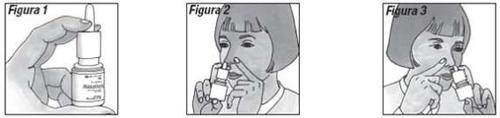
- Agite con cuidado el frasco y quite el tapón (Figura 1).
- Suénese suavemente la nariz.
- Tape un orificio nasal y ponga la boquilla en el otro orificio según se indica (Figura 2).
Incline ligeramente su cabeza hacia abajo, manteniendo el frasco en vertical.
- Empiece a inspirar suave o lentamente por la nariz y mientras está inspirando presione UNA VEZ con los dedos para permitir que el pulverizado entre en su nariz.
- Espire a través de la boca. Repita el paso 4 para inhalar un segundo pulverizado en el mismo orificio nasal, si procede.
- Retire la boquilla de este orificio nasal y espire por la boca.
- Repita los pasos 3 a 6 en el otro orificio nasal (Figura 3).
Después de utilizar el pulverizador, limpie la boquilla cuidadosamente con un pañuelo limpio o un pañuelo de papel y ponga el tapón.
Limpieza de su pulverizador nasal
- Es importante que limpie regularmente su pulverizador nasal, de lo contrario puede que no funcione adecuadamente.
- Quite el tapón y tire con cuidado de la boquilla.
- Lave la boquilla y el tapón con agua templada y luego aclare con agua corriente.
- No trate de desatascar el aplicador nasal mediante la inserción de una aguja u otro objeto puntiagudo ya que podría dañar el aplicador de forma que no se reciba la dosis correcta de medicamento.
- Ponga a secar el tapón y la boquilla en un lugar cálido.
- Presione la boquilla sobre el frasco y coloque el tapón.
- El pulverizador necesitará ser cebado de nuevo con 2 pulverizaciones cuando se use por primera vez después de la limpieza.
Si usa más Nasonex del que debe
Si accidentalmente usa más del que debe, coménteselo a su médico.
Si utiliza esteroides durante un periodo de tiempo largo o en grandes cantidades puede, en raras
ocasiones, afectar a alguna de sus hormonas. En niños puede afectar al crecimiento y desarrollo.
En caso de sobredosis o ingestión accidental consulte inmediatamente a su médico o farmacéutico o llame al Servicio de Información Toxicológica indicando el medicamento y la cantidad ingerida. Teléfono: 91 562 04 20
Si olvidó usar Nasonex
Si olvidó usar su pulverizador nasal en el momento adecuado, utilícelo tan pronto como lo recuerde, siguiendo posteriormente con el ritmo normal de administración. No use una dosis doble para compensar las dosis olvidadas.
Si interrumpe el tratamiento con Nasonex
En algunos pacientes Nasonex debe empezar a aliviar los síntomas 12 horas después de la primera dosis; sin embargo, puede que el beneficio completo del tratamiento no se muestre hasta dos días después. Es muy importante que use su pulverizador nasal regularmente. No interrumpa su tratamiento incluso si se siente mejor a menos que su médico se lo indique.
Si tiene cualquier otra duda sobre el uso de este medicamento, pregunte a su médico o farmacéutico.

¿Has empezado a tomar el medicamento y tienes preguntas?
Comenta tus síntomas y tratamiento con un médico online.
4. Posibles efectos adversos
Al igual que todos los medicamentos, este medicamento puede producir efectos adversos, aunque no todas las personas los sufran.
Pueden ocurrir reacciones inmediatas de hipersensibilidad (alérgicas) después del uso de este
medicamento. Estas reacciones pueden ser graves. Debe interrumpir el tratamiento con Nasonex y buscar ayuda médica inmediatamente si experimenta síntomas como:
- cara hinchada, lengua o faringe
- dificultad para tragar
- urticaria
- fatiga o dificultad para respirar
Si los pulverizadores nasales de corticosteroides se utilizan a dosis altas durante largos periodos de tiempo, se pueden producir efectos adversos, debido a que el medicamento se absorbe en el
organismo.
Otros efectos adversos
La mayoría de las personas no tienen ningún problema después de usar el pulverizador nasal. Sin embargo, algunas personas después de utilizar Nasonex u otros pulverizadores nasales de
corticosteroides pueden presentar:
Efectos adversos frecuentes (pueden afectar hasta a 1 de cada 10 personas)
- dolor de cabeza
- estornudos
- hemorragia nasal [muy frecuente (puede afectar a más de 1 de cada 10 personas) en personas con pólipos nasales que estén administrándose dos pulverizaciones de Nasonex en cada orificio nasal dos veces al día.]
- dolor en la nariz o en la garganta
- úlceras en la nariz
- infección respiratoria
Frecuencia no conocida (no puede estimarse a partir de los datos disponibles)
- aumento de la presión ocular (glaucoma) y/o cataratas que pueden dar lugar a alteraciones
visuales
- daño en el tabique de la nariz que separa los orificios nasales
- alteraciones del gusto y del olfato
- dificultad para respirar y/o fatiga
- visión borrosa
Comunicación de efectos adversos:
Si experimenta cualquier tipo de efecto adverso, consulte a su médico o farmacéutico, incluso si se trata de posibles efectos adversos que no aparecen en este prospecto. También puede comunicarlos directamente a través del Sistema Español de Farmacovigilancia de medicamentos de Uso Humano: https://www.notificaram.es. Mediante la comunicación de efectos adversos usted puede contribuir a proporcionar más información sobre la seguridad de este medicamento.
5. Conservación de Nasonex
- Mantener este medicamento fuera de la vista y del alcance de los niños.
- No conservar a temperatura superior a 25ºC. No congelar.
- No utilice este medicamento después de la fecha de caducidad que aparece en el envase después de CAD. La fecha de caducidad es el último día del mes que se indica.
- El frasco se debe utilizar dentro de los 2 meses desde la primera administración. Abrir solo un frasco a la vez.
Los medicamentos no se deben tirar por los desagües ni a la basura. Deposite los envases y los
medicamentos que no necesita en el Punto SIGRE de la farmacia. En caso de duda pregunte a su farmacéutico cómo deshacerse de los envases y de los medicamentos que no necesita. De esta forma, ayudará a proteger el medio ambiente.
6. Contenido del envase e información adicional
Composición de Nasonex
- El principio activo es furoato de mometasona. Cada pulverización contiene 50 microgramos de furoato de mometasona como monohidrato.
- Los demás componentes son celulosa dispersable glicerol, citrato sódico, ácido cítrico monohidrato, polisorbato 80, cloruro de benzalconio, agua purificada.
- Este medicamento contiene 0,02 mg de cloruro de benzalconio en cada pulverización.
Aspecto del producto y contenido del envase
Nasonex es una suspensión para pulverización nasal.
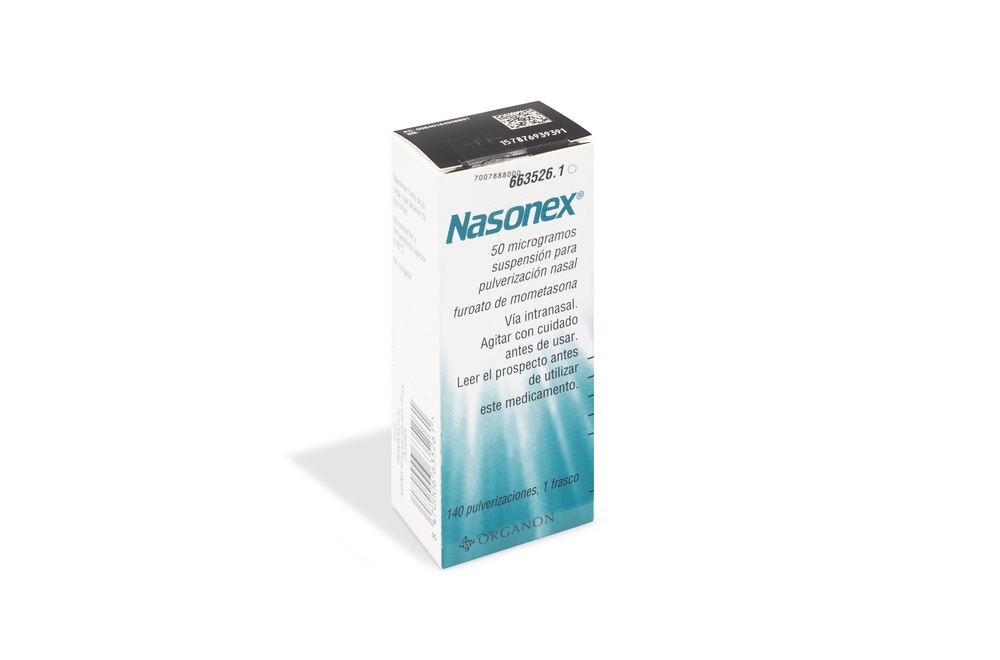
Cada frasco contiene 60 ó 140 pulverizaciones.
Los frascos que contienen 60 pulverizaciones se presentan en envases individuales.
Los frascos que contienen 140 pulverizaciones se presentan en envases de 1, 2 ó 3 frascos.
Puede que solamente estén comercializados algunos tamaños de envases.
Titular de la autorización de comercialización y responsable de fabricación
Titular de la autorización de comercialización Organon Salud, S.L. Paseo de la Castellana, 77 28046 Madrid España Tel.: 915911279 | Responsable de la fabricación Organon Heist bv Industriepark 30 2220 Heist-op-den Berg Bélgica |
Este medicamento está autorizado en los estados miembros del Espacio Económico Europeo con los siguientes nombres:
Austria: Nasonex aquosum – Nasenspray
Bélgica, Croacia, Dinamarca, Estonia, Finlandia, Francia, Alemania, Grecia, Hungría, Islandia, Irlanda, Italia, Lituania, Luxemburgo, Malta, Países Bajos, Noruega, Polonia, Eslovenia, Suecia, Reino Unido: Nasonex
Bulgaria, República Checa, Rumanía, Eslovaquia: NASONEX
Letonia: Nasonex 50 mikrogrami/deva deguna aerosols,suspensija
Portugal: Nasomet
España: NASONEX 50 microgramos suspensión para pulverización nasal
Fecha de la última revisión de este prospecto:03/2020
La información detallada y actualizada de este medicamento está disponible en la página Web de la Agencia Española de Medicamentos y Productos Sanitarios (AEMPS) http://www.aemps.gob.es/
- País de registro
- Forma farmacéuticaPRODUCTO USO NASAL, 50 µg
- Código ATCR01AD09
- Precio medio en farmacia8.99 EUR
- Principio activo
- Requiere recetaSí
- Fabricante
- ComposiciónPOLISORBATO 80 (0,1 mg mg), BENZALCONIO, CLORURO DE (0,2 mg mg), CITRATO DE SODIO (E-331) (2,8 mg mg), GLICEROL (E 422) (21,0 mg mg)
- Esta información es de carácter general y no sustituye la consulta con un profesional sanitario.
- Alternativas a NASONEX 50 MICROGRAMOS SUSPENSIÓN PARA PULVERIZACIÓN NASALForma farmacéutica: PRODUCTO USO NASAL, 50 microgramos/pulverizaciónPrincipio activo: mometasoneFabricante: Laboratorios Cinfa S.A.Requiere recetaForma farmacéutica: PRODUCTO USO NASAL, 50 microgramosPrincipio activo: mometasoneFabricante: Aristo Pharma GmbhRequiere recetaForma farmacéutica: PRODUCTO USO NASAL, 50 microgramos/pulsacionPrincipio activo: mometasoneFabricante: Laboratorios Alter S.A.Requiere receta
Médicos online para NASONEX 50 MICROGRAMOS SUSPENSIÓN PARA PULVERIZACIÓN NASAL
Comenta la dosis, los posibles efectos secundarios, interacciones, contraindicaciones o la revisión de receta de NASONEX 50 MICROGRAMOS SUSPENSIÓN PARA PULVERIZACIÓN NASAL, sujeto a valoración médica y a la normativa local.

Obtén una receta de NASONEX 50 MICROGRAMOS SUSPENSIÓN PARA PULVERIZACIÓN NASAL online
Rellena un formulario de 2 minutos
Cuéntanos tus síntomas, historial y el medicamento que necesitas.
Elige un médico o nosotros te asignamos uno
Escoge un especialista o te conectamos con el próximo médico disponible.
El médico revisa tu caso
Normalmente en 30 minutos. Puede hacerte preguntas adicionales por chat.
Recógela en cualquier farmacia
Receta electrónica enviada a tu correo, válida en toda España.
Preguntas frecuentes
NASONEX 50 MICROGRAMOS SUSPENSIÓN PARA PULVERIZACIÓN NASAL requiere receta en España. Puedes confirmarlo con un médico online según tu caso.
El principio activo de NASONEX 50 MICROGRAMOS SUSPENSIÓN PARA PULVERIZACIÓN NASAL es mometasone. Esta información ayuda a identificar medicamentos con la misma composición pero con diferentes nombres comerciales.
El precio medio en farmacia de NASONEX 50 MICROGRAMOS SUSPENSIÓN PARA PULVERIZACIÓN NASAL es de aproximadamente 8.99 EUR. Puede variar según el fabricante y la forma farmacéutica.
NASONEX 50 MICROGRAMOS SUSPENSIÓN PARA PULVERIZACIÓN NASAL es fabricado por Organon Salud S.L.. La marca y el envase pueden variar según el distribuidor.
Los Médicos de familia, Psiquiatras, Dermatólogos, Cardiólogos, Endocrinólogos, Gastroenterólogos, Neumólogos, Nefrólogos, Reumatólogos, Hematólogos, Infectólogos, Alergólogos, Geriatras, Pediatras, Oncólogos pueden valorar la prescripción de NASONEX 50 MICROGRAMOS SUSPENSIÓN PARA PULVERIZACIÓN NASAL cuando esté clínicamente indicado. Puedes reservar una videoconsulta para comentar tu caso y las opciones de tratamiento.
España cuenta con una infraestructura sanitaria bien desarrollada en ciudades principales como Madrid, Barcelona, Valencia y Sevilla. Las farmacias están ampliamente disponibles y operan bajo estrictas regulaciones, garantizando el acceso a medicamentos con receta.
Puedes comprar NASONEX 50 MICROGRAMOS SUSPENSIÓN PARA PULVERIZACIÓN NASAL en Madrid, Barcelona, Sevilla o Valencia en cualquier farmacia local con una receta válida.
Para obtener una receta, puedes utilizar Oladoctor:
Otros medicamentos con el mismo principio activo (mometasone) incluyen MOMCORT 50 MICROGRAMOS/PULVERIZACION SUSPENSION PARA PULVERIZACION NASAL, MOMETASONA ARISTO 50 MICROGRAMOS/PULVERIZACION SUSPENSIÓN PARA PULVERIZACIÓN NASAL, MOMETASONA FUROATO ALTER GENERICOS 50 MICROGRAMOS/PULSACION SUSPENSION PARA PULVERIZACION NASAL. Pueden tener diferentes nombres comerciales o formulaciones, pero contienen el mismo componente terapéutico. Consulta siempre con un médico antes de cambiar o iniciar un nuevo medicamento.
