



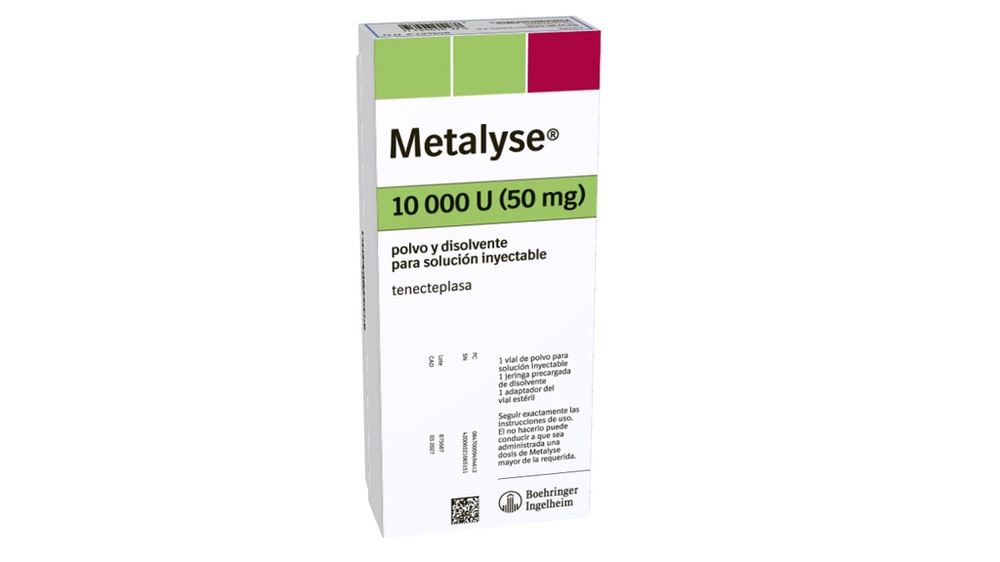
METALYSE 10.000 UNIDADES (50 MG) INYECTABLE

Revisión de receta online
Un médico revisará tu caso y determinará si la prescripción es médicamente apropiada.

Habla con un médico sobre este medicamento
Comenta tus síntomas y las opciones de tratamiento en una consulta online.



Cómo usar METALYSE 10.000 UNIDADES (50 MG) POLVO Y DISOLVENTE PARA SOLUCION INYECTABLE
Contenido del prospecto
- Introducción
- Qué es Metalyse y para qué se utiliza
- Qué necesita saber antes de que le sea administrado Metalyse
- Cómo se administra Metalyse
- Posibles efectos adversos
- Conservación de Metalyse
- Contenido del envase e información adicional
Introducción
Prospecto: información para el usuario
Metalyse 8000unidades (40 mg) polvo y disolvente para solución inyectable
Metalyse 10000unidades (50 mg) polvo y disolvente para solución inyectable
tenecteplasa
Lea todo el prospecto detenidamente antes de que le sea administrado este medicamento,porque contiene información importante para usted.
- Conserve este prospecto, ya que puede tener que volver a leerlo.
- Si tiene alguna duda, consulte a su médico o farmacéutico.
- Si experimenta efectos adversos, consulte a su médico o farmacéutico, incluso si se trata de efectos adversos que no aparecen en este prospecto. Ver sección 4.
Contenido del prospecto
- Qué es Metalyse y para qué se utiliza
- Qué necesita saber antes de que le sea administrado Metalyse
- Cómo se administra Metalyse
- Posibles efectos adversos
- Conservación de Metalyse
- Contenido del envase e información adicional
1. Qué es Metalyse y para qué se utiliza
Metalyse está constituido por polvo y disolvente para solución inyectable.
Metalyse pertenece a un grupo de medicamentos denominados trombolíticos. Estos medicamentos contribuyen a la disolución de los coágulos de sangre. Tenecteplasa es un activador recombinante del plasminógeno específico para la fibrina.
Metalyse se utiliza para el tratamiento de los infartos de miocardio (ataques al corazón) en las 6 horas siguientes a la aparición de los síntomas y contribuye a la disolución de los coágulos de sangre que se han formado en los vasos sanguíneos del corazón. Esto ayuda a evitar el daño ocasionado por los ataques al corazón y se ha demostrado que salva vidas.

¿No estás seguro de si este medicamento es adecuado para ti?
Comenta tus síntomas y tratamiento con un médico online.
2. Qué necesita saber antes de que le sea administrado Metalyse
Metalyse no será prescrito ni administrado por su médico
- si previamente ha sufrido una reacción alérgica repentina que haya puesto en peligro su vida (hipersensibilidad grave) a tenecteplasa, a alguno de los demás componentes de este medicamento (incluidos en la sección 6) o a gentamicina (sustancia residual del proceso de fabricación). Si de todos modos el tratamiento con Metalyse se considera necesario, los recursos de reanimación deben estar inmediatamente disponibles para su uso en caso de necesidad;
- si usted padece, o ha padecido recientemente, una enfermedad que aumente su riesgo de sangrado (hemorragia), incluyendo:
- un trastorno hemorrágico o tendencia al sangrado
- ictus (accidente cerebrovascular)
- presión arterial muy elevada, no controlada
- un traumatismo en la cabeza
- enfermedad grave del hígado
- una úlcera de estómago (úlcera péptica)
- venas varicosas en el esófago (varices esofágicas)
- anomalía de los vasos sanguíneos (p. ej., un aneurisma)
- determinados tumores
- inflamación de la capa que envuelve el corazón (pericarditis); inflamación o infección de las válvulas del corazón (endocarditis)
- demencia;
- si usted está tomando comprimidos/cápsulas para “diluir” la sangre, como derivados cumarínicos como warfarina (anticoagulantes);
- si usted tiene el páncreas inflamado (pancreatitis);
- si usted ha sido sometido recientemente a una operación importante, incluyendo cirugía cerebral o espinal;
- si durante las dos últimas semanas se le ha practicado reanimación cardiopulmonar (compresiones torácicas) de más de 2 minutos de duración.
Advertencias y precauciones
Su médico tendrá especial cuidado con Metalyse
- si usted ha tenido cualquier reacción alérgica distinta a reacciones alérgicas repentinas que pongan en peligro la vida (hipersensibilidad grave) a tenecteplasa, a alguno de los demás componentes de este medicamento (incluidos en la sección 6) o a gentamicina (una sustancia residual del proceso de fabricación);
- si usted presenta una presión arterial elevada;
- si usted tiene problemas con la circulación sanguínea cerebral (enfermedad cerebrovascular);
- si usted ha padecido hemorragia gastrointestinal o genitourinaria durante los últimos diez días (esto podría causar la presencia de sangre en las deposiciones o en la orina);
- si usted tiene una anomalía en las válvulas cardíacas (p. ej., estenosis mitral) con un ritmo cardíaco anormal (p. ej., fibrilación auricular);
- si usted ha recibido una inyección intramuscular en los dos últimos días;
- si usted tiene más de 75 años;
- si usted pesa menos de 60 kg;
- si a usted se le ha administrado Metalyse anteriormente.
Niños y adolescentes
No se recomienda el uso de Metalyse en niños y adolescentes hasta los 18 años.
Otros medicamentos y Metalyse
Informe a su médico o farmacéutico si está tomando, ha tomado recientemente o pudiera tener que tomar cualquier otro medicamento.
Embarazo y lactancia
Si está embarazada o en periodo de lactancia, cree que podría estar embarazada o tiene intención de quedarse embarazada, consulte a su médico antes de que le sea administrado este medicamento.
3. Cómo se administra Metalyse
El médico calcula su dosis de Metalyse de acuerdo con su peso corporal, según el siguiente esquema:
Peso corporal (kg) | Inferior a 60 | 60 a 70 | 70 a 80 | 80 a 90 | Superior a 90 |
Metalyse (U) | 6 000 | 7 000 | 8 000 | 9 000 | 10 000 |
Su médico le administrará un medicamento para la prevención de la coagulación de la sangre, además de Metalyse, lo antes posible después de que empiece el dolor en el pecho.
Metalyse se administra mediante una inyección única en una vena por un médico con experiencia en el uso de este tipo de medicamento.
Su médico le administrará Metalyse lo antes posible después del inicio de su dolor en el pecho, en forma de una dosis única.

¿Has empezado a tomar el medicamento y tienes preguntas?
Comenta tus síntomas y tratamiento con un médico online.
4. Posibles efectos adversos
Al igual que todos los medicamentos, este medicamento puede producir efectos adversos, aunque no todas las personas los sufran.
Los efectos adversos descritos a continuación han sido experimentados por pacientes que han recibido Metalyse:
Muy frecuentes (pueden afectar a más de 1 de cada 10 personas):
- hemorragia
Frecuentes (pueden afectar a hasta 1 de cada 10 personas):
- hemorragia en el lugar de inyección o punción
- hemorragias nasales
- hemorragia genitourinaria (es posible que observe sangre en su orina)
- moratones
- hemorragia gastrointestinal (p. ej., hemorragia del estómago o del intestino)
Poco frecuentes (pueden afectar a hasta 1 de cada 100 personas):
- latidos del corazón irregulares (arritmias por reperfusión), que ocasionalmente conducen a paro cardíaco. El paro cardíaco (del corazón) puede poner en peligro su vida.
- hemorragia interna en el abdomen (hemorragia retroperitoneal)
- hemorragia en el cerebro (hemorragia cerebral). Después de una hemorragia en el cerebro u otros acontecimientos graves de hemorragia puede producirse muerte o incapacidad permanente.
- hemorragia en los ojos (hemorragia ocular)
Frecuencia no conocida (no puede estimarse a partir de los datos disponibles):
- presión arterial baja (hipotensión)
- hemorragia en los pulmones (hemorragia pulmonar)
- hipersensibilidad (reacciones anafilactoides), p. ej., erupción, urticaria, dificultad para respirar (broncoespasmo)
- hemorragia en la zona que rodea el corazón (hemopericardio)
- coágulos de sangre en el pulmón (embolia pulmonar) y en los vasos de otros sistemas de órganos (embolias trombóticas)
Frecuencia no conocida (no puede estimarse a partir de los datos disponibles):
- embolia grasa (coágulos formados por grasa)
- náuseas
- vómitos
- aumento de la temperatura corporal (fiebre)
- transfusiones de sangre como consecuencia de hemorragias
Al igual que con otros agentes trombolíticos, se han descrito los siguientes acontecimientos como secuelas del infarto de miocardio y/o de la administración de trombolíticos:
Muy frecuentes (pueden afectar a más de 1 de cada 10 personas):
- presión arterial baja (hipotensión)
- latidos del corazón irregulares
- dolor en el pecho (angina de pecho)
Frecuentes (pueden afectar a hasta 1 de cada 10 personas):
- dolor en el pecho/angina adicionales (isquemia recurrente)
- ataque al corazón
- insuficiencia cardíaca
- shock debido a insuficiencia cardíaca
- inflamación del recubrimiento del corazón
- líquido en los pulmones (edema del pulmón)
Poco frecuentes (pueden afectar a hasta 1 de cada 100 personas):
- paro cardíaco
- problemas en la válvula del corazón o el recubrimiento del corazón (regurgitación de la válvula mitral, derrame pericárdico)
- coágulos de sangre en las venas (trombosis venosa)
- líquido entre el recubrimiento del corazón y el corazón (taponamiento cardíaco)
- rotura del músculo del corazón (rotura del miocardio)
Raros (pueden afectar a hasta 1 de cada 1 000 personas):
- coágulos de sangre en los pulmones (embolia pulmonar)
Estos acontecimientos cardiovasculares pueden ser potencialmente mortales y pueden conducir a la muerte.
En caso de hemorragias cerebrales se han descrito efectos relacionados con el sistema nervioso, p. ej., somnolencia, trastornos del habla, parálisis de partes del cuerpo (hemiparesia) y convulsiones.
Comunicación de efectos adversos
Si experimenta cualquier tipo de efecto adverso, consulte a su médico o enfermero, incluso si se trata de posibles efectos adversos que no aparecen en este prospecto. También puede comunicarlos directamente a través del sistema nacional de notificación incluido en el Apéndice V. Mediante la comunicación de efectos adversos usted puede contribuir a proporcionar más información sobre la seguridad de este medicamento.
5. Conservación de Metalyse
Mantener este medicamento fuera de la vista y del alcance de los niños.
No utilice este medicamento después de la fecha de caducidad que aparece en la etiqueta y la caja después de CAD.
No conservar a temperatura superior a 30 ºC.
Conservar el envase en el embalaje exterior para protegerlo de la luz.
Una vez reconstituido Metalyse puede conservarse durante 24 horas a 2‑8 ºC y 8 horas a 30 ºC. Sin embargo, por razones microbiológicas, normalmente su médico utilizará inmediatamente la solución inyectable reconstituida.
Los medicamentos no se deben tirar por los desagües ni a la basura. Pregunte a su farmacéutico cómo deshacerse de los envases y de los medicamentos que ya no necesita. De esta forma, ayudará a proteger el medio ambiente.
6. Contenido del envase e información adicional
Composición de Metalyse
- El principio activo es tenecteplasa.
- Cada vial contiene 8 000 unidades (40 mg) de tenecteplasa. Cada jeringa precargada contiene 8 ml de disolvente. Cada ml contiene 1 000 unidades de tenecteplasa cuando se reconstituye con 8 ml de disolvente.
o
- Cada vial contiene 10 000 unidades (50 mg) de tenecteplasa. Cada jeringa precargada contiene 10 ml de disolvente. Cada ml contiene 1 000 unidades de tenecteplasa cuando se reconstituye con 10 ml de disolvente.
- Los demás componentes son arginina, ácido fosfórico concentrado y polisorbato 20.
- El disolvente es agua para preparaciones inyectables.
- Contiene gentamicina como sustancia residual del proceso de fabricación.
Aspecto del producto y contenido del envase
La caja contiene:
- un vial con un polvo liofilizado con 40 mg de tenecteplasa, una jeringa precargada preparada para usar con 8 ml de disolvente y un adaptador del vial.
o
- un vial con un polvo liofilizado con 50 mg de tenecteplasa, una jeringa precargada preparada para usar con 10 ml de disolvente y un adaptador del vial.
Titular de la autorización de comercialización y responsable de la fabricación
Titular de la autorización de comercialización
Boehringer Ingelheim International GmbH
Binger Strasse 173
55216 Ingelheim am Rhein
Alemania
Responsable de la fabricación
Boehringer Ingelheim Pharma GmbH & Co. KG
Birkendorfer Strasse 65
88397 Biberach/Riss
Alemania
Boehringer Ingelheim France
100‑104 avenue de France
75013 Paris
Francia
Pueden solicitar más información respecto a este medicamento dirigiéndose al representante local del titular de la autorización de comercialización:
België/Belgique/Belgien | Lietuva |
Boehringer Ingelheim SComm | Boehringer Ingelheim RCV GmbH & Co KG |
Tél/Tel: +32 2 773 33 11 | Lietuvos filialas Tel: +370 5 2595942 |
???????? | Luxembourg/Luxemburg |
????????? ????????? ??? ???? ? ??. ?? -???? ???????? | Boehringer Ingelheim SComm Tél/Tel: +32 2 773 33 11 |
???: +359 2 958 79 98 | |
Ceská republika | Magyarország |
Boehringer Ingelheim spol. s r.o. | Boehringer Ingelheim RCV GmbH & Co KG Magyarországi Fióktelepe |
Tel: +420 234 655 111 | Tel: +36 1 299 89 00 |
Danmark | Malta |
Boehringer Ingelheim Danmark A/S | Boehringer Ingelheim Ireland Ltd. |
Tlf: +45 39 15 88 88 | Tel: +353 1 295 9620 |
Deutschland | Nederland |
Boehringer Ingelheim Pharma GmbH & Co. KG | Boehringer Ingelheim B.V. |
Tel: +49 (0) 800 77 90 900 | Tel: +31 (0) 800 22 55 889 |
Eesti | Norge |
Boehringer Ingelheim RCV GmbH & Co KG Eesti filiaal | Boehringer Ingelheim Norway KS |
Tel: +372 612 8000 | Tlf: +47 66 76 13 00 |
Eλλ?δα | Österreich |
Boehringer Ingelheim Ελλ?ς Μονοπρ?σωπη A.E. | Boehringer Ingelheim RCV GmbH & Co KG |
Tηλ: +30 2 10 89 06 300 | Tel: +43 1 80 105-7870 |
España | Polska |
Boehringer Ingelheim España, S.A. | Boehringer Ingelheim Sp. z o.o. |
Tel: +34 93 404 51 00 | Tel: +48 22 699 0 699 |
France | Portugal |
Boehringer Ingelheim France S.A.S. | Boehringer Ingelheim Portugal, Lda. |
Tél: +33 3 26 50 45 33 | Tel: +351 21 313 53 00 |
Hrvatska | România |
Boehringer Ingelheim Zagreb d.o.o. | Boehringer Ingelheim RCV GmbH & Co KG |
Tel: +385 1 2444 600 | Viena - Sucursala Bucuresti |
Tel: +40 21 302 28 00 | |
Ireland | Slovenija |
Boehringer Ingelheim Ireland Ltd. | Boehringer Ingelheim RCV GmbH & Co KG |
Tel: +353 1 295 9620 | Podružnica Ljubljana |
Tel: +386 1 586 40 00 | |
Ísland | Slovenská republika |
Vistor hf. | Boehringer Ingelheim RCV GmbH & Co KG |
Sími: +354 535 7000 | organizacná zložka |
Tel: +421 2 5810 1211 | |
Italia | Suomi/Finland |
Boehringer Ingelheim Italia S.p.A. | Boehringer Ingelheim Finland Ky |
Tel: +39 02 5355 1 | Puh/Tel: +358 10 3102 800 |
Κ?προς | Sverige |
Boehringer Ingelheim Ελλ?ς Μονοπρ?σωπη A.E. | Boehringer Ingelheim AB |
Tηλ: +30 2 10 89 06 300 | Tel: +46 8 721 21 00 |
Latvija | United Kingdom (Northern Ireland) | |
Boehringer Ingelheim RCV GmbH & Co KG | Boehringer Ingelheim Ireland Ltd. | |
Latvijas filiale | Tel: +353 1 295 9620 | |
Tel: +371 67 240 011 |
Fecha de la última revisión de este prospecto:
Otras fuentes de información
La información detallada de este medicamento está disponible en la página web de la Agencia Europea de Medicamentos: http://www.ema.europa.eu/.
En la página web de la Agencia Europea de Medicamentos puede encontrarse este prospecto en todas las lenguas de la Unión Europea/Espacio Económico Europeo.
- País de registro
- Forma farmacéuticaINYECTABLE
- Código ATCB01AD11
- Principio activo
- Requiere recetaSí
- Fabricante
- ComposiciónPOLISORBATO 20 (0 - mg)
- Esta información es de carácter general y no sustituye la consulta con un profesional sanitario.
- Alternativas a METALYSE 10.000 UNIDADES (50 MG) POLVO Y DISOLVENTE PARA SOLUCION INYECTABLEForma farmacéutica: INYECTABLE, 25 mgPrincipio activo: TenecteplasaFabricante: Boehringer Ingelheim International GmbhRequiere recetaPrincipio activo: TenecteplasaFabricante: Boehringer Ingelheim International GmbhRequiere recetaForma farmacéutica: INYECTABLE, 10 mgPrincipio activo: AlteplasaFabricante: Boehringer Ingelheim International GmbhRequiere receta
Médicos online para METALYSE 10.000 UNIDADES (50 MG) POLVO Y DISOLVENTE PARA SOLUCION INYECTABLE
Comenta la dosis, los posibles efectos secundarios, interacciones, contraindicaciones o la revisión de receta de METALYSE 10.000 UNIDADES (50 MG) POLVO Y DISOLVENTE PARA SOLUCION INYECTABLE, sujeto a valoración médica y a la normativa local.









Obtén una receta de METALYSE 10.000 UNIDADES (50 MG) POLVO Y DISOLVENTE PARA SOLUCION INYECTABLE online
Rellena un formulario de 2 minutos
Cuéntanos tus síntomas, historial y el medicamento que necesitas.
Elige un médico o nosotros te asignamos uno
Escoge un especialista o te conectamos con el próximo médico disponible.
El médico revisa tu caso
Normalmente en 30 minutos. Puede hacerte preguntas adicionales por chat.
Recógela en cualquier farmacia
Receta electrónica enviada a tu correo, válida en toda España.
Preguntas frecuentes
METALYSE 10.000 UNIDADES (50 MG) POLVO Y DISOLVENTE PARA SOLUCION INYECTABLE requiere receta en España. Puedes confirmarlo con un médico online según tu caso.
El principio activo de METALYSE 10.000 UNIDADES (50 MG) POLVO Y DISOLVENTE PARA SOLUCION INYECTABLE es Tenecteplasa. Esta información ayuda a identificar medicamentos con la misma composición pero con diferentes nombres comerciales.
METALYSE 10.000 UNIDADES (50 MG) POLVO Y DISOLVENTE PARA SOLUCION INYECTABLE es fabricado por Boehringer Ingelheim International Gmbh. La marca y el envase pueden variar según el distribuidor.
Los Médicos de familia, Psiquiatras, Dermatólogos, Cardiólogos, Endocrinólogos, Gastroenterólogos, Neumólogos, Nefrólogos, Reumatólogos, Hematólogos, Infectólogos, Alergólogos, Geriatras, Pediatras, Oncólogos pueden valorar la prescripción de METALYSE 10.000 UNIDADES (50 MG) POLVO Y DISOLVENTE PARA SOLUCION INYECTABLE cuando esté clínicamente indicado. Puedes reservar una videoconsulta para comentar tu caso y las opciones de tratamiento.
España cuenta con una infraestructura sanitaria bien desarrollada en ciudades principales como Madrid, Barcelona, Valencia y Sevilla. Las farmacias están ampliamente disponibles y operan bajo estrictas regulaciones, garantizando el acceso a medicamentos con receta.
Puedes comprar METALYSE 10.000 UNIDADES (50 MG) POLVO Y DISOLVENTE PARA SOLUCION INYECTABLE en Madrid, Barcelona, Sevilla o Valencia en cualquier farmacia local con una receta válida.
Para obtener una receta, puedes utilizar Oladoctor:
Otros medicamentos con el mismo principio activo (Tenecteplasa) incluyen METALYSE 5.000 UNIDADES (25 MG) POLVO PARA SOLUCION INYECTABLE, METALYSE 8.000 UNIDADES (40 MG) POLVO Y DISOLVENTE PARA SOLUCION INYECTABLE, ACTILYSE POLVO Y DISOLVENTE PARA SOLUCION INYECTABLE Y PARA PERFUSION. Pueden tener diferentes nombres comerciales o formulaciones, pero contienen el mismo componente terapéutico. Consulta siempre con un médico antes de cambiar o iniciar un nuevo medicamento.
