


Meiact 200 mg comprimidos recubiertos con película

Revisión de receta online
Un médico revisará tu caso y determinará si la prescripción es médicamente apropiada.

Habla con un médico sobre este medicamento
Comenta tus síntomas y las opciones de tratamiento en una consulta online.



Cómo usar MEIACT 200 mg COMPRIMIDOS RECUBIERTOS CON PELICULA
Contenido del prospecto
- Introducción
- Qué es MEIACT 200 mg comprimidos recubiertos con película y para qué se utiliza
- Qué necesita saber antes de empezar a tomar MEIACT 200 mg comprimidos recubiertos con película
- Cómo tomar MEIACT 200 mg comprimidos recubiertos con película
- Posibles efectos adversos
- Conservación de MEIACT 200 mg comprimidos recubiertos con película
- Contenido del envase e información adicional
Introducción
Prospecto: Información para el usuario
MEIACT 200 mg comprimidos recubiertos con película
cefditoreno
Lea todo el prospecto detenidamente antes de empezar a tomar este medicamento, porque contiene información importante para usted.
- Conserve este prospecto, ya que puede tener que volver a leerlo.
- Si tiene alguna duda, consulte a su médico o farmacéutico.
- Este medicamento se le ha recetado solamente a usted y no debe dárselo a otras personas aunque tengan los mismos síntomas que usted, ya que puede perjudicarles.
- Si experimenta efectos adversos, consulte a su médico o farmacéutico, incluso si se trata de efectos adversos que no aparecen en este prospecto. Ver sección 4.
Contenido del prospecto
- Qué es MEIACT 200 mg comprimidos recubiertos con película y para qué se utiliza
- Qué necesita saber antes de empezar a tomar MEIACT 200 mg comprimidos recubiertos con película
- Cómo tomar MEIACT 200 mg comprimidos recubiertos con película
- Posibles efectos adversos
- Conservación de MEIACT 200 mg comprimidos recubiertos con película
Contenido del envase e información adicional
1. Qué es MEIACT 200 mg comprimidos recubiertos con película y para qué se utiliza
MEIACT pertenece a un grupo de antibióticos denominados cefalosporinas, que actúan inhibiendo la síntesis de la pared bacteriana.
Los antibióticos se utilizan para tratar infecciones bacterianas y no sirven para tratar infecciones víricas como la gripe o el catarro. Es importante que siga las instrucciones relativas a la dosis, el intervalo de administración y la duración del tratamiento indicadas por su médico. No guarde ni reutilice este medicamento. Si una vez finalizado el tratamiento le sobra antibiótico, devuélvalo a la farmacia para su correcta eliminación. No debe tirar los medicamentos por el desagüe ni a la basura. |
MEIACT se utiliza en pacientes adultos para el tratamiento de las siguientes infecciones:
- Faringoamigdalitis aguda.
- Sinusitis maxilar aguda.
- Exacerbación aguda de bronquitis crónica.
- Neumonía adquirida en la comunidad, leve a moderada.
- Infecciones no complicadas de piel y tejidos blandos, tales como celulitis, heridas infectadas, abscesos, foliculitis, impétigo y forunculosis.
.

¿No estás seguro de si este medicamento es adecuado para ti?
Comenta tus síntomas y tratamiento con un médico online.
2. Qué necesita saber antes de empezar a tomar MEIACT 200 mg comprimidos recubiertos con película
No tome MEIACT
- si es alérgico a antibióticos, fundamentalmente a penicilina o a otro tipo de antibióticos ?-lactámicos, o a alguno de los demás componentes de este medicamento (incluidos en la sección 6).
- si tiene alergia a la caseína, deberá tener en cuenta que este medicamento contiene caseinato de sodio.
- si tiene una enfermedad denominada deficiencia primaria de carnitina.
Advertencias y precauciones
Consulte a su médico o farmacéutico antes de empezar a tomar MEIACT
- si padece alguna enfermedad del hígado y/o del riñón
- si está recibiendo terapia anticoagulante
- si tiene historia previa de enfermedad gastrointestinal, particularmente colitis
- si recibe a la vez tratamiento con principios activos nefrotóxicos como antibióticos aminoglicósidos o potentes diuréticos (como furosemida) ya que estas combinaciones pueden tener efectos indeseables sobre la función renal y han sido asociadas a ototoxicidad
Consulte a su médico si experimenta cualquiera de los siguientes efectos durante el tratamiento:
- Si durante el tratamiento presenta alguna reacción alérgica caracterizada por síntomas tales como picor, enrojecimiento, erupción de la piel, hinchazón o dificultad al respirar.
- Si presenta diarrea mientras toma este medicamento o una vez finalizado el tratamiento.
Al igual que con otros antibióticos, el tratamiento prolongado con MEIACT puede dar lugar a un sobrecrecimiento de microorganismos no sensibles que requiere la interrupción del tratamiento y la instauración de una terapia idónea.
El tratamiento con MEIACT puede interferir con el resultado de algunas pruebas analíticas pudiendo dar lugar a falsos positivos en:
- La prueba directa de Coombs
- La determinación de glucosa en orina
Y falsos negativos en:
- La determinación de glucosa en sangre o plasma.
Otros medicamentos y MEIACT
Informea su médico o farmacéutico si está tomando, ha tomado recientemente o pudiera tener que tomar cualquier otro medicamento.
Entre la administración de antiácidos y MEIACT se recomienda dejar transcurrir un período de al menos dos horas.
La administración conjunta de MEIACT con probenecid aumenta la cantidad de cefditoreno en sangre.
No se recomienda la administración conjunta de MEIACT con famotidina intravenosa porque puede dificultar que se alcance la cantidad necesaria en sangre.
Embarazo y lactancia
Si está embarazada o en periodo de lactancia, cree que podría estar embarazada o tiene intención de quedarse embarazada, consulte a su médico o farmacéutico antes de utilizar este medicamento.
No se recomienda la administración de MEIACT durante el embarazo o lactancia.
Conducción y uso de máquinas
MEIACT puede producir mareos y somnolencia, lo que puede interferir en la capacidad de conducir o manejar cualquier herramienta o máquina
MEIACT 200 mg comprimidos recubiertos con película contiene sodio
Este medicamento contiene menos de 23 mg de sodio (1 mmol) por comprimido; esto es, esencialmente “exento de sodio”.
3. Cómo tomar MEIACT 200 mg comprimidos recubiertos con película
Siga exactamente las instrucciones de administración de este medicamento indicadas por su médico o farmacéutico. En caso de duda, consulte de nuevo a su médico o farmacéutico. Recuerde tomar su medicamento. Su médico le indicará la duración del tratamiento con MEIACT.
Ingiera los comprimidos enteros, con una cantidad suficiente de líquido (un vaso de agua) durante las comidas.
La dosis recomendada de este medicamento y la frecuencia de administración es la siguiente:
Adultos y adolescentes (mayores de 12 años)
- Faringoamigdalitis aguda: 1 comprimido (200 mg de cefditoreno) cada 12 horas durante 10 días.
- Sinusitis maxilar aguda: 1 comprimido (200 mg de cefditoreno) cada 12 horas durante 10 días.
- Exacerbación aguda de bronquitis crónica: 1 comprimido (200 mg de cefditoreno) cada 12 horas durante 5 días.
- Neumonía adquirida en la comunidad:
- En casos leves: 1 comprimido (200 mg de cefditoreno) cada 12 horas durante 14 días.
- En casos moderados: 2 comprimidos (400 mg de cefditoreno) cada 12 horas durante 14 días.
- Infecciones no complicadas de piel y tejidos blandos: 1 comprimido (200 mg de cefditoreno) cada 12 horas durante 10 días.
Uso en niños menores de 12 años
El uso de MEIACT no se ha estudiado en pacientes menores de 12 años por lo que no se recomienda su administración.
Pacientes de edad avanzada
En pacientes de edad avanzada no se precisan ajustes de dosis excepto en casos de deterioro avanzado de las funciones hepática y/o renal.
Pacientes con insuficiencia renal
No se precisa ajuste de dosis en pacientes con alteración de la función renal de carácter leve. En pacientes con insuficiencia renal moderada no superar la dosis de 1 comprimido (200 mg de cefditoreno) cada 12 horas. En pacientes con insuficiencia renal grave está recomendada una dosis única de 1 comprimido (200 mg de cefditoreno) al día. No se ha determinado la dosis apropiada en pacientes sometidos a diálisis.
Pacientes con insuficiencia hepática
En insuficiencia hepática leve o moderada no es necesario modificar la pauta de tratamiento. En casos de insuficiencia grave no se dispone de datos que permitan hacer una recomendación de dosis.
Si toma más MEIACT del que debe
Si ha tomado más MEIACT del recomendado, consulte inmediatamente a su médico o farmacéutico, o llame al Servicio de Información Toxicológica, teléfono 91 562 04 20 indicando el medicamento y la cantidad ingerida. Se recomienda llevar el envase y prospecto del medicamento al profesional sanitario.
Si olvidó tomar MEIACT
En caso de que haya olvidado una dosis, tome otra tan pronto como sea posible y continúe con el horario habitual. No tome una dosis doble para compensar las dosis olvidadas.
Si interrumpe el tratamiento con MEIACT
No suspenda el tratamiento antes de la duración indicada por su médico ya que existe riesgo de recaída de la enfermedad.

¿Has empezado a tomar el medicamento y tienes preguntas?
Comenta tus síntomas y tratamiento con un médico online.
4. Posibles efectos adversos
Al igual que todos los medicamentos, este medicamento puede producir efectos adversos, aunque no todas las personas los sufran. Pueden presentarse efectos adversos principalmente de tipo gastrointestinal.
Muy frecuentes (más de 1 por cada 10 personas):
- diarrea.
Frecuentes (1 a 10 por cada 100 personas):
- dolor de cabeza, náuseas, dolor abdominal, sensación de indigestión e infección vaginal.
Poco frecuentes (1 a 10 por cada 1.000 personas):
- infección por hongos
- anorexia
- nerviosismo, mareos y trastornos del sueño
- faringitis, rinitis y sinusitis
- estreñimiento, flatulencia, vómitos, candidosis oral, eructación, sequedad de boca y pérdida del gusto
- alteración de la función hepática
- erupción cutánea, picor y urticaria
- inflamación de la vagina y flujo vaginal
- fiebre, debilidad y sudoración
- alteraciones en el número de células sanguíneas (leucopenia y trombocitosis), trastornos de pruebas de la función hepática (elevación de ALT)
Raros (1 a 10 por cada 10.000 personas):
- anemia hemolítica y alteración de ganglios linfáticos
- deshidratación
- demencia, despersonalización, debilidad emocional, euforia, alucinaciones y aumento de la libido
- pérdida de la memoria, descoordinación, aumento del tono muscular, meningitis y temblor
- fotosensibilidad, pérdida de agudeza visual, dolor ocular e inflamación del párpado
- zumbidos en los oídos
- alteraciones del ritmo cardiaco, fallo cardiaco y desmayo
- descenso de la tensión
- asma
- úlceras bucales, estomatitis, colitis hemorrágica, colitis ulcerosa, hemorragia gastrointestinal, hipo, inflamación y decoloración de la lengua, diarrea asociada a Clostridium difficile
- acné, caída del pelo, eccema, dermatitis exfoliativa (piel agrietada y escamada) y herpes simple
- dolor muscular
- dolor al orinar, inflamación del riñón, alteraciones de la frecuencia urinaria, incontinencia e infección urinaria
- dolor de mamas, trastornos menstruales y disfunción eréctil
- olor corporal y escalofríos
- alteración en el número de células sanguíneas (eosinofilia, neutropenia, trombocitopenia), trastornos de la coagulación (prolongación del tiempo de coagulación, disminución del tiempo de tromboplastina, alteración plaquetaria), trastornos de pruebas de la función hepática (aumento de AST, fosfatasa alcalina), alteraciones en los valores de ciertos componentes de la sangre (hiperglucemia, hipopotasemia, bilirrubinemia, elevación de LDH, hipoproteinemia, elevación de creatinina), o de la orina (albuminuria)
Frecuencia no conocida:
- neumonía
- síndrome de Stevens Johnson (ampollas y erosión de la piel y mucosas)
- enrojecimiento de la piel
- necrólisis epidérmica tóxica (forma severa del Síndrome de Steven Johnson seguido de dolor de la piel y desprendimiento de la capa superior de la piel)
- fallo renal agudo
- shock anafiláctico
- reacción de la enfermedad del suero (reacción alérgica tardía de la piel)
- disminución de las células sanguíneas (agranulocitosis)
- disminución de los valores de carnitina en la sangre
- colestasis (el flujo de la bilis del hígado está obstruido)
- anemia aplásica (disminución del número de células sanguíneas)
- daño hepático
- hepatitis
Comunicación de efectos adversos
Si experimenta cualquier tipo de efecto adverso, consulte a su médico o farmacéutico, incluso si se trata de posibles efectos adversos que no aparecen en este prospecto. También puede comunicarlos directamente a través del Sistema Español de Farmacovigilancia de Medicamentos de Uso Humano: https://www.notificaram.es. Mediante la comunicación de efectos adversos usted puede contribuir a proporcionar más información sobre la seguridad de este medicamento.
5. Conservación de MEIACT 200 mg comprimidos recubiertos con película
Mantener este medicamento fuera de la vista y del alcance de los niños.
Conservar en el embalaje original.
No conservar a temperatura superior a 30°C.
No utilice este medicamento después de la fecha de caducidad que aparece en el envase después de CAD. La fecha de caducidad es el último día del mes que se indica.
Los medicamentos no se deben tirar por los desagües ni a la basura. Deposite los envases y los medicamentos que no necesita en el Punto SIGRE de la farmacia. En caso de duda pregunte a su farmacéutico cómo deshacerse de los envases y de los medicamentos que no necesita. De esta forma, ayudará a proteger el medio ambiente.
6. Contenido del envase e información adicional
Composición de MEIACT 200 mg comprimidos recubiertos con película
- El principio activo es cefditoreno. Cada comprimido contiene 200 mg de cefditoreno (como pivoxilo de cefditoreno).
- Los demás componentes son:
núcleo: caseinato de sodio, croscarmelosa de sodio, manitol E-421, tripolifosfato de sodio y estearato de magnesio.
cubierta: opadry Y-1-7000 (hipromelosa, dióxido de titanio E-171, macrogol 400) y cera carnauba.
tinta de impresión Opacode S-1-20986 azul: goma de barniz, laca azul brillante, dióxido de titanio E-171, propilenglicol y solución concentrada de amoníaco.
Aspecto del producto y contenido del envase
MEIACT 200 mg se presenta en forma de comprimidos recubiertos con película. Cada envase contiene 16 ó 20 comprimidos.
Puede que solamente estén comercializados algunos tamaños de envases.
Otras presentaciones
MEIACT 400 mg comprimidos recubiertos con película: cada envase contiene 10 comprimidos.
Titular de la autorización de comercialización y responsable de la fabricación:
Meiji Pharma Spain, S.A.
Avda. de Madrid, 94
28802 Alcalá de Henares, Madrid (España)
Fecha de la última revisión de este prospecto: Noviembre 2020
La información detallada de este medicamento está disponible en la página web de la Agencia Española de Medicamentos y Productos Sanitarios (AEMPS) http://www.aemps.gob.es/
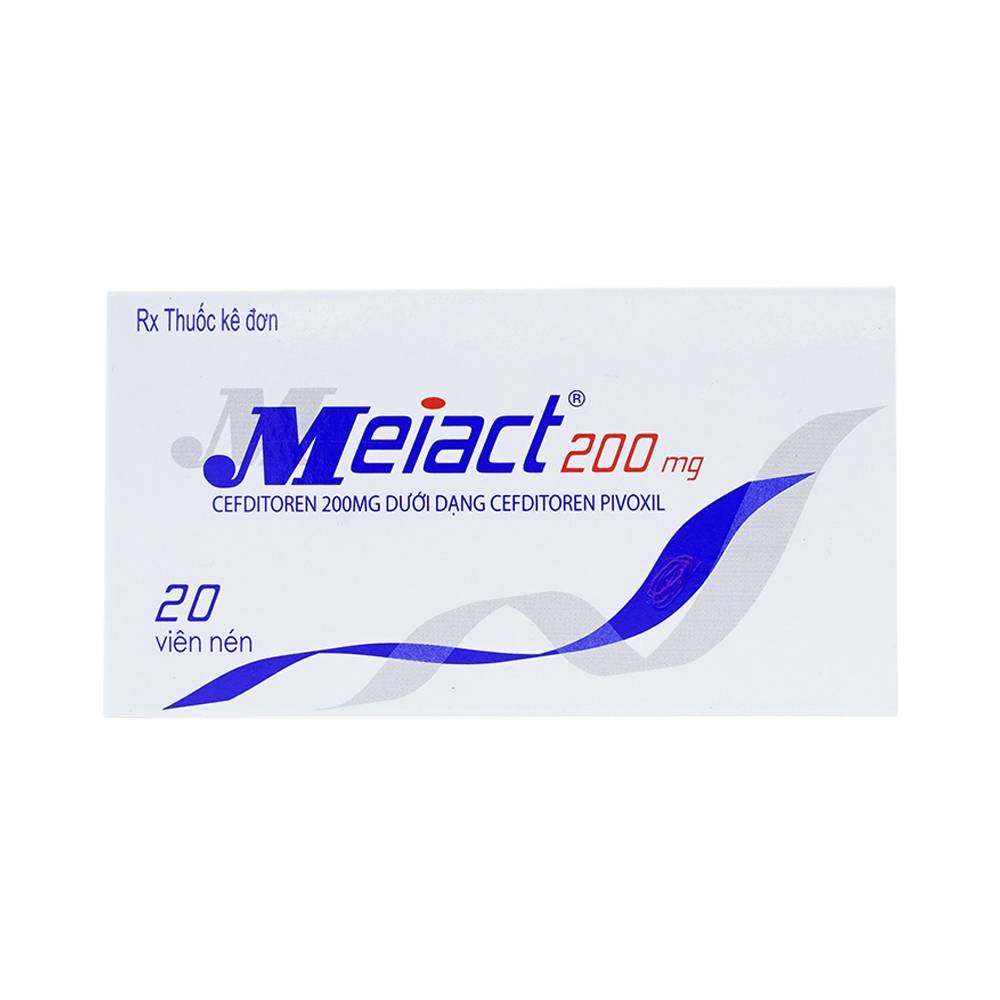
- País de registro
- Forma farmacéuticaCOMPRIMIDO, 200 mg
- Código ATCJ01DD16
- Precio medio en farmacia40.01 EUR
- Principio activo
- Requiere recetaSí
- Fabricante
- ComposiciónMANITOL (E-421) (c.s. C.S mg), CASEINATO SODICO (100 mg mg), CROSCARMELOSA SODICA (150 mg mg), TRIPOLIFOSFATO SODICO (4 mg mg), PROPILENGLICOL (2,91 PORCENTAJE mg)
- Esta información es de carácter general y no sustituye la consulta con un profesional sanitario.
- Alternativas a MEIACT 200 mg COMPRIMIDOS RECUBIERTOS CON PELICULAForma farmacéutica: COMPRIMIDO, 400 mgPrincipio activo: cefditorenFabricante: Meiji Pharma Spain S.A.Requiere recetaForma farmacéutica: COMPRIMIDO, 200 MGPrincipio activo: cefditorenFabricante: Meiji Pharma Spain S.A.Requiere recetaForma farmacéutica: COMPRIMIDO, 400 mgPrincipio activo: cefditorenFabricante: Meiji Pharma Spain S.A.Requiere receta
Médicos online para MEIACT 200 mg COMPRIMIDOS RECUBIERTOS CON PELICULA
Comenta la dosis, los posibles efectos secundarios, interacciones, contraindicaciones o la revisión de receta de MEIACT 200 mg COMPRIMIDOS RECUBIERTOS CON PELICULA, sujeto a valoración médica y a la normativa local.









Preguntas frecuentes
MEIACT 200 mg COMPRIMIDOS RECUBIERTOS CON PELICULA requiere receta en España. Puedes confirmarlo con un médico online según tu caso.
El principio activo de MEIACT 200 mg COMPRIMIDOS RECUBIERTOS CON PELICULA es cefditoren. Esta información ayuda a identificar medicamentos con la misma composición pero con diferentes nombres comerciales.
El precio medio en farmacia de MEIACT 200 mg COMPRIMIDOS RECUBIERTOS CON PELICULA es de aproximadamente 40.01 EUR. Puede variar según el fabricante y la forma farmacéutica.
MEIACT 200 mg COMPRIMIDOS RECUBIERTOS CON PELICULA es fabricado por Meiji Pharma Spain S.A.. La marca y el envase pueden variar según el distribuidor.
Los Médicos de familia, Psiquiatras, Dermatólogos, Cardiólogos, Endocrinólogos, Gastroenterólogos, Neumólogos, Nefrólogos, Reumatólogos, Hematólogos, Infectólogos, Alergólogos, Geriatras, Pediatras, Oncólogos pueden valorar la prescripción de MEIACT 200 mg COMPRIMIDOS RECUBIERTOS CON PELICULA cuando esté clínicamente indicado. Puedes reservar una videoconsulta para comentar tu caso y las opciones de tratamiento.
La receta la emite un médico tras valorar tu estado de salud. En España, MEIACT 200 mg COMPRIMIDOS RECUBIERTOS CON PELICULA se dispensa en las farmacias con esa receta médica. Una consulta online no garantiza su emisión: la decisión corresponde siempre al médico.
Para solicitar una valoración puedes usar Oladoctor:
Otros medicamentos con el mismo principio activo (cefditoren) incluyen MEIACT 400 mg COMPRIMIDOS RECUBIERTOS CON PELICULA, SPECTRACEF 200 mg COMPRIMIDOS RECUBIERTOS CON PELICULA, SPECTRACEF 400 mg COMPRIMIDOS RECUBIERTOS CON PELICULA. Pueden tener diferentes nombres comerciales o formulaciones, pero contienen el mismo componente terapéutico. Consulta siempre con un médico antes de cambiar o iniciar un nuevo medicamento.
