


MEGALOTECT 100 U/ML SOLUCION PARA PERFUSION



Cómo usar MEGALOTECT 100 U/ML SOLUCION PARA PERFUSION
Traducción generada por IA
Este contenido ha sido traducido automáticamente y se ofrece solo con fines informativos. No sustituye la consulta con un profesional sanitario.
Ver originalContenido del prospecto
- Introducción
- Qué es Megalotect y para qué se utiliza
- Qué necesita saber antes de empezar a usar Megalotect
- Reacciones a la perfusión
- Si usted nota cualquiera de los signos siguientes de reacción durante la perfusión de Megalotect, es decir, cefalea, sofocos, escalofríos, dolor muscular, pitos en el pecho (sibilancias), latidos cardíacos rápidos, lumbalgia, náuseas, hipotensión arterial, comuníqueselo de inmediato a su médico.
- Cómo usar Megalotect
- Posibles efectos adversos
- Conservación de Megalotect
- Contenido del envase e información adicional
Introducción
Prospecto: información para el usuario
Megalotect 100 U/ml solución para perfusión
Inmunoglobulina humana anticitomegalovirus
Lea todo el prospecto detenidamente antes de empezar a usar este medicamento, porque contiene información importante para usted.
- Conserve este prospecto, ya que puede tener que volver a leerlo.
- Si tiene alguna duda, consulte a su médico, farmacéutico o enfermero.
- Este medicamento se le ha recetado solamente a usted, y no debe dárselo a otras personas aunque tengan los mismos síntomas que usted, ya que puede perjudicarles.
- Si experimenta efectos adversos, consulte a su médico, farmacéutico o enfermero, incluso si se trata de efectos adversos que no aparecen en este prospecto. Ver sección 4.
Contenido del prospecto
- Qué es Megalotect y para qué se utiliza
- Qué necesita saber antes de empezar a usar Megalotect
- Cómo usar Megalotect
- Posibles efectos adversos
- Conservación de Megalotect
- Contenido del envase e información adicional
1. Qué es Megalotect y para qué se utiliza
Megalotect
- pertenece al grupo de las inmunoglobulinas. Estos medicamentos contienen anticuerpos (los anticuerpos son parte del sistema inmunitario del organismo).
- contiene anticuerpos contra el citomegalovirus.
- es una solución para la perfusión que se administra mediante un “goteo” (perfusión) en una vena.
Megalotect se administra a pacientes en tratamiento inmunosupresor (tratamiento para suprimir el sistema inmunitario), en particular después de un trasplante de órgano, para evitar la manifestación clínica de la infección por citomegalovirus.
Su médico considerará el uso concomitante de agentes virostáticos con Megalotect.

2. Qué necesita saber antes de empezar a usar Megalotect
No use Megalotect
- si es alérgicoa la inmunoglobulina humana anticitomegalovirus o a alguno de los demás componentes de este medicamento (incluidos en la sección 6).
- si sufre una deficiencia de la inmunoglobulina A, en particular, si usted presenta anticuerpos contra la inmunoglobulina A en la sangre, porque puede derivar en anafilaxia.
Advertencias y precauciones
Consulte a su médico, farmacéutico o enfermero antes de la administración de Megalotect.
- si se le va a administrar inmunoglobulina humana por primera vez o después de una interrupción prolongada del tratamiento,o si ha cambiado el producto de inmunoglobulina. En estos casos la frecuencia de las reacciones adversas puede ser mayor y su médico le someterá a un estrecho seguimiento.
- si es alérgicoa las inmunoglobulinas (ver la sección «No use Megalotect»). Usted puede ser alérgico a las inmunoglobulinas sin saberlo, incluso si se le han administrado anteriormente y las ha tolerado bien. No obstante, las reacciones de hipersensibilidad son raras.
- si tiene una infección no tratada o una inflamación subyacente prolongada (crónica)
- si usted
- tiene sobrepesoexcesivoo es un paciente de edad avanzada,
- tiene tensión arterial alta(hipertensión), diabeteso una vasculopatía,
- tiene una mayor tendencia a la coagulación de la sangre,
- ha permanecido postrado en la camadurante mucho tiempo,
- tiene un volumen sanguíneo bajo(hipovolemia) o la densidad de su sangre es mayor de lo normal,
- tiene una enfermedad renalpreexistente o toma medicamentos que pueden dañar los riñones.
En estos casos existe un mayor riesgo de sufrir efectos adversos. Su médico puede interrumpir el tratamiento con Megalotect o tomar otras medidas de precaución (p. ej. una velocidad de perfusión especialmente baja).
Reacciones a la perfusión

Si usted nota cualquiera de los signos siguientes de reacción durante la perfusión de Megalotect, es decir, cefalea, sofocos, escalofríos, dolor muscular, pitos en el pecho (sibilancias), latidos cardíacos rápidos, lumbalgia, náuseas, hipotensión arterial, comuníqueselo de inmediato a su médico.
Informe inmediatamente al médicosi nota estas reacciones durante la administración de Megalotect. Él decidirá si reducir la velocidad de perfusión o detenerla por completo, e iniciar las medidas médicas necesarias para tratar dichas reacciones.
Información sobre la seguridad con respecto a las infecciones
Megalotect se prepara con plasma humano (la parte líquida de la sangre). Cuando se administran medicamentos derivados de sangre o plasma humano, hay que llevar a cabo ciertas medidas para evitar que las infecciones pasen a los pacientes. La sangre de todos los donantes se analiza para detectar virus e infecciones. Además, el procesamiento de la sangre o del plasma incluye pasos que pueden inactivar o eliminar los virus.
A pesar de estas medidas, cuando se administran medicamentos derivados de la sangre o plasma humano, la posibilidad de transmisión de agentes infecciosos no se puede excluir totalmente.
Las medidas tomadas se consideran efectivas para virus como
- el virus de la inmunodeficiencia humana (VIH),
- el virus de la hepatitis A (VHA),
- el virus de la hepatitis B (VHB),
- el virus de la hepatitis C (VHC).
Las medidas tomadas son de valor limitado contra virus como
- el parvovirus B19.
Hasta la fecha, las inmunoglobulinas no se han relacionado con las infecciones por hepatitis A ni por el parvovirus B19. Esto se debe a que los anticuerpos contenidos en Megalotect protegen contra estas infecciones.
Le recomendamos encarecidamente que anote el nombre y el número de lote de cada dosis que se le administre de Megalotect. El número de lote proporciona información sobre las materias primas empleadas en su medicamento. Esto permite, en caso necesario, establecer la relación entre usted y la materia prima empleada.
Niños y adolescentes
Las advertencias y precauciones especiales para los adultos son válidas también para los niños y adolescentes.
Otros medicamentosyMegalotect
Informe a su médico o farmacéutico si está utilizando, ha utilizado recientemente o pudiera tener que utilizar cualquier otro medicamento.
Megalotect puede reducir la eficacia de determinadas vacunas, p. ej. la eficacia de las vacunas contra
- el sarampión
- la rubéola
- las paperas
- la varicela
Si se le ha administrado Megalotect debe esperar como mínimo 3 meses antes de ponerse determinadas vacunas, y al menos un año antes de vacunarse contra el sarampión.
Por favor, evite el uso simultáneo de diuréticos del asa con Megalotect.
Niños y adolescentes
Es de esperar que las interacciones mencionadas para los adultos sean las mismas para los niños y adolescentes.
Embarazo, lactancia y fertilidad
Si está embarazada o en periodo de lactancia, cree que podría estar embarazada o tiene intención de quedarse embarazada, consulte a su médico o farmacéutico antes de utilizar este medicamento.
Su médico decidirá si Megalotect puede usarse durante el embarazo y la lactancia.
Conducción y uso de máquinas
La influencia de Megalotect sobre la capacidad para conducir y utilizar máquinas es pequeña. Si experimenta efectos adversos durante el tratamiento espere a que se resuelvan antes de conducir o utilizar máquinas.
3. Cómo usar Megalotect
Su médico tratante le administrará Megalotect.
La dosis recomendada es de 1 ml por kg de peso corporal y día para adultos, niños y adolescentes.
El medicamento se le administrará por lo menos un total de 6 veces, en intervalos de 2 o 3 semanas. Su médico decidirá el número exacto de perfusiones que necesita y cuándo comenzar con el tratamiento.
Megalotect se administra mediante un equipo “goteo” (perfusión) en una vena. Este medicamento debe estar a temperatura ambiente o corporal antes de su empleo.
Si usa más Megalotect del que debe
Un exceso de Megalotect puede provocar sobrecarga de fluidos e hiperviscosidad (espesamiento) de la sangre, especialmente si usted es mayor de 65 años y/o tiene insuficiencia cardíaca o renal.
Si piensa que ha recibido más Megalotect del que debiera consulte a su médico a la mayor brevedad posible.
En caso de sobredosis o ingestión accidental, llame inmediatamente al Servicio de Información Toxicológica, teléfono 915620420.
Si tiene cualquier otra duda sobre el uso de este medicamento, pregunte a su médico, farmacéutico o enfermero.
4. Posibles efectos adversos
Al igual que todos los medicamentos, este medicamento puede producir efectos adversos, aunque no todas las personas los sufran.
Los siguientes efectos adversos han sido notificados de manera espontánea con Megalotect:
No conocida: La frecuencia no puede estimarse a partir de los datos disponibles
- Anemia (anemia hemolítica)
- Reacciones alérgicas graves, como shock anafiláctico, reacciones anafilácticas, reacciones anafilactoides, hipersensibilidad
- Cefalea, mareos
- Vómito
- Reacciones cutáneas como exantema, enrojecimiento anómalo de la piel, picor
- Dolor articular
- Resultados de los análisis de sangre que indican deterioro de la función renal (aumento del nivel de creatinina sérica) y/o insuficiencia renal aguda
- Escalofríos, fiebre, cansancio
Por lo general, los preparados de inmunoglobulinas humanas normales pueden causar las siguientes reacciones adversas (en frecuencia decreciente):
- escalofríos, dolor de cabeza, mareo, fiebre, vómitos, reacciones alérgicas, náuseas, dolor en las articulaciones, tensión arterial baja y lumbalgia moderada
- disminución del número de glóbulos rojos debido a su destrucción en los vasos sanguíneos (reacciones hemolíticas [reversibles]) y (raramente) anemia hemolítica que requiere transfusión de sangre
- (raramente) descenso brusco de la tensión arterial y en casos aislados shock anafiláctico
- (raramente) reacciones cutáneas pasajeras (incluido lupus eritematoso cutáneo, frecuencia no conocida)
- (muy raramente) reacciones tromboembólicas como ataque al corazón (infarto de miocardio), ictus, coágulos en los vasos sanguíneos del pulmón (embolia pulmonar), coágulos en una vena (trombosis venosa profunda)
- casos de inflamación aguda pasajera de las membranas protectoras que recubren el cerebro y la médula espinal (meningitis aséptica espinal)
- casos de resultados de análisis de sangre que indican disfunción renal y/o insuficiencia renal repentina
- casos de lesión pulmonar aguda relacionada con la transfusión (TRALI, por sus siglas en inglés). Esto provoca la acumulación de fluidos no relacionada con el corazón en los espacios aéreos de los pulmones (edema pulmonar no cardiogénico). Usted experimentaría una importante dificultad para respirar (distrés respiratorio), respiración rápida (taquipnea), concentración anómalamente baja de oxígeno en la sangre (hipoxia) y aumento de la temperatura corporal (fiebre).
Comunicación de efectos adversos
Si experimenta cualquier tipo de efecto adverso, consulte a su médico o farmacéutico, incluso si se trata de posibles efectos adversos que no aparecen en este prospecto. También puede comunicarlos directamente a través del Sistema Español de Farmacovigilancia de medicamentos de Uso Humano: https://www.notificaram.es. Mediante la comunicación de efectos adversos usted puede contribuir a proporcionar más información sobre la seguridad de este medicamento.
5. Conservación de Megalotect
Mantener este medicamento fuera de la vista y del alcance de los niños.
No utilice este medicamento después de la fecha de caducidad que aparece en la caja y el vial después de CAD.
Conservar en nevera (entre 2 °C y 8 °C). Conservar en el embalaje original para protegerlo de la luz.
No congelar.
El producto se debe inspeccionar visualmente antes del uso: la solución debe ser transparente o ligeramente opalescente (con un aspecto lechoso) e incolora o amarillo pálido. No usar Megalotect si la solución está turbia o se ha formado sedimento.
El medicamento se debe usar inmediatamente después de su apertura.
Los medicamentos no se deben tirar por los desagües ni a la basura. Pregunte a su farmacéutico cómo deshacerse de los envases y de los medicamentos que ya no necesita. De esta forma, ayudará a proteger el medio ambiente.
6. Contenido del envase e información adicional
Composición de Megalotect
El principio activo es inmunoglobulina humana anticitomegalovirus (CMVIG).
1 ml de la solución contiene:
50 mg de proteínas de plasma humano, de los cuales al menos un 96% es inmunoglobulina G (IgG), con un contenido de anticuerpos contra el citomegalovirus (CMV) de 100 U*.
Cada vial con 10 ml contiene: 500 mg de proteínas de plasma humano (de las cuales al menos un 96 % es inmunoglobulina G), con un contenido de anticuerpos contra el CMV de 1.000 U*.
Cada vial con 50 ml contiene: 2.500 mg de proteínas de plasma humano (de las cuales al menos un 96 % es inmunoglobulina G), con un contenido de anticuerpos contra el CMV de 5.000 U*.
La distribución de las subclases de IgG es aprox. 65% IgG1, 30% IgG2, 3% IgG3, 2% IgG4.
El contenido máximo de inmunoglobulina A (IgA) es de 2.000 microgramos/ml.
- unidades de la preparación de referencia del Instituto Paul Ehrlich
Los demás componentes son glicina y agua para preparaciones inyectables.
Aspecto del producto y contenido del envase
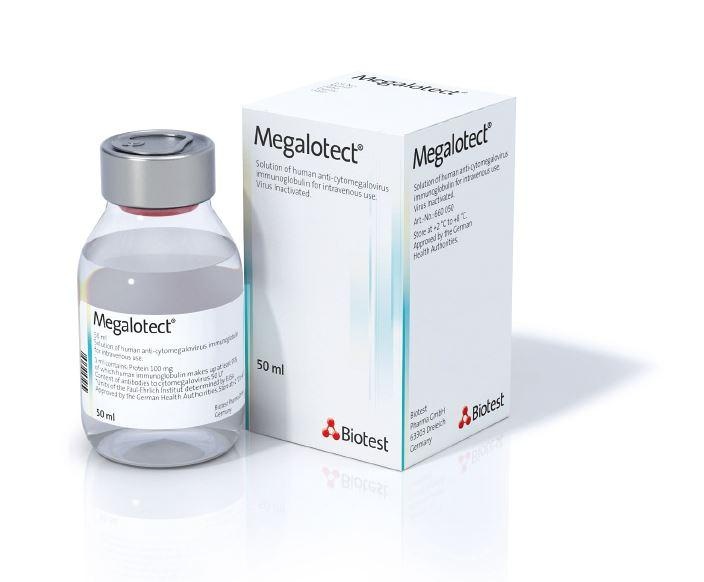
Megalotect es una solución transparente o ligeramente opalescente (con un aspecto lechoso), incolora o ligeramente amarillenta en viales fabricados de vidrio incoloro.
Megalotect está disponible en los siguientes tamaños de envase:
Un caja contiene 1 vial con 10 ml (1.000 U) de solución para perfusión
Un caja contiene 1 vial con 50 ml (5.000 U) de solución para perfusión
Puede que solamente estén comercializados algunos tamaños de envases.
Titular de la autorización de comercialización y responsable de la fabricación
Biotest Pharma GmbH
Landsteinerstraße 5
63303 Dreieich
Alemania
Tel.: + 49 6103 801-0
Fax: + 49 6103 801-150
E-mail: [email protected]
Para más información sobre este medicamento, póngase en contacto con el representante local del titular de la autorización de comercialización:
Grifols Movaco, S.A.
Can Guasc, s/n – Parets del Vallès
08150 Barcelona
España
Este medicamento está autorizado en los estados miembros del Espacio Económico Europeo con los siguientes nombres:
Croacia, Alemania, Hungría: Cytotect CP Biotest
Austria: Cytotect CP Biotest 100 E/ml Infusionslösung
Italia: Cytomegatect
España: Megalotect 100 U/ml solución para perfusión
Grecia, Polonia, Portugal: Megalotect CP
Bélgica, Países Bajos: Megalotect 100 E/ml
Eslovenia: Megalotect 100 e./ml raztopina za infundiranje
Fecha de la última revisión de este prospecto:05/2023.
-------------------------------------------------------------------------------------------------------------------
Esta información está destinada únicamente a profesionales del sector sanitario:
Posología y forma de administración
La administración se deberá iniciar en el día del trasplante. Si el trasplante es de médula ósea, también se puede planear el inicio de la profilaxis hasta 10 días antes de la intervención, especialmente en pacientes seropositivos para CMV. Se deben administrar al menos un total de 6 dosis en intervalos de 2 a 3 semanas.
Forma de administración
Vía intravenosa.
Megalotect se perfunde por vía intravenosa a una velocidad inicial de 0,08 ml/kg PC/h durante 10 minutos. En caso de reacción adversa se reducirá la velocidad de la administración o se detendrá la perfusión. Si se tolera bien se puede incrementar gradualmente la velocidad de administración hasta un máximo de 0,8 ml/kg PC/h durante el tiempo restante de la perfusión.
Advertencias y precauciones
La velocidad de la perfusión puede estar relacionada con determinadas reacciones graves al medicamento. Se debe seguir de forma detallada la velocidad de perfusión recomendada. Los pacientes serán sometidos a un seguimiento estrecho y una observación minuciosa por si mostraran alguno de los síntomas durante el periodo de perfusión.
Algunas reacciones adversas pueden producirse con mayor frecuencia
- en caso de una velocidad de perfusión alta
- en pacientes que reciben inmunoglobulina humana por primera vez o, en casos raros, en los que se ha reemplazado el producto de inmunoglobulina o casos en los que ha pasado mucho tiempo desde la última perfusión.
Con frecuencia, pueden evitarse las posibles complicaciones asegurándose que los pacientes
- no son sensibles a la inmunoglobulina humana. Para ello inyectar inicialmente el producto lentamente (0,08 ml/kg peso corporal/hora).
- son vigilados cuidadosamente durante el periodo de perfusión para detectar cualquier síntoma. En especial, los casos de aquellos pacientes no tratados con anterioridad con inmunoglobulina humana, los pacientes que provengan de otros tratamientos con productos de inmunoglobulina humana intravenosa (IgIV) o cuando ha pasado mucho tiempo desde la última perfusión, por ello deben ser vigilados en el hospital durante la primera perfusión y durante la primera hora posterior a la primera perfusión para detectar posibles efectos adversos. Los demás pacientes deben ser observados durante al menos 20 minutos después de la administración.
En caso de producirse una reacción adversa, se debe reducir la velocidad de la perfusión o detener la perfusión. El tratamiento necesario depende del tipo de reacción adversa y la naturaleza y la gravedad de la reacción adversa.
En caso de shock se aplicará el tratamiento médico habitual correspondiente.
En todos los pacientes, el tratamiento con inmunoglobulina requiere
- una hidratación adecuada antes de comenzar con la perfusión de inmunoglobulina,
- vigilancia de la diuresis,
- vigilancia de los niveles de creatinina sérica,
- evitar el uso simultáneo de diuréticos del asa.
Hipersensibilidad
Las reacciones de hipersensibilidad son infrecuentes. Pueden darse en pacientes con anticuerpos anti-IgA.
Se puede desarrollar anafilaxia en pacientes
- con IgA indetectable que tienen anticuerpos anti-IgA
- que hayan tolerado un tratamiento previo con immunoglobulina humana
En caso de shock se aplicará el tratamiento médico habitual correspondiente.
Tromboembolia
Existen evidencias clínicas de una asociación entre la administración de inmunoglobulina intravenosa (IgIV) y episodios tromboembólicos, como infarto de miocardio, accidente cerebrovascular, embolia pulmonar y trombosis venosa profunda. Se supone que estos eventos están relacionados con un aumento relativo en la viscosidad de la sangre debido a la alta afluencia de inmunoglobulina en los pacientes de riesgo. Se debe tener precaución cuando se prescribe y perfunde inmunoglobulinas a pacientes obesos y a pacientes con factores de riesgo preexistentes de eventos trombóticos (como edad avanzada, hipertensión, diabetes mellitus y antecedentes de vasculopatía o episodios trombóticos, pacientes con enfermedades trombofílicas adquiridas o hereditarias, pacientes inmovilizados durante periodos prolongados, pacientes gravemente hipovolémicos, pacientes con enfermedades que incrementan la viscosidad de la sangre).
En pacientes con riesgo de sufrir reacciones adversas tromboembólicas, los productos de IgIV se deben administrar a la velocidad mínima de perfusión y a la mínima dosis posible.
Insuficiencia renal aguda
Se han comunicado casos de insuficiencia renal aguda en pacientes tratados con inmunoglobulina intravenosa (IgIV). En la mayoría de los casos se han identificado los factores de riesgo, como insuficiencia renal preexistente, diabetes mellitus, hipovolemia, sobrepeso, administración concomitante de medicamentos nefrotóxicos o edad superior a 65.
Antes de la perfusión de la IgIV se deben evaluar los parámetros renales, especialmente en pacientes considerados con un mayor riesgo potencial de desarrollar insuficiencia renal aguda y, de nuevo, en intervalos adecuados. En los pacientes con riesgo de insuficiencia renal aguda, los productos de IgIV deben ser administrados a la mínima velocidad de perfusión y dosis viable.
En caso de insuficiencia renal deberá considerarse interrumpir la administración del producto de inmunoglobulina.
Aunque las notificaciones de disfunción renal e insuficiencia renal aguda se han asociado al uso de muchos medicamentos con IgIV autorizados que contienen diferentes excipientes como sacarosa, glucosa y maltosa, aquellos que contenían sacarosa como estabilizante representaron una parte desproporcionada del número total. En los pacientes de riesgo debe considerarse usar productos de inmunoglobulina que no contengan estos excipientes. Megalotect no contiene sacarosa, glucosa ni maltosa.
Síndrome de meningitis aséptica (SMA)
Se ha informado de que el SMA se produce en relación con el tratamiento con inmunoglobulinas intravenosas (productos de IgIV). Por lo general, el síndrome comienza desde transcurridas varias horas hasta 2 días después del inicio del tratamiento con IgIV. Con frecuencia, los análisis del líquido cefalorraquídeo son positivos con pleocitosis de hasta varios miles de células por mm3, predominantemente de las series granulocíticas, y unas concentraciones elevadas de proteínas de hasta varios cientos por mg/dl. El SMA se produce con mayor frecuencia en asociación con el tratamiento con altas dosis de IgIV (2 g/kg)
Los pacientes que muestren estos signos y síntomas se deben someter a un examen neurológico exhaustivo, incluidos estudios del líquido cefalorraquídeo (LCR), para excluir otras causas de meningitis.
La suspensión del tratamiento con IgIV ha resultado en la remisión del SMA en el plazo de varios días sin secuelas.
Anemia hemolítica
Las inmunoglobulinas intravenosas (productos de IgIV) pueden contener anticuerpos de grupos sanguíneos que actúan como hemolisinas e inducen el recubrimiento in vivode los glóbulos rojos con inmunoglobulina, provocando una reacción de antiglobulina directa positiva (prueba de Coombs directo positivo) y, excepcionalmente, hemólisis. La anemia hemolítica puede desarrollarse como consecuencia del tratamiento con IgIV y potenciado por el secuestro de eritrocitos. Los pacientes tratados con IgIV deben ser vigilados para detectar los signos y los síntomas clínicos de hemólisis.
Neutropenia/Leucopenia
Después del tratamiento con IgIV se ha notificado un descenso pasajero en el número de neutrófilos y/o episodios de neutropenia, en ocasiones graves. Esto suele suceder en las horas o días posteriores a la administración de IgIV, y se resuelve de manera espontánea en unos 7 a 14 días.
Lesión pulmonar aguda relacionada con la transfusión (TRALI, por sus siglas en inglés)
En ocasiones se ha notificado lesión pulmonar aguda no cardiogénica (lesión pulmonar aguda relacionada con la transfusión (TRALI) en pacientes que han recibido IgIV. TRALI se caracteriza por hipoxia grave, disnea, taquipnea, cianosis, fiebre e hipotensión. Por lo general, los síntomas de TRALI suelen desarrollarse durante o en las 6 horas siguientes a la perfusión, con frecuencia en las primeras 1-2 horas. Por tanto se debe vigilar a los receptores de IgIV e interrumpir inmediatamente la perfusión de IgIV en caso de reacciones adversas pulmonares. TRALI es una enfermedad potencialmente mortal, que se debe tratar inmediatamente en la unidad de cuidados intensivos.
Interferencia con las pruebas serológicas
Después de la administración de inmunoglobulina, el aumento transitorio de los diferentes anticuerpos transferidos pasivamente a la sangre del paciente puede provocar resultados falsos positivos en las pruebas serológicas.
La transmisión pasiva de anticuerpos a antígenos eritrocíticos, p. ej., A, B y D, puede interferir con algunas pruebas serológicas de anticuerpos de eritrocitos, por ejemplo, la prueba de antiglobulina directa (PAD, Test de Coombs directo).
Incompatibilidades y precauciones especiales de manipulación
Este medicamento no se debe mezclar con otros medicamentos, ni productos de IgIV.
El medicamento se debe usar inmediatamente después de su apertura.
Este medicamento debe estar a temperatura ambiente o corporal antes de su empleo.
Los productos se deben inspeccionar visualmente antes de administrarlos. La solución debe ser transparente o ligeramente opalescente e incolora o amarillo pálido. No use una solución que esté turbia o que tenga sedimentos.
- País de registro
- Forma farmacéuticaINYECTABLE PERFUSION, 100 U/ml
- Código ATCJ06BB09
- Principio activo
- Requiere recetaSí
- Fabricante
- Esta información es de carácter general y no sustituye la consulta con un profesional sanitario.
- Alternativas a MEGALOTECT 100 U/ML SOLUCION PARA PERFUSIONForma farmacéutica: INYECTABLE, 250 UIPrincipio activo: tetanus immunoglobulinFabricante: Instituto Grifols S.A.Requiere recetaForma farmacéutica: INYECTABLE, 500 UIPrincipio activo: tetanus immunoglobulinFabricante: Instituto Grifols S.A.Requiere recetaForma farmacéutica: INYECTABLE PERFUSION, 50 UI/MLPrincipio activo: hepatitis B immunoglobulinFabricante: Biotest Pharma GmbhRequiere receta

Médicos online para MEGALOTECT 100 U/ML SOLUCION PARA PERFUSION
Comenta la dosis, los posibles efectos secundarios, interacciones, contraindicaciones o la revisión de receta de MEGALOTECT 100 U/ML SOLUCION PARA PERFUSION, sujeto a valoración médica y a la normativa local.











Preguntas frecuentes
