



MALAWAY 250 mg/100 mg Comprimidos Recubiertos Con Pelicula

Revisión de receta online
Un médico revisará tu caso y determinará si la prescripción es médicamente apropiada.

Habla con un médico sobre este medicamento
Comenta tus síntomas y las opciones de tratamiento en una consulta online.



Cómo usar MALAWAY 250 MG/100 MG COMPRIMIDOS RECUBIERTOS CON PELICULA EFG
Contenido del prospecto
- Introducción
- Qué es Malaway y para qué se utiliza
- Qué necesita saber antes de empezar a tomar Malaway
- Cómo tomar Malaway
- Posibles efectos adversos
- Conservación de Malaway
- Contenido del envaso e información adicional
Introducción
Prospecto: información para el usuario
Malaway 250 mg/100 mg comprimidos recubiertos con película EFG
atovacuona/hidrocloruro de proguanil
Lea todo el prospecto detenidamente antes de empezar a tomar este medicamento,porque contiene información importante para usted.
- Conserve este prospecto, ya que puede tener que volver a leerlo.
- Si tiene alguna duda, consulte a su médico o farmacéutico.
- Este medicamento se le ha recetado solamente a usted, y no debe dárselo a otras personas aunque tengan los mismos síntomas que usted, ya que puede perjudicarles.
- Si experimenta efectos adversos, consulte a su médico o farmacéutico, incluso si se trata de efectos adversos que no aparecen en este prospecto. Ver sección 4.
Contenido del prospecto
- Qué es Malaway y para qué se utiliza
- Qué necesita saber antes de empezar a tomar Malaway
- Cómo tomar Malaway
- Posibles efectos adversos
- Conservación de Malaway
- Contenido del envase e información adicional
1. Qué es Malaway y para qué se utiliza
Malaway pertenece a un grupo de medicamentos denominados antipalúdicos.Contiene dos principios activos, atovacuona e hidrocloruro de proguanil.
Malaway tiene dos usos:
- Prevención de la malaria en adultos y niños con un peso superior a 40 kg
- Tratamiento de la malaria en adultos y niños con un peso superior a 11 kg
La malaria se transmite por la picadura de un mosquito infectado, que introduce el parásito de la malaria (Plasmodium falciparum)en la sangre. Malaway previene la malaria matando este parásito. Para las personas que ya han sido infectadas de malaria, Malaway también mata estos parásitos.
Protéjase de contraer la malaria
Cualquier persona, de cualquier edad, puede contraer la malaria. Es una enfermedad grave, pero es prevenible. Incluso tomando Malaway, es muy importante que tome precauciones para evitar que le puedan picar los mosquitos.
- Use repelente de mosquitos en todas aquellas áreas del cuerpo expuestas.
- Lleve ropa de colores claros que cubra la mayor parte posible del cuerpo,especialmente al anochecer que es cuando los mosquitos están más activos.
- Duerma en una habitación protegidacontra mosquitos o bajo una mosquitera impregnada con insecticida.
- Cierre las ventanas y las puertas al anochecer,si no están protegidas.
- Considere usar un insecticida(pastilla, spray, anti-mosquitos eléctrico) para despejar la habitación de insectos o impedir que entren en la habitación.
Si necesita más consejos,consulte a su médico o farmacéutico.
Aun tomando todas las precauciones necesarias es posible contraer la malaria.Algunos tipos de infección de malaria tardan mucho tiempo en ocasionar síntomas; por lo tanto la enfermedad no comenzará hasta después de varios días, semanas o incluso meses después de volver de viaje.
Consulte inmediatamente a un médico si tiene síntomastales como fiebre, dolor de cabeza, tiritona o cansancio, después de volver del extranjero.

¿No estás seguro de si este medicamento es adecuado para ti?
Comenta tus síntomas y tratamiento con un médico online.
2. Qué necesita saber antes de empezar a tomar Malaway
No tome Malaway
- Si es alérgico a la atovacuona y/o al proguanil o a alguno de los demás componentes de este medicamento (incluidos en la sección 6).
- Para prevenir la malaria, si padece insuficiencia renal grave.
Advertencias y precauciones
Consulte a su médico o farmacéutico antes de empezar a tomar este medicamento.
Para prevenir la malaria:
- Si se siente mal (vómitos)durante la primera hora después de tomar Malaway comprimidos, tómese otra dosis rápidamente.
- Es importante tomar todo el medicamento de Malaway. Si necesita tomar alguna dosis adicional debido a los vómitos, es posible que necesite otra receta.
- Si usted ha estado vomitando, es especialmente importante usar protección adicional, tales como repelentes y mosquiteras. Es posible que Malaway no sea tan eficaz, puesto que la cantidad absorbida será menor.
Para tratar la malaria:
- Si usted ha estado vomitando y con diarrea, consulte a su médico. Necesitará análisis de sangre periódicos. Como la cantidad absorbida de Malaway se ha reducido, podría no ser tan eficaz. Los análisis comprobarían si el parásito de la malaria está siendo eliminado de su sangre.
- Si padece una enfermedad renal grave, puede que su médico le quiera recetar un medicamento diferente
- Si contrae algún tipo de infección mientras está en tratamiento con Malaway, su médico puede prescribirle otro tipo de medicamentos en lugar de Malaway.
- Si se trata la malaria, pero aun así la vuelve a contraer o si la malaria es causada por un cierto tipo de parásito, su médico puede prescribirle otro medicamento aparte de Malaway.
Otros medicamentos y Malaway
Informe a su médico o farmacéutico si está tomando, ha tomado recientemente o pudiera tener que tomar cualquier otro medicamento.
Algunos medicamentos pueden afectar al modo en que funciona Malaway, o el mismo Malaway puede potenciar o disminuir el efecto de otros medicamentos utilizados al mismo tiempo. Estos incluyen:
- metoclopramida, usada para tratar las náuseas y los vómitos.
- los antibióticos: tetraciclina, rifampicina, rifabutina.
- efavirenz o algunos inhibidores de la proteasa muy activos utilizados para el tratamiento del VIH.
- indinavir, utilizado para el tratamiento del VIH.
- warfarina y otros medicamentos anticoagulantes.
- etopósido utilizado para el tratamiento del cáncer
Comunique a su médico si está tomando alguno de ellos. Su médico podría decidir que Malaway no es adecuado para usted, o bien que necesita hacerle revisiones adicionales mientras lo esté tomando.
RECUERDE consultar con su médico si empieza a tomar cualquier otro medicamento mientras está tomando Malaway.
Toma de Malaway con alimentos y bebidas
Tome Malaway con alimentos o una bebida láctea, si es posible. Esto aumentará la cantidad de Malaway que su organismo puede absorber, y hará su tratamiento más eficaz.
Es preferible no partir los comprimidos.
Embarazo y lactancia
Si está embarazada, o en periodo de lactancia, cree que podría estar embarazada o tiene intención de quedarse embarazada, consulte a su médico o farmacéutico antes de utilizar este medicamento. No tome Malaway a no ser que su médico se lo recomiende.
No amamante mientras esté tomando Malaway, ya que los componentes de Malaway pueden pasar a la leche materna y dañar a su bebé.
Conducción y uso de máquinas
Si se siente mareado, no conduzca. Malaway hace que algunas personas se sientan mareadas. Si esto le pasa a usted, no debe conducir, utilizar máquinas o tomar parte en actividades que puedan ponerle en riesgo a usted o a otras personas.
3. Cómo tomar Malaway
Siga exactamente las instrucciones de administración de este medicamento indicadas por su médico o farmacéutico. En caso de duda, consulte de nuevo a su médico o farmacéutico.
Tome Malaway junto con alimentos o una bebida láctea siempre que sea posible.
Se recomienda tomar Malaway todos los días a la misma hora.
Prevención de la malaria:
La dosis habitual en adultos y adolescentes que pesen más de 40 kg es un comprimido una vez al día, tomado como se indica abajo.
En niños, consulte a su médico.
Malaway no se recomienda para prevenir la malaria en niños, o en adultos o adolescentes cuyo peso sea inferior a 40 kg.
En su país puede estar disponible un tipo diferente de comprimido de Malaway para niños.
Para prevenir la malaria en adultos:
- Comience a tomar Malaway 1 o 2 días antes de viajar a la zona con malaria.
- Continúe tomándolo diariamente durante el viaje y siga tomándolo durante otros 7 días, una vez haya regresado a una zona sin malaria.
Tome todos los comprimidos del tratamiento de Malaway para una máxima protección.
Abandonarlo antes implica un riesgo de contraer malaria, ya que son necesarios 7 días para asegurarse de la muerte de los parásitos que pudiese haber en su cuerpo por la picadura del mosquito infectado.
Tratamiento de la malaria:
La dosis recomendada en adultos es de 4 comprimidos una vez al día durante 3 días.
Para niños que pesen 11 kg o más:
- de 11 a 20 kg – 1 comprimido al día durante 3 días.
- de 21 a 30 kg – 2 comprimidos al día durante 3 días.
- de 31 a 40 kg – 3 comprimidos al día durante 3 días.
- más de 40 kg – la misma dosis que para adultos.
Malaway no se recomienda para el tratamiento de la malaria en niños que pesen menos de 11 kg.
Para niños que pesen menos de 11 kg, consulte a su médico. Es posible que existan otro tipo de comprimidos de Malaway para niños en su país.
Si toma más Malaway del que debe
Contacte con su médico o farmacéutico para solicitar ayuda y si es posible muéstrele el envase del medicamento.
En caso de sobredosis o ingestión accidental, consulte inmediatamente a su médico o farmacéutico o llame al Servicio de Información Toxicológica, teléfono: 91.562.04.20 indicando el medicamento y la cantidad ingerida.
Si olvidó tomar Malaway
Es muy importante que tome el tratamiento completo de Malaway. Si se olvida una dosis, no se preocupe. Tome la siguiente dosis tan pronto como lo recuerde. Luego continúe el tratamiento como lo estaba haciendo anteriormente. No tome una dosis doble para compensar las dosis olvidadas.
No interrumpa el tratamiento con Malawaysin consultar con su médico
Siga tomando Malawaydurante 7 días después de regresar de un área libre de malaria. Tome el tratamiento completo de Malaway para conseguir la máxima protección. Si lo interrumpe antes, se pone en riesgo de contraer la malaria, ya que son necesarios 7 días para asegurarse de la muerte de los parásitos que pudiese haber en su cuerpo por la picadura de un mosquito infectado.
Consulte a su médico o farmacéutico para que le aconseje qué hacer.
Si tiene cualquier otra duda sobre el uso de este medicamento, pregunte a su médico o farmacéutico.

¿Has empezado a tomar el medicamento y tienes preguntas?
Comenta tus síntomas y tratamiento con un médico online.
4. Posibles efectos adversos
Al igual que todos los medicamentos, este medicamento puede producir efectos adversos, aunque no todas las personas los sufran.
Esté atento a las siguientes reacciones graves. Se han observado en un número reducido de personas, aunque se desconoce su frecuencia exacta.
Reacciones alérgicas graves. Los signos incluyen:
- Erupción y picor.
- Sibilancia repentina, opresión en el pecho o en la garganta, o dificultad para respirar.
- Hinchazón de los párpados, cara, labios, lengua o cualquier otra parte del cuerpo.
Si presenta alguno de estos síntomas, póngase en contacto con un médico inmediatamente. Deje de tomar Malaway.
Reacciones cutáneas graves:
- Erupción cutánea que puede presentar ampollas y que parecen pequeñas dianas (puntos centrales oscuros rodeados de zonas más claras con un anillo oscuro alrededor del borde) (eritema multiforme).
- Erupción cutánea grave extensa, con ampollas y descamación de la piel, especialmente alrededor de la boca, la nariz, los ojos y los genitales (síndrome de Stevens-Johnson).
Si detecta alguno de estos síntomas, póngase en contacto con un médico de forma urgente.
La mayoría de los otros efectos adversos notificados han sido leves y no han durado mucho tiempo.
Efectos adversos muy frecuentes (pueden afectar a más de 1 de cada 10 pacientes):
- Dolor de cabeza
- Sentirse y encontrarse mal (náuseas y vómitos)
- Dolor de estómago
- Diarrea
Efectos adversos frecuentes (pueden afectar a entre 1 y 10 de cada 100 pacientes):
- Mareos
- Problemas para dormir (insomnio)
- Sueños extraños
- Depresión
- Pérdida de apetito
- Fiebre
- Erupciones cutáneas
- Tos
- Reacciones alérgicas
- Picor (prurito)
Efectos adversos frecuentes que pueden descubrirse en sus análisis de sangre:
- Disminución del número de glóbulos rojos (anemia) que puede provocar cansancio, dolor de cabeza y dificultad para respirar.
- Disminución del número de glóbulos blancos (neutropenia) que le hace más propenso a contraer infecciones.
- Concentración baja de sodio en la sangre (hiponatremia).
- Aumento de las enzimas hepáticas
Efectos adversos poco frecuentes (pueden afectar a entre 1 y 10 de cada 1000 pacientes)
Estos pueden afectar hasta 1 de cada 100 personas:
- Ansiedad
- Una percepción inusual de un latido anómalo del corazón (palpitaciones),
- Hinchazón y enrojecimiento de la boca
- Manchas rojas e hinchadas en la piel (urticaria)
- Caída del cabello
Efectos adversos poco frecuentes que pueden descubrirse en sus análisis de sangre:
- Aumento de la amilasa (una enzima producida en el páncreas)
Efectos adversos raros: pueden afectar a entre 1 y 10 de cada de 10.000 personas
- Ver u oír cosas que no existen (alucinaciones)
Otros efectos adversos:Otros efectos adversos han ocurrido en un número reducido de personas no obstante su frecuencia es desconocida
- Inflamación del hígado (hepatitis)
- Obstrucción de los canales biliares (colestasis)
- Aumento de la frecuencia cardíaca (taquicardia)
- Inflamación de los vasos sanguíneos (vasculitis) que puede ser visible a través de unos puntos rojos o morados, aunque puede afectar a otras partes del cuerpo
- Ataques (convulsiones)
- Crisis de pánico, llanto
- Pesadillas
- Problemas de salud mental graves, en que la persona pierde contacto con la realidad y es incapaz de pensar y juzgar claramente
- Úlceras bucales
- Ampollas
- Descamación de la piel
- Aumento de la sensibilidad de la piel a la luz
- Efectos en su estómago (intolerancia gástrica)
Otros efectos adversos que pueden aparecer en los análisis de sangre:
- Descenso de todos los tipos celulares de la sangre (pancitopenia).
Si considera que alguno de los efectos adversos que sufre es grave o si aprecia cualquier efecto adverso no mencionado en este prospecto, informe a su médico o farmacéutico.
Comunicación de efectos adversos
Si experimenta cualquier tipo de efecto adverso, consulte a su médico o farmacéutico., incluso si se trata de posibles efectos adversos que no aparecen en este prospecto. También puede comunicarlos directamente a través del Sistema Español de Farmacovigilancia de Medicamentos de Uso Humano: www.notificaRAM.es. Mediante la comunicación de efectos adversos usted puede contribuir a proporcionar más información sobre la seguridad de este medicamento.
5. Conservación de Malaway
Mantener este medicamento fuera de la vista y del alcance de los niños.
No utilice este medicamento después de la fecha de caducidad que aparece en la caja y el blíster después de CAD. La fecha de caducidad es el último día del mes que se indica.
Este medicamento no requiere condiciones especiales de conservación.
Los medicamentos no se deben tirar por los desagües ni a la basura. Deposite los envases y los medicamentos que no necesita en el Punto SIGRE de la farmacia. Pregunte a su farmacéutico cómo deshacerse de los envases y de los medicamentos que ya no necesita. De esta forma, ayudará a proteger el medio ambiente.
6. Contenido del envaso e información adicional
Composición de Malaway
- Los principios activos son atovacuona e hidrocloruro de proguanil.
Cada comprimido contiene 250 mg de atovacuona y 100 mg de hidrocloruro de proguanil.
- Los demás componentes son:
Núcleo del comprimido: poloxamer 188, celulosa microcristalina, hidroxipropilcelulosa con bajo grado de sustitución, povidona K30, carboximetilalmidón de sodio (tipo A) (de patata), sílice coloidal anhidra, estearato de magnesio.
Recubrimiento pelicular: hipromelosa, dióxido de titanio (E171), óxido de hierro rojo (E172), Macrogol 400, Macrogol 8000.
Aspecto del producto y contenido del envase
Malaway son comprimidos de color marrón rosado, redondos, biconvexos, con borde biselado, recubiertos con película y marcados en una cara con "404" y con "G" en la otra.
Malaway se presenta en blísteres de PVC/PVDC (transparente) y láminas de aluminio PVC/PVDC rígido y templado.
Tamaños de envase: 12, 24, 36, 60 comprimidos.
Puede que solamente estén comercializados algunos tamaños de envases.
Titular de la autorización de comercializacióny responsable de la fabricación
Titular de la autorización de comercialización:
Glenmark Arzneimittel GmbH
Industriestr. 31
82194 Gröbenzell
Alemania
Responsable de la fabricación:
Glenmark Pharmaceuticals s.r.o.
Fibíchova 143
566 17 Vysoké Mýto
República Checa
Pueden solicitar más información respecto a este medicamento dirigiéndose al representante local del titular de la autorización de comercialización:
Glenmark Farmacéutica, S.L.U.
C/ Retama 7, 7ª planta
28045 Madrid
España
Este medicamento está autorizado en los estados miembros del Espacio Económico Europeo con los siguientes nombres:
País | Nombre del medicamento |
Alemania | Atovaquon/Proguanilhydrochlorid Glenmark 250 mg /100 mg Filmtabletten |
Austria | Atovaquon/Proguanilhydrochlorid Glenmark 250 mg/100 mg Filmtabletten |
Dinamarca | Atovaquone/Proguanil Glenmark 250 mg /100 mg Filmovertrukne tabletter |
España | Malaway 250 mg/100 mg comprimidos recubiertos con película EFG |
Francia | Atovaquone/Proguanil BGR 250 mg /100 mg comprimé pelliculé |
Irlanda | Atovaquone/Proguanil Hydrochloride 250 mg /100 mg Film-coated tablets |
Noruega | Atovaquone/Proguanil Glenmark |
Países Bajos | Atovaquone/Proguanilhydrochloride Glenmark 250 mg /100 mg Filmomhulde Tabletten |
Polonia | Falcimar |
Suecia | Atovaquone/Proguanil Glenmark 250/100 mg filmdragerade tabletter |
Fecha de la última revisión de este prospecto:diciembre 2023.
La información detallada de este medicamento está disponible en la página Web de la Agencia Española de Medicamentos y Productos Sanitarios (AEMPS) (http://www.aemps.gob.es/)
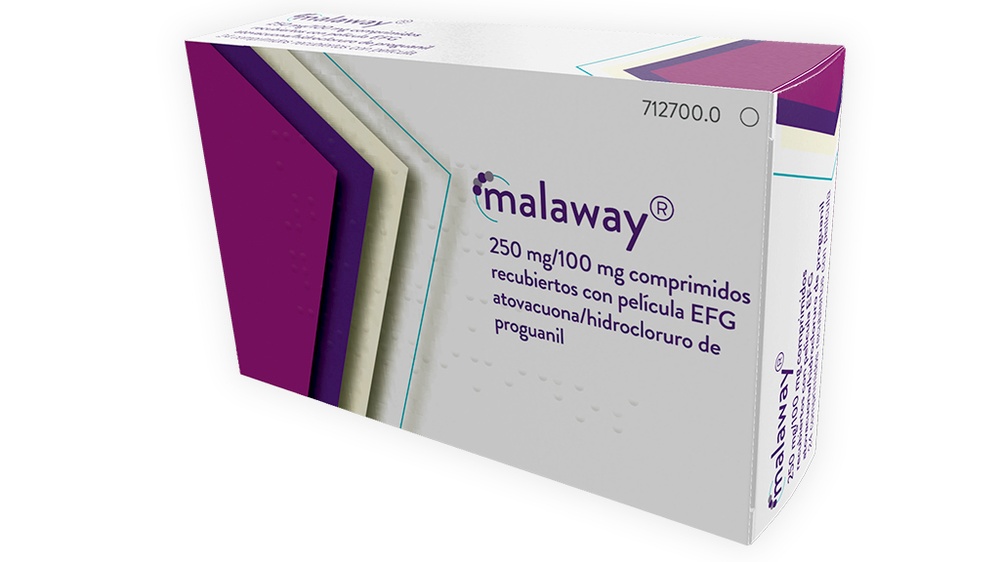
- País de registro
- Forma farmacéuticaCOMPRIMIDO, 250 mg/100 mg
- Código ATCP01BB51
- Precio medio en farmacia19.84 EUR
- Principio activo
- Requiere recetaSí
- Fabricante
- ComposiciónCARBOXIMETILALMIDON SODICO (30,00 mg mg), CARBOXIMETILALMIDON SODICO (20,00 mg mg)
- Esta información es de carácter general y no sustituye la consulta con un profesional sanitario.
- Alternativas a MALAWAY 250 MG/100 MG COMPRIMIDOS RECUBIERTOS CON PELICULA EFGForma farmacéutica: COMPRIMIDO, 250 mg/100 mgPrincipio activo: proguanil and atovaquoneFabricante: Viatris LimitedRequiere recetaForma farmacéutica: COMPRIMIDO, 250/100 mg/ mgPrincipio activo: proguanil and atovaquoneFabricante: Glaxosmithkline S.A.Requiere recetaForma farmacéutica: COMPRIMIDO, 62,5/25 mg/mgPrincipio activo: proguanil and atovaquoneFabricante: Glaxosmithkline S.A.Requiere receta
Médicos online para MALAWAY 250 MG/100 MG COMPRIMIDOS RECUBIERTOS CON PELICULA EFG
Comenta la dosis, los posibles efectos secundarios, interacciones, contraindicaciones o la revisión de receta de MALAWAY 250 MG/100 MG COMPRIMIDOS RECUBIERTOS CON PELICULA EFG, sujeto a valoración médica y a la normativa local.









Obtén una receta de MALAWAY 250 MG/100 MG COMPRIMIDOS RECUBIERTOS CON PELICULA EFG online
Rellena un formulario de 2 minutos
Cuéntanos tus síntomas, historial y el medicamento que necesitas.
Elige un médico o nosotros te asignamos uno
Escoge un especialista o te conectamos con el próximo médico disponible.
El médico revisa tu caso
Normalmente en 30 minutos. Puede hacerte preguntas adicionales por chat.
Recógela en cualquier farmacia
Receta electrónica enviada a tu correo, válida en toda España.
Preguntas frecuentes
MALAWAY 250 MG/100 MG COMPRIMIDOS RECUBIERTOS CON PELICULA EFG requiere receta en España. Puedes confirmarlo con un médico online según tu caso.
El principio activo de MALAWAY 250 MG/100 MG COMPRIMIDOS RECUBIERTOS CON PELICULA EFG es proguanil and atovaquone. Esta información ayuda a identificar medicamentos con la misma composición pero con diferentes nombres comerciales.
El precio medio en farmacia de MALAWAY 250 MG/100 MG COMPRIMIDOS RECUBIERTOS CON PELICULA EFG es de aproximadamente 19.84 EUR. Puede variar según el fabricante y la forma farmacéutica.
MALAWAY 250 MG/100 MG COMPRIMIDOS RECUBIERTOS CON PELICULA EFG es fabricado por Glenmark Arzneimittel Gmbh. La marca y el envase pueden variar según el distribuidor.
Los Médicos de familia, Psiquiatras, Dermatólogos, Cardiólogos, Endocrinólogos, Gastroenterólogos, Neumólogos, Nefrólogos, Reumatólogos, Hematólogos, Infectólogos, Alergólogos, Geriatras, Pediatras, Oncólogos pueden valorar la prescripción de MALAWAY 250 MG/100 MG COMPRIMIDOS RECUBIERTOS CON PELICULA EFG cuando esté clínicamente indicado. Puedes reservar una videoconsulta para comentar tu caso y las opciones de tratamiento.
España cuenta con una infraestructura sanitaria bien desarrollada en ciudades principales como Madrid, Barcelona, Valencia y Sevilla. Las farmacias están ampliamente disponibles y operan bajo estrictas regulaciones, garantizando el acceso a medicamentos con receta.
Puedes comprar MALAWAY 250 MG/100 MG COMPRIMIDOS RECUBIERTOS CON PELICULA EFG en Madrid, Barcelona, Sevilla o Valencia en cualquier farmacia local con una receta válida.
Para obtener una receta, puedes utilizar Oladoctor:
Otros medicamentos con el mismo principio activo (proguanil and atovaquone) incluyen ATOVACUONA/HIDROCLORURO DE PROGUANIL VIATRIS 250 MG/100 MG COMPRIMIDOS RECUBIERTOS CON PELICULA EFG, MALARONE 250 mg/100 mg COMPRIMIDOS RECUBIERTOS CON PELICULA, MALARONE PEDIATRICO 62,5 mg/25 mg COMPRIMIDOS RECUBIERTOS CON PELICULA. Pueden tener diferentes nombres comerciales o formulaciones, pero contienen el mismo componente terapéutico. Consulta siempre con un médico antes de cambiar o iniciar un nuevo medicamento.
