



MABTHERA 1400 mg Solution For Subcutaneous Injection

Prescription review online
A doctor will review your case and decide whether a prescription is medically appropriate.

Talk to a doctor about this medicine
Discuss your symptoms and possible next steps in a quick online consultation.



How to use MABTHERA 1400 mg SOLUTION FOR SUBCUTANEOUS INJECTION
Contents of the leaflet
- Introduction
- What is MabThera and what is it used for
- What you need to know before you use MabThera
- How to use MabThera
- Possible side effects
- Storage of MabThera
- Container contents and additional information
Introduction
Package Leaflet: Information for the Patient
MabThera 1400mg solution for subcutaneous injection
rituximab
Read all of this leaflet carefully before you start using this medicine because it contains important information for you.
- Keep this leaflet, you may need to read it again.
- If you have any further questions, ask your doctor, pharmacist, or nurse.
- If you experience any side effects, talk to your doctor, pharmacist, or nurse, even if they are not listed in this leaflet. See section 4.
Contents of the pack
- What is MabThera and what is it used for
- What you need to know before you use MabThera
- How to use MabThera
- Possible side effects
- Storage of MabThera
- Contents of the pack and other information
1. What is MabThera and what is it used for
What is MabThera
MabThera contains the active substance “rituximab”. This is a type of protein called a “monoclonal antibody”. It binds to the surface of a type of white blood cell called “B lymphocytes”. When rituximab binds to the surface of these cells, it causes their death.
MabThera is available as a medicine to be given by infusion (called MabThera 100 mg or MabThera 500 mg concentrate for solution for infusion), and as a medicine to be given as an injection under your skin (called MabThera 1400 mg or MabThera 1600 mg solution for subcutaneous injection).
What is MabThera used for
MabThera 1400 mg is used to treat Non-Hodgkin's Lymphoma in adults.
- This is a disease of the lymphatic system (part of the immune system) that affects a type of white blood cell called B lymphocytes.
MabThera 1400 mg may be given alone or with other medicines called “chemotherapy”.
At the start of your treatment, you will always be given MabThera by infusion (intravenous infusion).
After this, MabThera will be given to you as an injection under your skin. Your doctor will decide when to start using MabThera as an injection.
In patients who have responded to treatment, MabThera may be used as maintenance treatment for 2 years after completing initial treatment.

Not sure if this medicine is right for you?
Discuss your symptoms and treatment with a doctor online.
2. What you need to know before you use MabThera
Do not use MabThera
- if you are allergic to rituximab, to other proteins similar to rituximab, or to any of the other ingredients of this medicine (listed in section 6)
- if you are allergic to hyaluronidase (an enzyme that helps increase the absorption of the active substance)
- if you have any active, severe infection
- if you have a weak immune system.
Do not use MabThera if you have any of the above. If you are not sure, ask your doctor, pharmacist, or nurse before you are given MabThera.
Warnings and precautions
Tell your doctor, pharmacist, or nurse before using MabThera:
- if you think you have an infectious hepatitis or have had it in the past. This is because in a few cases, patients who had had hepatitis B may suffer a relapse that has been fatal in very rare cases. Patients with a history of hepatitis B infection will be closely monitored by their doctor for possible signs of hepatitis B
- if you have had any heart disease (such as angina, palpitations, or heart failure) or respiratory problems.
If any of the above apply to you (or you are not sure), ask your doctor, pharmacist, or nurse before you are given MabThera. Your doctor will need to monitor you during your treatment with MabThera.
Also, ask your doctor if you think you may need to be vaccinated in the near future, including vaccinations needed to travel to other countries. Some vaccinations must not be given at the same time as MabThera or in the months following its administration. Your doctor will check if you need any vaccination before receiving MabThera.
Children and adolescents
Tell your doctor, pharmacist, or nurse before you are given MabThera if you or your child is under 18 years old. This is because there is not much information on the use of MabThera in children and adolescents.
Other medicines and MabThera
Tell your doctor or pharmacist if you are using or have recently used other medicines, including those obtained without a prescription. This is because MabThera may affect the way other medicines work. Also, other medicines may affect the way MabThera works.
In particular, tell your doctor if:
- you are being treated for high blood pressure. You may be told not to take your medicines during the 12 hours before you are given MabThera. This is because some people experience a drop in blood pressure during the infusion.
- you have ever taken medicines that affect your immune system – such as chemotherapy or immunosuppressive medicines.
If any of the above apply to you (or you are not sure), ask your doctor, pharmacist, or nurse before you are given MabThera.
Pregnancy and breastfeeding
You must tell your doctor if you are pregnant, think you may be pregnant, or plan to become pregnant. This is because MabThera may cross the placenta and affect your baby.
If you are of childbearing age, you and your partner must use an effective method of contraception during treatment with MabThera and for up to 12 months after the last treatment with MabThera.
MabThera passes into breast milk in very small amounts. As the long-term effects on breastfed infants are unknown, breastfeeding is not recommended during treatment with MabThera and for 6 months after treatment.
Driving and using machines
It is not known if MabThera has any effects on the ability to drive or use machines.
MabThera contains sodium
This medicine contains less than 1 mmol of sodium (23 mg per 11.7 ml vial, and is therefore essentially “sodium-free”.
3. How to use MabThera
How this medicine is given
MabThera will be given to you by a doctor or nurse who is experienced in the use of this medicine. They will keep you under observation during the administration of MabThera in case you experience any side effects.
At the start of your treatment, you will always be given MabThera by infusion (intravenous infusion).
After this, MabThera will be given to you as an injection under your skin (subcutaneous injection), which takes about 5 minutes. A sticker is included on the vials that specifies the medication.
Your doctor or nurse will place the sticker on the syringe before the injection.
Your doctor will decide when to start giving you MabThera injections.
The injection of MabThera under your skin will be given in the abdominal area, not in other areas of your body, and never in abdominal areas where the skin is red, bruised, soft, hard, or where you have moles or scars.
Medicines given before each administration of MabThera
Before the administration of MabThera, you will be given medicines (pre-medication) to prevent or reduce possible side effects.
Dose and frequency of treatment
- MabThera will be given to you on the same day as chemotherapy. It is usually given up to 8 times at 3-week intervals.
- If you respond well to treatment, you may continue treatment with MabThera as maintenance every 2 or 3 months for 2 years.
Your doctor may change this depending on your response to the medicine.
If you have any further questions on the use of this medicine, ask your doctor, pharmacist, or nurse.

Started taking the medicine and have questions?
Discuss your symptoms and treatment with a doctor online.
4. Possible side effects
Like all medicines, MabThera can cause side effects, although not everybody gets them.
Most of these side effects are mild to moderate, but some of them can be serious and require treatment. In rare cases, some of these reactions have been fatal.
Reactions at the injection site
Many patients have local side effects at the site of injection of MabThera. These include: pain, swelling, bruising, bleeding, itching, or skin rash.
Your doctor may decide not to continue your treatment with MabThera if you have severe reactions to the infusion.
Infections
Tell your doctor immediately if you have any symptoms of infection, such as:
- fever, cough, sore throat, burning sensation when urinating, or if you start to feel tired or unwell,
- memory loss, concentration problems, difficulty walking, or loss of vision. This may be due to a very rare, serious infection in the brain (Progressive Multifocal Leukoencephalopathy or PML), which has been fatal,
- fever, headache, stiff neck, lack of coordination (ataxia), change in personality, hallucinations, altered consciousness, seizures, or coma – this could be due to a serious brain infection (enteroviral meningoencephalitis), which can be fatal.
You may catch infections more easily during treatment with MabThera. These are usually colds, but cases of pneumonia or urinary tract infections have been reported. All of these are listed below as “Other side effects”.
Other side effects
Very common (may affect more than 1 in 10 people):
- bacterial or viral infections, bronchitis,
- low white blood cell count with or without fever or low platelet count
- nausea,
- hair loss, chills, headache,
- low immunity due to decreased number of antibodies called “immunoglobulins” (IgG) in the blood that help protect against infection.
Common (may affect up to 1 in 10 people):
- blood infections (sepsis), pneumonia, herpes, colds, bronchitis, fungal infections, infections of unknown origin, sinusitis, hepatitis B,
- low red blood cell count (anemia), low white blood cell count,
- allergic reactions (hypersensitivity),
- high blood sugar, weight loss, peripheral and facial edema, increased LDH enzyme levels in the blood, decreased calcium levels in the blood,
- abnormal skin sensations, such as numbness, tingling, pricking, burning, increasing sensation in the skin, decreased sense of touch,
- agitation, difficulty sleeping,
- flushing of the face and other areas of the skin due to dilation of blood vessels,
- feeling of dizziness or anxiety,
- increased tear production, changes in the tear duct, eye inflammation (conjunctivitis),
- ringing in the ears, ear pain,
- heart problems, such as heart attack, irregular heartbeat, abnormally fast heartbeat,
- increased or decreased blood pressure (decreased blood pressure, especially when standing up),
- bronchospasm, inflammation, irritation in the lungs, throat, and/or nasal cavities, shortness of breath, runny nose,
- vomiting, diarrhea, abdominal pain, irritation or ulcers in the throat and mouth, difficulty swallowing, constipation, indigestion,
- eating disorders: not eating enough, leading to weight loss,
- hives, increased sweating, night sweats,
- muscle problems, such as muscle tension, joint or muscle pain, back and neck pain,
- tumor pain,
- general discomfort or feeling of unease or fatigue, agitation, cold symptoms,
- multi-organ failure.
Uncommon (may affect up to 1 in 100 people):
- coagulation disorders, decreased red blood cell production, increased destruction of red blood cells (aplastic hemolytic anemia), inflammation/swelling of lymph nodes,
- exhaustion, loss of interest in usual activities, nervousness,
- taste disorders, such as changes in the taste of food,
- heart problems, such as decreased heart rate or chest pain (angina),
- asthma, low oxygen levels in the blood,
- stomach swelling.
Rare (may affect up to 1 in 10,000 people):
- temporary increase in the amount of a type of antibody in the blood (called immunoglobulins – IgM), chemical changes in the blood caused by the breakdown of cancer cells,
- nerve damage in arms and legs, facial paralysis,
- heart failure,
- inflammation of blood vessels, including those that cause skin symptoms,
- respiratory failure,
- damage to the intestinal wall (perforation),
- serious skin problems that cause blisters that can be life-threatening,
- kidney problems (renal failure),
- severe vision loss (signs of nerve damage in the brain).
Frequency not known(the frequency with which these side effects occur is not known):
- delayed decrease in white blood cells in the blood,
- decrease in platelet count after infusion - reversible, but in rare cases can be fatal,
- hearing loss, loss of other senses,
- infection/inflammation of the brain and meninges (enteroviral meningoencephalitis).
MabThera may also cause changes in laboratory tests performed by your doctor.
If you are being treated with MabThera in combination with other medicines, some of the possible side effects may be due to the other medicines.
Reporting of side effects
If you experience any side effects, talk to your doctor, pharmacist, or nurse, even if they are not listed in this leaflet. You can also report side effects directly through the national reporting system listed in Appendix V. By reporting side effects, you can help provide more information on the safety of this medicine.
5. Storage of MabThera
Keep out of sight and reach of children.
Do not use this medicine after the expiry date which is stated on the carton after EXP. The expiry date is the last day of the month shown.
Store in a refrigerator (2°C - 8°C). Do not freeze. Keep the vial in the outer carton in order to protect from light.
Medicines should not be disposed of via wastewater or household waste. Ask your pharmacist how to dispose of medicines no longer required. These measures will help protect the environment.
6. Container contents and additional information
Composition of MabThera 1400 mg solution for subcutaneous injection
- The active substance of MabThera is rituximab. The vial contains 1400 mg/11.7 ml of rituximab. Each ml contains 120 mg of rituximab.
- The other components are recombinant human hyaluronidase (rHuPH20), L-histidine, L-histidine hydrochloride monohydrate, α,α-trehalose dihydrate, L-methionine, polysorbate 80, water for injectable preparations. See section 2 "MabThera contains sodium".
Appearance and container contents of the product
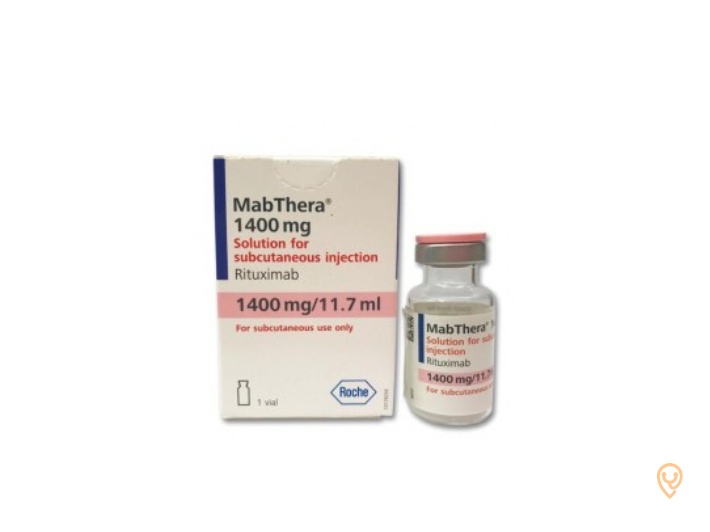
MabThera is a ready-to-use solution, from transparent to opalescent, from colorless to yellowish, presented as a solution for subcutaneous injection in a transparent glass vial with a butyl rubber stopper sealed with aluminum and a pink plastic flip-off disc.
Each vial contains 1400 mg/11.7 ml of rituximab. Each pack contains one vial.
Marketing authorization holder
Roche Registration GmbH
Emil-Barell-Strasse 1
79639 Grenzach-Wyhlen
Germany
Manufacturer
Roche Pharma AG
Emil-Barrell-Str. 1
79639 Grenzach-Wyhlen
Germany
You can request more information about this medicinal product by contacting the local representative of the marketing authorization holder.
Czech Republic Roche s. r. o. Tel.: +420 - 2 20382111 | Hungary Roche (Hungary) Kft. Tel.: +36 - 1 279 4500 |
Denmark Roche Pharmaceuticals A/S Tel.: +45 - 36 39 99 99 | Malta (See Ireland) |
Germany Roche Pharma AG Tel.: +49 (0) 7624 140 | Netherlands Roche Nederland B.V. Tel.: +31 (0) 348 438050 |
Estonia Roche Eesti OÜ Tel.: + 372 - 6 177 380 | Norway Roche Norge AS Tel.: +47 - 22 78 90 00 |
Greece Roche (Hellas) A.E. Tel.: +30 210 61 66 100 | Austria Roche Austria GmbH Tel.: +43 (0) 1 27739 |
Spain Roche Farma S.A. Tel: +34 - 91 324 81 00 | Poland Roche Polska Sp.z o.o. Tel.: +48 - 22 345 18 88 |
France Roche Tel: +33 (0) 1 47 61 40 00 | Portugal Roche Farmacêutica Química, Lda Tel.: +351 - 21 425 70 00 |
Croatia Roche d.o.o. Tel.: +385 1 4722 333 | Romania Roche România S.R.L. Tel.: +40 21 206 47 01 |
Ireland Roche Products (Ireland) Ltd. Tel.: +353 (0) 1 469 0700 | Slovenia Roche farmacevtska družba d.o.o. Tel.: +386 - 1 360 26 00 |
Iceland Roche Pharmaceuticals A/S c/o Icepharma hf Phone: +354 540 8000 | Slovak Republic Roche Slovensko, s.r.o. Tel.: +421 - 2 52638201 |
Italy Roche S.p.A. Tel.: +39 - 039 2471 | Finland Roche Oy Phone/Tel: +358 (0) 10 554 500 |
Cyprus Γ.Α.Σταμ?της & Σια Λτδ. Tel.: +357 - 22 76 62 76 | Sweden Roche AB Tel.: +46 (0) 8 726 1200 |
Latvia Roche Latvija SIA Tel.: +371 - 6 7039831 | United Kingdom (Northern Ireland) Roche Products (Ireland) Ltd. Tel: +44 (0) 1707 366000 |
Date of last revision of this leaflet
Other sources of information
Detailed information on this medicinal product is available on the European Medicines Agency website: http://www.ema.europa.eu.
This leaflet can be found in all languages of the European Union on the European Medicines Agency website.
- Country of registration
- Dosage formINJECTABLE, 1400 mg
- ATC codeL01FA01
- Active substance
- Prescription requiredYes
- Manufacturer
- CompositionPOLISORBATO 80 (0,06 % P/V mg)
- This information is for reference only and does not constitute medical advice. Always consult a doctor before taking any medication. Oladoctor is not responsible for medical decisions based on this content.
- Alternatives to MABTHERA 1400 mg SOLUTION FOR SUBCUTANEOUS INJECTIONDosage form: INJECTABLE PERFUSION, 100 mgActive substance: rituximabManufacturer: Reddy Holding GmbhPrescription requiredDosage form: INJECTABLE PERFUSION, 500 mgActive substance: rituximabManufacturer: Reddy Holding GmbhPrescription requiredDosage form: INJECTABLE, 100 mgActive substance: rituximabManufacturer: Roche Registration GmbhPrescription required
Online doctors for MABTHERA 1400 mg SOLUTION FOR SUBCUTANEOUS INJECTION
Discuss questions about MABTHERA 1400 mg SOLUTION FOR SUBCUTANEOUS INJECTION, including use, safety considerations and prescription review, subject to medical assessment and local regulations.
Get MABTHERA 1400 mg SOLUTION FOR SUBCUTANEOUS INJECTION Prescription Online
Fill in a 2-min form
Tell us your symptoms, history, and what medicine you're requesting.
Pick a doctor or let us assign
Choose a specialist or we'll match you with the next available doctor.
Doctor reviews your case
Usually within 30 minutes. They may ask follow-up questions via chat.
Collect from any pharmacy
Electronic prescription sent to your email — valid across Spain.
Frequently Asked Questions
MABTHERA 1400 mg SOLUTION FOR SUBCUTANEOUS INJECTION requires a prescription in Spain. You can check with a doctor online whether this medicine may be appropriate for your situation.
The active ingredient in MABTHERA 1400 mg SOLUTION FOR SUBCUTANEOUS INJECTION is rituximab. This information helps identify medicines with the same composition but different brand names.
MABTHERA 1400 mg SOLUTION FOR SUBCUTANEOUS INJECTION is manufactured by Roche Registration Gmbh. Pharmacy brands and packaging may differ depending on the distributor.
Doctors such as Family doctors, Psychiatrists, Dermatologists, Cardiologists, Endocrinologists, Gastroenterologists, Pulmonologists, Nephrologists, Rheumatologists, Hematologists, Infectious disease physicians, Allergists, Geriatricians, Paediatricians, Oncologists may assess whether MABTHERA 1400 mg SOLUTION FOR SUBCUTANEOUS INJECTION is appropriate, depending on your situation and local regulations. You can book an online consultation to discuss your symptoms and possible next steps.
Spain has a well-developed healthcare infrastructure across major cities such as Madrid, Barcelona, Valencia, and Seville. Pharmacies are widely available and operate under strict regulations, ensuring access to prescribed medications.
You can buy MABTHERA 1400 mg SOLUTION FOR SUBCUTANEOUS INJECTION in Madrid, Barcelona, Seville, or Valencia at any local pharmacy with a valid prescription.
To obtain a prescription, you can use Oladoctor:
Other medicines with the same active substance (rituximab) include ITUXREDI 100 mg CONCENTRATE FOR INFUSION SOLUTION, ITUXREDI 500 mg CONCENTRATE FOR INFUSION SOLUTION, MABTHERA 100 mg CONCENTRATE FOR INFUSION SOLUTION. These may have different brand names or formulations but contain the same therapeutic ingredient. Always consult a doctor before switching or starting a new medicine.
