



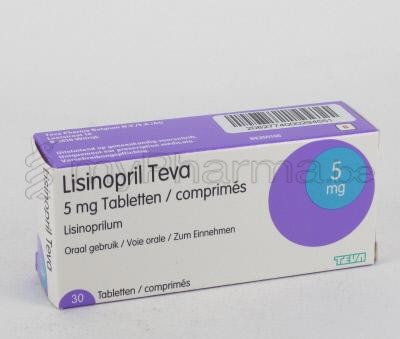
LISINOPRIL 5 mg Comprimidos

Revisión de receta online
Un médico revisará tu caso y determinará si la prescripción es médicamente apropiada.

Habla con un médico sobre este medicamento
Comenta tus síntomas y las opciones de tratamiento en una consulta online.



Cómo usar LISINOPRIL TEVA-RATIOPHARM 5 mg COMPRIMIDOS EFG
Contenido del prospecto
- Introducción
- Qué es Lisinopril Teva-ratiopharm y para qué se utiliza
- Qué necesita saber antes de empezar a tomar Lisinopril Teva-ratiopharm
- Cómo tomar Lisinopril Teva-ratiopharm
- Posibles efectos adversos
- Conservación de Lisinopril Teva-ratiopharm
- Contenido del envase e información adicional
Introducción
Prospecto: información para el usuario
Lisinopril Teva-ratiopharm 5 mg comprimidos EFG
Lisinopril dihidrato
Lea todo el prospecto detenidamente antes de empezar a tomareste medicamento, porque contiene información importante para usted.
|
Contenido del prospecto
- Qué es Lisinopril Teva-ratiopharm y para qué se utiliza
- Antes de tomar Lisinopril Teva-ratiopharm
- Cómo tomar Lisinopril Teva-ratiopharm
- Posibles efectos adversos
- Conservación de Lisinopril Teva-ratiopharm
Contenido del envase e información adicional
1. Qué es Lisinopril Teva-ratiopharm y para qué se utiliza
Lisinopril pertenece a un grupo de medicamentos denominados inhibidores de la ECA(inhibidores del enzima conversor de angiotensina). Lisinopril actúa dilatando sus vasos sanguíneos, lo cual ayuda a disminuir su presión arterialy facilita que su corazón bombee la sangre a todas las partes de su organismo. Su médico le ha prescrito Lisinopril Teva-ratiopharm por alguna de las siguientes razones:
- su presión arteriales demasiado alta(hipertensión)
- tiene una enfermedad cardiaca conocida como insuficiencia cardiacasintomática, en la cual el corazón no bombea la sangre al resto del cuerpo como debería hacerlo.
- ha sufrido un ataque al corazón(infarto de miocardio) que puede conllevar un debilitamiento de su corazón.
- tiene problemas renalesrelacionados con su diabetes e hipertensión.

¿No estás seguro de si este medicamento es adecuado para ti?
Comenta tus síntomas y tratamiento con un médico online.
2. Qué necesita saber antes de empezar a tomar Lisinopril Teva-ratiopharm
No tome Lisinopril Teva-ratiopharm
- si es alérgico a lisinopril, o a cualquiera de los demás componentes de este medicamento (incluidos en la sección 6) o a otros inhibidores del ECA.
- si alguna vez ha tenido una reacción alérgica a cualquier otro medicamento inhibidor del ECA que causó hinchazón de manos, pies o tobillos, cara, labios, lengua y/o garganta con dificultad para tragar o respirar (angioedema),
- si algún miembro de su familia ha tenido angioedema (puede haber predisposición familiar) o si usted ha tenido angioedema en alguna otra circunstancia o por cualquier otra causa,
- si está embarazadade más de tres meses (es mejor evitar también Lisinopril Teva-ratiopharm durante los primeros meses del embarazo - ver sección embarazo).
- si tiene diabetes o insuficiencia renal y le están tratando con un medicamento para bajar la presión arterial que contiene aliskirén.
- si ha tomado o está tomando actualmente sacubitrilo/valsartán, un medicamento utilizado para tratar un tipo de insuficiencia cardíaca a largo plazo (crónica) en adultos, el riesgo de angioedema (hinchazón rápida debajo de la piel en un área como la garganta ) está incrementado.
Si no está seguro de si debe empezar a tomar Lisinopril Teva-ratiopharm, consulte a su médico.
Advertencias y precauciones
Consulte a su médico o farmacéutico antes de emprezar a tomar Lisinopril Teva-ratiopharm.
- si está deshidratado debido al tratamiento con diuréticos, diálisis, dieta baja en sal o como resultado de vómitos fuertes y prolongados o diarrea. Es más probable que sufra una bajada brusca de la presión arterial (hipotensión) cuando comience a tomar los comprimidos, y puede sentirse débil o mareado.
- si le han dicho que presenta un aumento del grosor del músculo cardiaco o un estrechamiento de las válvulas del corazón (válvula mitral o válvula aórtica), o en la aorta.
- si tiene la presión arterial baja. Puede notarlo como sensación de vértigo o mareo, especialmente el ponerse de pie.
- si está tomando suplementos de potasio o sustitutos de la sal que contienen potasio,
- si está tomando alguno de los siguientes medicamentos utilizados para tratar la presión arterial alta (hipertensión):
- un antagonista de los receptores de angiotensina II (ARA) (también conocidos como “sartanes- por ejemplo, valsartán, telmisartán, irbesartán), en particular si sufre problemas renales relacionados con la diabetes.
- aliskirén
Puede que su médico le controle la función renal, la presión arterial y los niveles de electrolitos en la sangre (por ejemplo, potasio), a intervalos regulares.
Ver también la información bajo el encabezado “No tome Lisinopril Teva-ratiopharm”
- si tiene alguna enfermedad renal o estrechamiento de los vasos sanguíneos del riñón.
- si está sometido a diálisis.
- si tiene problemas hepáticos.
- si tiene diabetes.
- si padece alguna enfermedad vascular del colágeno p.ej. escleroderma, LES (lupus).
- si va a someterse a una operación quirúrgica y le van a administrar anestesia general o local; informe a su médico, dentista o personal del hospital.
- si va a someterse a un tratamiento de separación de la sangre (aféresis) o a un tratamiento de desensibilización para reducir el efecto de una alergia (p.ej. picadura de abeja o de avispa); su médico podrá suspender su tratamiento con Lisinopril Teva-ratiopharm para prevenir una posible reacción alérgica.
- si es de raza negra, ya que Lisinopril ratiopharm podría ser menos efectivo. También es más probable que desarrolle el efecto adverso “angioedema” (una reacción alérgica grave).
- si está tomando litio, utilizado en el tratamiento de la manía o depresión.
- si está tomando alguno de los siguientes medicamentos, el riesgo de angioedema puede aumentar:
- racecadotrilo, un medicamento utilizado para tratar la diarrea;
- medicamentos utilizados para prevenir el rechazo de trasplantes de órganos y para el cáncer (por ejemplo, temsirolimus, sirolimus, everolimus);
- vildagliptina, un medicamento utilizado para tratar la diabetes.
- Informe a su médico si está embarazada (o si sospecha que pudiera estarlo). No se recomienda utilizar Lisinopril Teva-ratiopharm al inicio del embarazo, y en ningún caso debe administrarse si está embarazada de mas de tres meses, ya que puede causar daños graves a su bebé cuando se administra a partir de ese momento (ver sección embarazo).
Si desarrolla tos seca que persiste durante mucho tiempo después de empezar el tratamiento con Lisinopril ratiopharm, consulte a su médico.
Mientras esté tomando Lisinopril Teva-ratiopharm,
Si desarrolla alguno de los siguientes síntomas debe informar a su médico inmediatamente:
- Si se siente mareado después de la primera dosis. Algunas personas reaccionan a la primera dosis o cuando se aumenta la dosis, sintiendo mareo, debilidad, desmayos y náuseas.
- Repentina hinchazón de labios, cara, cuello y posiblemente también manos y pies, dificultad para tragar, urticaria y dificultad para respirar o sibilancia o ronquera. Esta condición se denomina angioedema. Esto puede ocurrir en cualquier momento durante el tratamiento. Los inhibidores de la ECA causan una mayor tasa de angioedema en pacientes de raza negra que en pacientes que no son de raza negra.
- Fiebre alta, dolor de garganta o úlceras en la boca (estos pueden ser síntomas de una infección causada por la reducción del número de glóbulos blancos).
- Coloración amarillenta de la piel y del blanco de los ojos (ictericia) que puede ser signo de hepatopatía.
Al inicio del tratamiento y/o durante el periodo de ajuste de dosis, es necesario aumentar la frecuencia de visitas médicas. No debe faltar a estas visitas incluso si se siente bien. Su médico determinará la frecuencia de los reconocimientos médicos.
Niños y adolescentes
No administrelisinopril a niños menores de 6 añoso a niños con insuficiencia renal grave.Existe escasa información sobre seguridad y eficacia en niños menores de 6 años con presión arterial alta, pero no hay experiencia en otras indicaciones.
Otros medicamentos y Lisinopril Teva-ratiopharm
Informe a su médico o farmacéutico si está utilizando, ha utilizado recientemente o podría tener que utilizar cualquier otro medicamento. Estos incluyen remedios a base de plantas, productos de tiendas de salud o suplementos que haya comprado usted mismo. Esto también se aplica a medicamentos que se hayan utilizado hace algún tiempo. Algunos medicamentos pueden interaccionar con otros medicamentos.
Informe a su médico si está tomando alguno de los siguientes medicamentos:
- Diuréticos(incluyendo los ahorradores de potasio).
- Antihipertensivos(otros medicamentos para tratar la hipertensión).
- Un antagonista de los receptores de angiotensina II (ARA)o aliskiren(ver también la información bajo los encabezados “No tome Lisinopril ratiopharm” y “Advertencias y precauciones”).
- Betabloqueantes, tales como atenolol y propranolol.
- Nitroglicerinay otros nitratos (para cardiopatía isquémica, angina de pecho).
- Ácido acetilsalicílico(dosis altas de aspirina, más de 3 gramos al día) y otros medicamentos antiinflamatorios no esteroideos(AINEs) como indometacina(medicamento utilizado para el tratamiento de la artritis o el dolor muscular).
- Litio(para trastorno maniaco-depresivo).
- Medicamentos antipsicóticos o antidepresivos tricíclicos(medicamentos para trastornos mentales) o barbitúricos.
- Suplementos de potasio(incluidos los sustitutos de la sal), diuréticos ahorradores de potasioy otros medicamentos que pueden aumentar la cantidad de potasio en la sangre (por ejemplo, trimetoprim y cotrimoxazolpara infecciones causadas por bacterias; ciclosporina, un medicamento inmunosupresor que se usa para prevenir el rechazo de trasplantes de órganos; y heparina, un medicamento que se usa para diluir la sangre para prevenir coágulos.
- Medicamentos antidiabéticos orales(comprimidos para disminuir la glucemia) o insulina(medicamento para el tratamiento de la diabetes).
- Medicamentos simpaticomiméticos(estimulan el sistema nervioso central), como la efedrina,pseudoefedrinay salbutamol, que pueden encontrarse también en algunos medicamentos descongestionantes, antigripales y para el asma.
- Inmunosupresores(medicamentos que suprimen la respuesta inmune del organismo), alopurinol(para tratamiento de la gota) o procainamida(para tratar latidos del corazón anómalos).
- Oro.
Los siguientes medicamentos pueden aumentar el riesgo de angioedema (los signos de angioedema incluyen hinchazón de cara, labios, lengua y/o garganta con dificultad para tragar o respirar):
- Medicamentos para disolver coágulos de sangre(activador tisular de plasminógeno) que normalmente se administra en el hospital.
- Medicamentosque son más a menudo usados para evitar rechazos de trasplantes de órganos(sirolimus, everolimus, temsirolimus y otros medicamentos pertenecientes a la clase de inhibidores de mTOR). Ver sección “Advertencias y precauciones”.
- Vildagliptina, un medicamento utilizado para tratar la diabetes (ver sección “Advertencias y precauciones”).
- Racecadotrilo,usado para tratar la diarrea (ver sección “Advertencias y precauciones”).
- Sacubitrilo/valsartán,un medicamento utilizado para tratar un tipo de insuficiencia cardíaca prolongada (crónica) (ver sección “No tome Lisinopril ratiopharm”).
Toma de Lisinopril Teva-ratiopharm con alimentos, bebidas y alcohol
No tomar suplementos de potasio o sustitutos de la sal que contengan potasio mientras tome Lisinopril Teva-ratiopharm. Puede aumentar demasiado el nivel de potasio en sangre.
No tome cantidades excesivas de sal (cloruro sódico), ya que la sal puede elevar la presión arterial y disminuir la eficacia de Lisinopril Teva-ratiopharm.
El alcohol puede potenciar el efecto de Lisinopril Teva-ratiopharm.
Embarazo y lactancia
Si está embarazada o en periodo de lactancia, cree que podría estar embarazada o tiene intención de quedarse embarazada, consulte a su médico o farmacéutico antes de utilizar este medicamento.
Embarazo
Debe informar a su médico si está embarazada (o si sospecha que pudiera estarlo). Su médico generalmente le recomendará que deje de tomar Lisinopril Teva-ratiopharm antes de quedarse embarazada o tan pronto como sepa que está embarazada y le recomendará que tome otro medicamento en lugar de Lisinopril Teva-ratiopharm. No se recomienda utilizar Lisinopril Teva-ratiopharm al inicio del embarazo, y en ningún caso deben administrarse a partir del tercer mes de embarazo ya que puede causar daños graves a su bebé cuando se administra a partir de ese momento.
Lactancia
Informe a su médico si está en período de lactancia o va a comenzar con el mismo. No se recomienda el uso de Lisinopril Teva-ratiopharm durante la lactancia materna. Su médico elegirá otro tratamiento para usted si desea dar el pecho, especialmente si su bebé es recién nacido o prematuro.
Conducción y uso de máquinas
Algunas personas pueden sentirse mareadas o cansadas cuando toman este medicamento. Si esto ocurre, no conduzca ni utilice ninguna herramienta o máquina.
Debe esperar a ver cómo le afecta el medicamento antes de intentar realizar estas actividades.
Lisinopril Teva-ratiopharm contiene sodio
Este medicamento contiene menos de 1 mmol de sodio (23 mg) por comprimido; esto es, esencialmente “exento de sodio”.
3. Cómo tomar Lisinopril Teva-ratiopharm
Siga exactamente las instrucciones de administración de este medicamento indicadas por su médico o farmacéutico. En caso de duda, consulte de nuevo a su médico o farmacéutico.
Cuánto tomar
Su médico le indicará cuántos comprimidos debe tomar cada día. La dosis es individual y es importante que lo tome exactamente como se lo indica su médico. Su dosis inicial y la dosis a largo plazo dependerá de la condición médica y si está tomando otros medicamentos. Consulte con su médico o farmacéutico si no está seguro.
La dosis recomendadaes:
Hipertensión arterial
La dosis inicial recomendada es de 2 comprimidos de 5 mg de Lisinopril Teva-ratiopharm (10 mg de lisinopril) una vez al día. La dosis normal a largo plazo es de 4 comprimidos de 5 mg de Lisinopril Teva-ratiopharm (20 mg de lisinopril) una vez al día.
Para niños (de6 a16 años) con presión arterial alta
La dosis inicial recomendada es de medio comprimido de Lisinopril Teva-ratiopharm 5 mg (2,5 mg lisinopril) una vez al día en pacientes con un peso de 20 a 50 kg y 1 comprimido de Lisinopril Teva-ratiopharm (5 mg de lisinopril) una vez al día en pacientes con un peso superior a 50 kg. Su médico podrá ajustar la dosis individualmente hasta un máximo de 20 mg diarios en pacientes con un peso de 20 a 50 kg y 40 mg al día en pacientes con un peso superior a 50 kg.
Su médico puede prescribirle una dosis inicial más baja o recomendarle un incremento del intervalo de dosis para niños con función renal disminuida.
Insuficiencia cardiaca sintomática
La dosis inicial normal recomendada es de medio comprimido de Lisinopril Teva-ratiopharm 5 mg (2,5 mg de lisinopril) una vez al día. La dosis normal a largo plazo es de 1 a 7 comprimidos de Lisinopril Teva-ratiopharm 5 mg (de 5 a 35 mg de lisinopril) una vez al día.
Tras infarto agudo de miocardio
La dosis inicial normal recomendada es de 1 comprimido de Lisinopril Teva-ratiopharm 5 mg (5 mg de lisinopril) en el primer y segundo día, seguidos de 2 comprimidos de Lisinopril Teva-ratiopharm 5 mg (10 mg de lisinopril) una vez al día.
Complicaciones relacionadas con la diabetes
La dosis normal es de 2 a 4 comprimidos de Lisinopril Teva-ratiopharm 5 mg (10 mg ó 20 mg de lisinopril) una vez al día.
Pacientes con alteración de la función renal
Su médico podrá prescribirle una dosis más baja.
Cómo tomar Lisinopril Teva-ratiopharm
Trague el comprimido con un vaso de agua. Intente tomar sus comprimidos a la misma hora todos los días. No importa que tome Lisinopril Teva-ratiopharm 5 mg antes o después de las comidas.
Continúe tomando Lisinopril ratiopharm durante el tiempo que le indique su médico, ya que es un tratamiento a largo plazo. Es importante que continúe tomando Lisinopril ratiopharm todos los días.
El comprimido puede dividirse en dosis iguales.
Recuerde, la primera dosisde Lisinopril Teva-ratiopharm puede causar una disminución de la presión arterial mayorque la que se presentará al continuar el tratamiento. Puede notar esto como mareoso vértigosy tumbarse le ayudará. Si le pasa esto, por favor consulte con su médicotan pronto como sea posible.
Si estima que la acción de lisinopril es demasiado fuerte o débil, consulte a su médico o farmacéutico tan pronto como sea posible.
Si toma más Lisinopril Teva-ratiopharm5 mgdel que debiera
Si toma más Lisinopril Teva-ratiopharm 5 mg del que debiera, consulte inmediatamente a su médico,farmacéutico u hospitalmás cercano. Una sobredosis puede causar una presión arterial muy baja, que puede producir mareos o vértigos. También se pueden incluir síntomas como dificultad para respirar, pulso rápido o lento, palpitaciones, ansiedad o tos.
En caso de sobredosis o ingestión accidental, consulte inmediatamente a su médico o farmacéutico o llame al Servicio de Información Toxicológica, teléfono: 91 562 04 20, indicando el medicamento y la cantidad ingerida.
Si olvidó tomar Lisinopril Teva-ratiopharm5 mg
Si olvidó tomar una dosis, tómela tan pronto lo recuerde. Sin embargo, si ya casi es hora de su siguiente dosis, prescinda de la dosis olvidada
No tome una dosis doble para compensar la dosis olvidada.
Si interrumpe el tratamiento con Lisinopril Teva-ratiopharm 5 mg
No deje de tomar sus comprimidos aunque se encuentre bien, a menos que se lo indique su médico.
Si tiene cualquier otra duda sobre el uso de este medicamento, pregunte a su médico o farmacéutico.

¿Has empezado a tomar el medicamento y tienes preguntas?
Comenta tus síntomas y tratamiento con un médico online.
4. Posibles efectos adversos
Al igual que todos los medicamentos, este medicamento puede producir efectos adversos, aunque no todas las personas los sufran.
Si presenta alguna de las siguientes reacciones, deje de tomar Lisinopril ratiopharm y acuda a su médico inmediatamente.
?? Reacciones alérgicas graves (raros, pueden afectar hasta 1 de cada 1.000 personas). Los signos pueden incluir la aparición repentina de:
- Hinchazón de la cara, labios, lengua o garganta. Esto puede dificultar el tragar.
- Hinchazón grave o repentina de las manos, pies o tobillos.
- Dificultad para respirar.
- Picor grave de la piel (con habones)
?? Trastornos graves de la piel, como una erupción inesperada y repentina, enrojecimiento o descamación de la piel (muy raro, puede afectar hasta 1 de cada 10.000 personas).
Una infección con síntomas tales como fiebre y deterioro grave de su estado general, o fiebre con síntomas de infección local tales como irritación de garganta/faringe/boca o trastornos urinarios (muy raro, pueden afectar hasta 1 de cada 10.000 personas).
Lisinopril ratiopharm puede causar una reducción del número de glóbulos blancos y puede disminuir su resistencia a la infección. Si experimenta una infección con síntomas como fiebre y un deterioro grave de su estado general, o fiebre con síntomas de infección local tales como dolor de garganta/faringe/boca o trastornos urinarios debe consultar a su médico inmediatamente. Se le realizará un análisis de sangre para comprobar una posible reducción de glóbulos blancos (agranulocitosis). Es importante informar a su médico acerca de su medicamento.
Otros posibles efectos adversos
Frecuentes (pueden afectar hasta 1 de cada 10 personas) | Dolor de cabeza Mareos o vértigos especialmente al ponerse de pie rápidamente Diarrea Tos seca y persistente Vómitos Función renal reducida |
Poco frecuentes (pueden afectar hasta 1 de cada 100 personas) | Cambios de humor Ver y/ escuchar alucinaciones Infarto de miocardio o accidente cerebrovascular Palpitaciones Cambio en el color de la piel (pálido o azul seguido de enrojecimiento) y/o entumecimiento u hormigueo de los dedos de las manos o pies (Síndrome Raynaud) Vértigo Cambios en el sabor de las cosas Somnolencia o dificultad para dormir, trastornos del sueño Ataque cardiaco o accidente cerebrovascular, posiblemente secundario a una presión arterial muy baja en pacientes de alto riesgo Conciencia de los latidos cardiacos Latidos cardiacos rápidos Goteo nasal (rinorrea) Náuseas Dolor de estómago o indigestión Erupción cutánea Picor Impotencia Cansancio o debilidad (falta de fuerza) Debilidad física (pérdida de fuerza) Aumento de urea en sangre, de creatinina en suero, o de enzimas hepáticas. Altos niveles de potasio (hiperpotasemia) |
Los pacientes con cardiopatía isquémica o con estrechamiento de la aorta (estenosis aórtica), de la arteria renal (estenosis de la arteria renal) o de válvulas cardiacas (estenosis de la válvula mitral), o pacientes con un engrosamiento del músculo cardiaco (miocardiopatía hipertrófica) pueden experimentar una disminución importante de la presión arterial.
Raros (pueden afectar hasta 1 de cada 1.000 personas) | Disminución de la sustancia de los glóbulos rojos que transporta el oxígeno a todo el cuerpo (hemoglobina) y de la cantidad de glóbulos rojos en la sangre (hematocrito) Síndrome de secreción inadecuada de la hormona antidiurética (SIADH) Confusión Cambio en el olor de las cosas Boca seca Angioedema: reacción alérgica con hinchazón repentina de las manos, pies, o tobillos, la cara, labios, lengua, y/o garganta con dificultad para tragar y respirar Caída de cabello Psoriasis Uremia (retención en el torrente sanguíneo de productos de desecho que normalmente se excretan en la orina) (pueden afectar hasta 1 de cada 10.000 personas) Insuficiencia renal aguda Desarrollo de mamas en hombres Aumento de la bilirrubina en sangre (pigmento amarillo-naranja en la bilis) Bajos niveles de sodio (hiponatremia) |
Muy raros (pueden afectar hasta 1 de cada 10.000 personas) | Depresión de la médula ósea, déficit de glóbulos rojos, bajo número de plaquetas (trombocitopenia), disminución del recuento de glóbulos blancos (neutropenia, leucopenia, agranulocitosis), lo que hace más probable una infección, trastorno de los ganglios linfáticos, enfermedad autoinmune, en la cual el cuerpo se ataca a sí mismo. Disminución de la glucosa en sangre Sinusitis Sibilancias Inflamación de los pulmones Reacción alérgica en el intestino delgado (angioedema intestinal) Color amarillento de piel y/o ojos (ictericia) Inflamación del hígado o páncreas Trastornos graves de la piel (síntomas como enrojecimiento, ampollas y descamación), inflamación transitoria de los nódulos linfáticos de la piel Sudoración Disminución de la excreción de orina (oliguria) o imposibilidad para orinar (anuria) |
No conocidos (no puede estimarse a partir de los datos disponibles) | Reacciones alérgicas (anafilácticas) graves Síntomas depresivos Desmayo |
Se ha notificado un complejo de síntomas que puede incluir uno o más de los siguientes síntomas: fiebre, dolor e inflamación de los vasos sanguíneos (vasculitis), dolor muscular, inflamación de una o más articulaciones (artralgia/artritis), prueba positiva de anticuerpos antinucleares (ANA), velocidad de sedimentación de glóbulos rojos elevada (ESR), eosinofília y leucocitosis, erupción, sensibilidad a la luz (fotosensibilidad) u otras manifestaciones dermatológicas.
Efectos adversos adicionales en niños y adolescentes
Los datos de seguridad obtenidos en estudios clínicos sugieren que lisinopril es generalmente bien tolerado en pacientes pediátricos hipertensos, y que el perfil de seguridad en niños de entre 6 – 16 años de edad es comparable con el observado en adultos.
Comunicación de efectos adversos:
Si experimenta cualquier tipo de los efectos adversos, consulte a su médico o farmacéutico, incluso si se trata de efectos adversos que no aparecen en este prospecto. También puede comunicarlos directamente a través del Sistema Español de Farmacovigilancia de Medicamentos de Uso Humano, Website: www.notificaRAM.es. Mediante la comunicación de efectos adversos usted puede contribuir a proporcionar más información sobre la seguridad de este medicamento.
5. Conservación de Lisinopril Teva-ratiopharm
Mantener fuera de la vista y del alcance de los niños.
No utilice este medicamento después de la fecha de caducidadque aparece en el blíster y envase después de CAD. La fecha de caducidad es el último día del mes que se indica.
Este medicamento no requiere condiciones especiales de conservación.
Los medicamentos nose deben tirar por los desagües ni a la basura. Deposite los envases y los medicamentos que no necesita en el Punto SIGRE de la farmacia. Pregunte a su farmacéutico cómo deshacerse de los envases y de los medicamentos que ya no necesita. De esta forma, ayudará a proteger el medio ambiente.
6. Contenido del envase e información adicional
Composición de Lisinopril Teva-ratiopharm 5 mg
- El principio activo es lisinopril dihidrato.
Cada comprimido contiene como principio activo 5 mg de lisinopril dihidrato.
- Los demás componentes son: manitol (E421), fosfato de calcio básico dihidratado, almidón (de maíz), pregelatinizado, croscarmelosa de sodio y estearato de magnesio.
Aspecto del producto y contenido del envase
Comprimidos de color blanco, redondos, biconvexos, sin recubrimientos ni marcas de impresión y con ranura para partirlos.
Lisinopril Teva-ratiopharm comprimidos se suministra en 2 formatos: 5 mg y 20 mg.
Están disponibles en blister de PVC-Aluminio en envases de 1, 14, 20, 28, 30, 30x1, 50, 56, 60, 98, 100, 100x1, 400 (10x40), 500 comprimidos y en frascos de 100 y 250 comprimidos.
Puede que solamente estén comercializados algunos tamaños de envases.
Titular de la autorización de comercialización y responsable de la fabricación
Titularde la autorización de comercialización
Teva Pharma, S.L.U.
C/ Anabel Segura 11, Edificio Albatros B 1ª planta
28108 Alcobendas, Madrid (España)
Responsable de la fabricación
Merckle GmbH
Ludwig-Merckle-Strasse, 3
89143 Blaubeuren (Alemania)
Fecha de la última revisión de este prospecto:Junio 2019
Otras fuentes de información
La información detallada y actualizada de este medicamento está disponible en la página Web de la Agencia Española de Medicamentos y Productos Sanitarios (AEMPS) http: //www.aemps.gob.es/
Puede acceder a información detallada y actualizada sobre este medicamento escaneando con su teléfono móvil (smartphone) el código QR incluido en el cartonaje. También puede acceder a esta información en la siguiente dirección de internet: https://cima.aemps.es/cima/dochtml/p/63961/P_63961.html
Código QR + URL
- País de registro
- Forma farmacéuticaCOMPRIMIDO, 5 mg
- Código ATCC09AA03
- Precio medio en farmacia3.4 EUR
- Principio activo
- Requiere recetaSí
- Fabricante
- ComposiciónCROSCARMELOSA SODICA (8,40 mg mg), MANITOL (E-421) (42,00 mg mg)
- Esta información es de carácter general y no sustituye la consulta con un profesional sanitario.
- Alternativas a LISINOPRIL TEVA-RATIOPHARM 5 mg COMPRIMIDOS EFGForma farmacéutica: COMPRIMIDO, 5 mgPrincipio activo: lisinoprilFabricante: Neuraxpharm Spain S.L.Requiere recetaForma farmacéutica: COMPRIMIDO, 20 mgPrincipio activo: lisinoprilFabricante: Neuraxpharm Spain S.L.Requiere recetaForma farmacéutica: COMPRIMIDO, 20 mgPrincipio activo: lisinoprilFabricante: Aurovitas Spain, S.A.U.Requiere receta
Médicos online para LISINOPRIL TEVA-RATIOPHARM 5 mg COMPRIMIDOS EFG
Comenta la dosis, los posibles efectos secundarios, interacciones, contraindicaciones o la revisión de receta de LISINOPRIL TEVA-RATIOPHARM 5 mg COMPRIMIDOS EFG, sujeto a valoración médica y a la normativa local.
Obtén una receta de LISINOPRIL TEVA-RATIOPHARM 5 mg COMPRIMIDOS EFG online
Rellena un formulario de 2 minutos
Cuéntanos tus síntomas, historial y el medicamento que necesitas.
Elige un médico o nosotros te asignamos uno
Escoge un especialista o te conectamos con el próximo médico disponible.
El médico revisa tu caso
Normalmente en 30 minutos. Puede hacerte preguntas adicionales por chat.
Recógela en cualquier farmacia
Receta electrónica enviada a tu correo, válida en toda España.
Preguntas frecuentes
LISINOPRIL TEVA-RATIOPHARM 5 mg COMPRIMIDOS EFG requiere receta en España. Puedes confirmarlo con un médico online según tu caso.
El principio activo de LISINOPRIL TEVA-RATIOPHARM 5 mg COMPRIMIDOS EFG es lisinopril. Esta información ayuda a identificar medicamentos con la misma composición pero con diferentes nombres comerciales.
El precio medio en farmacia de LISINOPRIL TEVA-RATIOPHARM 5 mg COMPRIMIDOS EFG es de aproximadamente 3.4 EUR. Puede variar según el fabricante y la forma farmacéutica.
LISINOPRIL TEVA-RATIOPHARM 5 mg COMPRIMIDOS EFG es fabricado por Teva Pharma S.L.U.. La marca y el envase pueden variar según el distribuidor.
Los Médicos de familia, Psiquiatras, Dermatólogos, Cardiólogos, Endocrinólogos, Gastroenterólogos, Neumólogos, Nefrólogos, Reumatólogos, Hematólogos, Infectólogos, Alergólogos, Geriatras, Pediatras, Oncólogos pueden valorar la prescripción de LISINOPRIL TEVA-RATIOPHARM 5 mg COMPRIMIDOS EFG cuando esté clínicamente indicado. Puedes reservar una videoconsulta para comentar tu caso y las opciones de tratamiento.
España cuenta con una infraestructura sanitaria bien desarrollada en ciudades principales como Madrid, Barcelona, Valencia y Sevilla. Las farmacias están ampliamente disponibles y operan bajo estrictas regulaciones, garantizando el acceso a medicamentos con receta.
Puedes comprar LISINOPRIL TEVA-RATIOPHARM 5 mg COMPRIMIDOS EFG en Madrid, Barcelona, Sevilla o Valencia en cualquier farmacia local con una receta válida.
Para obtener una receta, puedes utilizar Oladoctor:
Otros medicamentos con el mismo principio activo (lisinopril) incluyen DONEKA 5 mg COMPRIMIDOS, DONEKA COMPRIMIDOS 20 mg, LISINOPRIL AUROVITAS 20 MG COMPRIMIDOS EFG. Pueden tener diferentes nombres comerciales o formulaciones, pero contienen el mismo componente terapéutico. Consulta siempre con un médico antes de cambiar o iniciar un nuevo medicamento.
