



LEVETIRACETAM 100 mg /Ml Solución Oral

Revisión de receta online
Un médico revisará tu caso y determinará si la prescripción es médicamente apropiada.

Habla con un médico sobre este medicamento
Comenta tus síntomas y las opciones de tratamiento en una consulta online.



Cómo usar LEVETIRACETAM STADA 100 MG/ML SOLUCION ORAL EFG
Contenido del prospecto
- Introducción
- Qué es Levetiracetam Stada y para qué se utiliza
- Qué necesita saber antes de empezar a tomar Levetiracetam Stada
- Cómo tomar Levetiracetam Stada
- Posibles efectos adversos
- Conservación de Levetiracetam Stada
- Contenido del envase e información adicional
Introducción
Prospecto: Información para el paciente
Levetiracetam Stada 100 mg/ml solución oral EFG
Lea todo el prospecto detenidamente antes de empezar a tomar este medicamento, porque contiene información importante para usted.
- Conserve este prospecto, ya que puede tener que volver a leerlo.
- Si tiene alguna duda, consulte a su médico o farmacéutico.
- Este medicamento se le ha recetado solamente a usted, y no debe dárselo a otras personas aunque tengan los mismos síntomas que usted, ya que puede perjudicarles.
- Si experimenta efectos adversos, consulte a su médico o farmacéutico, incluso si se trata de efectos adversos que no aparecen en este prospecto. Ver sección 4.
Contenido del prospecto
- Qué es Levetiracetam Stada y para qué se utiliza
- Qué necesita saber antes de empezar a tomar Levetiracetam Stada
- Cómo tomar Levetiracetam Stada
- Posibles efectos adversos
- Conservación de Levetiracetam Stada
- Contenido del envase e información adicional
1. Qué es Levetiracetam Stada y para qué se utiliza
Levetiracetam Stada es un medicamento antiepiléptico (un medicamento para el tratamiento de crisis en epilepsia).
Levetiracetam se utiliza:
- en solitario en adultos y adolescentes de 16 años de edad o mayores con epilepsia diagnosticada recientemente para tratar una forma de epilepsia. La epilepsia es una enfermedad donde los pacientes tienen ataques (crisis). Levetiracetam se utiliza para la forma de epilepsia en la cual las crisis inicialmente afectan sólo a un lado del cerebro, pero pueden después extenderse a zonas más amplias en los dos lados del cerebro (crisis de inicio parcial con o sin generalización secundaria). Su médico le ha recetado levetiracetam para reducir el número de crisis.
- conjuntamente con otros medicamentos antiepilépticos para tratar:
- las crisis de inicio parcial con o sin generalización en adultos, adolescentes, niños y lactantes a partir de 1 mes de edad.
- las crisis mioclónicas (sacudidas tipo shock, cortas, de un músculo o grupo de músculos) en adultos y adolescentes a partir de 12 años con epilepsia mioclónica juvenil.
- las crisis tónico-clónicas generalizadas primarias (crisis mayores, incluyendo pérdida de consciencia) en adultos y adolescentes a partir de 12 años de edad con epilepsia idiopática generalizada (tipo de epilepsia que se piensa que tiene una causa genética).

¿No estás seguro de si este medicamento es adecuado para ti?
Comenta tus síntomas y tratamiento con un médico online.
2. Qué necesita saber antes de empezar a tomar Levetiracetam Stada
No tome Levetiracetam Stada:
- Si es alérgico a levetiracetam, a los derivados de pirrolidona o a alguno de los demás componentes de este medicamento (incluidos en la sección 6).
Advertencias y precauciones
Consulte a su médico antes de empezar a tomar Levetiracetam Stada:
- si usted padece problemas de riñón, siga las instrucciones de su médico quien decidirá si debe ajustarle la dosis a tomar.
- si observa cualquier disminución en el crecimiento de su hijo o un desarrollo de la pubertad inesperado, contacte con su médico.
- un pequeño número de personas en tratamiento con antiepilépticos tales como levetiracetam han tenido pensamientos de hacerse daño o suicidarse. Si tiene cualquier síntoma de depresión y/o pensamientos suicidas, contacte con su médico.
- si tiene antecedentes médicos o familiares de ritmo cardíaco irregular (visible en el electrocardiograma), o si tiene una enfermedad y/o toma un tratamiento que le haga(n) propenso a arritmias cardíacas o desequilibrios de sales.
Informe a su médico o farmacéutico si alguno de los siguientes efectos adversos se agrava o dura más de unos pocos días:
- Pensamientos anormales, sensación de irritabilidad o reacciona de forma más agresiva de lo normal o si usted o su familia y amigos notan cambios importantes en el estado de ánimo o comportamiento.
- Agravamiento de la epilepsia
En raras ocasiones, las crisis epilépticas pueden empeorar o producirse con más frecuencia, principalmente durante el primer mes después del inicio del tratamiento o del aumento de la dosis. Si experimenta alguno de estos síntomas nuevos mientras toma levetiracetam, acuda a un médico tan pronto como sea posible.
Niños y adolescentes
El tratamiento exclusivo con levetiracetam (monoterapia) no está indicado en niños y adolescentes menores de 16 años.
Otros medicamentos y Levetiracetam Stada
Informe a su médico o farmacéutico si está utilizando, ha utilizado recientemente o pudiera tener que utilizar cualquier otro medicamento.
No tome macrogol (medicamento utilizado como laxante) durante una hora antes y una hora después de tomar levetiracetam ya que podría reducir su efecto.
Embarazo y lactancia
Si está embarazada o en periodo de lactancia, cree que podría estar embarazada o tiene intención de quedarse embarazada, consulte a su médico antes de utilizar este medicamento. Levetiracetam sólo se puede utilizar durante el embarazo si, después de una cuidadosa evaluación, su médico lo considera necesario. No debe abandonar su tratamiento sin comentarlo antes con su médico. No se puede excluir completamente el riesgo de defectos de nacimiento para el bebé. No se recomienda la lactancia natural durante el tratamiento.
Conducción y uso de máquinas
Levetiracetam puede alterar su capacidad para conducir o manejar herramientas o maquinaria, puesto que puede producirle sensación de sueño. Esto es más probable al inicio del tratamiento o cuando se aumenta la dosis. No debería conducir o utilizar maquinaria hasta que se compruebe que su capacidad para realizar estas actividades no está afectada.
Levetiracetam Stada contiene parahidroxibenzoato de metilo (E218), maltitol líquido (E965), sodio y alcohol bencílico.
Este medicamento contiene parahidroxibenzoato de metilo el cual puede causar reacciones alérgicas (posiblemente retardadas).
Este medicamento contiene también maltitol. Si su médico le informa de que usted tiene intolerancia a algunos azúcares, contacte con su médico antes de tomar este medicamento.
Este medicamento contiene menos de 1 mmol de sodio (23 mg) por ml; esto es, esencialmente “exento de sodio”.
Este medicamento contiene 0,0016 mg de alcohol bencílico en cada ml. El alcohol bencílico puede provocar reacciones alérgicas.
No utilizar durante más de una semana en niños pequeños (menores de 3 años), a menos que así lo indique su médico o farmacéutico.
Consulte a su médico o farmacéutico si está embarazada o en periodo de lactancia. Esto es debido a que se pueden acumular grandes cantidades de alcohol bencílico en su organismo y provocar efectos adversos (acidosis metabólica).
Consulte a su médico o farmacéutico si tiene enfermedades de hígado o riñón. Esto es debido a que se pueden acumular en el organismo grandes cantidades de alcohol bencílico y provocar efectos adversos (acidosis metabólica).
3. Cómo tomar Levetiracetam Stada
Siga exactamente las instrucciones de administración de este medicamento indicadas por su médico o farmacéutico. En caso de duda, consulte de nuevo a su médico o farmacéutico.
Levetiracetam se debe tomar dos veces al día, una vez por la mañana y otra por la noche, aproximadamente a la misma hora cada día.
Tome la solución oral según las instrucciones de su médico.
Monoterapia (desde 16 años de edad)
Adultos (≥18 años) y adolescentes (desde 16 años de edad):
Mida la dosis apropiada utilizando la jeringa de 10 ml incluida en el envase para pacientes de 4 años de edad en adelante.
Dosis general: Levetiracetam se toma dos veces al día, repartido en dos dosis iguales, cada una de entre 5 ml (500 mg) y 15 ml (1500 mg).
Cuando empiece a tomar levetiracetam, su médico le prescribirá una dosis inferiordurante dos semanas antes de administrarle la dosis general más baja.
Terapia concomitante
Dosis en adultos y adolescentes (de 12 a 17 años):
Mida la dosis apropiada utilizando la jeringa de 10 ml incluida en el envase para pacientes de 4 años de edad en adelante.
Dosis general: Levetiracetam se toma dos veces al día, repartido en dos dosis iguales, cada una de entre 5 ml (500 mg) y 15 ml (1500 mg).
Dosis en niños de 6 meses de edad en adelante:
Su médico le prescribirá la forma farmacéutica de levetiracetam más apropiada según la edad, el peso y la dosis.
Para niños de 6 meses a 4 años, mida la dosis apropiada utilizando la jeringa de 3 mlincluida en el envase.
Para niños mayores de 4 años, mida la dosis apropiada utilizando la jeringa de 10 mlincluida en el envase.
Dosis general: Levetiracetam se toma dos veces al día, repartido en dos dosis iguales, cada una de entre 0,1 ml (10 mg) y 0,3 ml (30 mg) por kg de peso corporal del niño (ver ejemplos de dosis en la tabla más abajo).
Dosis en niños de 6 meses de edad en adelante:
Peso | Dosis inicial: 0,1 ml/kg dos veces al día | Dosis máxima: 0,3 ml/kg dos veces al día |
6 kg | 0,6 ml dos veces al día | 1,8 ml dos veces al día |
8 kg | 0,8 ml dos veces al día | 2,4 ml dos veces al día |
10 kg | 1 ml dos veces al día | 3 ml dos veces al día |
15 kg | 1,5 ml dos veces al día | 4,5 ml dos veces al día |
20 kg | 2 ml dos veces al día | 6 ml dos veces al día |
25 kg | 2,5 ml dos veces al día | 7,5 ml dos veces al día |
A partir de 50 kg | 5 ml dos veces al día | 15 ml dos veces al día |
Dosificación en lactantes (de 1 mes a menos de 6 meses):
Para lactantes de 1 mes a menos de 6 meses, mida la dosis apropiada utilizando la jeringa de 1 mlincluida en el envase.
Dosis general: Levetiracetam se toma dos veces al día, repartido en dos dosis iguales, cada una de entre 0,07 ml (7 mg) y 0,21 ml (21 mg) por kg de peso corporal del lactante (ver ejemplos de dosis en la tabla de abajo).
Dosificación en lactantes (de 1 mes a menos de 6 meses):
Peso | Dosis inicial: 0,07 ml/kg dos veces al día | Dosis máxima: 0,21 ml/kg dos veces al día |
4 kg | 0,3 ml dos veces al día | 0,85 ml dos veces al día |
5 kg | 0,35 ml dos veces al día | 1,05 ml dos veces al día |
6 kg | 0,45 ml dos veces al día | 1,25 ml dos veces al día |
7 kg | 0,5 ml dos veces al día | 1,5 ml dos veces al día |
Forma de administración
Después de medir la dosis correcta con una jeringa apropiada, levetiracetam se puede tomar diluyendo la solución oral en un vaso de agua o en un biberón. Puede tomar levetiracetam con o sin alimentos. Tras la administración oral de levetiracetam se puede apreciar su sabor amargo.
Instrucciones para la correcta administración:
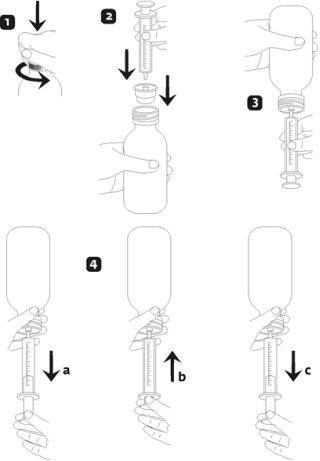
- Abrir el frasco: apretar el tapón y desenroscar en sentido contrario a las agujas del reloj (figura 1).
- Separar el adaptador de la jeringa (figura 2). Insertar el adaptador en el cuello del frasco. Asegurarse de que está bien fijo.
- Coger la jeringa e introducirla en la abertura del adaptador. Poner el frasco boca abajo (figura 3).
- Llenar la jeringa con una pequeña cantidad de solución bajando el émbolo (figura 4a) y después subiéndolo para eliminar cualquier posible burbuja (figura 4b). Baje el émbolo hasta la marca de graduación que corresponda con la dosis en mililitros (ml) prescrita por su médico (figura 4c).
- Poner el frasco boca arriba. Retirar la jeringa del adaptador.
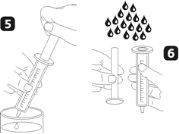
- Vaciar el contenido de la jeringa en un vaso de agua o en un biberón, bajando el émbolo hasta el final de la jeringa (figura 5).
- Beber el contenido del vaso o del biberón entero.
- Cerrar el frasco con el tapón a prueba de niños.
- Lavar la jeringa sólo con agua (figura 6).
Duración del tratamiento
- Levetiracetam se utiliza como un tratamiento crónico. Debe continuar con el tratamiento con levetiracetam durante el tiempo indicado por su médico.
- No deje su tratamiento sin la recomendación de su médico ya que pueden aumentar sus crisis.
Si toma más Levetiracetam Stada del que debe
En caso de sobredosis o ingestión accidental, consulte inmediatamente a su médico o farmacéutico, o llame al Servicio de Información Toxicológica, teléfono: 91 562 04 20, indicando el medicamento y la cantidad ingerida. Se recomienda llevar el envase y el prospecto del medicamento al profesional sanitario.
Los posibles efectos adversos de una sobredosis de levetiracetam son somnolencia, agitación, agresividad, disminución de la alerta, inhibición de la respiración y coma.
Su médico establecerá el mejor tratamiento posible de la sobredosis.
Si olvidó tomar Levetiracetam Stada
Contacte con su médico si ha dejado de tomar una o más dosis. No tome una dosis doble para compensar las dosis olvidadas.
Si interrumpe el tratamiento con Levetiracetam Stada
La finalización del tratamiento con levetiracetam debe efectuarse de forma gradual para evitar un incremento de las crisis. Si su médico decide parar su tratamiento con levetiracetam, él/ella le dará las instrucciones para la retirada gradual del medicamento.
Si tiene cualquier otra duda sobre el uso de este medicamento, pregunte a su médico o farmacéutico.

¿Has empezado a tomar el medicamento y tienes preguntas?
Comenta tus síntomas y tratamiento con un médico online.
4. Posibles efectos adversos
Al igual que todos los medicamentos, este medicamento puede producir efectos adversos, aunque no todas las personas los sufran.
Informe a su médico inmediatamente, o vaya al servicio de urgencias de su hospital más cercano si experimenta:
- debilidad, sensación de mareo o dificultad para respirar, ya que éstos pueden ser signos de una reacción alérgica (anafiláctica) grave.
- hinchazón de la cara, labios, lengua o garganta (edema de Quincke).
- síntomas de gripe y erupción en la cara seguido de una erupción prolongada con temperatura elevada, niveles de enzimas hepáticos elevados en tests sanguíneos y un aumento en un tipo de células blancas sanguíneas (eosinofilia) y nódulos linfáticos agrandados (Reacción de hipersensibilidad al medicamento con eosinofilia y síntomas sistémicos (DRESS)).
- síntomas como bajo volumen de orina, cansancio, náuseas, vómitos, confusión e hinchazón de piernas, brazos o pies, ya que puede ser un signo de disminución súbita de la función renal
- una erupción cutánea que puede formar ampollas y puede aparecer como pequeñas dianas (puntos centrales oscuros rodeados por un área más pálida, con un anillo oscuro alrededor del borde) (eritema multiforme)
- una erupción generalizada con ampollas y descamación de la piel, especialmente alrededor de la boca, nariz, ojos y genitales (síndrome de Stevens-Johnson)
- una forma más grave que causa descamación de la piel en más del 30% de la superficie corporal (necrólisis epidérmica tóxica)
- signos de cambios mentales graves o si alguien a su alrededor nota signos de confusión, somnolencia (adormecimiento), amnesia (pérdida de memoria), deterioro de la memoria (olvidos), comportamiento anormal u otros signos neurológicos incluyendo movimientos involuntarios o incontrolados. Éstos pueden ser síntomas de encefalopatía.
Los efectos adversos notificados más frecuentemente son nasofaringitis, somnolencia (sensación de sueño), dolor de cabeza, fatiga y mareo. Los efectos adversos como sensación de sueño, sensación de debilidad y mareos pueden ser más frecuentes cuando se inicia el tratamiento o se aumenta la dosis. Sin embargo, estos efectos adversos deben disminuir con el tiempo.
Muy frecuentes(pueden afectar a más de 1 de cada 10 personas):
- nasofaringitis;
- somnolencia (sensación de sueño), dolor de cabeza.
Frecuentes(pueden afectar hasta 1 de cada 10 personas):
- anorexia (pérdida de apetito);
- depresión, hostilidad o agresividad, ansiedad, insomnio, nerviosismo o irritabilidad;
- convulsiones, trastorno del equilibrio, mareos (sensación de inestabilidad), letargo (falta de energía y entusiasmo), temblor (temblor involuntario);
- vértigo (sensación de rotación);
- tos;
- dolor abdominal, diarrea, dispepsia (digestión pesada, ardor y acidez), vómitos, náuseas;
- erupción en la piel;
- astenia/fatiga (sensación de debilidad).
Poco frecuentes(pueden afectar hasta 1 de cada 100 personas):
- disminución del número de plaquetas, disminución de los glóbulos blancos;
- pérdida de peso, aumento de peso;
- intento de suicidio y pensamientos suicidas, alteraciones mentales, comportamiento anormal, alucinaciones, cólera, confusión, ataque de pánico, inestabilidad emocional/cambios de humor, agitación;
- amnesia (pérdida de memoria), deterioro de la memoria (falta de memoria), coordinación anormal/ataxia (coordinación de los movimientos alterada), parestesia (hormigueo), alteraciones de la atención (pérdida de concentración);
- diplopía (visión doble), visión borrosa;
- valores elevados/ anormales en las pruebas sobre la funcionalidad del hígado;
- pérdida de cabello, eczema, picor;
- debilidad muscular, mialgia (dolor muscular);
- lesión.
Raros(pueden afectar hasta 1 de cada 1.000 personas):
- infección;
- disminución de todos los tipos de células sanguíneas;
- reacciones alérgicas graves (DRESS, reacción anafiláctica (reacción alérgica importante y grave), edema de Quincke (hinchazón de cara, labios, lengua y garganta));
- disminución de la concentración de sodio en sangre;
- suicidio, trastornos de la personalidad (problemas de comportamiento), pensamiento anormal (pensamiento lento, dificultad para concentrarse);
- delirio
- encefalopatía (ver subsección “Informe a su médico inmediatamente” para ver una descripción detallada de los síntomas);
- las crisis epilépticas pueden empeorar o producirse con más frecuencia;
- espasmos musculares incontrolables que afectan a la cabeza, al torso y a las extremidades,
dificultad para controlar los movimientos, hipercinesia (hiperactividad);
- cambio del ritmo cardíaco (electrocardiograma);
- pancreatitis;
- insuficiencia hepática, hepatitis
- disminución súbita de la función renal
- erupción cutánea, que puede dar lugar a ampollas que pueden aparecer como pequeñas dianas (puntos centrales oscuros rodeados por un área más pálida, con un anillo oscuro alrededor del borde) (eritema multiforme), una erupción generalizada con ampollas y descamación de la piel, especialmente alrededor de la boca, nariz, ojos y genitales (síndrome de Stevens-Johnson) y una forma más grave que causa descamación de la piel en más del 30% de la superficie corporal (necrólisis epidérmica tóxica).
- rabdomiólisis (rotura del tejido muscular) y aumento de creatinfosfoquinasa sanguínea asociado. La prevalencia es significativamente mayor en pacientes japoneses en comparación con pacientes no japoneses.
- Cojera o dificultad para caminar.
Comunicación de efectos adversos
Si experimenta cualquier tipo de efecto adverso, consulte a su médico o farmacéutico, incluso si se trata de posibles efectos adversos que no aparecen en este prospecto. También puede comunicarlos a través del Sistema Español de Farmacovigilancia de Medicamentos de Uso Humano: https:/www.notificaram.es. Mediante la comunicación de efectos adversos usted puede contribuir a proporcionar más información sobre la seguridad de este medicamento.
5. Conservación de Levetiracetam Stada
Mantener este medicamento fuera de la vista y del alcance de los niños.
No utilice este medicamento después de la fecha de caducidad que aparece en la caja y en el frasco después de CAD. La fecha de caducidad es el último día del mes que se indica.
Este medicamento no requiere condiciones especiales de conservación.
Tras la primera apertura: No conservar a temperatura superior a 25°C.
No usar después de 7 meses de haber abierto el frasco.
Los medicamentos no se deben tirar por los desagües ni a la basura. Deposite los envases y los medicamentos que no necesita en el Punto SIGRE de la farmacia. Pregunte a su farmacéutico cómo deshacerse de los envases y de los medicamentos que ya no necesita. De esta forma, ayudará a proteger el medio ambiente.
6. Contenido del envase e información adicional
Composición de Levetiracetam Stada
- El principio activo es levetiracetam.
Cada ml de solución contiene 100 mg de levetiracetam.
- Los demás componentes son: citrato de sodio (para ajustar el pH), ácido cítrico (para ajustar el pH), parahidroxibenzoato de metilo (E218), glicerol (E422), acesulfamo de potasio (E950), maltitol líquido (E965), frambuesa líquida (contiene alcohol bencílico).
Aspecto del producto y contenido del envase
Levetiracetam Stada 100 mg/ml solución oral es un líquido transparente.
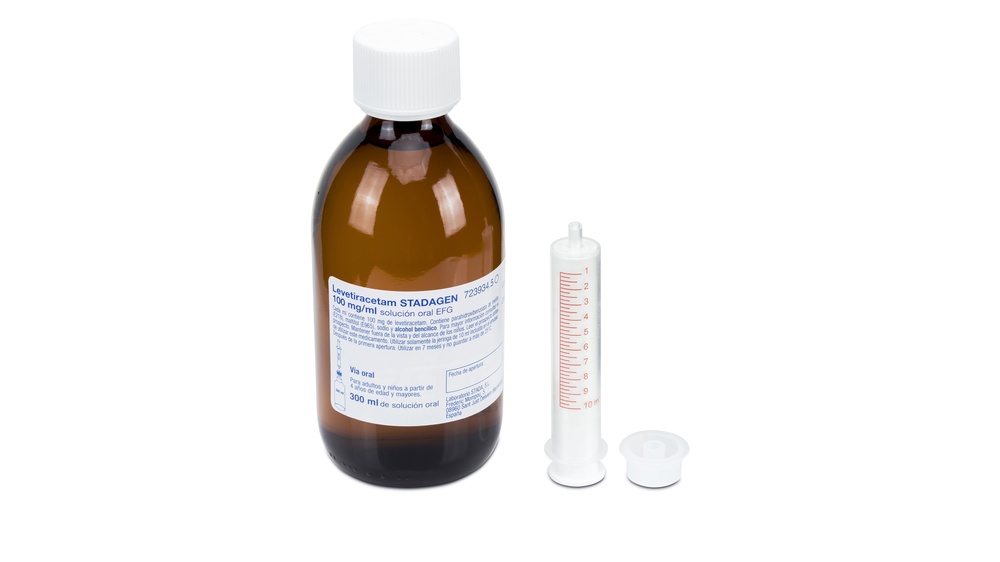
El frasco de vidrio de 300 ml de Levetiracetam Stada (para niños a partir de 4 años de edad, adolescentes y adultos) se acondiciona en una caja de cartón acompañado de una jeringa oral de 10 ml (graduada cada 0,25 ml) y un adaptador para la jeringa.
El frasco de vidrio de 150 ml de Levetiracetam Stada (para lactantes y niños pequeños desde 6 meses a menos de 4 años de edad) se acondiciona en una caja de cartón acompañado de una jeringa oral de 3 ml (graduada cada 0,1 ml) y un adaptador para la jeringa.
El frasco de vidrio de 150 ml de Levetiracetam Stada (para lactantes de 1 mes a menos de 6 meses de edad) se acondiciona en una caja de cartón acompañado de una jeringa oral de 1 ml (graduada cada 0,05 ml) y de un adaptador para la jeringa.
Puede que solamente estén comercializados algunos tamaños de envases.
Titular de la autorización de comercialización y responsable de la fabricación
Titular de la autorización de comercialización:
Laboratorio STADA, S.L.
Frederic Mompou, 5
08960 Sant Just Desvern (Barcelona)
España
Responsable de la fabricación:
Remedica Ltd
Aharnon Street, Limassol Industrial Estate
Limassol 3056
Chipre
o
STADA Arzneimittel AG
Stadastrasse 2 – 18
61118 Bad Vilbel
Alemania
o
STADA Arzneimittel GmbH
Muthgasse 36/2, 1
190 Viena
Austria
o
Galenica Pharmaceutical Industry S.A.
3rd Km Old National Road Chalkida Athens,
Chalcis, 341 00
Grecia
Fecha de la última revisión de este prospecto:octubre 2021
La información detallada y actualizada de este medicamento está disponible en la página web de la Agencia Española de Medicamentos y Productos Sanitarios (AEMPS) http://www.aemps.gob.es/.
- País de registro
- Forma farmacéuticaSOLUCIÓN/SUSPENSIÓN ORAL, 100 mg/ml
- Código ATCN03AX14
- Precio medio en farmacia56.64 EUR
- Principio activo
- Requiere recetaSí
- Fabricante
- ComposiciónCITRATO DE SODIO (E-331) (4,2 mg/ml mg), PARAHIDROXIBENZOATO DE METILO (E-218) (2,5 mg/ml mg), GLICEROL (E 422) (50 mg/ml mg), ACESULFAMO POTASICO (10 mg/ml mg), MALTITOL LIQUIDO E965 (300 mg/ml mg)
- Esta información es de carácter general y no sustituye la consulta con un profesional sanitario.
- Alternativas a LEVETIRACETAM STADA 100 MG/ML SOLUCION ORAL EFGForma farmacéutica: INYECTABLE PERFUSION, 100 mgPrincipio activo: LevetiracetamFabricante: Ucb PharmaRequiere recetaForma farmacéutica: INYECTABLE PERFUSION, 100 mg/mlPrincipio activo: LevetiracetamFabricante: Ucb PharmaRequiere recetaForma farmacéutica: SOLUCIÓN/SUSPENSIÓN ORAL, 100 mgPrincipio activo: LevetiracetamFabricante: Ucb PharmaRequiere receta
Médicos online para LEVETIRACETAM STADA 100 MG/ML SOLUCION ORAL EFG
Comenta la dosis, los posibles efectos secundarios, interacciones, contraindicaciones o la revisión de receta de LEVETIRACETAM STADA 100 MG/ML SOLUCION ORAL EFG, sujeto a valoración médica y a la normativa local.



Obtén una receta de LEVETIRACETAM STADA 100 MG/ML SOLUCION ORAL EFG online
Rellena un formulario de 2 minutos
Cuéntanos tus síntomas, historial y el medicamento que necesitas.
Elige un médico o nosotros te asignamos uno
Escoge un especialista o te conectamos con el próximo médico disponible.
El médico revisa tu caso
Normalmente en 30 minutos. Puede hacerte preguntas adicionales por chat.
Recógela en cualquier farmacia
Receta electrónica enviada a tu correo, válida en toda España.
Preguntas frecuentes
LEVETIRACETAM STADA 100 MG/ML SOLUCION ORAL EFG requiere receta en España. Puedes confirmarlo con un médico online según tu caso.
El principio activo de LEVETIRACETAM STADA 100 MG/ML SOLUCION ORAL EFG es Levetiracetam. Esta información ayuda a identificar medicamentos con la misma composición pero con diferentes nombres comerciales.
El precio medio en farmacia de LEVETIRACETAM STADA 100 MG/ML SOLUCION ORAL EFG es de aproximadamente 56.64 EUR. Puede variar según el fabricante y la forma farmacéutica.
LEVETIRACETAM STADA 100 MG/ML SOLUCION ORAL EFG es fabricado por Laboratorio Stada S.L.. La marca y el envase pueden variar según el distribuidor.
Los Médicos de familia, Psiquiatras, Dermatólogos, Cardiólogos, Endocrinólogos, Gastroenterólogos, Neumólogos, Nefrólogos, Reumatólogos, Hematólogos, Infectólogos, Alergólogos, Geriatras, Pediatras, Oncólogos pueden valorar la prescripción de LEVETIRACETAM STADA 100 MG/ML SOLUCION ORAL EFG cuando esté clínicamente indicado. Puedes reservar una videoconsulta para comentar tu caso y las opciones de tratamiento.
España cuenta con una infraestructura sanitaria bien desarrollada en ciudades principales como Madrid, Barcelona, Valencia y Sevilla. Las farmacias están ampliamente disponibles y operan bajo estrictas regulaciones, garantizando el acceso a medicamentos con receta.
Puedes comprar LEVETIRACETAM STADA 100 MG/ML SOLUCION ORAL EFG en Madrid, Barcelona, Sevilla o Valencia en cualquier farmacia local con una receta válida.
Para obtener una receta, puedes utilizar Oladoctor:
Otros medicamentos con el mismo principio activo (Levetiracetam) incluyen KEPPRA 100 mg/ml CONCENTRADO PARA SOLUCION PARA PERFUSION, KEPPRA 100 mg/ml CONCENTRADO PARA SOLUCION PARA PERFUSION, KEPPRA 100 mg/ml SOLUCION ORAL. Pueden tener diferentes nombres comerciales o formulaciones, pero contienen el mismo componente terapéutico. Consulta siempre con un médico antes de cambiar o iniciar un nuevo medicamento.
