



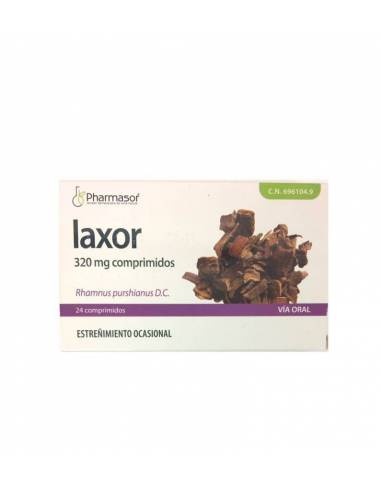
LAXOR 320 mg Comprimidos

Revisión de receta online
Un médico revisará tu caso y determinará si la prescripción es médicamente apropiada.

Habla con un médico sobre este medicamento
Comenta tus síntomas y las opciones de tratamiento en una consulta online.



Cómo usar LAXOR 320 MG COMPRIMIDOS.
Contenido del prospecto
- Introducción
- Qué es Laxor y para qué se utiliza
- Qué necesita saber antes de empezar a tomar Laxor
- Cómo tomar Laxor
- Posibles efectos adversos
- Conservación de Laxor
- Contenido del envase e información adicional
Introducción
Prospecto: Información para el usuario.
Laxor 320 mg comprimidos
Rhamnus purshianusD.C.
Lea todo el prospecto detenidamente antes de empezar a tomar este medicamento, porque contiene información importante para usted. Siga exactamente las instrucciones de administración del medicamento contenidas en este prospecto o las indicadas por su médico o farmacéutico.
|
Contenido del prospecto:
- Qué es Laxor y para qué se utiliza
- Qué necesita saber antes de empezar a tomar Laxor
- Cómo tomar Laxor
- Posibles efectos adversos
- Conservación de Laxor
- Contenido del envase e información adicional
1. Qué es Laxor y para qué se utiliza
Medicamento a base de plantas para uso a corto plazo en casos de estreñimiento ocasional.
Debe consultar a un médico o farmacéutico si los síntomas persisten durante el uso del medicamento.

¿No estás seguro de si este medicamento es adecuado para ti?
Comenta tus síntomas y tratamiento con un médico online.
2. Qué necesita saber antes de empezar a tomar Laxor
No tome Laxor
Si es alérgico al principio activo o a cualquiera de los demás componentes de este medicamento (incluidos en la sección 6).
No utilice este medicamento durante el embarazo y lactancia ni en niños menores de 12 años.
Si padece dolor abdominal de origen desconocido.
En estado de deshidratación grave con disminución de agua y electrolitos.
En caso de obstrucción intestinal y estenosis, atonía, apendicitis, enfermedades inflamatorias del intestino (por ejemplo; enfermedad de Crohn, colitis ulcerosa).
Advertencias y precauciones
Consulte a su médico o farmacéutico antes de empezar a tomar Laxor:
- Si está tomando medicamentos como glucósidos cardíacos, medicamentos antiarrítmicos, medicamentos que inducen la prolongación del QT, diuréticos, adrenocorticosteroides o raíz de regaliz
- Si padece retención fecal y molestias gastrointestinales no diagnosticadas, agudas o persistentes, por ejemplo, dolor abdominal, náuseas y vómitos, ya que estos síntomas pueden ser signos de una obstrucción intestinal (íleo) potencial o existente.
Debe evitarse el uso a largo plazo de laxantes estimulantes, ya que el uso durante más de un breve período de tratamiento puede dar lugar a un deterioro de la función del intestino y a la dependencia de los laxantes. Si el uso de laxantes se necesita todos los días, deberá investigarse la causa del estreñimiento. Los preparados de corteza de cáscara sagrada sólo deben utilizarse si no se puede lograr un efecto terapéutico mediante un cambio de dieta o la administración de agentes formadores de volumen.
Cuando se administran preparados de corteza de cáscara sagrada a adultos con incontinencia, las compresas/pañales deben cambiarse con mayor frecuencia para evitar el contacto prolongado de la piel con las heces.
Los pacientes con trastornos renales deben ser conscientes del posible desequilibrio electrolítico.
Si los síntomas empeoran durante el uso del medicamento, consulte a un médico o farmacéutico.
Niños y adolescentes
No administrar a niños menores de 12 años.
Otros medicamentos y Laxor
Informe a su farmacéutico o médico si está tomando, ha tomado recientemente o podría tener que tomar cualquier otro medicamento.
La hipopotasemia (resultante del abuso de laxantes durante largo tiempo) potencia la acción de los glucósidos cardíacos e interactúa con los medicamentos antiarrítmicos.
El uso concomitante con diuréticos, adrenocorticoesteroides y raíz de regaliz puede aumentar la pérdida de potasio.
Toma de Laxor con alimentos, bebidas y alcohol
Los alimentos, bebidas y alcohol no influyen en el efecto del medicamento.
Embarazo, lactancia y fertilidad
Si está embarazada o en periodo de lactancia, cree que podría estar embarazada o tiene intención de quedarse embarazada, consulte a su médico o farmacéutico antes de utilizar este medicamento.
El uso durante el embarazo está contraindicado debido a los datos experimentales relativos al riesgo genotóxico de varios antranoides, por ejemplo, la emodina y la aloe-emodina.
El uso durante la lactancia está contraindicado porque después de la administración de antranoides, los metabolitos activos, como el rhein, se excretan en la leche materna en pequeñas cantidades.
Conducción y uso de máquinas
No se ha descrito ningún efecto sobre la capacidad de conducir y usar máquinas.
3. Cómo tomar Laxor
Siga exactamente las instrucciones de administración del medicamento contenidas en este prospecto o las indicadas por su médico o farmacéutico. En caso de duda, pregunte a su médico o farmacéutico.
La dosis recomendada es:
Adolescentes, adultos y personas de edad avanzada: 1 comprimido al día, antes de acostarse con un vaso de agua.
No debe utilizarse durante más de una semana. La posología debe adaptarse según necesidad, normalmente es suficiente con tomar este medicamento 2-3 veces durante la semana.
Laxor necesita entre 6-12 horas tras su administración para que actúe, por lo que se recomienda tomar por la noche.
Si los síntomas persisten durante el uso del medicamento, se debe consultar a un médico o farmacéutico.
Uso en niños y adolescentes
No administrar a niños menores de 12 años sin prescripción médica.
Si toma más Laxor del que debe
Los principales síntomas de la sobredosis/abuso son el dolor punzante y la diarrea severa con las consiguiente pérdida de líquidos y electrolitos. El tratamiento debe ser de apoyo con cantidades generosas de líquido.
Los electrolitos, especialmente el potasio, deben ser controlados. Esto es especialmente importante en.las personas de edad avanzada.
Las sobredosis crónicas ingeridas de medicamentos que contengan antranoides pueden provocar una hepatitis tóxica.
En caso de sobredosis o ingestión accidental, consulte inmediatamente a su médico, farmacéutico o llame al Servicio de Información Toxicológica, teléfono 91.562.04.20 indicando el medicamento y la cantidad ingerida.
Si olvidó tomar Laxor
No tome una dosis doble para compensar las dosis olvidadas.
Si interrumpe el tratamiento con Laxor
Si tiene cualquier otra duda sobre el uso de este medicamento, pregunte a su médico o farmacéutico.

¿Has empezado a tomar el medicamento y tienes preguntas?
Comenta tus síntomas y tratamiento con un médico online.
4. Posibles efectos adversos
Al igual que todos los medicamentos, este medicamento puede producir efectos adversos, aunque no todas las personas los sufran.
Hipersensibilidad:
Pueden producirse reacciones de hipersensibilidad (prurito, urticaria, exantema local o generalizado)
Desórdenes gastrointentinales:
Este medicamento puede producir dolor y espasmo abdominal y el paso de heces líquidas, en particular en pacientes con colon irritable. Sin embargo, estos síntomas también pueden producirse de manera general como consecuencia de una sobredosis individual. En esos casos es necesario reducir la dosis.
Además, el uso crónico puede causar pigmentación de la mucosa intestinal (pseudomelanosis coli), que suele remitir cuando el paciente deja de tomar el preparado.
Síntomas de riñon y tracto urinario:
El uso a largo plazo puede conducir a un desequilibrio de agua y electrolitos y puede resultar en albuminuria y hematuria.
Durante el tratamiento puede producirse una decoloración amarilla o marrón-roja (dependiente del pH) de la orina por los metabolitos, que no es clínicamente significativa.
Se desconoce la frecuencia.
Si se producen otras reacciones adversas no mencionadas anteriormente, se debe consultar a un médico o profesional de la salud cualificado.
Comunicación de efectos adversos
Si experimenta cualquier tipo de efecto adverso, consulte a su médico o farmacéutico, incluso si se trata de posibles efectos adversos que no aparecen en este prospecto. También puede comunicarlos directamente a través del Sistema Español de Farmacovigilancia de Medicamentos de Uso Humano: www.notificaRAM.es. Mediante la comunicación de efectos adversos usted puede contribuir a proporcionar más información sobre la seguridad de este medicamento.
5. Conservación de Laxor
Mantener este medicamento fuera de la vista y del alcance de los niños.
Conservar en el embalaje original.
No utilice este medicamento después de la fecha de caducidad que aparece en el envase después de Cad. La fecha de caducidad es el último día del mes que se indica.
No utilice este medicamento si observa indicios visibles de deterioro.
Los medicamentos no se deben tirar por los desagües ni a la basura. Deposite los envases y los medicamentos que no necesita en el Punto SIGRE de la farmacia. En caso de duda pregunte a su farmacéutico cómo deshacerse de los envases y de los medicamentos que no necesita. De esta forma ayudará a proteger el medio ambiente.
6. Contenido del envase e información adicional
Composición de Laxor
Composición por comprimido:
El principio activo es 320 mg de corteza de Rhamnus purshianusDC. (Cáscara sagrada)
(Contenido en glucósidos hidroxiantracénicos expresados como cascarósido A 26,88 mg/comprimido).
Los demás componentes (excipientes) son celulosa microcristalina, estearato de magnesio y croscarmelosa sódica.
Aspecto del producto y contenido del envase
Se presenta en envase de cartón conteniendo 24 comprimidos de 400 mg en blister de PVC/PVDC/AL.
Titular de la autorización de comercialización y responsable de la fabricación
Soria natural S.A.
Polígono La Sacea nº 1.
Garray. (42162). Soria.
Tel: 975252046
Fax: 975252267
e-mail: [email protected]
Fecha de la última revisión de este prospecto:Diciembre 2021
La información detallada de este medicamento está disponible en la página web de la Agencia Española de Medicamentos y Productos Sanitarios (AEMPS) http://www.aemps.gob.es/
- País de registro
- Forma farmacéuticaCOMPRIMIDO, 320 mg/comprimido
- Requiere recetaNo
- Fabricante
- ComposiciónCROSCARMELOSA SODICA (4 mg mg)
- Esta información es de carácter general y no sustituye la consulta con un profesional sanitario.
- Alternativas a LAXOR 320 MG COMPRIMIDOS.Forma farmacéutica: SOLUCIÓN/SUSPENSIÓN ORAL, 1g/mlPrincipio activo: Aceite ricinoFabricante: Laboratorio Reig Jofre, S.A.No requiere recetaForma farmacéutica: COMPRIMIDO, 5,00 mg de bisacodilo/comp.Principio activo: BisacodiloFabricante: Roha Arzneimittel GmbhNo requiere recetaForma farmacéutica: CAPSULA, 250 mgPrincipio activo: cascaraFabricante: Arkopharma Laboratorios S.A.U.No requiere receta
Médicos online para LAXOR 320 MG COMPRIMIDOS.
Comenta la dosis, los posibles efectos secundarios, interacciones, contraindicaciones o la revisión de receta de LAXOR 320 MG COMPRIMIDOS., sujeto a valoración médica y a la normativa local.









Obtén una receta de LAXOR 320 MG COMPRIMIDOS. online
Rellena un formulario de 2 minutos
Cuéntanos tus síntomas, historial y el medicamento que necesitas.
Elige un médico o nosotros te asignamos uno
Escoge un especialista o te conectamos con el próximo médico disponible.
El médico revisa tu caso
Normalmente en 30 minutos. Puede hacerte preguntas adicionales por chat.
Recógela en cualquier farmacia
Receta electrónica enviada a tu correo, válida en toda España.
Preguntas frecuentes
LAXOR 320 MG COMPRIMIDOS. no requiere receta en España. Puedes confirmarlo con un médico online según tu caso.
LAXOR 320 MG COMPRIMIDOS. es fabricado por Soria Natural S.A.. La marca y el envase pueden variar según el distribuidor.
Los Médicos de familia, Psiquiatras, Dermatólogos, Cardiólogos, Endocrinólogos, Gastroenterólogos, Neumólogos, Nefrólogos, Reumatólogos, Hematólogos, Infectólogos, Alergólogos, Geriatras, Pediatras, Oncólogos pueden valorar la prescripción de LAXOR 320 MG COMPRIMIDOS. cuando esté clínicamente indicado. Puedes reservar una videoconsulta para comentar tu caso y las opciones de tratamiento.
España cuenta con una infraestructura sanitaria bien desarrollada en ciudades principales como Madrid, Barcelona, Valencia y Sevilla. Las farmacias están ampliamente disponibles y operan bajo estrictas regulaciones, garantizando el acceso a medicamentos con receta.
Puedes comprar LAXOR 320 MG COMPRIMIDOS. en Madrid, Barcelona, Sevilla o Valencia en cualquier farmacia local con una receta válida.
Para obtener una receta, puedes utilizar Oladoctor:
Otros medicamentos con el mismo principio activo () incluyen ACEITE DE RICINO REIG JOFRE 1G/ML LIQUIDO ORAL, BEKUNIS 5 mg COMPRIMIDOS GASTRORRESISTENTES, CÁSCARA SAGRADA ARKOPHARMA CÁPSULAS DURAS. Pueden tener diferentes nombres comerciales o formulaciones, pero contienen el mismo componente terapéutico. Consulta siempre con un médico antes de cambiar o iniciar un nuevo medicamento.
