



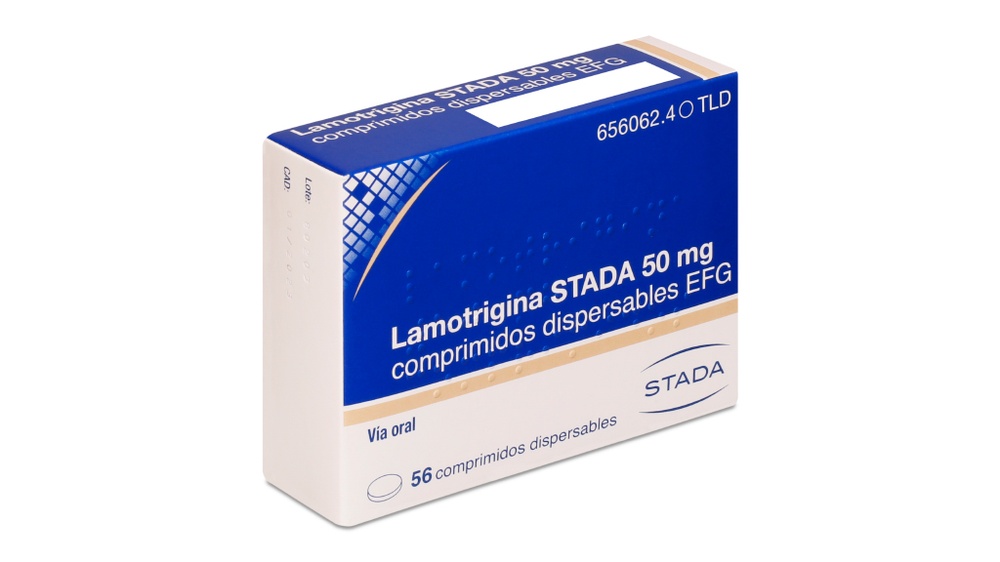
LAMOTRIGINA 50 mg Comprimidos Dispersables

Revisión de receta online
Un médico revisará tu caso y determinará si la prescripción es médicamente apropiada.

Habla con un médico sobre este medicamento
Comenta tus síntomas y las opciones de tratamiento en una consulta online.



Cómo usar LAMOTRIGINA STADA 50 mg COMPRIMIDOS DISPERSABLES EFG
Contenido del prospecto
- Introducción
- Qué es Lamotrigina Stada y para qué se utiliza
- Qué necesita saber antes de empezar a tomar Lamotrigina Stada
- Cómo tomar Lamotrigina Stada
- Posibles efectos adversos
- Conservación de Lamotrigina Stada
- Contenido del envase e información adicional
Introducción
Prospecto: información para el usuario
Lamotrigina Stada 25 mg comprimidos dispersables EFG
Lamotrigina Stada 50 mg comprimidos dispersables EFG
Lamotrigina Stada 100 mg comprimidos dispersables EFG
Lamotrigina Stada 200 mg comprimidos dispersables EFG
Lea todo el prospecto detenidamente antes de empezar a tomar este medicamento, porque contiene información importante para usted.
- Conserve este prospecto ya que puede tener que volver a leerlo.
- Si tiene alguna duda, consulte a su médico o farmacéutico.
- Este medicamento se le ha recetado solamente a usted, y no debe dárselo a otras personas aunque tengan los mismos síntomas que usted, ya que puede perjudicarles.
- Si experimenta efectos adversos, consulte a su médico o farmacéutico, incluso si se trata de efectos adversos que no aparecen en este prospecto. Ver sección 4.
Contenido del prospecto:
- Qué es Lamotrigina Stada y para qué se utiliza
- Qué necesita saber antes de empezar a tomar Lamotrigina Stada
- Cómo tomar Lamotrigina Stada
- Posibles efectos adversos
- Conservación de Lamotrigina Stada
- Contenido del envase e información adicional
1. Qué es Lamotrigina Stada y para qué se utiliza
Lamotrigina pertenece a un grupo de medicamentos denominados antiepilépticos. Se puede utilizar para el tratamiento de dos enfermedades: la epilepsiay el trastorno bipolar.
Lamotrigina se utiliza para el tratamiento de la epilepsiaporque bloquea las señales en el cerebro que desencadenan convulsiones (ataques).
- En adultos y niños de 13 años de edad en adelante, lamotrigina puede utilizarse solo o en combinación con otros medicamentos, para el tratamiento de la epilepsia. Lamotrigina también puede utilizarse junto con otros medicamentos para el tratamiento de las convulsiones que produce una enfermedad llamada Síndrome de Lennox-Gastaut.
- En niños entre 2 y 12 años de edad, lamotrigina puede utilizarse en combinación con otros medicamentos para el tratamiento de las mismas enfermedades. También puede utilizarse sin combinar con otros medicamentos para el tratamiento de un tipo de epilepsia llamado crisis de ausencia típica.
Lamotrigina también se usa para el tratamiento del trastorno bipolar.
Personas con trastorno bipolar (antes denominado trastorno maníaco-depresivo) padecen cambios de humor radicales, con períodos de manía (excitación o euforia) alternados con períodos de depresión (tristeza profunda o desesperación). En adultos de 18 años de edad en adelante, lamotrigina puede usarse, para prevenir los períodos de depresión que tienen lugar en el trastorno bipolar bien solo o en combinación con otros medicamentos. No se conoce cómo actúa lamotrigina en el cerebro para tener este efecto.

¿No estás seguro de si este medicamento es adecuado para ti?
Comenta tus síntomas y tratamiento con un médico online.
2. Qué necesita saber antes de empezar a tomar Lamotrigina Stada
NO tome Lamotrigina Stada:
- Si es alérgico a la lamotrigina o a alguno de los demás componentes de este medicamento (incluidos en la sección 6).
Si este es su caso:
??Comuníqueselo a su médico, y no tome lamotrigina.
Advertencias y precauciones
Consulte a su médico o farmacéutico antes de empezar tomar lamotrigina.
- si tiene algún problema de riñón
- si alguna vez ha desarrollado alguna erupción cutáneadespués de tomar lamotrigina u otros medicamentos para el trastorno bipolar o la epilepsia
- si experimenta una erupción o quemaduras solares después de tomar lamotrigina y haber estado expuesto al sol o luz artificial (por ejemplo, en un solárium). Su médico comprobará su tratamiento y puede aconsejarle que evite la luz solar o que se proteja del sol (por ejemplo, el uso de un protector solar y/o ropa protectora).
- si en alguna ocasión ha tenido meningitis después de tomar lamotrigina(lea la descripción de estos síntomas en la sección 4 de este prospecto: Efectos adversos raros)
- si ya está tomando medicamentos que contienen lamotrigina
- sipadece una enfermedad llamada Síndrome de Brugada u otros problemas cardíacos. El síndrome de Brugada es una enfermedad genética que causa una actividad eléctrica anormal del corazón. Lamotrigina puede dar lugar a anomalías en el electrocardiograma (ECG) que pueden provocar arritmias (ritmo cardiaco anormal)
Si este es su caso:
- Comuníqueselo al médico, quien decidirá disminuir la dosis, o determinará que lamotrigina no es adecuado para usted.
Información importante sobre reacciones potencialmente mortales
Un pequeño número de personas que tomaron lamotrigina tienen reacciones alérgicas o reacciones en la piel que potencialmente pueden amenazar la vida, las cuales pueden conducir a problemas más graves si no son tratadas. Estas reacciones pueden incluir síndrome de Stevens-Johnson (SSJ), necrólisis epidérmica tóxica (NET) y reacción farmacológica con eosinofilia y síntomas sistémicos (DRESS). Es necesario que conozca los síntomas de estas reacciones y que esté pendiente de las mismas mientras esté tomando lamotrigina. Este riesgo puede estar asociado con una variante en genes en personas de origen asiático (principalmente chinos han y tailandeses). Si usted es de uno de estos orígenes y ha sido diagnosticado previamente con esta variante genética (HLA B* 1502), hable con su médico antes de tomar Lamotrigina Stada.
- Lea la descripción de estos síntomas en el apartado 4 de este prospecto“Reacciones quepotencialmente pueden amenazar la vida: obtenga ayuda médica de inmediato”.
Linfohistiocitosis hemofagocítica (LHH)
Se han notificado casos de una reacción, rara pero muy grave, del sistema inmunológico en pacientes que toman lamotrigina.
?Contactede forma inmediata con su médico o farmacéuticosi presenta alguno de los siguientes síntomas mientras está tomando lamotrigina: fiebre, erupción, síntomas neurológicos (p. ej., espasmos o temblor, estado confusional, alteraciones de la función cerebral).
Pensamientos de autolesión o suicidio
Los fármacos antiepilépticos se utilizan para tratar diferentes enfermedades, entre ellas la epilepsia y el trastorno bipolar. Las personas con trastorno bipolar pueden haber tenido en alguna ocasión ideas de autolesión o suicidio. Si padece trastorno bipolar, puede que tenga más probabilidad de tener estas ideas en las siguientes situaciones:
- cuando empiece el tratamiento
- si ha tenido anteriormente ideas de autolesión o suicidio
- si tiene menos de 25 años.
Si tiene pensamientos o experiencias preocupantes, o si nota que se siente peor o que desarrolla nuevos síntomas mientras esté en tratamiento con lamotrigina:
??Consulte a su médico lo antes posible o acérquese al hospital más cercano.
Puede ser útil para usted explicarle a algún familiar, cuidador o a un amigo cercano que puede deprimirse o tener cambios significativos de ánimo, y pedirles que lean este prospecto. Puede pedirles que le digan si están preocupados por su depresión u otros cambios en su conducta.
Un número reducido de personas que estuvieron en tratamiento con antiepilépticos como lamotrigina también han tenido pensamientos de autolesión o suicidio. Si en cualquier momento tiene usted estos pensamientos, contacte inmediatamente con su médico.
Si usted está tomando Lamotrigina Stada para la epilepsia
Las crisis en algunos tipos de epilepsia pueden ocasionalmente empeorar o suceder más a menudo mientras esté tomando lamotrigina. Algunos pacientes pueden experimentar convulsiones graves, las cuales pueden causar serios problemas de salud. Si las crisis suceden más a menudo o si experimenta crisis graves mientras está tomando lamotrigina:
??Acuda a un médico inmediatamente.
No se debe administrar lamotrigina a niños menores de 18 años para el tratamiento del trastorno bipolar. Los medicamentos indicados para el tratamiento de la depresión y de otros problemas de salud mental aumentan el riesgo de pensamientos y comportamientos suicidas en niños y adolescentes menores de 18 años.
 Otros medicamentos y Lamotrigina Stada
Informe a su médico o farmacéutico si está tomando, ha tomado recientemente o podría tener que tomar cualquier otro medicamento.
Su médico necesita saber si está tomando otros medicamentos para el tratamiento de la epilepsia o para problemas de salud mental. Esto es para asegurarse de que toma la dosis correcta de lamotrigina. Entre estos medicamentos se incluyen:
- oxcarbazepina, felbamato, gabapentina, levetiracetam, pregabalina, topiramatoo zonisamida, utilizados para el tratamiento de la epilepsia
- litio, olanzapinao aripiprazol, utilizados para el tratamiento de problemas de salud mental
- bupropión, utilizado para el tratamiento de problemas mentaleso para dejar de fumar
- paracetamol, utilizado para tratar el dolor y la fiebre.
??Informe a su médico?si está utilizando alguno de estos medicamentos.
Algunos medicamentos interaccionan con lamotrigina o hacen más probable que las personas tengan efectos adversos. Estos incluyen:
- valproato, utilizado para el tratamiento de la epilepsiay problemas de salud mental
- carbamazepina, utilizado para el tratamiento de la epilepsiay problemas de salud mental
- fenitoína, primidona o fenobarbital, utilizados para el tratamiento de la epilepsia
- risperidona, utilizado para el tratamiento de problemas de salud mental
- rifampicina, que es un antibiótico
- medicamentos utilizados para el tratamiento de la infección por el Virus de Inmunodeficiencia Humana (VIH) (una combinación de lopinavir y ritonavir o atazanavir y ritonavir)
- anticonceptivos hormonales, como la píldora anticonceptiva(ver a continuación).
- Informe a su médicosi está utilizando cualquiera de estos medicamentos, o si empieza o deja de utilizarlos.
Los anticonceptivos hormonales (como la píldora anticonceptiva) pueden afectar la forma de actuar de Lamotrigina Stada
Puede que su médico le recomiende que utilice un anticonceptivo hormonal en concreto, o que utilice otro método anticonceptivo distinto, como preservativos, diafragma o DIU. Si está tomando un anticonceptivo hormonal como la píldora anticonceptiva, puede que su médico le pida que se haga un análisis de sangre para comprobar los niveles de lamotrigina. Si está utilizando un anticonceptivo hormonal o si usted está pensando en empezar a usar uno:
- Informe a su médico, ya que él le indicará cuáles son los métodos anticonceptivos más adecuados para usted.
Puede que la administración de lamotrigina modifique la forma de actuar de los anticonceptivos hormonales, aunque es poco probable que disminuya su eficacia. Si usted está utilizando un anticonceptivo hormonal, y nota cambios en su ciclo menstrual, como sangrados intermenstruales o pérdidas entre menstruaciones:
- Informe a su médico. Éstos pueden ser signos de que lamotrigina está afectando a la forma de actuar de su anticonceptivo.
Embarazo y lactancia
- Si está embarazada, cree que podría estar embarazada o tiene intención de quedarse embarazada, consulte a su médico o farmacéutico antes de utilizar este medicamento.
- No debe dejar su tratamiento sin consultarlo con su médico. Esto es particularmente importante si tiene epilepsia.
- El embarazo puede modificar la eficacia del tratamiento con lamotrigina, por lo que puede necesitar que le hagan un análisis de sangre y le ajusten su dosis.
- Si lamotrigina se toma durante los 3 primeros meses del embarazo, puede haber un pequeño aumento del riesgo de que se produzcan defectos de nacimiento, incluyendo labio y/o paladar hendido.
- Puede que su médico le aconseje tomar suplementos de ácido fólicosi está planeando quedarse embarazada y también durante el embarazo.
- Si está en período de lactancia o si planea iniciar un período de lactancia, consulte a su médico o farmacéutico antes de tomar este medicamento.El principio activo de Lamotrigina Stada pasa a la leche materna y puede afectar a su bebé. Su médico le comentará los riesgos y beneficios de la lactancia mientras está tomando lamotrigina. En el caso de que decida iniciar la lactancia, el médico hará revisiones a su bebé de vez en cuando ya que puede sufrir somnolencia, erupción o una ganancia de peso escasa. Informe a su médico si observa alguno de estos síntomas en su bebé.
Conducción y uso de máquinas
Lamotrigina Stada puede causar mareos y visión doble.
??No conduzca ni use máquinas a menos que esté seguro de no sentir estos efectos.?
Si padece epilepsia, consulte a su médico la posibilidad de conducir o usar máquinas.
Lamotrigina Stada contiene sodio
Este medicamento contiene menos de 1 mmol de sodio (23 mg) por comprimido dispersable; esto es, esencialmente “exento de sodio”.
3. Cómo tomar Lamotrigina Stada
Siga exactamente las instrucciones de administración de este medicamento indicadas por su médico o farmacéutico. En caso de duda consulte de nuevo a su médico o farmacéutico.
Qué dosis de Lamotrigina Stada tomar
Puede llevar un tiempo hasta que el médico encuentre la dosis de lamotrigina más apropiada para usted. La dosis que debe tomar dependerá de:
- su edad
- si está tomando lamotrigina junto con otros medicamentos
- si tiene algún problema de hígado o de riñón
El médico le prescribirá una dosis baja al inicio del tratamiento y, de forma gradual, aumentará la dosis durante varias semanas hasta alcanzar la más apropiada para usted (llamada dosis efectiva). No tomenunca más cantidad de lamotrigina de la que su médico le haya indicado.
La dosis recomendada de lamotrigina para adultos y niños de 13 años y en adelante, está entre 100 mg y 400 mg al día.
Para niños entre 2 y 12 años de edad, la dosis efectiva depende de su peso corporal, normalmente entre 1 mg y 15 mg por cada kilogramo de peso del niño, hasta una dosis de mantenimiento máxima de 200 mg al día.
No se recomienda el uso de lamotrigina en niños menores de 2 años.
Cómo tomar la dosis de Lamotrigina Stada
Tome su dosis de lamotrigina una o dos veces al día, según le haya aconsejado el médico. Pueden ser tomados con o sin alimentos.
- Siempre tome la dosis completaque el médico le ha prescrito. Nunca tome parte del comprimido.
Su médico puede aconsejarle que empiece o deje de tomar otros medicamentos, dependiendo del problema por el que está siendo tratado y de la forma en que responde al tratamiento.
Los comprimidos dispersables de lamotrigina pueden tanto ser tragados enteros con un poco de agua, masticados o mezclados con agua para disolverlos.
 Masticar el comprimido:
Es posible que, al masticar el comprimido, necesite beber un poco de agua para ayudar a que el comprimido se disuelva en la boca. Después de tragarlo, beba un poco más de agua para asegurarse de que ha tomado todo el medicamento.
Para disolver el medicamento (hacer un medicamento líquido):
- Ponga el comprimido en un vaso que contenga, como mínimo, suficiente agua para cubrir el comprimido entero.
- Agite para disolver, o espere durante un minuto, hasta que el comprimido esté totalmente disuelto.
- Beba todo el líquido.
- Añada un poco más de agua al vaso y bébala, para asegurarse de que no queda nada del medicamento en el vaso.
Si toma más Lamotrigina Stada de la que debe
- Consulte con su médico o al centro hospitalario de urgencias más cercano inmediatamente o al Servicio de Información Toxicológica, teléfono: 91 5620420. Se recomienda llevar el envase y el prospecto del medicamento al profesional sanitario.
Si toma más lamotrigina de la que debe puede ser más propenso a tener efectos adversos graves que pueden ser mortales.
Alguien que haya tomado demasiada lamotrigina puede tener alguno de estos síntomas:
- movimientos rápidos e incontrolables de los ojos (nistagmo)
- torpeza y pérdida de coordinación, afectando al equilibrio (ataxia)
- cambios en el ritmo cardíaco (generalmente detectados con un ECG)
- pérdida de consciencia, ataques (convulsiones) o coma.
Si olvidó tomar una dosis de Lamotrigina Stada
- No tome una dosis doble para compensar las dosis olvidadas. Tome la siguiente dosis a la hora habitual.
En caso de olvidar tomar múltiples dosis de lamotrigina
- Pregunte a su médico para que le explique cómo empezar de nuevo el tratamiento. Es importante que haga esto.
No deje de tomar lamotrigina sin consultarlo
Debe tomar lamotrigina durante todo el tiempo que su médico le recomiende. No suspenda el tratamiento hasta que su médico se lo indique.
Si está tomando lamotrigina para el tratamiento de la epilepsia
Para dejar de tomar lamotrigina, es importante que la dosis se reduzca gradualmente, durante aproximadamente 2 semanas. Si deja de tomar lamotrigina de golpe, puede volver a padecer los síntomas de la epilepsia o puede que la enfermedad empeore.
Si usted está tomando lamotrigina para el trastorno bipolar
Lamotrigina puede tardar un tiempo en actuar, por lo que es improbable que se sienta mejor de forma inmediata. Si deja de tomar lamotrigina, no necesita reducir la dosis gradualmente. Pero, aun así, antes de interrumpir el tratamiento con lamotrigina, debe consultar con su médico.
Si tiene cualquier otra duda sobre el uso de este medicamento, pregunte a su médico, farmacéutico o enfermero.

¿Has empezado a tomar el medicamento y tienes preguntas?
Comenta tus síntomas y tratamiento con un médico online.
4. Posibles efectos adversos
Al igual que todos los medicamentos, este medicamento puede tener efectos adversos, aunque no todas las personas los sufran.
Reacciones que potencialmente pueden amenazar la vida: obtenga ayuda médica de inmediato.
Un número reducido de personas que toman lamotrigina desarrollan reacciones alérgicas o reacciones cutáneas que potencialmente pueden amenazar su vida, las cuales pueden dar lugar a problemas más graves si no se tratan.
Es más probable que estos síntomas aparezcan durante los primeros meses de  tratamiento con lamotrigina, especialmente si la dosis inicial es demasiado alta o si la dosis se incrementa demasiado rápido o si se toma lamotrigina junto con otro medicamento llamado valproato. Algunos de estos síntomas son más frecuentes en niños, por lo que los padres deberán prestarles una atención especial.
Los síntomas de estas reacciones incluyen:
- erupciones o enrojecimiento en la piel,que pueden dar lugar a reacciones en la piel que pueden amenazar la vida, incluyendo erupción diseminada con ampollas ydescamaciónde la piel, sobre todo alrededor de la boca, nariz, ojos y genitales (Síndrome deStevens-Johnson), descamaciones extensas de la piel (más del 30 % de superficie corporal – necrólisis epidérmica tóxica) o erupción cutánea extensa con afectación del hígado, la sangre y otros órganos del cuerpo (reacción farmacológica con eosinofilia y síntomas sistémicos también conocida como síndrome de hipersensibilidad (DRESS)).
- úlcerasen la boca, garganta, nariz o genitales
- dolor en la boca o tener los ojos rojos o hinchados(conjuntivitis)
- temperatura elevada(fiebre), síntomas parecidos a la gripe o somnolencia (sopor)
- hinchazón alrededor de la carao inflamación de los gangliosdel cuello, axilas o ingles
- sangrado o aparición de moratones de forma inesperada, o que los dedos se vuelvan azulados
- dolor de gargantao padecer más infecciones de lo normal (como resfriados)
- aumento de los niveles de las enzimas hepáticas en los análisis de sangre
- aumento de un tipo de glóbulos blancos (eosinófilos)
- nódulos linfáticos agrandados
- afectación de órganos del cuerpo incluyendo el hígado y los riñones.
En muchos casos, estos síntomas pueden ser signos de efectos adversos menos graves. Pero usteddebe ser consciente de que potencialmente pueden amenazar la vida y pueden dar lugar a problemas más graves,como fallo orgánico, si no se tratan. Si nota cualquiera de estos síntomas:
??Contacte con un médico inmediatamente. Su médico decidirá si debe realizarle pruebas para valorar el funcionamiento del hígado, los riñones o de la sangre y puede indicarle que interrumpa el tratamiento con lamotrigina. Si ha desarrollado Síndrome de Stevens-Johnson o necrólisis tóxica epidérmica, su médico le indicará que nunca más debe volver a usar lamotrigina.
Linfohistiocitosis hemofagocítica (LHH)(ver sección 2. Qué necesita saber antes de empezar a tomar Lamotrigina Stada).
Efectos adversos muy frecuentes
Pueden afectar a más de 1 de cada 10personas:
- dolor de cabeza
- erupción cutánea
Efectos adversos frecuentes
Pueden afectar a hasta 1 de cada 10personas:
- agresividad o irritabilidad
- sensación de sueño o somnolencia
- sensación de mareo
- espasmos o temblores
- dificultad para dormir (insomnio)
- sentirse agitado
- diarrea
- boca seca
- náuseas o vómitos
- sensación de cansancio
- dolor en la espalda o en las articulaciones, o en otros lugares.
Efectos adversos poco frecuentes
Pueden afectar hasta 1 de cada 100personas:
- torpeza y pérdida de coordinación (ataxia)
- visión doble o visión borrosa
- disminución de la masa capilar o pérdida inusual del pelo (alopecia)
- erupción cutánea o quemaduras solares después de la exposición al sol o la luz artificial (fotosensibilidad)
Efectos adversos raros
Pueden afectar a hasta 1 de cada 1.000personas
- reacción en la piel que puede amenazar la vida (Síndrome de Stevens-Johnson)(véase también la información al inicio de la sección 4)
- un conjunto de síntomas que incluyen: fiebre, náuseas, vómitos, dolor de cabeza, rigidez de cuello y sensibilidad extrema a la luz brillante. Esto puede ser causado por una inflamación de las membranas que cubren el cerebro y la médula espinal (meningitis). Estos síntomas desaparecen normalmente cuando se interrumpe el tratamiento. No obstante, si los síntomas continúan o empeoran, contacte con su médico
- movimientos rápidos e incontrolables de ojos (nistagmo)
- picor de ojos, con secreción y legañas en los párpados (conjuntivitis)
Efectos adversos muy raros
Pueden afectar a hasta 1 de cada 10.000personas
- reacción en la piel que puede amenazar la vida (necrólisis tóxica epidérmica)(véase la información al inicio de la sección 4)
- reacción farmacológica con eosinofilia y síntomas sistémicos (DRESS) (véase también la información al principio de la sección 4)
- temperatura elevada (fiebre) (véase también la información al principio de la sección 4)
- hinchazón alrededor de la cara (edema) o inflamación de las glándulas del cuello, ingles o axilas (linfadenopatía) (véase también la información al principio de la sección 4)
- cambios en la función del hígado, que pueden observarse en los análisis de sangre o fallo hepático (véase también la información al principio de la sección 4)
- trastorno grave de la coagulación de la sangre, que puede causar sangrado o aparición inesperada de moratones (coagulación intravascular diseminada) (véase también la información al principio de la sección 4)
- linfohistiocitosis hemofagocítica (LHH) (véase sección 2. Qué necesita saber antes de empezar a tomar Lamotrigina Stada)
- cambios que puedan observarse en los análisis de sangre incluyendo número reducido de glóbulos rojos (anemia), número reducido de glóbulos blancos (leucopenia, neutropenia, agranulocitosis), número reducido de plaquetas (trombocitopenia), número reducido de todos los tipos de células de la sangre (pancitopenia), y una alteración de la médula espinal denominada anemia aplásica
- alucinaciones (escuchar o ver cosas que no están realmente)
- confusión
- sentirse inseguro o con inestabilidad al moverse
- movimientos corporales repetidos incontrolables y/o sonidos o palabras (tics), espasmos musculares incontrolables que afectan a los ojos, cabeza y torso (coreoatetosis) u otros movimientos inusuales como sacudidas, espasmos o rigidez
- en personas con epilepsia, crisis más frecuentes
- en personas que padecen la enfermedad de Parkinson, empeoramiento de los síntomas
- reacción similar al lupus (los síntomas pueden incluir: dolor de espalda o articulaciones los cuales pueden ir algunas veces acompañados de fiebre y/o enfermedad generalizada).
Otros efectos adversos
Otros efectos adversos han aparecido en un reducido número de personas pero su frecuencia exacta no es conocida (la frecuencia no puede estimarse a partir de los datos disponibles)
- se han notificado alteraciones óseas que incluyen osteopenia y osteoporosis (disminución del espesor del hueso) y fracturas. Consulte con su médico o farmacéutico si ha tomado medicamentos antiepilépticos durante un tiempo prolongado, si tiene un historial de osteoporosis, o si toma esteroides
- inflamación del riñón (nefritis tubulointersticial) o inflamación del riñón y del ojo (síndrome de nefritis tubulointersticial aguda y uveítis)
- pesadillas
- disminución de la inmunidad, debido a la reducción en los niveles de anticuerpos llamados inmunoglobulinas en la sangre que ayudan a proteger contra la infección
- nódulos rojos o parches en la piel (pseudolinfoma).
Comunicación de efectos adversos
Si experimenta cualquier tipo de efecto adverso, consulte a su médico o farmacéutico, incluso si se trata de posibles efectos adversos que no aparecen en este prospecto. También puede comunicarlos a través del Sistema Español de Farmacovigilancia de Medicamentos de Uso Humano. https:/www.notificaram.es. Mediante la comunicación de efectos adversos usted puede contribuir a proporcionar más información sobre la seguridad de este medicamento.
5. Conservación de Lamotrigina Stada
Mantener este medicamento fuera de la vista y del alcance de los niños.
No utilice este medicamento después de la fecha de caducidad que aparece en el blíster y el envase. La fecha de caducidad es el último día del mes que se indica.
No requiere condiciones especiales de conservación.
Los medicamentos no se deben tirar por los desagües ni a la basura. Deposite los envases y los medicamentos que no necesita en el Punto SIGRE de la farmacia. Pregunte a su farmacéutico cómo deshacerse de los envases y de los medicamentos que ya no necesita. De esta forma, ayudará a proteger el medio ambiente.
6. Contenido del envase e información adicional
Composición de Lamotrigina Stada
-El principio activo es lamotrigina. Cada comprimido dispersable contiene 25 mg, 50 mg, 100 mg o 200 mg de lamotrigina.
-Los demás componentes son: crospovidona, acesulfamo potásico (E 950), aroma de naranja, manitol (E 421), sílice coloidal anhidra, estearil fumarato sódico.
Aspecto del producto y contenido del envase
Lamotrigina Stada 25 mg se presenta en forma de comprimidos dispersables. Los comprimidos son blancos, redondos, planos y con la marca “25” en una cara.
Lamotrigina Stada 50 mg se presenta en forma de comprimidos dispersables. Los comprimidos son blancos, redondos, planos y con la marca “50” en una cara.
Lamotrigina Stada 100 mg se presenta en forma de comprimidos dispersables. Los comprimidos son blancos, redondos, planos y con la marca “100” en una cara.
Lamotrigina Stada 200 mg se presenta en forma de comprimidos dispersables. Los comprimidos son blancos, redondos, planos y con la marca “200” en una cara.
Lamotrigina Stada comprimidos dispersables se envasa en blísteres de Aluminio/Aluminio conteniendo 10, 14, 21, 28, 30, 42, 50, 56, 90, 100 y 200 comprimidos o en blísteres de polímeros de Aluminio/PVC/Aclar que contienen 10, 14, 21, 28, 30, 42, 50, 56, 60, 90, 100 y 200 comprimidos.
Puede que solamente estén comercializados algunos tamaños de envase.
Titular de la autorización de comercialización y responsable de la fabricación
Titular de la autorización de comercialización
Laboratorio STADA, S.L.
Frederic Mompou, 5
08960 Sant Just Desvern (Barcelona)
España
Responsable de la fabricación
SANICO N.V.
Industriezone 4, Veedijk 59
B-2300 - Turnhout
Bélgica
o
STADA ARZNEIMITTEL AG
Stadastrasse 2- 18
D-61118 - Bad Vilbel
Alemania
Este medicamento está autorizado en los estados miembros del espacio Económico Europeo con los siguientes nombres:
BE: Lamotrigine EG 25/50/100/200 mg dispergeerbare tabletten
LU: Lamotrigine EG 25/50/100/200 mg comprimés dispersibles
DK: Lamotrigin Stada 5/25/50/100/200 mg dispergible tabletter
HU: LATRIGIL 25/50/100/200 mg diszpergálódó tabletta
IT: Lamotrigina EG 5/25/50/100/200 mg compresse dispersibili
ES: Lamotrigina STADA 25/50/100/200 mg comprimidos dispersables EFG
Fecha de la última revisión de este prospecto:enero 2024.
La información detallada de este medicamento está disponible en la página web de la Agencia Española del Medicamento y Productos Sanitarios (AEMPS) http://www.aemps.gob.es/”.
- País de registro
- Forma farmacéuticaCOMPRIMIDO, 50 lamotrigina
- Código ATCN03AX09
- Precio medio en farmacia13.18 EUR
- Principio activo
- Requiere recetaSí
- Fabricante
- ComposiciónACESULFAMO POTASICO (6,00 mg mg), MANITOL (E-421) (115,20 mg mg), FUMARATO DE ESTEARILO Y SODIO (4,00 mg mg)
- Esta información es de carácter general y no sustituye la consulta con un profesional sanitario.
- Alternativas a LAMOTRIGINA STADA 50 mg COMPRIMIDOS DISPERSABLES EFGForma farmacéutica: COMPRIMIDO MASTICABLE, 100 mg lamotriginaPrincipio activo: lamotriginaFabricante: Glaxosmithkline S.A.Requiere recetaForma farmacéutica: COMPRIMIDO MASTICABLE, 200 mg lamotriginaPrincipio activo: lamotriginaFabricante: Glaxosmithkline S.A.Requiere recetaForma farmacéutica: COMPRIMIDO MASTICABLE, 25 mg lamotriginaPrincipio activo: lamotriginaFabricante: Glaxosmithkline S.A.Requiere receta
Médicos online para LAMOTRIGINA STADA 50 mg COMPRIMIDOS DISPERSABLES EFG
Comenta la dosis, los posibles efectos secundarios, interacciones, contraindicaciones o la revisión de receta de LAMOTRIGINA STADA 50 mg COMPRIMIDOS DISPERSABLES EFG, sujeto a valoración médica y a la normativa local.



Obtén una receta de LAMOTRIGINA STADA 50 mg COMPRIMIDOS DISPERSABLES EFG online
Rellena un formulario de 2 minutos
Cuéntanos tus síntomas, historial y el medicamento que necesitas.
Elige un médico o nosotros te asignamos uno
Escoge un especialista o te conectamos con el próximo médico disponible.
El médico revisa tu caso
Normalmente en 30 minutos. Puede hacerte preguntas adicionales por chat.
Recógela en cualquier farmacia
Receta electrónica enviada a tu correo, válida en toda España.
Preguntas frecuentes
LAMOTRIGINA STADA 50 mg COMPRIMIDOS DISPERSABLES EFG requiere receta en España. Puedes confirmarlo con un médico online según tu caso.
El principio activo de LAMOTRIGINA STADA 50 mg COMPRIMIDOS DISPERSABLES EFG es lamotrigina. Esta información ayuda a identificar medicamentos con la misma composición pero con diferentes nombres comerciales.
El precio medio en farmacia de LAMOTRIGINA STADA 50 mg COMPRIMIDOS DISPERSABLES EFG es de aproximadamente 13.18 EUR. Puede variar según el fabricante y la forma farmacéutica.
LAMOTRIGINA STADA 50 mg COMPRIMIDOS DISPERSABLES EFG es fabricado por Laboratorio Stada S.L.. La marca y el envase pueden variar según el distribuidor.
Los Médicos de familia, Psiquiatras, Dermatólogos, Cardiólogos, Endocrinólogos, Gastroenterólogos, Neumólogos, Nefrólogos, Reumatólogos, Hematólogos, Infectólogos, Alergólogos, Geriatras, Pediatras, Oncólogos pueden valorar la prescripción de LAMOTRIGINA STADA 50 mg COMPRIMIDOS DISPERSABLES EFG cuando esté clínicamente indicado. Puedes reservar una videoconsulta para comentar tu caso y las opciones de tratamiento.
España cuenta con una infraestructura sanitaria bien desarrollada en ciudades principales como Madrid, Barcelona, Valencia y Sevilla. Las farmacias están ampliamente disponibles y operan bajo estrictas regulaciones, garantizando el acceso a medicamentos con receta.
Puedes comprar LAMOTRIGINA STADA 50 mg COMPRIMIDOS DISPERSABLES EFG en Madrid, Barcelona, Sevilla o Valencia en cualquier farmacia local con una receta válida.
Para obtener una receta, puedes utilizar Oladoctor:
Otros medicamentos con el mismo principio activo (lamotrigina) incluyen CRISOMET 100 mg COMPRIMIDOS MASTICABLES/DISPERSABLES, CRISOMET 200 mg COMPRIMIDOS MASTICABLES/DISPERSABLES, CRISOMET 25 mg COMPRIMIDOS MASTICABLES/DISPERSABLES. Pueden tener diferentes nombres comerciales o formulaciones, pero contienen el mismo componente terapéutico. Consulta siempre con un médico antes de cambiar o iniciar un nuevo medicamento.
