



KYTRIL 1 mg Comprimidos Recubiertos Con Película

Revisión de receta online
Un médico revisará tu caso y determinará si la prescripción es médicamente apropiada.

Habla con un médico sobre este medicamento
Comenta tus síntomas y las opciones de tratamiento en una consulta online.



Cómo usar KYTRIL 1 MG COMPRIMIDOS RECUBIERTOS CON PELICULA
Contenido del prospecto
- Introducción
- Qué es Kytril y para qué se utiliza
- Qué necesita saber antes de tomar Kytril
- Cómo tomar Kytril
- Posibles efectos adversos
- Conservación de Kytril
- Contenido del envase e información adicional
Introducción
Prospecto: información para el usuario
Kytril1mg comprimidos recubiertos con pelicula
Granisetrón
<Lea todo el prospecto detenidamente antes de empezara tomareste medicamento, porque contiene información importante para usted.
- Conserve este prospecto, ya que puede tener que volver a leerlo.
- Si tiene alguna duda, consulte a su médico o farmacéutico.
- Este medicamento se le ha recetado solamente a usted, y no debe dárselo a otras personas aunque tengan los mismos síntomas que usted, ya que puede perjudicarles.
- Si experimenta efectos adversos, consulte a su médico, enfermero o farmacéutico, incluso si se trata de efectos adversos que no aparecen en este prospecto. Ver sección 4.
Contenido del prospecto
- Qué es Kytril y para qué se utiliza
- Qué necesita saber antes de tomar Kytril
- Cómo tomar Kytril
- Posibles efectos adversos
- Conservación de Kytril
- Contenido del envase e información adicional
1. Qué es Kytril y para qué se utiliza
Kytril contiene el principio activo granisetrón. Éste pertenece a un grupo de medicamentos llamados antagonistas de los receptores de serotonina, 5-HT3, o antieméticos, es decir, previenen o evitan las náuseas y vómitos. Estos comprimidos sólo están indicados en adultos.
Kytril está indicado para la prevención y el tratamiento de las náuseas y vómitos (sensación de malestar) producidos por determinados tratamientos, tales como la quimioterapia o la radioterapia en la terapia anticancerosa.

¿No estás seguro de si este medicamento es adecuado para ti?
Comenta tus síntomas y tratamiento con un médico online.
2. Qué necesita saber antes de tomar Kytril
No tome Kytril comprimidos
? si es alérgico (hipersensible) a granisetrón o a cualquiera de los demás componentes de Kytril (incluidos en la sección 6: Información adicional y el apartado sobre Información importante sobre algunos de los componentes de Kytril).
Si no está seguro, consulte a su médico, enfermero o farmacéutico antes de tomar estos comprimidos.
Advertencias y precauciones
Consulte a su médico o farmacéutico antes de empezar a tomar estos comprimidos,especialmente si usted:
? tiene problemas de estreñimiento por obstrucción del intestino
? tiene problemas de corazón, está recibiendo medicamentos anticancerosos que puedan ser perjudiciales para su corazón y/o sufre algún trastorno de los niveles de sales como el potasio, el sodio o el calcio (alteraciones electrolíticas).
? está tomando otro medicamento del grupo de los “antagonistas de los receptores 5-HT3”. Dentro de este grupo se encuentran el dolasetrón y el ondasetrón utilizados, al igual que Kytril, para el tratamiento y la prevención de náuseas y vómitos.
El Síndrome Serotoninérgico es una reacción poco frecuente pero potencialmente mortal que puede ocurrir con granisetrón (ver sección 4). Puede causar cambios graves en cómo su cerebro, músculos y aparato digestivo funcionan. La reacción puede ocurrir si usted toma granisetrón sólo,peroes más probable que ocurra si usted toma granisetrón con otros medicamentos (en particular fluoxetina, paroxetina, sertralina, fluvoxamina, citalopram, escitalopram, venlafaxina, duloxetina). El riesgo de síndrome serotoninérgico también aumenta si está tomando medicamentos que contienen buprenorfina u otros opioides. Asegúrese de comunicar a su médico, enfermero o farmacéutico todos los medicamentos que está tomando.
Niños
Los niños no deben tomar estos comprimidos.
Otros medicamentos y Kytril
Informe a su médico, enfermero o farmacéutico si está utilizando o ha utilizando recientemente o podría tomar otros medicamentos, incluso los adquiridos sin receta. Esto se debe a que Kytril puede interaccionar con algunos medicamentos. También algunos medicamentos pueden interaccionar con estos comprimidos.
Informe a su médico, enfermero o farmacéutico si está tomando o podría haber tomado otros medicamentos:
? medicamentos utilizados para tratar los latidos irregulares del corazón, otros medicamentos “antagonistas de los receptores 5-HT3” tales como el dolasetrón o el ondasetrón (ver “Advertencias y precauciones”).
? fenobarbital, medicamento utilizado para el tratamiento de la epilepsia
? ketoconazol, medicamento utilizado para tratar infecciones producidas por hongos
? eritromicina, antibiótico utilizado para tratar infecciones producidas por bacterias
? ISRS (inhibidores selectivos de la recaptación de serotonina) utilizados para tratar la depresión y /o ansiedad. Por ejemplo: fluoxetina, paroxetina, sertralina, fluvoxamina, citalopram, escitalopram
? IRSN (inhibidores selectivos de la recaptación de serotonina y noradrenalina) utilizados para tratar la depresión y/o ansiedad. Por ejemplo: venlafaxina, duloxetina.
- Medicamentos que contienen buprenorfina u otros opioides.
Embarazo y lactancia
No tome estos comprimidos si está usted embarazada, si está tratando de quedarse embarazada o si está en periodo de lactancia, a menos que se lo haya dicho su médico.
Si está embarazada o en período de lactancia, cree que podría estar embarazada o tiene intención de quedarse embarazada, consulte a su médico, enfermero o farmacéutico antes de utilizar este medicamento.
Conducción y uso de máquinas
El efecto de Kytril sobre la capacidad para conducir y utilizar máquinas es nula o insignificante.
Contenido de Kytril
Kytril contiene lactosa (un tipo de azúcar). Si su médico le ha indicado que padece una intolerancia a ciertos azúcares, consulte con él antes de tomar este medicamento.
Kytril contiene menos de 23 mg (1mmol) de sodio por dosis (1mg), por lo que se considera esencialmente “exento de sodio“.
3. Cómo tomar Kytril
Siga exactamente las instrucciones de administración de este medicamento indicadas por su médico. En caso de duda, consulte de nuevo a su médico, enfermero o farmacéutico
La dosis recomendada de Kytril varía de un paciente a otro. Ésta depende de la edad, el peso, y si está tomando otros medicamentos para prevenir o tratar las nauseas y vómitos. El médico decidirá cuanto tiene que tomar.
Prevención de náuseas o vómitos (sensación de malestar)
La primera dosis de Kytril se le dará generalmente una hora antes de su radio o quimioterapia. La dosis se debe tomar como:
- un comprimido de 1 mg dos veces al día o
- dos comprimidos de 1 mg una vez al día o
- un comprimido de 2 mg una vez al día
hasta un máximo de una semana después de su radio o quimioterapia.
Tratamiento de náuseas o vómitos (sensación de malestar)
La dosis generalmente será:
- un comprimido de 1 mg dos veces al día o
- dos comprimidos de 1 mg una vez al día o
- un comprimido de 2 mg una vez al día
Si toma más Kytril del que debe
Si cree que ha tomado más comprimidos del que debiera, comuníqueselo a su médico o enfermero. También puede llamar al Servicio de Información Toxicológica teléfono 91 562 04 20, indicando el medicamento y la cantidad ingerida.
Dentro de los síntomas de sobredosis se incluye un ligero dolor de cabeza (cefalea). Usted será tratado según sus síntomas.
Si olvidó tomar Kytril
Si cree que se le ha olvidado tomar su medicamento, pregunte a su médico o enfermero.
No tome una dosis doble para compensar las dosis olvidadas.
Si interrumpe el tratamiento con Kytril
No deje de tomar su medicamento antes de que haya terminado el tratamiento. Si interrumpe el tratamiento sus síntomas pueden volver a aparecer.
Si tiene cualquier otra duda sobre el uso de este medicamento, pregunte a su médico, enfermero o farmacéutico
.

¿Has empezado a tomar el medicamento y tienes preguntas?
Comenta tus síntomas y tratamiento con un médico online.
4. Posibles efectos adversos
Al igual que todos los medicamentos, este medicamento puede producir efectos adversos, aunque no todas las personas los sufran. Si observa alguno de los siguientes efectos adversos, debe acudir inmediatamente a su médico:
- reacciones alérgicas (anafilaxis). Los signos pueden incluir inflamación de garganta, o que se le hinche cara , labios y boca, y dificultad al respirar o tragar
- Síndrome de la serotonina. Los signos pueden incluir diarrea, náuseas, vómitos, temperatura y presión arterial altas, sudoración excesiva y latidos cardíacos rápidos, agitación, confusión, alucinación, escalofríos, temblores musculares, sacudidas o rigidez, pérdida de coordinación e inquietud. Esta reacción puede producirse si toma Kytril solo o, más probablemente, con otros medicamentos (ver “Advertencias y precauciones“)
Otros efectos adversos que pueden ocurrir mientras tome este medicamento son:
Muy frecuentes, pueden afectar a más de 1 de cada 10 personas
? dolor de cabeza
? estreñimiento. Su médico vigilará su estado.
Frecuentes, pueden afectar hasta 1 de cada 10 personas
? dificultad para conciliar el sueño (insomnio)
? a través de los análisis de sangre se muestran cambios en el funcionamiento del hígado
? diarrea
Poco frecuentes, puede afectar hasta 1 de cada 100 personas
? erupciones cutáneas o una reacción alérgica o urticaria. Los signos pueden incluir manchas de color rojo que pican.
? cambios en los latidos del corazón (ritmo) y cambios en el ECG (electrocardiograma)
? movimientos anormales involuntarios, como temblores, rigidez de los músculos y contracciones de los músculos
- Síndrome Serotoninérgico. Los signos pueden incluir diarrea, náuseas, vómitos, fiebre y presión arterial alta, sudoración excesiva y ritmo cardíaco acelerado, agitación confusión, alucinaciones, escalofríos, espasmos musculares, sacudidas o rigidez, pérdida de la coordinación e inquietud.
Comunicación de efectos adversos
Si experimenta cualquier tipo de efecto adverso, consulte con su médico o farmaceutico, incluso si se trata de posibles efectos adversos que no aparecen en este prospecto. Tambien puede comunicarlos directamente a través del Sistema Español de Farmacovigilancia de medicamentos de uso humano, https: //www.notificaRAM.es. Apéndice V mediante la comunicación de efectos adversos usted puede contribuir a proporcionar más información sobre la seguridad de este medicamento
5. Conservación de Kytril
Mantener este medicamento fuera de la vista y del alcance de los niños.
No utilice este medicamento después de la fecha de caducidad que aparece en el blíster y envase después de “CAD“. La fecha de caducidad es el último día del mes que se indica.
Este medicamento no requiere condiciones especiales de conservación.
Los medicamentos no se deben tirar por los desagües ni a la basura. Deposite los envases y los medicamentos que no necesita en el punto SIGRE de la farmacia. Pregunte a su farmacéutico cómo deshacerse de los envases y de los medicamentos que ya no necesita. De esta forma ayudará a proteger el medio ambiente.
6. Contenido del envase e información adicional
Composición de Kytril
El principio activo es granisetrón
Cada comprimido recubierto con película contiene 1 mg de granisetrón (como hidrocloruro de granisetrón).
Los demás componentes son:
Lactosa monohidrato
Hipromelosa
Glicolato de sodio de almidón
Celulosa microcristalina
Estearato de magnesio
Cubierta del comprimido:
Hipromelosa
Dioxido de titanio (E171)
Macrogol 400
Polisorbato 80
Aspecto de Kytril y contenido del envase
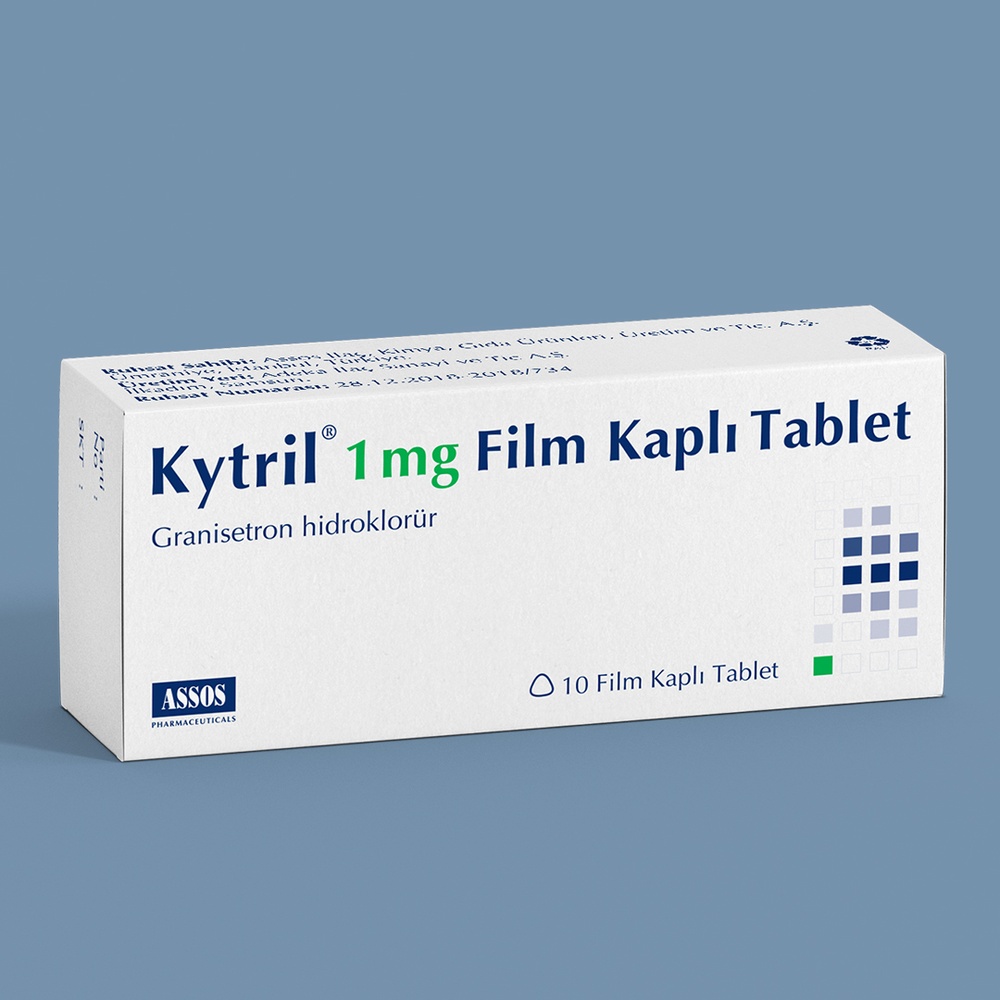
Los comprimidos son biconvexos triangulares, de color blanco a casi blanco y llevan la inscripción “K1” en una de sus caras. Se suministra en blister PVC/Aluminio opaco conteniendo 2 ó 10 comprimidos por envase.
Puede que no todos los tamaños de envase estén comercializados.
Otras presentaciones:
Kytril 3 mg/3 ml solución inyectable (uso hospitalario)
Kytril 1 mg/1 ml solución inyectable (uso hospitalario)
Titular de la autorización de comercialización y responsable de la fabricación
Titular de la autorización de comercialización
Atnahs Pharma Netherlands B.V.
Copenhagen Towers
Ørestads Boulevard 108, 5.tv
DK-2300 København S
Dinamarca
Responsable de la fabricación
IL CSM Clinical Supplies Management
Marie-Curie-Strasse 8
Lörrach
Baden-Württemberg
79539, Alemania
O
Waymade Plc
Sovereign House
Miles Gray Road
Basildon
Essex SS14 3FR
Reino Unido
Este medicamento está autorizado en los estados miembros del Espacio Económico Europeo y en el Reino Unido (Irlanda del Norte) con los siguientes nombres:
Austria, Bélgica,,República Checa, Estonia, Finlandia, Francia, Irlanda, Italia, Letonia, Holanda, República Eslovaca, Eslovenia, España,, Reino Unido (Irlanda del Norte): Kytril
Alemania: Kevatril
Fecha de la última revisión de este prospecto: Marzo 2025
Otras fuentes de información
La información detallada de este medicamento está disponible en la página web de la Agencia Española de Medicamentos y Productos Sanitarios (AEMPS) http://www.aemps.gob.es/
- País de registro
- Forma farmacéuticaCOMPRIMIDO, 1 mg
- Código ATCA04AA02
- Principio activo
- Requiere recetaSí
- Fabricante
- ComposiciónLACTOSA MONOHIDRATO (69,38 mg mg), POLISORBATO 80 (0,03 mg mg)
- Esta información es de carácter general y no sustituye la consulta con un profesional sanitario.
- Alternativas a KYTRIL 1 MG COMPRIMIDOS RECUBIERTOS CON PELICULAForma farmacéutica: INYECTABLE PERFUSION, 3 mg granisetron hidrocloruro/50 mlPrincipio activo: granisetronFabricante: Altan Pharmaceuticals SaRequiere recetaForma farmacéutica: COMPRIMIDO, 1 mgPrincipio activo: granisetronFabricante: Aurovitas Spain, S.A.U.Requiere recetaForma farmacéutica: INYECTABLE, 1 mgPrincipio activo: granisetronFabricante: Fresenius Kabi España, S.A.U.Requiere receta
Médicos online para KYTRIL 1 MG COMPRIMIDOS RECUBIERTOS CON PELICULA
Comenta la dosis, los posibles efectos secundarios, interacciones, contraindicaciones o la revisión de receta de KYTRIL 1 MG COMPRIMIDOS RECUBIERTOS CON PELICULA, sujeto a valoración médica y a la normativa local.









Obtén una receta de KYTRIL 1 MG COMPRIMIDOS RECUBIERTOS CON PELICULA online
Rellena un formulario de 2 minutos
Cuéntanos tus síntomas, historial y el medicamento que necesitas.
Elige un médico o nosotros te asignamos uno
Escoge un especialista o te conectamos con el próximo médico disponible.
El médico revisa tu caso
Normalmente en 30 minutos. Puede hacerte preguntas adicionales por chat.
Recógela en cualquier farmacia
Receta electrónica enviada a tu correo, válida en toda España.
Preguntas frecuentes
KYTRIL 1 MG COMPRIMIDOS RECUBIERTOS CON PELICULA requiere receta en España. Puedes confirmarlo con un médico online según tu caso.
El principio activo de KYTRIL 1 MG COMPRIMIDOS RECUBIERTOS CON PELICULA es granisetron. Esta información ayuda a identificar medicamentos con la misma composición pero con diferentes nombres comerciales.
KYTRIL 1 MG COMPRIMIDOS RECUBIERTOS CON PELICULA es fabricado por Atnahs Pharma Netherlands Bv.. La marca y el envase pueden variar según el distribuidor.
Los Médicos de familia, Psiquiatras, Dermatólogos, Cardiólogos, Endocrinólogos, Gastroenterólogos, Neumólogos, Nefrólogos, Reumatólogos, Hematólogos, Infectólogos, Alergólogos, Geriatras, Pediatras, Oncólogos pueden valorar la prescripción de KYTRIL 1 MG COMPRIMIDOS RECUBIERTOS CON PELICULA cuando esté clínicamente indicado. Puedes reservar una videoconsulta para comentar tu caso y las opciones de tratamiento.
España cuenta con una infraestructura sanitaria bien desarrollada en ciudades principales como Madrid, Barcelona, Valencia y Sevilla. Las farmacias están ampliamente disponibles y operan bajo estrictas regulaciones, garantizando el acceso a medicamentos con receta.
Puedes comprar KYTRIL 1 MG COMPRIMIDOS RECUBIERTOS CON PELICULA en Madrid, Barcelona, Sevilla o Valencia en cualquier farmacia local con una receta válida.
Para obtener una receta, puedes utilizar Oladoctor:
Otros medicamentos con el mismo principio activo (granisetron) incluyen GRANISETRON ALTAN 3 MG/50 ML SOLUCION PARA PERFUSION, GRANISETRON AUROVITAS SPAIN 1 mg COMPRIMIDOS RECUBIERTOS CON PELÍCULA EFG, GRANISETRON KABI 1 mg/ml CONCENTRADO PARA SOLUCION INYECTABLE EFG. Pueden tener diferentes nombres comerciales o formulaciones, pero contienen el mismo componente terapéutico. Consulta siempre con un médico antes de cambiar o iniciar un nuevo medicamento.
