



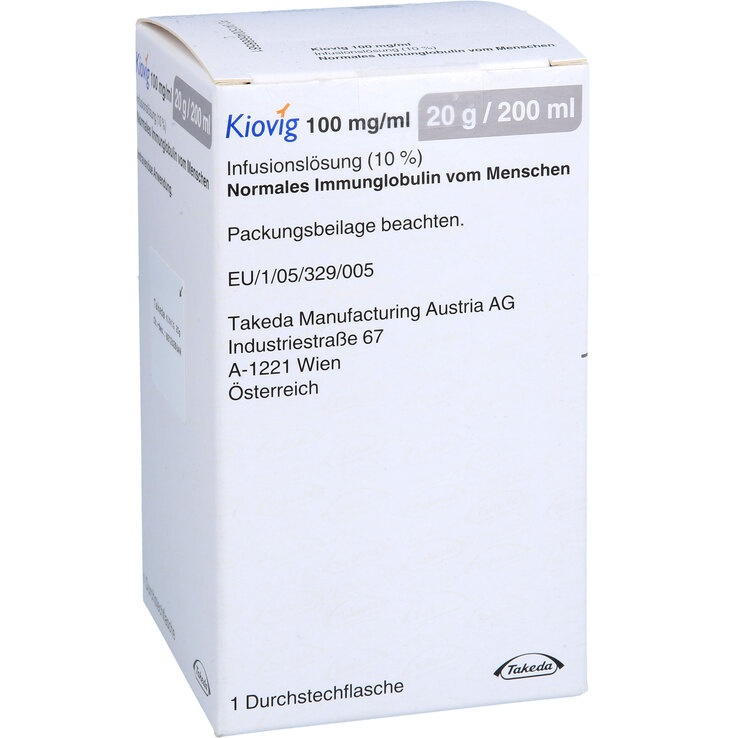
KIOVIG 100 mg /Ml Solucion Para Perfusion

Revisión de receta online
Un médico revisará tu caso y determinará si la prescripción es médicamente apropiada.

Habla con un médico sobre este medicamento
Comenta tus síntomas y las opciones de tratamiento en una consulta online.



Cómo usar KIOVIG 100 MG/ML SOLUCION PARA PERFUSION
Contenido del prospecto
- Introducción
- Qué es KIOVIG y para qué se utiliza
- Qué necesita saber antes de empezar a usar KIOVIG
- No useKIOVIG
- Cómo usar KIOVIG
- Posibles efectos adversos
- Conservación de KIOVIG
- Contenido del envase e información adicional
Introducción
Prospecto: Información para el usuario
KIOVIG100mg/ml solución para perfusión
inmunoglobulina humana normal
Lea todo el prospecto detenidamente antes de empezar a usar el medicamento porque contiene información importante para usted
- Conserve este prospecto, ya que puede tener que volver a leerlo.
- Si tiene alguna duda, consulte a su médico, farmacéutico o enfermero.
- Este medicamento se le ha recetado solamente a usted y no debe dárselo a otras personas, aunque tengan los mismos síntomas que usted, ya que puede perjudicarles.
- Si experimenta efectos adversos, consulte a su médico, farmacéutico o enfermero, incluso si se trata de efectos adversos que no aparecen en este prospecto. Ver sección 4.
Contenido delprospecto:
- Qué es KIOVIG y para qué se utiliza
- Qué necesita saber antes de empezar a usar KIOVIG
- Cómo usar KIOVIG
- Posibles efectos adversos
- Conservación de KIOVIG
- Contenido del envase e información adicional
1. Qué es KIOVIG y para qué se utiliza
KIOVIG pertenece a una clase de medicamentos llamados inmunoglobulinas. Estos medicamentos contienen anticuerpos humanos, presentes también en la sangre. Los anticuerpos ayudan a combatir las infecciones. Los medicamentos como KIOVIG se utilizan en pacientes que no tienen anticuerpos suficientes en la sangre y suelen padecer infecciones con frecuencia. Estos medicamentos también se pueden utilizar en pacientes que necesitan anticuerpos adicionales para la cura de determinados trastornos inflamatorios (enfermedades autoinmunes).
KIOVIG se utiliza para
Tratamiento de pacientes que no tienen anticuerpos suficientes (tratamiento restitutivo). Haycinco grupos:
- Pacientes con una falta congénita de producción de anticuerpos (síndromes de inmunodeficiencia primaria).
- Pacientes con inmunodeficiencias secundarias (IDS) que sufren infecciones graves o recurrentes, tratamiento antimicrobiano ineficaz y déficit de anticuerpos específicos (PSAF, por su sigla en inglés)* o IgG en suero <4 g/l.
*PSAF = incapacidad para aumentar al menos 2 veces el título de anticuerpos IgG frente a la vacuna neumocócica polisacárida y a vacunas de antígenos polipeptídicos.
Tratamiento de pacientes con determinados trastornos inflamatorios(inmunomodulación).
Haycinco grupos:
- Pacientes que no tienen suficientes plaquetas en la sangre (trombocitopenia inmune primaria) y con un alto riesgo de hemorragia o que vayan a ser sometidos a una intervención quirúrgica próximamente.
- Pacientes con una enfermedad que se caracteriza por la inflamación múltiple de los nervios de todo el cuerpo (Síndrome de Guillain Barré).
- Pacientes con una enfermedad que provoca la inflamación múltiple de diversos órganos del cuerpo (Enfermedad de Kawasaki).
- Pacientes con una enfermedad rara caracterizada por una debilidad asimétrica y progresiva de los miembros sin pérdida sensorial (neuropatía motora multifocal, NMM).
- Pacientes con polirradiculoneuropatía desmielinizante inflamatoria crónica (PDIC).

¿No estás seguro de si este medicamento es adecuado para ti?
Comenta tus síntomas y tratamiento con un médico online.
2. Qué necesita saber antes de empezar a usar KIOVIG
No useKIOVIG
Si es alérgico a las inmunoglobulinas o a cualquiera de los demás componentes de este medicamento (incluidos en la sección 6).
Por ejemplo, si usted tiene deficiencia de inmunoglobulina A, en cuyo caso puede tener anticuerpos anti‑inmunoglobulina A en la sangre. Dado que KIOVIG contiene cantidades traza de inmunoglobulina A (hasta 0,14 mg/ml), usted puede desarrollar una reacción alérgica.
Advertencias y precauciones
Consulte a su médico, farmacéutico o enfermero antes de empezar a usar KIOVIG.
Período de control requerido durante la perfusión
- Usted será controlado atentamente durante el período de perfusión de KIOVIG para evitar que sufra una reacción alérgica. El médico se asegurará de que la velocidad de perfusión de KIOVIG es la adecuada en su caso.
- Si KIOVIG se administra a una velocidad alta, si padece un trastorno que se caracteriza por un nivel bajo de anticuerpos en la sangre (hipo‑ o agammaglobulinemia), si no ha recibido este medicamento antes o si ha transcurrido un largo período (por ejemplo, varias semanas) desde la última vez que le fue administrado, puede existir un riesgo mayor de efectos adversos. En estos casos, será controlado exhaustivamente durante la perfusión y una hora después de la perfusión.
- Si ya ha recibido KIOVIG previamente y ha recibido el último tratamiento recientemente, sólo será observado durante la perfusión y durante al menos 20 minutos después de la perfusión.
Cuándo es necesario detener o disminuir la velocidad de la perfusión
En casos raros el organismo puede haber reaccionado previamente a determinados anticuerpos y, por tanto, estar sensibilizado a medicamentos que contienen anticuerpos. Esto puede ocurrir sobre todo si presenta una deficiencia de inmunoglobulina A. En estos casos raros, puede padecer reacciones alérgicas como un descenso brusco de la tensión arterial o un shock, incluso si ha recibido anteriormente un tratamiento con medicamentos que contienen anticuerpos.
Si experimenta una reacción alérgica durante la perfusión de KIOVIG, informe a su médico inmediatamente. Según la decisión del médico, puede reducirse la velocidad de la perfusión o bien interrumpirse.
Grupos de pacientes especiales
- Su médico adoptará precauciones especiales si usted padece sobrepeso, es de edad avanzada, diabético o si tiene la tensión arterial alta, bajo volumen sanguíneo (hipovolemia) o problemas en los vasos sanguíneos (enfermedades vasculares). En estos casos, las inmunoglobulinas pueden aumentar el riesgo de infarto de miocardio, accidente cerebrovascular, embolia pulmonar o trombosis venosa profunda, aunque en muy raros casos.
Informe a su médico si es diabético. Aunque KIOVIG no contiene azúcar, se puede diluir con una solución especial de azúcar (5 % de glucosa), lo que puede influir en el nivel de azúcar en sangre.
- Su médico tendrá también un cuidado especial si tiene o ha tenido problemas con sus riñones, o si ha recibido medicamentos que hayan podido dañar sus riñones (medicamentos nefrotóxicos), ya que existe una probabilidad muy rara de insuficiencia renal grave.
Informe a su médico si tiene o ha tenido problemas renales. Su médico elegirá la inmunoglobulina intravenosa apropiada para usted.
Información sobre el material original de KIOVIG
KIOVIG se elabora a partir de plasma humano (parte líquida de la sangre). Cuando los medicamentos se elaboran a partir de sangre o plasma humanos, hay que llevar a cabo ciertas medidas para evitar que las infecciones pasen a los pacientes. Tales medidas incluyen una cuidadosa selección de los donantes, para excluir a aquellos que están en riesgo de ser portadores de enfermedades infecciosas, análisis de marcadores específicos de infecciones en las donaciones individuales y en las mezclas de plasma, así como la inclusión de etapas en el proceso de fabricación para eliminar / inactivar virus. A pesar de esto, cuando se administran medicamentos derivados de la sangre o plasma humanos, la posibilidad de transmisión de agentes infecciosos no se puede excluir totalmente. Esto también se refiere a virus emergentes o de naturaleza desconocida u otros tipos de infecciones.
Las medidas adoptadas para la fabricación de KIOVIG se consideran efectivas para virus envueltos como el virus de la inmunodeficiencia humana (VIH), virus de la hepatitis B y virus de la hepatitis C y para virus no envueltos de la hepatitis A y parvovirus B19. KIOVIG también contiene determinados anticuerpos que pueden prevenir una infección por virus de hepatitis A y parvovirus B19.
Uso de KIOVIG con otros medicamentos
Informe a su médico o farmacéutico si está tomando o ha tomado recientemente o podría tener que tomar cualquier otro medicamento.
Si se le ha administrado una vacuna durante las últimas seis semanas y hasta tres meses, la perfusión de inmunoglobulinas como KIOVIG puede alterar la eficacia de algunas vacunas de virus vivos como la del sarampión, rubeola, paperas y varicela. Por tanto, tras la administración de inmunoglobulinas, puede que tenga que esperar hasta 3 meses antes de recibir una vacuna de virus vivos atenuada. Puede que tenga que esperar hasta 1 año después de recibir inmunoglobulinas antes de la administración de la vacuna contra el sarampión.
Efectos sobre los análisis de sangre
KIOVIG contiene una amplia variedad de anticuerpos diferentes, algunos de los cuales pueden interferir con los análisis de sangre. Si se le realiza un análisis de sangre después de recibir KIOVIG, por favor informe al analista o a su médico que ha recibido la medicación.
Embarazo, lactancia y fertilidad
- Si está embarazada o en periodo de lactancia, cree que podría estar embarazada o tiene intención de quedarse embarazada, consulte a su médico o farmacéutico antes de utilizar este medicamento.
- No se han realizado estudios clínicos con KIOVIG en mujeres embarazadas o en periodo de lactancia. Sin embargo, se han utilizado medicamentos que contienen anticuerpos en mujeres embarazadas o en periodo de lactancia y esto ha demostrado que no deben esperarse efectos perjudiciales durante el embarazo ni para el bebé.
- Si usted está en periodo de lactancia y recibe KIOVIG, los anticuerpos del medicamento pueden encontrarse también en la lecha materna. Por tanto, su bebé puede estar protegido frente a ciertas infecciones.
Conducción yuso de máquinas
Los pacientes pueden experimentar reacciones (por ejemplo, mareos o náuseas) durante el tratamiento con KIOVIG que podrían afectar a la capacidad de conducir y utilizar máquinas. Si esto ocurriera, espere hasta que las reacciones hayan desaparecido.

¿Has empezado a tomar el medicamento y tienes preguntas?
Comenta tus síntomas y tratamiento con un médico online.
3. Cómo usar KIOVIG
KIOVIG es para administración intravenosa (perfusión en vena). Le será administrado por su médico o enfermera. La dosis y la frecuencia de la perfusión pueden variar dependiendo de su situación y peso corporal.
Al comienzo de la perfusión usted recibirá KIOVIG a una velocidad baja. Su médico puede aumentar gradualmente la velocidad de perfusión dependiendo de si usted lo tolera bien.
Uso en niños y adolescentes
En niños y adolescentes (0 a 18 años) se utilizan las mismas indicaciones, dosis y frecuencia de perfusión que en los adultos.
Si usa más KIOVIG del que debiera
Si recibe más KIOVIG del que debiera, la sangre se puede espesar (hiperviscosidad). Esto puede ocurrir sobre todo si es un paciente de riesgo (por ejemplo, un paciente de edad avanzada o un paciente con problemas renales). Asegúrese de tomar los líquidos adecuados para no deshidratarse e informe a su médico si tiene problemas médicos.
4. Posibles efectos adversos
Al igual que todos los medicamentos, este medicamento puede tener efectos adversos, aunque no todas las personas los sufran. Algunos efectos adversos, como dolor de cabeza o enrojecimiento, se pueden evitar reduciendo la velocidad de perfusión.
La lista de efectos adversos observados en el tratamiento con KIOVIG se describe a continuación:
- Efectos adversos muy frecuentes (pueden afectar a más de 1 de cada 10 pacientes):
Dolor de cabeza, presión arterial alta, náuseas, erupción, reacciones locales (por ejemplo, dolor e hinchazón u otras reacciones en el lugar de perfusión), fiebre, cansancio.
- Efectos adversos frecuentes (pueden afectar hasta 1 de cada 10 pacientes):
Bronquitis, resfriado común, recuento bajo de glóbulos rojos, ganglios linfáticos hinchados, apetito disminuido, dificultad para dormir, ansiedad, mareo, migraña, entumecimiento o cosquilleo de la piel o de una extremidad, disminución del sentido del tacto, inflamación ocular, aumento de las pulsaciones, rubor, tos, moqueo, tos crónica o sibilancia (asma), congestión nasal, dolor de garganta, dificultad para respirar, diarrea, vómitos, dolor abdominal, indigestión, contusión, picores y habones, dermatitis, enrojecimiento de la piel, dolores de espalda, dolores articulares, dolor de brazos o piernas, dolores musculares, calambres musculares, pérdida de fuerza muscular, escalofríos, acumulación de líquido bajo la piel, enfermedad de tipo gripal, dolor o malestar en el pecho, falta fuerza o sensación de debilidad, indisposición, escalofríos y temblores.
- Efectos adversos poco frecuentes (pueden afectar hasta 1 de cada 100 pacientes):
Infección crónica de la nariz, infecciones por hongos, diversas infecciones (de nariz y garganta, riñón o vejiga), inflamaciónde las membranas que recubren el cerebro, reacciones alérgicas graves, trastornos del tiroides, respuesta excesiva a los estímulos, alteración de la memoria, dificultad para hablar, mal sabor de boca, alteración del equilibrio, temblor involuntario, dolor o hinchazón ocular, vértigo, líquido en el oído medio, frialdad periférica, inflamación de una vena, inflamación de nariz y garganta, distensión abdominal, inflamación rápida de la piel, inflamación aguda de la piel, sudor frío, aumento de la reacción de la piel al sol, sudoración excesiva incluso durante el sueño, sacudidas musculares, exceso de proteína sérica en la orina, opresión en el pecho, sensación de calor, sensación de ardor, hinchazón, frecuencia respiratoria aumentada, cambios en los resultados de los análisis de sangre.
- Frecuencia no conocida (no puede estimarse a partir de los datos disponibles):
Destrucción de glóbulos rojos, shock alérgico grave con peligro de muerte, ictus transitorio, ictus, tensión arterial baja, ataque al corazón, coágulo sanguíneo en una vena principal, coágulo sanguíneo en la arteria principal del pulmón, acumulación de líquido en el pulmón, resultado positivo en la prueba de Coombs, saturación de oxígeno disminuida en sangre, lesión pulmonar aguda relacionada con transfusión.
Comunicación de efectos adversos
Si experimenta cualquier tipo de efecto adverso, consulte a su médico, farmacéutico o enfermero, incluso si se trata de posibles efectos adversos que no aparecen en este prospecto. También puede comunicarlos directamente a través del sistema nacionalde notificación incluido en elApéndice V.
Mediante la comunicación de efectos adversos usted puede contribuir a proporcionar más información sobre la seguridad de este medicamento.
5. Conservación de KIOVIG
- Mantener este medicamento fuera de la vista y del alcance de los niños.
- No utilice este medicamento después de la fecha de caducidad que aparece en la etiqueta y en el envase después de CAD. La fecha de caducidad es el último día del mes que se indica.
- No utilice este medicamento si observapartículas o decoloración.
- No conservar a temperatura superior a 25°C.
- No congelar.
- Conservar el envase en el embalaje original para protegerlo de la luz.
6. Contenido del envase e información adicional
Composición de KIOVIG
- El principio activo de KIOVIG es inmunoglobulina humana normal.
- 1 ml de KIOVIG contiene 100 mg de proteína humana, de la cual al menos el 98 % es inmunoglobulina G (IgG).
- Los demás componentes (excipientes) son glicina y agua para preparaciones inyectables.
Aspecto del producto ycontenido del envase
KIOVIG es una solución para perfusión en viales de 10, 25, 50, 100, 200 o 300 ml. La solución es transparente o ligeramente opalescente, incolora o de color amarillo pálido.
Puede que no se comercialicen todas las presentaciones.
Titular de la autorización de comercialización:
Takeda Manufacturing Austria AG
Industriestrasse 67
A‑1221 Vienna
Austria
Tel.: +800 66838470
E-mail: [email protected]
Fabricante:
Baxalta Belgium Manufacturing SA
Boulevard René Branquart, 80
B‑7860 Lessines
Belgium
Fecha de la última revisión de este prospecto.
Otras fuentes de información
La información detallada sobre este medicamento está disponible en la página web de la Agencia Europea de Medicamentos: http://www.ema.europa.eu.
Esta información está destinada únicamente a profesionales del sector sanitario:
Forma de administración
- KIOVIG sólo debe administrarse intravenosamente. No se han evaluado otras vías de administración.
- KIOVIG se debe perfundir por vía intravenosa a una velocidad inicial de 0,5 ml/kg de peso corporal/h durante 30 minutos. Si se tolera bien, la velocidad de administración puede aumentarse gradualmente hasta un máximo de 6 ml/kg de peso corporal/h. Datos clínicos obtenidos de un número limitado de pacientes indican también que pacientes adultos con IDP pueden tolerar una velocidad de perfusión de hasta 8 ml/kg de peso corporal/h.
- Si se necesita una dilución a concentraciones más bajas previa a la perfusión, KIOVIG puede diluirse con una solución de glucosa al 5 % hasta una concentración final de 50 mg/ml (5 % de inmunoglobulina).
- Cualquier caso de reacción adversa relacionado con la perfusión debe tratarse disminuyendo la velocidad de perfusión o deteniéndola.
Precauciones especiales
- Cualquier caso de reacción adversa relacionado con la perfusión debe tratarse disminuyendo la velocidad de perfusión o deteniéndola.
- Se recomienda anotar el nombre y el número de lote del producto cada vez que se administra KIOVIG.
Incompatibilidades
Este medicamento no debe mezclarse con otros medicamentos.
Precauciones especiales de conservación
- Se recomienda el uso inmediato después de la dilución. Se ha demostrado la estabilidad en uso de KIOVIG después de la dilución con una solución de glucosa al 5 % hasta una concentración final de 50 mg/ml (5 % de inmunoglobulina) durante 21 días de 2 ºC a 8 ºC así como de 28 ºC a 30 ºC, sin embargo, estos estudios no incluyeron el aspecto de contaminación microbiana y seguridad.
Instrucciones de manipulación yeliminación
- El producto debe alcanzar la temperatura ambiente o corporal antes de su uso.
- KIOVIG debe inspeccionarse visualmente antes de su administración para verificar la ausencia de partículas y decoloración. Sólo se debe utilizar una solución transparente o ligeramente opalescente e incolora o amarillo pálido. No utilizar si se observan partículas o decoloración.
- Si es necesario realizar una dilución, se recomienda una solución de glucosa al 5 %. Para la obtención de una solución de inmunoglobulina de 50 mg/ml (5 %), se debe diluir KIOVIG 100 mg/ml (10 %) con un volumen igual de solución de glucosa. Se recomienda minimizar el riesgo de contaminación microbiana durante la dilución.
- La eliminación del medicamento no utilizado y de todos los materiales que hayan estado en contacto con él se realizará de acuerdo con la normativa local
Recomendaciones de dosis
Indicación | Dosis | Frecuencia de perfusión |
Tratamiento restitutivo en inmunodeficiencia primaria | ‑ Dosis inicial: 0,4‑0,8 g/kg Dosis de mantenimiento: 0,2‑0,8 g/kg | cada 3‑4 semanas para obtener un nivel mínimo (valle) de IgG de al menos 5‑6 g/l |
Tratamiento restitutivo en inmunodeficiencia secundaria | 0,2‑0,4 g/kg | cada 3‑4 semanas para obtener un nivel mínimo (valle) de IgG de al menos 5‑6 g/l |
Inmunomodulación: | ||
Trombocitopenia inmune primaria | 0,8‑1 g/kg o 0,4 g/kg/d | el primer día, pudiéndose repetir una vez durante los tres días siguientes durante 2‑5 días |
Síndrome de Guillain‑Barré | 0,4 g/kg/d | durante 5 días |
Enfermedad de Kawasaki | 2 g/kg | en una dosis, asociado a ácido acetilsalicílico |
Polirradiculoneuropatía desmielinizante inflamatoria crónica (PDIC) | Dosis inicial: 2 g/kg Dosis de mantenimiento: 1 g/kg | en dosis divididas durante 2-5 días cada 3 semanas durante 1-2 días |
Neuropatía motora multifocal (NMM) | Dosis inicial: 2 g/kg Dosis de mantenimiento:1 g/kg o 2 g/kg | administrado durante 2‑5 días cada 2‑4 semanas o cada 4‑8 semanas durante 2-5 días |
- País de registro
- Forma farmacéuticaINYECTABLE PERFUSION, 100 mg/ml
- Código ATCJ06BA02
- Principio activo
- Requiere recetaSí
- Fabricante
- Esta información es de carácter general y no sustituye la consulta con un profesional sanitario.
- Alternativas a KIOVIG 100 MG/ML SOLUCION PARA PERFUSIONForma farmacéutica: INYECTABLE PERFUSION, 100 mg/mlPrincipio activo: immunoglobulins, normal human, for intravascular adm.Fabricante: Instituto Grifols S.A.Requiere recetaForma farmacéutica: INYECTABLE PERFUSION, 100 mg/mlPrincipio activo: immunoglobulins, normal human, for intravascular adm.Fabricante: Instituto Grifols S.A.Requiere recetaForma farmacéutica: INYECTABLE PERFUSION, 100 mg/mlPrincipio activo: immunoglobulins, normal human, for intravascular adm.Fabricante: Instituto Grifols S.A.Requiere receta
Médicos online para KIOVIG 100 MG/ML SOLUCION PARA PERFUSION
Comenta la dosis, los posibles efectos secundarios, interacciones, contraindicaciones o la revisión de receta de KIOVIG 100 MG/ML SOLUCION PARA PERFUSION, sujeto a valoración médica y a la normativa local.









Obtén una receta de KIOVIG 100 MG/ML SOLUCION PARA PERFUSION online
Rellena un formulario de 2 minutos
Cuéntanos tus síntomas, historial y el medicamento que necesitas.
Elige un médico o nosotros te asignamos uno
Escoge un especialista o te conectamos con el próximo médico disponible.
El médico revisa tu caso
Normalmente en 30 minutos. Puede hacerte preguntas adicionales por chat.
Recógela en cualquier farmacia
Receta electrónica enviada a tu correo, válida en toda España.
Preguntas frecuentes
KIOVIG 100 MG/ML SOLUCION PARA PERFUSION requiere receta en España. Puedes confirmarlo con un médico online según tu caso.
El principio activo de KIOVIG 100 MG/ML SOLUCION PARA PERFUSION es immunoglobulins, normal human, for intravascular adm.. Esta información ayuda a identificar medicamentos con la misma composición pero con diferentes nombres comerciales.
KIOVIG 100 MG/ML SOLUCION PARA PERFUSION es fabricado por Takeda Manufacturing Austria Ag. La marca y el envase pueden variar según el distribuidor.
Los Médicos de familia, Psiquiatras, Dermatólogos, Cardiólogos, Endocrinólogos, Gastroenterólogos, Neumólogos, Nefrólogos, Reumatólogos, Hematólogos, Infectólogos, Alergólogos, Geriatras, Pediatras, Oncólogos pueden valorar la prescripción de KIOVIG 100 MG/ML SOLUCION PARA PERFUSION cuando esté clínicamente indicado. Puedes reservar una videoconsulta para comentar tu caso y las opciones de tratamiento.
España cuenta con una infraestructura sanitaria bien desarrollada en ciudades principales como Madrid, Barcelona, Valencia y Sevilla. Las farmacias están ampliamente disponibles y operan bajo estrictas regulaciones, garantizando el acceso a medicamentos con receta.
Puedes comprar KIOVIG 100 MG/ML SOLUCION PARA PERFUSION en Madrid, Barcelona, Sevilla o Valencia en cualquier farmacia local con una receta válida.
Para obtener una receta, puedes utilizar Oladoctor:
Otros medicamentos con el mismo principio activo (immunoglobulins, normal human, for intravascular adm.) incluyen FLEBOGAMMA DIF 100 mg/ml SOLUCION PARA PERFUSION, FLEBOGAMMA DIF 100 mg/ml SOLUCION PARA PERFUSION, FLEBOGAMMA DIF 100 mg/ml SOLUCION PARA PERFUSION. Pueden tener diferentes nombres comerciales o formulaciones, pero contienen el mismo componente terapéutico. Consulta siempre con un médico antes de cambiar o iniciar un nuevo medicamento.
