


Ketorolaco Kabi 30 mg/ml solución inyectable

Solicitud de receta online
Un médico revisará tu caso y determinará si la prescripción es médicamente apropiada.

Habla con un médico sobre este medicamento
Comenta tus síntomas y las opciones de tratamiento en una consulta online.



Cómo usar KETOROLACO KABI 30 MG/ML SOLUCION INYECTABLE EFG
Contenido del prospecto
- Introducción
- Qué es Ketorolaco Kabi y para qué se utiliza
- Qué necesita saber antes de empezar a usar Ketorolaco Kabi
- Cómo tomar Ketorolaco Kabi
- Posibles efectos adversos
- Conservación de Ketorolaco Kabi
- Contenido del envase e información adicional
Introducción
Prospecto: Información para el usuario
Ketorolaco Kabi 30 mg/ml solución inyectable EFG
ketorolaco trometamol
Lea todo el prospecto detenidamente antes de empezar a tomar el medicamento, porque contiene información importante para usted.
|
Contenido del prospecto:
- Qué es Ketorolaco Kabi y para qué se utiliza
- Qué necesita saber antes de empezar a usar Ketorolaco Kabi
- Cómo tomar Ketorolaco Kabi
- Posibles efectos adversos
- Conservación de Ketorolaco Kabi
- Contenido del envase e información adicional
1. Qué es Ketorolaco Kabi y para qué se utiliza
Ketorolaco Kabi contiene un medicamento llamado ketorolaco trometamol. Este es un "medicamento antiinflamatorio no esteroideo" (AINE).
Ketorolaco se usa en el hospital para aliviar el dolor después de las operaciones en pacientes mayores o iguales a 16 años de edad. Ketorolaco puede disminuir el dolor, la hinchazón, el enrojecimiento y el calor (inflamación).

¿No estás seguro de si este medicamento es adecuado para ti?
Comenta tus síntomas y tratamiento con un médico online.
2. Qué necesita saber antes de empezar a usar Ketorolaco Kabi
No debe recibir ketorolaco si es alérgico (hipersensible) a:
- Ketorolaco trometamol o cualquiera de los demás componentes de este medicamento (incluidos en la sección 6).
- Aspirina u otros AINEs (como ibuprofeno o diclofenaco).
No se le debe dar ketorolaco si:
- Es menor de 16 años de edad.
- Tiene o ha tenido algún problema con su estómago o intestino como una úlcera o sangrado.
- Tiene problemas graves con el hígado o el corazón.
- Tiene problemas moderados o graves en sus riñones.
- Alguna vez ha tenido sangrado en su cerebro.
- Tiene un problema que le hace sangrar fácilmente, incluida una afección como la hemofilia.
- Está tomando medicamentos para detener la coagulación de la sangre, como warfarina, heparina o clopidogrel.
- Tiene un volumen sanguíneo bajo (causado por sangrado o deshidratación severa).
- Tiene asma o alergias (como rinitis alérgica) o ha tenido hinchazón de la cara, labios, ojos o lengua en el pasado.
- Tiene o ha tenido bultos en la nariz (pólipos).
- Está tomando otros AINEs, como ibuprofeno o aspirina.
- Está tomando pentoxifilina (para su circulación), probenecid (para la gota) o litio (para problemas de salud mental).
- Planea quedarse embarazada, está embarazada, está de parto o en periodo de lactancia.
- Está a punto de ser intervenido quirúrgicamente.
- Se le ha informado que tiene un alto riesgo de sangrado después de una operación o que todavía está sangrando después de una operación.
No debe recibir ketorolaco si se encuentra en alguna de los situaciones mencionadas anteriormente. Si no está seguro, informe a su médico o enfermero antes de que le administren ketorolaco.
Ketorolaco contiene alcohol y, por lo tanto, no es apto para uso epidural o intratecal (inyección en la columna vertebral).
Advertencias y precauciones
Se han notificado reacciones graves en la piel con el uso de AINEs, que se manifiestan como manchas rojizas, enrojecimiento generalizado de la piel, úlceras o erupción extendida acompañado de síntomas similares a los de la gripe, incluyendo fiebre (ver sección 4). La erupción puede progresar a ampollas generalizadas o descamación de la piel. El mayor riesgo de aparición de reacciones graves de la piel es en las primeras semanas de tratamiento, pero podrían empezar a desarrollarse hasta varios meses después de la administración del medicamento (ver sección 4). Si usted ha desarrollado alguna reacción grave en la piel tras el uso de Ketorolaco Kabi no debe reiniciar el tratamiento en ningún momento. Si usted desarrolla erupción cutánea o estos síntomas en la piel, interrumpa el tratamiento con Ketorolaco Kabi y contacte con su médico o busque atención médica inmediatamente.
Hable con su médico o enfermero antes de recibir ketorolaco. Si tiene problemas cardíacos, accidente cerebrovascular previo o cree que podría estar en riesgo de estas afecciones (por ejemplo, si tiene presión arterial alta, diabetes o colesterol alto o si es fumador), debe hablar sobre su tratamiento con su médico o enfermero.
Informe a su médico si se ha sometido recientemente o se va a someter a una intervención quirúrgica de estómago o del tracto intestinal antes de recibir/tomar/utilizar Ketorolaco Kabi, ya que Ketorolaco Kabi puede empeorar a veces la cicatrización de las heridas en el intestino después de una intervención quirúrgica.
Consulte con su médico o enfermero antes de recibir ketorolaco si:
- Es una persona mayor (es más probable que sufra problemas).
- Tiene problemas con los riñones o el hígado.
- Tiene presión arterial alta.
- Tiene problemas con los vasos sanguíneos (arterias) en cualquier parte de su cuerpo.
- Tiene demasiada grasa (lípidos) en la sangre (hiperlipidemia).
- Tiene una afección autoinmune, como 'lupus eritematoso sistémico' (LES, que causa dolor en las articulaciones, erupciones cutáneas y fiebre) y colitis o enfermedad de Crohn (afecciones que causan inflamación del intestino, dolor intestinal, diarrea, vómitos y pérdida de peso).
Si sufre alguna de las condiciones anteriores, o si no está seguro, hable con su médico o enfermero antes de recibir ketorolaco.
Uso en niños y adolescentes
Ketorolaco no se recomienda para el uso en niños menores de 16 años.
Uso de otros medicamentos con ketorolaco
Informe a su médico, enfermero o farmacéutico si está utilizando, o ha utilizado recientemente, cualquier otro medicamento, incluso los adquiridos sin receta médica.
En particular, informe a su médico o enfermero si está tomando alguno de los siguientes medicamentos antes de recibir ketorolaco:
- Otros AINEs, como la aspirina, el ibuprofeno o el diclofenaco.
- Medicamentos para detener la coagulación de la sangre, como warfarina, heparina o clopidogrel.
- Pentoxifilina (para su circulación).
- Probenecid (para la gota).
- Litio (para problemas de salud mental).
Si está tomando alguno de los medicamentos mencionados anteriormente, no debe recibir ketorolaco.
Informe a su médico o enfermero si está tomando:
- Un "inhibidor de la ECA" u otro medicamento para la presión arterial alta, como cilazapril, enalapril o propranolol.
- Un diurético (para la retención de líquido) (para la presión arterial alta), como la furosemida.
- Un ‘glucósido cardíaco’ (para problemas cardíacos), como la digoxina.
- Un esteroide (para la hinchazón y la inflamación), como la hidrocortisona, la prednisolona y la dexametasona.
- Un "antibiótico de quinolona" (para infecciones), como ciprofloxacino o moxifloxacino.
- Ciertos medicamentos para los problemas de salud mental "ISRS", como fluoxetina o citalopram.
- Metotrexato (utilizado para tratar problemas de la piel, artritis o cáncer).
- Ciclosporina o tacrolimus (para problemas de la piel o después de un trasplante de órgano).
- Zidovudina (utilizada para tratar el SIDA y las infecciones por VIH).
- Mifepristona (utilizada para interrumpir el embarazo o para provocar el parto si el bebé ha muerto).
Si se encuentra en alguna situación de las anteriormente mencionadas, o si no está seguro, hable con su médico o enfermero antes de recibir ketorolaco.
Embarazo, lactancia y fertilidad
Si está embarazada o en periodo de lactancia, cree que podría estar embarazada o tiene intención de quedarse embarazada, consulte a su médico antes de recibir este medicamento.
No tome ketorolaco si se encuentra en los últimos 3 meses de embarazo, ya que podría pejudicar al feto o provocar problemas durante el parto. Puede provocar problemas renales y cardíacos a su feto. Puede afectar a su tendencia y la de su bebé a sangrar y retrasar o alargar el parto más de lo esperado. No debe tomar ketorolaco durante los primeros 6 meses de embarazo a no ser que se considere estrictamente necesario y se lo indique su médico. Si necesita tratamiento durante este periodo o mientras trata de quedarse embarazada, deberá tomar la dosis mínima durante el menor tiempo posible. A partir de la semana 20 de embarazo, ketorolaco puede provocar problemas renales a su feto si se toma durante más de unos días, lo que puede provocar niveles bajos del líquido amniótico que rodea al bebé (oligohidramnios). Si necesita tratamiento durante un periodo superior a unos días, su médico podría recomendar controles adicionales.
Ketorolaco puede hacer que sea más difícil quedarse embarazada. Informe a su médico si tiene intención de quedarse embarazada o si tiene problemas para quedarse embarazada.
No debe recibir ketorolaco si está embarazada, de parto o en periodo de lactancia.
Conducción y uso de máquinas
Ketorolaco puede causarle cansancio, somnolencia, mareos, problemas con el equilibrio o la vista, depresión o dificultad para dormir. Hable con su médico si le ocurre algo de esto y no maneje ni use herramientas o máquinas.
Ketorolaco Kabi contiene sodio y alcohol
Este medicamento contiene menos de 23 mg de sodio (1mmol) por cada ampolla de 1 ml, esto es, esencialmente “exento de sodio”.
Este medicamento contiene 100 mg de alcohol (etanol) en cada vial, lo que equivale a 100 mg/ml (9,9% p/v). La cantidad contenida en 1 ml de este medicamento equivale a menos de 2,5 ml de cerveza o 1 ml de vino.
La pequeña cantidad de alcohol que contiene este medicamento no tendrá efectos notables.
3. Cómo tomar Ketorolaco Kabi
Ketorolaco le será administrado por un médico o enfermero. Se le administrará mediante inyección en un músculo (como en su brazo) o en una vena.
Los medicamentos como ketorolaco pueden estar asociados (relacionados) con un pequeño aumento del riesgo de ataque cardíaco ("infarto de miocardio") o accidente cerebrovascular. Cualquier riesgo es más probable con dosis más altas y un tratamiento prolongado (a más largo plazo).
La duración máxima del tratamiento debe ser de dos días.
Uso en niños y adolescentes
Ketorolaco no está recomendado para uso en niños menores de 16 años.
Uso en adultos
- La dosis inicial habitual es de 10 mg.
- Esto puede ser seguido por una dosis de 10 a 30 mg cada 4 a 6 horas, según sea necesario.
- La dosis máxima es de 90 mg al día.
- Su médico también puede administrarle otros analgésicos (como la petidina o la morfina) si su dolor es intenso.
Uso en pacientes mayores de 65 años, o con problemas renales o que pesen menos de 50 kg
- Su médico generalmente le administrará dosis más bajas que las descritas para adultos.
- La dosis máxima es de 60 mg al día.
- Su médico también puede administrarle otros analgésicos (como la petidina o la morfina) si su dolor es intenso.
Si tiene más preguntas sobre el uso de este medicamento, consulte a su médico o enfermero.

¿Has empezado a tomar el medicamento y tienes preguntas?
Comenta tus síntomas y tratamiento con un médico online.
4. Posibles efectos adversos
Como todos los medicamentos, este medicamento puede provocar efectos adversos, aunque no todas las personas los sufran.
Los medicamentos como ketorolaco pueden estar asociados con un pequeño aumento del riesgo de ataque cardíaco ("infarto de miocardio") o accidente cerebrovascular.
Efectos secundarios graves
Informe a un médico o enfermera INMEDIATAMENTE si ocurre cualquiera de lo siguiente. Es posible que necesite tratamiento médico urgente:
Trastornos estomacales o intestinales graves, los signos incluyen:
- Sangrado del estómago, como un vómito que tiene sangre, o fragmentos que parecen granos de café.
- Sangrado rectal (ano), como un movimiento de heces negras y pegajosas (diarrea) o diarrea con sangre.
- Úlceras o agujeros que se forman en el estómago o intestino. Esto puede verse como malestar estomacal con dolor de estómago, fiebre, sentirse o estar enfermo.
- Problemas con su páncreas, como dolor de estómago severo que se extiende a su espalda.
- Empeoramiento de la colitis ulcerosa o de la enfermedad de Crohn, como dolor, diarrea, vómitos y pérdida de peso.
Reacciones alérgicas, los signos incluyen:
- Hinchazón repentina de su garganta, cara, manos o pies.
- Dificultad para respirar, opresión en el pecho.
- Erupciones en la piel, ampollas o picazón.
Erupciones cutáneas graves, los signos incluyen:
- Una erupción grave que se desarrolla rápidamente, con ampollas o descamación de la piel y posiblemente ampollas en la boca, garganta u ojos. Puede darse fiebre, dolor de cabeza, tos y dolor en el cuerpo al mismo tiempo.
Ataque al corazón, los signos incluyen:
- Dolor en el pecho que puede extenderse a su cuello y hombros y por su brazo izquierdo.
Derrame cerebral, los signos incluyen:
- Debilidad muscular y entumecimiento. Esto puede solo ocurrir en un lado de tu cuerpo.
- Un sentido del olfato, gusto, audición o visión repentinamente alterado, confusión.
Meningitis, los signos incluyen:
- Fiebre, sentirse o estar enfermo, rigidez en el cuello, dolor de cabeza, sensibilidad a la luz brillante y confusión (más probable en personas con enfermedades autoinmunes como el "lupus eritematoso sistémico").
Trastornos del hígado, los signos incluyen:
- Coloración amarillenta de la piel o el blanco de los ojos (ictericia).
- Sensación de cansancio, pérdida de apetito, sensación de estar enfermo y heces de color pálido (hepatitis) y problemas (incluida la hepatitis) que se muestran en los análisis de sangre.
Problemas urinarios, los signos incluyen:
- Una sensación de plenitud y la necesidad de vaciar la vejiga, pero con dificultad para vaciarla.
Si nota alguno de los efectos secundarios graves mencionados anteriormente, informe a su médico o enfermera de inmediato.
Otros efectos secundarios
Informe a su médico o enfermero si tiene alguno de los siguientes síntomas:
Estómago y tripa
- Acidez estomacal, indigestión, dolor de estómago, sentirse o estar enfermo, estreñimiento, diarrea, gases.
- Eructos o sensación de plenitud.
Sangre
- Sangrado de la herida después de una operación o hemorragias nasales.
- Una hinchazón llena de sangre.
- Problemas en sangre, como demasiado potasio o falta de sodio.
- Problemas en sangre, como anemia, insuficiencia de plaquetas o cambios en la cantidad de glóbulos blancos.
Enfermedad mental
- Tener dificultad para dormir o cambios en sus patrones de sueño.
- Depresión.
- Sentirse preocupado (ansioso) o nervioso o extremadamente feliz (euforia).
- Ver y posiblemente escuchar cosas que realmente no existen (alucinaciones).
- Problemas mentales que pueden hacerte sentir confundido, inquieto y perturbado (agitado) y perder el contacto con la realidad.
Sistema nervioso
- Dolor de cabeza.
- Ataques o convulsiones, sensación de mareo o aturdimiento o somnolencia.
- Sensación de pinchazos o adormecimiento de sus manos y pies.
- Dificultad en la memoria o concentración.
Ojos y oídos
- Cambios en la vista, dolor ocular.
- Cambios en su audición, incluyendo zumbidos en los oídos (tinnitus) y pérdida de audición.
- Mareos que causan problemas con su equilibrio.
Corazón y circulación
- Hinchazón de sus manos, pies o piernas (edema). Esto puede dar lugar a dolores en el pecho, cansancio, falta de aliento (insuficiencia cardíaca).
- Una sensación de aleteo en su corazón (palpitaciones), latidos cardíacos lentos o presión arterial alta.
- Problemas con la forma en que su corazón bombea sangre alrededor del cuerpo. Los signos pueden incluir cansancio, falta de aliento, sensación de desmayo.
Pecho
- Dificultad para respirar, incluyendo falta de aliento, sibilancias o tos.
- Hinchazón de sus pulmones.
Piel y cabello
- Sensibilidad a la luz, erupciones en la piel que incluyen enrojecimiento, urticaria, granos y ampollas en el cuerpo y la cara.
- Picazón o sudoración, piel pálida o enrojecimiento de la cara y el cuello (enrojecimiento).
Sistema urinario
- Sangre en su orina o problemas renales.
- Ir al baño con más frecuencia para orinar, o ir con menos frecuencia.
- Dolor en el costado.
Otros
- Dolor en el lugar de la inyección.
- Sed, boca seca, cambios en el gusto, fiebre, aumento o pérdida de peso.
- Malestar general o sentirse cansado.
- Dolor de boca.
- Espasmos musculares, dolor o debilidad.
- En mujeres, problemas para quedarse embarazada.
Si alguno de los efectos adversos se agrava, o si nota cualquier efecto adverso no mencionado en este prospecto, informe a su médico o enfermero.
Comunicación de efectos adversos
Si experimenta cualquier tipo de efecto adverso, consulte a su médico o farmacéutico, incluso si se trata de posibles efectos adversos que no aparecen en este prospecto. También puede comunicarlos directamente a través del Sistema Español de Farmacovigilancia de Medicamentos de Uso Humano: www.notificaRAM.es . Mediante la comunicación de efectos adversos usted puede contribuir a proporcionar más información sobre la seguridad de este medicamento.
5. Conservación de Ketorolaco Kabi
Mantenga este medicamento fuera de la vista y del alcance de los niños.
No utilice este medicamento después de la fecha de caducidad que aparece en el envase o en la etiqueta de las ampollas después de CAD. La fecha de caducidad es el último día del mes que se indica.
Conserve las ampollas en el embalaje exterior para protegerlas de la luz.
Se permiten periodos de bajas temperaturas a corto plazo (hasta 3 semanas) hasta -20°C.
Antes de la administración, el producto debe ser inspeccionado visualmente. No use este medicamento si observa partículas.
Los medicamentos no se deben tirar por los desagües ni a la basura. Deposite los envases y los medicamentos que no necesita en el punto SIGRE ?? de la farmacia. En caso de duda pregunte a su farmacéutico cómo deshacerse de los envases y de los medicamentos que no necesita. De esta forma ayudará a proteger el medio ambiente
6. Contenido del envase e información adicional
Composición de Ketorolaco Kabi:
- El principio activo es ketorolaco trometamol. Cada 1 ml de medicamento líquido contiene 30 mg (miligramos) de ketorolaco trometamol.
- Los demás componentes son: etanol (96 por ciento), cloruro de sodio, edetato de disodio, hidróxido de sodio o ácido clorhídrico (soluciones 1M para ajustar el pH), agua para preparaciones inyectables.
Aspecto del producto y contenido del envase
Ketorolaco Kabi es una solución inyectable transparente, ligeramente amarilla. Esta solución inyectable puede diluirse aún más para atenuarla antes de que se le administre.
Ketorolaco Kabi se suministra en ampollas de vidrio que contienen 1 ml de solución, en paquetes de 5, 6 o 10.
Puede que solamente estén comercializados algunos tamaños de envases.
Titular de la autorización de comercialización:
Fresenius Kabi España, S.A.U.
Marina 16-18
08005 Barcelona
España
Responsable de la fabricación:
S.C. Rompharm Company S.R.L.
Str. Eroilor, no. 1A
075100, Otopeni, Ilfov County,
Rumanía
Fecha de la última revisión de este prospecto: Enero 2024
“La información detallada de este medicamento está disponible en la página web de la Agencia Española de Medicamentos y Productos Sanitarios (AEMPS) http://www.aemps.gob.es“
------------------------------------------------------------------------------------------------------------------------
La siguiente información está dirigida únicamente a profesionales sanitarios:
Posología y forma de administración.
Ketorolaco se administra por inyección intravenosa o intramuscular.
Adultos
La dosis inicial recomendada de ketorolaco es de 10 mg, seguida de una dosis de 10 a 30 mg cada 4 a 6 horas, según sea necesario. No se debe exceder una dosis diaria total de 90 mg. La duración máxima del tratamiento no debe exceder los dos días.
Ancianos
Los ancianos tienen un mayor riesgo de sufrir las graves consecuencias derivadas de las reacciones adversas. No se debe exceder una dosis diaria total de 60 mg (ver sección 4.4).
Población pediátrica
Ketorolaco no está recomendado para uso en niños menores de 16 años.
Insuficiencia renal
Ketorolaco está contraindicado en insuficiencia renal moderada a grave; y se debe administrar una dosis reducida en pacientes con menor grado de insuficiencia renal (sin superar una dosis IV o IM de 60 mg/día).
Incompatibilidades
Ketorolaco no debe mezclarse en un volumen pequeño (por ejemplo, en una jeringa) con sulfato de morfina, clorhidrato de petidina, clorhidrato de prometazina o hidrocloruro de hidroxizina, ya que se puede producir precipitación del ketorolaco.
Ketorolaco es compatible con cloruro de sodio al 0,9%, glucosa al 5%, Ringer 5% y Ringer lactato o soluciones. La compatibilidad de ketorolaco con otros medicamentos es desconocida.
Precauciones especiales de conservación
Mantenga las ampollas en el embalaje exterior para protegerlas de la luz.
Se permiten periodos de bajas temperaturas a corto plazo (hasta 3 semanas) hasta -20°C.
Precauciones especiales de eliminación
No hay instrucciones especiales.
Cualquier medicamento o material de desecho no utilizado debe eliminarse de acuerdo con los requisitos locales.
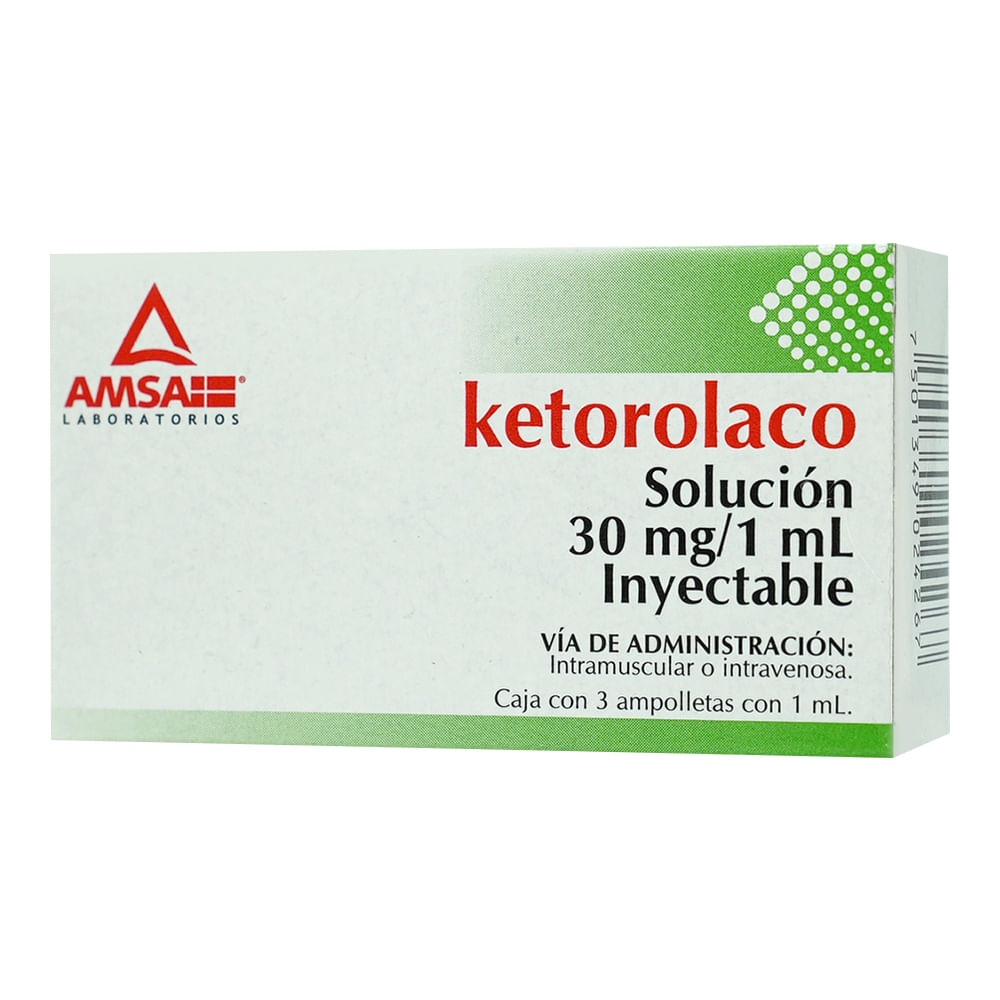
- País de registro
- Forma farmacéuticaINYECTABLE, 30 mg/ml
- Código ATCM01AB15
- Principio activo
- Requiere recetaSí
- Fabricante
- ComposiciónETANOL AL 96% (100 mg/ml mg), CLORURO DE SODIO (4.35 mg/ml mg), EDETATO DE DISODIO (0,5 mg/ml mg), ACIDO CLORHIDRICO/HIDROXIDO DE SODIO (csp pH mg)
- Esta información es de carácter general y no sustituye la consulta con un profesional sanitario.
- Alternativas a KETOROLACO KABI 30 MG/ML SOLUCION INYECTABLE EFGForma farmacéutica: INYECTABLE, 30 MG/MLPrincipio activo: ketorolacFabricante: Laboratorios Normon S.A.Requiere recetaForma farmacéutica: COMPRIMIDO, 10 mgPrincipio activo: ketorolacFabricante: Neuraxpharm Spain S.L.Requiere recetaForma farmacéutica: INYECTABLE, 30 mgPrincipio activo: ketorolacFabricante: Atnahs Pharma Netherlands Bv.Requiere receta
Médicos online para KETOROLACO KABI 30 MG/ML SOLUCION INYECTABLE EFG
Comenta la dosis, los posibles efectos secundarios, interacciones, contraindicaciones o si una receta es apropiada para KETOROLACO KABI 30 MG/ML SOLUCION INYECTABLE EFG, sujeto a valoración médica y a la normativa local.









Preguntas frecuentes
KETOROLACO KABI 30 MG/ML SOLUCION INYECTABLE EFG requiere receta en España. Puedes confirmarlo con un médico online según tu caso.
El principio activo de KETOROLACO KABI 30 MG/ML SOLUCION INYECTABLE EFG es ketorolac. Esta información ayuda a identificar medicamentos con la misma composición pero con diferentes nombres comerciales.
KETOROLACO KABI 30 MG/ML SOLUCION INYECTABLE EFG es fabricado por Fresenius Kabi España, S.A.U.. La marca y el envase pueden variar según el distribuidor.
Los Médicos de familia, Psiquiatras, Dermatólogos, Cardiólogos, Endocrinólogos, Gastroenterólogos, Neumólogos, Nefrólogos, Reumatólogos, Hematólogos, Infectólogos, Alergólogos, Geriatras, Pediatras, Oncólogos pueden valorar la prescripción de KETOROLACO KABI 30 MG/ML SOLUCION INYECTABLE EFG cuando esté clínicamente indicado. Puedes reservar una videoconsulta para comentar tu caso y las opciones de tratamiento.
La receta la emite un médico tras valorar tu estado de salud. En España, KETOROLACO KABI 30 MG/ML SOLUCION INYECTABLE EFG se dispensa en las farmacias con esa receta médica. Una consulta online no garantiza su emisión: la decisión corresponde siempre al médico.
Para solicitar una valoración puedes usar Oladoctor:
Otros medicamentos con el mismo principio activo (ketorolac) incluyen KETOROLACO TROMETAMOL NORMON 30 mg/ml SOLUCION INYECTABLE EFG, KETOROLACO TROMETAMOL QUALIGEN 10 MG COMPRIMIDOS RECUBIERTOS CON PELICULA EFG, TORADOL 30 mg/1 ml SOLUCION INYECTABLE. Pueden tener diferentes nombres comerciales o formulaciones, pero contienen el mismo componente terapéutico. Consulta siempre con un médico antes de cambiar o iniciar un nuevo medicamento.
