


Javlor 25 mg/ml concentrado para solución para perfusión





Cómo usar JAVLOR 25 mg/ml CONCENTRADO PARA SOLUCION PARA PERFUSION
Contenido del prospecto
- Introducción
- Qué es Javlor y para qué se utiliza
- Qué necesita saber antes de empezar a usar Javlor
- Cómo usar Javlor
- Posibles efectos adversos
- Conservación de Javlor
- Contenido del envase e información adicional
Introducción
Prospecto: información para el usuario
Javlor 25 mg/ml concentrado para solución para perfusión
vinflunina
Lea todo el prospecto detenidamente antes de empezar a usar el medicamento porque contiene información importante para usted.
- Conserve este prospecto, ya que puede tener que volver a leerlo.
- Si tiene alguna duda, consulte a su médico.
- Si experimenta efectos adversos, consulte a su médico, incluso si se trata de efectos adversos que no aparecen en este prospecto. Ver sección 4.
Contenido del prospecto
- Qué es Javlor y para qué se utiliza
- Qué necesita saber antes de empezar a usar Javlor
- Cómo usar Javlor
- Posibles efectos adversos
- Conservación de Javlor
- Contenido del envase e información adicional
1. Qué es Javlor y para qué se utiliza
Javlor contiene el principio activo vinflunina, que pertenece al grupo de medicamentos anticancerígenos denominado alcaloides de la vinca. Estos medicamentos afectan al crecimiento de las células cancerígenas deteniendo la división celular, lo que da lugar a la muerte de la célula (citotoxicidad).
Javlor se utiliza para tratar el cáncer de vejiga y del tracto urinario en una fase avanzada o metastásica, cuando el tratamiento previo con medicamentos que hayan incluido derivados del platino ha fracasado.

¿No estás seguro de si este medicamento es adecuado para ti?
Comenta tus síntomas y tratamiento con un médico online.
2. Qué necesita saber antes de empezar a usar Javlor
No use Javlor
- si es alérgico al principio activo (vinflunina) o a otros alcaloides de la vinca (vinblastina, vincristina, vindesina, vinorelbina),
- si ha sufrido una infección (en las últimas 2 semanas) o sufre una infección grave en la actualidad,
- si sus niveles de glóbulos blancos y/o plaquetas son demasiado bajos,
- si está en período de lactancia.
Advertencias y precauciones
Informe a su médico:
- si tiene problemas de hígado, riñones o corazón,
- si padece cualquiera de los síntomas neurológicos que podría ser un signo de “síndrome de encefalopatía posterior reversible”: inflamación del cerebro con efectos generalmente temporales tales como dolor de cabeza, cambios del estado mental que pueden conducir a confusión y coma, convulsiones, cambios en la visión, presión arterial alta, náuseas y vómitos puede ser necesario dejar de usar este medicamento,
- Si padece síntomas de hiponatremia (niveles bajos de sodio en sangre) o un “síndrome de secreción inadecuada de hormona antidiurética”, como dolor de cabeza, cansancio, convulsiones o coma. Se recomienda un control regular de los niveles séricos de sodio durante el tratamiento con Javlor.
- si está tomando algún medicamento mencionado a continuación en “Otros medicamentos y Javlor”,
- si tiene estreñimiento, o si está siendo tratado con medicamentos contra el dolor (opioides), o si ha tenido cáncer abdominal, o si tuvo una cirugía abdominal previa. El estreñimiento es un efecto adverso muy frecuente de Javlor. Para prevenir el estreñimiento le pueden administrar laxantes,
- si tiene intención de concebir un niño (ver recomendaciones importantes para hombres y mujeres en “Embarazo, lactancia y fertilidad” a continuación).
Su médico controlará de forma regular los recuentos de sus células sanguíneas antes y durante su tratamiento, puesto que la disminución de los recuentos de células sanguíneas es un efecto adverso frecuente del tratamiento con Javlor.
La administración intratecal de Javlor puede ser mortal. Javlor no se debe administrar intratecalmente (en la columna vertebral).
Niños y adolescentes
Javlor no debe ser utilizado en niños y en adolescentes.
Otros medicamentos y Javlor
Informe a su médico si está utilizando, ha utilizado recientemente o podría tener que utilizar cualquier otro medicamento.
Concretamente, informe a su médico si está tomando algún medicamento que contenga cualquiera de las sustancias activas siguientes:
- ketoconazol e itraconazol, utilizados en caso de infecciones por hongos,
- opioides, utilizados para tratar el dolor
- ritonavir, utilizado para tratar la infección por el virus del VIH,
- doxorrubicina, doxorrubicina pegilada liposomal, paclitaxel y docetaxel utilizado para tratar ciertos tipos de cáncer,
- rifampicina, utilizada para el tratamiento de la tuberculosis o la meningitis,
- preparaciones a base de plantas que contengan Hypericum perforatum(Hierba de San Juan) que se utiliza para el tratamiento de la depresión leve o moderada.
O si está tomando medicamentos que se sabe que provocan cambios en el electrocardiograma (ECG), especialmente medicamentos que se sabe que provocan una "prolongación del intervalo QT".
Javlor con alimentos y bebidas
Informe a su médico si consume zumo de pomelo ya que puede aumentar el efecto de Javlor.
También debe beber agua y comer alimentos de alto contenido en fibra.
Embarazo, lactancia y fertilidad
Si está embarazada o en periodo de lactancia, cree que podría estar embarazada o tiene intención de quedarse embarazada, consulte con su médico antes de iniciar el tratamiento.
Si es una mujer o un hombre en edad fértil, debe usar un método anticonceptivo adecuado y eficaz durante el tratamiento y durante los 4 meses si es hombre, o 7 meses si es mujer, posteriores a su última dosis de Javlor.
Embarazo
No debería recibir Javlor si está embarazada, a menos que sea absolutamente necesario.
Si se queda embarazada durante el tratamiento, debe ser informada sobre el riesgo para el feto y ser monitorizada cuidadosamente.
Lactancia
No debe dar el pecho durante el tratamiento con Javlor.
Fertilidad
Si quisiera tener hijos, consulte con su médico. Quizás quiera pedir consejo sobre bancos de esperma antes de empezar el tratamiento debido a la posibilidad de infertilidad irreversible debido al tratamiento con vinflunina.
Conducción y uso de máquinas
Javlor puede producir efectos adversos, como cansancio, mareos, alteración visual y desmayos.
No conduzca o utilice máquinas sin el consejo de su médico.
3. Cómo usar Javlor
Dosis
La dosis recomendada en pacientes adultos es de 320 mg/m2 de superficie corporal (lo calculará el médico de acuerdo con su peso y altura). El tratamiento se repetirá cada 3 semanas.
No es necesario ajustar la dosis por edad en pacientes menores de 75 años. Su médico ajustará su dosis si tiene 75 años o más.
Su médico también ajustará la dosis inicial de Javlor en función de su condición física y en situaciones específicas:
- si ha sido sometido previamente a irradiación de la pelvis,
- si tiene un problema moderado o grave en los riñones,
- si tiene problemas de hígado.
Durante el tratamiento, el médico puede disminuir la dosis de Javlor, retrasarla o interrumpir el tratamiento si experimenta determinados efectos adversos.
Cómo se administra Javlor
Javlor SÓLO SE DEBE administrar por vía intravenosa.
Javlor le será administrado en perfusión intravenosa (goteo en vena) durante 20 minutos, por un profesional sanitario (con experiencia en el uso del tratamiento del cáncer en unidades especializadas de salud).
Javlor es un concentrado que debe ser diluido antes de la administración.
Si le administran más Javlor del que debe recibir
Este medicamento le será administrado por su médico o enfermero. En caso de que le administren demasiado (una sobredosis), su médico lo examinará para detectar efectos adversos.
Si olvidó usar Javlor
Es muy importante que no omita ninguna dosis de este medicamento. Si pierde una cita, llame a su médico de inmediatopara reprogramar su cita.
Si interrumpe el tratamiento con Javlor
Su médico decidirá cuándo debe interrumpir su tratamiento. Si desea interrumpir prematuramente el tratamiento, deberá consultar con su médico las otras opciones de tratamiento disponibles.
Si tiene cualquier otra duda sobre el uso de este medicamento, pregunte a su médico.

¿Has empezado a tomar el medicamento y tienes preguntas?
Comenta tus síntomas y tratamiento con un médico online.
4. Posibles efectos adversos
Al igual que todos los medicamentos, Javlor puede producir efectos adversos, aunque no todas las personas los sufran.
Informe a su médico inmediatamentesi presenta cualquiera de los siguientes efectos adversos graves mientras está siendo tratado con Javlor:
- fiebre y/o escalofríos que podrían ser signos de una infección,
- dolor en el pecho que podría ser signo de un ataque cardíaco,
- estreñimiento que no responde al tratamiento con laxantes,
- síntomas neurológicos que podrían ser signo de “síndrome de encefalopatía posterior reversible”: inflamación del cerebro con efectos generalmente temporales como dolor de cabeza, cambios del estado mental que pueden conducir a confusión y coma, convulsiones, cambios en la visión, presión arterial alta, náuseas y vómitos (ver sección 2 “advertencias y precauciones”).
Otros efectos adversos pueden incluir:
Muy frecuentes (pueden afectar a más de 1 de cada 10 personas)
- dolor abdominal, náuseas, vómitos
- estreñimiento, diarrea
- inflamación de la mucosa de la boca (estomatitis)
- cansancio (astenia), dolor muscular (mialgia)
- falta de sensibilidad en el tacto debido a daño a los nervios (neuropatía sensorial periférica)
- pérdida de peso, disminución del apetito
- pérdida de pelo (alopecia)
- reacciones en el lugar de inyección (dolor, enrojecimiento, hinchazón)
- fiebre
- niveles bajos de células de la serie blanca en la sangre, células de la serie roja en la sangre y/o plaquetas (se observa en un análisis de sangre)
- niveles bajos de sodio en sangre (hiponatremia) visto en el análisis de sangre
Frecuentes (pueden afectar hasta 1 de cada 10 personas)
- infecciones (infección neutropénica, neutropenia febril, infecciones (virales, bacterianas, fúngicas)) con síntomas como fiebre alta y deterioro del estado de salud general
- escalofríos, sudoración excesiva (hiperhidrosis), dolor
- alergia (hipersensibilidad), deshidratación, dolor de cabeza, erupción cutánea, picor (prurito), urticaria
- pérdida de movimiento en los músculos intestinales (íleo) problemas digestivos (dispepsia), dificultad para tragar (disfagia), trastornos bucales (dolor en la boca, en la lengua y dolor dental), alteración del gusto
- debilidad muscular, dolor en la mandíbula, dolor en los brazos y las piernas, dolor de espalda, dolor en las articulaciones, dolor muscular, dolor en los huesos, dolor en el oído
- mareos, insomnio, pérdida de conocimiento transitoria (desmayo)
- dificultad para realizar movimientos corporales debido a daño nervioso (neuropatía) y dolor nervioso (neuralgia)
- latido del corazón rápido (taquicardia), aumento de la presión sanguínea, disminución de la presión sanguínea
- dificultad para respirar (disnea), tos, dolor torácico
- hinchazón de brazos, manos, pies, tobillos, piernas u otras partes de su cuerpo (edema)
- inflamación de las venas (flebitis) y formación de coágulos de sangre en los vasos sanguíneos (trombosis venosa)
Poco frecuentes (pueden afectar hasta 1 de cada 100 personas)
- infección de la sangre con niveles bajos de glóbulos blancos (septicemia neutropénica)
- alteraciones de la vista
- sequedad en la piel, enrojecimiento de la piel (eritema)
- daño a los nervios que causa trastornos de la contracción muscular (neuropatía motora periférica)
- inflamación del tubo que conduce al estómago (esofagitis), dolor al tragar (odinofagia) dolor de garganta (dolor farolaringeo), trastornos gingivales
- aumento de peso
- problemas urinarios, que podría ser un signo de incapacidad de los riñones para funcionar correctamente (insuficiencia renal)
- zumbidos o silbidos en los oídos (tinitus)
- aumento de los enzimas hepáticos (transaminasas) se observa en un análisis de sangre,
- “Síndrome de Secreción Inadecuada de la Hormona Antidiurética”, que es una enfermedad que provoca niveles bajos de sodio en sangre
- dolor tumoral
- sensación de dar vueltas (vértigo)
- ataque cardíaco (infarto de miocardio), reducción del suministro de sangre (isquemia miocárdica)
- dificultad para respirar, que puede ser síntoma de una afección conocida como síndrome de dificultad respiratoria aguda y puede ser grave y poner en peligro la vida
- extravasación (cuando un medicamento que normalmente se inyecta en una vena se escapa o se inyecta accidentalmente en el tejido que rodea la vena, donde puede causar daños graves)
Comunicación de efectos adversos
Si experimenta cualquier tipo de efecto adverso, consulte a su médico o farmacéutico, incluso si se trata de efectos adversos que no aparecen en este prospecto. También puede comunicarlos directamente a través del sistema nacional de notificación incluido en el Apéndice V. Mediante la comunicación de efectos adversos usted puede contribuir a proporcionar más información sobre la seguridad de este medicamento.
5. Conservación de Javlor
Mantener este medicamento fuera de la vista y del alcance de los niños.
No utilice este medicamento después de la fecha de caducidad que aparece en la etiqueta del vial y en el envase después de la abreviatura EXP o CAD.
Es muy poco probable que se le pida a usted que almacene este medicamento.
Las condiciones de conservación se detallan en la sección destinada a médicos o profesionales del sector sanitario.
Vial cerrado
Conservar en nevera (2ºC a 8ºC).
Conservar en el embalaje original para protegerlo de la luz.
Solución diluida
La solución diluida debe usarse inmediatamente.
Los medicamentos no se deben tirar por los desagües ni a la basura. Pregunte a su farmacéutico cómo deshacerse de los envases y de los medicamentos que ya no utiliza. De esta forma, ayudará a proteger el medio ambiente.
6. Contenido del envase e información adicional
Composición de Javlor
- El principio activo es vinflunina. Cada ml de concentrado contiene 25 mg de vinflunina (como ditartrato).
Un vial de 2 ml contiene 50 mg de vinflunina (como ditartrato).
Un vial de 4 ml contiene 100 mg de vinflunina (como ditartrato).
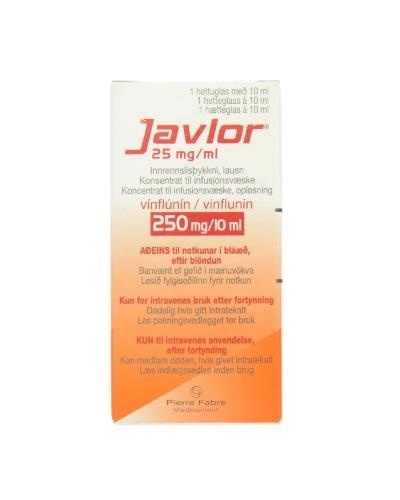
Un vial de 10 ml contiene 250 mg de vinflunina (como ditartrato).
- El otro componente es agua para inyectables.
Aspecto del producto y contenido del envase
Javlor es una solución transparente, incolora o ligeramente amarillenta. Se presenta en viales transparentes de vidrio cerrados mediante un tapón de goma cubierto con un sello flip-off de aluminio con cubierta amarilla para vial de 2 ml, cubierta rosa para vial de 4 ml o cubierta naranja para vial de 10 ml de concentrado. Cada envase contiene 1 o 10 viales.
Puede que solamente estén comercializados algunos tamaños de envase.
Titular de la autorización de comercialización
PIERRE FABRE MEDICAMENT
Les Cauquillous
81500 Lavaur
Francia
Responsable de la fabricación
FAREVA PAU
FAREVA PAU 1
Avenue du Béarn
64320 Idron
Francia
Para cualquier información sobre este medicamento, por favor contactar con el Titular de la Autorización de Comercialización.
Fecha de la última revisión de este prospecto: MM/AAAA.
Otras fuentes de información
La información detallada de este medicamento está disponible en la página web de la Agencia Europea de Medicamentos: http://www.ema.europa.eu.
<---------------------------------------------------------------------------------------------------------------->
Esta información está destinada únicamente a profesionales del sector sanitario:
INSTRUCCIONES DE USO
Precauciones generales para la preparación y administración
Vinflunina es un medicamento antineoplásico citotóxico y, como sucede con otros compuestos potencialmente tóxicos, Javlor debe manipularse con precaución. Deben tenerse en cuenta los procedimientos para la correcta manipulación y eliminación de medicamentos antineoplásicos. Todos los procedimientos de transferencia requieren el seguimiento estricto de técnicas asépticas, usando preferentemente una cabina de seguridad de flujo laminar vertical. Javlor solución para perfusión únicamente puede ser preparado y administrado por personal con la formación adecuada y experiencia en las técnicas de manipulación de agentes citotóxicos. Las mujeres de la plantilla del hospital que estén embarazadas no deben manipular Javlor. Se recomienda el uso de guantes, gafas protectoras y ropa protectora.
En caso de contacto con la piel, se lavará el área afectada inmediatamente con agua en abundancia y jabón. En caso de contacto con las membranas mucosas, éstas deben lavarse a fondo con abundante agua.
Dilución del concentrado
El volumen de Javlor (concentrado) correspondiente a la dosis calculada de vinflunina debe mezclarse en una bolsa de 100 ml de solución para perfusión de cloruro sódico 9 mg/ml (0,9%). También puede utilizarse solución para perfusión de glucosa 50 mg/ml (5%). La solución diluida debe protegerse de la luz hasta su administración.
Forma de administración
Para uso SÓLO por vía intravenosa.
Javlor es para un solo uso.
Tras la disolución del concentrado de Javlor, la solución para perfusión se administrará de la forma siguiente:
- Se establecerá un acceso venoso para una bolsa de 500 ml de solución para perfusión de cloruro sódico 9 mg/ml (0,9%) o de solución para perfusión de glucosa 50 mg/ml (5%), preferentemente en una vena grande en la parte superior del antebrazo o utilizando una vía venosa central.
- La perfusión intravenosa debe iniciarse con la mitad de una bolsa de 500 ml de solución para perfusión de cloruro sódico 9 mg/ml (0,9%) o de solución para perfusión de glucosa 50 mg/m (5%), es decir, 250 ml, a un flujo adecuado para irrigar la vena.
- La solución para perfusión de Javlor debe perfundirse mediante un dispositivo de infusión intravenosa en “Y” en el puerto más cercano posible a la bolsa de 500 ml para diluir más el medicamento durante la administración.
- La solución para perfusión de Javlor debe perfundirse durante 20 minutos
- Se controlará la ausencia de obstrucción frecuentemente y se deberán mantener las precauciones de extravasación a lo largo de la perfusión.
- Una vez terminada la perfusión, los 250 ml restantes de la bolsa con solución para perfusión de cloruro sódico 9 mg/ml (0,9%) o con solución para perfusión de glucosa 50 mg/ml (5%) deben perfundirse a un flujo de 300 ml/h. Para irrigar la vena, la administración de Javlor debe ir siempre seguida por la administración de al menos un volumen igual de solución para infusión de cloruro sódico 9 mg/ml (0,9%) o de solución para infusión de glucosa 50 mg/ml (5%).
Eliminación
La eliminación del medicamento no utilizado y de todos los materiales que hayan estado en contacto con él, se realizará de acuerdo con la normativa local relativa a la eliminación de medicamentos citotóxicos.
Condiciones de conservación:
Viales cerrados:
Conservar en nevera (2ºC a 8ºC).
Conservar en el embalaje original para protegerlo de la luz.
Solución diluida:
Se ha demostrado la estabilidad química y física en uso para la solución diluida:
- protegida de la luz, en bolsas de perfusión de polietileno o de cloruro de polivinilo hasta 6 días en nevera (2ºC – 8ºC) o hasta 24 horas a 25ºC.
- expuestos a la luz, en equipos de perfusión de polietileno o cloruro de polivinilo a 25ºC durante un período de hasta 1 hora.
Desde un punto de vista microbiológico, el producto debe usarse inmediatamente después de la dilución. Si no se usa inmediatamente, los tiempos y condiciones de almacenamiento de la solución en uso antes de la administración son responsabilidad del usuario y no deberían superar normalmente las 24 horas a 2°C – 8ºC, a no ser que la dilución se haya realizado en condiciones asépticas controladas y validadas.
- País de registro
- Forma farmacéuticaINYECTABLE PERFUSION, 25 mg/ml de vinflunina
- Código ATCL01CA05
- Principio activo
- Requiere recetaSí
- Fabricante
- Esta información es de carácter general y no sustituye la consulta con un profesional sanitario.
- Alternativas a JAVLOR 25 mg/ml CONCENTRADO PARA SOLUCION PARA PERFUSIONForma farmacéutica: INYECTABLE PERFUSION, 25 mg/ml de vinfluninaPrincipio activo: VinfluninaFabricante: Pierre Fabre MedicamentRequiere recetaForma farmacéutica: INYECTABLE PERFUSION, 25 mg/ml de vinfluninaPrincipio activo: VinfluninaFabricante: Pierre Fabre MedicamentRequiere recetaForma farmacéutica: INYECTABLE PERFUSION, 25 mg/ml de vinfluninaPrincipio activo: VinfluninaFabricante: Pierre Fabre MedicamentRequiere receta
Médicos online para JAVLOR 25 mg/ml CONCENTRADO PARA SOLUCION PARA PERFUSION
Comenta la dosis, los posibles efectos secundarios, interacciones, contraindicaciones o si una receta es apropiada para JAVLOR 25 mg/ml CONCENTRADO PARA SOLUCION PARA PERFUSION, sujeto a valoración médica y a la normativa local.
Preguntas frecuentes
JAVLOR 25 mg/ml CONCENTRADO PARA SOLUCION PARA PERFUSION requiere receta en España. Puedes confirmarlo con un médico online según tu caso.
El principio activo de JAVLOR 25 mg/ml CONCENTRADO PARA SOLUCION PARA PERFUSION es Vinflunina. Esta información ayuda a identificar medicamentos con la misma composición pero con diferentes nombres comerciales.
JAVLOR 25 mg/ml CONCENTRADO PARA SOLUCION PARA PERFUSION es fabricado por Pierre Fabre Medicament. La marca y el envase pueden variar según el distribuidor.
Los Médicos de familia, Psiquiatras, Dermatólogos, Cardiólogos, Endocrinólogos, Gastroenterólogos, Neumólogos, Nefrólogos, Reumatólogos, Hematólogos, Infectólogos, Alergólogos, Geriatras, Pediatras, Oncólogos pueden valorar la prescripción de JAVLOR 25 mg/ml CONCENTRADO PARA SOLUCION PARA PERFUSION cuando esté clínicamente indicado. Puedes reservar una videoconsulta para comentar tu caso y las opciones de tratamiento.
La receta la emite un médico tras valorar tu estado de salud. En España, JAVLOR 25 mg/ml CONCENTRADO PARA SOLUCION PARA PERFUSION se dispensa en las farmacias con esa receta médica. Una consulta online no garantiza su emisión: la decisión corresponde siempre al médico.
Para solicitar una valoración puedes usar Oladoctor:
Otros medicamentos con el mismo principio activo (Vinflunina) incluyen JAVLOR 25 mg/ml CONCENTRADO PARA SOLUCION PARA PERFUSION, JAVLOR 25 mg/ml CONCENTRADO PARA SOLUCION PARA PERFUSION, JAVLOR 25 mg/ml CONCENTRADO PARA SOLUCION PARA PERFUSION. Pueden tener diferentes nombres comerciales o formulaciones, pero contienen el mismo componente terapéutico. Consulta siempre con un médico antes de cambiar o iniciar un nuevo medicamento.
