



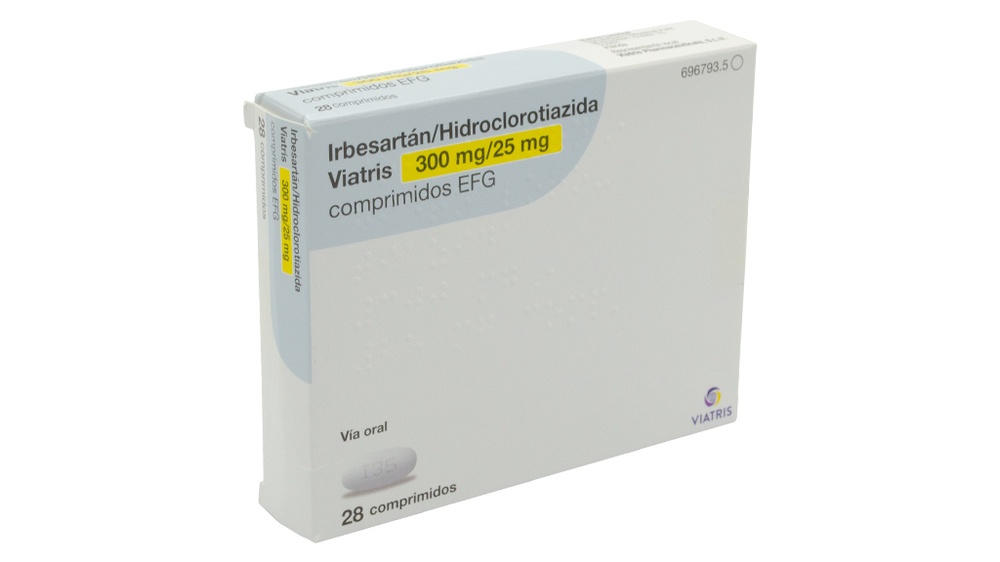
IRBESARTAN 300 mg/25 mg Comprimidos

Revisión de receta online
Un médico revisará tu caso y determinará si la prescripción es médicamente apropiada.

Habla con un médico sobre este medicamento
Comenta tus síntomas y las opciones de tratamiento en una consulta online.



Cómo usar IRBESARTAN/HIDROCLOROTIAZIDA VIATRIS 300 MG/25 MG COMPRIMIDOS EFG
Contenido del prospecto
- Introducción
- Qué es Irbesartán/Hidroclorotiazida Viatris y para qué se utiliza
- Qué necesita saber antes de empezar a tomar Irbesartán/Hidroclorotiazida Viatris
- Cómo tomar Irbesartán/Hidroclorotiazida Viatris
- Posibles efectos adversos
- Conservación de Irbesartán/Hidroclorotiazida Viatris
- Contenido del envase e información adicional
Introducción
Prospecto: información para el paciente
Irbesartán/Hidroclorotiazida Viatris 300 mg/25 mg comprimidos EFG
Lea todo el prospecto detenidamente antes de empezar a tomar este medicamento, porque contiene información importante para usted.
- Conserve este prospecto, ya que puede tener que volver a leerlo.
- Si tiene alguna duda, consulte a su médico o farmacéutico.
- Este medicamento se le ha recetado solamente a usted y no debe dárselo a otras personas, aunque tengan los mismos síntomas que usted, ya que puede perjudicarles
- Si experimenta efectos adversos, consulte a su médico o farmacéutico, incluso si se trata de efectos adversos que no aparecen en este prospecto. Ver sección 4.
Contenido del prospecto
- Qué es Irbesartán/Hidroclorotiazida Viatris y para qué se utiliza
- Qué necesita saber antes de empezar a tomar Irbesartán/Hidroclorotiazida Viatris
- Cómo tomar Irbesartán/Hidroclorotiazida Viatris
- Posibles efectos adversos
- Conservación de Irbesartán/Hidroclorotiazida Viatris
Contenido del envase e información adicional
1. Qué es Irbesartán/Hidroclorotiazida Viatris y para qué se utiliza
Irbesartán/Hidroclorotiazida Viatris es una asociación de dos principios activos, irbesartán e hidroclorotiazida.
Irbesartán pertenece al grupo de medicamentos conocidos como antagonistas de los receptores de la angiotensina-II. La angiotensina-II es una sustancia producida en el organismo que se une a los receptores de los vasos sanguíneos produciendo su contracción. Ello origina un incremento de la presión arterial. Irbesartán impide la unión de la angiotensina-II a estos receptores, relajando los vasos sanguíneos y reduciendo la presión arterial.
Hidroclorotiazida pertenece al grupo de medicamentos (llamados diuréticos tiazídicos) que, aumentando la cantidad de orina eliminada, disminuyen la presión arterial.
Los dos principios activos de irbesartán/hidroclorotiazida actúan conjuntamente para lograr una disminución de la presión arterial superior a la obtenida con cada uno de ellos por separado.
Irbesartán/hidroclorotiazida se utiliza para tratar la presión arterial elevada,cuando el tratamiento solo con irbesartán o solo con hidroclorotiazida no proporciona el control adecuado de su presión arterial.

¿No estás seguro de si este medicamento es adecuado para ti?
Comenta tus síntomas y tratamiento con un médico online.
2. Qué necesita saber antes de empezar a tomar Irbesartán/Hidroclorotiazida Viatris
Notome Irbesartán/Hidroclorotiazida Viatris:
- Si es alérgicoa irbesartán o a cualquiera de los demás componentes de este medicamento (incluidos en la sección 6).
- Si es alérgicoa hidroclorotiazida o a cualquier otro medicamento derivado de las sulfonamidas.
- Si está embarazada de más de 3 meses(en cualquier caso es mejor evitar tomar este medicamento también al inicio de su embarazo - ver sección Embarazo).
- Si tiene problemas graves de hígado o riñón.
- Si su médico detecta que tiene niveles persistentemente elevados de calcio o niveles bajos de potasio en sangre.
- Si tiene diabetes mellitus o dañada la función renaly está en tratamiento con un medicamento para bajar la presión arterial que contiene aliskirén.
Advertencias y precauciones
Consulte a su médico o farmacéutico antes de empezar a tomar Irbesartán/Hidroclorotiazida Viatris y en cualquiera de los siguientes casos:
- Si ha tenido problemas respiratorios o pulmonares (como inflamación o líquido en los pulmones) tras la toma de hidroclorotiazida en el pasado. Si presenta disnea o dificultad para respirar grave después de tomar Irbesartán/Hidroclorotiazida Viatris, acuda al médico inmediatamente.
- Si ha tenido cáncer de piel o si le aparece una lesión de la piel inesperada durante el tratamiento. El tratamiento con hidroclorotiazida, en particular su uso a largo plazo a dosis altas, puede aumentar el riesgo de algunos tipos de cáncer de piel y labios (cáncer de piel no-melanoma). Proteja la piel de la exposición al sol y a los rayos UV mientras esté tomando irbesartán/hidroclorotiazida.
- Si tiene vómitos o diarrea excesivos.
- Si padece alteraciones del riñón,incluyendo estrechamiento de la arteria renalo si le han realizado un trasplante de riñón.
- Si padece alteraciones del corazón, incluyendo un estrechamiento de las válvulas del corazón, un agrandamiento o debilidad en el músculo corazón (insuficiencia cardíaca).
- Si tiene un estrechamiento de los vasos sanguíneos del corazón,lo que puede causar dolor en el pecho, por ejemplo angina.
- Si padece otrasalteraciones del hígado.
- Si padece diabetes.
- Si presenta niveles bajos de azúcar en sangre (los síntomas pueden incluir sudoración, debilidad, hambre, mareos, temblores, dolor de cabeza, rubor o palidez, entumecimiento, latidos cardíacos rápidos y fuertes), especialmente si está siendo tratado para la diabetes.
- Si padece lupus eritematoso(también conocido como lupus o LES).
- Si padece un histórico de alergias o asma.
- Si padece aldosteronismo primario(una afección relacionada con la producción elevada de la hormona aldosterona, que provoca retención de sodio y, a su vez, un aumento de la presión arterial).
- Si sigue una dieta baja en sal.
- Si usted está tomando diuréticos.
- Si está tomando alguno de los siguientes medicamentos utilizados para tratar la presión arterial alta (hipertensión):
- Un inhibidor de la enzima convertidora de angiotensina (IECA) (por ejemplo, enalapril, lisinopril, ramipril), en particular si sufre problemas renales relacionados con la diabetes.
- Aliskirén.
Consulte a su médico si presenta dolor abdominal, náuseas, vómitos o diarrea después de tomar irbesartán/hidroclorotiazida. Su médico decidirá si continuar con el tratamiento. No deje de tomar irbesartán/hidroclorotiazida por su cuenta.
Puede que su médico le controle la función renal, la presión arterial y los niveles de electrolitos en la sangre (por ejemplo, potasio), a intervalos regulares.
Ver también la información bajo el encabezado “No tome Irbesartán/Hidroclorotiazida Viatris”.
Si sospecha que pudiera estar embarazada o si planea quedarse embarazada, debe informar a su médico. No se recomienda el uso de irbesartán/hidroclorotiazida al inicio del embarazo y en ningún caso debe administrarse a partir del tercer mes de embarazo, porque puede causar daños graves a su bebé (ver sección Embarazo).
Durante el tratamiento
También debe comunicar a su médico:
- Si presenta alguno de estos signos: sensación de sed, sequedad de boca, debilidad generalizada, sensación de sueño, dolores musculares o calambres, náuseas, vómitos o latido cardíaco acelerado, ya que pueden indicar un efecto excesivo de hidroclorotiazida (contenida en irbesartán/hidroclorotiazida).
- Si experimenta un aumento de la sensibilidad de la piel al solcon síntomas de quemadura solar (como enrojecimiento, picor, hinchazón, ampollas) que se produce más rápidamente de lo normal.
- Si va a ser operado(intervención quirúrgica) o si le van a administrar anestésicos.
- Si experimenta una disminución de la visión o dolor de ojo. Estos podrían ser síntomas de acumulación de líquido en la capa vascular del ojo (derrame coroideo) o un aumento de la presión en el ojo y se pueden producir en un plazo de entre unas horas a semanas después de tomar irbesartán/hidroclorotiazida. Esto puede conducir a un empeoramiento de la visión permanente, si no se trata. Si anteriormente ha tenido alergia a la penicilina o sulfonamida, puede tener un mayor riesgo de desarrollar esta.
- Si necesita que le realicen un análisis de sangrepara comprobar cómo la paratiroidea(una glándula que ayuda a mantener los niveles de calcio) está trabajando, dígale al médico o al personal del hospital que está tomando este medicamento.
La hidroclorotiazida que contiene este medicamento puede ocasionar resultados positivos en el control del dopaje.
Niños y adolescentes
Irbesartán/hidroclorotiazida no se debe administrar a niños y adolescentes (menores de 18 años).
Otros medicamentos e Irbesartán/Hidroclorotiazida Viatris
Informe a su médico o farmacéutico si está tomando, ha tomado recientemente o pudiera tener que tomar cualquier otro medicamento.
Los diuréticos, como hidroclorotiazida que contiene irbesartán/hidroclorotiazida, pueden tener un efecto sobre otros medicamentos.
No debe tomar junto con irbesartán/hidroclorotiazida los medicamentos que contengan litio (utilizado en problemas de salud mental) sin la supervisión de su médico.
Su médico podría necesitar cambiar su dosis y/o tomar otras precauciones
- Si está tomando un inhibidor de la enzima convertidora de angiotensina (IECA) o aliskirén (ver también la información bajo los encabezados “No tome Irbesartán/Hidroclorotiazida Viatris” y “Advertencias y precauciones”.
Puede que necesite hacerse análisis de sangre si toma:
- Suplementos de potasio.
- Sustitutos de la sal que contengan potasio.
- Medicamentos ahorradores de potasio u otros diuréticos (comprimidos que aumentan la producción de orina).
- Algunos laxantes.
- Medicamentos utilizados en el tratamiento de la gota, por ejemplo, probenecid, sulfinpirazona.
- Suplementos de vitamina D o calcio.
- Medicamentos para controlar el ritmo cardíaco, por ejemplo, digoxina.
- Medicamentos para la diabetes (agentes orales como repaglinida o insulinas).
- Carbamazepina (un medicamento utilizado para el tratamiento de la epilepsia).
- Anfotericina (un medicamento utilizado para tratar las infecciones por hongos).
- Penicilina G-sódica (un antibiótico usado para tratar infecciones bacterianas).
- Carbenoxolona (utilizado para las úlceras en el estómago y la boca).
- Medicamentos que pueden aumentar los niveles de potasio en la sangre, por ejemplo, heparina (usada para prevenir los coágulos de sangre).
También es importante que comunique a su médico si está tomando otros medicamentos para bajar su presión arterial, esteroides, medicamentos para tratar el cáncer, como por ejemplo, ciclofosfamida, metotrexato, analgésicos conocidos como AINEs o inhibidores de la "COX-2", como por ejemplo, celecoxib o ácido acetilsalicílico, amantadina (un medicamento utilizado para tratar la enfermedad de Parkinson o la gripe), alopurinol para la gota, medicamentos que tienen el efecto de vaciar el estómago como por ejemplo atropina, biperideno, o resinas de colestiramina o colestipol, para reducir el colesterol en sangre.
Toma de Irbesartán/Hidroclorotiazida Viatris con alcohol
Debido a la hidroclorotiazida que contiene irbesartán/hidroclorotiazida, si bebe alcohol mientras está en tratamiento con este medicamento, puede tener una mayor sensación de mareo al ponerse de pie, especialmente al levantarse desde una posición sentada.
Embarazo y lactancia
Embarazo
Debe informar a su médico si sospecha que pudiera estar embarazada o si planea quedarse embarazada. Por lo general, su médico le aconsejará que deje de tomar irbesartán/hidroclorotiazida antes de quedarse embarazada o tan pronto como se quede embarazada y le recomendará tomar otro medicamento en su lugar. No se recomienda utilizar irbesartán/hidroclorotiazida durante el embarazo y en ningún caso debe administrarse a partir del tercer mes de embarazo, ya que puede causar daños graves a su bebé cuando se administra a partir de ese momento.
Lactancia
Informe a su médico si va a iniciar o está en periodo de lactancia puesto que no se recomienda administrar irbesartán/hidroclorotiazida a mujeres durante este periodo. Su médico puede decidir administrarle un tratamiento que sea más adecuado si quiere dar el pecho, especialmente a recién nacidos o prematuros.
Conducción y uso de máquinas
No se han realizado estudios sobre la capacidad para conducir y utilizar máquinas. Es poco probable que irbesartán/hidroclorotiazida modifique su capacidad para conducir vehículos o utilizar máquinas. Sin embargo, durante el tratamiento de la hipertensión pueden aparecer ocasionalmente mareos o cansancio. Si presenta estos síntomas hable con su médico antes de conducir o usar máquinas.
Irbesartán/Hidroclorotiazida Viatris contiene lactosa y sodio
Este medicamento contiene lactosa. Si su médico le ha indicado que padece una intolerancia a ciertos azúcares, consulte con él antes de tomar este medicamento.
Este medicamentocontiene menos de 1 mmol de sodio (23 mg) por comprimido; estoes, esencialmente “exento de sodio”.
3. Cómo tomar Irbesartán/Hidroclorotiazida Viatris
Siga exactamente las instrucciones de administración de este medicamento indicadas por su médico o farmacéutico. En caso de duda, consulte de nuevo a su médico o farmacéutico.
Dosis
La dosis recomendada de irbesartán/hidroclorotiazida es de un comprimido al día.
En general, el médico le prescribirá irbesartán/hidroclorotiazida cuando los tratamientos anteriores que recibiera no hubieran reducido suficientemente su presión arterial. El médico le indicará cómo pasar de tratamientos anteriores a irbesartán/hidroclorotiazida.
Forma de administración
Irbesartán/hidroclorotiazida se administra por vía oral.
Los comprimidos deben tragarse con una cantidad suficiente de líquido (por ejemplo, un vaso de agua). Puede tomar irbesartán/hidroclorotiazida con o sin alimentos. Debe intentar tomar su dosis diaria a la misma hora cada día. Es importante que continúe tomando irbesartán/hidroclorotiazida hasta que su médico le aconseje lo contrario.
El efecto máximo reductor de la presión arterial debe alcanzarse 6-8 semanas después del inicio del tratamiento.
Si toma más Irbesartán/Hidroclorotiazida Viatris del que debe
Si accidentalmente toma demasiados comprimidos, contacte inmediatamente con su médico o farmacéutico, llame al Servicio de Información Toxicológica (Tel. 91 562 04 20), indicando el medicamento y la cantidad ingerida, o acuda al servicio de urgencias del hospital más cercano. Puede sentirse mareado, débil, sentir su corazón latir más rápido o más lento, sentirse enfermo y con sueño o somnolencia.
Los niños no deben tomar Irbesartán/Hidroclorotiazida Viatris
Irbesartán/hidroclorotiazida no debe darse a niños menores de 18 años de edad. Si un niño traga algunos comprimidos, póngase en contacto con su médico inmediatamente.
Si olvidó tomar Irbesartán/Hidroclorotiazida Viatris
Si accidentalmente olvida tomarse una dosis, simplemente tome su dosis normal cuando le corresponda la siguiente. No tome una dosis doble para compensar las dosis olvidadas.
Si tiene cualquier otra duda sobre el uso de este medicamento, pregunte a su médico o farmacéutico.

¿Has empezado a tomar el medicamento y tienes preguntas?
Comenta tus síntomas y tratamiento con un médico online.
4. Posibles efectos adversos
Al igual que todos los medicamentos, este medicamento puede producir efectos adversos, aunque no todas las personas los sufran.
Algunos de estos efectos pueden ser graves y pueden requerir atención médica. Si nota cualquiera de los siguientes efectos adversos, deje de tomar irbesartán/hidroclorotiazida y comuníquelo a su médico o acuda de inmediato al servicio de urgencias del hospital más cercano:
Poco frecuentes(pueden afectar hasta 1 de cada 100 personas)
- Amarilleamiento de la piel y el blanco de los ojos.
Frecuencia no conocida(no puede estimarse a partir de los datos disponibles)
- En raras ocasiones se han comunicado casos de reacciones alérgicas cutáneas (erupción cutánea, urticaria), así como también inflamación localizada en la cara, labios y/o lengua y dificultad para respirar.
- Latido del corazón más rápido e irregular o sensación de latidos cardíacos fuertes (palpitaciones), golpeando en el pecho, sensación de desmayos y mareos, que pueden ser causados por los problemas con el ritmo cardíaco. Esto puede detectarse mediante ECG (una prueba utilizada para mostrar cómo está latiendo el corazón).
- Un aumento en el número de infecciones como por ejemplo, dolor de garganta, úlceras en la boca, aspecto pálido, sensación de cansancio, sin aliento, especialmente después de hacer ejercicio, moratones o sangrado con mayor facilidad, esto puede ser debido a una reducción en el número o tipo de las células sanguíneas en la sangre. Esto puede ser causado por un problema con la médula ósea (donde se producen células sanguíneas).
- Palidez, sensación de cansancio o sin aliento, que puede ser causada por la ruptura de los glóbulos rojos.
- Disminución de la visión o dolor de ojo (signos posibles de acumulación de líquido en la capa vascular del ojo (derrame coroideo) o glaucoma agudo de ángulo cerrado).
- Dolor y dificultad al respirar, fiebre, dolor en el pecho y tos, causados por líquido en los pulmones (edema pulmonar).
- Mayor frecuencia de micción, en grandes cantidades, de color pálido o estar incapacitado o que suponga un esfuerzo miccionar con menos frecuencia, en este caso la orina puede ser la de color más oscuro o con sangre, esto puede deberse a problemas con los riñones.
- Dolor intenso de la parte superior del estómago, sensación de estar enfermo, estar enfermo, que puede ser debido a problemas en el hígado.
- Erupción con manchas elevadas de color púrpura y áreas rojas planas causadas por la inflamación de los vasos sanguíneos (vasculitis).
- Una reacción alérgica grave en la piel que incluye erupción con áreas rojas planas, ampollas y grandes áreas de descamación de la piel por todo el cuerpo.
- Lupus eritematoso cutáneo - puede notar una erupción que puede aparecer en la cara, el cuello y el cuero cabelludo.
- Aumento de la sensibilidad de la piel al sol.
- Inflamación del páncreas - puede tener dolor severo del estómago que se irradia y da la vuelta por la espalda además de sensación de malestar.
- Cáncer de piel y labios (cáncer de piel no-melanoma).
Otros posibles efectos adversos
Los efectos adversos comunicados en los estudios clínicos en pacientes tratados con los comprimidos de combinación de irbesartán/hidroclorotiazida fueron:
Frecuentes(pueden afectarhasta1 de cada 10personas)
- Sensación de estar enfermo/estar enfermo (náuseas/vómitos).
- Sensación de cansancio (fatiga).
- Mareos.
- Los análisis de sangre pueden mostrar niveles elevados de un enzima que mide cómo están trabajando el músculo y el corazón (creatina-cinasa) o niveles elevados de sustancias que miden cómo está trabajando el riñón (nitrógeno ureico en la sangre, creatinina).
Poco frecuentes(pueden afectarhasta1 de cada 100personas)
- Diarrea.
- Presión arterial baja.
- Síncope.
- Taquicardia.
- Rubor.
- Hinchazón.
- Disfunción sexual (alteraciones de la función sexual).
- Los análisis de sangre pueden mostrar niveles bajos de sodio y potasio en sangre.
- Sensación de estar mareado después de levantarse tras estar acostado o sentado.
Frecuencia no conocida(no puede estimarse a partir de los datos disponibles)
- Dolor de cabeza.
- Zumbidos en los oídos.
- Tos.
- Alteración del gusto, indigestión.
- Dolor en articulaciones y músculos.
- Los análisis de sangre pueden mostrar que el hígado no está funcionando correctamente.
- Los análisis de sangre pueden mostrar niveles elevados de potasio en sangre.
Tal y como sucede con todas las combinaciones de dos principios activos, no se pueden excluir los efectos adversos asociados a cada uno de los componentes.
Efectos adversos asociados a irbesartán en monoterapia
Poco frecuentes(pueden afectar a 1 de cada 100 personas)
- Dolor en el pecho.
Raras(pueden afectar hasta 1 de cada 1.000 personas)
- Angioedema intestinal: hinchazón en el intestino que cursa con síntomas como dolor abdominal, náuseas, vómitos y diarrea.
Frecuencia no conocida(no puede estimarse a partir de los datos disponibles)
- Formación de moratones y mayor facilidad para sangrar, que puede deberse a una reducción del número de plaquetas (células de coagulación sanguínea).
- Cansancio, dolores de cabeza, dificultad para respirar al hacer ejercicio o mareos y palidez que puede deberse a un número reducido de glóbulos rojos (anemia).
- Niveles altos de azúcar en sangre.
- Reacciones alérgicas graves (shock anafiláctico).
Efectos adversos asociados a hidroclorotiazida en monoterapia
Muy raros (pueden afectar a 1 de cada 10.000 personas)
- Dificultad respiratoria aguda (los signos incluyen dificultad respiratoria grave, fiebre, debilidad y confusión).
Frecuencia no conocida(no puede estimarse a partir de los datos disponibles)
- Pérdida del apetito.
- Irritación de estómago; calambres en el estómago; estreñimiento.
- Trastornos del sueño.
- Depresión.
- Visión borrosa, visión del color afectada con objetos que parecen más amarillos de lo que son (xantopsia), miopía (miopía aguda).
- Fiebre.
- Debilidad y espasmos musculares.
- Hormigueo, pinchazos o sensación de ardor "alfileres y agujas" en la piel (parestesia).
- Inquietud, mareo.
- Reducción de la presión arterial después de un cambio de la posición corporal.
- Hinchazón de las glándulas salivares.
- Niveles altos de azúcar en la sangre.
- Azúcar en la orina.
- Aumentos de algunos tipos de grasas de la sangre; niveles altos de ácido úrico en la sangre, lo que puede causar gota.
Se sabe que los efectos adversos asociados a hidroclorotiazida pueden aumentar con dosis mayores de hidroclorotiazida.
Comunicación de efectos adversos
Si experimenta cualquier tipo de efecto adverso, consulte a su médico o farmacéutico, incluso si se trata de posibles efectos adversos que no aparecen en este prospecto. También puede comunicarlos directamente a través del Sistema Español de Farmacovigilancia de Medicamentos de Uso Humano: https://www.notificaram.es. Mediante la comunicación de efectos adversos usted puede contribuir a proporcionar más información sobre la seguridad de este medicamento.
5. Conservación de Irbesartán/Hidroclorotiazida Viatris
Mantener este medicamento fuera de la vista y del alcance de los niños.
No utilice este medicamento después de la fecha de caducidad que aparece en el envase, la etiqueta o el blíster después de CAD o EXP. La fecha de caducidad es el último día del mes que se indica.
La vida media del producto en frasco es de 90 días una vez abierto.
Este medicamento no requiere condiciones especiales de conservación.
Los medicamentos no se deben tirar por los desagües ni a la basura. Deposite los envases y los medicamentos que no necesita en el Punto SIGRE de la farmacia. En caso de duda pregunte a su farmacéutico cómo deshacerse de los envases y de los medicamentos que no necesita. De esta forma, ayudará a proteger el medio ambiente.
6. Contenido del envase e información adicional
Composición de Irbesartán/Hidroclorotiazida Viatris
- Los principios activos son irbesartán e hidroclorotiazida.
Cada comprimido contiene 300 mg de irbesartán y 25 mg de hidroclorotiazida.
- Los demás componentes son: celulosa microcristalina (E-460), sílice coloidal anhidra, laurilsulfato de sodio, almidón de maíz pregelatinizado, estearato de magnesio (E-470b), povidona (K‑90), lactosa monohidrato, croscarmelosa sódica. Ver sección 2 “Irbesartán/Hidroclorotiazida Viatris contiene lactosa y sodio”.
Aspecto del producto y contenido del envase
Los comprimidos son comprimidos de color blanco a blanquecino, ovalados, biconvexos, marcados con “M” en una cara e “I35” en la otra.
Irbesartán/Hidroclorotiazida Viatris está disponible en envases tipo blíster de 14, 28, 30, 56, 90, 98 o 100 comprimidos, en dosis unitarias en blíster de 56 comprimidos, en envases calendario tipo blíster de 28 comprimidos y en frascos de 500 comprimidos.
Puede que solamente estén comercializados algunos tamaños de envases.
Titular de la autorización de comercialización y responsable de la fabricación
Titular de la autorización de comercialización:
Viatris Limited
Damastown Industrial Park
Mulhuddart, Dublín 15
Dublín
Irlanda
Responsable de la fabricación:
McDermott Laboratories trading as Gerard Laboratories
35/36 Baldoyle Industrial Estate
Grange Road
Dublín 13
Irlanda
o
Mylan Hungary Kft
H-2900 Komarom,
Mylan utca 1
Hungría
Pueden solicitar más información respecto a este medicamento dirigiéndose al representante local del titular de la autorización de comercialización:
Viatris Pharmaceuticals, S.L.U.
C/ General Aranaz, 86
28027 - Madrid
España
Este medicamento está autorizado en los estados miembros del Espacio Económico Europeo con los siguientes nombres:
España Irbesartán/Hidroclorotiazida Viatris 300 mg/25 mg comprimidos EFG
Francia Irbesartan/Hydrochlorothiazide Mylan 300 mg/25 mg Comprimés
Italia Irbesartan e Idroclorotiazide Mylan 300 mg/25 mg Compresse
Noruega Irbesartan/Hydrochlorothiazide Mylan 300 mg/25 mg Tabletter
Países Bajos Irbesartan/Hydrochloorthiazide Mylan 300 mg/25 mg tabletten
Reino Unido Irbesartan/Hydrochlorothiazide Mylan 300 mg/25 mg Tablets
República Checa Irbesartan/Hydrochlorothiazid Mylan 300 mg/25 mg tablety
Fecha de la última revisión de este prospecto:enero 2025
La información detallada de este medicamento está disponible en la página web de la Agencia Española de Medicamentos y Productos Sanitarios (AEMPS) https://www.aemps.gob.es/
- País de registro
- Forma farmacéuticaCOMPRIMIDO, 300/25 mg
- Código ATCC09DA04
- Precio medio en farmacia19.29 EUR
- Principio activo
- Requiere recetaSí
- Fabricante
- ComposiciónLACTOSA MONOHIDRATO (120,0 mg mg), CROSCARMELOSA SODICA (54,0 mg mg)
- Esta información es de carácter general y no sustituye la consulta con un profesional sanitario.
- Alternativas a IRBESARTAN/HIDROCLOROTIAZIDA VIATRIS 300 MG/25 MG COMPRIMIDOS EFGForma farmacéutica: COMPRIMIDO, 150 mgPrincipio activo: irbesartan and diureticsFabricante: Sanofi Winthrop IndustrieRequiere recetaForma farmacéutica: COMPRIMIDO, 300 mgPrincipio activo: irbesartan and diureticsFabricante: Sanofi Winthrop IndustrieRequiere recetaForma farmacéutica: COMPRIMIDO, 300 mgPrincipio activo: irbesartan and diureticsFabricante: Sanofi Winthrop IndustrieRequiere receta
Médicos online para IRBESARTAN/HIDROCLOROTIAZIDA VIATRIS 300 MG/25 MG COMPRIMIDOS EFG
Comenta la dosis, los posibles efectos secundarios, interacciones, contraindicaciones o la revisión de receta de IRBESARTAN/HIDROCLOROTIAZIDA VIATRIS 300 MG/25 MG COMPRIMIDOS EFG, sujeto a valoración médica y a la normativa local.
Obtén una receta de IRBESARTAN/HIDROCLOROTIAZIDA VIATRIS 300 MG/25 MG COMPRIMIDOS EFG online
Rellena un formulario de 2 minutos
Cuéntanos tus síntomas, historial y el medicamento que necesitas.
Elige un médico o nosotros te asignamos uno
Escoge un especialista o te conectamos con el próximo médico disponible.
El médico revisa tu caso
Normalmente en 30 minutos. Puede hacerte preguntas adicionales por chat.
Recógela en cualquier farmacia
Receta electrónica enviada a tu correo, válida en toda España.
Preguntas frecuentes
IRBESARTAN/HIDROCLOROTIAZIDA VIATRIS 300 MG/25 MG COMPRIMIDOS EFG requiere receta en España. Puedes confirmarlo con un médico online según tu caso.
El principio activo de IRBESARTAN/HIDROCLOROTIAZIDA VIATRIS 300 MG/25 MG COMPRIMIDOS EFG es irbesartan and diuretics. Esta información ayuda a identificar medicamentos con la misma composición pero con diferentes nombres comerciales.
El precio medio en farmacia de IRBESARTAN/HIDROCLOROTIAZIDA VIATRIS 300 MG/25 MG COMPRIMIDOS EFG es de aproximadamente 19.29 EUR. Puede variar según el fabricante y la forma farmacéutica.
IRBESARTAN/HIDROCLOROTIAZIDA VIATRIS 300 MG/25 MG COMPRIMIDOS EFG es fabricado por Viatris Limited. La marca y el envase pueden variar según el distribuidor.
Los Médicos de familia, Psiquiatras, Dermatólogos, Cardiólogos, Endocrinólogos, Gastroenterólogos, Neumólogos, Nefrólogos, Reumatólogos, Hematólogos, Infectólogos, Alergólogos, Geriatras, Pediatras, Oncólogos pueden valorar la prescripción de IRBESARTAN/HIDROCLOROTIAZIDA VIATRIS 300 MG/25 MG COMPRIMIDOS EFG cuando esté clínicamente indicado. Puedes reservar una videoconsulta para comentar tu caso y las opciones de tratamiento.
España cuenta con una infraestructura sanitaria bien desarrollada en ciudades principales como Madrid, Barcelona, Valencia y Sevilla. Las farmacias están ampliamente disponibles y operan bajo estrictas regulaciones, garantizando el acceso a medicamentos con receta.
Puedes comprar IRBESARTAN/HIDROCLOROTIAZIDA VIATRIS 300 MG/25 MG COMPRIMIDOS EFG en Madrid, Barcelona, Sevilla o Valencia en cualquier farmacia local con una receta válida.
Para obtener una receta, puedes utilizar Oladoctor:
Otros medicamentos con el mismo principio activo (irbesartan and diuretics) incluyen COAPROVEL 150 mg/12,5 mg COMPRIMIDOS RECUBIERTOS CON PELICULA, COAPROVEL 300 mg/12,5 mg COMPRIMIDOS RECUBIERTOS CON PELICULA, COAPROVEL 300 mg/25 mg COMPRIMIDOS RECUBIERTOS CON PELICULA. Pueden tener diferentes nombres comerciales o formulaciones, pero contienen el mismo componente terapéutico. Consulta siempre con un médico antes de cambiar o iniciar un nuevo medicamento.
