



HULIO 40 mg Solución Inyectable

Revisión de receta online
Un médico revisará tu caso y determinará si la prescripción es médicamente apropiada.

Habla con un médico sobre este medicamento
Comenta tus síntomas y las opciones de tratamiento en una consulta online.



Cómo usar HULIO 40 MG SOLUCION INYECTABLE EN PLUMA PRECARGADA
Contenido del prospecto
- Introducción
- Qué es Hulio y para qué se utiliza
- Qué necesita saber antes de empezar a usar Hulio
- Cómo usar Hulio
- Posibles efectos adversos
- Conservación de Hulio
- Contenido del envase e información adicional
Introducción
Prospecto: información para el paciente
Hulio 40 mg solución inyectable en pluma precargada
adalimumab
Lea todo el prospecto detenidamente antes de empezar a usar este medicamento, porque contiene información importante para usted.
- Conserve este prospecto, ya que puede tener que volver a leerlo.
- Su médico le dará una Tarjeta de Información para el Paciente, que contiene información de seguridad importante que necesita conocer antes y durante el tratamiento con Hulio. Lleve la Tarjeta de Información para el Paciente con usted en todo momento y durante 4 meses después de que se le inyecte Hulio.
- Si tiene alguna duda, consulte a su médico o farmacéutico.
- Este medicamento se le ha recetado solamente a usted, y no debe dárselo a otras personas, aunque tengan los mismos síntomas que usted, ya que puede perjudicarles.
- Si experimenta efectos adversos, consulte a su médico o farmacéutico, incluso si se trata de efectos adversos que no aparecen en este prospecto. Ver sección 4.
Contenido del prospecto
- Qué es Hulio y para qué se utiliza
- Qué necesita saber antes de empezar a usar Hulio
- Cómo usar Hulio
- Posibles efectos adversos
- Conservación de Hulio
- Contenido del envase e información adicional
- Instrucciones de uso
1. Qué es Hulio y para qué se utiliza
Hulio contiene como sustancia activa adalimumab, un medicamento que actúa sobre el sistema inmunitario (defensas) del cuerpo.
Hulio está indicado en el tratamiento de las enfermedades inflamatorias que se describen a continuación:
- artritis reumatoide;
- artritis idiopática juvenil poliarticular;
- artritis asociada a entesitis;
- espondilitis anquilosante;
- espondiloartritis axial sin evidencia radiográfica de espondilitis anquilosante;
- artritis psoriásica;
- psoriasis;
- hidradenitis supurativa;
- enfermedad de Crohn;
- colitis ulcerosa;
- uveítis no infecciosa en adultos y niños.
La sustancia activa de Hulio, adalimumab, es un anticuerpo monoclonal. Los anticuerpos monoclonales son proteínas que atacan a una diana específica en el cuerpo.
La diana de adalimumab es una proteína llamada factor de necrosis tumoral (TNFα), que se encuentra en niveles elevados en las enfermedades inflamatorias descritas arriba. Mediante el ataque al TNFα, Hulio disminuye el proceso de inflamación en esas enfermedades.
Artritis reumatoide
La artritis reumatoide es una enfermedad inflamatoria de las articulaciones.
Hulio se utiliza para tratar la artritis reumatoide en adultos. Si usted padece artritis reumatoide activa moderada a grave, puede que se le administren antes otros medicamentos modificadores de la enfermedad tales como metotrexato. Si estos medicamentos no responden suficientemente bien, recibirá Hulio para tratar la artritis reumatoide.
Hulio también puede usarse en el tratamiento de la artritis reumatoide grave, activa y progresiva sin tratamiento previo con metotrexato.
Hulio puede reducir el daño de los cartílagos y huesos de las articulaciones producido por la enfermedad y mejorar el rendimiento físico.
Habitualmente Hulio se usa junto con metotrexato. Si su médico considera que el metotrexato no es apropiado, Hulio puede administrarse solo.
Artritis idiopática juvenil poliarticular y artritis asociada a entesitis
La artritis idiopática juvenil poliarticular y la artritis asociada a entesitis son unas enfermedades inflamatorias de las articulaciones que habitualmente aparece por primera vez en la infancia.
Hulio se utiliza para tratar la artritis idiopática juvenil poliarticular en niños y adolescentes de edades comprendidas entre los 2 y los 17 años y la artritis asociada a entesitis en niños y adolescentes de edades comprendidas entre los 6 y los 17 años. Pueden haber recibido primero otros fármacos modificadores de la enfermedad, como metotrexato. Si estos medicamentos no responden suficientemente bien, recibirá Hulio para tratar su artritis idiopática juvenil poliarticular o su artritis asociada a entesitis.
Espondilitis anquilosante y espondiloartritis axial sin evidencia radiográfica de espondilitis anquilosante
La espondilitis anquilosante y la espondiloartritis axial sin evidencia radiográfica de espondilitis anquilosante son enfermedades inflamatorias que afectan a la columna vertebral.
Hulio se utiliza para tratar la espondilitis anquilosante y la espondiloartritis axial sin evidencia radiográfica de espondilitis anquilosante en adultos. Si tiene espondilitis anquilosante o espondiloartritis axial sin evidencia radiográfica de espondilitis anquilosante, será tratado primero con otros medicamentos. Si estos medicamentos no responden suficientemente bien, recibirá Hulio para reducir los signos y síntomas de la enfermedad.
Artritis psoriásica
La artritis psoriásica es una enfermedad inflamatoria de las articulaciones asociada con la psoriasis.
Hulio se utiliza para tratar la artritis psoriásica en adultos. Hulio puede reducir el daño de los cartílagos y huesos de las articulaciones producido por la enfermedad y mejorar el rendimiento físico.
Psoriasis en placas en adultos y niños
La psoriasis en placas es una enfermedad inflamatoria de la piel que causa áreas enrojecidas, escamosas, con costras y cubiertas por escamas plateadas. La psoriasis en placas también puede afectar a las uñas, provocando que se deterioren, se engrosen y se levanten del lecho de la uña, lo cual puede ser doloroso. Se cree que la psoriasis está causada por un defecto en el sistema inmunitario del cuerpo que lleva a un incremento en la producción de células de la piel. 154
Hulio se utiliza para tratar la psoriasis en placas de moderada a grave en adultos. Hulio también se utiliza para tratar la psoriasis en placas grave en niños y adolescentes de entre 4 y 17 años de edad que no hayan respondido bien, o no sean buenos candidatos para terapia tópica y con luz UV.
Hidradenitis supurativa en adultos y adolescentes
La hidradenitis supurativa (a veces denominada acné inverso) es una enfermedad crónica inflamatoria de la piel y a menudo dolorosa. Los síntomas pueden incluir nódulos dolorosos (bultos) y abscesos (forúnculos) que pueden secretar pus. Normalmente afecta a áreas específicas de la piel, como debajo del pecho, de las axilas, zona interior de los muslos, ingle y nalgas. También puede haber cicatrices en las áreas afectadas.
Hulio se utiliza para tratar la hidradenitis supurativa en adultos y adolescentes a partir de 12 años. Hulio puede reducir el número de nódulos y abscesos que tiene, y el dolor que normalmente va asociado a esta enfermedad. Puede haber recibido otros medicamentos previamente. Si estos medicamentos no responden suficientemente bien, recibirá Hulio.
Enfermedad de Crohn en adultos y niños
La enfermedad de Crohn es una enfermedad inflamatoria del tracto digestivo.
Hulio se utiliza para tratar la enfermedad de Crohn en adultos y niños de edades comprendidas entre los 6 y los 17 años. Si padece enfermedad de Crohn será tratado primero con otros medicamentos. Si no responde suficientemente a estos medicamentos, recibirá Hulio para reducir los signos y síntomas de la enfermedad de Crohn.
Colitis ulcerosa en adultos y niños
La colitis ulcerosa es una enfermedad inflamatoria del intestino.
Hulio se utiliza para tratar la colitis ulcerosa en adultos. Si usted sufre colitis ulcerosa primero le recetarán otros medicamentos. Si estos medicamentos no responden suficientemente bien, recibirá Hulio para reducir los signos y síntomas de la enfermedad.
Uveítis no infecciosa que afecta a la parte posterior del ojo
La uveítis no infecciosa es una enfermedad inflamatoria que afecta a ciertas partes del ojo. Esta inflamación conduce a una disminución de la visión y/o a la presencia de motas en el ojo (puntos negros o líneas delgadas que se mueven a lo largo del campo de visión). Hulio actúa reduciendo esta inflamación.
Hulio se utiliza para tratar a:
- adultos con uveítis no infecciosa con inflamación que afecta a la parte posterior del ojo;
- niños y adolescentes desde los 2 hasta los 17 años para el tratamiento de la uveítis crónica no infecciosa con inflamación que afecta a la parte frontal del ojo.

¿No estás seguro de si este medicamento es adecuado para ti?
Comenta tus síntomas y tratamiento con un médico online.
2. Qué necesita saber antes de empezar a usar Hulio
No use Hulio
- Si es alérgico a adalimumab o a alguno de los demás componentes de este medicamento (incluidos en la sección 6).
- Si padece una infección grave, incluyendo tuberculosis (ver “Advertencias y precauciones”). En caso de tener síntomas de cualquier infección, por ejemplo: fiebre, heridas, cansancio, problemas dentales, es importante que informe a su médico.
- Si padece insuficiencia cardiaca moderada o grave. Es importante que le diga a su médico si ha tenido o tiene algún problema cardiaco serio (ver “Advertencias y precauciones”).
Advertencias y precauciones
Consulte a su médico o farmacéutico antes de empezar a usar Hulio.
Reacciones alérgicas
Si tiene una reacción alérgica con síntomas como opresión en el pecho, dificultad para respirar, mareo, hinchazón o sarpullido, interrumpa las inyecciones de Hulio y póngase en contacto con su médico inmediatamente ya que, en casos raros, estas reacciones pueden poner en peligro la vida.
Infecciones
- Si padece cualquier infección, incluyendo las crónicas o las localizadas (por ejemplo: una úlcera en la pierna), consulte a su médico antes de comenzar el tratamiento con Hulio. Si no está seguro, póngase en contacto con su médico.
- Con el tratamiento con Hulio podría contraer infecciones con más facilidad. Este riesgo puede ser mayor si tiene afectados los pulmones. Estas infecciones pueden ser graves e incluyen tuberculosis, infecciones causadas por virus, hongos, parásitos o bacterias u otros microorganismos infecciosos y sepsis (septicemia) poco frecuentes. En casos raros, estas infecciones pueden poner en peligro la vida. Por esta razón es importante que en el caso de que tenga síntomas como fiebre, heridas, cansancio o problemas dentales, se lo diga a su médico. El médico le puede recomendar que interrumpa temporalmente el tratamiento con Hulio.
Tuberculosis (TB)
- Dado que se han descrito casos de tuberculosis en pacientes en tratamiento con adalimumab, su médico le examinará en busca de signos o síntomas de tuberculosis antes de comenzar su tratamiento con Hulio. Esto incluirá la realización de una evaluación médica minuciosa, incluyendo su historia médica y pruebas de diagnóstico (por ejemplo radiografía de tórax y la prueba de la tuberculina). La realización y resultados de estas pruebas deben anotarse en su Tarjeta de Información para el Paciente. Es muy importante que informe a su médico en caso de haber padecido tuberculosis o haber estado en contacto con un paciente de tuberculosis. Se puede desarrollar tuberculosis durante el tratamiento incluso si usted ha recibido el tratamiento preventivo para la tuberculosis. Si apareciesen síntomas de tuberculosis (tos persistente, pérdida de peso, malestar general, febrícula) o de cualquier otra infección durante o una vez finalizado el tratamiento, póngase en contacto inmediatamente con su médico.
Infección recurrente/contraída en viajes
- Informe al médico si reside o viaja por regiones en las que infecciones fúngicas como histoplasmosis, coccidiomicosis o blastomicosis sean comunes.
- Informe a su médico si tiene antecedentes de infecciones recurrentes u otras patologías o factores que aumenten el riesgo de infecciones.
Virus de la hepatitis B
- Informe a su médico si es usted portador del virus de la hepatitis B (VHB), si ha tenido infecciones activas con infección por VHB activa o si piensa que podría correr riesgo de contraer el VHB. Su médico le realizará un análisis para el VHB. Hulio puede causar la reactivación de la infección por VHB en personas portadoras de este virus. En casos raros, especialmente si está tomando otros medicamentos que suprimen el sistema inmunitario, la reactivación de la infección por VHB puede poner en peligro su vida.
Personas de más de 65 años
- Si tiene más de 65 años puede ser más susceptible de padecer infecciones mientras está en tratamiento con Hulio. Tanto usted como su médico deben prestar atención especial a la aparición de signos de infección mientras esté siendo tratado con Hulio. Es importante informar a su médico si tiene síntomas de infecciones, como fiebre, heridas, sensación de cansancio o problemas dentales.
Intervención quirúrgica o dental
- Si le van a realizar una intervención quirúrgica o dental, informe a su médico de que está usando Hulio. El médico le puede recomendar que interrumpa temporalmente el tratamiento con Hulio.
Enfermedad desmielinizante
- Si padece o desarrolla una enfermedad desmielinizante (una enfermedad que afecta a la capa aislante que rodea a los nervios), como la esclerosis múltiple, el médico decidirá si debe ser tratado o continuar en tratamiento con Hulio. Informe inmediatamente a su médico si tiene síntomas tales como cambios en la visión, debilidad en brazos o piernas o entumecimiento u hormigueo en cualquier parte del cuerpo.
Vacunas
- Ciertas vacunas contienen formas vivas pero debilitadas de bacterias o virus que causan enfermedades y no deben administrarse durante el tratamiento con Hulio si causan infección. Consulte con su médico antes de la administración de cualquier tipo de vacuna. Se recomienda que, en la medida de lo posible, los niños reciban todas las vacunas previstas para su edad antes de iniciar el tratamiento con Hulio. Si recibió Hulio mientras estaba embarazada, su bebé puede tener un riesgo mayor de sufrir infecciones durante aproximadamente los 5 meses siguientes a la última dosis que haya recibido durante su embarazo. Es importante que informe al médico de su hijo y a otros profesionales sanitarios sobre su uso de Hulio durante el embarazo, para que ellos puedan decidir si su hijo debe recibir alguna vacuna.
Insuficiencia cardiaca
- Es importante que informe a su médico si ha padecido o padece problemas serios de corazón. Si padece insuficiencia cardiaca leve y está en tratamiento con Hulio, su médico debe hacerle un seguimiento continuo de su insuficiencia cardiaca. En caso de que aparezcan nuevos síntomas de insuficiencia cardiaca o empeoren los actuales (por ejemplo: dificultad al respirar, o hinchazón de los pies), debe ponerse en contacto con su médico inmediatamente.
Fiebre, hematomas, sangrado o aspecto pálido
- En algunos pacientes, el organismo puede ser incapaz de producir un número suficiente del tipo de células sanguíneas que luchan contra las infecciones (glóbulos blancos) o de las que contribuyen a parar las hemorragias (plaquetas). Si tiene fiebre persistente, cardenales o sangra muy fácilmente o está muy pálido, consulte inmediatamente a su médico. Su médico puede decidir la interrupción del tratamiento.
Cáncer
- En muy raras ocasiones se han dado casos de ciertos tipos de cáncer en niños y adultos tratados con adalimumab u otros agentes que bloquean el TNFα. Las personas con artritis reumatoide de grado más grave que padezcan la enfermedad desde hace mucho tiempo pueden tener un riesgo mayor que la media de desarrollar un linfoma y leucemia (cánceres que afectan a la sangre y a la médula ósea). Si está en tratamiento con Hulio el riesgo de padecer linfoma, leucemia y otros tipos de cáncer puede incrementarse. Se ha observado, en raras ocasiones, un tipo de linfoma específico y grave en algunos pacientes en tratamiento con Hulio. Algunos de estos pacientes recibían tratamiento también con azatioprina o mercaptopurina. Informe a su médico si está tomando azatioprina o mercaptopurina con Hulio.
- Además, se han observado casos de cáncer de piel (tipo no melanoma) en pacientes que usan adalimumab. Informe al médico si aparecen nuevas zonas de piel lesionadas durante o después del tratamiento o si las marcas o zonas lesionadas existentes cambian de apariencia.
- Se han informado cánceres, diferentes del linfoma, en pacientes con una determinada enfermedad pulmonar, denominada enfermedad pulmonar obstructiva crónica (EPOC), tratados con otro agente bloqueante del TNFα. Si tiene EPOC, o fuma mucho, debe consultar a su médico si el tratamiento con un bloqueante del TNFα es adecuado en su caso.
Niños y adolescentes
- No administre Hulio a niños menores de 2 años con artritis idiopática juvenil poliarticular y uveítis crónica no infecciosa.
- No administre Hulio a niños menores de 6 años con artritis asociada a entesitis y enfermedad de Crohn.
- No administre Hulio a niños menores de 4 años con psoriasis en placas.
- No administre Hulio a niños menores de 12 años con hidradenitis supurativa.
- No utilice la pluma precargada de 40 mg si se recomiendan dosis diferentes de 40 mg.
Otros medicamentos y Hulio
Informe a su médico o farmacéutico si está utilizando, ha utilizado recientemente o pudiera tener que utilizar cualquier otro medicamento.
Hulio se puede tomar junto con metotrexato o con ciertos medicamentos antirreumáticos modificadores de la enfermedad (sulfasalazina, hidroxicloroquina, leflunomida y preparaciones inyectables a base de oro), corticoesteroides o medicamentos para el dolor, incluidos los antiinflamatorios no esteroideos (AINEs).
No debe utilizar Hulio junto con medicamentos cuyos principios activos sean anakinra o abatacept. Basándose en el posible incremento del riesgo de infecciones, incluyendo infecciones graves, y otras interacciones farmacológicas potenciales, no se recomienda la combinación de Hulio con anakinra o abatacept. Si tiene alguna duda, consulte a su médico.
Embarazo y lactancia
- Su hija debe considerar el uso de métodos anticonceptivos adecuados para evitar quedarse embarazada y continuar con su uso durante al menos 5 meses después del último tratamiento con Hulio.
- Si su hija está embarazada, cree que podría estar embarazada o tiene intención de tener un bebé, pida consejo a su médico sobre el uso de este medicamento.
- Hulio debe usarse durante el embarazo solo si es necesario.
- Según un estudio en embarazo, no hubo un mayor riesgo de defectos congénitos cuando la madre había recibido tratamiento con Hulio durante el embarazo comparado con las madres con la misma enfermedad que no recibieron tratamiento con Hulio.
- Hulio puede usarse durante la lactancia.
- Si su hija utilizara Hulio durante su embarazo, su bebé puede tener un riesgo más alto de contraer una infección.
- Es importante que le diga al pediatra o a otros profesionales sanitarios que su hija usa Hulio durante el embarazo antes de que el bebé reciba ninguna vacuna. Para más información sobre vacunas ver la sección “Advertencias y precauciones”.
Conducción y uso de máquinas
La influencia de Hulio sobre la capacidad para conducir, montar en bicicleta o utilizar máquinas es pequeña. Puede producirse sensación de que la habitación da vueltas (vértigo) y alteraciones de la visión después de utilizar Hulio.
Hulio contiene sodio y sorbitol
Cada pluma precargada de Hulio contiene 38,2 mg de sorbitol. El sorbitol es una fuente de fructosa. Si el médico le ha indicado que usted (o su hijo) padecen una intolerancia a ciertos azúcares o se les ha diagnosticado intolerancia hereditaria a la fructosa (IHF), una enfermedad genética rara en la que el paciente no puede descomponer la fructosa, consulte usted (o su hijo) con su médico antes de administrarse el medicamento (o de administrárselo al niño).
Además, este medicamento contiene menos de 1 mmol de sodio (23 mg) por pluma precargada, esto es, esencialmente “exento de sodio”.
3. Cómo usar Hulio
Siga exactamente las instrucciones de administración de este medicamento indicadas por su médico o farmacéutico. En caso de duda, pregunte a su médico o farmacéutico. Su médico le puede prescribir otra dosis de Hulio si su hijo necesita una dosis diferente.
Adultos con artritis reumatoide, artritis psoriásica, espondilitis anquilosante o espondiloartritis axial sin evidencia radiográfica de espondilitis anquilosante.
La dosis normal en adultos con estas enfermedades es de 40 mg de adalimumab administrados en semanas alternas como dosis única.
En el caso de la artritis reumatoide el tratamiento con metotrexato se mantiene durante el uso de
Hulio. Si su médico determina que el metotrexato no es apropiado, Hulio puede administrarse solo.
Si usted padece artritis reumatoide y no recibe metotrexato durante su tratamiento con Hulio, su médico puede decidir darle 40 mg de adalimumab cada semana u 80 mg cada dos semanas.
Niños y adolescentes con artritis idiopática juvenil poliarticular
Niños y adolescentes desde 2 a 17 años de edad con 10 kg de peso hasta menos de 30 kg:
La dosis recomendada de Hulio es 20 mg en semanas alternas.
Niños y adolescentes desde 2 a 17 años de edad con peso de 30 kg o más:
La dosis recomendada de Hulio es 40 mg en semanas alternas.
Niños y adolescentes con artritis asociada a entesitis
Niños y adolescentes desde 6 a 17 años de edad con 15 kg de peso hasta menos de 30 kg:
La dosis recomendada de Hulio es 20 mg en semanas alternas.
Niños y adolescentes desde 6 a 17 años de edad con peso de 30 kg o más:
La dosis recomendada de Hulio es 40 mg en semanas alternas.
Adultos con psoriasis
La posología normal en adultos con psoriasis consiste en una dosis inicial de 80 mg (como dos inyecciones de 40 mg en un día), seguida de 40 mg en semanas alternas comenzando una semana después de la dosis inicial. Debe continuar inyectándose Hulio durante tanto tiempo como le haya indicado su médico. Si esta dosis no tiene el resultado deseado, el médico puede aumentar la frecuencia de las dosis a 40 mg cada semana o a 80 mg en semanas alternas.
Niños o adolescentes con psoriasis en placas
Niños y adolescentes desde 4 a 17 años de edad con 15 kg de peso hasta menos de 30 kg:
La dosis recomendada de Hulio es una dosis inicial de 20 mg, seguida de 20 mg una semana después. A partir de entonces, la dosis habitual es de 20 mg en semanas alternas.
Niños y adolescentes desde 4 a 17 años de edad con peso de 30 kg o más:
La dosis recomendada de Hulio es una dosis inicial de 40 mg, seguida de 40 mg una semana después. A partir de entonces, la dosis habitual es de 40 mg en semanas alternas.
Adultos con hidradenitis supurativa
La pauta de dosificación habitual para la hidradenitis supurativa es de una dosis inicial de 160 mg (como cuatro inyecciones de 40 mg en un día o dos inyecciones de 40 mg por día durante dos días consecutivos), seguido de una dosis de 80 mg (como dos inyecciones de 40 mg en un día) dos semanas después. Después de dos semanas más, continuar con una dosis de 40 mg semanales u 80 mg cada dos semanas, según se lo haya recetado su médico.
Se recomienda que utilice a diario un líquido antiséptico en las zonas afectadas.
Adolescentes con hidradenitis supurativa en adolescentes de 12 años de edad, con un peso
de al menos 30 kg
La dosis recomendada de Hulio es una dosis inicial de 80 mg (2 inyecciones de 40 mg en un día), seguido de 40 mg en semanas alternas comenzando una semana después. Si esta dosis no tiene el resultado deseado, el pediatra puede aumentarla a 40 mg cada semana o a 80 mg en semanas alternas.
Se recomienda que su hijo utilice a diario un líquido antiséptico en las zonas afectadas.
Adultos con enfermedad de Crohn
El régimen de dosificación habitual para la enfermedad de Crohn es de 80 mg (como dos inyecciones de 40 mg en un día) inicialmente, seguido de 40 mg en semanas alternas comenzando dos semanas después. Si se requiere un efecto más rápido, su médico puede recetarle una dosis inicial de 160 mg (como cuatro inyecciones de 40 mg en un día o dos inyecciones de 40 mg por día durante dos días consecutivos), seguido de 80 mg (como dos inyecciones de 40 mg en un día) dos semanas después y a partir de entonces 40 mg en semanas alternas. Si esta dosis no tiene el resultado deseado, el médico puede aumentar la frecuencia de las dosis a 40 mg cada semana o a 80 mg en semanas alternas.
Niños o adolescentes con enfermedad de Crohn
Niños o adolescentes desde 6 a 17 años de edad con peso inferior a 40 kg:
La posología habitual es de 40 mg inicialmente seguido de 20 mg dos semanas después. Si se requiere una respuesta más rápida, su médico puede recetarle una dosis inicial de 80 mg (como 2 inyecciones de 40 mg en un día) seguido de 40 mg dos semanas después.
A partir de entonces, la dosis habitual es de 20 mg en semanas alternas. Si esta dosis no tiene el resultado deseado, el médico puede aumentar la frecuencia de las dosis a 20 mg cada semana.
Niños o adolescentes desde 6 a 17 años de edad con peso de 40 kg o más:
La posología habitual es de 80 mg (como dos inyecciones de 40 mg en un día) inicialmente seguido de 40 mg dos semanas después. Si se requiere una respuesta más rápida, su médico puede recetarle una dosis inicial de 160 mg (como cuatro inyecciones de 40 mg en un día o como dos inyecciones de 40 mg por día durante dos días consecutivos) seguido de 80 mg (como dos inyecciones de 40 mg en un día) dos semanas después.
A partir de entonces, la dosis habitual es de 40 mg en semanas alternas. Si esta dosis no tiene el resultado deseado, el médico puede aumentar la frecuencia de la dosificación a 40 mg cada semana o a 80 mg en semanas alternas.
Los pacientes que necesitan una dosis inferior a 40 mg deben usar la presentación de vial de 40 mg de Hulio.
Adultos con colitis ulcerosa
La posología normal en adultos con colitis ulcerosa es de 160 mg inicialmente (como cuatro inyecciones de 40 mg en un día o dos inyecciones de 40 mg por día en dos días consecutivos) seguido de 80 mg (como dos inyecciones de 40 mg en un día) en la semana 2 y a partir de entonces 40 mg en semanas alternas. Si esta dosis no tiene el resultado deseado, el médico puede aumentar la frecuencia de las dosis a 40 mg cada semana o a 80 mg en semanas alternas.
Niños y adolescentes con colitis ulcerosa
Niños y adolescentes desde 6años con un peso inferior a 40kg
La dosis habitual de Hulio es de 80 mg (como dos inyecciones de 40 mg en un día) inicialmente, seguida de una dosis de 40 mg (como una inyección de 40 mg) dos semanas después. A partir de entonces, la dosis habitual es de 40 mg en semanas alternas.
Los pacientes que cumplan 18 años mientras reciben tratamiento con 40 mg en semanas alternas deben continuar con su dosis prescrita.
Niños y adolescentes desde 6años con un peso de 40kg o superior
La dosis habitual de Hulio es de 160 mg (como cuatro inyecciones de 40 mg en un día o dos inyecciones de 40 mg al día en dos días consecutivos) inicialmente, seguida de una dosis de 80 mg (como dos inyecciones de 40 mg en un día) dos semanas después. A partir de entonces, la dosis habitual es de 80 mg en semanas alternas.
Los pacientes que cumplan 18 años mientras reciben tratamiento con 80 mg en semanas alternas deben continuar con su dosis prescrita.
Adultos con uveítis no infecciosa que afecta a la parte posterior del ojo
La dosis habitual en adultos con uveítis no infecciosa es una dosis inicial de 80 mg (como dos inyecciones en un día), seguida de 40 mg en semanas alternas comenzando una semana después de la dosis inicial. Debe continuar inyectándose Hulio durante tanto tiempo como le haya indicado su médico.
En uveítis no infecciosa, se puede continuar el tratamiento con corticoesteroides u otros medicamentos que afectan al sistema inmunitario. Hulio también se puede administrar solo.
Niños y adolescentes con uveítis crónica no infecciosa
Niños y adolescentes desde 2 a 17años de edad con peso menor a 30kg:
La dosis habitual de Hulio es de 20 mg en semanas alternas junto con metotrexato.
Su pediatra puede prescribir una dosis inicial de 40 mg que puede ser administrada una semana antes de empezar con la pauta habitual recomendada.
Niños y adolescentes desde 2 a 17años de edad con peso de 30kg o más:
La dosis habitual de Hulio es de 40 mg en semanas alternas junto con metotrexato.
Su pediatra puede prescribir una dosis inicial de 80 mg que puede ser administrada una semana antes de empezar con la pauta habitual recomendada.
Para los pacientes a los que se ha indicado una dosis inferior a 40 mg, debe usarse Hulio 20 mg solución inyectable en jeringa precargada o Hulio 40 mg/0,8 ml solución inyectable en vial (disponible en la farmacia).
Forma y vía de administración
Hulio se inyecta bajo la piel (uso subcutáneo).
En las instrucciones de uso, se proporcionan instrucciones detalladas sobre cómo inyectar Hulio.
Si usa más Hulio del que debe
Si se inyecta Hulio accidentalmente con una frecuencia superior a la normal, llame al médico o farmacéutico e infórmele de que recibió una dosis mayor de la necesaria. Siempre lleve la caja del medicamento consigo, incluso si está vacía.
Si olvidó usar Hulio
Si olvida administrarse una inyección, debe inyectarse la siguiente dosis de Hulio tan pronto como lo recuerde. Después se administrará la siguiente dosis como habitualmente, como si no se hubiese olvidado una dosis.
Si interrumpe el tratamiento con Hulio
La decisión de dejar de usar Hulio debe ser discutida con el médico. Los síntomas pueden volver tras la interrupción del tratamiento.
Si tiene cualquier otra duda sobre el uso de este medicamento, pregunte a su médico o farmacéutico.

¿Has empezado a tomar el medicamento y tienes preguntas?
Comenta tus síntomas y tratamiento con un médico online.
4. Posibles efectos adversos
Al igual que todos los medicamentos, este medicamento puede producir efectos adversos, aunque no todas las personas los sufran.
La mayoría de los efectos adversos son leves a moderados. Sin embargo, algunos pueden ser graves y requerir tratamiento médico urgente.
Los efectos adversos pueden aparecer hasta 4 meses, o más, después de la última inyección de Hulio.
Solicite atención médica de inmediatosi presenta cualquiera de los signos siguientes de
reacción alérgica o insuficiencia cardiaca:
- erupción grave, urticaria;
- hinchazón de la cara, manos o pies;
- dificultad para respirar o tragar;
- aspecto pálido, mareos, fiebre persistente, hematomas o sangrado con mucha facilidad.
Póngase en contacto con su médico tan pronto como sea posiblesi nota alguno de los siguientes efectos:
- signos y síntomas de infección tales como fiebre, ganas de vomitar, heridas, problemas dentales; sensación de quemazón al orinar, debilidad, cansancio o tos;
- síntomas de problemas nerviosos como hormigueo, entumecimiento, visión doble o debilidad en brazos o piernas;
- signos de cáncer de piel, como una protuberancia o una herida abierta que no se cura;
- signos y síntomas de alteraciones en la sangre como fiebre persistente, cardenales, hemorragias y palidez.
Se han observado los siguientes efectos adversos de adalimumab:
Muy frecuentes(pueden afectar a más de 1 de cada 10 personas):
- reacciones en el lugar de inyección (incluyendo dolor, hinchazón, enrojecimiento o picor);
- infecciones del tracto respiratorio inferior (incluyendo resfriado, moqueo, sinusitis, infección de garganta, neumonía);
- valores anormales en sangre;
- dolor de cabeza;
- dolor abdominal;
- náuseas y vómitos;
- dolor en huesos y músculos.
Frecuentes(pueden afectar a un máximo de 1 de cada 10 personas):
- cualquier infección (incluidas tuberculosis, toxicidad en la sangre, gripe, celulitis, herpes, infecciones del oído, infecciones dentales, herpes labiales, infecciones en el sistema reproductor, infección del tracto urinario, infecciones por hongos, infecciones de las articulaciones);
- tumores benignos;
- cáncer de piel;
- reacciones alérgicas moderadas (incluyendo alergia estacional);
- deshidratación;
- cambios de humor (incluyendo depresión);
- ansiedad;
- dificultad para dormir;
- alteraciones sensoriales como hormigueo, escozor o entumecimiento;
- migraña;
- dolor de espalda o de cuello;
- alteraciones visuales;
- inflamación o hinchazón de los ojos/párpados;
- vértigo (sensación de que la habitación da vueltas);
- tos;
- sensación de pulso acelerado;
- alta presión sanguínea;
- rubor;
- coágulos de sangre;
- asma;
- hemorragia en el estómago;
- indigestión, hinchazón y ardor;
- acidez/reflujo ácido;
- sequedad en ojos y boca;
- picores, inflamación de la piel (incluido el eccema);
- aumento de la transpiración;
- pérdida de pelo;
- psoriasis de nueva aparición o empeoramiento de la psoriasis existente (piel enrojecida y escamosa);
- espasmos musculares;
- sangre en orina;
- problemas renales;
- cicatrización lenta de heridas.
Poco frecuentes(pueden afectar a hasta 1 de cada 100 personas):
- cáncer que afecta al sistema linfático (linfoma);
- alteraciones inmunológicas que pueden afectar a los pulmones, la piel y los ganglios linfáticos (la presentación más frecuente es la sarcoidosis);
- inflamación de los vasos sanguíneos;
- temblor;
- lesión de nervio;
- derrame cerebral;
- visión doble;
- pérdida de auditiva, zumbidos;
- latido cardiaco irregular;
- enfermedades pulmonares que pueden causar dificultad para respirar (incluyendo inflamación);
- bloqueo de una arteria del pulmón;
- cantidad excesiva de líquido alrededor del pulmón;
- inflamación del páncreas;
- dificultad para tragar;
- inflamación de la vesícula, piedras en la vesícula;
- hígado graso (acumulación de grasa en las células del hígado);
- sudores nocturnos;
- cicatrices;
- crisis muscular anormal;
- lupus eritematoso sistémico (incluyendo inflamación de la piel, corazón, pulmones, articulaciones y otros órganos);
- micción nocturna excesiva;
- impotencia.
Raros(pueden afectar a hasta 1 de cada 1000 personas):
- leucemia (cáncer que afecta a la sangre y la médula ósea);
- esclerosis múltiple;
- alteraciones nerviosas (como inflamación del nervio óptico y síndrome de Guillain-Barré, que puede provocar debilidad muscular, sensaciones anormales, hormigueo en los brazos y la parte superior del cuerpo);
- ataque al corazón;
- fibrosis pulmonar (cicatriz en el pulmón);
- perforación/desgarro intestinal;
- inflamación del hígado;
- inflamación de los vasos sanguíneos en la piel;
- síndrome de Stevens-Johnson;
- erupción inflamatoria en la piel;
- síndrome similar al lupus.
- reacción liquenoide en la piel (sarpullido rojizo-morado con picor).
Frecuencia no conocida(no se puede estimar la frecuencia a partir de los datos disponibles):
- linfoma hepatoesplénico de células T (cáncer sanguíneo raro);
- carcinoma de células de Merkel (un tipo de cáncer de piel);
- insuficiencia hepática;
- empeoramiento de una erupción cutánea con debilidad muscular.
Comunicación de efectos adversos
Si experimenta efectos adversos, consulte a su médico o farmacéutico, incluso si se trata de efectos adversos que no aparecen en este prospecto.
También puede comunicarlos directamente a través del sistema nacional de notificación incluido en el Apéndice V. Mediante la comunicación de efectos adversos usted puede contribuir a proporcionar más información sobre la seguridad de este medicamento.
5. Conservación de Hulio
Mantener este medicamento fuera de la vista y del alcance de los niños.
No utilice este medicamento después de la fecha de caducidad que aparece en la etiqueta, el blíster o el envase después de CAD. La fecha de caducidad es el último día del mes que se
indica.
Conservar en nevera (entre 2 °C y 8 °C). No congelar.
Mantener la pluma precargada en el embalaje exterior para protegerla de la luz.
Almacenamiento alternativo:
Cuando sea necesario (por ejemplo, cuando esté de viaje), puede almacenar una pluma precargada individual de Hulio a temperatura ambiente (hasta 25 °C) durante un periodo máximo de 8 semanas (asegúrese de protegerla de la luz). Una vez que la ha sacado de la nevera para almacenarla a temperatura ambiente, debe usarla pluma a lo largo de las siguientes 8 semanas o desecharla, incluso si la vuelve a meter en la nevera.
Debe anotar la fecha en la que retiró la pluma de la nevera, y la fecha después de la cual debe desechar la pluma.
Los medicamentos no se deben tirar por los desagües ni a la basura. Pregunte a su farmacéutico cómo deshacerse de los envases y de los medicamentos que ya no necesita. De esta forma, ayudará a proteger el medio ambiente.
6. Contenido del envase e información adicional
Composición de Hulio
- El principio activo es adalimumab.
- Los demás componentes son: glutamato monosódico, sorbitol, metionina, polisorbato 80, ácido clorhídrico y agua para preparaciones inyectables.
Aspecto del producto y contenido del envase
Hulio 40 mg solución inyectable (inyección) en pluma precargada se suministra como una solución estéril de 40 mg de adalimumab disuelto en 0,8 ml de solución amarilla amarronada transparente o ligeramente opalescente, de incolora a pálida.
La pluma precargada de Hulio se fabrica en plástico con un tapón y una aguja con tapa. Cada envase contiene 1, 2, 4 o 6 plumas precargadas y 2, 2, 4 o 6 toallitas empapadas en alcohol.
Hulio también está disponible en vial para uso pediátrico o en jeringa precargada.
Titular de la autorización de la comercialización
Biosimilar Collaborations Ireland Limited
Unit 35/36
Grange Parade,
Baldoyle Industrial Estate,
Dublin 13
DUBLIN
Irlanda
D13 R20R
Fabricante
Biosimilar Collaborations Ireland Limited
Block B, The Crescent Building, Santry Demesne
Dublin
D09 C6X8
Irlanda
Pueden solicitar más información respecto a este medicamento dirigiéndose al representante local del titular de la autorización de la comercialización:
België/Belgique/Belgien Biocon Biologics Belgium BV Tél/Tel: 0080008250910 | Lietuva Biosimilar Collaborations Ireland Limited Tel: 0080008250910 |
| Luxemburgo/Luxemburg Biocon Biologics France S.A.S Tél/Tel: 0080008250910 |
Ceská republika Biocon Biologics Germany GmbH Tel: 0080008250910 | Magyarország Biosimilar Collaborations Ireland Limited Tel.: 0080008250910 |
Danmark Biocon Biologics Finland OY Tlf: 0080008250910 | Malta Biosimilar Collaborations Ireland Limited Tel.: 0080008250910 |
Deutschland Biocon Biologics Germany GmbH Tel: 0080008250910 | Nederland Biocon Biologics France S.A.S Tel: 0080008250910 |
Eesti Biosimilar Collaborations Ireland Limited Tel: 0080008250910 | Norge Biocon Biologics Finland OY Tlf: +47 800 62 671 |
Ελλ?da Biocon Biologics Greece ΜΟΝΟΠΡΟΣΩΠΗ Ι.Κ.Ε Τηλ.: 0080008250910 | Österreich Biocon Biologics Germany GmbH Tel: 0080008250910 |
España Biocon Biologics Spain S.L. Tel: 0080008250910 | Polska Biosimilar Collaborations Ireland Limited Tel: 0080008250910 |
France Biocon Biologics France S.A.S Tel: 0080008250910 | Portugal Biocon Biologics Spain S.L. Tel: 0080008250910 |
Hrvatska Biocon Biologics Germany GmbH Tel: 0080008250910 | România Biosimilar Collaborations Ireland Limited Tel: 0080008250910 |
Ireland Biosimilar Collaborations Ireland Limited Tel: 1800 777 794 | Slovenija Biosimilar Collaborations Ireland Limited T el: 0080008250910 |
Ísland Biocon Biologics Finland OY Sími: +345 800 4316 | Slovenská republika Biocon Biologics Germany GmbH Tel: 0080008250910 |
Italia Biocon Biologics Spain S.L. Tel: 0080008250910 | Suomi/Finland Biocon Biologics Finland OY Puh/Tel: 99980008250910 |
Κ?pρος Biosimilar Collaborations Ireland Limited Τηλ: 0080008250910 | Sverige Biocon Biologics Finland OY Tel: 0080008250910 |
Latvija Biosimilar Collaborations Ireland Limited Tel: 0080008250910 |

Fecha de la última revisión de este prospecto {MM/AAAA}
Otras fuentes de información
La información detallada de este medicamento está disponible en la página web de la Agencia Europea de Medicamentos: http://www.ema.europa.eu.
- Instrucciones de uso
Lea las instrucciones con atención y sígalas paso a paso. Su médico, un integrante del personal de enfermería u otro profesional le mostrarán cómo aplicar la inyección con la pluma precargada de Hulio. Consulte al médico o al personal de enfermería si hay algo que no entiende.
No intente ponerse la inyección antes de tener la seguridad de haber entendido cómo la debe preparar y administrar. Después de un periodo adecuado de entrenamiento, puede autoinyectarse u otra persona le puede administrar la inyección, por ejemplo un familiar o un cuidador.
Cada pluma precargada es de un solo uso únicamente y contiene una dosis de 40 mg de adalimumab.
No mezcle la solución de Hulio con ningún otro medicamento.
Puede resultar útil hacer anotaciones en un calendario o diario, para recordar qué días de la semana debe inyectar Hulio.
Antes de comenzar
Busque un lugar tranquilo con una superficie de trabajo bien iluminada, limpia y plana y reúna todos
los suministros que necesitará para aplicarse la inyección.
Suministros que necesitará:
- 1 pluma precargada
- 1 toallita impregnada en alcohol
- 1 recipiente para eliminación de objetos punzantes (no se incluye en la caja de Hulio)
- 1 gasa o algodón (no se incluye en la caja de Hulio)
Si no dispone de todos los suministros necesarios, solicítelos al personal de enfermería o al
farmacéutico.
Preparación de la pluma precargada
Las plumas precargadas deben almacenarse en la nevera (entre 2 °C y 8 °C).
- Saque de la nevera una sola pluma al menos 30 minutos antes de usarla, para permitir que el contenido alcance la temperatura ambiente.
- NO utilice ninguna fuente de calor, como un horno de microondas o agua caliente para calentar la pluma.
- NO vuelva a colocar la pluma en la nevera una vez que haya alcanzado la temperatura ambiente.
- Compruebe la fecha de caducidad impresa en la pluma.
- NO vuelva a colocar la pluma después de la fecha de caducidad.
- Observe la ventana de visualización para asegurarse de que el medicamento se encuentre en el indicador de llenado o cerca de él (es posible que deba agitar suavemente para verlo), y de que el líquido sea transparente, incoloro y no presente partículas en suspensión.
- NO utilice la pluma si el medicamento no se encuentra cerca del indicador de llenado.
- NO use la pluma si el líquido está turbio, blanquecino o presenta partículas en suspensión.

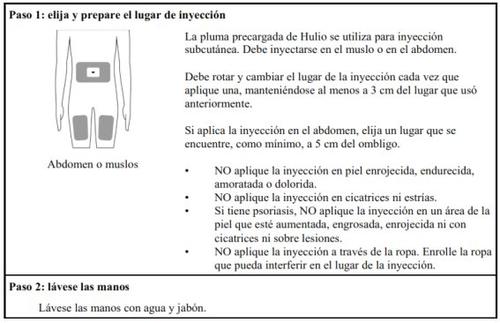
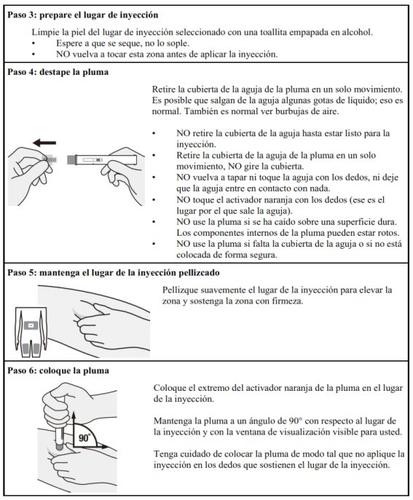
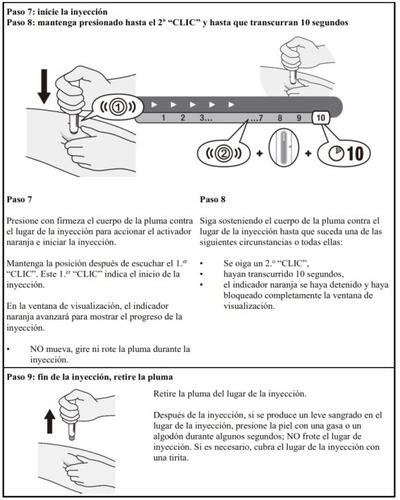
Pasos para la inyección
Siga con cuidado los pasos indicados a continuación, cada vez que inyecte Hulio con la pluma
precargada:

- País de registro
- Forma farmacéuticaINYECTABLE, 40 mg
- Código ATCL04AB04
- Principio activo
- Requiere recetaSí
- Fabricante
- ComposiciónSORBITOL (38,2 mg mg)
- Esta información es de carácter general y no sustituye la consulta con un profesional sanitario.
- Alternativas a HULIO 40 MG SOLUCION INYECTABLE EN PLUMA PRECARGADAForma farmacéutica: INYECTABLE, 20 mgPrincipio activo: AdalimumabFabricante: Amgen Europe B.V.Requiere recetaForma farmacéutica: INYECTABLE, 20 mgPrincipio activo: AdalimumabFabricante: Amgen Europe B.V.Requiere recetaForma farmacéutica: INYECTABLE, 40 mgPrincipio activo: AdalimumabFabricante: Amgen Europe B.V.Requiere receta
Médicos online para HULIO 40 MG SOLUCION INYECTABLE EN PLUMA PRECARGADA
Comenta la dosis, los posibles efectos secundarios, interacciones, contraindicaciones o la revisión de receta de HULIO 40 MG SOLUCION INYECTABLE EN PLUMA PRECARGADA, sujeto a valoración médica y a la normativa local.
Obtén una receta de HULIO 40 MG SOLUCION INYECTABLE EN PLUMA PRECARGADA online
Rellena un formulario de 2 minutos
Cuéntanos tus síntomas, historial y el medicamento que necesitas.
Elige un médico o nosotros te asignamos uno
Escoge un especialista o te conectamos con el próximo médico disponible.
El médico revisa tu caso
Normalmente en 30 minutos. Puede hacerte preguntas adicionales por chat.
Recógela en cualquier farmacia
Receta electrónica enviada a tu correo, válida en toda España.
Preguntas frecuentes
HULIO 40 MG SOLUCION INYECTABLE EN PLUMA PRECARGADA requiere receta en España. Puedes confirmarlo con un médico online según tu caso.
El principio activo de HULIO 40 MG SOLUCION INYECTABLE EN PLUMA PRECARGADA es Adalimumab. Esta información ayuda a identificar medicamentos con la misma composición pero con diferentes nombres comerciales.
HULIO 40 MG SOLUCION INYECTABLE EN PLUMA PRECARGADA es fabricado por Biosimilar Collaborations Ireland Limited. La marca y el envase pueden variar según el distribuidor.
Los Médicos de familia, Psiquiatras, Dermatólogos, Cardiólogos, Endocrinólogos, Gastroenterólogos, Neumólogos, Nefrólogos, Reumatólogos, Hematólogos, Infectólogos, Alergólogos, Geriatras, Pediatras, Oncólogos pueden valorar la prescripción de HULIO 40 MG SOLUCION INYECTABLE EN PLUMA PRECARGADA cuando esté clínicamente indicado. Puedes reservar una videoconsulta para comentar tu caso y las opciones de tratamiento.
España cuenta con una infraestructura sanitaria bien desarrollada en ciudades principales como Madrid, Barcelona, Valencia y Sevilla. Las farmacias están ampliamente disponibles y operan bajo estrictas regulaciones, garantizando el acceso a medicamentos con receta.
Puedes comprar HULIO 40 MG SOLUCION INYECTABLE EN PLUMA PRECARGADA en Madrid, Barcelona, Sevilla o Valencia en cualquier farmacia local con una receta válida.
Para obtener una receta, puedes utilizar Oladoctor:
Otros medicamentos con el mismo principio activo (Adalimumab) incluyen AMGEVITA 20 MG SOLUCION INYECTABLE EN JERINGA PRECARGADA, AMGEVITA 20 MG SOLUCION INYECTABLE EN JERINGA PRECARGADA, AMGEVITA 40 MG SOLUCION INYECTABLE EN JERINGA PRECARGADA. Pueden tener diferentes nombres comerciales o formulaciones, pero contienen el mismo componente terapéutico. Consulta siempre con un médico antes de cambiar o iniciar un nuevo medicamento.
