


HIBISCRUB 40 mg/ml SOLUCION CUTANEA



Cómo usar HIBISCRUB 40 mg/ml SOLUCION CUTANEA
Traducción generada por IA
Este contenido ha sido traducido automáticamente y se ofrece solo con fines informativos. No sustituye la consulta con un profesional sanitario.
Ver originalContenido del prospecto
Introducción
Prospecto: información para el usuario
Hibiscrub 40 mg/ml solución cutánea
digluconato de clorhexidina
Lea todo el prospecto detenidamente antes de empezar a usar este medicamento, porque contiene información importante para usted.
- Siga exactamente las instrucciones de administración del medicamento contenidas en este prospecto o las indicadas por su médico, farmacéutico o enfermero.
- Conserve este prospecto, ya que puede tener que volver a leerlo.
- Si necesita consejo o más información, consulte a su farmacéutico.
- Si experimenta efectos adversos, consulte a su médico, farmacéutico o enfermero, incluso si se trata de efectos adversos que no aparecen en este prospecto. Ver sección 4.
Contenido del prospecto
- Qué es Hibiscrub y para qué se utiliza
- Qué necesita saber antes de empezar a usar Hibiscrub
- Cómo usar Hibiscrub
- Posibles efectos adversos
- Conservación de Hibiscrub
- Contenido del envase e información adicional
1. Qué es Hibiscrub y para qué se utiliza
Hibiscrub pertenece a un grupo de medicamentos denominados antisépticos y desinfectantes.
Está indicado para adultos y niños como antiséptico para el lavado de las manos en cirugía y del personal sanitario, y como antiséptico de la piel pre y post-operatorio.

2. Qué necesita saber antes de empezar a usar Hibiscrub
No use Hibiscrub
- si es alérgico al digluconato de clorhexidina o a alguno de los demás componentes de este medicamento (incluidos en la sección 6).
- Hibiscrub contiene aceite de soja. No utilizar este medicamento en caso de alergia al cacahuete o a la soja.
Advertencias y precauciones
Consulte a su médico, farmacéutico o enfermero antes de empezar a usar Hibiscrub.
- Uso externo sobre la piel. No ingerir.
- En caso de contacto accidental con oidos, lavar inmediatamente con abundante agua.
- Hibiscrub no debe entrar en contacto con los ojos debido al riesgo de lesiones visuales. Si entra en contacto con los ojos, lávese inmediata y abundantemente con agua. En caso de irritación, enrojecimiento o dolor en los ojos, o alteraciones visuales, consulte a un médico inmediatamente.Se han notificado casos graves de lesión persistente de la córnea cuando productos similares han entrado accidentalmente en contacto con los ojos durante intervenciones quirúrgicas, en pacientes con anestesia general (sueño profundo inducio indoloro).
- No utilizar en caso de heridas profundas y extensas.
- En caso de aplicaciones repetidas, aplicaciones sobre zonas muy extensas o en caso de usar vendajes que tapen la zona afectada, puede favorecerse que el producto penetre a través de la piel y produzca efectos no deseados.
- Las ropas sobre las que hayan estado en contacto con Hibiscrub no deben lavarse con lejía ni otros hipocloritos, pues se produciría una coloración parduzca en los tejidos, sino con detergentes domésticos a base de perborato sódico.
- Utilice con cuidado en neonatos, especialmente en niños prematuros. Hibiscrub puede causar quemaduras químicas en la piel.
- Hibiscrub es inflamable. No lo use con fuentes de ignición hasta que esté seco.
Niños y pacientes de edad avanzada
No hay recomendaciones especiales de dosificación para niños y pacientes de edad avanzada. La dosis normal de adultos es apropiada a menos que se recomiende otra por el médico.
Otros medicamentos y Hibiscrub
Informe a su médico o farmacéutico si está utilizando, ha utilizado recientemente o pudiera tener que utilizar cualquier otro medicamento.
Debe evitarse utilizar varios desinfectantes a la vez o de forma sucesiva, salvo con otros compuestos catiónicos.
No debe usarse en combinación ni después de la aplicación de jabones aniónicos, ácidos, sales de metales pesados y yodo.
Embarazo, lactancia y fertilidad
Si está embarazada o en periodo de lactancia, cree que podría estar embarazada o tiene intención de quedarse embarazada, consulte a su médico o farmacéutico antes de utilizar este medicamento.
No existe evidencia de efectos adversos sobre el feto derivados del uso de este medicamento para el lavado de manos durante el embarazo y la lactancia.
Conducción y uso de máquinas
No se han descrito efectos sobre la capacidad de conducción y uso de máquinas tras el uso de este medicamento.
Hibiscrubcontiene alcohol isopropílico y perfume cítrico
Este medicamento contiene 40 mg de alcohol isopropílico en cada ml. Se puede producir sequedad, irritación, enrojecimiento o sensación de quemazón en la piel. La dermatitis de contacto alérgica o las alergias de contacto son muy infrecuentes.
Este medicamento contiene fragancias con 3-Metil-4-(2,6,6-trimetil-2-ciclohexen-1-il)-3-buten-2-ona, Amilcinamaldehído, Alcohol amilcinamaldehído, Alcohol anisílico, Alcohol bencílico, Benzoato de bencilo, Cinamato de bencilo, Salicilato de bencilo, Cinamaldehído, Alcohol cinamílico, Citral, Citronelol, Cumarina, d-Limoneno, Eugenol, Farnesol, Geraniol, Hexil cinamaldehido, Hidroxicitronelal, Hidroximetilpentil-ciclohexenecarboxaldehido, Isoeugenol, Lilial, Linalol, Metil heptina carbonato, Extracto de musgo de roble y Extracto de musgo. Estos puede provocar reacciones alérgicas.
La fragancia también contiene Aceite de bergamota que contiene bergapteno, Aceite de soja, Etanol, Benzoato de metilo, Acido benzoico, Bálsamo de Perú, Formaldehído y Laurilsulfato de sodio.
Aceite de bergamota que contiene bergapteno puede aumentar la sensibilidad a la luz UV (luz diurna natural o artificial).
Etanol puede causar sensación de ardor en piel lesionada.
El Acido benzoico, Benzoato de bencilo y Benzoato de metilo puede provocar irritación local. El Acido benzoico, Benzoato de bencilo y Benzoato de metilo puede aumentar el riesgo de ictericia (coloración amarillenta de la piel y los ojos) en los recién nacidos (hasta de 4 semanas de edad).
Bálsamo de Perú puede provocar reacciones en la piel.
Formaldehído puede provocar reacciones locales en la piel (como dermatitis de contacto).
El laurilsulfato de sodio puede provocar reacciones cutáneas locales (como picazón o sensación de ardor) o aumentar las reacciones cutáneas provocadas por otros medicamentos cuando se aplican en la misma zona.
3. Cómo usar Hibiscrub
Siga exactamente las instrucciones de administración del medicamento contenidas en este prospecto o las indicadas por su médico o farmacéutico. En caso de duda, pregunte a su médico o farmacéutico.
Uso cutáneo.
Lavado antiséptico de las manos en cirugía:
Mojar manos y antebrazos, aplicar 5 ml de Hibiscrub y lavar durante 1 minuto, limpiando uñas con cepillo, enjuagar y aplicar otros 5 ml durante 2 minutos; enjuagar y secar.
Lavado antiséptico de las manos del personal sanitario:
Mojar manos y antebrazos, aplicar 5 ml de Hibiscrub y lavar durante 1 minuto; enjuagar y secar.
Lavado antiséptico de la piel pre-operatorio:
Lavar todo el cuerpo (baño o ducha) por lo menos 2 veces, habitualmente el día antes y el de la operación en la forma siguiente: el día antes de operar lavar con 25 ml de Hibiscrub desde la cara y en sentido descendente, prestando atención a las áreas circundantes de la nariz, axilas, ombligo, ingles y perineo. A continuación enjuagar y repetir el lavado con otros 25 ml, incluyendo el cabello. Finalmente enjuagar y secar. Este procedimiento se repetirá al día siguiente. Para pacientes encamados, aplicar la técnica habitual de lavado en cama. Realizar el lavado antiséptico convencional de la zona operatoria con el paciente en el quirófano.
Lavado antiséptico de la piel post-operatorio:
A partir del tercer día del procedimiento quirúrgico lavar todo el cuerpo, excluyendo la zona de la cirugía, siguiendo el procedimiento de lavado antiséptico de la piel pre-operatorio.
Si usa más Hibiscrub del que debe
En caso de sobredosis o ingestión accidental, consulte inmediatamente a su médico o farmacéutico o llame al Servicio de Información Toxicológica, teléfono: 91 562 04 20, indicando el medicamento y la cantidad ingerida.

4. Posibles efectos adversos
Al igual que todos los medicamentos, este medicamento puede producir efectos adversos, aunque no todas las personas los sufran.
Efectos adversos graves:
Frecuencia no conocida (no puede estimarse a partir de los datos disponibles):
- Reacciones alérgicas serias (reacción anafiláctica) que puede causar dificultad de la respiración, debilidad, colapso y muerte y en ocasiones pueden estar precedidas de hinchazón (particularmente hinchazón labial, de la lengua y tumefacción facial) o erupción.
- Quemaduras químicas en neonatos.
A los primeros signos de éstas reacciones, informe a su médico, farmacéutico o enfermero y suspenda inmediatamente la aplicación de Hibiscrub.
Otros posibles efectos adversos son:
- Frecuencia no conocida (no puede estimarse a partir de los datos disponibles): trastornos alérgicos de la piel, inflamación de la piel (dermatitis), picor (prurito), enrojecimiento de la piel (eritema), eczema, erupción, urticaria (habón urticarial), irritación de la piel y ampollas.
- lesión corneal (lesión en la superficie del ojo) y lesión ocular permanente, incluido deterioro visual permanente (tras la exposición ocular accidental durante las intervenciones quirúrgicas en la cabeza, la cara y el cuello) en pacientes bajo anestesia general (sueño profundo inducido indoloro).
Comunicación de efectos adversos
Si experimenta cualquier tipo de efecto adverso, consulte a su médico o farmacéutico, incluso si se trata de posibles efectos adversos que no aparecen en este prospecto. También puede comunicarlos directamente a través del Sistema Español de Farmacovigilancia de medicamentos de Uso Humano: https://www.notificaram.es. Mediante la comunicación de efectos adversos usted puede contribuir a proporcionar más información sobre la seguridad de este medicamento.
5. Conservación de Hibiscrub
Mantener este medicamento fuera de la vista y del alcance de los niños.
No utilice este medicamento después de la fecha de caducidad que aparece en el frasco después de 'CAD'. La fecha de caducidad es el último día del mes que se indica.
No conservar a temperatura superior a 25º C.
Los medicamentos no se deben tirar por los desagües ni a la basura. Deposite los envases y los medicamentos que no necesita en el Punto SIGRE de la farmacia. En caso de duda pregunte a su farmacéutico cómo deshacerse de los envases y de los medicamentos que no necesita. De esta forma, ayudará a proteger el medio ambiente.
6. Contenido del envase e información adicional
Composición de Hibiscrub
- El principio activo es digluconato de clorhexidina. Cada ml contiene 40 mg de digluconato de clorhexidina.
- Los demás componentes (excipientes) son: PEG-7-gliceril cocoato, glicerol (E422), D-gluconolactona, alcohol isopropilico, óxido de laurildimetilamina, perfume cítrico, copolímero de polioxietileno-polioxipropileno (poloxamer 237), Ponceau 4R (E124), hidróxido de sodio (E524) y agua purificada.
Aspecto del producto y contenido del envase
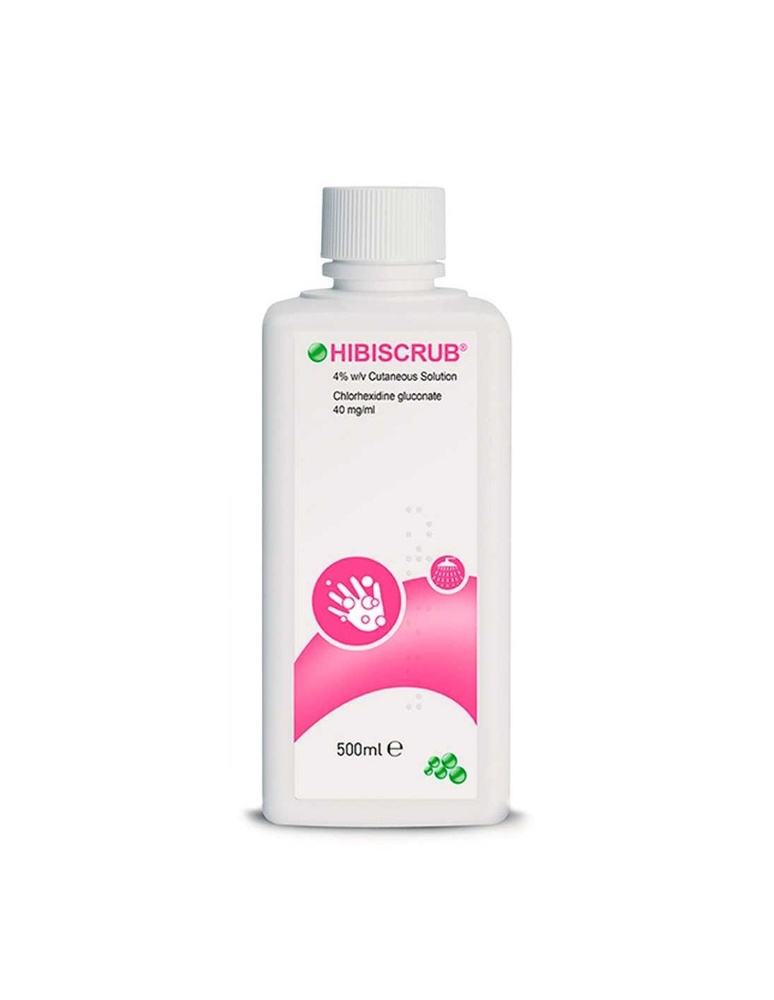
Hibiscrub se presenta en frascos de 500 ml de HPDE.
Titular de la autorización de comercialización
Mölnlycke Health Care AB
Entreprenörsstråket 21
SE-431 53 Mölndal
Suecia
Responsable de la fabricación
Société de Production Pharmaceutique et d'Hygiène (SPPH)
7 Impasse des Boussenots
21800 Quetigny
Francia
Representante Local
Mölnlycke Healthcare, S.L.
Fecha de la última revisión de este prospecto: Junio 2024
La información detallada y actualizada de este medicamento está disponible en la página Web de la Agencia Española de Medicamentos y Productos Sanitarios (AEMPS) http://www.aemps.gob.es/
- País de registro
- Forma farmacéuticaLIQUIDO USO TOPICO, 0,04 g clorhexidina digluconato/ ml
- Código ATCD08AC02
- Principio activo
- Requiere recetaNo
- Fabricante
- Esta información es de carácter general y no sustituye la consulta con un profesional sanitario.
- Alternativas a HIBISCRUB 40 mg/ml SOLUCION CUTANEAForma farmacéutica: LIQUIDO USO TOPICO, 20 mg/mlPrincipio activo: ClorhexidinaFabricante: Vesismin S.L.U.No requiere recetaForma farmacéutica: EMULSION, 20 mg/mlPrincipio activo: ClorhexidinaFabricante: Vesismin S.L.U.No requiere recetaForma farmacéutica: LIQUIDO USO TOPICO, 20 MG/MLPrincipio activo: ClorhexidinaFabricante: Lainco S.A.No requiere receta


Médicos online para HIBISCRUB 40 mg/ml SOLUCION CUTANEA
Comenta la dosis, los posibles efectos secundarios, interacciones, contraindicaciones o la revisión de receta de HIBISCRUB 40 mg/ml SOLUCION CUTANEA, sujeto a valoración médica y a la normativa local.











Preguntas frecuentes
