






Cómo usar GLUCOSA 5% MEIN SOLUCION PARA PERFUSION
Traducción generada por IA
Este contenido ha sido traducido automáticamente y se ofrece solo con fines informativos. No sustituye la consulta con un profesional sanitario.
Ver originalContenido del prospecto
Introducción
PROSPECTO: INFORMACIÓN PARA EL USUARIO
Glucosa 5% Mein solución para perfusión
Glucosa
Lea todo el prospecto detenidamente antes de empezar a usar el medicamento:
los mismos síntomas, ya que puede perjudicarles.
|
Contenido del prospecto:
- Qué es Glucosa 5% Mein y para qué se utiliza
- Antes de usar Glucosa 5% Mein
- Cómo usar Glucosa 5% Mein
- Posibles efectos adversos
- Conservación de Glucosa 5% Mein
- Información adicional
1. Qué es GLUCOSA 5% MEIN y para qué se utiliza
Glucosa 5% Mein es una solución para perfusión intravenosa que se presenta en frascos de 100 ml conteniendo 50 ml ó 100 ml de solución, frascos de 250 ml, 500 ml y 1000 ml.
Pertenece al grupo de soluciones para nutrición parenteral destinadas al aporte de agua y energía.
Está indicada para el tratamiento de la deshidratación hipertónica (vómitos, diarrea, sudoración profusa, fístulas gastrointestinales), como aporte energético en nutrición parenteral cuando la toma de alimentos por la boca está limitada, en alteraciones del metabolismo de los carbohidratos (hipoglucemia, coma insulínico, coma hepático, vómitos acetónicos) y como vehículo para la administración de medicamentos compatibles.

2. ANTES DE USAR GLUCOSA 5% MEIN
No use Glucosa 5% Mein
- si es alérgico (hipersensible) al principio activo o a cualquiera de los demás componentes de Glucosa 5% Mein
- si le han detectado deshidratación hipotónica, pérdida de sales o disminución en el volumen de orina.
- en las primeras 24 horas después de un traumatismo craneal.
- en estados de hiperglucemia o aumento del nivel de glucosa en sangre.
- en estados de hiperhidratación (sobrecarga de líquido)
- en situaciones de edema generalizado (acumulación de líquido en los tejidos del cuerpo)
- si tiene hiperlactacidemia (presencia de ácido láctico en sangre)
- si sufre alteraciones importantes de la tolerancia a la glucosa, incluyendo coma hiperosmolar.
Advertencias y precauciones
Tenga especial cuidado con Glucosa 5% Mein
- La concentración de glucosa en sangre debe controlarse cuidadosamente en casos de hipertensión intracraneal.
- En caso de haber sufrido ataques isquémicos agudos (disminución o ausencia de circulación en arterias), ya que la hiperglucemia se ha relacionado con un incremento en el daño isquémico cerebral y dificultad en la recuperación.
- En caso de shock y de alteraciones del equilibrio ácido-base,. En los pacientes con déficit de sodio, la administración de soluciones sin sodio puede producir un colapso circulatorio periférico y oliguria (secreción de orina escasa).
- Es recomendable que le realicen regularmente controles analíticos en la sangre de glucosa y electrolitos y del balance de agua y del equilibrio ácido-base, ya que la administración frecuente y masiva de soluciones de glucosa a través de las venas (parenterales) puede ocasionar sobrecarga de fluido (hiperhidratación) y depleciones iónicas importantes. En este caso será necesario que se le administren suplementos electrolíticos.
- Junto a solución glucosada puede que le administren potasio para evitar la hipopotasemia (niveles bajos de potasio en sangre) producida durante alimentaciones parenterales prolongadas con glucosa
- Si presenta malnutrición, puede tener deficiencia de vitamina B1. Esta vitamina es esencial para el metabolismo de la glucosa, por lo que, si es necesario, esta deficiencia debe ser corregida en primer lugar.
- Si padece diabetes. En este caso, las soluciones de glucosa pueden ser utilizadas siempre que le haya sido instaurado inicialmente el tratamiento adecuado (insulina). La glucemia debe monitorizarse de forma regular en pacientes diabéticos y modificar los requerimientos de insulina.
- No le deben administrar sangre simultáneamente utilizando el mismo equipo de administración que este medicamento.
- Si se administra continuamente en el mismo lugar de perfusión, puede producirse tromboflebitis (inflamación de las venas).
- Si es un paciente de edad avanzada le prestarán especial atención, debido a que pueden tener afectadas las funciones hepáticas y/o renales.
- No administrar por vía intramuscular.
- Si sufre de estados críticos, dolor, estrés posoperatorio, infecciones, quemaduras o enfermedades del sistema nervioso central
- Tiene cualquier tipo de enfermedad del corazón, el hígado y el riñón y está siendo tratado con un medicamento que aumenta el efecto de la vasopresina (una hormona que regula la retención de agua del organismo) porque puede aumentar el riesgo de adquirir en el hospital niveles bajos de sodio en sangre (hiponatremia). (ver la sección Otros medicamentos y Glucosa 5% Mein)
Todos los pacientes deben estar estrechamente monitorizados. En casos donde la regulación normal del contenido de agua de la sangre se altera debido al aumento de la secreción de vasopresina, también llamada Hormona Antidiurética (ADH), la perfusión de fluidos con una baja concentración de cloruro de sodio (fluidos hipotónicos) puede dar como resultado un nivel bajo de sodio en la sangre (hiponatremia). Esto puede causar dolor de cabeza, náuseas, convulsiones, letargo, coma, inflamación del cerebro (edema cerebral) y la muerte; por lo tanto, estos síntomas (encefalopatía hiponatrémica aguda sintomática) se consideran una emergencia médica. (Ver la sección 4.Posibles efectos secundarios)
Los niños, las mujeres en edad fértil y los pacientes con enfermedades cerebrales como meningitis, hemorragia cerebral, contusión cerebral y edema cerebral tienen un riesgo especial de sufrir inflamación cerebral grave y potencialmente mortal causado por una hiponatremia aguda.
Otros medicamentos y Glucosa 5% Mein
Informe a su médico o farmacéutico si está utilizando o ha utilizado recientemente cualquier otro medicamento, incluso los adquiridos sin receta médica, ya que puede ser necesario interrumpir el tratamiento o ajustar la dosis de alguno de ellos.
Es importante que informe a su médico si utiliza alguno de los siguientes medicamentos:
- Insulina o antidiabéticos orales (biguanidas, sulfonilureas): estos medicamentos disminuyen el efecto de la glucosa.
- Corticosteroides: por el riesgo del aumento de glucosa en sangre o por la capacidad de éstos medicamentos de retener sodio y agua.
- Glucósidos digitálicos (digoxina): Si la administración intravenosa de glucosa coincide con un tratamiento con glucósidos digitálicos (digoxina), existe el riesgo de desarrollar intoxicaciones por estos medicamentos.
- Medicamentos que conducen a un aumento del efecto vasopresina (ver la sección Advertencias y precauciones), por ejemplo:
- Medicamentos que estimulan la liberación de vasopresina (por ejemplo, antipsicóticos, narcóticos)• Medicamentos que potencian la acción de la vasopresina (por ejemplo, medicamentos antiinflamatorios no esteroideos)
- Medicamentos que actúan como la vasopresina, los llamados análogos de vasopresina
- Otros medicamentos que aumentan el riesgo de hiponatremia, incluyendo los diuréticos en general y los antiepilépticos.
En cualquier caso el médico deberá comprobar la compatibilidad de los medicamentos añadidos.
Embarazo y lactancia
Consulte a su médico o farmacéutico antes de utilizar cualquier medicamento.
Este medicamento debe administrarse con especial precaución en mujeres embarazadas durante el parto, especialmente si se administra en combinación con oxitocina (una hormona que se puede administrar para inducir el parto y controlar el sangrado) debido al riesgo de hiponatremia.
En caso de embarazo, su médico decidirá la conveniencia de usar solución glucosada al 5%, dado que se debe usar con precaución en este caso. La administración de glucosa por vía endovenosa durante el embarazo puede elevar los niveles de glucosa e insulina así como los componentes ácidos en la sangre del feto.
No existen evidencias que hagan pensar que la Glucosa al 5% pueda provocar efectos adversos durante el período de lactancia en el neonato. No obstante, se recomienda utilizar con precaución durante este período.
Conducción y uso de máquinas
No procede, por las características de su empleo.
3. Cómo USAR GLUCOSA 5% MEIN
Siga exactamente las instrucciones de administración de Glucosa 5% Mein indicadas por su médico. Consulte a su médico o farmacéutico si tiene dudas.
Por lo general se recomienda la administración intravenosa gota a gota de acuerdo con su edad, peso corporal, situación clínica, y estado metabólico.
En adultos, la dosis máxima es 40 ml/kg peso corporal/día y la velocidad máxima de perfusión es 5 ml/kg peso corporal/hora = 0,25 g/kg peso corporal/hora.
En niños, la velocidad de perfusión depende de la edad y peso del niño, y generalmente no debe exceder
10-18 mg de glucosa (0,2-0,36 ml de solución)/kg/min.
0-10 kg: 100 ml/kg/24h
10-20 kg: 1000 ml + 50 ml/kg/24 h para el peso superior a 10 kg.
Más de 20 kg: 1500 ml + 20 ml/kg/24h para el peso superior a 20 kg.
Si usa más Glucosa 5% Mein del que debiera
En caso de sobredosificación puede aparecer hiperglucemia, glucosuria (presencia de glucosa en orina), hiperhidratación o desórdenes electrolíticos. Se suspenderá la administración y se recurrirá al tratamiento sintomático.
Si no está ingresado en un hospital acuda al hospital más cercano o consulte al Servicio de Información Toxicológica. Teléfono: 91 562 04 20.

4. Posibles efectos adversos
Al igual que todos los medicamentos, Glucosa 5% Mein puede producir efectos adversos, aunque no todas las personas los sufran.
Puede producirse hiperglucemia, glucosuria (glucosa en orina) o alteraciones en el equilibrio de fluidos o electrolitos si se administra de forma demasiado rápida o si el volumen de fluido es excesivo, o en casos de insuficiencia metabólica.
Por otra parte, la hiperglucemia resultante de una perfusión rápida o de un volumen excesivo debe vigilarse en los casos graves de diabetes mellitus, pudiendo evitarse disminuyendo la dosis y la velocidad de perfusión o bien administrando insulina.
Puede producirse una reacción local en el lugar de la inyección.
Dolor de cabeza, náuseas, convulsiones, letargo. Esto puede ser causado por un bajo nivel de sodio en la sangre. Cuando los niveles de sodio en la sangre bajan considerablemente, el agua ingresa en las células del cerebro y hace que se inflamen. Esto da como resultado un aumento de la presión craneal y causa encefalopatía hiponatrémica.
Siempre que se manifieste alguna de estas reacciones adversas deberá informar a su médico, que valorará la conveniencia o no de suspender la medicación.
Si se utiliza como vehículo para la administración de otros medicamentos, la naturaleza de los medicamentos añadidos determinará la probabilidad de otras reacciones adversas.
Si considera que alguno de los efectos adversos que sufre es grave o si aprecia cualquier efecto adverso no mencionado en este prospecto, informe a su médico o farmacéutico
5. Conservación de GLUCOSA 5% MEIN
No se precisan condiciones especiales de conservación.
Mantener fuera del alcance y de la vista de los niños.
No utilice Glucosa 5% Mein después de la fecha de caducidad que aparece en el envase.
No utilice Glucosa 5% Mein si la solución no es transparente y contiene precipitados.
Los medicamentos no se deben tirar por los desagües ni a la basura. Pregunte a su farmacéutico cómo deshacerse de los envases y de los medicamentos que no necesita. De esta forma ayudará a proteger al medio ambiente.
6. INFORMACIÓN ADICIONAL
Composición de Glucosa 5% Mein
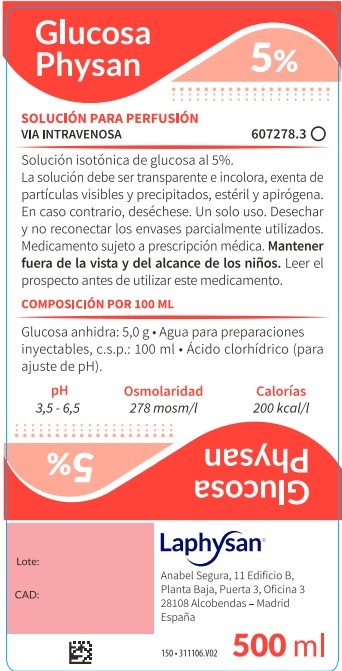
El principio activo es glucosa. Cada 100 ml de solución contienen 5 g de glucosa (como monohidrato 5,5 g).
Los demás componentes son: agua para inyectables, ácido clorhídrico para ajuste de pH.
Solución isotónica, apirógena y estéril
Osmolaridad teórica: 278 mosm/l pH: 3,5-6,5
Calorías teóricas: 200 kcal/l
Aspecto del producto y contenido del envase
Glucosa 5% Mein es una solución transparente e incolora, sin partículas visibles. Se presenta en frascos de 100 ml conteniendo 50 ml ó 100 ml de solución, frascos de 250 ml, 500 ml y 1000 ml
Titular de la autorización de comercialización
Fresenius Kabi España S.A.
C/ Marina 16-18
08005-Barcelona (España)
Responsable de la fabricaciónFresenius Kabi Italia S.R.L.
Via Camagre, 41/43
37063 Isola della Scala - Verona
(Italia)
Este prospecto ha sido revisado en
Agosto 2018
---------------------------------------------------------------------------------------------------------------------------
Esta información está destinada únicamente a médicos o profesionales del sector sanitario:
Este medicamento será administrado siempre por personal especializado. Se administrará por perfusión, por una vena central o periférica.
La solución debe ser transparente y no contener precipitados. No administrar en caso contrario.
El contenido de cada envase es para una sola perfusión, debe desecharse la fracción no utilizada.
Utilizar un método aséptico, para administrar la solución y en caso de preparación de mezclas.
Antes de adicionar medicamentos a la solución o de administrar simultáneamente con otros medicamentos se debe comprobar que no existen incompatibilidades.
Consejo general
Puede que se tenga que vigilar el balance hídrico, la glucosa sérica, el sodio sérico y otros electrolitos antes y durante administración, especialmente en pacientes con aumento de la liberación no osmótica de vasopresina (síndrome de secreción inadecuada de la hormona antidiurética, SIADH) y en pacientes que reciban medicación concomitante con agonistas de la vasopresina debido al riesgo de hiponatremia.
La vigilancia del sodio sérico es especialmente importante en productos con una menor concentración de sodio en comparación con la concentración del sodio sérico. Después de la perfusión de Glucosa 5% Mein se produce un rápido y activo transporte de glucosa a las células del cuerpo. Esta condición promueve un efecto que puede considerarse como un suministro de agua libre y puede conducir a una hiponatremia grave.
-

- País de registro
- Forma farmacéuticaINYECTABLE PERFUSION, 5 g
- Código ATCB05BA03
- Principio activo
- Requiere recetaSí
- Fabricante
- Esta información es de carácter general y no sustituye la consulta con un profesional sanitario.
- Alternativas a GLUCOSA 5% MEIN SOLUCION PARA PERFUSIONForma farmacéutica: INYECTABLE PERFUSION, 50 g glucosaPrincipio activo: carbohydratesFabricante: Fresenius Kabi España, S.A.U.Requiere recetaForma farmacéutica: INYECTABLE PERFUSION, 11 gPrincipio activo: carbohydratesFabricante: Fresenius Kabi España, S.A.U.Requiere recetaForma farmacéutica: INYECTABLE PERFUSION, GLUCOSA MONOHIDRATADA 5,5 gPrincipio activo: carbohydratesFabricante: Fresenius Kabi España, S.A.U.Requiere receta

Médicos online para GLUCOSA 5% MEIN SOLUCION PARA PERFUSION
Comenta la dosis, los posibles efectos secundarios, interacciones, contraindicaciones o la revisión de receta de GLUCOSA 5% MEIN SOLUCION PARA PERFUSION, sujeto a valoración médica y a la normativa local.









Obtén una receta de GLUCOSA 5% MEIN SOLUCION PARA PERFUSION online
Rellena un formulario de 2 minutos
Cuéntanos tus síntomas, historial y el medicamento que necesitas.
Elige un médico o nosotros te asignamos uno
Escoge un especialista o te conectamos con el próximo médico disponible.
El médico revisa tu caso
Normalmente en 30 minutos. Puede hacerte preguntas adicionales por chat.
Recógela en cualquier farmacia
Receta electrónica enviada a tu correo, válida en toda España.
Preguntas frecuentes
GLUCOSA 5% MEIN SOLUCION PARA PERFUSION requires receta en España. Puedes confirmarlo con un médico online según tu caso.
El principio activo de GLUCOSA 5% MEIN SOLUCION PARA PERFUSION es carbohydrates. Esta información ayuda a identificar medicamentos con la misma composición pero con diferentes nombres comerciales.
GLUCOSA 5% MEIN SOLUCION PARA PERFUSION es fabricado por Fresenius Kabi España, S.A.U.. La marca y el envase pueden variar según el distribuidor.
Los Médicos de familia, Psiquiatras, Dermatólogos, Cardiólogos, Endocrinólogos, Gastroenterólogos, Neumólogos, Nefrólogos, Reumatólogos, Hematólogos, Infectólogos, Alergólogos, Geriatras, Pediatras, Oncólogos pueden valorar la prescripción de GLUCOSA 5% MEIN SOLUCION PARA PERFUSION cuando esté clínicamente indicado. Puedes reservar una videoconsulta para comentar tu caso y las opciones de tratamiento.
España cuenta con una infraestructura sanitaria bien desarrollada en ciudades principales como Madrid, Barcelona, Valencia y Sevilla. Las farmacias están ampliamente disponibles y operan bajo estrictas regulaciones, garantizando el acceso a medicamentos con receta.
Puedes comprar GLUCOSA 5% MEIN SOLUCION PARA PERFUSION en Madrid, Barcelona, Sevilla o Valencia en cualquier farmacia local con una receta válida.
Para obtener una receta, puedes utilizar Oladoctor:
Otros medicamentos con el mismo principio activo (carbohydrates) incluyen DEXTROSA FRESENIUS KABI 50% SOLUCION PARA PERFUSION, FREEFLEX GLUCOSA 10% SOLUCIÓN PARA PERFUSIÓN, FREEFLEX GLUCOSA 5% SOLUCION PARA PERFUSION. Pueden tener diferentes nombres comerciales o formulaciones, pero contienen el mismo componente terapéutico. Consulta siempre con un médico antes de cambiar o iniciar un nuevo medicamento.
