



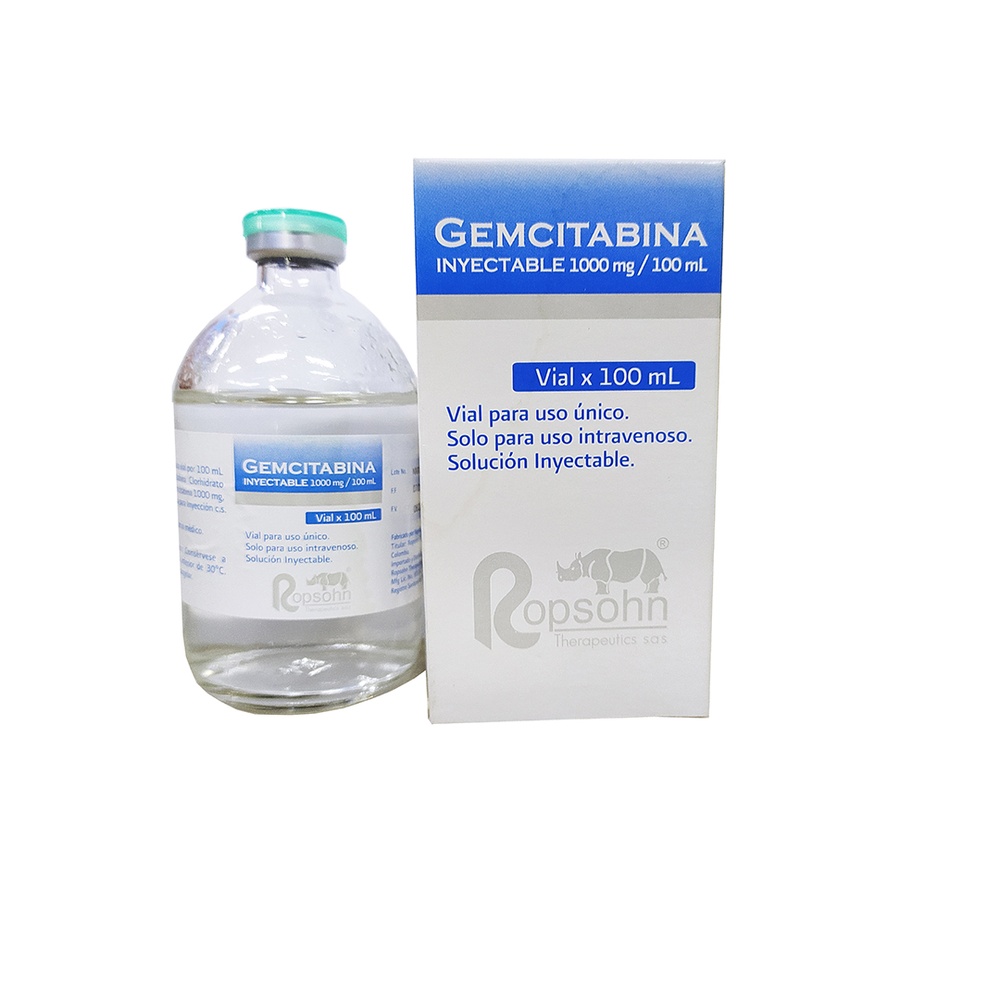
GEMCITABINA 2000 mg /52.6 Ml Inyectable Perfusion

Revisión de receta online
Un médico revisará tu caso y determinará si la prescripción es médicamente apropiada.

Habla con un médico sobre este medicamento
Comenta tus síntomas y las opciones de tratamiento en una consulta online.



Cómo usar GEMCITABINA KOANAA 1.000 MG CONCENTRADO PARA SOLUCION PARA PERFUSION
Contenido del prospecto
- Introducción
- Qué es Gemcitabina Koanaa y para qué se utiliza
- Qué necesita saber antes de empezar a usar Gemcitabina Koanaa
- Cómo usar Gemcitabina Koanaa
- Posibles efectos adversos
- Conservación de Gemcitabina Koanaa
- Contenido del envase e información adicional
Introducción
Prospecto:información para el usuario
Gemcitabina Koanaa 200 mg concentrado para solución para perfusión
Gemcitabina Koanaa 1.000 mg concentrado para solución para perfusión
Gemcitabina Koanaa 2.000 mg concentrado para solución para perfusión
Gemcitabina
Lea todo el prospecto detenidamente antes de empezar a usar este medicamento,porque contiene información importante para usted.
- Conserve este prospecto, ya que puede tener que volver a leerlo.
- Si tiene alguna duda, consulte a su médico, farmacéutico o enfermero.
- Si experimenta efectos adversos, consulte a su médico, farmacéutico o enfermero, incluso si se trata de efectos adversos que no aparecen en este prospecto. Ver sección 4.
Contenido del prospecto
- Qué es Gemcitabina Koanaa y para qué se utiliza
- Qué necesita saber antes de empezar a usar Gemcitabina Koanaa
- Cómo usar Gemcitabina Koanaa
- Posibles efectos adversos
5 Conservación de Gemcitabina Koanaa
- Contenido del envase e información adicional
1. Qué es Gemcitabina Koanaa y para qué se utiliza
Gemcitabina pertenece al grupo de medicamentos denominados “citotóxicos”, que son medicamentos para tratar el cáncer. Estos medicamentos destruyen las células que se dividen, incluidas las células cancerígenas.
Gemcitabina puede administrarse sola o en combinación con otros antineoplásicos (por ejemplo, cisplatino, paclitaxel, carboplatino), dependiendo del tipo de cáncer que tenga.
Gemcitabina se utiliza en el tratamiento de los siguientes tipos de cáncer:
- cáncer de pulmón, del tipo “no microcítico” (CPNM), solo o en combinación con cisplatino
- cáncer de páncreas,
- cáncer de mama, se administra con paclitaxel,
- cáncer de ovario, se administra con carboplatino,
- cáncer de vejiga, se administra con cisplatino.
Debe consultar a un médico si empeora o si no mejora.

¿No estás seguro de si este medicamento es adecuado para ti?
Comenta tus síntomas y tratamiento con un médico online.
2. Qué necesita saber antes de empezar a usar Gemcitabina Koanaa
No use Gemcitabina Koanaa :
- si es alérgico al gemcitabina o a alguno de los demás componentes de este medicamento (incluidos en la sección 6).
- está en periodo de lactancia.
Advertencias y precauciones
Consulte a su médico,farmacéutico o enfermero antes de empezar a usar este medicamento.
Antes de la primera perfusión, le extraerán muestras de sangre para comprobar si el hígado y los riñones le funcionan bien. Antes de cada perfusión también le extraerán muestras de sangre para comprobar si tiene suficientes células sanguíneas para recibir el tratamiento con este medicamento.
Dependiendo de su estado general de salud y de los resultados de los análisis de sangre, su médico podrá decidir cambiar la dosis o posponer el tratamiento con gemcitabina si el recuento de sus células sanguíneas es demasiado bajo.
Periódicamente, se le tomarán muestras de sangre para evaluar el funcionamiento del hígado y de los riñones.
Consulte con su médico o enfermera antes de recibir gemcitabina si:
- tiene o ha tenido anteriormente enfermedades hepáticas, de corazón o vasculares
- ha recibido en los últimos días, o va recibir radioterapia
- se ha vacunado recientemente
- tiene dificultades para respirar o se siente muy débil y está muy pálido (puede ser un síntoma de fallo renal).
Niños y adolescentes
No se recomienda usar este medicamento en niños de menos de 18 años de edad debido a la falta de datos en seguridad y eficacia.
Otros medicamentos y Gemcitabina Koanaa
Informe a su médico o farmacéutico si está tomando, ha tomado recientemente o pudiera tener que tomar cualquier otro medicamento.
Embarazo,lactanciay fertilidad
Embarazo
Si está embarazada o tiene intención de quedarse embarazada, consulte a su médico. Se debe evitar el uso de gemcitabina durante el embarazo. Su médico le informará sobre los posibles riesgos de usar gemcitabina durante el embarazo.
Lactancia
Informe a su médico si está en periodo de lactancia.
Ha de interrumpir la lactancia durante el tratamiento con gemcitabina.
Fertilidad
Si es hombre, debe evitar tener hijos durante el tratamiento con gemcitabina y en los 6 meses siguientes a la finalización del mismo. Si desea ser padre durante el tratamiento, o en los 6 meses siguientes al tratameinto, debe pedir consejo a su médico o farmacéutico. Tal vez quiera informarse sobre la conservación de esperma antes de comenzar el tratamiento.
Conducción y uso de máquinas
El tratamiento con este medicamento puede causarle somnolencia, especialmente si ha tomado alcohol. No debe conducir ni usar máquinas hasta que esté seguro de que el tratamiento con gemcitabina no le ha producido somnolencia o aturdimiento.
Gemcitabina Koanaa contiene sodio
Este medicamento contiene hasta 2,4 mg de sodio (<1 mmol) en cada vial de 200 mg, hasta 12,1 mg de sodio (<1 mmol) en cada vial de 1,000 mg y hasta 24,2 mg de sodio en cada vial de 2,000 mg. Esto debe tenerse en cuenta en pacientes con una dieta controlada en sodio.
3. Cómo usar Gemcitabina Koanaa
Siga exactamente las instrucciones de administración de este medicamento indicadas por su médico o farmacéutico. En caso de duda, consulte de nuevo a su médico o farmacéutico.
El médico calculará la dosis inicial de gemcitabina y dependerá del tipo de cáncer que tenga y del área de superficie corporal en metros cuadrados (m2).
La altura y el peso se miden para calcular la superficie corporal. Su médico empleará esta información para calcular la dosis adecuada. La dosis habitual es entre 1 g/m2 y 1,25 g/m2.
Esta dosis se puede ajustar o retrasar el tratamiento dependiendo de los resultados de los análisis de sangre, su estado general de salud y las reacciones adversas que tenga.
La frecuencia con la que recibirá una dosis de gemcitabina por perfusión, dependerá del tipo de cáncer para el que está siendo tratado.
Gemcitabina se le administrará siempre como una perfusión (una inyección lenta vía un gotero) en una de sus venas. La perfusión durará aproximadamente 30 minutos.
Ya que recibirá Gemcitabina bajo la supervisión de un médico, es poco probable que reciba una dosis incorrecta. Sin embargo, si tiene alguna duda sobre la dosis que recibe o si tiene cualquier otra pregunta sobre el uso de este medicamento, hable con su médico, farmacéutico o enfermero.

¿Has empezado a tomar el medicamento y tienes preguntas?
Comenta tus síntomas y tratamiento con un médico online.
4. Posibles efectos adversos
Al igual que todos los medicamentos, este medicamento puede producir efectos adversos, aunque no todas las personas los sufran.
Debe contactar con su médico inmediatamente si observa cualquiera de los siguientes efectos:
- Sangrado de las encías, nariz o boca o cualquier sangrado que no se detiene, orina rojiza o rosada, hematomas inesperados (puesto que podría tener menos plaquetas de lo normal lo cual es muy frecuente).
- Cansancio, sensación de desvanecimiento, se queda fácilmente sin aliento o si está pálido (puesto que podría tener menos hemoglobina de lo normal, lo cual es muy frecuente).
- Erupción cutánea leve o moderada (muy frecuente) / prurito (frecuente), o fiebre (muy frecuente); (reacciones alérgicas).
- Temperatura de 38ºC o más alta, sudoración u otros signos de infección (puesto que podría tener menos leucocitos de los normales, acompañado con fiebre también conocida como neutropenia febril) (frecuente).
- Dolor, enrojecimiento, hinchazón o llagas en la boca (estomatitis) (frecuente).
- Frecuencia cardiaca irregular (arritmia) (poco frecuente).
- Cansancio extremo y debilidad, manchas púrpuras o pequeñas áreas de sangrado en la piel (hematomas), insuficiencia renal aguda (baja o nula producción de orina), y signos de infección. Éstos pueden ser signos de microangiopatía trombótica (coágulos que se forman en pequeños vasos sanguíneos) (muy raro) y de síndrome hemolítico urémico (poco frecuente), que pueden ser mortales.
- Dificultad para respirar (es muy frecuente tener una leve dificultad para respirar inmediatamente después de la perfusión de gemcitabina, que pasa pronto, sin embargo, poco frecuentemente o raramente puede haber problemas de pulmón más graves).
- Dolor en el pecho severo (infarto de miocardio (raro).
- Reacción de hipersensibilidad /alérgica severa con erupción severa en la piel incluyendo picor y rojez en la piel, hinchazón de manos, pies, tobillos, cara, labios, boca y garganta (que puede causar dificultades para tragar o respirar), sibilancias, latidos rápidos del corazón y puede sentir que va a desmayarse (reacción anafiláctica) (muy raro).
- Hinchazón generalizada, dificultad para respirar o aumento de peso, ya que puede sufrir extravasaciones de fluido desde los vasos sanguíneos pequeños a los tejidos (síndrome de extravasación capilar) (muy raro).
- Dolor de cabeza con cambios en la visión, confusión, crisis o ataques (síndrome de encefalopatía posterior reversible) (muy raro).
- Erupción severa con picor, ampollas o descamación de la piel (síndrome de Stevens-Johnson, necrólisis epidermal tóxica) (muy raro).
Otros efectos adversos con gemcitabina pueden incluir:
Muy frecuentes: (pueden afectar a más de 1 de cada 10 personas)
- Nivel bajo de glóbulos blancos
- Dificultad para respirar
- Vómitos
- Náuseas
- Pérdida de cabello
- Problemas de hígado: se detecta mediante resultados anormales en los análisis de sangre
- Sangre en la orina
- Análisis de orina anormales: proteínas en la orina
- Síndrome pseudogripal, incluye fiebre
- Hinchazón de tobillos, dedos, pies, cara (edema)
Frecuentes: (pueden afectar hasta 1 de cada 10 personas)
- Poco apetito (anorexia)
- Dolor de cabeza
- Insomnio
- Somnolencia
- Tos
- Nariz congestionada
- Estreñimiento
- Diarrea
- Picor
- Sudoración
- Dolor muscular
- Dolor de espalda
- Fiebre
- Debilidad
- Escalofríos
- Infecciones
Poco frecuentes: (pueden afectar a hasta 1 de cada 100 personas)
- Endurecimiento de las paredes de los alvéolos pulmonares (neumonitis intersticial)
- Respiración sibilante (espasmo de las vías respiratorias)
- Cicatrización de los pulmones (radiografía / exploración anormal del tórax)
- Fallo cardiaco
- Fallo del riñón
- Daño hepático grave, incluido fallo hepático
- Infarto cerebral (Ictus)
Raros: (pueden afectar a hasta 1 de cada 1.000 personas)
- Presión sanguínea baja.
- Descamación de la piel, ulceración o formación de ampollas.
- Descamación de la piel y aparición de ampollas graves en la piel.
- Reacciones en el lugar de la inyección.
- Inflamación pulmonar grave que causa fallo respiratorio (síndrome de distrés respiratorio del adulto).
- Erupción cutánea parecida a una quemadura de sol grave que puede ocurrir en piel que haya sido expuesta previamente a la radioterapia (toxicidad cutánea tardía asociada a la radioterapia).
- Líquido en los pulmones.
- Endurecimiento de las paredes de los alvéolos pulmonares asociada con radioterapia (toxicidad asociada a la radioterapia).
- Gangrena de los dedos de los pies o de las manos.
- Inflamación de los vasos sanguíneos (vasculitis periférica).
Muy raros: (puede afectar a hasta 1 de cada 10.000 personas)
- Aumento del número de plaquetas
- Inflamación de la membrana del intestino grueso, causada por un menor suministro de sangre (colitis isquémica)
- Se pueden detectar mediante análisis de sangre bajo nivel de hemoglobina (anemia), células blancas de la sangre bajas y recuento de plaquetas.
- Coágulos que se forman en pequeños vasos sanguíneos (microangiopatía trombótica)
No conocida: (no puede estimarse a partir de los datos disponibles).
- Enrojecimiento de la piel con hinchazón (pseudocelulitis)
- Cuando una bacteria y sus toxinas circulan en su sangre y empiezan a dañar los órganos (sepsis)
Puede tener cualquiera de estos síntomas y/o condiciones. Debe informar a su médico tan pronto como sea posible si comienza a experimentar alguno de estos efectos adversos.
Hable con su médico si está preocupado por alguno de los efectos adversos.
Comunicación de efectos adversos
Si experimenta cualquier tipo de efecto adverso, consulte a su médico, farmacéutico o enfermero, incluso si se trata de posibles efectos adversos que no aparecen en este prospecto. También puede comunicarlos directamente a través del Sistema Español de Farmacovigilancia de Medicamentos de Uso Humano: www.notificaRAM.es. Mediante la comunicación de efectos adversos usted puede contribuir a proporcionar más información sobre la seguridad de este medicamento.
5. Conservación de Gemcitabina Koanaa
Mantener este medicamento fuera de la vista y del alcance de los niños.
Conservar en nevera (entre 2ºC y 8ºC).
No utilice este medicamento después de la fecha de caducidad que aparece en la etiqueta y en la caja después de caducidad (CAD). La fecha de caducidad es el último día del mes que se indica.
Este medicamento es únicamente para un solo uso; el medicamento no utilizado se eliminará de acuerdo con la normativa local.
Los medicamentos no se deben tirar por los desagües ni a la basura. Pregunte a su farmacéutico cómo deshacerse de los envases y de los medicamentos que ya no necesita. De esta forma, ayudará a proteger el medio ambiente.
6. Contenido del envase e información adicional
Composición de Gemcitabina Koanaa
- El principio activo es gemcitabina. Un ml de concentrado para solución para perfusión contiene de gemcitabina (como hidrocloruro), equivalente a 38 mg de gemcitabina.
Cada vial de 5,26 ml contiene 200 mg de gemcitabina (como hidrocloruro).
Cada vial de 26,3 ml contiene 1000 mg de gemcitabina (como hidrocloruro).
Cada vial de 52,6 ml contiene 2000 mg de gemcitabina (como hidrocloruro).
- Los demás componentes son agua para preparaciones inyectables, ácido clorhídrico (para ajustar el pH) e hidróxido de sodio (para ajustar el pH).
Aspecto del producto y contenido del envase
Gemcitabina Koanaa concentrado para solución para perfusión es un Solución clara, transparente o ligeramente amarillenta.
Gemcitabina 200 mg concentrado para solución para perfusión (200 mg/5,26 ml)
Un vial tubular de cristal transparente de 10 ml/20 mm Tipo 1 con un tapón de goma de bromobutilo omniflex plus recubierto gris de 20 mm (listo para la esterilización) y sellado con una tapa con lengüeta de aluminio rojo claro de 20 mm. Cada vial de la presentación de 200 mg contiene 5,3 ml del concentrado. Cada envase contiene 1 vial.
Gemcitabina 1.000 mg concentrado para solución para perfusión (1.000 mg/26,3 ml)
Un vial tubular de cristal transparente de 30 ml/20 mm Tipo 1 con un tapón de goma de bromobutilo omniflex plus recubierto gris de 20 mm (listo para la esterilización) y sellado con una tapa con lengüeta de aluminio rojo claro de 20 mm. Cada vial de la presentación de 1 g contiene 26,3 ml del concentrado. Cada envase contiene 1 vial.
Gemcitabina 2.000 mg concentrado para solución para perfusión (2.000 mg/52,6 ml)
Un vial tubular de cristal transparente de 100 ml/20 mm Tipo 1 con un tapón de goma de bromobutilo omniflex plus recubierto gris de 20 mm (listo para la esterilización) y sellado con una tapa con lengüeta de aluminio rojo claro de 20 mm. Cada vial de la presentación de 2 g contiene 52,6 ml del concentrado. Cada envase contiene 1 vial.
Puede que solamente estén comercializados algunos tamaños de envases.
Titular de la autorización de comercialización y responsable de la fabricación
Titular de la autorización de comercialización
Koanaa Healthcare GmbH
Fehrgasse 7
A-2401 Fischamend
Austria
Responsable de la fabricación
Drehm Pharma GmbH
Hietzinger Hauptstraβe 37/ 2
1130 Austria
Este medicamento está autorizado en los estados miembros del Espacio Económico Europeo con los siguientes nombres:
Austria Gemcitabin Koanaa 38 mg/ml Konzentrat zur Herstellung einer Infusionslösung
Francia Gemcitabine Koanaa 38 mg/ml, solution à diluer pour perfusion
Alemania Gemcitabin Koanaa 38 mg/ml Konzentrat zur Herstellung einer Infusionslösung
España Gemcitabina Koanaa 200 mg concentrado para solución para perfusión
Gemcitabina Koanaa 1,000 mg concentrado para solución para perfusión
Gemcitabina Koanaa 2,000 mg concentrado para solución para perfusión
Fecha de la última revisión de esteprospecto:Septiembre 2019.
La información detallada y actualizada de este medicamento está disponible en la página Web de la Agencia Española de Medicamentos y Productos Sanitarios (AEMPS) http://www.aemps.gob.es/
-----------------------------------------------------------------------------------------------------------------------------------
Esta información está destinada únicamente a profesionales del sector sanitario:
Instrucciones de uso, manipulación y eliminación
Uso
- Consulte la Ficha técnica para calcular la dosis y el número de viales necesarios.
- Se requiere diluir la solución: Un diluyente autorizado para la solución de este medicamento es cloruro de sodio 9 mg/ml (0,9%) solución para inyectables (sin conservante). Siga la técnica aséptica durante la dilución de Gemcitabina concentrado, antes de una administración.
- Antes de la administración, los medicamentos parenterales se deben inspeccionar visualmente por si presentan partículas o decoloración. Si se observan partículas, no debe administrarlo.
- Después de la dilución, se ha demostrado la estabilidad química y física durante el uso para:
Diluyente | Concentración final | Condiciones de almacenamiento | Intervalo de tiempo |
Solución para perfusión de cloruro de sodio al 0,9% | 0,1 mg/ml y 26 mg/ml | 2-8oC protegido de la luz en bolsas de perfusión sin PVC (poliolefina) | 84 días |
Solución para perfusión de cloruro de sodio al 0,9% | 0,1 mg/ml y 26 mg/ml | 2-8oC protegido de la luz en bolsas de perfusión de PVC | 24 horas |
Solución para perfusión de cloruro de sodio al 0,9% | 0,1 mg/ml y 26 mg/ml | 25oC bajo condiciones normales de luz en bolsas de perfusión de PVC | 24 horas |
Solución para perfusión de glucosa al 5% | 0,1 mg/ml y 26 mg/ml | 25oC bajo condiciones normales de luz en bolsas de perfusión de PVC | 24 horas |
Desde un punto de vista microbiológico, se debe usar el producto inmediatamente. Si no es así, los tiempos de conservación durante el uso y las condiciones antes del uso son responsabilidad del usuario y no deberían exceder más de 24 horas a 2 a 8°C, a menos que la dilución haya tenido lugar en condiciones asépticas controladas y validadas.
Manipulación
- Se deben tener en cuenta las precauciones de seguridad habituales para citostáticos al preparar y eliminar la solución para perfusión. La manipulación de la solución para perfusión debe llevarse a cabo en una caja de seguridad y con los guantes y las batas protectoras puestos. Si no se dispone de una caja de seguridad, se agregará al equipo una máscara y unas gafas protectoras.
- Si el preparado entra en contacto con los ojos, podría producir irritación grave. Se deben aclarar bien e inmediatamente los ojos con agua. Si la irritación persiste, se debe acudir al médico. Si se salpica la piel con la solución, se deberá aclarar bien con agua.
Eliminación
Gemcitabina Koanaa es únicamente para un solo uso. La eliminación del medicamento no utilizado y de todos los materiales que hayan estado en contacto con él, se realizará de acuerdo con la normativa local para agentes citotóxicos.
- País de registro
- Forma farmacéuticaINYECTABLE PERFUSION, 2.000 mg/52,6 ml
- Código ATCL01BC05
- Principio activo
- Requiere recetaSí
- Fabricante
- ComposiciónHIDROXIDO DE SODIO (E 524) (cs pH mg)
- Esta información es de carácter general y no sustituye la consulta con un profesional sanitario.
- Alternativas a GEMCITABINA KOANAA 1.000 MG CONCENTRADO PARA SOLUCION PARA PERFUSIONForma farmacéutica: INYECTABLE PERFUSION, 100 mg/ mlPrincipio activo: GemcitabinaFabricante: Accord Healthcare S.L.U.Requiere recetaForma farmacéutica: INYECTABLE PERFUSION, 100 mg/ mlPrincipio activo: GemcitabinaFabricante: Accord Healthcare S.L.U.Requiere recetaForma farmacéutica: INYECTABLE PERFUSION, 100 mg/ mlPrincipio activo: GemcitabinaFabricante: Accord Healthcare S.L.U.Requiere receta
Médicos online para GEMCITABINA KOANAA 1.000 MG CONCENTRADO PARA SOLUCION PARA PERFUSION
Comenta la dosis, los posibles efectos secundarios, interacciones, contraindicaciones o la revisión de receta de GEMCITABINA KOANAA 1.000 MG CONCENTRADO PARA SOLUCION PARA PERFUSION, sujeto a valoración médica y a la normativa local.
Obtén una receta de GEMCITABINA KOANAA 1.000 MG CONCENTRADO PARA SOLUCION PARA PERFUSION online
Rellena un formulario de 2 minutos
Cuéntanos tus síntomas, historial y el medicamento que necesitas.
Elige un médico o nosotros te asignamos uno
Escoge un especialista o te conectamos con el próximo médico disponible.
El médico revisa tu caso
Normalmente en 30 minutos. Puede hacerte preguntas adicionales por chat.
Recógela en cualquier farmacia
Receta electrónica enviada a tu correo, válida en toda España.
Preguntas frecuentes
GEMCITABINA KOANAA 1.000 MG CONCENTRADO PARA SOLUCION PARA PERFUSION requiere receta en España. Puedes confirmarlo con un médico online según tu caso.
El principio activo de GEMCITABINA KOANAA 1.000 MG CONCENTRADO PARA SOLUCION PARA PERFUSION es Gemcitabina. Esta información ayuda a identificar medicamentos con la misma composición pero con diferentes nombres comerciales.
GEMCITABINA KOANAA 1.000 MG CONCENTRADO PARA SOLUCION PARA PERFUSION es fabricado por Koanaa Healthcare Gmbh. La marca y el envase pueden variar según el distribuidor.
Los Médicos de familia, Psiquiatras, Dermatólogos, Cardiólogos, Endocrinólogos, Gastroenterólogos, Neumólogos, Nefrólogos, Reumatólogos, Hematólogos, Infectólogos, Alergólogos, Geriatras, Pediatras, Oncólogos pueden valorar la prescripción de GEMCITABINA KOANAA 1.000 MG CONCENTRADO PARA SOLUCION PARA PERFUSION cuando esté clínicamente indicado. Puedes reservar una videoconsulta para comentar tu caso y las opciones de tratamiento.
España cuenta con una infraestructura sanitaria bien desarrollada en ciudades principales como Madrid, Barcelona, Valencia y Sevilla. Las farmacias están ampliamente disponibles y operan bajo estrictas regulaciones, garantizando el acceso a medicamentos con receta.
Puedes comprar GEMCITABINA KOANAA 1.000 MG CONCENTRADO PARA SOLUCION PARA PERFUSION en Madrid, Barcelona, Sevilla o Valencia en cualquier farmacia local con una receta válida.
Para obtener una receta, puedes utilizar Oladoctor:
Otros medicamentos con el mismo principio activo (Gemcitabina) incluyen GEMCITABINA ACCORD 1000 MG CONCENTRADO PARA SOLUCION PARA PERFUSION, GEMCITABINA ACCORD 1500 mg CONCENTRADO PARA SOLUCION PARA PERFUSION, GEMCITABINA ACCORD 200 mg CONCENTRADO PARA SOLUCION PARA PERFUSION. Pueden tener diferentes nombres comerciales o formulaciones, pero contienen el mismo componente terapéutico. Consulta siempre con un médico antes de cambiar o iniciar un nuevo medicamento.
