






Cómo usar GELOPLASMA, SOLUCION PARA PERFUSION
Traducción generada por IA
Este contenido ha sido traducido automáticamente y se ofrece solo con fines informativos. No sustituye la consulta con un profesional sanitario.
Ver originalContenido del prospecto
- Introducción
- Qué es Geloplasma, solución para perfusión y para qué se utiliza
- Qué necesita saber antes de usar Geloplasma, solución para perfusión
- Cómo usar Geloplasma, solución para perfusión
- Posibles efectos adversos
- Conservación de Geloplasma, solución para perfusión
- Contenido del envase e información adicional
Introducción
Prospecto: información para el paciente
GELOPLASMA, solución para perfusión
Lea todo el prospecto detenidamente antes de empezar a usar el medicamento,porque contiene información importante para usted..
- Conserve este prospecto, ya que puede tener que volver a leerlo.
- Si tiene alguna duda, consulte a su médico, farmacéutico o enfermero.
- Este medicamento se le ha recetado solamente a usted,y no debe dárselo a otras personas aunque tengan los mismos síntomas que usted, ya que puede perjudicarles.
- Si experimenta efectos adversos, consulte a su médico, farmacéutico o enfermero, incluso si se trata de efectos adversos que no aparecen en este prospecto. Ver sección 4.
Contenido del prospecto
- Qué es Geloplasma, solución para perfusión y para qué se utiliza
- Qué necesita saber antes de empezar a usar Geloplasma, solución para perfusióna
- Cómo usar Geloplasma, solución para perfusión
- Posibles efectos adversos
- Conservación de Geloplasma, solución para perfusión
- Contenido del envase e información adicional
1. Qué es Geloplasma, solución para perfusión y para qué se utiliza
Geloplasma es una solución para perfusión intravenosa. Contiene gelatina, que pertenece al grupo de medicamentos conocidos como expansores del volumen plasmático. Los expansores del volumen plasmático incrementan el fluido de su torrente sanguíneo, lo que ayuda a mantener su torrente sanguíneo, y por lo tanto su presión sanguínea, estables.
Este medicamento es un tratamiento de emergencia en caso de una disminución del volumen sanguíneo en las siguientes situaciones:
- Hemorragia (sangrado), deshidratación, extravasación capilar (incremento de la permeabilidad microvascular), quemaduras;
- Vasodilatación grave (ensanchamiento de los vasos sanguíneos) de origen traumático, quirúrgico, séptico o tóxico.
También se utiliza en el tratamiento de la disminución del volumen sanguíneo asociada a hipotensión (presión sanguínea baja) en el contexto de una vasodilatación grave relacionada con los efectos de fármacos hipotensores, principalmente durante la anestesia.

2. Qué necesita saber antes de usar Geloplasma, solución para perfusión
No use GELOPLASMA, solución para perfusión:
- si es alérgico a las gelatinas o a cualquiera de los demás componentes de este medicamento (incluidos en la sección 6);
- si es alérgico a un alergeno llamado galactosa-α-1,3-galactosa (alfa-Gal)” o al a carne roja (carne de mamífero) y las asaduras;
- en caso de exceso de fluido corporal;
- en caso de hiperkalemia (exceso de potasio en sangre);
- en caso de una elevada acumulación de sustancias alcalinas (por ejemplo, bicarbonato o lactato) en su sangre y fluido corporal;
- al final del embarazo (durante el parto/alumbramiento): ver la sección “Embarazo, lactancia y fertilidad”.
Advertencias y precauciones
Hable con su médico, farmacéutico o enfermero antes de usar Geloplasma, solución para perfusión.
- Esta solución no debe administrarse por vía intramuscular.
- Esta solución puede producir acumulación de sustancias alcalinas en su sangre debido a la presencia de iones lactato.
- Esta solución puede no producir su acción alcalinizante en pacientes con función hepática alterada, ya que el metabolismo del lactato puede verse alterado.
- Geloplasma no debe ser administrado al mismo tiempo que la sangre o sus derivados (concentrados de células, plasma y fracciones de plasma), a no ser que se utilicen dos sistemas de perfusión separados.
- Le podrán determinar el grupo sanguíneo y realizarle otras pruebas hematológicas si usted ha recibido hasta 2 litros de gelatina fluida, pero es preferible que le tomen la muestra para estas pruebas antesde la perfusión de esta solución.
- Debido a la posibilidad de una reacción alérgica es necesario que le mantengan en observación. En caso de producirse una reacción alérgica, debe interrumpirse inmediatamente la perfusión y administrar un tratamiento adecuado.
- En los siguientes casos Geloplasma no debe serle administrado debido al riesgo de reacciones cruzadas:
- Si sabe que tiene alergia a la carne roja (carne de mamífero) o las asaduras.
- Si sabe que ha dado positivo para los anticuerpos (IgE) contra el alergeno alfa-Gal
- El uso de esta solución requiere monitorización clínica y la realización de pruebas de laboratoriode:
- La presión sanguínea, y posiblemente la presión venosa central (medida mediante un catéter en una vena que conduzca directamente al corazón);
- La eliminación de orina;
- El hematocrito (volumen sanguíneo) y electrolitos (iones presentes en la sangre)
Especialmente en las siguientes situaciones:
- insuficiencia cardiaca congestiva (condición en la que el corazón no puede bombear suficiente sangre a los demás órganos del cuerpo);
- función pulmonar alterada;
- enfermedad grave del riñón;
- edema con retención de agua/sal;
- sobrecarga circulatoria (exceso de líquido intravascular);
- tratamiento con corticosteroides o sus derivados;
- trastornos importantes de la coagulación.
Uso de Geloplasma, solución para perfusión con otros medicamentos
- No se aconseja el uso de otros medicamentos intravenosos al mismo tiempo que Gelosplasma.
- Como esta solución contiene potasio, es preferible evitar la utilización de potasio y de medicamentos que puedan causar un aumento de potasio en su sangre.
Informe a su médico o farmacéutico si está utilizando, ha utilizado recientemente opuede tener que utilizar cualquier otro medicamento.
Uso de Geloplasma, solución para perfusión con alimentos y bebidas
No procede.
Embarazo, lactancia y fertilidad:
Embarazo
Si está embarazada o en periodo de lactancia, cree que podría estar embarazada o tiene intención de quedarse embarazada, consulte a su médico o farmacéutico antes de utilizar este medicamento.
No existen datos o existen datos limitados acerca del uso de Geloplasma, solución para perfusión en mujeres embarazadas. Geloplasma, solución para perfusión sólo debe ser administrado si es clínicamente necesario. Su médico valorará los beneficios frente a los riesgos potenciales para el niño.
Lactancia
Se desconoce si Geloplasma se excreta en la leche materna. No se puede excluir un riesgo para el bebé.
Fertilidad
No existen datos de los efectos de Geloplasma, solución para perfusión en la fertilidad humana o animal.
Conducción y uso de máquinas
No es relevante.
Geloplasma solución para perfusión, contiene:
Este medicamento contiene 5 mmol de potasiopor litro. Los pacientes con el funcionamiento de los riñones reducido o pacientes que estén siguiendo una dieta con control del potasio deben tener en cuenta esta información.
Este medicamento contiene 150 mmol de sodiopor litro. Los pacientes que estén siguiendo una dieta baja en sodio deben tener en cuenta esta información.
3. Cómo usar Geloplasma, solución para perfusión
Siga exactamente las instrucciones de administración de este medicamento indicadas por su médico. Consulte a su médico o farmacéutico si tiene dudas.
El medicamento se le administrará por perfusión (goteo intavenoso). Puede utilizarse una bomba para incrementar la velocidad de perfusión.
La velocidad de perfusión, junto con el volumen perfundido, dependerá de sus requerimientos específicos.
Como media la cantidad que le administrarán será de 500 a 1000 ml (1 o 2 bolsas), algunas veces más.
Como norma general, en adultos y niños de peso superior a 25 kg se administrarán 500 ml (1 bolsa) a una velocidad de perfusión adecuada.
Si hay una pérdida de sangre mayor a 1,5 litros en un adulto, generalmente se administrará sangre además de Geloplasma, solución para perfusión.
Durante el tratamiento pueden realizarle análisis para asegurar que su presión sanguínea, parámetros de la sangre y de la coagulación estén controlados.
Si usa más Geloplasma, solución para perfusión del que debe:
Dosis altas pueden provocar que su volumen de sangre sea excesivo.
Un incremento de la presión en la circulación pulmonar puede llevar a una salida de fluido hacia el espacio extravascular y puede causar la aparición de fluido en los pulmones (síntomas de dificultad al respirar).
Si se produce una sobredosis, debe interrumpirse la perfusión inmediatamente y administrarse un diurético de acción rápida (fármaco que incrementa la salida de orina de su cuerpo).
Si tiene más preguntas acerca del uso de este medicamento, consulte a su médico, farmacéutico o enfermero.

4. Posibles efectos adversos
Al igual que todos los medicamentos, este medicamento puede producir efectos adversos, aunque no todas las personas los sufran.
Raros (puede afectar hasta 1 de cada 1000 personas):
Shock anafiláctico (reacción alérgica grave).
Reacciones alérgicas de la piel.
Si usted nota estos efectos, informe inmediatamente a su médico o enfermero, se le parará la perfusión inmediatemente y se le administrará el tratamiento necesario (ver también la sección 2 “Qué necesita saber antes de usar Geloplasma, solución para perfusión” especialmente para alergias relacionadas con el alergeno galactosa- α-1,3-galactosa (alfa-Gal), carne roja y asaduras).
Muy raros (pueden afectar hasta 1 de cada 10000 personas):
- Disminución de la presión sanguínea
- Disminución de la frecuencia cardiaca
- Dificultades respiratorias
- Fiebre y escalofríos
Comunicación de efectos adversos
Si experimenta cualquier tipo de efecto adverso, consulte a su médico, farmacéutico o enfermero, incluso si se trata de posibles efectos adversos que no aparecen en este prospecto. También puede comunicarlos directamente a través del Sistema Español de Farmacovigilancia de Medicamentos de _Uso Humano: www.notificaRAM.es. Mediante la comunicación de efectos adversos usted puede contribuir a proporcionar más información sobre la seguridad de este medicamento.
5. Conservación de Geloplasma, solución para perfusión
Mantener este medicamento fuera de la vista y del alcance de los niños.
No utilice este medicamento después de la fecha de caducidad que aparece en el envase. La fecha de caducidad es el último día del mes que se indica.
No conservar a temperatura superior a 25ºC.
No congelar.
No conservar en el frigorífico.
Una vez abierto: utilizar inmediatamente y desechar el la porción no utilizada
No utilice este medicamento si observa que:
- el envase está dañado,
- la solución no es transparente,
- el líquido ha salido de la bolsa.
Los medicamentos no se deben tirar por los desagües ni a la basura. Pregunte a su farmacéutico cómo deshacerse de los envases y de los medicamentos que ya no necesita. De esta forma, ayudará a proteger el medio ambiente.
6. Contenido del envase e información adicional
Composición de Geloplasma solución para perfusión
Los principios activos son:
Gelatina fluida modificada*
cantidad expresada como gelatina anhidra 3,0000 g
Cloruro de sodio 0,5382 g
Cloruro de magnesio hexahidrato 0,0305 g
Cloruro de potasio 0,0373 g
Solución de (S)-lactato de sodio
cantidad expresada como lactato de sodio 0,3360 g
por 100 ml de solución para perfusión
*parcialmente hidrolizada y succinilada
Los demás componentes son:hidróxido de sodio, anhídrido succínico como ácido succínico, ácido clorhídrico, concentrado y agua para preparaciones inyectables.
Fórmula iónica:
Sodio | = | 150 mmol/l |
Potasio | = | 5 mmol/l |
Magnesio | = | 1,5 mmol/l |
Cloruro | = | 100 mmol/l |
Lactato | = | 30 mmol/l |
Osmolalidad total: 295 mOsm/kg
pH: 5,8 a 7,0
Aspecto del producto y contenido del envase
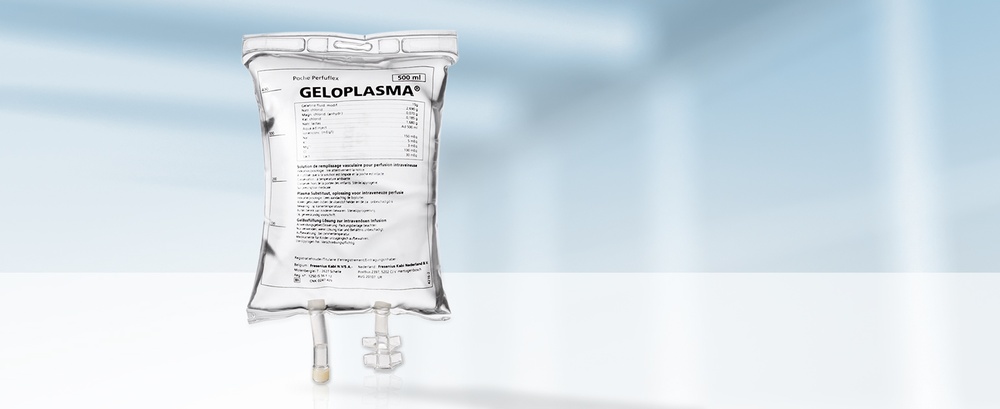
Geloplasma, solución para perfusión se presenta en bolsas de PVC (cajas de 1 y 15 bolsas) o de freeflex(poliolefinas) de 500 ml con sobrebolsa (caja con 20 bolsas)..
Puede que no se comercialicen todos los tamaños de envase.
Titular de la autorización de comercialización y responsable de la fabricación
Titular de la autorización de comercialización: Responsable de la fabricación :
Fresenius Kabi España, S.A .U. Fresenius Kabi France
C/ Marina 16-18 6, rue du Rempart
08005 BARCELONA 27400 Louviers
ESPAÑA FRANCIA
Este medicamento está autorizado en los estados miebros del Espacio Económico Europeo con los siguientes nombres:
Austria: GELOPLASMA Infusionslösung
República Checa: Geloplasma, infuzní roztok
Estonia: Geloplasma, infusioonilahus
Finlandia: GELOPLASMA infuusioneste, liuos
Francia: PLASMION, solution pour perfusion
Alemani: Geloplasma Infusionslösung
Hungría: Geloplasma oldatos infúzió
Irlanda: GELOPLASMA, solution for infusion
Italia: Infuplas soluzione per infusione
Letonia: Geloplasma škidums infuzijam
Lituania: GELOPLASMA infuzinis tirpalas
Noruega: Geloplasma infusjonsvæske, oppløsning
Polonia: GELOPLASMA
Portugal: Geloplasma, Solução para perfusão
Rumanía: Geloplasma 3 g/100 ml solutie perfuzabila
Eslovaquia; GELOPLASMA, infúzny roztok
Eslovenia: Geloplasma raztopina za infundiranje
España: Geloplasma, solución para perfusión
Reino Unido: GELOPLASMA solution for infusion
Este prospecto fue revisado enOctubre 2017.
-----------------------------------------------------------------------------------------------------------
Esta información está destinada únicamente a médicos o profesionales del sector sanitario:
Posología y método de administración
Posología
El volumen de la dosis y la velocidad de perfusión dependen del estado del paciente, de las circunstancias y de la respuesta a la sustitución vascular.
La gelatina fluida modificada se administra mediante perfusión intravenosa (perfusión en goteo). La velocidad de perfusión puede incrementarse utilizando una bomba.
La dosis y la velocidad de perfusión dependen de las necesidades del paciente y del volumen de sangre que debe ser reemplazado y del estado hemodinámico del paciente.
Como media, la dosis administrada es de 500 a 1000 ml (1 o 2 bolsas), a veces más.
Como regla general, en adultos y niños que pesen más de 25 kilos, se administran 500 ml (1 bolsa) a una velocidad apropiada dependiendo del estado del paciente. La velocidad de perfusión puede incrementarse en caso de hemorragia grave.
Si hay una pérdida de sangre/fluido mayor de 1,5 litros en un adulto (es decir, mayor del 20% del volumen de sangre) normalmente debería administrarse sangre además de Geloplasma, solución para perfusión. El sistema hemodinámico, hematológico y la coagulación deberían monitorizarse.
Población pediátrica
Ver arriba.
Forma de administración
La solución debe ser administrada por vía intravenosa.
Advertencias y precauciones especiales de empleo
Advertencias
Esta solución no debe ser administrada mediante inyección intramuscular.
Esta solución de gelatina fluida no debe ser perfundida al mismo tiempo que la sangre o sus derivados (concentrados de células, plasma y fracciones de plasma) sino utilizando dos sistemas de perfusión separados.
La determinación del grupo sanguíneo, antígenos irregulares y análisis de sangre de laboratorio son posibles en los pacientes que han recibido hasta 2 litros de gelatina fluida, aunque la interpretación puede verse obstaculizada por la hemodilución y es preferible tomar las muestras para estas pruebas antes de la perfusión de la gelatina fluida.
Precauciones
El uso de esta solución requiere monitorización clínica y de laboratorio del estado del paciente:
- presión sanguínea, y posiblemente presión venosa central;
- eliminación de orina;
- hematocrito y electrolitos.
Especialmente en las siguientes situaciones:
- insuficiencia cardíaca congestiva;
- función pulmonar alterada
- función renal gravemente alterada;
- edema con retención de agua/sal;
- sobrecarga circulatoria;
- tratamiento con corticosteroides y sus derivados;
- trastornos importantes de coagulación.
El hematocrito no debe caer por debajo del 25%; en pacientes ancianos no debe caer por debajo del 30%. Se debe evitar las alteraciones de la coagulación sanguínea causadas por la dilución de los factores de coagulación.
Si se perfunden más de 2000 a 3000 ml de Geloplasma, solución para perfusión pre- e intra-cirugía, se recomienda que se controle la concentración de proteínas séricas post-cirugía, especialmente si hay signos de edema tisular.
Sobredosis
Si se produce sobredosis, se debe detener la perfusión y administrar un diurético de acción rápida.
En caso de sobredosis, el paciente debe ser tratado sintomáticamente y se deben monitorizar los electrolitos.
Precauciones especiales de eliminación y otras manipulaciones
Debe asegurarse el manejo aséptico de la solución
Comprobar que el envase está intacto y que la solución es transparente antes de su uso.
Desechar cualquier envase que esté dañado o del que haya salido líquido.
El volumen residual de la solución restante después de la perfusión no debe volver a utilizarse bajo ninguna circunstancia.
La eliminación del medicamento no utilizado y de todos los materiales que hayan estado en contacto con él, se realizará de acuerdo con la normativa local.
-

- País de registro
- Forma farmacéuticaINYECTABLE PERFUSION, 3 g; 0,5382 g; 0,0305 g; 0,0373 g; 0,3360 g
- Código ATCB05AA06
- Principio activo
- Requiere recetaSí
- Fabricante
- Esta información es de carácter general y no sustituye la consulta con un profesional sanitario.
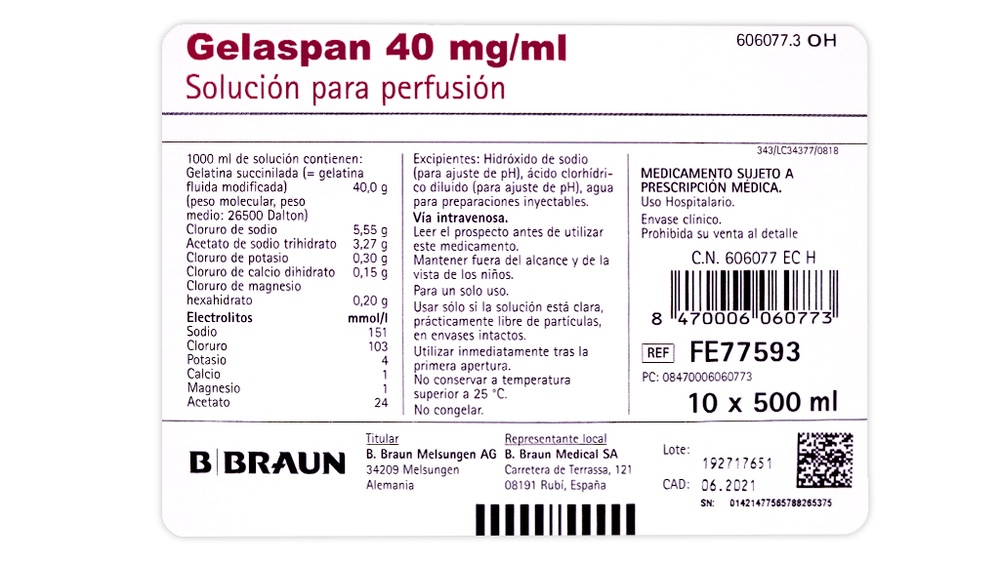
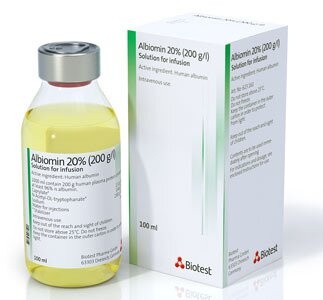
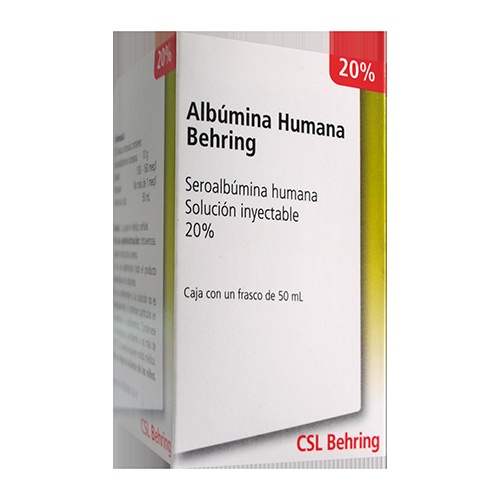
- Alternativas a GELOPLASMA, SOLUCION PARA PERFUSIONForma farmacéutica: INYECTABLE PERFUSION, 4%Principio activo: gelatin agentsFabricante: B. Braun Melsungen AgRequiere recetaForma farmacéutica: INYECTABLE PERFUSION, 200 g/lPrincipio activo: AlbuminaFabricante: Biotest Pharma GmbhRequiere recetaForma farmacéutica: INYECTABLE PERFUSION, 200 g/lPrincipio activo: AlbuminaFabricante: Csl Behring GmbhRequiere receta
Médicos online para GELOPLASMA, SOLUCION PARA PERFUSION
Comenta la dosis, los posibles efectos secundarios, interacciones, contraindicaciones o la revisión de receta de GELOPLASMA, SOLUCION PARA PERFUSION, sujeto a valoración médica y a la normativa local.









Obtén una receta de GELOPLASMA, SOLUCION PARA PERFUSION online
Rellena un formulario de 2 minutos
Cuéntanos tus síntomas, historial y el medicamento que necesitas.
Elige un médico o nosotros te asignamos uno
Escoge un especialista o te conectamos con el próximo médico disponible.
El médico revisa tu caso
Normalmente en 30 minutos. Puede hacerte preguntas adicionales por chat.
Recógela en cualquier farmacia
Receta electrónica enviada a tu correo, válida en toda España.
Preguntas frecuentes
GELOPLASMA, SOLUCION PARA PERFUSION requires receta en España. Puedes confirmarlo con un médico online según tu caso.
El principio activo de GELOPLASMA, SOLUCION PARA PERFUSION es gelatin agents. Esta información ayuda a identificar medicamentos con la misma composición pero con diferentes nombres comerciales.
GELOPLASMA, SOLUCION PARA PERFUSION es fabricado por Fresenius Kabi España, S.A.U.. La marca y el envase pueden variar según el distribuidor.
Los Médicos de familia, Psiquiatras, Dermatólogos, Cardiólogos, Endocrinólogos, Gastroenterólogos, Neumólogos, Nefrólogos, Reumatólogos, Hematólogos, Infectólogos, Alergólogos, Geriatras, Pediatras, Oncólogos pueden valorar la prescripción de GELOPLASMA, SOLUCION PARA PERFUSION cuando esté clínicamente indicado. Puedes reservar una videoconsulta para comentar tu caso y las opciones de tratamiento.
España cuenta con una infraestructura sanitaria bien desarrollada en ciudades principales como Madrid, Barcelona, Valencia y Sevilla. Las farmacias están ampliamente disponibles y operan bajo estrictas regulaciones, garantizando el acceso a medicamentos con receta.
Puedes comprar GELOPLASMA, SOLUCION PARA PERFUSION en Madrid, Barcelona, Sevilla o Valencia en cualquier farmacia local con una receta válida.
Para obtener una receta, puedes utilizar Oladoctor:
Otros medicamentos con el mismo principio activo (gelatin agents) incluyen GELASPAN 40 MG/ML SOLUCION PARA PERFUSION, ALBIOMIN 20% (200 g/L) SOLUCION PARA PERFUSION, ALBUMINA HUMANA CSL BEHRING 200 G/L SOLUCION PARA PERFUSION. Pueden tener diferentes nombres comerciales o formulaciones, pero contienen el mismo componente terapéutico. Consulta siempre con un médico antes de cambiar o iniciar un nuevo medicamento.
