



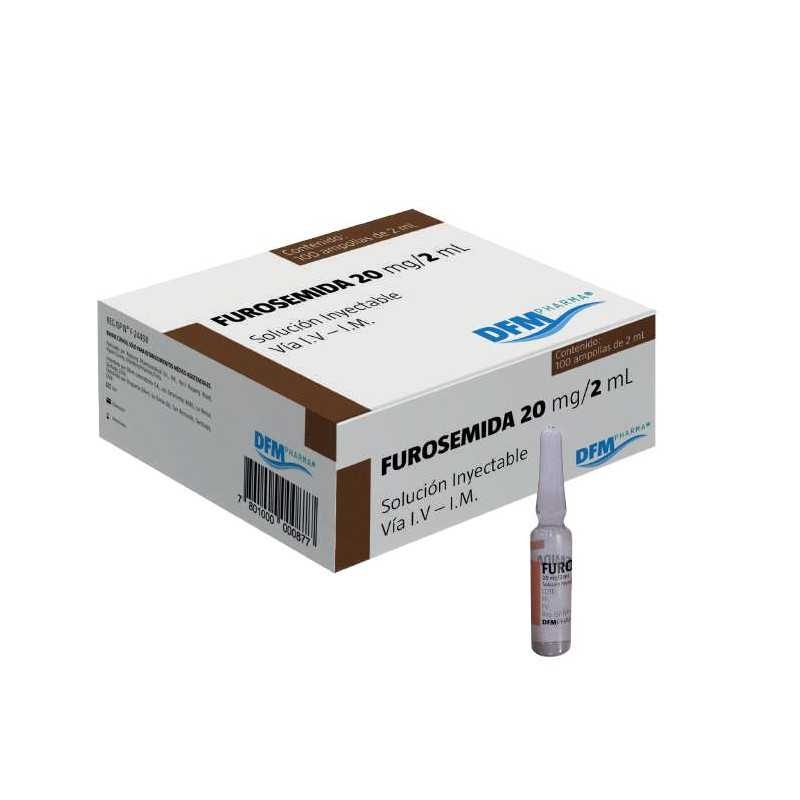
FUROSEMIDA 20 mg /2 Ml Solución Inyectable

Revisión de receta online
Un médico revisará tu caso y determinará si la prescripción es médicamente apropiada.

Habla con un médico sobre este medicamento
Comenta tus síntomas y las opciones de tratamiento en una consulta online.



Cómo usar FUROSEMIDA FRESENIUS KABI 20 MG/2 ML SOLUCION INYECTABLE Y PARA PERFUSION EFG
Contenido del prospecto
- Introducción
- Qué es Furosemida Fresenius Kabi y para qué se utiliza
- Qué necesita saber antes de empezar a usar Furosemida Fresenius Kabi
- Cómo usar Furosemida Fresenius Kabi
- Posibles efectos adversos
- Conservación de Furosemida Fresenius Kabi
- Contenido del envase e información adicional.
Introducción
Prospecto: información para el usuario
Furosemida Fresenius Kabi 20 mg/2 ml solución inyectable y para perfusión EFG
furosemida
Lea todo el prospecto detenidamente antes de empezar a usar este medicamento, porque contiene información importante para usted.
- Conserve este prospecto, ya que puede tener que volver a leerlo.
- Si tiene alguna duda, consulte a su médico o enfermero.
- Este medicamento se le ha recetado solamente a usted y no debe dárselo a otras personas, aunque tengan los mismos síntomas que usted, ya que puede perjudicarles.
- Si experimenta efectos adversos, consulte a su médico o enfermero, incluso si se trata de efectos adversos que no aparecen en este prospecto.
Contenido del prospecto
- Qué es Furosemida Fresenius Kabi y para qué se utiliza
- Qué necesita saber antes de empezar a usar Furosemida Fresenius Kabi
- Cómo usar Furosemida Fresenius Kabi
- Posibles efectos adversos
- Conservación de Furosemida Fresenius Kabi
- Contenido del envase e información adicional
1. Qué es Furosemida Fresenius Kabi y para qué se utiliza
Furosemida Fresenius Kabi pertenece al grupo de medicamentos denominados diuréticos.
Furosemida aumenta la cantidad de orina producida por su cuerpo.
Furosemida se utiliza para eliminar del cuerpo el exceso de líquido (también llamado edema). El exceso
de líquido puede producirse por:
- problemas de corazón
- problemas de hígado
- problemas de riñones
Furosemida también se utiliza en periodos en los que la tensión es extremadamente alta, pudiendo ser
peligroso para la salud (crisis hipertensivas).

¿No estás seguro de si este medicamento es adecuado para ti?
Comenta tus síntomas y tratamiento con un médico online.
2. Qué necesita saber antes de empezar a usar Furosemida Fresenius Kabi
No use Furosemida Fresenius Kabi:
- Si es alérgico a furosemida o a cualquiera de los otros componentes de este
medicamento (incluidos en la sección 6)
- Si es alérgico a las sulfonamidas
- Si se encuentra gravemente deshidratado (ha perdido gran cantidad de líquido corporal, por ejemplo por vómitos o diarreas graves)
- Si padece insuficiencia renal y no puede orinar, a pesar del tratamiento con furosemida
- Si tiene insuficiencia renal como consecuencia de una intoxicación con sustancias tóxicas para el riñón o el hígado
- Si tiene niveles muy bajos de potasio o sodio en sangre
- Si el paciente está en coma debido a una insuficiencia hepática
- Si está en periodo de lactancia
Si no está seguro de si puede o no utilizar este medicamento, consulte a su médico o farmacéutico.
Advertencias y precauciones
Consulte a su médico o enfermero antes de empezar a usar Furosemida Fresenius Kabi:
- Si normalmente tiene problemas para eliminar líquido debido a una obstrucción (como una
hipertrofia de próstata)
- Si padece diabetes
- Si tiene la presión arterial baja o en ocasiones padece descensos pronunciados de la presión
arterial (los vasos sanguíneos de su corazón o cerebro son muy estrechos)
- Si padece una enfermedad de hígado (por ejemplo cirrosis)
- Si tiene problemas de riñones (como síndrome nefrótico)
- Si está deshidratado (ha perdido mucha cantidad de líquido por vómitos o diarreas graves),
pudiéndose producir colapso del sistema circulatorios y formación de coágulos.
- Si padece de gota (articulaciones inflamadas o doloridas) debido a niveles altos de ácido úrico
(producidos por el metabolismo) en sangre
- Si tiene una enfermedad inflamatoria llamada “lupus eritematoso” (SLE)
- Si tiene problemas de oído
- Si está tomando sorbitol (sustitutivo del azúcar en personas diabéticas)
- Si se está medicando con fármacos que pueden causar un ritmo cardíaco irregular que amenace
la vida (prolongación del intérvalo QT)
- Si se está medicando con litio
- Si padece de porfiria (enfermedad en la cual el oxígeno no se puede unir a las proteínas de las
células rojas de la sangre y la orina adquiere color púrpura)
- Si su piel tiene una sensibilidad alta a la luz del sol (fotosensibilidad)
- Si es deportista; este fármaco puede dar un resultado positivo en los tests antidoping
- Si tiene lupus eritematoso sistémico (LES), una enfermedad del sistema inmunitario que afecta a la piel, los huesos, las articulaciones y los órganos internos
- Si usted es una persona de edad avanzada, si está siendo tratado con medicamentos que puedan causar disminución de la presión sanguínea o si presenta otros cuadros médicos que tengan asociado el riesgo de disminución de la presión sanguínea
Si se administra a bebés prematuros puede causar piedras o calcificación en el riñón
Si le ocurre cualquiera de estas circunstancias, puede que su médico quiera cambiarle el tratamiento o
darle alguna advertencia especial.
Mientras esté utilizando Furosemida Fresenius Kabi, es posible que sus médicos le recomienden
realizarse análisis regulares de sangre para comprobar los niveles de azúcar y ácido úrico. También puede
querer comprobar los niveles en sangre de sales importantes como potasio y sodio. Esta monitorización es
particularmente importante si usted está enfermo o tiene diarrea.
Otros medicamentos y Furosemida Fresenius Kabi
Informe a su médico o enfermero si está utilizando, ha utilizado recientemente o pudiera tener que utilizar cualquier otro medicamento. Esto es importante ya que algunos medicamentos no deben tomarse junto con Furosemida Fresenius Kabi.
En concreto, informe a su médico o farmacéutico si está tomando:
- Litio – para trastornos de comportamiento, ya que sus efectos adversos pueden incrementarse
por la furosemida. Su médico debe prescribirle este fármaco sólo si es absolutamente
imprescindible y deberá comprobar los niveles de litio en sangre y posiblemente ajustar la
dosis prescrita.
- Risperidona – utilizada para el tratamiento de ciertas psicosis
- Medicamentos para el corazón, como digoxina. Su médico quizás deba ajustar la dosis.
- Cualquier medicamento para la presión arterial alta, incluyendo diuréticos tiazídicos (como
bendroflumetiazida o hidroclorotiazida), inhibidores de la ECA (como lisinoprilo),
antagonistas de la angiotensina II (como losartán), ya que furosemida puede bajar mucho la
tensión. Su doctor quizás deba ajustar la dosis de furosemida.
- Medicamentos para disminuir el colesterol o los lípidos, como los fibratos, (clofibrato,
fenofibrato o bezafibrato), ya que puede aumentar el efecto de furosemida
- Medicamentos para la diabetes, como metformina e insulina, ya que se pueden incrementar
los niveles de azúcar.
- Medicamentos anti-inflamatorios, incluyendo los no esteroideos (como aspirina o celecoxib),
puesto que éstos pueden reducir el efecto de furosemida; altas dosis de calmantes (salicilatos)
pueden incrementar los efectos adversos de furosemida.
- Medicamentos anti-inflamatorios o antialérgicos como corticosteroides, fármacos para tratar
úlceras de estómago como carbenoxolona o laxantes, ya que en combinación con furosemida
pueden afectar los niveles de potasio y sodio. El regaliz tiene el mismo efecto que la
carbenoxolona. Su médico comprobará los niveles de potasio en sangre.
- Inyecciones administradas durante operaciones, incluyendo tobocuranina, succinilcolina y
derivados curarínicos.
- Hidrato de cloral – para problemas de sueño. En casos aislados, la administración intravenosa
(inyección en una vena) de furosemida durante un período de 24 horas previa a la
administración de hidrato de cloral, puede provocar rubor, aumento de sudoración, ansiedad,
náuseas, aumento de la presión sanguínea y del ritmo cardíaco. Consecuentemente, no se
recomienda la administración conjunta de furosemida e hidrato de cloral.
- Fenitoina o fenobarbital – para la epilepsia, puesto que se puede reducir el efecto de
furosemida.
- Teofilina – para el asma, puede incrementar el efecto de furosemida.
- Algunos antibióticos, incluyendo algunas cefalosporinas, polimixinas, aminoglucósidos o
quinolonas u otros fármacos que puedan afectar sus riñones como immunosupresores, medios
de contraste iodados, foscarnet o pentamidina, ya que furosemida puede empeorar su
funcionamiento.
- Amfotericina B – utilizada para infecciones por hongos (si se utiliza durante un tiempo prolongado)
- Probenecid – utilizado con algunos otros medicamentos para proteger los riñones, puede
reducir el efecto de furosemida.
- Organoplatinos – utilizados en algunos tipos de cáncer, puesto que la furosemida puede
aumentar sus efectos adversos.
- Metotrexato – utilizado en algunos tipos de cáncer y para artritis graves, puede reducir el
efecto de la furosemida
- Fármacos para aumentar la presión arterial (aminas vasopresoras), ya que pueden no tener
efecto cuando se toman con furosemida.
- Aminoglutetimida – utilizada para suprimir la producción de corticosteroides (síndrome de
Cushing), pueden aumentar el efecto de furosemida
- Carbamazepina – utilizada para el tratamiento de la epilepsia o esquizofrenia, puede
incrementar los efectos adversos de furosemida
- Ciclosporina – utilizada para prevenir el rechazo en trasplantes, existe riesgo de artritits
gotosa (dolor en articulaciones)
- Fármacos que puedan alterar el ritmo cardíaco como amiodarona, sotalol, dofelitida, ibutilida,
ya que pueden aumentar el efecto de furosemide
- Medicamentos inyectables utilizados antes de los exámenes de rayos X
- Levotiroxina – utilizada para problemas de tiroides
Uso de Furosemida Fresenius Kabi con alimentos, bebidas y alcohol
No se espera que los alimentos influyan en este medicamento cuando se administra por vía intravenosa. Puede comer y beber normalmente cuando esté tomando furosemida. No es necesario que cambie su dieta
a menos que se lo sugiera su médico.
Embarazo, lactancia y fertilidad
Furosemida no debe usarse durante el embarazo a menos que existan muy buenas razones médicas para usarla.
Si está embarazada o en periodo de lactancia, cree que podría estar embarazada o tiene intención de quedarse embarazada, consulte a su médico o farmacéutico antes de utilizar este medicamento.
- Furosemida puede pasar de la madre al niño
- Por lo tanto, este medicamento sólo se administra a mujeres embarazadas si es absolutamente
necesario.
No utilice Furosemida Fresenius Kabi si está en periodo de lactancia
- Este medicamento pasa a través de la leche materna.
Consulte a su médico o farmacéutico antes de utilizar cualquier medicamento.
Conducción y uso de máquinas
Furosemida Fresenius Kabi puede disminuir su capacidad de concentración y reacción. Si tiene estos
síntomas no conduzca ni utilice máquinas (ver sección 4, “Posibles efectos adversos”)
Furosemida Fresenius Kabi contiene sodio
Este medicamento contiene 3,7 mg de sodio (principal componente de la sal de cocina/mesa) en cada ml. Esto equivale al 0,2% de la ingesta dietética diaria máxima recomendada para un adulto.
3. Cómo usar Furosemida Fresenius Kabi
Siga exactamente las instrucciones de administración de este medicamento indicadas por su médico o enfermero. En caso de duda, consulte de nuevo a su médico o enfermero
Normalmente, un médico o una enfermera le administrarán Furosemida Fresenius Kabi. Se le
administrará:
- mediante una inyección lenta en una vena (intravenoso) o
- excepcionalmente en un músculo (intramuscular)
Su médico decidirá la dosis. La dosis depende de su condición particular, la gravedad de la enfermedad y
el tiempo durante el que ha sido tratado.
- La primera dosis recomendada para adultos (incluyendo adolescentes a partir de 15 años) es de 20 a 40 mg.
- Si su médico cree que es necesaria una dosis mayor, le pueden administrar inyecciones
adicionales de 20 mg. Normalmente se le administrarán cada 2 horas hasta conseguir la
pérdida de líquido deseada.
- En algunos casos, en lugar de inyecciones, su médico puede recomendarle la administración
de este medicamento mediante perfusión continua en vena (goteo).
- En los niños, (sólo se tratarán los niños menores de 15 años en casos excepcionales), la dosis
depende del peso. La primera dosis es de 0,5 a 1 mg/kg al día.
- En ancianos la dosis inicial normalmente es de 20 mg/día. Esto puede aumentarse
gradualmente hasta conseguir la pérdida de líquido deseada.
La pérdida de peso por eliminación de líquidos no debe superar 1 Kg de peso corporal por día.
Si continua necesitando Furosemida Fresenius Kabi, su médico probablemente le recomendará, tan pronto
como sea posible, un cambio de inyecciones a una forma por vía oral (comprimidos) de este
medicamento.
Si utiliza más Furosemida Fresenius Kabi del que debe:
Si cree que ha recibido demasiado medicamento, informe a su médico directamente.
Los síntomas que podrían indicar que ha recibido una dosis demasiado elevada son: sequedad de boca,
aumento de la sed, ritmo cardíaco irregular, cambios en el estado de ánimo, dolor o calambres
musculares, malestar, debilidad o cansancio inusual, pulso débil o pérdida de apetito.
En caso de sobredosis o ingestión accidental, consultar al Servicio de Información Toxicológica. Teléfono
91 562 04 20.
Si olvidó usar Furosemida Fresenius Kabi
Si cree que ha olvidado una inyección, consulte con su médico o enfermera. No use una dosis doble para
compensar las dosis olvidadas.
Si tiene cualquier otra duda sobre el uso de este medicamento, consulte con su médico o enfermero.

¿Has empezado a tomar el medicamento y tienes preguntas?
Comenta tus síntomas y tratamiento con un médico online.
4. Posibles efectos adversos
Al igual que todos los medicamentos, este medicamento puede producir efectos adversos, aunque
no todas las personas los sufran. Durante el tratamiento con furosemida pueden aparecer los siguientes
efectos adversos:
Frecuentes
Encefalopatía hepática en pacientes con insuficiencia hepatocelular (los síntomas incluyen pérdida de memoria, convulsiones, cambios de humor y coma
Poco frecuentes (afecta a entre 1 y 10 de cada 1.000 pacientes):
- Erupciones cutáneas (incluyendo enrojecimiento, picor, descamación), tendencia a producirse
cardenales o sensibilidad a la luz del sol
- Cambios en las células sanguíneas que pueden provocar fallos en la coagulación (mayor
riesgo de hemorragias)
- Sordera (en ocasiones irreversible)
Raros (afecta a entre 1 y 10 de cada 10.000 pacientes):
- Malestar, diarrea, estreñimiento, pérdida de apetito, molestias en la boca y estómago
- Problemas de audición (más frecuente en personas con fallo renal) y tinnitus (zumbido en los
oídos)
- Anafilaxis, una reacción alérgica grave que puede causar erupción cutánea, hinchazón,
dificultad respiratoria, y pérdida de conciencia. Consiga ayuda médica inmediatamente.
- Daño en los riñones (nefritis intersticial)
- Niveles muy bajos de glóbulos blancos en sangre (que pueden llevar a infecciones que
pueden amenazar la vida). Consiga ayuda médica inmediatamente.
- Problemas musculares, incluyendo debilidad muscular y calambres en las piernas
- Dolor o malestar cuando se le administra la inyección (especialmente tras administración
intramuscular)
- Lupus eritrematoso o agravamiento de éste
- Modificaciones en las analíticas de sangre (lípidos en sangre)
- Mareo, hormigueo o entumecimiento
- Fiebre alta
- Visión borrosa, confusión, somnolencia
- Sequedad de boca
Muy raros (afecta a menos de 1 de cada 10.000 pacientes):
- Problemas musculares graves incluyendo tirones, espasmos, calambres.
- Modificaciones en las células sanguíneas que pueden provocar anemia, incapacidad de luchar
contra las infecciones.
- Pancreatitis (dolor abdominal) debido a la inflamación del páncreas.
Frecuencia no conocida (no puede estimarse a partir de los datos disponibles):
- Síndrome de Stevens-Johnson (formación de ampollas o descamación de la piel, labios, ojos, nariz y genitales, síntomas gripales y fiebre).
- Necrólisis epidérmica tóxica (las capas de la piel pueden despegarse para dejar grandes áreas de piel en carne viva expuesta por todo el cuerpo).
- Pustulosis exantemática generalizada aguda (PEGA).
- Síndrome de hipersensibilidad medicamentosa con eosinofilia y síntomas sistémicos (DRESS).
- Mareo, desvanecimientos y pérdida de consciencia (causados por hipotensión sintomática o por otras causas), dolor de cabeza.
- Exacerbación o activación del lupus eritematoso sistémico (los signos pueden incluir sarpullido, dolor en la articulación, fiebre).
- Se han notificado casos de lesiones musculares (rabdomiólisis), frecuentemente relacionadas con una hipocalemia grave.
También se puede producir:
- Bajada de tensión, haciéndole sentir débil o mareado. Puede producir sensación de presión en
la cabeza, dolor articular, formación de coágulos sanguíneos, o colapso de su circulación
(shock).
- Niveles bajos de potasio en sangre. Puede provocar debilidad muscular, hormigueo y
entumecimiento, ligera incapacidad de mover alguna parte de su cuerpo, sensación de mareo,
estreñimiento, aumento de gases en sus intestinos, aumento en la cantidad de orina, aumento
en la necesidad de beber, ritmo cardíaco irregular o más lento. Estos complicaciones son más
probables si tiene problemas de hígado, o su dieta es muy baja en potasio, o está tomando
otros fármacos (ver “Uso de otros medicamentos”). Las pérdidas extremas de potasio pueden
reducir de forma temporal el movimiento intestinal o su capacidad de atención, en algunos
casos con disminución profunda y prolongada de la conciencia. Puede ser necesario realizar
análisis de sangre regulares y tomar suplementos de potasio.
- Niveles bajos de magnesio, calcio y sodio en sangre debidos a un aumento de su eliminación
por la orina. Los bajos niveles de sodio causan típicamente falta de interés, calambres en la
pantorrilla, falta de apetito, debilidad, somnolencia, confusión y mareos. Los niveles bajos de
calcio causan calambres musculares. Los niveles bajos de magnesio pueden también causar
calambres musculares o un ritmo cardíaco irregular.
- Gota, o puede agravarse si ya la padece.
- Pueden empeorarse los problemas existentes de eliminación de líquidos.
- Diabetes, o puede agravarse si ya la padece.
- Los problemas del hígado o los cambios en la sangre pueden causar ictericia (piel amarilla,
orina oscura, cansancio).
- Un menor volumen de fluidos corporales, especialmente en ancianos. Pérdidas severas de
fluidos corporales pueden aumentar la concentración de células en sangre y con ello la
tendencia a producirse coágulos.
- Los bebés prematuros pueden desarrollar calcificaciones o piedras en los riñones.
- En los bebés prematuros el canal entre la aorta y la arteria hepática, el cual se encuentra
abierto en los fetos, podría permanecer abierto.
Comunicación de efectos adversos
Si experimenta cualquier tipo de efecto adverso, consulte a su médico, farmacéutico o enfermero, incluso si se trata de posibles efectos adversos que no aparecen en este prospecto. También puede comunicarlos directamente a través del Sistema Español de Farmacovigilancia de Medicamentos de Uso Humano: www.notificaram.es. Mediante la comunicación de efectos adversos usted puede contribuir a proporcionar más información sobre la seguridad de este medicamento.
5. Conservación de Furosemida Fresenius Kabi
- Mantener este medicamento fuera de la vista y del alcance de los niños.
- No utilice este medicamento después de la fecha de caducidad indicada en el envase después de CAD. La fecha de caducidad hace referencia al último día del mes.
- Mantener las ampollas en su estuche externo para protegerlas de la luz.
- Los medicamentos no se deben tirar por los desagües ni a la basura. Deposite los envases y los medicamentos que no necesita en el Punto SIGRE de la farmacia. En caso de duda pregunte a su farmacéutico cómo deshacerse de los envases y de los medicamentos que no necesita. De esta forma ayudará a proteger el medio ambiente.
6. Contenido del envase e información adicional.
Composición de Furosemida Fresenius Kabi
- El principio activo es furosemida.
- Los demás componentes son: cloruro de sodio, hidróxido de sodio y agua para preparaciones inyectables.
Aspecto del producto y contenido del envase
Furosemida Fresenius Kabi es una solución transparente e incolora o prácticamente incolora.
El envase puede contener 5, 50 o 100 ampollas de color ámbar con 2 ml de Furosemida Fresenius Kabi 20
mg/2 ml.
Puede que solamente estén comercializados algunos tamaños de envase.
Titular de la autorización de comercialización y responsable de fabricación
Titular de la Autorización de comercialización:
Fresenius Kabi España, S.A.
C/ Marina 16-18, planta 17
Torre Mapfre
E-08005 Barcelona
Tel: +34 932256580
Responsable de fabricación:
LABESFAL – Laboratórios Almiro S.A. (Grupo Fresenius Kabi)
Lagedo, 3465-157 Santiago de Besteiros
Portugal
Telf: +351 232 831100
Este medicamento está autorizado en los estados miembros del Espacio Económico Europeo y en el Reino Unido (Irlanda del Norte) con los
siguientes nombres:
Bélgica | Furosemide Fresenius Kabi 20 mg/2 ml oplossing voor injectie/infusie Furosemide Fresenius Kabi 20 mg/2 ml solution injectable /pour perfusion Furosemide Fresenius Kabi 20 mg/2 ml Injektionslösung/ Infusionslösung |
República Checa | Furosemid Kabi |
Finlandia | Furosemide Fresenius Kabi 10 mg/ml injektio-/infuusioneste |
Irlanda | Furosemide 20mg/2ml solution for injection/infusion |
Portugal | Furosemida Fresenius Kabi 20mg/2ml solução injectável ou para perfusão |
Polonia | Furosemid Kabi |
Holanda | Furosemide Fresenius Kabi 20 mg/2 ml oplossing voor injectie/infusie |
Eslovaquia | Furosemid Kabi 20 mg/ 2 ml , injekcný /infúzny roztok |
España | Furosemida Fresenius Kabi 20 mg/2 ml solución inyectable y para perfusión EFG |
Reino Unido (Irlanda del Norte) | Furosemide 20mg/2ml solution for injection/infusion |
Fecha de la última revisión de este prospecto: 05/2023
La información detallada y actualizada de este medicamento está disponible en la página Web de la Agencia Española de Medicamentos y Productos Sanitarios (AEMPS) http://www.aemps.gob.es/.
---------------------------------------------------------------------------------------------------
Esta información está destinada a profesionales del sector sanitario:
Administración
La administración intravenosa de furosemida debe ser lenta; no debe excederse la velocidad de 4 mg por
minuto y nunca debe darse en asociación con otros medicamentos en la misma jeringa.
La administración intramuscular debe restringirse a casos excepcionales en que no sea posible la
administración oral ni la administración intravenosa. Debe señalarse que la inyección intramuscular no es
adecuada para el tratamiento de procesos agudos como el edema pulmonar.
La dosis inicial recomendada en adultos y adolescentes mayores de 15 años es de 20 a 40 mg (1 o 2
ampollas) administrados por vía intravenosa (o intramuscular en casos excepcionales); la dosis máxima
varía en función de la respuesta individual. Si son necesarias dosis más altas, deben administrarse
realizando incrementos de 20 mg y no administrarse con más frecuencia que cada 2 horas.
En adultos, la dosis máxima recomendada de furosemida es de 1.500 mg.
Incompatibilidades
La furosemida se puede mezclar con soluciones neutras y alcalinas débiles con pH entre 7 y 10, como el
cloruro de sodio 0,9% y la solución Ringer.
La furosemida no debe mezclarse con soluciones de ácidos fuertes (pH por debajo de 5,5), como las
soluciones con ácido ascórbico, noradrenalina y adrenalina, debido al riesgo de precipitación.
Si el producto contiene partículas visibles no debe usarse.
Producto de un solo uso. Eliminar cualquier contenido sobrante tras su utilización.
Período de validez del producto: 3 años.
Después de la primera apertura el producto debe ser utilizado inmediatamente.
Después de la dilución:
La estabilidad física y química está garantizada durante 24 horas, a 25ºC y protegido de la luz.
El producto debe ser utilizado inmediatamente desde un punto de vista microbiológico. Si no se utiliza
inmediatamente, el tiempo de utilización, almacenamiento y condiciones previas a su uso, son
responsabilidad del usuario y normalmente no deben exceder 24 horas a una temperatura entre 2º y 8ºC, a
no ser que la disolución se haya preparado en condiciones asépticas controladas y validadas.
- País de registro
- Forma farmacéuticaINYECTABLE, 20 mg/2 ml
- Código ATCC03CA01
- Principio activo
- Requiere recetaSí
- Fabricante
- ComposiciónCLORURO DE SODIO (15 mg mg), HIDROXIDO DE SODIO (E 524) (2,56 mg mg)
- Esta información es de carácter general y no sustituye la consulta con un profesional sanitario.
- Alternativas a FUROSEMIDA FRESENIUS KABI 20 MG/2 ML SOLUCION INYECTABLE Y PARA PERFUSION EFGForma farmacéutica: COMPRIMIDO, 40 mgPrincipio activo: FurosemidaFabricante: Uxa Farma S.A.Requiere recetaForma farmacéutica: INYECTABLE PERFUSION, 10 MG/MLPrincipio activo: FurosemidaFabricante: Altan Pharmaceuticals SaRequiere recetaForma farmacéutica: COMPRIMIDO, 40 mgPrincipio activo: FurosemidaFabricante: Laboratorios Alter S.A.Requiere receta
Médicos online para FUROSEMIDA FRESENIUS KABI 20 MG/2 ML SOLUCION INYECTABLE Y PARA PERFUSION EFG
Comenta la dosis, los posibles efectos secundarios, interacciones, contraindicaciones o la revisión de receta de FUROSEMIDA FRESENIUS KABI 20 MG/2 ML SOLUCION INYECTABLE Y PARA PERFUSION EFG, sujeto a valoración médica y a la normativa local.
Obtén una receta de FUROSEMIDA FRESENIUS KABI 20 MG/2 ML SOLUCION INYECTABLE Y PARA PERFUSION EFG online
Rellena un formulario de 2 minutos
Cuéntanos tus síntomas, historial y el medicamento que necesitas.
Elige un médico o nosotros te asignamos uno
Escoge un especialista o te conectamos con el próximo médico disponible.
El médico revisa tu caso
Normalmente en 30 minutos. Puede hacerte preguntas adicionales por chat.
Recógela en cualquier farmacia
Receta electrónica enviada a tu correo, válida en toda España.
Preguntas frecuentes
FUROSEMIDA FRESENIUS KABI 20 MG/2 ML SOLUCION INYECTABLE Y PARA PERFUSION EFG requiere receta en España. Puedes confirmarlo con un médico online según tu caso.
El principio activo de FUROSEMIDA FRESENIUS KABI 20 MG/2 ML SOLUCION INYECTABLE Y PARA PERFUSION EFG es Furosemida. Esta información ayuda a identificar medicamentos con la misma composición pero con diferentes nombres comerciales.
FUROSEMIDA FRESENIUS KABI 20 MG/2 ML SOLUCION INYECTABLE Y PARA PERFUSION EFG es fabricado por Fresenius Kabi España, S.A.U.. La marca y el envase pueden variar según el distribuidor.
Los Médicos de familia, Psiquiatras, Dermatólogos, Cardiólogos, Endocrinólogos, Gastroenterólogos, Neumólogos, Nefrólogos, Reumatólogos, Hematólogos, Infectólogos, Alergólogos, Geriatras, Pediatras, Oncólogos pueden valorar la prescripción de FUROSEMIDA FRESENIUS KABI 20 MG/2 ML SOLUCION INYECTABLE Y PARA PERFUSION EFG cuando esté clínicamente indicado. Puedes reservar una videoconsulta para comentar tu caso y las opciones de tratamiento.
España cuenta con una infraestructura sanitaria bien desarrollada en ciudades principales como Madrid, Barcelona, Valencia y Sevilla. Las farmacias están ampliamente disponibles y operan bajo estrictas regulaciones, garantizando el acceso a medicamentos con receta.
Puedes comprar FUROSEMIDA FRESENIUS KABI 20 MG/2 ML SOLUCION INYECTABLE Y PARA PERFUSION EFG en Madrid, Barcelona, Sevilla o Valencia en cualquier farmacia local con una receta válida.
Para obtener una receta, puedes utilizar Oladoctor:
Otros medicamentos con el mismo principio activo (Furosemida) incluyen ACUIX 40 MG COMPRIMIDOS EFG, FUROSEMIDA ALTAN 250mg/ 25ml SOLUCION PARA PERFUSION EFG, FUROSEMIDA ALTER 40 MG COMPRIMIDOS EFG. Pueden tener diferentes nombres comerciales o formulaciones, pero contienen el mismo componente terapéutico. Consulta siempre con un médico antes de cambiar o iniciar un nuevo medicamento.
