



FUROSEMIDA COMBIX 40 mg Comprimidos

Revisión de receta online
Un médico revisará tu caso y determinará si la prescripción es médicamente apropiada.

Habla con un médico sobre este medicamento
Comenta tus síntomas y las opciones de tratamiento en una consulta online.



Cómo usar FUROSEMIDA COMBIX 40 MG COMPRIMIDOS EFG
Contenido del prospecto
- Introducción
- Qué es Furosemida Combix y para qué se utiliza
- Qué necesita saber antes de empezar a tomar Furosemida Combix
- Cómo tomar Furosemida Combix
- Posibles efectos adversos
- Conservación de Furosemida Combix
- Contenido del envase e información adicional
Introducción
Prospecto:informaciónparael usuario
Furosemida Combix40mgcomprimidos EFG
Leatodoelprospectodetenidamenteantesdeempezaratomarestemedicamento,porquecontiene informaciónimportanteparausted.
- Conserve este prospecto, ya que puede tener que volver a leerlo.
- Si tiene alguna duda, consulte a su médico o farmacéutico.
- Este medicamento se le ha recetado solamente a usted, y no debe dárselo a otras personas aunque tengan los mismos síntomas que usted, ya que puede perjudicarles.
- Si experimenta efectos adversos, consulte a su médico o farmacéutico, incluso si se trata de efectos adversos que no aparecen en este prospecto. Ver sección 4.
Contenidodelprospecto
- Qué es Furosemida Combix y para qué se utiliza
- Qué necesita saber antes de empezar a tomar Furosemida Combix
- Cómo tomar Furosemida Combix
- Posibles efectos adversos
- Conservación de Furosemida Combix
- Contenido del envase e información adicional
1. Qué es Furosemida Combix y para qué se utiliza
Furosemida Combix, es un diurético perteneciente al grupo de las sulfonamidas. Actúa aumentando la eliminación de orina (diurético) y reduciendo la presión arterial (antihipertensivo).
Siempre bajo la prescripción de su médico, este medicamento está indicado para el tratamiento de:
- Edema (hinchazón por acumulación de líquidos) asociado a insuficiencia cardiaca congestiva, cirrosis hepática (ascitis), y enfermedad renal, incluyendo síndrome nefrótico (tiene prioridad el tratamiento de la enfermedad básica).
- Edemas subsiguientes a quemaduras.
- Hipertensión arterial leve y moderada.

¿No estás seguro de si este medicamento es adecuado para ti?
Comenta tus síntomas y tratamiento con un médico online.
2. Qué necesita saber antes de empezar a tomar Furosemida Combix
Lea atentamente las instrucciones que se proporcionan en el apartado 3. “Cómo tomar Furosemida Combix”.
No tome Furosemida Combix
- Si es alérgico a furosemida, a los medicamentos del tipo furosemida (sulfonamida), o a cualquiera de los demás componentes de este medicamento (incluidos en la sección 6).
- En el caso de que disminuya su volumen total de sangre (hipovolemia), o sufra deshidratación.
- Si sufre problemas graves en los riñones, acompañados de una disminución en la eliminación de orina
- (insuficiencia renal con anuria), que no respondan a este medicamento.
- Si disminuye gravemente su nivel de potasio en sangre (hipopotasemia grave).
- Si sufre deficiencia grave de sales de sodio en sangre (hiponatremia grave).
- En caso de encontrarse en estado precomatoso y comatoso (asociado a encefalopatía hepática).
- Si está usted amamantando a un bebé.
Si está embarazada, ver apartado “Embarazo, lactancia y fertilidad”.
Advertencias y precauciones
Consulte a su médico o farmacéutico antes de empezar a tomar Furosemida Combix.
Tenga especial cuidado con este medicamento:
- Si tiene problemas de eliminación de orina, sobre todo al inicio del tratamiento.
- Si su presión arterial es baja (hipotensión).
- Si tiene un riesgo elevado de sufrir un descenso pronunciado de la presión arterial (por ejemplo en pacientes con estenosis coronaria o cerebral significativa).
- Si padece diabetes mellitus latente o manifiesta.
- Si sufre gota.
- Si tiene problemas graves de riñón, asociados a enfermedad grave del hígado (síndrome hepatorrenal).
- Si sus niveles de proteínas en sangre son bajos (hipoproteinemia), además de padecer por ejemplo síndrome nefrótico (ver apartado “Posibles efectos adversos”).
- En niños prematuros (ver apartado “Posibles efectos adversos”).
- Si usted es una persona de edad avanzada, si está siendo tratado con medicamentos que puedan causar disminución de la presión sanguínea o si presenta otros cuadros médicos que tengan asociado el riesgo de disminución de la presión sanguínea.
Durante su tratamiento con este medicamento, generalmente se requerirá un control periódico de sus niveles en sangre de sodio, potasio y creatinina, y en especial si usted sufre una pérdida grave de líquidos, por vómitos, diarrea o sudoración intensa (deshidratación o hipovolemia), ya que su médico podría requerir la interrupción del tratamiento.
Los pacientes mayores de edad avanzada con demencia que están tomando risperidona deben tener especial cuidado con la toma de este medicamento. La risperidona es un medicamento que se utiliza para tratar ciertas enfermedades mentales, como la demencia (enfermedad que se caracteriza por presentar varios síntomas: pérdida de memoria, problemas para hablar, problemas para pensar).
Uso de Furosemida Combix con otros medicamentos
Informe a su médico o farmacéutico si está utilizando, ha utilizado recientemente o podría tener que utilizar cualquier otro medicamento.
Informe al médico si está siendo tratado con medicamentos para:
- Presión arterial alta (aliskireno).
Algunas sustancias pueden ver aumentada su toxicidad en el oído y en el riñón, si son administradas junto con este medicamento. De ahí que si se administran conjuntamente, sea bajo estricto control médico. Entre estas sustancias están:
- Antibióticos aminoglucósidos (medicamentos para las infecciones) tipo gentamicina, kanamicina y tobramicina.
- Medicamentos para el cáncer (cisplatino).
Este medicamento y sucralfato no deben ser administrados conjuntamente, con un intervalo menor de 2 horas, ya que el efecto de Furosemida Combix podría verse reducido.
Este medicamento puede debilitar el efecto de otros medicamentos como:
- Medicamentos usados para la diabetes (antidiabéticos).
- Medicamentos usados para elevar la presión arterial (simpaticomiméticos con efecto hipertensor por ejemplo, epinefrina y norepinefrina).
También puede aumentar la acción de otros medicamentos como:
- Medicamentos para el asma (teofilina).
- Relajantes musculares tipo curare.
- Medicamentos para la depresión (litio), pudiendo potenciar los efectos perjudiciales del litio sobre el corazón o el cerebro.
- Salicilatos (puede aumentar su toxicidad)
- Medicamentos hipotensores (para disminuir la presión arterial), como diuréticos, inhibidores de la ECA, o un antagonista de los receptores de angiotensina II.
- Medicamentos tóxicos para los riñones.
Algunos medicamentos para la inflamación y el dolor, por ejemplo, indometacina (antiinflamatorios no esteroideos incluyendo ácido acetilsalicílico) y medicamentos para la epilepsia (fenitoína) pueden reducir el efecto de Furosemida Combix.
Además pueden reducir el efecto de Furosemida Combix o ver aumentados sus efectos adversos (por reducir la eliminación renal de estos medicamentos), medicamentos como probenecid y metotrexato u otros medicamentos que tengan una secreción significativa por los riñones.
Las siguientes sustancias pueden reducir los niveles de potasio en sangre (hipopotasemia) si se administran con Furosemida Combix:
- Medicamentos para la inflamación (corticosteroides).
- Carbenoxolona (medicamento para el tratamiento de lesiones de la mucosa oral).
- Cantidades importantes de regaliz.
- Uso prolongado de laxantes para el estreñimiento.
Algunas alteraciones electrolíticas (por ejemplo, la disminución en sangre de los niveles de potasio (hipopotasemia), o de magnesio (hipomagnesemia)) podrían aumentar la toxicidad de algunos medicamentos para el corazón (por ejemplo, digitálicos y medicamentos inductores del síndrome de prolongación del intervalo QT).
Algunos pacientes que reciban altas dosis de antibióticos del tipo de las cefalosporinas pueden sufrir disminución de la función de los riñones.
La administración conjunta de Furosemida Combix y ciclosporina A puede producir artritis gotosa.
Aquellos pacientes con alto riesgo de nefropatía (enfermedad de los riñones) por contraste que reciben Furosemida Combix, pueden sufrir deterioro de la función de los riñones.
La administración de Furosemida Combix junto a risperidona en pacientes de edad avanzada con demencia, podría aumentar la mortalidad.
Embarazo, lactancia y fertilidad
Si está embarazada o en periodo de lactancia, cree que podría estar embarazada o tiene intención de quedarse embarazada, consulte a su médico o farmacéutico antes de utilizar este medicamento.
Si se encuentra embarazada, solamente utilizará Furosemida Combix bajo estricta indicación de su médico.
Durante la lactancia no debe administrarse Furosemida Combix, en caso de que su administración resulte imprescindible, su médico puede requerirle interrumpir la lactancia, ya que Furosemida Combix pasa a la leche materna.
Conducción y uso de máquinas
Este medicamento puede producir mareos o somnolencia. Esto puede ocurrirle con mayor frecuencia al inicio del tratamiento, cuando su médico le aumente la dosis o si consume alcohol. No conduzca ni maneje herramientas o máquinas si se siente mareado o somnoliento.
Furosemida Combix contiene lactosa
Si su médico le ha indicado que padece una intolerancia a ciertos azúcares, consulte con él antes de tomar este medicamento.
Uso en deportistas
Se debe advertir a los pacientes que este medicamento contiene furosemida que puede producir un resultado positivo en las pruebas de control de dopaje.
3. Cómo tomar Furosemida Combix
Siga exactamente las instrucciones de administración de este medicamento indicadas por su médico o farmacéutico. En caso de duda, consulte de nuevo a su médico o farmacéutico.
Recuerde tomar su medicamento.
Tome Furosemida Combix con el estómago vacío, ingiriéndolo sin masticar y con suficiente cantidad de líquido.
Si estima que la acción de este medicamento es demasiado fuerte o débil comuníqueselo a su médico o farmacéutico.
Su médico le prescribirá la menor dosis suficiente para producir el efecto deseado.
En adultosse recomienda iniciar el tratamiento con medio, uno o dos comprimidos (20 a 80 mg de furosemida) diarios. La dosis de mantenimiento es de medio a un comprimido al día y la dosis máxima será la indicada por su médico y dependerá de su respuesta al tratamiento.
Usoenniños
En lactantes y niños se recomienda la administración diaria de 2 mg/kg de peso corporal, hasta un máximo de 40 mg por día.
Su médico le indicará la duración de su tratamiento con este medicamento. No suspenda su tratamiento antes.
SitomamásFurosemida Combixdelquedebe
En caso de sobredosis o ingestión accidental, consulte inmediatamente a su médico o farmacéutico, diríjase al servicio de urgencias del hospital más próximo acompañado de este prospecto, o llame al Servicio de Información Toxicológica, teléfono 91 562 04 20 indicando el medicamento y la cantidad ingerida o administrada.
Una sobredosis accidental podría dar lugar a una disminución grave de la presión arterial (que puede evolucionar a shock), problemas en los riñones (insuficiencia renal aguda), problemas en la coagulación (trombosis), delirio, parálisis que afecta a músculos blandos (parálisis flácida), apatía y confusión.
No se conoce un antídoto específico.
En casos de sobredosis, el tratamiento será en función de los síntomas.
SiolvidótomarFurosemida Combix
No tome una dosis doble para compensar las dosis olvidadas.

¿Has empezado a tomar el medicamento y tienes preguntas?
Comenta tus síntomas y tratamiento con un médico online.
4. Posibles efectos adversos
Al igual que todos los medicamentos, este medicamento puede producir efectos adversos, aunque no todas las personas los sufran.
Se han agrupado los efectos adversos según su frecuencia de acuerdo con la siguiente clasificación:
Muy frecuentes: pueden afectar a más de 1 de cada 10 pacientes
Frecuentes: pueden afectar hasta 1 de cada 10 pacientes
Poco frecuentes: pueden afectar hasta 1 de cada 100 pacientes
Raros: pueden afectar hasta 1 de cada 1.000 pacientes
Muy raros: pueden afectar hasta 1 de cada 10.000 pacientes
Frecuencia no conocida (no puede estimarse a partir de los datos disponibles).
Trastornos del metabolismo y de la nutrición
Muy frecuentes: alteraciones de electrolitos (incluyendo las sintomáticas), deshidratación y descenso del volumen total de sangre (hipovolemia), en particular en pacientes de edad avanzada, nivel elevado de creatinina y de triglicéridos en sangre.
Frecuentes:disminución los niveles de sodio (hiponatremia), cloro (hipocloremia), potasio
(hipopotasemia), aumento de los niveles de colesterol y de ácido úrico en sangre, ataques de gota.
Poco frecuentes:alteración de la tolerancia a la glucosa. Puede manifestarse una diabetes mellitus latente.
Frecuencia no conocida:disminución de los niveles de calcio (hipocalcemia), magnesio (hipomagnesemia), aumento del nivel de urea en sangre, alcalosis metabólica, síndrome de pseudo Bartter en caso de uso indebido y/o uso prolongado de furosemida.
Trastornos vasculares
Raros:inflamación alérgica de los vasos sanguíneos (vasculitis).
Frecuencia no conocida:alteración de la coagulación de la sangre (trombosis).
Trastornos renales y urinarios
Frecuentes:aumento del volumen de orina.
Raros:reacción renal de tipo alérgico (nefritis túbulo-intersticial).
Frecuencia no conocida:aumento del nivel de sodio y cloro en la orina, retención de orina (en pacientes con obstrucción parcial del flujo de orina), formación de cálculos en el riñón (nefrocalcinosis/nefrolitiasis) en niños prematuros, fallo renal.
Trastornos gastrointestinales
Poco frecuentes: náuseas.
Raros:vómitos, diarrea.
Muy raros:inflamación del páncreas (pancreatitis aguda).
Trastornos hepatobiliares
Muy raros: problema del hígado (colestasis), incremento de las enzimas del hígado (transaminasas).
Trastornos del oído y del laberinto
Poco frecuentes:trastornos auditivos, aunque de carácter transitorio, en especial en pacientes con insuficiencia renal, disminución del nivel de proteínas en sangre (hipoproteinemia) y/o tras una administración intravenosa demasiado rápida de furosemida, sordera (en ocasiones irreversible)
Muy raros:sensación subjetiva de tintineo (tinnitus).
Trastornos de la piel y del tejido subcutáneo
Poco frecuentes: picor, sarpullido, ampollas y otras reacciones más graves como eritema multiforme, penfigoide, dermatitis exfoliativa, púrpura y reacción de fotosensibilidad.
Frecuencia no conocida:reacciones vesiculosas graves de la piel y de las membranas mucosas (Síndrome de Stevens-Johnson), alteración grave de la piel caracterizada por la formación de ampollas y lesiones exfoliativa (necrólisis epidérmica tóxica), y pustulosis exantemática generalizada aguda (PEGA) y síndrome de hipersensibilidad a medicamentos con eosinofilia y síntomas sistémicos (DRESS).
Trastornos del sistema inmunológico
Raros:reacciones alérgicas (anafilácticas o anafilactoides) graves (p. ej. con shock).
Trastornos del sistema nervioso
Frecuentes:alteraciones mentales en pacientes con problemas hepáticos (encefalopatía hepática)
Raros:sensación de hormigueo en las extremidades (parestesias).
Frecuencia no conocida:mareo, desvanecimientos y pérdida de consciencia (causados por hipotensión sintomática).
Trastornos de la sangre y el sistema linfático
Frecuentes:aumento de la viscosidad de la sangre (hemoconcentración).
Poco frecuentes:disminución de los niveles de plaquetas (trombocitopenia).
Raros:disminución del nivel de glóbulos blancos (leucopenia), aumento de un tipo de glóbulos blanco, los eosinófilos (eosinofilia).
Muy raros: disminución de un tipo de glóbulos blancos, los granulocitos (agranulocitosis), disminución del número de glóbulos rojos (anemia aplásica, anemia hemolítica).
Trastornos congénitos, familiares y genéticos
Frecuencia no conocida:aumento del riesgo de persistencia del conducto “ductus arterioso permeable” cuando se administra furosemida a niños prematuros durante las primeras semanas de vida.
Trastornos generales y alteraciones en el lugar de administración
Raros: fiebre.
Al igual que con otros diuréticos, tras la administración prolongada de este medicamento puede aumentar la eliminación de sodio, cloro, agua, potasio, calcio y magnesio. Estas alteraciones se manifiestan con sed intensa, dolor de cabeza, confusión, calambres musculares, contracción dolorosa de los músculos especialmente de las extremidades (tetania), debilidad muscular, alteraciones del ritmo cardíaco y síntomas gastrointestinales.
Comunicación de efectos adversos
Si experimenta cualquier tipo de efecto adverso, consulte a su médico o farmacéutico, incluso si se trata de posibles efectos adversos que no aparecen en este prospecto. También puede comunicarlos directamente a través el Sistema Español de Farmacovigilancia de Medicamentos de Uso Humano: https://www.notificaram.es. Mediante la comunicación de efectos adversos usted puede contribuir a proporcionar más información sobre la seguridad de este medicamento.
5. Conservación de Furosemida Combix
Mantener este medicamento fuera de la vista y del alcance de los niños.
Conservar por debajo de 25ºC.
Conservar en el embalaje original para protegerlo de la luz.
No utilice este medicamento después de la fecha de caducidad que aparece en el envase después de CAD. La fecha de caducidad es el último día del mes que se indica.
Los medicamentos no se deben tirar por los desagües ni a la basura. Deposite los envases y los medicamentos que no necesita en el Punto SIGRE de la farmacia. En caso de duda pregunte a su farmacéutico cómo deshacerse de los envases y de los medicamentos que no necesita. De esta forma ayudará a proteger el medio ambiente.
6. Contenido del envase e información adicional
Composición de Furosemida Combix
- El principio activo es furosemida. Cada comprimido contiene 40 mg de furosemida.
- Los demás componentes son: lactosa monohidrato, almidón de maíz pregelatinizado, sílice coloidal anhidra (E551), almidón de maíz, povidona K 30, lauril sulfato sódico, poloxamero 407, talco (E553b) y estearato de magnesio (E470b).
Aspecto del producto y contenido del envase
Comprimidos de color blanco o blanquecino, redondos, planos, con bordes biselados, grabados con “40” en una de las caras y ranurados en la otra.
El comprimido se puede dividir en dosis iguales.
Blísteres de PVC-Aluminio (estándar y perforados). Envases conteniendo 10 y 30 comprimidos.
Puede que solamente estén comercializados algunos tamaños de envases.
Titular de la autorización de comercialización
Laboratorios Combix, S.L.U.
C/Badajoz, 2. Edificio 2
28223 Pozuelo de Alarcón (Madrid)
España
Responsable de la fabricación
Zydus France
ZAC Les Hautes Patures
Parc d'activités des Peupliers
25 Rue des Peupliers
92000 Nanterre
Francia
o
Centre Spécialités Pharmaceutiques
ZAC des Suzots
35 rue de la Chapelle
63450 Saint Amant Tallende
Francia
Fecha de la última revisión de este prospecto: Abril 2024
La información detallada y actualizada de este medicamento está disponible en la página Web de la Agencia Española de Medicamentos y Productos Sanitarios (AEMPS) http://www.aemps.gob.es/.
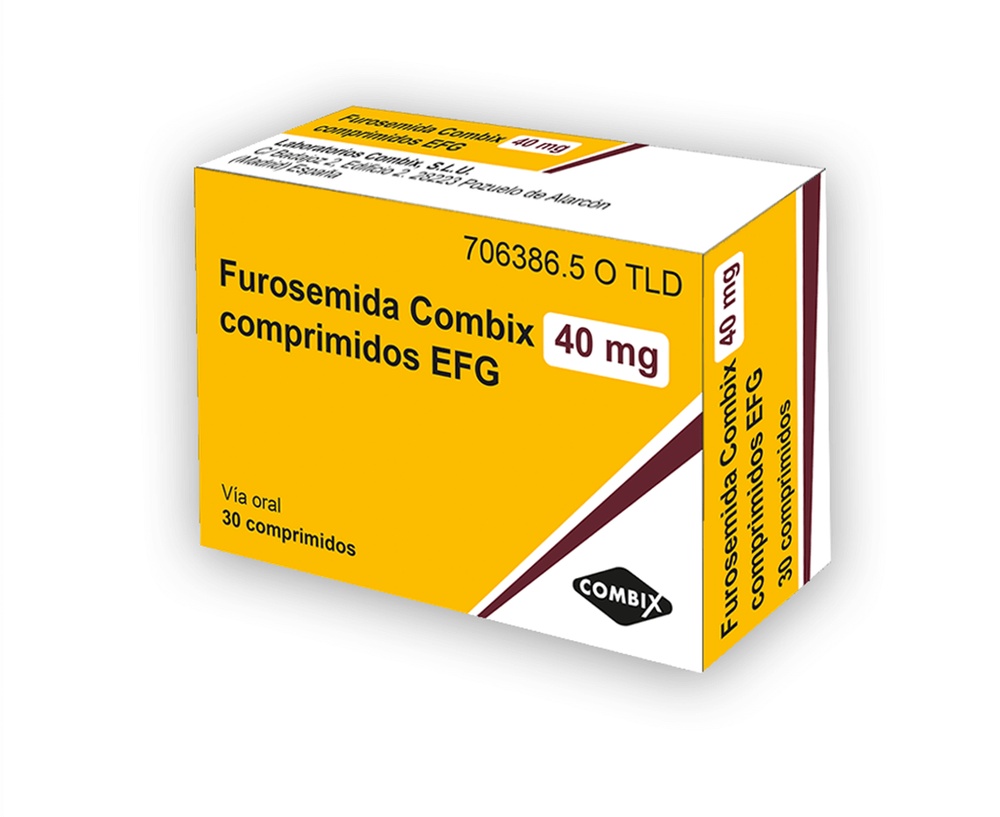
- País de registro
- Forma farmacéuticaCOMPRIMIDO, 40 MG
- Código ATCC03CA01
- Precio medio en farmacia1.06 EUR
- Principio activo
- Requiere recetaSí
- Fabricante
- ComposiciónLACTOSA MONOHIDRATO (PHARMATOSE 200M) (80,450 mg mg), LAURILSULFATO DE SODIO (0,750 mg mg)
- Esta información es de carácter general y no sustituye la consulta con un profesional sanitario.
- Alternativas a FUROSEMIDA COMBIX 40 MG COMPRIMIDOS EFGForma farmacéutica: COMPRIMIDO, 40 mgPrincipio activo: FurosemidaFabricante: Uxa Farma S.A.Requiere recetaForma farmacéutica: INYECTABLE PERFUSION, 10 MG/MLPrincipio activo: FurosemidaFabricante: Altan Pharmaceuticals SaRequiere recetaForma farmacéutica: COMPRIMIDO, 40 mgPrincipio activo: FurosemidaFabricante: Laboratorios Alter S.A.Requiere receta
Médicos online para FUROSEMIDA COMBIX 40 MG COMPRIMIDOS EFG
Comenta la dosis, los posibles efectos secundarios, interacciones, contraindicaciones o la revisión de receta de FUROSEMIDA COMBIX 40 MG COMPRIMIDOS EFG, sujeto a valoración médica y a la normativa local.
Obtén una receta de FUROSEMIDA COMBIX 40 MG COMPRIMIDOS EFG online
Rellena un formulario de 2 minutos
Cuéntanos tus síntomas, historial y el medicamento que necesitas.
Elige un médico o nosotros te asignamos uno
Escoge un especialista o te conectamos con el próximo médico disponible.
El médico revisa tu caso
Normalmente en 30 minutos. Puede hacerte preguntas adicionales por chat.
Recógela en cualquier farmacia
Receta electrónica enviada a tu correo, válida en toda España.
Preguntas frecuentes
FUROSEMIDA COMBIX 40 MG COMPRIMIDOS EFG requiere receta en España. Puedes confirmarlo con un médico online según tu caso.
El principio activo de FUROSEMIDA COMBIX 40 MG COMPRIMIDOS EFG es Furosemida. Esta información ayuda a identificar medicamentos con la misma composición pero con diferentes nombres comerciales.
El precio medio en farmacia de FUROSEMIDA COMBIX 40 MG COMPRIMIDOS EFG es de aproximadamente 1.06 EUR. Puede variar según el fabricante y la forma farmacéutica.
FUROSEMIDA COMBIX 40 MG COMPRIMIDOS EFG es fabricado por Laboratorios Combix S.L.U.. La marca y el envase pueden variar según el distribuidor.
Los Médicos de familia, Psiquiatras, Dermatólogos, Cardiólogos, Endocrinólogos, Gastroenterólogos, Neumólogos, Nefrólogos, Reumatólogos, Hematólogos, Infectólogos, Alergólogos, Geriatras, Pediatras, Oncólogos pueden valorar la prescripción de FUROSEMIDA COMBIX 40 MG COMPRIMIDOS EFG cuando esté clínicamente indicado. Puedes reservar una videoconsulta para comentar tu caso y las opciones de tratamiento.
España cuenta con una infraestructura sanitaria bien desarrollada en ciudades principales como Madrid, Barcelona, Valencia y Sevilla. Las farmacias están ampliamente disponibles y operan bajo estrictas regulaciones, garantizando el acceso a medicamentos con receta.
Puedes comprar FUROSEMIDA COMBIX 40 MG COMPRIMIDOS EFG en Madrid, Barcelona, Sevilla o Valencia en cualquier farmacia local con una receta válida.
Para obtener una receta, puedes utilizar Oladoctor:
Otros medicamentos con el mismo principio activo (Furosemida) incluyen ACUIX 40 MG COMPRIMIDOS EFG, FUROSEMIDA ALTAN 250mg/ 25ml SOLUCION PARA PERFUSION EFG, FUROSEMIDA ALTER 40 MG COMPRIMIDOS EFG. Pueden tener diferentes nombres comerciales o formulaciones, pero contienen el mismo componente terapéutico. Consulta siempre con un médico antes de cambiar o iniciar un nuevo medicamento.
