



FERBISOL 100 mg Capsulas Gastrorresistentes

Revisión de receta online
Un médico revisará tu caso y determinará si la prescripción es médicamente apropiada.

Habla con un médico sobre este medicamento
Comenta tus síntomas y las opciones de tratamiento en una consulta online.



Cómo usar FERBISOL 100 mg CAPSULAS GASTRORRESISTENTES
Contenido del prospecto
- Introducción
- Qué es Ferbisol y para qué se utiliza
- Qué necesita saber antes de empezar a tomar Ferbisol
- Cómo tomar Ferbisol
- Duración del tratamiento
- Posibles efectos adversos
- Conservación de Ferbisol
- Contenido del envase e información adicional
Introducción
Prospecto: información para el paciente
Ferbisol 100 mg cápsulas duras gastrorresistentes
Hierro (Fe2+)
Lea todo el prospecto detenidamente antes de empezar a tomar este medicamento, porque contiene información importante para usted.
- Conserve este prospecto, ya que puede tener que volver a leerlo.
- Si tiene alguna duda, consulte a su médico o farmacéutico.
- Este medicamento se le ha recetado solamente a usted, y no debe dárselo a otras
personas aunque tengan los mismos síntomas que usted, ya que puede perjudicarles.
- Si experimenta efectos adversos, consulte a su médico o farmacéutico, incluso si se trata
de efectos adversos que no aparecen en este prospecto. Ver sección 4.
Contenido del prospecto
- Qué es Ferbisol y para qué se utiliza
- Qué necesita saber antes de empezar a tomar Ferbisol
- Cómo tomar Ferbisol
- Posibles efectos adversos
- Conservación de Ferbisol
- Contenido del envase e información adicional
1. Qué es Ferbisol y para qué se utiliza
Ferbisol es una forma de hierro que puede tomarse por vía oral para tratar o prevenir la deficiencia de hierro. El hierro es esencial para el transporte de oxígeno y la transferencia de energía en el organismo. Las cápsulas se denominan gastrorresistentes porque no liberan su contenido en el estómago. Liberan el hierro en su intestino donde es absorbido.
Ferbisol se usa para el tratamiento de la deficiencia de hierro.

¿No estás seguro de si este medicamento es adecuado para ti?
Comenta tus síntomas y tratamiento con un médico online.
2. Qué necesita saber antes de empezar a tomar Ferbisol
No tome Ferbisol
- Si es alérgico al complejo de hierro o a alguno de los demás componentes de este medicamento (incluidos en la sección 6),
- Si tiene un estrechamiento en su garganta (esófago),
- Si sufre una enfermedad llamada enfermedad hereditaria del almacenamiento de hierro (hemocromatosis),
- Si sufre una enfermedad con acumulación de hierro (hemolisis crónica, talasemia, otras hemoglobinopatías),
- Si sufre algún trastorno en la utilización del hierro (p.ej., anemia sideroblástica (se pueden producir glóbulos rojos defectuosos), anemia por plomo),
- Si recibe transfusiones de sangre periódicas.
Niños
- Los niños menores de 6 años no deben tomar Ferbisol.
- Los niños de 6 años en adelante, cuyo peso corporal sea inferior a 20 kg, no deben tomar Ferbisol.
Advertencias y precauciones
Consulte a su médico o farmacéutico antes de empezar a tomar Ferbisol.
Se debe tener especial cuidado con Ferbisol.
- Si ya sufre una enfermedad del sistema digestivo tal como enfermedad inflamatoria crónica del intestino, estrechamiento del esófago e intestino, protuberancias en el intestino (divertículos), gastritis, úlceras gástricas e intestinales.
- Si sufre de enfermedad renal crónica que requiere eritropoyetina, el hierro se debe administrar intravenosamente ya que el hierro por vía oral es absorbido pobremente en individuos urémicos.
- Si sufre de insuficiencia hepática y/o sufre de alcoholismo.
- Si es una persona de edad avanzada, con pérdidas de sangre o hierro de origen desconocido. En este caso, la causa de la anemia/fuente de la hemorragia se tiene que estudiar cuidadosamente.
- Sus dientes pueden colorearse durante el tratamiento con Ferbisol (esta coloración puede desaparecer cuando deje de tomar Ferbisol. Si no es así, puede eliminarla con una pasta dentífrica abrasiva o con una limpieza dental profesional).
Niños
- Tenga especial cuidado cuando administre Ferbisol a niños, ya que una sobredosis puede conducir al envenenamiento en niños.
Otros medicamentos y Ferbisol
Informe a su médico o farmacéutico si está utilizando, ha utilizado recientemente o podría tener que utilizar cualquier otro medicamento.
Aumento de la eficacia y de los posibles efectos adversos
- Los calmantes para el dolor (analgésicos) y antirreumáticos (p. ej., salicilatos y fenilbutazona): pueden empeorar cualquier irritación de la mucosa del estómago que pueda causar Ferbisol.
- La administración de hierro intravenoso concomitantemente con la administración de hierro oral puede inducir disminución de la presión sanguínea (hipotensión) o incluso colapso por la liberación muy rápida de hierro y una posible sobrecarga. No se recomienda esta combinación.
Disminución de la eficacia y posible aumento de los efectos adversos
- Ciertos antibióticos (tetraciclinas) o medicamentos (bis-fosfonatos) usados para el tratamiento de los huesos debilitados (osteoporosis): si está tomando Ferbisol se reduce tanto la absorción de hierro como la absorción de tetraciclinas o bis-fosfonatos. Esto quiere decir que los efectos de todos estos medicamentos se reducirán. Pregunte a su médico si necesita aumentar la dosis de estos medicamentos.
- Medicamentos que contienen calcio, magnesio o aluminio, p. ej. antiácidos, sales de calcio y magnesio para sustitución: estos medicamentos reducen o impiden que absorba el hierro de Ferbisol. Puede necesitar incrementar la cantidad de Ferbisol que toma.
- Los medicamentos para la artritis, tales como penicilamina y compuestos de oro administrados por vía oral, medicamentos para la enfermedad de Parkinson, tales como la L-metildopa y levodopa y L-tiroxina, utilizados en el tratamiento de la deficiencia de tiroxina: estos medicamentos son peor absorbidos cuando toma Ferbisol con hierro. Debe consultar a su médico si necesita incrementar su dosis de estos medicamentos.
- Tratamientos para infecciones (antibióticos) del grupo conocido como fluoroquinolonas, tales como ciprofloxacino, levofloxacino, norfloxacino y ofloxacino: el hierro reduce mayoritariamente la cantidad absorbida de estos fármacos. Debe consultar a su médico si está tomando Ferbisol antes de comenzar un tratamiento con estos medicamentos.
El intervalo de tiempo entre la administración de Ferbisol y cualquiera de los medicamentos anteriormente mencionados debe ser al menos de 2 horas.
El intervalo entre la administración de Ferbisol y tetraciclinas y otras doxiciclinas (ver a continuación) debe ser al menos de 3 horas.
- No debe tomar doxiciclina y Ferbisol juntos, ya que doxiciclina puede inhibir la absorción y circulación de Ferbisol.
Otros posibles efectos secundarios
- Pueden originarse en los ensayos de trazas de sangre en heces falsos positivos con frecuencia.
Toma de Ferbisolcon alimentos y bebidas
Ferbisol no debe tomarse con la comida. Algunas sustancias contenidas en los alimentos vegetales (p. ej., cereales y verduras) pueden formar complejos con el hierro (p. ej., fitatos, oxalatos y fosfatos). Estos complejos interrumpen la absorción de hierro. Los ingredientes del café, té, leche y bebidas con cola pueden reducir también la absorción de hierro en la sangre.
El intervalo entre la administración de estos compuestos y Ferbisol debe ser al menos de dos horas.
Embarazo, lactancia y fertilidad
No hay riesgos conocidos cuando se usa Ferbisol durante el embarazo y lactancia.
Si está embarazada o en periodo de lactancia, cree que podría estar embarazada o tiene intención de quedarse embarazada, consulte a su médico o farmacéutico antes de utilizar este medicamento.
Conducción y uso de máquinas
Ferbisol no afecta a su habilidad para conducir o manejar maquinaria.
Ferbisol contiene lauril sulfato de sodio
Este medicamento contiene menos de 23 mg de sodio (1mmol) por cápsula; esto es,
esencialmente "exento de sodio".
3. Cómo tomar Ferbisol
Siga exactamente las instrucciones de administración de este medicamento indicadas por su médico. En caso de duda, consulte de nuevo a su médico o farmacéutico.
No debe tomar más de 5 mg de Ferbisol por cada kilo de peso. Por ejemplo, si pesa 60 kg, la dosis máxima diaria debería ser 5 x 60 = 300 mg (3 cápsulas).
A menos que su médico lo prescriba de otra manera, la dosis usual es:
Niños mayores de 6 años (con un peso corporal mínimo de 20 kg), adolescentes y adultos
Peso corporal (kg) | Cápsulas por toma | Frecuencia de las tomas | Dosis total de Fe2+ (mg) |
≥ 20 | 1 | 1 vez al día | 100 |
Adolescentes mayores de 15 años (con un peso corporal superior a 50 kg) y adultos.
En adolescentes mayores de 15 años y adultos se recomiendan las siguientes dosis al comienzo del tratamiento en casos de deficiencia de hierro pronunciada.
Peso corporal (kg) | Cápsulas por toma | Frecuencia de las tomas | Dosis total de Fe2+ (mg) |
50 - < 60 | 1 | 2 veces al día | 200 |
≥ 60 | 1 | 2 – 3 veces al día distribuidos a lo largo del día | 200 -300 |
Uso enniños y adolescentes
Ferbisol no debe usarse en niños menores de 6 años (con un peso corporal de menos de 20 kg) (ver sección 2).
A niños mayores de 6 años (peso corporal mínimo de 20 kg) (ver sección 2) puede administrarse una cápsula al día. Para otras dosis, ver tabla.
Modo de administración
Tomar las cápsulas de Ferbisol con suficiente agua. NO mastique la cápsula. Las cápsulas se toman con un intervalo de separación suficiente de tiempo desde las comidas (por ejemplo, con el estómago vacío por la mañana o entre las comidas principales), porque la absorción puede reducirse por los ingredientes de la comida.
Nota
Si no puede tragar las cápsulas o no le gusta, puede vaciar la cápsula y tragarse el contenido. Al hacer esto, separar cuidadosamente las dos partes de la cápsula sobre un tazón. Agitar suavemente el contenido, recoger con una cucharilla e ingerirlo. Debe beber algo de agua tras ingerir el contenido de la cápsula.

¿Has empezado a tomar el medicamento y tienes preguntas?
Comenta tus síntomas y tratamiento con un médico online.
Duración del tratamiento
Su médico decidirá la duración de su tratamiento.
El tratamiento debe continuar hasta que alcance niveles de hierro en sangre normales, esto requiere entre 10 a 20 semanas, o más tiempo en el caso de persistir la patología subyacente.
La duración del tratamiento para prevenir la deficiencia de hierro varía dependiendo de la situación (embarazo, donación de sangre, hemodiálisis crónica, transfusión autóloga planeada).
Si toma más Ferbisol del que debe
Después de una sobredosis intencionada o accidental, los síntomas descritos en el apartado 4 “Posibles efectos adversos” son los que se producen más frecuentemente y serán más graves.
Si ha tomado mucho Ferbisol debe informar a su médico inmediatamente.
La sobredosis puede causar envenenamiento, especialmente en niños.
El envenenamiento por hierro puede presentar síntomas como agitación, dolor de estómago, náuseas, vómitos y diarrea. Las heces muestran una coloración alquitranada, el vómito puede contener sangre. Pueden producirse shock, cambios metabólicos tales como aumento de la cantidad de ácido en el organismo y coma. Puede producirse la muerte después de convulsiones, respiración Cheyne-Stokes (modelo anormal de respiración, caracterizada por periodos alternativos de respiración superficial y respiración profunda), coma y edema pulmonar.
En caso de sobredosis o ingestión accidental, consultar al Servicio de Información Toxicológica, teléfono 91 562 04 20.
Si olvidó tomar Ferbisol
No tome una dosis doble para compensar las dosis olvidadas. Si ha olvidado tomar una o varias dosis de Ferbisol, continúe tomándolo durante un poco más de tiempo.
Si interrumpe el tratamiento con Ferbisol
No necesita tomar precauciones especiales antes de interrumpir el tratamiento con Ferbisol.
Si tiene cualquier otra duda sobre el uso de este medicamento, pregunte a su médico o farmacéutico.
4. Posibles efectos adversos
Al igual que todos los medicamentos, este medicamento puede producir efectos adversos, aunque no todas las personas los sufran.
Ferbisol puede en algún caso (para el cual la frecuencia no puede ser calculada) causar una alergia grave (reacción anafiláctica). Si experimenta una erupción grave, picor y dificultad al respirar debe consultar inmediatamente a su médico.
Efectos adversos frecuentes(afectan a entre 1 y 10 pacientes de cada 100)
- molestias estomacales o intestinales (abdominales),
- ardores,
- vómitos,
- deposiciones líquidas (diarrea),
- náuseas,
- estreñimiento,
- deposiciones (heces) oscuras.
Efectos adversos raros(afectan a entre 1 y 10 pacientes de cada 10.000)
- tinción dental (ver también “Tenga especial cuidado con Ferbisol” en el apartado 2),
- hipersensibilidad de la piel (p. ej. manifestaciones en la piel, exantema, erupción, urticaria).
No conocidos(no se puede estimar la frecuencia a partir de los datos disponibles)
- dolor abdominal y dolor en el abdomen superior,
- hemorragias gastrointestinales,
- decoloración de la lengua,
- decoloración en el interior de la boca.
Otros efectos en niños
En niños menores de 6 años, las cápsulas de hierro pueden provocar intoxicaciones (ver secciones 2 y 3).
Comunicación de efectos adversos
Si experimenta cualquier tipo de efecto adverso, consulte a su médico o farmacéutico, incluso si se trata de posibles efectos adversos que no aparecen en este prospecto. También puede comunicarlos directamente a través del Sistema Español de Farmacovigilancia de medicamentos de Uso Humano: http://www.notificaram.es. Mediante la comunicación de efectos adversos usted puede contribuir a proporcionar más información sobre la seguridad de este medicamento.
5. Conservación de Ferbisol
Mantener este medicamento fuera de la vista y del alcance de los niños.
No utilice este medicamento después de la fecha de caducidad que aparece en el envase y blíster después de CAD. La fecha de caducidad es el último día del mes que se indica.
No conservar a temperatura superior a 25ºC.
Los medicamentos no se deben tirar por los desagües ni a la basura. Deposite los envases y los medicamentos que no necesita en el Punto SIGRE de la farmacia. Pregunte a su farmacéutico cómo deshacerse de los envases y de los medicamentos que ya no necesita. De esta forma, ayudará a proteger el medio ambiente.
6. Contenido del envase e información adicional
Composición de Ferbisol
- El principio activo es el complejo de ferroglicina (II) sulfato. Una cápsula contiene: 567,7 mg de complejo de ferroglicina (II) sulfato (que equivale a 100 mg de Fe2+).
- Los demás componentes son:
Pellets con el complejo de ferroglicina (II) sulfato:
Ácido ascórbico, celulosa microcristalina, hipromelosa, hidroxipropilcelulosa, copolímero del ácido metacrílico acrilato de etilo (1:1) dispersión 30% (Eudragit L30 D-55) (contiene copolímero del ácido metacrílico-acrilato de etilo, lauril sulfato de sodio, polisorbato 80), acetil trietil citrato y talco.
Cápsula:
Cuerpo: gelatina, dióxido de titanio (E 171), óxido de hierro rojo (E 172), óxido de hierro amarillo (E 172).
Tapa: gelatina, dióxido de titanio (E 171), óxido de hierro rojo (E 172), óxido de hierro negro (E 172).
Aspecto del producto y contenido del envase
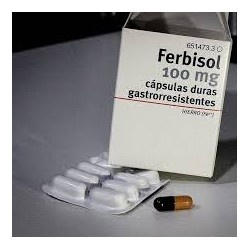
Ferbisol es una cápsula de gelatina dura gastrorresistente de tamaño aproximado 21,7 mm x 7,5 mm, con una tapa de color marrón chocolate opaco, sin grabado y un cuerpo naranja opaco, sin grabado. Contiene pellets recubiertos, entéricos, marrón grisáceo.
Ferbisol está disponible en envases que contienen 50 cápsulas gastrorresistentes.
Titular de la autorización de comercialización y responsable de la fabricación
Titular de la autorización de comercialización
UCB Pharma, S.A.
Plaza de Manuel Gómez Moreno, s/n
Edificio Bronce, Planta 5,
28020 Madrid
España
Representante local
Laboratorios BIAL, S.A.
C/Alcalá 265, Edificio 2, Planta 2ª
28027 Madrid
España
Responsable de la fabricación
Aesica Pharmaceuticals GmbH
Alfred-Nobel-Strasse 10
40789 Monheim
Alemania
Fecha de la última revisión de este prospecto:01/2024
La información detallada de este medicamento está disponible en la página web de la Agencia Española de Medicamentos y Productos Sanitarios (AEMPS) http://www.aemps.gob.es
- País de registro
- Forma farmacéuticaCAPSULA, 100 mg ferroglicina sulfato
- Código ATCB03AA01
- Precio medio en farmacia13.57 EUR
- Principio activo
- Requiere recetaSí
- Fabricante
- Esta información es de carácter general y no sustituye la consulta con un profesional sanitario.
- Alternativas a FERBISOL 100 mg CAPSULAS GASTRORRESISTENTESForma farmacéutica: CAPSULA, 100 MGPrincipio activo: ferrous glycine sulfateFabricante: Ucb Pharma S.A.Requiere recetaForma farmacéutica: SOLUCION/SUSPENSION GOTAS ORALES, 170 mg ferroglicina sulfato/mlPrincipio activo: ferrous glycine sulfateFabricante: Medix S.A.Requiere recetaForma farmacéutica: COMPRIMIDO LIBERACION MODIFICADA, 105 mgPrincipio activo: sulfato ferrosoFabricante: Teofarma S.R.L.Requiere receta
Médicos online para FERBISOL 100 mg CAPSULAS GASTRORRESISTENTES
Comenta la dosis, los posibles efectos secundarios, interacciones, contraindicaciones o la revisión de receta de FERBISOL 100 mg CAPSULAS GASTRORRESISTENTES, sujeto a valoración médica y a la normativa local.









Obtén una receta de FERBISOL 100 mg CAPSULAS GASTRORRESISTENTES online
Rellena un formulario de 2 minutos
Cuéntanos tus síntomas, historial y el medicamento que necesitas.
Elige un médico o nosotros te asignamos uno
Escoge un especialista o te conectamos con el próximo médico disponible.
El médico revisa tu caso
Normalmente en 30 minutos. Puede hacerte preguntas adicionales por chat.
Recógela en cualquier farmacia
Receta electrónica enviada a tu correo, válida en toda España.
Preguntas frecuentes
FERBISOL 100 mg CAPSULAS GASTRORRESISTENTES requiere receta en España. Puedes confirmarlo con un médico online según tu caso.
El principio activo de FERBISOL 100 mg CAPSULAS GASTRORRESISTENTES es ferrous glycine sulfate. Esta información ayuda a identificar medicamentos con la misma composición pero con diferentes nombres comerciales.
El precio medio en farmacia de FERBISOL 100 mg CAPSULAS GASTRORRESISTENTES es de aproximadamente 13.57 EUR. Puede variar según el fabricante y la forma farmacéutica.
FERBISOL 100 mg CAPSULAS GASTRORRESISTENTES es fabricado por Ucb Pharma S.A.. La marca y el envase pueden variar según el distribuidor.
Los Médicos de familia, Psiquiatras, Dermatólogos, Cardiólogos, Endocrinólogos, Gastroenterólogos, Neumólogos, Nefrólogos, Reumatólogos, Hematólogos, Infectólogos, Alergólogos, Geriatras, Pediatras, Oncólogos pueden valorar la prescripción de FERBISOL 100 mg CAPSULAS GASTRORRESISTENTES cuando esté clínicamente indicado. Puedes reservar una videoconsulta para comentar tu caso y las opciones de tratamiento.
España cuenta con una infraestructura sanitaria bien desarrollada en ciudades principales como Madrid, Barcelona, Valencia y Sevilla. Las farmacias están ampliamente disponibles y operan bajo estrictas regulaciones, garantizando el acceso a medicamentos con receta.
Puedes comprar FERBISOL 100 mg CAPSULAS GASTRORRESISTENTES en Madrid, Barcelona, Sevilla o Valencia en cualquier farmacia local con una receta válida.
Para obtener una receta, puedes utilizar Oladoctor:
Otros medicamentos con el mismo principio activo (ferrous glycine sulfate) incluyen FERRO SANOL 100 mg CAPSULAS GASTRORRESISTENTES, GLUTAFERRO 170 MG/ML GOTAS ORALES EN SOLUCIÓN, FERO-GRADUMET 105 mg COMPRIMIDOS DE LIBERACION PROLONGADA.. Pueden tener diferentes nombres comerciales o formulaciones, pero contienen el mismo componente terapéutico. Consulta siempre con un médico antes de cambiar o iniciar un nuevo medicamento.
