


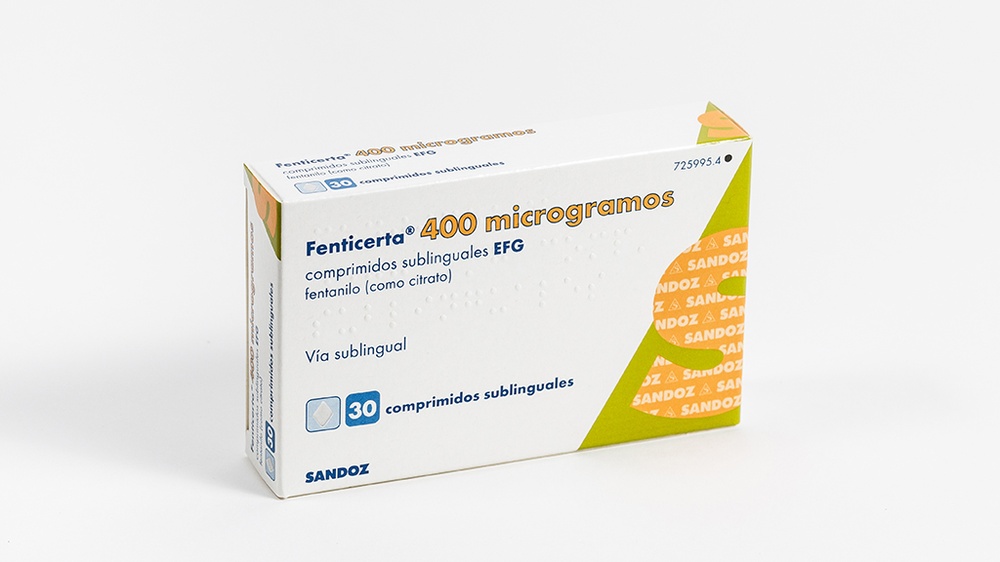
FENTICERTA 400 MICROGRAMOS COMPRIMIDOS SUBLINGUALES EFG



Cómo usar FENTICERTA 400 MICROGRAMOS COMPRIMIDOS SUBLINGUALES EFG
Traducción generada por IA
Este contenido ha sido traducido automáticamente y se ofrece solo con fines informativos. No sustituye la consulta con un profesional sanitario.
Ver originalContenido del prospecto
Introducción
Prospecto: Información para el usuario
Fenticerta®100 microgramos comprimidos sublinguales EFG
Fenticerta®200 microgramos comprimidos sublinguales EFG
Fenticerta®300 microgramos comprimidos sublinguales EFG
Fenticerta®400 microgramos comprimidos sublinguales EFG
Fenticerta®600 microgramos comprimidos sublinguales EFG
Fenticerta®800 microgramos comprimidos sublinguales EFG
fentanilo (como citrato)
Lea todo el prospecto detenidamente antes de empezar a tomar este medicamento, porque contiene información importante para usted.
- Conserve este prospecto, ya que puede tener que volver a leerlo.
- Si tiene alguna duda, consulte a su médico o farmacéutico.
- Este medicamento se le ha recetado solamente a usted, y no debe dárselo a otras personas aunque tengan los mismos síntomas que usted, ya que puede perjudicarles.
- Si experimenta efectos adversos, consulte a su médico o farmacéutico, incluso si se trata de efectos adversos que no aparecen en este prospecto. Ver sección 4.
Contenido del prospecto:
- Qué es Fenticerta y para qué se utiliza
- Qué necesita saber antes de empezar a tomar Fenticerta
- Cómo tomar Fenticerta
- Posibles efectos adversos
- Conservación de Fenticerta
- Contenido del envase e información adicional
1. Qué es Fentanilo Fenticerta y para qué se utiliza
Fenticerta es un tratamiento para adultos que estén ya tomando regularmente medicamentos potentes para el dolor (opioides)para su dolor persistente por cáncer, pero que requieren tratamiento para el dolor irruptivo. Si no está seguro, consulte con su médico.
El dolor irruptivo es un tipo de dolor que aparece de repente, incluso aunque haya tomado o utilizado su medicamento habitual opioide para su dolor.
La sustancia activa de Fenticerta es fentanilo. Fentanilo pertenece a un grupo de medicamentos potentes para el dolor denominados opioides.

2. Qué necesita saber antes de empezar a tomar Fenticerta
No tome Fenticerta:
- si es alérgico al principio activo o a alguno de los demás componentes de este medicamento (incluidos en la sección 6),
- si tiene problemas graves de respiración,
- si no está usando regularmente un medicamento opioide prescrito por su médico (p. ej., codeína, fentanilo, hidromorfona, morfina, oxicodona, meperidina), todos los días a la misma hora, al menos durante una semana, para controlar el dolor persistente. Si no ha estado usando esos medicamentos, no tomefentanilo comprimidos sublinguales dado que su uso puede aumentar el riesgo de que su respiración se vuelva más lenta y/o poco profunda, e incluso de que se llegue a parar,
- si padece dolor de corta duración distinto al dolor irruptivo.
Advertencias y precauciones
Conserve este medicamento en un lugar seguro y protegido, al que no puedan acceder otras personas (ver sección 5 “Conservación de Fenticerta”, para más información).
Consulte a su médico o farmacéutico o enfermero antes de empezar a tomar Fenticerta si tiene o ha tenido alguno de los síntomas que se detallan a continuación, ya que su médico necesitará tenerlo en cuenta cuando le prescriba su dosis:
- Una lesión en la cabeza, ya que Fenticerta puede disimular la extensión del daño
- Problemas de respiración o miastenia grave (una condición caracterizada por la debilidad muscular)
- Si tiene problemas de corazón, especialmente frecuencia cardiaca baja
- Tensión sanguínea baja
- Enfermedad de hígado o riñón, ya que puede necesitar que su médico ajuste la dosis con más precaución
- Tumor cerebral y/o presión intracraneal elevada (aumento de la presión en el cerebro que produce dolor de cabeza grave, náuseas, vómitos y visión borrosa)
- Heridas en la boca o mucositis (inflamación y enrojecimiento del interior de la boca)
- Si toma antidepresivos o antipsicóticos; consulte la sección “Otros medicamentos y Fenticerta”.
- Si alguna vez ha presentado insuficiencia suprarrenal o falta de hormonas sexuales (deficiencia de andrógenos) con el uso de opioides.
Cuando esté tomando fentanilo comprimidos sublinguales, informe a su médico o dentista de que está tomando este medicamento, si
- va a sufrir alguna operación
- siente dolor o mayor sensibilidad al dolor (hiperalgesia) que no responde a una dosis más alta del medicamento tal como se lo recetó el médico.
- presenta una combinación de los siguientes síntomas: náuseas, vómitos, anorexia, fatiga, debilidad, mareo y presión arterial baja. Juntos, estos síntomas pueden ser una indicación de una afección potencialmente mortal denominada insuficiencia suprarrenal, en la que las glándulas suprarrenales no producen suficientes hormonas.
Consulte a su médico DURANTEel uso de Fenticerta:
- si presenta trastornos respiratorios relacionados con el sueño: Fenticerta puede causar trastornos respiratorios relacionados con el sueño tales como apnea del sueño (pausas respiratorias durante el sueño) e hipoxemia relacionada con el sueño (nivel bajo de oxígeno en la sangre). Los síntomas pueden incluir pausas respiratorias durante el sueño, despertar nocturno debido a dificultad para respirar, dificultad para mantener el sueño o somnolencia excesiva durante el día. Si usted u otra persona observan estos síntomas, póngase en contacto con su médico. Es posible que su médico considere la posibilidad de reducir la dosis.
Uso a largo plazo y tolerancia
Este medicamento contiene fentanilo, un opioide. El uso repetido de analgésicos opioides puede hacer que el fármaco sea menos eficaz (el organismo se acostumbra a él, lo que se conoce como tolerancia farmacológica). También es posible que se vuelva más sensible al dolor cuando se use Fenticerta. Esto se conoce como hiperalgesia. Aumentar la dosis de Fenticerta puede seguir reduciendo el dolor durante un tiempo, pero también puede ser perjudicial. Si observa que el medicamento pierde eficacia, consulte a su médico. Su médico decidirá si es mejor que aumente la dosis o que disminuya gradualmente el uso de Fenticerta.
Dependencia y adicción
Este medicamento contiene fentanilo, que es un opioide. Puede producir dependencia y/o adicción. |
El uso repetido de Fenticerta también puede provocar dependencia, abuso y adicción, lo que podría dar lugar a una sobredosis potencialmente mortal. El riesgo de estos efectos adversos puede ser mayor con una dosis más alta y un uso más prolongado. La dependencia o la adicción pueden provocar la sensación de falta de control sobre la cantidad de medicamento que debe usar o sobre la frecuencia con la que debe usarlo. Es posible que sienta la necesidad de seguir usando el medicamento aunque no ayude a aliviar el dolor.
El riesgo de dependencia o adicción varía de una persona a otra. El riesgo de volverse dependiente o adicto a Fenticerta puede ser mayor si:
- usted o cualquier miembro de su familia han abusado del alcohol o experimentado dependencia de él, de medicamentos con receta o de drogas ilegales («adicción»).
- fuma.
- ha tenido alguna vez problemas de humor (depresión, ansiedad o un trastorno de la personalidad) o ha seguido tratamiento instaurado por un psiquiatra por otras enfermedades mentales.
Si nota cualquiera de los siguientes síntomas mientras utiliza Fenticerta, podría ser un signo de dependencia o adicción.
- necesita usar el medicamento durante más tiempo del indicado por su médico.
- necesita usar una dosis superior a la recomendada.
- está utilizando el medicamento por motivos distintos a los prescritos, por ejemplo, «para mantenerse tranquilo» o «para ayudarle a dormir».
- ha realizado intentos repetidos e infructuosos de dejar de usar el medicamento o controlar su uso.
- se siente indispuesto cuando deja de usar el medicamento (por ejemplo, náuseas, vómitos, diarrea, ansiedad, escalofríos, temblores y sudoración), y se siente mejor una vez que vuelve a tomarlo («efectos de abstinencia»).
Si nota cualquiera de estos signos, consulte a su médico para determinar la mejor modalidad de tratamiento para usted, cuándo es apropiado suspender el medicamento y cómo hacerlo de forma segura
Si se interrumpe el tratamiento, pueden aparecer síntomas de abstinencia. Informe a su médico o enfermera si usted cree que le está pasando esto (ver también sección 4. Posibles efectos adversos).
Uso en deportistas
Este medicamento contiene fentanilo que puede producir un resultado positivo en las pruebas de control de dopaje.
Otros medicamentos y Fenticerta
Informe a su médico o farmacéutico que está utilizando, ha utilizado recientemente o pudiera tener que utilizar cualquier otro medicamento (que no sean los medicamentos opioides que toma regularmente para el dolor).
Algunos medicamentos pueden aumentar o disminuir los efectos de Fenticerta. En consecuencia, si usted comienza, modifica la dosis o suspende el tratamiento con los siguientes medicamentos, infórmelo a su médico, ya que es posible que deba ajustar su dosis de fentanilo comprimidos sublinguales:
- Ciertos tipos de medicamentos antifúngicos conteniendo sustancias como ketoconazol o itraconazol (utilizados para tratar infecciones por hongos)
- Ciertos tipos de medicamentos antibióticos utilizados para tratar infecciones (llamados macrólidos, conteniendo sustancias como eritromicina)
- Ciertos tipos de medicamentos antivirales denominados inhibidores de la proteasa, que contienen, por ejemplo, ritonavir (utilizados para tratar las infecciones producidas por virus).
- Rifampicina o rifabutina (medicamentos utilizados para tratar infecciones bacterianas)
- Carbamazepina, fenitoína o fenobarbital (medicamentos utilizados para tratar convulsiones).
- Medicamentos a base de plantas que contengan hierba de San Juan (Hypericum perforatum)
- Medicamentos que contengan alcohol
- Medicamentos llamados inhibidores de monoamino-oxidasa (MAO), utilizados para el tratamiento de la depresión grave y enfermedad de Parkinson. Informe a su médico si ha tomado este tipo de medicamentos en las últimas dos semanas
- Determinados tipos de analgésicos potentes, denominados agonistas/antagonistas parciales, como buprenorfina, nalbufina y pentazocina (medicamentos para tratar el dolor) y algunos analgésicos para el dolor neuropático (gabapentina y pregabalina). Puede experimentar síntomas del síndrome de abstinencia (náuseas, vómitos, diarrea, ansiedad, escalofríos, temblores y sudoración) mientras utiliza estos medicamentos.
Fenticerta puede aumentar el efecto de los medicamentos que le hacen sentir sueño, incluidos:
- otros medicamentos potentes para aliviar el dolor(medicamentos tipo opioide, para el dolor y la tos)
- anestésicos generales (utilizados para dormirle durante las operaciones)
- relajantes musculares
- pastillas para dormir
- medicamentos utilizados para tratar
- depresión
- alergias
- ansiedad y psicosis
- medicamentos que contengan clonidina (utilizada para tratar la tensión sanguínea elevada)
El riesgo de efectos adversos aumenta si está tomando medicamentos tales como ciertos antidepresivos o antipsicóticos. Fenticerta puede interactuar con estos medicamentos y usted puede presentar cambios en el estado mental (p. ej., agitación, alucinaciones, coma) y otros efectos como temperatura corporal mayor de 38°C, aumento de la frecuencia cardiaca, presión arterial inestable y exageración de los reflejos, rigidez muscular, falta de coordinación y/o síntomas gastrointestinales (p. ej., náuseas, vómitos, diarrea). Su médico le dirá si Fenticertaes adecuado para usted.
Toma de Fenticerta con alimentos, bebidas y alcohol
Fenticerta puede producir sueño en algunas personas. No consuma alcohol sin consultar con su médico ya que puede hacerle sentir más somnoliento de lo habitual.
No beba zumo de pomelo durante su tratamiento con Fenticerta ya que puede aumentar los efectos adversos de Fenticerta.
Embarazo y lactancia
Si está embarazada o en periodo de lactancia, cree que podría estar embarazada o tiene intención de quedarse embarazada, consulte a su médico o farmacéutico antes de utilizar este medicamento.
No debe tomar fentanilo durante el embarazo a menos que su médico se lo haya indicado expresamente.
Fentanilo puede pasar a la sangre materna y provocar efectos adversos en el lactante. No use Fenticerta si está dando el pecho. No debe iniciar la lactancia hasta que hayan transcurrido al menos 5 días desde la última dosis de fentanilo comprimidos sublinguales.
Consulte a su médico o farmacéutico antes de utilizar cualquier medicamento durante el embarazo o lactancia.
Conducción y uso de máquinas
Fenticerta puede disminuir su capacidad mental y/o física para realizar tareas potencialmente peligrosas como conducir o usar máquinas.
Si se siente mareado, con sueño o tiene visión borrosa mientras toma Fenticerta, no conduzca ni maneje máquinas.
3. Cómo tomar Fenticerta
Antes de iniciar el tratamiento y de forma regular durante el mismo, su médico también le explicará lo que puede esperar del uso de Fenticerta, cuándo y durante cuánto tiempo debe usarlo, cuándo debe ponerse en contacto con su médico y cuándo debe suspender el uso (ver también la sección 2).
Siga exactamente las instrucciones de administración de este medicamento indicadas por su médico. En caso de duda, consulte de nuevo a su médico o farmacéutico.
SOLO deberá utilizar usted este medicamento conforme a las instrucciones de su médico. No lo deberá utilizar ninguna otra persona ya que podría causar GRAVES riesgos para su salud, especialmente en niños.
Fenticerta es un tipo de medicamento diferente de otros medicamentos que usted puede haber utilizado para tratar el dolor irruptivo. Siempre deberá tomar la dosis de Fenticerta tal como se lo ha indicado su médico;ésta puede ser una dosis distinta de la que usted ha utilizado con otros medicamentos para el dolor irruptivo.
Inicio del tratamiento – Establecimiento de la dosis más adecuada
Para que el tratamiento con Fenticerta tenga éxito, su médico necesitará identificar la dosis más adecuada para el tratamiento de su dolor irruptivo. Fenticerta está disponible en una amplia variedad de dosis. Puede necesitar probar diferentes dosis de Fenticerta durante diferentes episodios de dolor antes de encontrar la dosis más adecuada. Su médico le ayudará en esta tarea y encontrará la dosis más adecuada para usted.
Si no obtiene un alivio adecuado al dolor con una dosis, su médico le podrá indicar tomar una dosis adicional para tratar un episodio de dolor irruptivo. No tome una segunda dosis a menos que se lo indique su médico, ya que podría sufrir una sobredosis.
Puede que su médico le aconseje tomar una dosis compuesta por más de un comprimido al mismo tiempo. Hágalo únicamente si así se lo ha indicado su médico.
Después de tomar la última dosis, espere como mínimo dos horas antes de tratar con Fenticerta el siguiente episodio de dolor irruptivo.
Continuación del tratamiento – Una vez que se haya establecido la dosis más adecuada
Una vez que usted y su médico hayan establecido una dosis de Fenticerta que controle sus picos de dolor, no deberá tomar esta dosis más de cuatro veces al día. Una dosis de Fenticerta puede consistir en más de un comprimido.
Después de tomar la última dosis, espere como mínimo dos horas antes de tratar con Fenticerta el siguiente episodio de dolor irruptivo.
Si cree que la dosis de Fenticerta que está utilizando no controla sus picos de dolor de forma satisfactoria, informe a su médico porque puede necesitar que se le ajuste la dosis.
No debe cambiar su dosis de Fenticerta a menos que se lo indique su médico.
Toma del medicamento
Fenticerta se debe utilizar por vía sublingual. Esto significa que deberá colocarse el comprimido debajo de la lengua, donde se disolverá rápidamente para permitir que el principio activo se absorba a través del revestimiento de la boca. Una vez que se ha absorbido, comienza a actuar para aliviar el dolor.
Cuando tenga un episodio de dolor irruptivo, tome la dosis indicada por su médico como sigue:
- Si tiene la boca seca, tome un sorbo de agua para humedecerla. Escupa o trague el agua.
- Extraer el (los) comprimido (s) del blíster inmediatamente antes de su uso como sigue:
- Separe una de las unidades del blíster de la plaqueta rasgando por la línea de puntos / perforaciones (mantenga las unidades restantes del blíster juntas).
- Despegue el borde de la lámina por donde indica la flecha y extraiga el comprimido con cuidado. No intente presionar sobre los comprimidos sublinguales de Fenticerta a través de la lámina superior, ya que eso dañaría los comprimidos.
- Coloque el comprimido bajo su lengua lo más atrás que pueda, y déjelo disolver por completo.
- Fenticerta se disolverá rápidamente bajo la lengua y se absorberá para proporcionarle alivio a su dolor. Es por tanto importante que no chupe, ni mastique, ni trague el comprimido.
- No debe beber ni comer nada hasta que el comprimido se haya disuelto por completo bajo su lengua.
Si toma más Fenticerta del que debe
- Elimine cualquier comprimido restante de su boca
- Dígale a su cuidador o a otra persona lo que le ha ocurrido
- Debe contactar inmediatamente con su médico, farmacéutico u hospital local y preguntar las acciones a tomar
- Mientras espera al médico, mantenga a la persona despierta hablándole o agitándole de vez en cuando
Los síntomas de una sobredosis incluyen:
- Somnolencia extrema
- Respiración lenta, poco profunda
Si ocurre esto, pida asistencia médica inmediatamente.
Una sobredosis también puede provocar un trastorno cerebral conocido comoleucoencefalopatía tóxica.
En caso de sobredosis o ingesta accidental, consulte inmediatamente a su médico o farmacéutico o llame al servicio de Información Toxicológica, teléfono: 91 562 04 20, indicando el medicamento y la cantidad ingerida.
Si interrumpe el tratamiento con Fenticerta
Debe dejar de utilizar Fenticerta cuando ya no tenga más dolor irruptivo. Sin embargo, debe seguir tomando sus medicamentos opioides habituales para tratar el dolor persistente del cáncer tal como le haya recomendado su médico. Puede sufrir síntomas de abstinencia similares a los posibles efectos adversos de Fenticerta. Si tiene síntomas de abstinencia o si le preocupa el alivio del dolor, consulte a su médico, el cual evaluará si usted necesita algún tipo de medicamento para reducir o suprimir los síntomas de abstinencia.
Si tiene cualquier otra duda sobre el uso de este medicamento, pregunte a su médico o farmacéutico.

4. Posibles efectos adversos
Al igual que todos los medicamentos, este medicamento puede producir efectos adversos, aunque no todas las personas los sufran.
Si empieza a sentir somnolencia inusual o extrema o su respiración se vuelve poco profunda y lenta, usted o su cuidador deben contactar con su médico u hospital local para buscar ayuda de urgencia (ver también sección 3 “Si toma más Fenticerta del que debe”).
Efectos adversos muy frecuentes (pueden afectar a más de 1 de cada 10 personas) incluyen:
- náuseas
Efectos adversos frecuentes (pueden afectar hasta 1 de cada 10 personas) incluyen:
- mareos, dolor de cabeza, somnolencia excesiva
- falta de aire/dificultad para respirar
- inflamación en el interior de la boca, vómitos, estreñimiento, boca seca
- sudoración, cansancio/fatiga/falta de energía
Efectos adversos poco frecuentes (pueden afectar hasta 1 de cada 100 personas):
- reacción alérgica, temblores/estremecimiento, visión alterada o borrosa, frecuencia cardíaca lenta o rápida, presión arterial baja, pérdida de memoria
- depresión, pensamientos de sospecha/miedos sin motivo, sensación de confusión, desorientación, ansiedad/infelicidad/inquietud, sentirse inusualmente feliz/saludable, cambios del estado de ánimo
- sensación de plenitud permanente, dolor de estómago, indigestión
- úlceras en la boca, problemas en la lengua, dolor en la boca o la garganta, opresión en la garganta, úlceras en labios o encías
- pérdida de apetito, pérdida o alteración del sentido del olfato/gusto
- aturdimiento/somnolencia, dificultad para dormir o alteraciones del sueño, problemas de atención/distracción fácil, falta de energía/debilidad/pérdida de fuerza
- alteraciones en la piel, erupción cutánea, picor, sudoración nocturna, disminución de la sensibilidad al tacto, facilidad para la formación de hematomas
- dolor o rigidez articular, rigidez muscular
- síndrome de abstinencia (se puede manifestar por los siguientes efectos adversos: náuseas, vómitos, diarrea, ansiedad, escalofríos, temblor y sudoración), sobredosis accidental, en los hombres incapacidad de lograr o mantener una erección, malestar general
Efectos adversos de frecuencia no conocida (no puede estimarse a partir de los datos disponibles):
- hinchazón de la lengua,
- problemas respiratorios graves,
- caídas,
- rubor,
- sensación de mucho calor,
- diarrea,
- convulsión (crisis epiléptica),
- inflamación de brazos o piernas,
- ver o escuchar cosas que no son reales (alucinaciones),
- fiebre,
- tolerancia farmacológica, dependencia de drogas (adicción), abuso de drogas (ver sección 2),
- reducción o pérdida de consciencia,
- erupción con picor,
- delirio (los síntomas pueden consistir en una combinación de agitación, inquietud, desorientación, confusión, miedo, ver u oír cosas que realmente no existen, trastornos del sueño, pesadillas).
El tratamiento prolongado con fentanilo durante el embarazo puede causar síntomas de abstinencia en el recién nacido, que pueden ser potencialmente mortales (ver sección 2).
Comunicación de efectos adversos
Si experimenta cualquier tipo de efecto adverso, consulte con su médico o farmacéutico, incluso si se trata de posibles efectos adversos que no aparecen en este prospecto. También puede comunicarlos directamente a través del Sistema Español de Farmacovigilancia de Medicamentos de uso humano: www.notificaram.es. Mediante la comunicación de efectos adversos puede contribuir a proporcionar más información sobre la seguridad de este medicamento.
5. Conservación de Fenticerta
El alivio del dolor de este medicamento es muy fuerte y puede ser extremadamente peligroso si un niño lo tomara accidentalmente. Mantener este medicamento fuera de la vista y del alcance de los niños.
Conserve este medicamento en un lugar seguro y protegido, al que no puedan acceder otras personas. Este medicamento puede causar daños graves e incluso ser mortal para las personas que lo usen de manera accidental, o intencionadamente cuando no se les haya recetado.
Se recomienda conservar Fenticerta en un lugar cerrado o con llave.
No utilice este medicamento después de la fecha de caducidad que aparece en el blíster después de CAD/EXP. La fecha de caducidad es el último día del mes que se indica.
No requiere condiciones especiales de conservación.
Los medicamentos no se deben tirar por los desagües ni a la basura. Deposite los envases y los medicamentos que no necesita en el Punto SIGRE de la farmacia. En caso de duda pregunte a su farmacéutico cómo deshacerse de los envases y de los medicamentos que no necesita. De esta forma ayudará a proteger el medio ambiente.
6. Contenido del envase e información adicional
Composición de Fenticerta
- El principio activo es fentanilo. Un comprimido sublingual contiene:
- 100 microgramos de fentanilo (como citrato).
- 200 microgramos de fentanilo (como citrato).
- 300 microgramos de fentanilo (como citrato).
- 400 microgramos de fentanilo (como citrato).
- 600 microgramos de fentanilo (como citrato).
- 800 microgramos de fentanilo (como citrato).
- Los demás componentes son manitol (E421), celulosa microcristalina silicificada, croscarmelosa sódica y estearato de magnesio.
Aspecto del producto y contenido del envase
Fenticerta es un pequeño comprimido sublingual de color blanco que debe ser colocado debajo de la lengua. Se presenta en una amplia variedad de dosis y formas. Su médico le prescribirá la dosis (forma) y número de comprimidos adecuado para usted.
El comprimido de 100 microgramos es un comprimido circular de color blanco.
El comprimido de 200 microgramos es un comprimido ovalado de color blanco.
El comprimido de 300 microgramos es un comprimido triangular de color blanco.
El comprimido de 400 microgramos es un comprimido con forma de diamante de color blanco.
El comprimido de 600 microgramos es un comprimido con forma de “D” de color blanco.
El comprimido de 800 microgramos es un comprimido con forma de cápsula de color blanco.
Los comprimidos sublinguales se presentan en blísteres unidosis perforados a prueba de niños (PA/AL/PVC//AL/PET) e insertados en un envase de cartón.
Fenticerta está disponible en envases de 10x1 o 30x1 comprimidos.
Puede que solamente estén comercializados algunos tamaños de envases.
Titular de la autorización de comercialización y responsable de la fabricación
Titular de la autorización de comercialización
Sandoz Farmacéutica, S.A.
Centro Empresarial Parque Norte
Edificio Roble
C/ Serrano Galvache, 56
28033 MadridEspaña
Responsable de la fabricación
Prasfarma S.L.
C/ Sant Joan 11-15
08560 Manlleu – Barcelona
España
ó
KERN PHARMA, S.L.
Polígono Ind. Colón II
Venus, 72
08228 Terrassa – Barcelona
España
ó
LEK PHARMACEUTICALS D.D.
Verovškova 57
1526 Ljubljana,
Eslovenia
Fecha de la última revisión de este prospecto:abril 2025
La información detallada y actualizada de este medicamento está disponible en la página Web de la Agencia Española de Medicamentos y Productos Sanitarios (AEMPS) http://www.aemps.gob.es/
- País de registro
- Forma farmacéuticaCOMPRIMIDO SUBLINGUAL, 400 microgramos
- Código ATCN02AB03
- Precio medio en farmacia74.18 EUR
- Disponibilidad en farmacias
Problema de suministro reportado
Los datos de la Agencia Española de Medicamentos y Productos Sanitarios (AEMPS) indican un problema de suministro que afecta a este medicamento.<br><br>La disponibilidad puede ser limitada en algunas farmacias.<br><br>Para actualizaciones o alternativas, consulte a su farmacéutico. - Principio activo
- Requiere recetaSí
- Fabricante
- Esta información es de carácter general y no sustituye la consulta con un profesional sanitario.
- Alternativas a FENTICERTA 400 MICROGRAMOS COMPRIMIDOS SUBLINGUALES EFGForma farmacéutica: PARCHE TRANSDERMICO, 12 MCG/HPrincipio activo: fentaniloFabricante: Aristo Pharma Iberia S.L.Requiere recetaForma farmacéutica: COMPRIMIDO BUCAL/PARA CHUPAR, 1200 microgramosPrincipio activo: fentaniloFabricante: Ferrer Internacional S.A.Requiere recetaForma farmacéutica: COMPRIMIDO BUCAL/PARA CHUPAR, 1600 microgramosPrincipio activo: fentaniloFabricante: Ferrer Internacional S.A.Requiere receta

Médicos online para FENTICERTA 400 MICROGRAMOS COMPRIMIDOS SUBLINGUALES EFG
Comenta la dosis, los posibles efectos secundarios, interacciones, contraindicaciones o la revisión de receta de FENTICERTA 400 MICROGRAMOS COMPRIMIDOS SUBLINGUALES EFG, sujeto a valoración médica y a la normativa local.






.jpg)




Preguntas frecuentes
