



ETOXISCLEROL 5 mg /Ml Solución Inyectable

Revisión de receta online
Un médico revisará tu caso y determinará si la prescripción es médicamente apropiada.

Habla con un médico sobre este medicamento
Comenta tus síntomas y las opciones de tratamiento en una consulta online.



Cómo usar ETOXISCLEROL 5 mg/ml SOLUCIÓN INYECTABLE
Contenido del prospecto
- Introducción
- Lea todo el prospecto detenidamente antes de empezar a usar este medicamento, porque contiene información importante para usted.
- Contenido del prospecto:
- Qué es Etoxisclerol y para qué se utiliza
- Qué necesita saber antes de empezar a usar Etoxisclerol
- No use Etoxisclerol en el tratamiento esclerosante de varices
- Advertencias y precauciones
- Otros medicamentos y Etoxisclerol
- Embarazo, lactancia y fertilidad
- Conducción y uso de máquinas
- Cómo usar Etoxisclerol
- Si usa más Etoxisclerol del que debe
- Posibles efectos adversos
- Conservación de Etoxisclerol
- Contenido del envase e información adicional
- Composición de Etoxisclerol 5 mg/ml
- Aspecto del producto y contenido del envase
- Otras presentaciones
- Titular de la autorización de comercialización y responsable de la fabricación
- Fecha de la última revisión de este prospecto:junio 2021
- Forma de administración
Introducción
Prospecto: información para el usuario
Etoxisclerol 5 mg/ml solución inyectable
lauromacrogol 400
Lea todo el prospecto detenidamente antes de empezar a usar este medicamento, porque contiene información importante para usted.
- Conserve este prospecto, ya que puede tener que volver a leerlo.
- Si tiene alguna duda, consulte a su médico, farmacéutico o enfermero.
- Este medicamento se le ha recetado solamente a usted y no debe dárselo a otras personas, aunque tengan los mismos síntomas que usted, ya que puede perjudicarles.
- Si experimenta efectos adversos, consulte a su médico, farmacéutico o enfermero, incluso si se trata de efectos adversos que no aparecen en este prospecto. Ver sección 4.

¿No estás seguro de si este medicamento es adecuado para ti?
Comenta tus síntomas y tratamiento con un médico online.
Contenido del prospecto:
- Qué es Etoxisclerol y para qué se utiliza
- Qué necesita saber antes de empezar a usar Etoxisclerol
- Cómo usar Etoxisclerol
- Posibles efectos adversos
- Conservación de Etoxisclerol
- Contenido del envase e información adicional
1. Qué es Etoxisclerol y para qué se utiliza
Etoxisclerol es un esclerosante cuyo principio activo es lauromacrogol 400.
Etoxisclerol está indicado en el tratamiento esclerosante o destrucción de venas varicosas y telangiectasias (arañas vasculares).

¿Has empezado a tomar el medicamento y tienes preguntas?
Comenta tus síntomas y tratamiento con un médico online.
2. Qué necesita saber antes de empezar a usar Etoxisclerol
No use Etoxisclerol en el tratamiento esclerosante de varices
- Si es alérgico a lauromacrogol 400 o a cualquiera de los demás componentes de este medicamento (incluidos en la sección 6),
- Si padece enfermedad sistémica (que afecta a todo el cuerpo) aguda grave (especialmente en pacientes no tratados),
- Si debe permanecer en la cama o no puede caminar,
- Si padece alteración de la circulación arterial severa (enfermedad arterial oclusiva, estadios III y IV de Fontaine),
- Si padece una oclusión vascular debida a un trombo o coágulo sanguíneo (enfermedades tromboembólicas),
- Si presenta alto riesgo de oclusiones vasculares (trombosis), por ejemplo, pacientes con predisposición hereditaria a producir coágulos de sangre o con múltiples factores de riesgo como: uso de anticonceptivos hormonales (por ejemplo la píldora), tratamiento hormonal sustitutivo, sobrepeso, tabaquismo, períodos prolongados de inmovilidad, etc.
Advertencias y precauciones
Etoxisclerol debe ser administrado por un profesional de la salud con experiencia en técnicas de escleroterapia.
Consulte a su médico, farmacéutico o enfermero antes de empezar a usar Etoxisclerol:
- Si tiene fiebre,
- Si padece crisis de dificultad respiratoria (asma bronquial),
- Si padece fuerte predisposición a alergias,
- Si su estado general de salud es malo,
- Si le van a efectuar un tratamiento esclerosante de arañas vasculares: en pacientes con trastornos de la circulación arterial (enfermedades oclusivas arteriales estadio II de Fontaine),
- Si tiene las piernas hinchadas por acumulación de líquido (edema) y no puede modificarse mediante compresión,
- Si padece enfermedad inflamatoria de la piel en el área a tratar,
- Si tiene síntomas de oclusión de los vasos sanguíneos más pequeños, por ejemplo debido a la diabetes (microangiopatía) y al deterioro de la sensibilidad (neuropatía),
- Si presenta movilidad reducida,
- Si padece migrañas frecuentemente.
Otros medicamentos y Etoxisclerol
Informe a su médico o farmacéutico si está utilizando, ha utilizado recientemente o podría tener que utilizar cualquier otro medicamento.
El uso de Etoxisclerol junto con anestésicos puede aumentar el efecto anestésico en el sistema cardiovascular.
Embarazo, lactancia y fertilidad
Si está embarazada o en periodo de lactancia, cree que podría estar embarazada o tiene intención de quedarse embarazada, consulte a su médico o farmacéutico antes de utilizar este medicamento.
Si está embarazada, su médico no debe administrarle Etoxisclerol, al menos que sea estrictamente necesario, ya que no se dispone de información suficiente sobre la utilización de Etoxisclerol en mujeres embarazadas. Los estudios en animales no mostraron ninguna evidencia de malformación.
Si fuese necesario el tratamiento con Etoxisclerol durante la lactancia, se recomienda suspenderla durante 2-3 días, ya que no se dispone de datos en humanos sobre el paso de lauromacrogol 400 a la leche materna.
Conducción y uso de máquinas
No se conocen efectos negativos sobre la capacidad para conducir y utilizar máquinas debidos a la utilización de Etoxisclerol.
Etoxisclerol contiene etanol,potasio y sodio
- Este medicamento contiene 84 mg de alcohol (etanol al 96%) en cada ampolla de 2 ml que equivale a 5% (v/v). La cantidad en una ampolla de este medicamento es equivalente a menos de 3 ml de cerveza o 1 ml de vino.
- Es poco probable que la cantidad de alcohol que contiene este medicamento tenga algún efecto perceptible en adultos o adolescentes.
- La cantidad de alcohol contenida en este medicamento puede alterar el efecto de otros medicamentos. Consulte con su médico o farmacéutico si está tomando otros medicamentos. Si está embarazada o en periodo de lactancia, consulte con su médico o farmacéutico antes de tomar este medicamento.
- Si tiene adicción al alcohol, consulte con su médico o farmacéutico antes de tomar este medicamento.
- Este medicamento contiene menos de 39 mg (1 mmol) de potasio por ampolla, por lo que se considera esencialmente “exento de potasio”.
Este medicamento contiene menos de 23 mg (1 mmol) de sodio por ampolla, esto es esencialmente “exento de sodio”.
3. Cómo usar Etoxisclerol
Etoxisclerol es un medicamento cuya administración debe ser practicada por un médico, corresponde por tanto a éste el conocimiento y la elección de la posología y de la técnica más conveniente en cada caso.
En función del tamaño de la variz a tratar y la situación individual de cada paciente, su médico decidirá qué tratamiento debe aplicarle. En caso de duda se debe elegir la dosis más baja posible.
Generalmente, la dosis de 2 mg/kg/día de lauromacrogol 400 no debe ser excedida.
Para evitar una posible reacción alérgica, especialmente en un paciente con una alta predisposición a reacciones de hipersensibilidad, se recomienda que para el primer tratamiento se le administre sólo una pequeña dosis de prueba de Etoxisclerol. Dependiendo de la respuesta, se le pueden administrar varias inyecciones en sesiones de tratamiento posteriores, siempre que no se supere la dosis máxima.
Dado que el volumen a inyectar por sesión está limitado, por lo general se necesitan sesiones repetidas (de 2 a 4 de promedio).
Después de haber sido tratado con Etoxisclerol, usted deberá seguir los consejos de su médico. Puede que le aconseje llevar un vendaje o medias de compresión para ayudar a reducir la inflamación y la pigmentación de la piel.
Uso en niños y adolescentes
No hay un uso relevante de Etoxisclerol en población pediátrica.
Si usa más Etoxisclerol del que debe
En caso de sobredosis o de ingestión accidental, consulte inmediatamente a su médico, farmacéutico o llame al Servicio de Información Toxicológica, teléfono 91 562 04 20, indicando el medicamento y la cantidad ingerida.
La sobredosis puede causar la muerte local de los tejidos (necrosis), especialmente después de la inyección en el tejido próximo a la variz.
4. Posibles efectos adversos
Al igual que todos los medicamentos, este medicamento puede producir efectos adversos, aunque no todas las personas los sufran.
En esta sección informamos sobre las reacciones adversas que se han notificado asociadas al uso extendido de la sustancia activa. En algunos casos estas reacciones fueron molestas pero, en la mayoría de los casos, solo temporales. Como se trató con frecuencia de informes espontáneos, sin ninguna referencia a un grupo definido de pacientes y sin ningún grupo de referencia, no es posible calcular exactamente las frecuencias o establecer una clara relación causal al contacto con el fármaco en cada caso. Sin embargo, es posible una estimación razonable a partir de la experiencia a largo plazo.
Se han observado efectos adversos locales (ej. necrosis), especialmente en la piel y tejido próximo a la variz (y en raros casos, en los nervios) cuando se tratan varices de las piernas tras inyecciones accidentales en el tejido próximo a las mismas.
El riesgo aumenta cuando aumenta la concentración y volumen de Etoxisclerol.
Se han observado los siguientes efectos adversos con las frecuencias descritas a continuación:
- Frecuentes(pueden afectar hasta 1 de cada 10 personas):aparición de vasos sanguíneos en el área tratada no visibles antes del tratamiento (neovascularización), moretón (hematoma), manchas en la piel (hiperpigmentación), hemorragia cutánea (equimosis), dolor en el lugar de inyección (a corto plazo), trombosis en el lugar de inyección (coágulos sanguíneos locales intravaricosos).
- Poco frecuentes (pueden afectar hasta 1 de cada 100 personas):inflamación venosa (tromboflebitis superficial, flebitis), inflamación alérgica de la piel (dermatitis), urticaria de contacto, reacción en la piel, enrojecimiento de la piel (eritema), muerte local de los tejidos (necrosis), endurecimiento de los tejidos, hinchazón, lesión del nervio.
- Raros (pueden afectar hasta 1 de cada 1000 personas):trombosis venosa profunda (posiblemente debido a otra enfermedad que padece al mismo tiempo), dolor en las extremidades.
- Muy raros (pueden afectar hasta 1 de cada 10.000 personas):shock anafiláctico (reacción alérgica grave y súbita, cuyos síntomas son dificultad para respirar, mareo, caída de la presión arterial), angioedema (cuyos síntomas incluyen hinchazón repentina, especialmente en la cara, por ejemplo, de párpados, labios o laringe), urticaria generalizada, asma (crisis asmática), ictus (accidente cerebrovascular), debilidad causante de pérdida de mobilidad en una parte del cuerpo (hemiparesia), dolor de cabeza, migraña, alteraciones sensoriales locales (parestesia local), sensibilidad o sensaciones en la boca disminuidas (hipoestesia oral), pérdida de conciencia, confusión, transtornos del habla de origen central (afasia), dificultad en controlar movimientos (ataxia), mareo, alteraciones visuales, ataque al corazón (paro cardíaco), síndrome del corazón roto (miocardiopatía de estrés), latidos rápidos o irregulares del corazón (palpitaciones), frecuencia cardíaca anormal, obstrucción de la arteria pulmonar (embolia pulmonar), desvanecimiento (síncope vasovagal), colapso circulatorio, inflamación de la pared de los vasos sanguíneos (vasculitis), dificultad para respirar (disnea), sensación de presión en el pecho, tos, trastornos del gusto, náuseas, vómitos, crecimiento excesivo del pelo (hipertricosis) en el área sometida al tratamiento, fiebre, sofocos, debilidad inusual (astenia), malestar general, presión sanguínea anormal.
Comunicación de efectos adversos
Si experimenta cualquier tipo de efecto adverso, consulte a su médico o farmacéutico, incluso si se trata de posibles efectos adversos que no aparecen en este prospecto. También puede comunicarlos directamente a través del Sistema Español de Farmacovigilancia de Medicamentos de Uso Humano: https://www.notificaram.es. Mediante la comunicación de efectos adversos usted puede contribuir a proporcionar más información sobre la seguridad de este medicamento.
5. Conservación de Etoxisclerol
Este medicamento no requiere ninguna temperatura especial de conservación.
Mantener este medicamentofuera de la vista y del alcance de los niños.
No utilice este medicamento después de la fecha de caducidad que aparece en el envase, después de CAD. La fecha de caducidad es el último día del mes que se indica.
Los medicamentos no se deben tirar por los desagües ni a la basura. Deposite los envases y los medicamentos que no necesita en el punto SIGRE de la farmacia. En caso de duda pregunte a su farmacéutico cómo deshacerse de los envases y de los medicamentos que ya no necesita. De esta forma, ayudará a proteger el medio ambiente.
6. Contenido del envase e información adicional
Composición de Etoxisclerol 5 mg/ml
- El principio activo es lauromacrogol 400.
Cada ml de solución inyectable contiene 5 mg de lauromacrogol 400.
Cada ampolla de 2 ml de solución inyectable contiene 10 mg de lauromacrogol 400.
- Los demás componentes (excipientes) son: etanol 96%, dihidrogenofosfato de potasio, hidrogenofosfato de disodio dihidrato, agua para preparaciones inyectables.
Aspecto del producto y contenido del envase
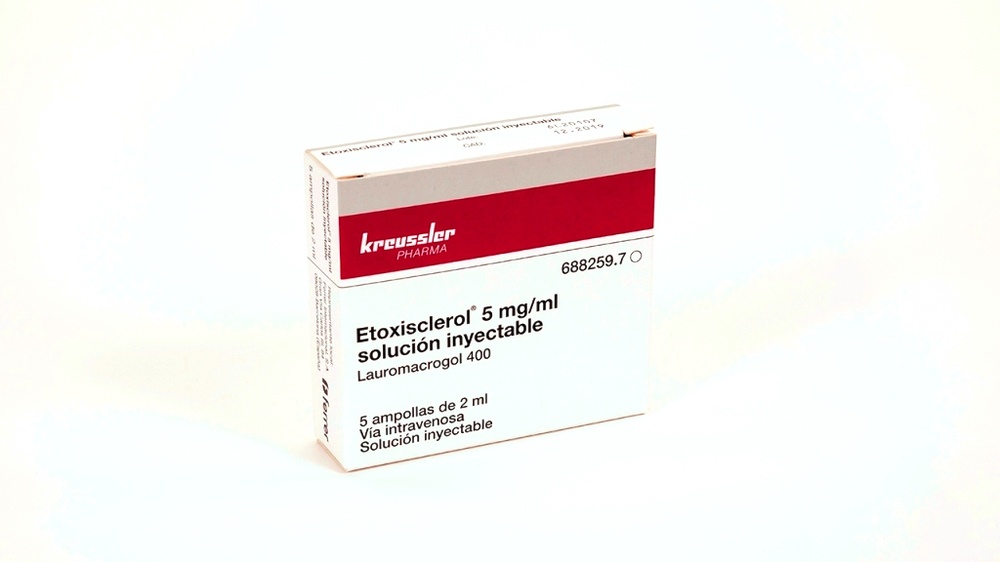
Etoxisclerol es una solución transparente, con un ligero color amarillo verdoso. Se presenta como solución inyectable en estuche conteniendo 5 ampollas de 2 ml cada una.
Otras presentaciones
- Etoxisclerol 10 mg/ml solución inyectable. Estuche conteniendo 5 ampollas de 2 ml cada una.
- Etoxisclerol 20 mg/ml solución inyectable. Estuche conteniendo 5 ampollas de 2 ml cada una.
- Etoxisclerol 30 mg/ml solución inyectable. Estuche conteniendo 5 ampollas de 2 ml cada una.
Titular de la autorización de comercialización y responsable de la fabricación
Chemische Fabrik Kreussler & Co. GmbH
Rheingaustrasse 87-93
65203 Wiesbaden, Alemania
tel.: +49 611 9271-0
fax: +49 611 9271-111
e-mail: [email protected]
Pueden solicitar más información respecto a este medicamento dirigiéndose al representante local del titular de la autorización de comercialización:
FERRER FARMA, S.A.
Av. Diagonal 549 5ª Planta,
08029 Barcelona (España)
Fecha de la última revisión de este prospecto:junio 2021
La información detallada y actualizada de este medicamento está disponible en la página web de la Agencia Española de Medicamentos y Productos Sanitarios (AEMPS) http://www.aemps.gob.es/
Está información está destinada únicamente a profesionales del sector sanitario
Para más información, ver la Ficha Técnica.
Precauciones importantes para la utilización
- Etoxisclerol deberá ser administrado únicamente por un profesional de la salud experimentado en anatomía venosa y en diagnóstico y tratamiento de las enfermedades que afectan al sistema venoso y que esté familiarizado con una técnica de inyección correcta.
- Antes del tratamiento el profesional sanitario debe investigar los factores de riesgo del paciente e informarles sobre los riesgos de esta técnica. La escleroterapia está particularmente no recomendada en pacientes con un historial de eventos tromboembólicos. No obstante si se juzgara necesaria la escleroterapia, se puede iniciar una anticoagulación preventiva.
- Efectos locales adversos severos, como necrosis de los tejidos, pueden ocurrir tras la extravasación, por lo tanto, se debe tener mucho cuidado en la colocación de la aguja intravenosa y es importante utilizar el mínimo volumen efectivo en cada sitio de inyección.
- Los esclerosantes no deben inyectarse nunca de forma intraarterial porque puede producirse necrosis severa que puede llegar a precisar amputación. En caso de accidente, deberá recurrirse inmediatamente a tratamiento quirúrgico vascular.
- El uso de cualquier tipo de esclerosante en el área facial debe ser estrictamente valorado, ya que las inyecciones intravasculares pueden dar lugar a presión negativa en las arterias y provocar pérdida de visión irreversible.
- En algunas partes del cuerpo como los pies o la región maleolar el riesgo de infiltrar de forma inadvertida en el interior de la arteria puede verse aumentado. Por lo tanto, sólo se deberán usar pequeñas cantidades y en bajas concentraciones con especial cuidado durante este tipo de tratamiento.
Posologíade dosis única y diaria
Adultos y ancianos
Generalmente, la dosis de 2 mg/kg/día de lauromacrogol 400 no debe ser excedida.
Concentración | Volumen normal inyectado por vía intravenosa en los lugares apropiados por punción | Volumen total máximo a inyectar por día en un paciente de 70 kg |
Etoxisclerol 5 mg/ml | 0,1 – 0,3 ml | 28 ml |
Para evitar una posible reacción alérgica, especialmente en un paciente con una alta predisposición a reacciones de hipersensibilidad, se recomienda que para el primer tratamiento se le administre sólo una pequeña dosis de prueba de Etoxisclerol. Dependiendo de la respuesta, se le pueden administrar varias inyecciones en sesiones de tratamiento posteriores, siempre que no se supere la dosis máxima.
Dado que el volumen a inyectar por sesión está limitado, por lo general se necesitan sesiones repetidas (de 2 a 4 de promedio).
Población pediátrica
No hay un uso relevante de Etoxisclerol en población pediátrica.
Forma de administración
Todas las inyecciones deben administrarse por vía intravenosa; la posición de la aguja debe ser comprobada (por ejemplo, mediante una aspiración de sangre).
Independientemente del modo de punción venosa (en un paciente de pie con sólo una cánula o en un paciente sentado con una jeringa lista para la inyección), las inyecciones se llevarán a cabo normalmente en una pierna en posición horizontal. Se recomiendan jeringas desechables de movimiento suave para la escleroterapia, así como agujas de diferentes diámetros, en función de la indicación.
Para telangiectasias se usan agujas muy finas (por ejemplo, agujas de insulina). La punción se realiza tangencialmente y la inyección se administra lentamente.
El esclerosante debe ser administrado por vía intravenosa en pequeñas alícuotas en múltiples puntos de la vena a tratar. En el tratamiento de las venas perforantes, se recomienda no inyectar directamente en la vena diana. El objetivo es lograr la destrucción óptima de la pared del vaso con la menor concentración de esclerosante necesaria para un resultado clínico. Si la concentración es demasiado alta se puede producir necrosis u otras secuelas adversas.
Dependiendo del grado y la extensión de las venas varicosas, se pueden requerir varias sesiones de tratamiento.
Se deberá mantener una técnica estrictamente aséptica durante el manejo de Etoxisclerol.
Tratamiento de compresión tras la inyección de Etoxisclerol
Una vez que el sitio de inyección se ha cubierto, se debe aplicar un vendaje de compresión o una media elástica. Después de esto, el paciente debe caminar durante 30 minutos, preferiblemente dentro del ámbito de la clínica o consulta donde se haya realizado la inyección.
La compresión debe aplicarse desde varios días a varias semanas, dependiendo de la extensión y la severidad de las venas varicosas.
Pueden aparecer ocasionalmente trombos que se eliminan mediante incisión y evacuación del trombo.
- País de registro
- Forma farmacéuticaINYECTABLE, 0,5%
- Código ATCC05BB02
- Principio activo
- Requiere recetaSí
- Fabricante
- ComposiciónHIDROGENOFOSFATO DE SODIO DIHIDRATO (2,40 mg mg), ALCOHOL ETILICO 96% (84 mg mg), DIHIDROGENOFOSFATO DE POTASIO (0,86 mg mg)
- Esta información es de carácter general y no sustituye la consulta con un profesional sanitario.
- Alternativas a ETOXISCLEROL 5 mg/ml SOLUCIÓN INYECTABLEForma farmacéutica: INYECTABLE, 10 mg/mlPrincipio activo: polidocanolFabricante: Chemische Fabrik Kreussler & Co GmbhRequiere recetaForma farmacéutica: INYECTABLE, 2% polidocanolPrincipio activo: polidocanolFabricante: Chemische Fabrik Kreussler & Co GmbhRequiere recetaForma farmacéutica: INYECTABLE, 3%Principio activo: polidocanolFabricante: Chemische Fabrik Kreussler & Co GmbhRequiere receta
Médicos online para ETOXISCLEROL 5 mg/ml SOLUCIÓN INYECTABLE
Comenta la dosis, los posibles efectos secundarios, interacciones, contraindicaciones o la revisión de receta de ETOXISCLEROL 5 mg/ml SOLUCIÓN INYECTABLE, sujeto a valoración médica y a la normativa local.









Obtén una receta de ETOXISCLEROL 5 mg/ml SOLUCIÓN INYECTABLE online
Rellena un formulario de 2 minutos
Cuéntanos tus síntomas, historial y el medicamento que necesitas.
Elige un médico o nosotros te asignamos uno
Escoge un especialista o te conectamos con el próximo médico disponible.
El médico revisa tu caso
Normalmente en 30 minutos. Puede hacerte preguntas adicionales por chat.
Recógela en cualquier farmacia
Receta electrónica enviada a tu correo, válida en toda España.
Preguntas frecuentes
ETOXISCLEROL 5 mg/ml SOLUCIÓN INYECTABLE requiere receta en España. Puedes confirmarlo con un médico online según tu caso.
El principio activo de ETOXISCLEROL 5 mg/ml SOLUCIÓN INYECTABLE es polidocanol. Esta información ayuda a identificar medicamentos con la misma composición pero con diferentes nombres comerciales.
ETOXISCLEROL 5 mg/ml SOLUCIÓN INYECTABLE es fabricado por Chemische Fabrik Kreussler & Co Gmbh. La marca y el envase pueden variar según el distribuidor.
Los Médicos de familia, Psiquiatras, Dermatólogos, Cardiólogos, Endocrinólogos, Gastroenterólogos, Neumólogos, Nefrólogos, Reumatólogos, Hematólogos, Infectólogos, Alergólogos, Geriatras, Pediatras, Oncólogos pueden valorar la prescripción de ETOXISCLEROL 5 mg/ml SOLUCIÓN INYECTABLE cuando esté clínicamente indicado. Puedes reservar una videoconsulta para comentar tu caso y las opciones de tratamiento.
España cuenta con una infraestructura sanitaria bien desarrollada en ciudades principales como Madrid, Barcelona, Valencia y Sevilla. Las farmacias están ampliamente disponibles y operan bajo estrictas regulaciones, garantizando el acceso a medicamentos con receta.
Puedes comprar ETOXISCLEROL 5 mg/ml SOLUCIÓN INYECTABLE en Madrid, Barcelona, Sevilla o Valencia en cualquier farmacia local con una receta válida.
Para obtener una receta, puedes utilizar Oladoctor:
Otros medicamentos con el mismo principio activo (polidocanol) incluyen ETOXISCLEROL 10 MG/ML SOLUCION INYECTABLE, ETOXISCLEROL 20 mg/ml SOLUCIÓN INYECTABLE, ETOXISCLEROL 30 mg/ml SOLUCIÓN INYECTABLE. Pueden tener diferentes nombres comerciales o formulaciones, pero contienen el mismo componente terapéutico. Consulta siempre con un médico antes de cambiar o iniciar un nuevo medicamento.
