



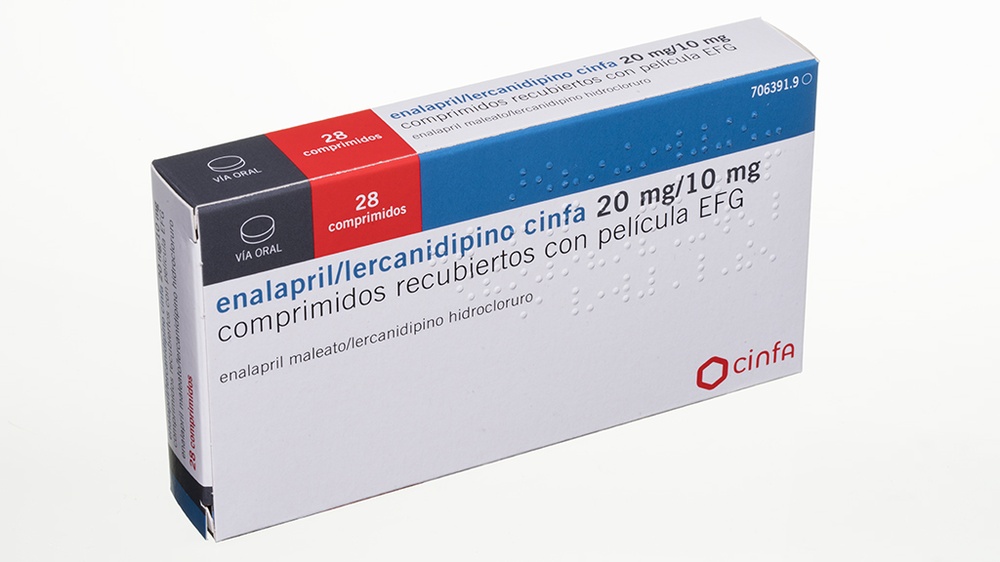
ENALAPRIL 20 mg/10 mg Comprimidos Recubiertos Con Pelicula

Revisión de receta online
Un médico revisará tu caso y determinará si la prescripción es médicamente apropiada.

Habla con un médico sobre este medicamento
Comenta tus síntomas y las opciones de tratamiento en una consulta online.



Cómo usar ENALAPRIL/LERCANIDIPINO CINFA 20 MG/10 MG COMPRIMIDOS RECUBIERTOS CON PELICULA EFG
Contenido del prospecto
- Introducción
- Qué es enalapril/lercanidipino cinfa y para qué se utiliza
- Qué necesita saber antes de empezar a tomar enalapril/lercanidipino cinfa
- Cómo tomar enalapril/lercanidipino cinfa
- Posibles efectos adversos
- Conservación de enalapril/lercanidipino cinfa
- Contenido del envase e información adicional
Introducción
Prospecto: información para el usuario
enalapril/ lercanidipino cinfa 20 mg/10 mg comprimidos recubiertos con película EFG
Enalapril maleato/lercanidipino hidrocloruro
Lea todo el prospecto detenidamente antes de empezar a tomar este medicamento, porque contiene información importante para usted.
- Conserve este prospecto, ya que puede tener que volver a leerlo.
- Si tiene alguna duda, consulte a su médico o farmacéutico.
- Este medicamento se le ha recetado solamente a usted, y no debe dárselo a otras personas aunque tengan los mismos síntomas que usted, ya que puede perjudicarles.
- Si experimenta efectos adversos, consulte a su médico o farmacéutico, incluso si se trata de efectos adversos que no aparecen en este prospecto. Ver sección 4.
Contenido del prospecto
- Qué es enalapril/lercanidipino cinfa y para qué se utiliza
- Qué necesita saber antes de empezar a tomar enalapril/lercanidipino cinfa
- Cómo tomar enalapril/lercanidipino cinfa
- Posibles efectos adversos
- Conservación de enalapril/lercanidipino cinfa
- Contenido del envase e información adicional
1. Qué es enalapril/lercanidipino cinfa y para qué se utiliza
enalapril/lercanidipino cinfa es una combinación fija de un inhibidor de la ECA (enalapril) y un bloqueante de los canales de calcio (lercanidipino), dos medicamentos que reducen la presión arterial.
enalapril/lercanidipino cinfa se utiliza para tratar la presión arterial alta (hipertensión) en pacientes adultos cuya presión arterial no está adecuadamente controlada por enalapril 20 mg solo. enalapril/lercanidipino cinfa no se debe usar para el tratamiento inicial de la hipertensión.

¿No estás seguro de si este medicamento es adecuado para ti?
Comenta tus síntomas y tratamiento con un médico online.
2. Qué necesita saber antes de empezar a tomar enalapril/lercanidipino cinfa
No tomeenalapril/lercanidipino cinfa
- Si es alérgico al enalapril maleato, al lercanidipino hidrocloruro o a alguno de los demás componentes de este medicamento (incluidos en la sección 6).
- Si ha experimentado alguna vez una reacción alérgica a un tipo de medicamento similar a los que contiene enalapril/lercanidipino, es decir, medicamentos denominados inhibidores de la ECA o bloqueantes de los canales de calcio.
- Si alguna vez ha experimentado hinchazón de la cara, labios, boca, lengua o garganta que le haya provocado dificultad para tragar o respirar (angioedema) tras tomar un tipo de medicamento llamado inhibidores de la ECA, o si se desconocía la causa de la reacción o en caso de tratarse de una afección hereditaria.
- Si ha tomado o actualmente esta tomando sacubitrilo/valsartán, un medicamento utilizado para el tratamiento de insuficiencia cardiaca crónica en adultos, se incrementa el riesgo de padecer angioedema (hinchazón rápida de la garganta).
- Si padece diabetes o presenta una alteración de la función renal y si está recibiendo tratamiento con un medicamento reductor de la presión arterial que contenga aliskiren.
- Si está embarazada de más de 3 meses (también se recomienda evitar el uso de enalapril/lercanidipino al inicio del embarazo, ver sección Embarazo).
- Si sufre determinadas cardiopatías:
- obstrucción del flujo de salida de sangre del corazón.
- insuficiencia cardiaca no tratada.
- angina inestable (molestias en el pecho que aparecen en reposo o se incrementan progresivamente)
- durante el primer mes después de haber sufrido un infarto de miocardio.
- Si tiene problemas de hígado graves.
- Si tiene problemas de riñón graves, o si está sometido a diálisis.
- Si está tomando fármacos inhibidores del metabolismo hepático, como:
- antifúngicos (tales como ketoconazol o itraconazol).
- antibióticos macrólidos (tales como eritromicina, troleandomicina o claritromicina).
- antivirales (tales como ritonavir).
- Si está tomando otro medicamento llamado ciclosporina (utilizado después de un trasplante para evitar el rechazo del órgano).
- Junto con pomelo o zumo de pomelo.
Advertencias y precauciones
Consulte a su médico o farmacéutico antes de empezar a tomar enalapril/lercanidipino cinfa.
- Si tiene la presión arterial baja (que puede manifestarse como mareo o desmayo, en especial estando de pie).
- Si ha estado muy enfermo (con vómitos excesivos) o ha tenido diarrea recientemente.
- Si tiene restringido el uso de sal en la dieta.
- Si tiene un problema cardiaco.
- Si padece un trastorno que afecta a los vasos sanguíneos del cerebro.
- Si tiene problemas de riñón (incluido el trasplante renal). Esto puede conducir a altos niveles de potasio en sangre que pueden ser graves. Su médico podría necesitar ajustarle la dosis de enalapril o monitorizar su nivel de potasio.
- Si presenta problemas de hígado.
- Si tiene problemas sanguíneos, como un número bajo o ausencia de glóbulos blancos (leucopenia, agranulocitosis), un recuento plaquetario bajo (trombocitopenia) o una disminución del número de glóbulos rojos (anemia).
- Si tiene una enfermedad vascular del colágeno (p.ej., lupus eritematoso, artritis reumatoide o esclerodermia), está con una terapia que suprime su sistema inmune o si está tomando alopurinol o procainamida o una combinación de ambos medicamentos.
- Si es usted un paciente de raza negra deberá ser consciente de que estos pacientes tienen mayor riesgo de experimentar reacciones alérgicas con inflamación de la cara, labios, lengua o garganta, acompañada de dificultad para tragar o respirar, al tomar inhibidores de la ECA.
- Si es usted diabético, deberá controlar su sangre en caso de que sus niveles de glucosa sean bajos, especialmente durante el primer mes de tratamiento. El nivel de potasio en sangre también puede ser elevado.
- Si está tomando suplementos de potasio, agentes ahorradores de potasio o sustitutos de la sal que contengan potasio.
- Si usted tiene más de 70 años de edad.
- Si usted está tomando cualquiera de los siguientes medicamentos, el riesgo de angioedema puede verse incrementado:
- Rececadotrilo, un medicamento utilizado en el tratamiento de la diarrea.
- Medicamentos utilizados en la prevención del rechazo de órganos tras un trasplante o en el tratamiento del cáncer (p.ej., temsirolimus, sirolimus, everolimus).
- Vildagliptina, un medicamento utilizado en el tratamiento de la diabetes.
- Si está tomando alguno de los siguientes medicamentos utilizados para el tratamiento de la presión arterial alta.
- un bloqueante del receptor de la angiotensina II (BRA) (también conocidos como sartanes, como por ejemplo, valsartán, telmisartán o irbesartán), en particular si presenta problemas renales relacionados con la diabetes.
- aliskiren.
Su médico podría revisar su función renal, su presión arterial y la cantidad de electrolitos (p. ej., potasio) presente en su sangre a intervalos regulares.
Consulte también la información incluida bajo el epígrafe “No tome enalapril/lercanidipino cinfa”.
Si va a someterse a alguna cirugía o ciertos tratamientos en breve.
Si está a punto de someterse a alguno de los siguientes procesos, informe a su médico de que está tomando enalapril/lercanidipino:
- cualquier intervención quirúrgica o si le van a administrar algún anestésico (incluso en la consulta del dentista).
- un tratamiento para extraerle el colesterol de la sangre conocido como “aféresis de LDL”.
- un tratamiento de desensibilización, para disminuir el efecto de una alergia a las abejas o a las avispas.
Debe informar a su médico si cree que está (o si podría estar) embarazada o si está dando el pecho (ver la sección Embarazo, lactancia y fertilidad).
Niños y adolescentes
No se ha establecido la seguridad y eficacia de enalapril/lercanidipino en niños menores de 18 años.
Otros medicamentos y enalapril/lercanidipino cinfa
Enalapril/lercanidipino no se debe tomar con ciertos medicamentos.
Informe a su médico o farmacéutico si está tomando, ha tomado recientemente o pudiera tener que tomar cualquier otro medicamento.
Esto se debe a que cuando se toma enalapril/lercanidipino con ciertos medicamentos, el efecto de enalapril/lercanidipino o el de los otros medicamentos podría modificarse, o puede que se produzcan determinados efectos adversos con mayor frecuencia.
En concreto, informe a su médico o farmacéutico si está tomando alguno de los siguientes medicamentos:
- medicamentos que disminuyen la presión arterial.
- suplementos de potasio (incluidos los sustitutos de la sal en la dieta).
- diuréticos ahorradores de potasio y otros medicamentos que pueden aumentar los niveles de potasio en sangre (p.ej., trimetoprima y sulfametoxazol para infecciones causadas por una bacteria; ciclosporina, un medicamento inmunosupresor utilizado en la prevención del rechazo de órganos; heparina, un medicamento utilizado como anticoagulante para prevenir los coágulos). Ver sección “No tome enalapril/lercanidipino cinfa”.
- litio (un medicamento utilizado para el tratamiento de un determinado tipo de depresión).
- medicamentos para la depresión llamados “antidepresivos tricíclicos”.
- medicamentos para el tratamiento de problemas mentales, denominados “antipsicóticos”.
- medicamentos antiinflamatorios no esteroideos, incluidos los inhibidores de COX-2 (medicamentos que reducen la inflamación y que se pueden emplear para combatir el dolor).
- determinados medicamentos para el dolor o la artritis, incluida la terapia con oro.
- determinados medicamentos para el tratamiento de la tos y el resfriado y los medicamentos que se utilizan para reducir el peso que contengan una sustancia llamada “agente simpaticomimético”.
- medicamentos para el tratamiento de la diabetes (incluidos los medicamentos antidiabéticos orales y la insulina).
- astemizol o terfenadina (medicamentos para las alergias).
- amiodarona, quinidina o sotalol (medicamentos para el tratamiento de un latido cardiaco rápido).
- fenitoína, fenobarbital o carbamazepina (medicamentos para la epilepsia).
- rifampicina (un medicamento para el tratamiento de la tuberculosis).
- digoxina (un medicamento para el tratamiento de problemas cardiacos).
- midazolam (un medicamento para ayudarle a dormir).
- beta-bloqueantes p.ej., metoprolol (medicamentos que tratan la presión arterial alta, insuficiencia cardiaca y ritmo cardiaco anormal).
- cimetidina (administrado a dosis diarias superiores a los 800 mg, un medicamento para las úlceras, indigestión o acidez).
No tome enalapril/lercanidipino, si ha tomado o actualmente esta tomando sacubitrilo/valsartán, un medicamento utilizado para el tratamiento de insuficiencia cardiaca crónica en adultos, se incrementa el riesgo de padecer angioedema (inflamación rápida bajo la piel como puede ser la garganta).
Si usted está tomando cualquiera de los siguientes medicamentos, el riesgo de angioedema puede verse incrementado:
- Racecadotrilo, un medicamento utilizado en el tratamiento de la diarrea.
- Medicamentos utilizados en la prevención del rechazo de órganos tras un trasplante o en el tratamiento del cáncer (p.ej., temsirolimus, sirolimus, everolimus).
- Vildagliptina, un medicamento utilizado en el tratamiento de la diabetes.
Puede que su médico tenga que modificar su dosis y/o tomar otras precauciones:
- Si está tomando un bloqueante del receptor de la angiotensina II (BRA) o aliskiren (consulte también la información incluida bajo los epígrafes “No tome enalapril/lercanidipino cinfa” y “Advertencias y precauciones”).
Toma de enalapril/lercanidipino cinfa con alimentos, bebidas y alcohol
Enalapril/lercanidipino se deberá tomar al menos 15 minutos antes de las comidas.
Una comida rica en grasas aumenta significativamente los niveles del medicamento en sangre.
El alcohol puede incrementar el efecto de enalapril/lercanidipino. Durante el tratamiento con enalapril/lercanidipino no se debe consumir alcohol. Enalapril/lercanidipino no se deberá tomar con pomelo o zumo de pomelo, ya que puede incrementar su efecto antihipotensivo (ver “No tome enalapril/lercanidipino cinfa”).
Embarazo, lactancia y fertilidad
Si está embarazada o en periodo de lactancia, cree que podría estar embarazada o tiene intención de quedarse embarazada, consulte a su médico o farmacéutico antes de utilizar este medicamento.
Embarazo y fertilidad
Debe informar a su médico si cree que está (o si podría estar) embarazada. Generalmente su médico le aconsejará que deje de tomar enalapril/lercanidipino antes de quedarse embarazada o tan pronto como sepa que está embarazada y le recomendará tomar otro medicamento en lugar de enalapril/lercanidipino. No se recomienda el uso de enalapril/lercanidipino en mujeres que pueden quedarse embarazadas ni al inicio del embarazo, y no se debe tomar si está embarazada de más de tres meses, ya que puede dañar gravemente al feto en caso de utilizarse después del tercer mes de embarazo.
Lactancia
Enalapril/lercanidipino no se debe tomar durante la lactancia.
Conducción y uso de máquinas
Si experimenta mareos, debilidad o somnolencia con este medicamento, no debe conducir ni manejar máquinas.
enalapril/lercanidipino cinfa contiene sodio
Este medicamento contiene menos de 1 mmol de sodio (23 mg) por comprimido; esto es, esencialmente “exento de sodio”.
3. Cómo tomar enalapril/lercanidipino cinfa
Siga exactamente las instrucciones de administración de este medicamento indicadas por su médico o farmacéutico. En caso de duda, consulte de nuevo a su médico o farmacéutico.
Adultos: a menos que su médico le indique lo contrario, la dosis recomendada es un comprimido una vez al día, a la misma hora cada día. El comprimido se deberá tomar preferiblemente por la mañana, al menos 15 minutos antes del desayuno. Los comprimidos se deberán tragar enteros con agua. Ver “Toma de enalapril/lercanidipino cinfa con alimentos, bebidas y alcohol”.
Pacientes con problemas renales/pacientes de edad avanzada: su médico decidirá la dosis de medicamento que debe tomar, teniendo en cuenta lo bien que funcionen sus riñones.
Si toma más enalapril/lercanidipino cinfa del que debe
En caso de sobredosis o ingestión accidental consulte inmediatamente a su médico o farmacéutico, o llame al Servicio de Información Toxicológica, teléfono 91 562 04 20, indicando el medicamento y la cantidad ingerida. Lleve consigo el envase y el prospecto del medicamento al profesional sanitario.
Una dosis superior a la correcta puede provocar una caída excesiva de la presión arterial y su corazón puede latir de forma irregular o más deprisa.
Si olvidó tomar enalapril/lercanidipino cinfa
- Si se olvidó de tomar su comprimido, no tome la dosis olvidada.
- Tome la siguiente dosis siguiendo la pauta habitual.
- No tome una dosis doble para compensar las dosis olvidadas.
Si interrumpe el tratamiento con enalapril/lercanidipino cinfa
No deje de tomar su medicamento, a menos que su médico se lo indique.
Si tiene cualquier otra duda sobre el uso de este medicamento, pregunte a su médico o farmacéutico.

¿Has empezado a tomar el medicamento y tienes preguntas?
Comenta tus síntomas y tratamiento con un médico online.
4. Posibles efectos adversos
Al igual que todos los medicamentos, este medicamento puede producir efectos adversos, aunque no todas las personas los sufran. Este medicamento puede provocar los siguientes efectos adversos:
Algunos efectos adversos pueden ser graves.
Informe a su médico de inmediato si nota cualquiera de los siguientes efectos adversos:
- Una reacción alérgica acompañada de hinchazón de la cara, labios, lengua o garganta que puede provocar dificultad para respirar o tragar;
Cuando empiece a tomar enalapril/lercanidipino puede sentir debilidad o mareo, o notar que su visión se vuelve borrosa; esto está provocado por una caída repentina de la presión arterial, y en caso de que ocurra, será útil que se tumbe. Si está preocupado, consulte a su médico.
Efectos adversos observados con enalapril/lercanidipino
Frecuentes (pueden afectar hasta 1 de cada 10 pacientes)
Tos, sensación de mareo, cefalea.
Poco frecuentes (pueden afectar hasta 1 de cada 100 pacientes)
Cambios en los valores de los parámetros sanguíneos, tales como una disminución del recuento plaquetario, aumento de la concentración de potasio en sangre, nerviosismo (ansiedad), sensación de mareo al levantarse, vértigo, latido cardiaco rápido, latido cardiaco rápido o irregular (palpitaciones), enrojecimiento repentino de la cara, el cuello o la parte superior del pecho (eritema), presión arterial baja, dolor abdominal, estreñimiento, sentirse enfermo (náuseas), incremento de los niveles de las enzimas hepáticas, enrojecimiento de la piel, dolor articular, aumento de la frecuencia urinaria, sensación de debilidad, cansancio, sensación de calor, inflamación de los tobillos.
Raros (pueden afectar hasta 1 de cada 1.000 pacientes)
Anemia, reacciones alérgicas, zumbido en los oídos (acúfenos), desmayo, garganta seca, dolor de garganta, indigestión, sensación salada en la lengua, diarrea, boca seca, inflamación de las encías, reacción alérgica con hinchazón de la cara, labios, lengua o garganta que produce dificultad para tragar o respirar, erupción cutánea, urticaria, nocturia, producción de grandes cantidades de orina, impotencia.
Efectos adversos adicionales observados con enalapril o lercanidipino solos
Enalapril
Muy frecuentes (pueden afectar a más de 1 de cada 10 pacientes)
Visión borrosa, sensación de mareo, debilidad o malestar y tos.
Frecuentes (pueden afectar hasta 1 de cada 10 pacientes)
Depresión, dolor de cabeza, desvanecimiento (síncope), dolor en el pecho, mareos debido a la presión arterial baja, cambios en la frecuencia cardiaca, latidos cardiacos rápidos, angina, disnea, alteraciones en el sentido del gusto, aumento de los niveles de creatinina en sangre (habitualmente se detecta mediante un análisis), niveles elevados de potasio en sangre, diarrea, dolor abdominal, cansancio (fatiga), erupción, reacción alérgica con inflamación de la cara, labios, lengua o garganta con dificultad al tragar o respirar.
Poco frecuentes (pueden afectar hasta 1 de cada 100 pacientes)
Anemia (incluidas la anemia aplásica y la hemolítica), caída repentina de la presión arterial, confusión, nerviosismo, somnolencia o insomnio, sensación de pinchazos en la piel o entumecimiento, infarto de miocardio (posiblemente ocasionado por una presión arterial muy baja en determinados pacientes de alto riesgo, incluidos aquéllos con problemas de aporte sanguíneo al corazón o al cerebro), accidente cerebrovascular (posiblemente debido a una presión arterial muy baja en pacientes de alto riesgo), goteo nasal, dolor de garganta y ronquera, asma asociado a opresión en el pecho, ralentización del movimiento del alimento a través del intestino (ileus), inflamación del páncreas, sentirse enfermo (vómitos), indigestión, estreñimiento, estomago irritado (irritación gástrica), boca seca, úlcera, anorexia, picor o urticaria, pérdida de cabello, alteración de la función renal, insuficiencia renal, aumento de la sudoración, niveles altos de proteínas en la orina (medidos a través de un análisis), calambres musculares, sensación de malestar general, temperatura alta (fiebre), concentraciones bajas de azúcar o sodio en sangre, niveles altos de urea en la sangre (todo ello medido mediante un análisis de sangre), enrojecimiento, latidos cardiacos rápidos o irregulares (palpitaciones), vértigo (sensación de mareo), pitido en los oídos (tinitus), impotencia.
Raros (pueden afectar hasta 1 de cada 1.000 pacientes)
Cambios en los valores de los parámetros sanguíneos, como un descenso del número de glóbulos blancos, depresión de la médula ósea, enfermedades autoinmunitarias, sueños extraños o trastornos del sueño, fenómeno de "Raynaud" (en el que las manos y los pies se pueden enfriar intensamente y adquirir un color blanco a consecuencia de un flujo sanguíneo bajo), inflamación de la nariz, neumonía, problemas hepáticos, como una disminución de la función hepática, inflamación del hígado, ictericia (amarilleamiento de la piel o los ojos), aumento de los niveles de enzimas hepáticas o bilirrubina (medida a través de un análisis de sangre), eritema multiforme (puntos rojos de diferentes formas que aparecen en la piel), síndrome de Stevens-Johnson y necrólisis epidérmica tóxica (una afección cutánea grave en la que se producen el enrojecimiento de la piel y la formación de escamas, formación de ampollas o de llagas abiertas), dermatitis exfoliativa/ eritrodermia (erupción cutánea 0078grave con descamación o desprendimiento de la piel), pénfigo (pequeñas ampollas llenas de líquido en la piel), disminución de la producción de orina, hipertrofia de las glándulas mamarias en varones (ginecomastia), glándulas inflamadas en el cuello, axilas o ingles, acumulación de fluidos u otras sustancias en los pulmones (como se aprecia en rayos X), inflamación de las mejillas, encías, lengua, labios y garganta.
Muy raros (pueden afectar hasta 1 de cada 10.000 pacientes)
Inflamación intestinal (angioedema intestinal).
Frecuencia no conocida (no puede estimarse a partir de los datos disponibles)
Producción excesiva de hormona antidiurética que causa retención de líquidos, originando debilidad, cansancio o confusión.
Se ha notificado un conjunto de síntomas que puede incluir alguno o varios de los siguientes: fiebre, inflamación de los vasos sanguíneos (serositis, vasculitis), dolor muscular (mialgia, miositis), dolor en las articulaciones (artralgia/artritis). Puede producirse erupción, fotosensibilidad u otras manifestaciones cutáneas.
Lercanidipino
Algunos de estos efectos adversos pueden ser graves. Si sufre cualquiera de estos efectos adversos, consulte a su médico.
Raros (pueden afectar hasta 1 de cada 1.000 pacientes)
Angina de pecho (dolor en el pecho ocasionado por la falta de aporte sanguíneo al corazón), reacciones alérgicas, (con síntomas como picazón, erupción, urticaria), desmayo.
Los pacientes con angina de pecho preexistente pueden experimentar un aumento de la frecuencia, duración o gravedad de los ataques asociado al tratamiento con el grupo de medicamentos al que pertenece lercanidipino. Se pueden observar casos aislados de infarto de miocardio.
Otros efectos adversos posibles:
Frecuentes (puede afectar hasta 1 de cada 10 pacientes): dolor de cabeza, latidos cardiacos rápidos o irregulares (palpitaciones), enrojecimiento súbito de la cara, cuello o parte superior del pecho, hinchazón de los tobillos.
Poco frecuentes (puede afectar hasta 1 de cada 100 pacientes): mareos, caída de la presión arterial, ardor de estómago, malestar, dolor de estómago, erupción en la piel, picor, dolor muscular, aumento de la cantidad de orina, debilidad o cansancio.
Raros (puede afectar hasta 1 de cada 1.000 pacientes): somnolencia, vómitos, diarrea, urticaria, aumento en la frecuencia urinaria, dolor torácico.
Frecuencia no conocida (no puede estimarse a partir de los datos disponibles): hinchazón de las encías, cambios en la función hepática (detectada en análisis sanguíneos), líquido turbio (al realizar la hemodiálisis a través de un tubo al interior del abdomen), hinchazón de la cara, labios, lengua o garganta que pueda provocar dificultades al respirar o tragar.
Si alguno de los efectos adversos se agrava, o si experimenta cualquier tipo de efecto adverso que no aparece en este prospecto, informe a su médico o farmacéutico. Puede consultar a su médico o farmacéutico para obtener más información acerca de los efectos adversos, ya que ambos disponen de una lista más completa de efectos adversos.
Comunicación de efectos adversos
Si experimenta cualquier tipo de efecto adverso, consulte a su médico o farmacéutico, incluso si se trata de posibles efectos adversos que no aparecen en este prospecto. También puede comunicarlos directamente a través del Sistema Español de Farmacovigilancia de Medicamentos de Uso Humano: https:// www.notificaram.es. Mediante la comunicación de efectos adversos usted puede contribuir a proporcionar más información sobre la seguridad de este medicamento.
5. Conservación de enalapril/lercanidipino cinfa
Mantener este medicamento fuera de la vista y del alcance de los niños.
No utilice este medicamento después de la fecha de caducidad que aparece en el envase después de CAD. La fecha de caducidad es el último día del mes que se indica.
No conservar a temperatura superior a 25ºC.
Los medicamentos no se deben tirar por los desagües ni a la basura. Deposite los envases y los medicamentos que no necesita en el Punto SIGRE de la farmacia. En caso de duda, pregunte a su farmacéutico cómo deshacerse de los envases y de los medicamentos que no necesita. De esta forma, ayudará a proteger el medio ambiente.
6. Contenido del envase e información adicional
Composición de enalapril/lercanidipino cinfa
- Los principios activos son enalapril maleato y lercanidipino hidrocloruro. Cada comprimido recubierto con película contiene 20 mg de enalapril maleato (equivalente a 15,29 mg de enalapril) y 10 mg de lercanidipino hidrocloruro (equivalente a 9,44 mg de lercanidipino).
- Los demás componentes son:
Núcleo del comprimido: celulosa microcristalina, hidrogenocarbonato sódico, almidón de maíz pregelatinizado, carboximetilalmidón sódico (tipo A) (de patata), sílice coloidal anhidra y estearato magnésico.
Recubrimiento: hipromelosa, macrogol 6000, talco, dióxido de titanio (E-171), óxido de hierro amarillo (E-172).
Aspecto del producto y contenido del envase
Comprimidos recubiertos con película de amarillo claro a amarillos redondos y biconvexos.
Se presentan en blísteres de poliamida-aluminio-PVC/aluminio.
Cada envase contiene 28 comprimidos.
Titular de la autorización de comercialización y responsable de la fabricación
Titular de la autorización de comercialización
Laboratorios Cinfa, S.A.
Carretera Olaz-Chipi, 10. Polígono Industrial Areta
31620 Huarte (Navarra) - España
Responsable de fabricación
TEVA Gyógyszergyár Zrt.
Pallagi úl 13, Debrecen H-4042
Hungría
o
Teva Pharma S.L.U.
C/ C, nº 4, Polígono Industrial Malpica
Zaragoza 50016
o
Merckle GmbH
Ludwig- Merckle Strasse 3
Blaubeuren 89143
Alemania
o
Laboratorios Cinfa, S.A.
Carretera Olaz-Chipi, 10. Polígono Industrial Areta
31620 Huarte (Navarra) - España
Fecha de la última revisión de este prospecto:Febrero 2022
La información detallada y actualizada de este medicamento está disponible en la página web de la Agencia Española de Medicamentos y Productos Sanitarios (AEMPS) www.aemps.gob.es
Puede acceder a información detallada y actualizada sobre este medicamento escaneando con su teléfono móvil (smartphone) el código QR incluido en prospecto y cartonaje. También puede acceder a esta información en la siguiente dirección de internet: https://cima.aemps.es/cima/dochtml/p/79821/P_79821.html
Código QR a: https://cima.aemps.es/cima/dochtml/p/79821/P_79821.html
- País de registro
- Forma farmacéuticaCOMPRIMIDO, 20 mg/10 mg
- Código ATCC09BB02
- Precio medio en farmacia11.24 EUR
- Principio activo
- Requiere recetaSí
- Fabricante
- ComposiciónHIDROGENO CARBONATO DE SODIO (10,20 mg mg)
- Esta información es de carácter general y no sustituye la consulta con un profesional sanitario.
- Alternativas a ENALAPRIL/LERCANIDIPINO CINFA 20 MG/10 MG COMPRIMIDOS RECUBIERTOS CON PELICULA EFGForma farmacéutica: COMPRIMIDO, 10mg lercanidipino hidrocloruro/10mg enalapril malPrincipio activo: enalapril and lercanidipineFabricante: Recordati Ireland LimitedRequiere recetaForma farmacéutica: COMPRIMIDO, 10mg lercanidipino hidrocloruro/20mg enalapril malPrincipio activo: enalapril and lercanidipineFabricante: Recordati Ireland LimitedRequiere recetaForma farmacéutica: COMPRIMIDO, 10 mg/10 mgPrincipio activo: enalapril and lercanidipineFabricante: Laboratorios Cinfa S.A.Requiere receta
Médicos online para ENALAPRIL/LERCANIDIPINO CINFA 20 MG/10 MG COMPRIMIDOS RECUBIERTOS CON PELICULA EFG
Comenta la dosis, los posibles efectos secundarios, interacciones, contraindicaciones o la revisión de receta de ENALAPRIL/LERCANIDIPINO CINFA 20 MG/10 MG COMPRIMIDOS RECUBIERTOS CON PELICULA EFG, sujeto a valoración médica y a la normativa local.
Obtén una receta de ENALAPRIL/LERCANIDIPINO CINFA 20 MG/10 MG COMPRIMIDOS RECUBIERTOS CON PELICULA EFG online
Rellena un formulario de 2 minutos
Cuéntanos tus síntomas, historial y el medicamento que necesitas.
Elige un médico o nosotros te asignamos uno
Escoge un especialista o te conectamos con el próximo médico disponible.
El médico revisa tu caso
Normalmente en 30 minutos. Puede hacerte preguntas adicionales por chat.
Recógela en cualquier farmacia
Receta electrónica enviada a tu correo, válida en toda España.
Preguntas frecuentes
ENALAPRIL/LERCANIDIPINO CINFA 20 MG/10 MG COMPRIMIDOS RECUBIERTOS CON PELICULA EFG requiere receta en España. Puedes confirmarlo con un médico online según tu caso.
El principio activo de ENALAPRIL/LERCANIDIPINO CINFA 20 MG/10 MG COMPRIMIDOS RECUBIERTOS CON PELICULA EFG es enalapril and lercanidipine. Esta información ayuda a identificar medicamentos con la misma composición pero con diferentes nombres comerciales.
El precio medio en farmacia de ENALAPRIL/LERCANIDIPINO CINFA 20 MG/10 MG COMPRIMIDOS RECUBIERTOS CON PELICULA EFG es de aproximadamente 11.24 EUR. Puede variar según el fabricante y la forma farmacéutica.
ENALAPRIL/LERCANIDIPINO CINFA 20 MG/10 MG COMPRIMIDOS RECUBIERTOS CON PELICULA EFG es fabricado por Laboratorios Cinfa S.A.. La marca y el envase pueden variar según el distribuidor.
Los Médicos de familia, Psiquiatras, Dermatólogos, Cardiólogos, Endocrinólogos, Gastroenterólogos, Neumólogos, Nefrólogos, Reumatólogos, Hematólogos, Infectólogos, Alergólogos, Geriatras, Pediatras, Oncólogos pueden valorar la prescripción de ENALAPRIL/LERCANIDIPINO CINFA 20 MG/10 MG COMPRIMIDOS RECUBIERTOS CON PELICULA EFG cuando esté clínicamente indicado. Puedes reservar una videoconsulta para comentar tu caso y las opciones de tratamiento.
España cuenta con una infraestructura sanitaria bien desarrollada en ciudades principales como Madrid, Barcelona, Valencia y Sevilla. Las farmacias están ampliamente disponibles y operan bajo estrictas regulaciones, garantizando el acceso a medicamentos con receta.
Puedes comprar ENALAPRIL/LERCANIDIPINO CINFA 20 MG/10 MG COMPRIMIDOS RECUBIERTOS CON PELICULA EFG en Madrid, Barcelona, Sevilla o Valencia en cualquier farmacia local con una receta válida.
Para obtener una receta, puedes utilizar Oladoctor:
Otros medicamentos con el mismo principio activo (enalapril and lercanidipine) incluyen CORIPREN 10 mg/10 mg COMPRIMIDOS RECUBIERTOS CON PELICULA, CORIPREN 20 mg/10 mg COMPRIMIDOS RECUBIERTOS CON PELICULA, ENALAPRIL/LERCANIDIPINO CINFA 10 MG/10 MG COMPRIMIDOS RECUBIERTOS CON PELICULA EFG. Pueden tener diferentes nombres comerciales o formulaciones, pero contienen el mismo componente terapéutico. Consulta siempre con un médico antes de cambiar o iniciar un nuevo medicamento.
