



EMEND 125 mg/80 mg Capsulas Duras

Revisión de receta online
Un médico revisará tu caso y determinará si la prescripción es médicamente apropiada.

Habla con un médico sobre este medicamento
Comenta tus síntomas y las opciones de tratamiento en una consulta online.



Cómo usar EMEND 125 MG CAPSULAS DURAS/EMEND 80 MG CAPSULAS DURAS
Contenido del prospecto
- Introducción
- Qué es EMEND y para qué se utiliza
- Qué necesita saber antes de empezar a tomar o dar EMEND
- Cómo tomar EMEND
- Posibles efectos adversos
- Conservación de EMEND
- Contenido del envase e información adicional
Introducción
Prospecto: información para el usuario
EMEND 125mg cápsulas duras
EMEND 80mg cápsulas duras
aprepitant
Lea todo el prospecto detenidamente antes de empezar a tomar este medicamento, porque contiene información importante para usted.Si es usted el progenitor de un niño que está tomando EMEND, lea esta información detenidamente.
- Conserve este prospecto, ya que puede tener que volver a leerlo.
- Si tiene alguna duda, consulte a su médico, farmacéutico o enfermero.
- Este medicamento se le ha recetado solamente a usted o al niño, y no debe dárselo a otras personas aunque tengan los mismos síntomas, ya que puede perjudicarles.
- Si usted o el niño experimentan efectos adversos, consulte a su médico, farmacéutico o enfermero, incluso si se trata de efectos adversos que no aparecen en este prospecto. Ver sección 4.
Contenido del prospecto
- Qué es EMEND y para qué se utiliza
- Qué necesita saber antes de empezar a tomar o dar EMEND
- Cómo tomar EMEND
- Posibles efectos adversos
- Conservación de EMEND
- Contenido del envase e información adicional
1. Qué es EMEND y para qué se utiliza
EMEND contiene el principio activo aprepitant y pertenece a un grupo de medicamentos llamados "antagonistas del receptor de la neurocinina 1 (NK1)". El cerebro tiene una zona específica que controla las náuseas y los vómitos. EMEND actúa bloqueando las señales a esta zona, y por tanto, reduciendo las náuseas y los vómitos. EMEND cápsulas se usa en adultos y adolescentes a partir de 12 años de edad, en combinacióncon otros medicamentospara evitar las náuseas y los vómitos que provoca un tipo de quimioterapia (tratamiento del cáncer) que desencadena de forma fuerte y moderada náuseas y vómitos (como cisplatino, ciclofosfamida, doxorubicina o epirubicina).

¿No estás seguro de si este medicamento es adecuado para ti?
Comenta tus síntomas y tratamiento con un médico online.
2. Qué necesita saber antes de empezar a tomar o dar EMEND
No tome EMEND
- si usted o el niño son alérgicos a aprepitant o a alguno de los demás componentes de este medicamento (incluidos en la sección 6).
- con medicamentos que contengan pimozida (utilizado para tratar enfermedades psiquiátricas), terfenadina y astemizol (utilizados para la rinitis alérgica y otros trastornos alérgicos), cisaprida (utilizado para tratar problemas digestivos). Informe al médico si usted o el niño están tomando estos medicamentos ya que el tratamiento debe ser modificado antes de que usted o el niño empiecen a tomar EMEND.
Advertencias y precauciones
Consulte a su médico, farmacéutico o enfermero antes de empezar a tomar EMEND o de dar al niño este medicamento.
Antes del tratamiento con EMEND, informe al médico si usted o el niño tienen una enfermedad del hígado, porque el hígado es importante para eliminar el medicamento del cuerpo. Por lo tanto, su médico puede tener que controlar el estado de su hígado o el del niño.
Niños y adolescentes
No dé EMEND 80 mg y 125 mg cápsulas a niños menores de 12 años de edad, porque las cápsulas de 80 mg y 125 mg no se han estudiado en esta población.
Otros medicamentos y EMEND
EMEND puede afectar a otros medicamentos durante y después del tratamiento con EMEND. Hay algunos medicamentos que no deben tomarse con EMEND (tales como pimozida, terfenadina, astemizol y cisaprida) o que requieren un ajuste en la dosis (véase también ‘No tome EMEND’).
Los efectos de EMEND o de otros medicamentos pueden estar influenciados si usted o el niño toman EMEND junto con otros medicamentos, incluyendo los indicados a continuación. Consulte a su médico o farmacéutico si usted o el niño están tomando alguno de los siguientes medicamentos:
- medicamentos anticonceptivos que pueden incluir píldoras anticonceptivas, parches cutáneos, implantes y ciertos dispositivos intrauterinos (DIUs) que liberan hormonas, puede que no funcionen adecuadamente cuando se toman junto con EMEND. Durante el tratamiento con EMEND y hasta 2 meses después de usar EMEND, deben utilizarse otros métodos o métodos adicionales de anticoncepción no hormonales,
- ciclosporina, tacrolimus, sirolimus, everolimus (inmunosupresores),
- alfentanilo, fentanilo (usados para tratar el dolor),
- quinidina (usado para tratar los latidos irregulares),
- irinotecán, etopósido, vinorelbina, ifosfamida (medicamentos usados para tratar el cáncer),
- medicamentos que contengan alcaloides derivados del ergot, tales como ergotamina o diergotamina (usados para tratar migrañas),
- warfarina, acenocumarol (diluyentes de la sangre; se pueden necesitar análisis de sangre),
- rifampicina, claritromicina, telitromicina (antibióticos usados para tratar infecciones),
- fenitoína (un medicamento usado para tratar las convulsiones),
- carbamazepina (usado para tratar la depresión y la epilepsia),
- midazolam, triazolam, fenobarbital (medicamentos usados para tranquilizar o para ayudar a dormir),
- hierba de San Juan (un preparado a base de plantas usado para tratar la depresión),
- inhibidores de la proteasa (usados para tratar infecciones por VIH),
- ketoconazol, excepto champú (usado para tratar el síndrome de Cushing - cuando el cuerpo produce un exceso de cortisol),
- itraconazol, voriconazol, posaconazol (antifúngicos),
- nefazodona (usado para tratar la depresión),
- corticosteroides (tales como dexametasona y metilprednisolona),
- medicamentos para la ansiedad (tales como alprazolam),
- tolbutamida (un medicamento usado para tratar la diabetes).
Informe a su médico o farmacéutico si usted o el niño están tomando, han tomado recientemente o pudieran tener que tomar cualquier otro medicamento.
Embarazo y lactancia
No debe utilizar este medicamento durante el embarazo a no ser que sea claramente necesario. Si usted o la niña están embarazadas o en periodo de lactancia, podrían estar embarazadas o tienen intención de quedarse embarazadas, consulte a su médico antes de utilizar este medicamento.
Para información relacionada con el control de natalidad, ver ‘Otros medicamentos y EMEND’.
Se desconoce si EMEND pasa a la leche materna; por tanto, no se recomienda dar el pecho durante el tratamiento con este medicamento. Es importante informar al médico antes de tomar este medicamento si usted o la niña están dando el pecho a su bebé o tienen previsto hacerlo.
Conducción y uso de máquinas
Se debe tener en cuenta que algunas personas tienen mareo y sueño después de tomar EMEND. Si usted o el niño se sienten mareados o somnolientos, eviten conducir, montar en bicicleta o usar máquinas o herramientas después de tomar este medicamento (ver ‘Posibles efectos adversos’).
EMEND contiene sacarosa
EMEND cápsulas contiene sacarosa. Si su médico le ha indicado que usted o el niño padecen una intolerancia a ciertos azúcares, consulte con él antes de tomar este medicamento.
EMEND contiene sodio
Este medicamento contiene menos de 23 mg de sodio (1 mmol) por cápsula; esto es, esencialmente “exento de sodio”.
3. Cómo tomar EMEND
Siga exactamente las instrucciones de administración de este medicamento indicadas para usted o para el niño por su médico, farmacéutico o enfermero. En caso de duda, consulte de nuevo a su médico, farmacéutico o enfermero. Tome siempre EMEND junto con otros medicamentos para prevenir las náuseas y vómitos. Después del tratamiento con EMEND, el médico puede pedir que usted o el niño continúen tomando otros medicamentos para prevenir las náuseas y los vómitos, incluyendo corticosteroides (como dexametasona) y un ‘antagonista 5‑HT3’ (como ondansetrón). En caso de duda consulte de nuevo a su médico, farmacéutico o enfermero.
La dosis oral recomendada de EMEND es:
Día 1:
- una cápsula de 125 mg 1 hora antes de empezar la sesión de quimioterapia
y
Días 2 y 3:
- una cápsula de 80 mg cada día.
- si no le están administrando quimioterapia, tome EMEND por la mañana.
- si le están administrando quimioterapia, tome EMEND 1 hora antes de comenzar su sesión de quimioterapia.
EMEND se puede tomar con o sin alimentos.
Trague la cápsula entera con algún líquido.
Si toma más EMEND del que debe
No tome más cápsulas de las que el médico recomienda. Si usted o el niño han tomado demasiadas cápsulas, contacte con su médico inmediatamente.
Si olvidó tomar EMEND
Si usted o el niño han olvidado una dosis, pida consejo a su médico.
Si tiene cualquier otra duda sobre el uso de este medicamento, pregunte a su médico o farmacéutico.

¿Has empezado a tomar el medicamento y tienes preguntas?
Comenta tus síntomas y tratamiento con un médico online.
4. Posibles efectos adversos
Al igual que todos los medicamentos, este medicamento puede producir efectos adversos, aunque no todas las personas los sufran.
Deje de tomar EMEND y acuda a su médico inmediatamente si usted o el niño notan alguno de los siguientes efectos adversos, que pueden ser graves, y para los que usted o el niño pueden necesitar tratamiento médico urgente:
- Ronchas, sarpullido, picor, dificultad para respirar o tragar (frecuencia no conocida, no puede estimarse a partir de los datos disponibles): estos son signos de una reacción alérgica.
Otros efectos adversos que se han comunicado se detallan a continuación.
Efectos adversos frecuentes(pueden afectar hasta 1de cada 10personas)son:
- estreñimiento, indigestión,
- cefaleas,
- cansancio,
- pérdida de apetito,
- hipo,
- aumento de la cantidad de enzimas del hígado en la sangre.
Efectos adversos poco frecuentes(pueden afectar hasta 1de cada 100personas)son:
- mareo, somnolencia,
- acné, sarpullido,
- ansiedad,
- eructos, náuseas, vómitos, ardor de estómago, dolor de estómago, boca seca, flatulencias,
- aumento de la micción dolorosa o que escuece,
- debilidad, malestar general,
- sofocos/enrojecimiento de la cara o de la piel,
- latidos rápidos o irregulares,
- fiebre con riesgo elevado de infección, disminución de los glóbulos rojos.
Efectos adversos raros(pueden afectar hasta 1de cada 1000personas)son:
- dificultad para pensar, falta de energía, alteración del gusto,
- sensibilidad de la piel al sol, sudor excesivo, piel grasa, llagas en la piel, erupción con picor, síndrome de Stevens-Johnson/necrolisis epidérmica tóxica (reacción cutánea grave rara),
- euforia (sensación de felicidad extrema), desorientación,
- infección bacteriana, infección por hongos,
- estreñimiento intenso, úlcera de estómago, inflamación del intestino delgado y colon, llagas en la boca, hinchazón del vientre,
- frecuentes ganas de orinar, orinar más de lo normal, presencia de azúcar o sangre en la orina,
- molestias en el pecho, hinchazón, cambios en la manera de andar,
- tos, mucosidad en la parte de atrás de la garganta, irritación de la garganta, estornudos, dolor de garganta,
- secreción y picor oculares,
- zumbido de oídos,
- espasmos musculares, debilidad muscular,
- sed excesiva,
- latidos lentos, problemas de los vasos del corazón y de las venas,
- disminución de los glóbulos blancos, niveles bajos de sodio en la sangre, pérdida de peso,
Comunicación de efectos adversos
Si usted o el niño experimentan cualquier tipo de efecto adverso, consulte a su médico, farmacéutico o enfermero, incluso si se trata de posibles efectos adversos que no aparecen en este prospecto. También puede comunicarlos directamente a través del sistema nacional de notificación incluido en el Apéndice V. Mediante la comunicación de efectos adversos usted puede contribuir a proporcionar más información sobre la seguridad de este medicamento.
5. Conservación de EMEND
Mantener este medicamento fuera de la vista y del alcance de los niños.
No utilice este medicamento después de la fecha de caducidad que aparece en el envase después de CAD. La fecha de caducidad es el último día del mes que se indica.
Conservar en el embalaje original para protegerlo de la humedad.
No extraer la cápsula de su blíster hasta el momento de tomarla.
Los medicamentos no se deben tirar por los desagües ni a la basura. Pregunte a su farmacéutico cómo deshacerse de los envases y de los medicamentos que ya no necesita. De esta forma, ayudará a proteger el medio ambiente.
6. Contenido del envase e información adicional
Composición de EMEND
- El principio activo es aprepitant. Cada cápsula dura de 125 mg contiene 125 mg de aprepitant. Cada cápsula dura de 80 mg contiene 80 mg de aprepitant.
- Los demás componentes son sacarosa, celulosa microcristalina (E‑460), hidroxipropilcelulosa (E‑463), lauril sulfato de sodio, gelatina, dióxido de titanio (E‑171), laca, hidróxido de potasio y óxido de hierro negro (E‑172); la cápsula dura de 125 mg también contiene óxido de hierro rojo (E‑172) y óxido de hierro amarillo (E‑172).
Aspecto del producto y contenido del envase
La cápsula dura de 125 mg es opaca con cuerpo blanco y tapa rosa con “462” y “125 mg” impreso en forma radial en tinta negra en el cuerpo.
La cápsula dura de 80 mg es opaca con cuerpo y tapa blancos con “461” y “80 mg” impreso en forma radial en tinta negra en el cuerpo.
Las cápsulas duras de EMEND 125 mg y 80 mg se suministran en los siguientes tamaños de envases:
- Blíster de aluminio que contiene una cápsula de 80 mg
- Envase para un tratamiento de 2 días que contiene dos cápsulas de 80 mg
- 5 blísteres de aluminio que contienen una cápsula de 80 mg cada uno
- Blíster de aluminio que contiene una cápsula de 125 mg
- 5 blísteres de aluminio que contienen una cápsula de 125 mg cada uno
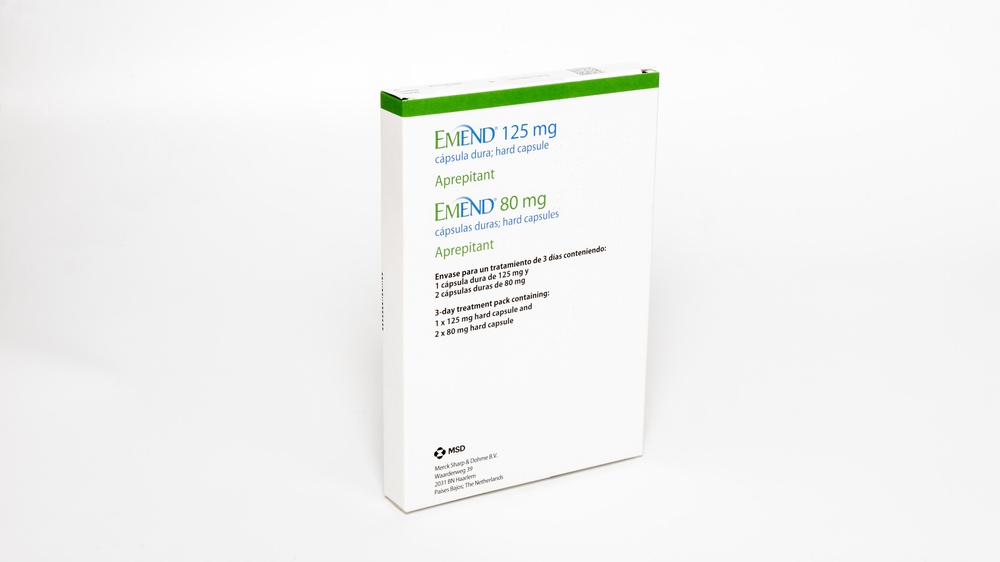
- Envase para un tratamiento de 3 días que contiene una cápsula de 125 mg y dos cápsulas de 80 mg
Puede que solamente estén comercializados algunos tamaños de envases.
Titular de la autorizaciónde comercializaciónyresponsable de la fabricación
Merck Sharp & Dohme B.V.Waarderweg 392031 BN HaarlemPaíses Bajos |
Pueden solicitar más información respecto a este medicamento dirigiéndose al representante local del titular de la autorización de comercialización:
Belgique/België/Belgien MSD Belgium Tél/Tel: +32(0)27766211 | Lietuva UAB Merck Sharp & Dohme Tel. +370 5 2780 247 |
| Luxembourg/Luxemburg MSD Belgium Tél/Tel: +32(0)27766211 |
Ceská republika Merck Sharp & Dohme s.r.o. Tel: +420 233 010 111 | Magyarország MSD Pharma Hungary Kft. Tel.: +36 1 888 5300 |
Danmark MSD Danmark ApS Tlf.: + 45 4482 4000 | Malta Merck Sharp & Dohme Cyprus Limited Tel: 8007 4433 (+356 99917558) |
Deutschland MSD Sharp & Dohme GmbH Tel.: +49 (0) 89 20 300 4500 | Nederland Merck Sharp & Dohme B.V. Tel: 0800 9999000 (+31 23 5153153) |
Eesti Merck Sharp & Dohme OÜ Tel: +372 614 4200 | Norge MSD (Norge) AS Tlf: +47 32 20 73 00 |
Eλλ?δα MSD Α.Φ.Ε.Ε. Τηλ: +30 210 98 97 300 | Österreich Merck Sharp & Dohme Ges.m.b.H. Tel: +43 (0) 1 26 044 |
España Merck Sharp & Dohme de España, S.A. Tel: +34 91 321 06 00 | Polska MSD Polska Sp. z o.o. Tel: +48 22 549 51 00 |
France MSD France Tél: + 33 (0) 1 80 46 40 40 | Portugal Merck Sharp & Dohme, Lda Tel: +351 21 4465700 |
Hrvatska Merck Sharp & Dohme d.o.o. Tel: + 385 1 6611 333 | România Merck Sharp & Dohme Romania S.R.L. Tel: +40 21 529 29 00 |
Ireland Merck Sharp & Dohme Ireland (Human Health) Limited Tel: +353 (0)1 2998700 | Slovenija Merck Sharp & Dohme, inovativna zdravila d.o.o. Tel: +386 1 520 4201 |
Ísland Vistor ehf. Sími: + 354 535 7000 | Slovenská republika Merck Sharp & Dohme, s. r. o. Tel: +421 2 58282010 |
Ιtalia MSD Italia S.r.l. Tel: 800 23 99 89 (+39 06 361911) | Suomi/Finland MSD Finland Oy Puh/Tel: +358 (0)9 804 650 |
Κ?προς Merck Sharp & Dohme Cyprus Limited Τηλ.: 800 00 673 (+357 22866700) | Sverige Merck Sharp & Dohme (Sweden) AB Tel: +46 77 5700488 |
Latvija SIA Merck Sharp & Dohme Latvija Tel.: + 371 67025300 |
Fecha de la última revisión de este prospecto:
Otras fuentes de información
La información detallada de este medicamento está disponible en la página web de la Agencia Europea de Medicamentos: https://www.ema.europa.eu.
- País de registro
- Forma farmacéuticaCAPSULA, 125/80 mg/mg
- Código ATCA04AD12
- Principio activo
- Requiere recetaSí
- Fabricante
- ComposiciónSACAROSA (0 - mg), LAURILSULFATO DE SODIO (0 - mg), POTASIO, HIDROXIDO DE (E-525) (0 - mg)
- Esta información es de carácter general y no sustituye la consulta con un profesional sanitario.
- Alternativas a EMEND 125 MG CAPSULAS DURAS/EMEND 80 MG CAPSULAS DURASForma farmacéutica: CAPSULA, 125 y 80 mgPrincipio activo: AprepitantFabricante: Accord Healthcare S.L.U.Requiere recetaForma farmacéutica: CAPSULA, 125 mgPrincipio activo: AprepitantFabricante: Qilu Pharma Spain S.L.Requiere recetaForma farmacéutica: CAPSULA, 125 mg/80 mgPrincipio activo: AprepitantFabricante: Qilu Pharma Spain S.L.Requiere receta
Médicos online para EMEND 125 MG CAPSULAS DURAS/EMEND 80 MG CAPSULAS DURAS
Comenta la dosis, los posibles efectos secundarios, interacciones, contraindicaciones o la revisión de receta de EMEND 125 MG CAPSULAS DURAS/EMEND 80 MG CAPSULAS DURAS, sujeto a valoración médica y a la normativa local.









Obtén una receta de EMEND 125 MG CAPSULAS DURAS/EMEND 80 MG CAPSULAS DURAS online
Rellena un formulario de 2 minutos
Cuéntanos tus síntomas, historial y el medicamento que necesitas.
Elige un médico o nosotros te asignamos uno
Escoge un especialista o te conectamos con el próximo médico disponible.
El médico revisa tu caso
Normalmente en 30 minutos. Puede hacerte preguntas adicionales por chat.
Recógela en cualquier farmacia
Receta electrónica enviada a tu correo, válida en toda España.
Preguntas frecuentes
EMEND 125 MG CAPSULAS DURAS/EMEND 80 MG CAPSULAS DURAS requiere receta en España. Puedes confirmarlo con un médico online según tu caso.
El principio activo de EMEND 125 MG CAPSULAS DURAS/EMEND 80 MG CAPSULAS DURAS es Aprepitant. Esta información ayuda a identificar medicamentos con la misma composición pero con diferentes nombres comerciales.
EMEND 125 MG CAPSULAS DURAS/EMEND 80 MG CAPSULAS DURAS es fabricado por Merck Sharp & Dohme B.V.. La marca y el envase pueden variar según el distribuidor.
Los Médicos de familia, Psiquiatras, Dermatólogos, Cardiólogos, Endocrinólogos, Gastroenterólogos, Neumólogos, Nefrólogos, Reumatólogos, Hematólogos, Infectólogos, Alergólogos, Geriatras, Pediatras, Oncólogos pueden valorar la prescripción de EMEND 125 MG CAPSULAS DURAS/EMEND 80 MG CAPSULAS DURAS cuando esté clínicamente indicado. Puedes reservar una videoconsulta para comentar tu caso y las opciones de tratamiento.
España cuenta con una infraestructura sanitaria bien desarrollada en ciudades principales como Madrid, Barcelona, Valencia y Sevilla. Las farmacias están ampliamente disponibles y operan bajo estrictas regulaciones, garantizando el acceso a medicamentos con receta.
Puedes comprar EMEND 125 MG CAPSULAS DURAS/EMEND 80 MG CAPSULAS DURAS en Madrid, Barcelona, Sevilla o Valencia en cualquier farmacia local con una receta válida.
Para obtener una receta, puedes utilizar Oladoctor:
Otros medicamentos con el mismo principio activo (Aprepitant) incluyen APREPITANT ACCORD 125 MG CAPSULAS DURAS EFG/APREPITANT ACCORD 80 MG CAPSULAS DURAS EFG, APREPITANT QILU 125 MG CAPSULAS DURAS EFG, APREPITANT QILU 125 MG CAPSULAS DURAS/ APREPITANT QILU 80 MG CAPSULAS DURAS EFG. Pueden tener diferentes nombres comerciales o formulaciones, pero contienen el mismo componente terapéutico. Consulta siempre con un médico antes de cambiar o iniciar un nuevo medicamento.
