



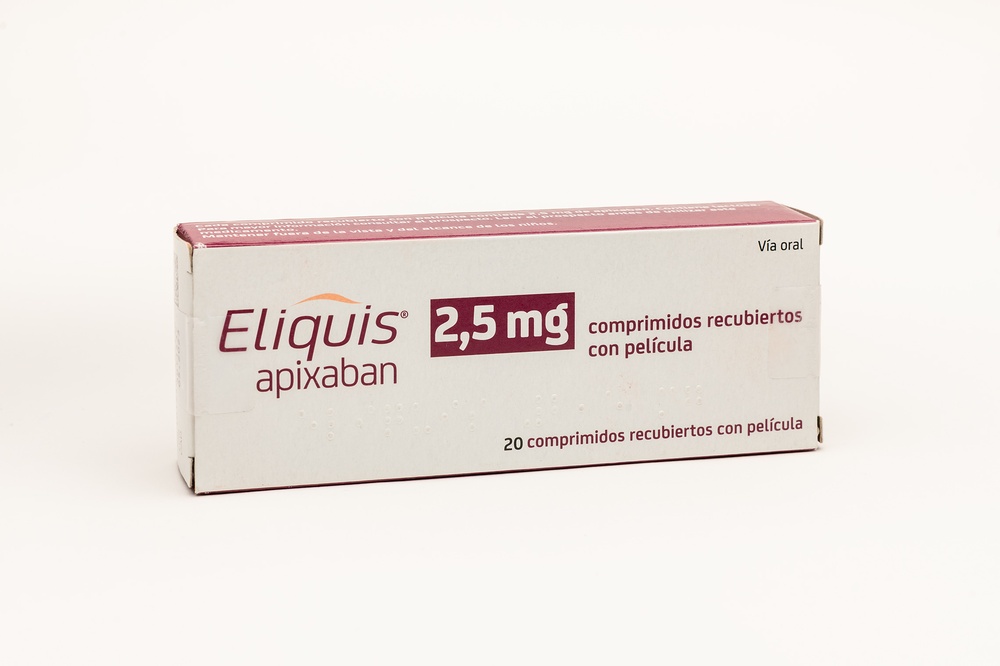
ELIQUIS 2,5 MG COMPRIMIDOS RECUBIERTOS CON PELICULA

Revisión de receta online
Un médico revisará tu caso y determinará si la prescripción es médicamente apropiada.

Habla con un médico sobre este medicamento
Comenta tus síntomas y las opciones de tratamiento en una consulta online.



Cómo usar ELIQUIS 2,5 MG COMPRIMIDOS RECUBIERTOS CON PELICULA
Contenido del prospecto
- Introducción
- Qué es Eliquis y para qué se utiliza
- Qué necesita saber antes de empezar a tomar Eliquis
- Cómo tomar Eliquis
- Posibles efectos adversos
- Conservación de Eliquis
- Contenido del envase e información adicional
Introducción
Prospecto: información para el usuario
Eliquis 2,5mg comprimidos recubiertos con película
apixabán
Lea todo el prospecto detenidamente antes de empezar a tomar este medicamento porque contiene información importante para usted.
- Conserve este prospecto, ya que puede tener que volver a leerlo.
- Si tiene alguna duda, consulte a su médico, farmacéutico o enfermero.
- Este medicamento se le ha recetado solamente a usted y no debe dárselo a otras personas, aunque tengan los mismos síntomas que usted, ya que puede perjudicarles.
- Si experimenta efectos adversos, consulte a su médico, farmacéutico o enfermero, incluso si se trata de efectos adversos que no aparecen en este prospecto. Ver sección 4.
Contenido del prospecto:
- Qué es Eliquis y para qué se utiliza
- Qué necesita saber antes de empezar a tomar Eliquis
- Cómo tomar Eliquis
- Posibles efectos adversos
- Conservación de Eliquis
- Contenido del envase e información adicional
1. Qué es Eliquis y para qué se utiliza
Eliquis contiene el principio activo apixabán y pertenece a un grupo de medicamentos llamados anticoagulantes. Este medicamento ayuda a prevenir la formación de coágulos de sangre al bloquear el Factor Xa, un elemento importante de la coagulación de la sangre.
Eliquis se usa en adultos:
- para prevenir la formación de coágulos de sangre (trombosis venosa profunda [TVP]) después de una operación de reemplazo de cadera o rodilla. Después de una operación de cadera o rodilla usted puede tener un mayor riesgo de que se le formen coágulos de sangre en las venas de las piernas. Esto puede causar hinchazón en las piernas, con o sin dolor. Si un coágulo de sangre viaja de la pierna a sus pulmones, puede impedir el flujo de sangre, causando dificultad para respirar, con o sin dolor de pecho. Esta condición médica (embolismo pulmonar) puede suponer un riesgo para su vida y requiere atención médica inmediata.
- para prevenir la formación de un coágulo sanguíneo en el corazón en pacientes con un latido irregular del corazón (fibrilación auricular) y al menos un factor de riesgo adicional. Los coágulos sanguíneos se pueden desprender, moverse hasta el cerebro y provocar un ictus, o moverse a otros órganos evitando una correcta irrigación del mismo (también conocida como embolia sistémica). Un ictus puede tener riesgo para la vida y requiere atención médica inmediata.
- para tratar los coágulos de sangre en las venas de las piernas (trombosis venosa profunda) y en los vasos sanguíneos de los pulmones (embolia pulmonar), y para prevenir que estos coágulos de sangre vuelvan a aparecer en los vasos sanguíneos de las piernas y/o de los pulmones.
Eliquis se usa en niños de 28 días hasta menos de 18 años de edad para tratar los coágulos de sangre y para prevenir que estos coágulos de sangre vuelvan a aparecer en las venas y los vasos sanguíneos de los pulmones.
Para la dosis recomendada apropiada para el peso corporal, ver sección 3.

¿No estás seguro de si este medicamento es adecuado para ti?
Comenta tus síntomas y tratamiento con un médico online.
2. Qué necesita saber antes de empezar a tomar Eliquis
No tome Eliquis si
- es alérgicoa apixabán o a cualquiera de los demás componentes de este medicamento (incluidos en la sección 6);
- sangra excesivamente;
- tiene una enfermedad en un órganodel cuerpo que aumente el riesgo de sangrado grave (como una úlcera activa o recientedel estómago o intestino, o hemorragia cerebral reciente);
- padece una enfermedad del hígadoque aumente el riesgo de sangrado (coagulopatía hepática);
- está tomando medicamentos para prevenir la coagulación de la sangre(p. ej., warfarina, rivaroxaban, dabigatrán o heparina), excepto cuando cambie de tratamiento anticoagulante, mientras tenga una vía arterial o venosa y sea tratado con heparina para mantener esa vía abierta, o cuando se le inserte un tubo en un vaso sanguíneo (ablación por catéter) para tratar un ritmo cardiaco irregular (arritmia).
Advertencias y precauciones
Informe a su médico, farmacéutico o enfermero antes de tomar este medicamento si presenta alguna de estas condiciones:
- un riesgo aumentado de sangrado, como por ejemplo:
- trastornos hemorrágicos, incluyendo situaciones que resulten en una disminución de la actividad plaquetaria;
- presión arterial muy alta,no controlada por tratamiento médico;
- es usted mayor de 75 años;
- pesa usted 60 kg o menos;
- una enfermedad renal grave o si está sometido a diálisis;
- un problema de hígado o historial de problemas de hígado;
- Este medicamento se utilizará con precaución en pacientes con señales de alteración en la función del hígado
- tuvo un catéter o recibió una inyección en la columna vertebral(para anestesia o alivio del dolor), su médico le indicará que deje pasar un mínimo de 5 horas después de retirar el catéter antes de tomar este medicamento;
- lleva una prótesis valvular cardiaca;
- si su médico determina que su presión arterial es inestable o tiene previsto recibir otro tratamiento o ser sometido a una cirugía para extraer el coágulo de sangre de sus pulmones.
Tenga especial cuidado con Eliquis
- si sabe que padece una enfermedad denominada síndrome antifosfolipídico (un trastorno del sistema inmunitario que aumenta el riesgo de que se formen coágulos de sangre), informe a su médico para que decida si puede ser necesario modificar el tratamiento.
Si necesita una intervención quirúrgica o un proceso que pueda provocar un sangrado, su médico le indicará suspender temporalmente la toma de este medicamento durante un tiempo. Si no está seguro de si una intervención puede provocar un sangrado, consulte a su médico.
Niños y adolescentes
No se recomienda el uso de este medicamento en niños y adolescentes con un peso corporal inferior a 35 kg.
Uso de Eliquis con otros medicamentos
Informe a su médico, farmacéutico o enfermero si está utilizando, ha utilizado recientemente o podría tener que utilizar otros medicamentos.
Algunos medicamentos pueden aumentar los efectos de Eliquis y algunos medicamentos pueden disminuir sus efectos. Su médico decidirá si debe ser tratado con Eliquis si está tomando estos medicamentos y si debe mantenerse bajo observación más estrecha.
Los siguientes medicamentos pueden aumentar los efectos de Eliquis e incrementar la posibilidad de una hemorragia no deseada:
- algunos medicamentos para las infecciones fúngicas(p. ej., ketoconazol, etc.);
- algunos medicamentos antivirales para el VIH/SIDA(p. ej., ritonavir);
- otros medicamentos para reducir la coagulación de la sangre(p. ej., enoxaparina, etc.);
- antiinflamatorioso medicamentos para aliviar el dolor(p. ej., ácido acetilsalicílico o naproxeno). En especial si es usted mayor de 75 años y toma ácido acetilsalicílico, existe una mayor probabilidad de sufrir sangrado;
- medicamentos para la presión arterial alta o problemas de corazón(p. ej., diltiazem);
- antidepresivosllamados inhibidores selectivos de la recaptación de serotoninao inhibidores de la recaptación de serotonina‑noradrenalina.
Los siguientes medicamentos pueden reducir la capacidad de Eliquis de prevenir la formación de coágulos de sangre:
- medicamentos para el tratamiento de la epilepsia o convulsiones(p. ej., fenitoína, etc.);
- Hierba de San Juan(un medicamento a base de plantas para el tratamiento de la depresión);
- medicamentos para tratar la tuberculosisu otras infecciones(p. ej., rifampicina).
Embarazo y lactancia
Si está embarazada o en periodo de lactancia, cree que podría estar embarazada o tiene intención de quedarse embarazada, consulte a su médico, farmacéutico o enfermero antes de utilizar este medicamento.
Se desconocen los efectos de Eliquis sobre el embarazo y el feto. No debe tomar este medicamento si está embarazada. Informe inmediatamente a su médico, farmacéutico o enfermerosi se queda embarazada mientras toma este medicamento.
Se desconoce si Eliquis se excreta en la leche humana. Pregunte a su médico o farmacéutico antes de tomar este medicamento durante la lactancia. Ellos le indicarán si interrumpir la lactancia o si dejar de tomar o no empezar a tomar este medicamento.
Conducción y uso de máquinas
Eliquis no tiene ninguna influencia sobre la capacidad para conducir o utilizar máquinas.
Eliquis contiene lactosa (un tipo de azúcar) y sodio
Si su médico le ha dicho que tiene una intolerancia a ciertos azúcares, hable con él antes de tomar este medicamento.
Este medicamento contiene menos de 1 mmol de sodio (23 mg) por comprimido; esto es, esencialmente “exento de sodio”.
3. Cómo tomar Eliquis
Siga exactamente las instrucciones de administración de este medicamento indicadas por su médico o farmacéutico. En caso de duda, consulte a su médico, farmacéutico o enfermero.
Dosificación
Tome el comprimido con agua. Eliquis puede tomarse con o sin alimentos.
Trate de tomar los comprimidos a la misma hora cada día para conseguir un mejor efecto del tratamiento.
Si tiene dificultad para ingerir el comprimido entero, hable con su médico sobre otras posibles formas de tomar Eliquis. El comprimido se puede triturar y mezclar con agua, glucosa al 5 % en agua, zumo de manzana o puré de manzana, inmediatamente antes de tomarlo.
Instrucciones para triturar:
- Triturar los comprimidos con un mortero.
- Transferir todo el polvo cuidadosamente en un recipiente adecuado, mezclando el polvo con una pequeña cantidad, p. ej., 30 ml (2 cucharadas), de agua o cualquiera de los líquidos mencionados para hacer la mezcla.
- Ingerir la mezcla.
- Aclarar el mortero y mano del mortero que se han utilizado para triturar el comprimido y el envase, con una pequeña cantidad de agua o uno de los otros líquidos (p. ej., 30 ml), e ingerir ese líquido.
Si fuera necesario, su médico también podrá administrarle el comprimido triturado de Eliquis mezclado en 60 ml de agua o glucosa al 5 % en agua, a través de una sonda nasogástrica.
Tome Eliquis de acuerdo a las siguientes recomendaciones:
Para prevenir la formación de coágulos de sangre en operaciones de sustitución de cadera o rodilla.
La dosis recomendada de Eliquis es de un comprimido de Eliquis 2,5 mg dos veces al día. Por ejemplo, tome un comprimido por la mañana y otro por la noche.
Debe tomar el primer comprimido entre 12 a 24 horas después de la operación.
Si se ha sometido a una cirugía mayor de cadera, generalmente tomará los comprimidos durante un periodo de 32 a 38 días.
Si se ha sometido a una cirugía mayor de rodilla, generalmente tomará los comprimidos durante un periodo de 10 a 14 días.
Para prevenir la formación de un coágulo de sangre en el corazón de los pacientes con un latido irregular del corazón y al menos un factor de riesgo adicional.
La dosis recomendada de Eliquis es de un comprimido de Eliquis 5mgdos veces al día.
La dosis recomendada es de un comprimido de Eliquis 2,5mgdos veces al día sí:
- tiene la función renal gravemente disminuida;
- le aplican dos o más de los siguientes factores:
- sus resultados de los análisis de sangre sugieren un pobre funcionamiento del riñón (el valor de creatinina sérica es de 1,5 mg/dl (133 micromoles/l) o superior);
- tiene una edad igual o superior a 80 años;
- su peso es igual o inferior a 60 kg.
La dosis recomendada es de un comprimido dos veces al día, por ejemplo, tome un comprimido por la mañana y otro por la noche. Su médico le indicará durante cuánto tiempo debe continuar el tratamiento.
Para tratar los coágulos de sangre en las venas de las piernas y en los vasos sanguíneos de los pulmones
La dosis recomendada es de dos comprimidosde Eliquis 5mgdos veces al día durante los primeros 7 días, por ejemplo, dos comprimidos por la mañana y dos comprimidos por la noche.
Después de 7 días la dosis recomendada es de un comprimidode Eliquis 5mgdos veces al día, por ejemplo, un comprimido por la mañana y otro por la noche.
Para prevenir que los coágulos de sangre vuelvan a producirse después de 6 meses de tratamiento
La dosis recomendada es de un comprimido de Eliquis 2,5mgdos veces al día, por ejemplo, un comprimido por la mañana y otro por la noche.
Su médico le indicará durante cuánto tiempo debe continuar el tratamiento.
Uso en niños y adolescentes
Para el tratamiento de los coágulos de sangre y para prevenir que estos coágulos de sangre vuelvan a aparecer en las venas y los vasos sanguíneos de los pulmones.
Siga exactamente las instrucciones de toma o administración de este medicamento indicadas por el médico o el farmacéutico suyo o del niño. En caso de duda, consulte al médico, farmacéutico o enfermero suyo o del niño.
Trate de tomar o administrar la dosis a la misma hora cada día para conseguir un mejor efecto del tratamiento.
La dosis de Eliquis depende del peso corporal y será el médico quien la calcule.
La dosis recomendada para niños y adolescentes con un peso de al menos 35 kg es de cuatro comprimidosde Eliquis 2,5mgdos veces al día durante los primeros 7 días, por ejemplo, cuatro comprimidos por la mañana y cuatro por la noche.
Después de 7 días la dosis recomendada es de dos comprimidosde Eliquis 2,5mgdos veces al día, por ejemplo, dos comprimidos por la mañana y dos por la noche.
Para progenitores y cuidadores: observe al niño para asegurarse de que se toma la dosis completa.
Es importante respetar las visitas programadas al médico, ya que puede ser necesario ajustar la dosis en función de los cambios de peso.
Su médico puede cambiar su tratamiento anticoagulante tal como se indica a continuación:
- Cambio de Eliquis a medicamentos anticoagulantes
Deje de tomar Eliquis. Inicie el tratamiento con los medicamentos anticoagulantes (por ejemplo heparina) en el momento que tenga que tomar el próximo comprimido.
- Cambio de medicamentos anticoagulantes a Eliquis
Deje de tomar medicamentos anticoagulantes. Inicie el tratamiento con Eliquis en el momento que tenga que tomar la próxima dosis de un medicamento anticoagulante, y entonces continúe con normalidad.
- Cambio de un tratamiento con anticoagulantes que contiene antagonistas de la vitamina K (p.ej., warfarina) a Eliquis
Deje de tomar el medicamento que contiene un antagonista de la vitamina K. Su médico necesitará realizarle análisis de sangre e indicarle cuando empezar a tomar Eliquis.
- Cambio del tratamiento con Eliquis a un tratamiento anticoagulante que contiene un antagonista de la vitamina K (p.ej., warfarina).
Si su médico le indica que debe empezar a tomar un medicamento que contiene un antagonista de la vitamina K, continúe tomando Eliquis durante al menos 2 días después de su primera dosis del medicamento que contiene un antagonista de la vitamina K. Su médico necesitará realizarle análisis de sangre e indicarle cuando dejar de tomar Eliquis.
Pacientes sometidos a cardioversión
Si su latido cardíaco necesita ser recuperado mediante un proceso llamado cardioversión, tome este medicamento en los momentos que su médico le indique para prevenir coágulos de sangre en los vasos sanguíneos del cerebro y otros vasos sanguíneos del cuerpo.
Si toma más Eliquis del que debe
Informe inmediatamente a su médicosi ha tomado una dosis mayor que la dosis recetada de este medicamento. Lleve el envase del medicamento a su médico, aunque no queden comprimidos.
Si toma más Eliquis que la dosis recomendada, puede aumentar el riesgo de sangrado. Si ocurre una hemorragia, pueden ser necesarias una cirugía, transfusiones de sangre, u otros tratamientos que puedan revertir la actividad anti‑factor Xa.
Si olvidó tomar Eliquis
- Si olvidó una dosis de la mañana, tómela en cuanto se acuerde y puede tomarla junto con la dosis de la noche.
- Si se olvida una dosis de la noche, solo puede tomarla durante esa misma noche. No tome dos dosis a la mañana siguiente, sino que siga tomando el medicamento al día siguiente como de costumbre dos veces al día según lo recomendado.
Si tiene dudas sobre qué hacer o si olvidó tomar más de una dosis,pregunte a su médico, farmacéutico o enfermero.
Si interrumpe el tratamiento con Eliquis
No interrumpa el tratamiento con este medicamento sin hablar primero con su médico, porque el riesgo de desarrollar un coágulo de sangre puede ser mayor si interrumpe el tratamiento demasiado pronto.
Si tiene cualquier otra duda sobre el uso de este medicamento, pregunte a su médico, farmacéutico o enfermero.

¿Has empezado a tomar el medicamento y tienes preguntas?
Comenta tus síntomas y tratamiento con un médico online.
4. Posibles efectos adversos
Al igual que todos los medicamentos, este medicamento puede producir efectos adversos, aunque no todas las personas los sufran. Eliquis puede administrarse en tres enfermedades distintas. Los efectos adversos conocidos y la frecuencia con que se producen pueden ser distintos y por tanto se indican por separado a continuación. Para esas condiciones, el efecto adverso más frecuente de este medicamento es el sangrado, que puede poner en peligro la vida del paciente y requiere atención médica inmediata.
Los siguientes efectos adversos se han notificado cuando se toma Eliquis en la prevención de la formación de coágulos sanguíneos en las operaciones de reemplazo de cadera o rodilla.
Efectos adversos frecuentes (pueden afectar hasta 1 de cada 10personas)
- Anemia, que puede causar cansancio o palidez;
- Sangrado que incluye:
- hematoma e hinchazón;
- Náuseas (malestar general).
Efectos adversos poco frecuentes (pueden afectar hasta 1 de cada 100personas)
- Disminución del número de plaquetas en sangre (que puede afectar la coagulación);
- Sangrado:
- después de su operación que incluye hematoma e hinchazón, secreción de sangre o líquido procedente de la herida/incisión quirúrgica (supuración), o en el lugar de inyección;
- del estómago, del intestino o sangre roja/brillante en las heces;
- sangre en la orina;
- de la nariz;
- vaginal;
- Presión arterial baja que puede producir desvanecimiento o latido de corazón más rápido;
- Los análisis de sangre pueden mostrar:
- función anormal del hígado;
- aumento de algunas enzimas del hígado;
- aumento de la bilirrubina, un producto derivado de los glóbulos rojos de la sangre, que puede causar coloración amarilla de la piel y los ojos;
- Picor.
Efectos adversos raros (pueden afectar hasta 1 de cada 1.000personas)
- Reacciones alérgicas (hipersensibilidad) que puede producir: hinchazón de la cara, labios, boca, lengua y/o garganta, y dificultad para respirar. Informe a su médico inmediatamentesi sufre cualquiera de estos síntomas.
- Sangrado:
- en un músculo;
- en los ojos;
- de las encías y tos con sangre;
- del recto;
- Pérdida de cabello.
Frecuencia no conocida (no puede estimarse a partir de los datos disponibles)
- Sangrado:
- en el cerebro o la columna vertebral;
- en los pulmones o la garganta;
- en la boca;
- en el abdomen o el espacio detrás de la cavidad abdominal;
- hemorroidal;
- pruebas que muestran sangre en las heces o en la orina;
- Erupción cutánea que puede formar ampollas y parecerse a pequeñas dianas (puntos oscuros en el centro rodeados de un área más pálida, con un anillo oscuro alrededor) (eritema multiforme);
- Inflamación de los vasos sanguíneos (vasculitis) que puede causar erupción cutánea, aparición de puntos rojos redondos y lisos bajo la superficie de la piel o hematomas.
Los siguientes efectos adversos se han notificado cuando se toma Eliquis para prevenir la formación de coágulos sanguíneos en el corazón en pacientes con latido irregular del corazón y al menos un factor de riesgo adicional.
Efectos adversos frecuentes (pueden afectar hasta 1 de cada 10personas)
- Sangrado que incluye:
- en los ojos;
- en el estómago o intestino;
- del recto;
- sangre en la orina;
- de la nariz;
- de las encías;
- hematoma e hinchazón;
- Anemia, que puede causar cansancio o palidez;
- Presión arterial baja que puede producir desvanecimiento o latido de corazón más rápido;
- Náuseas (malestar general);
- Los análisis de sangre pueden mostrar:
- un aumento en la gamma glutamil transferasa (GGT).
Efectos adversos poco frecuentes (pueden afectar hasta 1 de cada 100personas)
- Sangrado:
- en el cerebro o la columna vertebral;
- en la boca o tos con sangre;
- en el abdomen, o vagina;
- sangre brillante/roja en las heces;
- sangrado después de su operación que incluye hematoma e hinchazón, secreción de sangre o líquido procedente de la herida/incisión quirúrgica (supuración) o en el lugar de inyección;
- hemorroidal;
- pruebas que muestran sangre en las heces o en la orina;
- Disminución del número de plaquetas en sangre (que puede afectar la coagulación);
- Los análisis de sangre pueden mostrar:
- función anormal del hígado;
- aumento de algunas enzimas del hígado;
- aumento de la bilirrubina, un producto derivado de los glóbulos rojos de la sangre, que puede causar coloración amarilla de la piel y los ojos;
- Erupción cutánea;
- Picor;
- Pérdida de cabello;
- Reacciones alérgicas (hipersensibilidad) que puede producir: hinchazón de la cara, labios, boca, lengua y/o garganta, y dificultad para respirar. Informe a su médico inmediatamentesi sufre cualquiera de estos síntomas.
Efectos adversos raros (pueden afectar hasta 1 de cada 1.000personas)
- Sangrado:
- en los pulmones o la garganta;
- dentro del espacio detrás de la cavidad abdominal;
- en un músculo.
Efectos adversos muy raros (pueden afectar hasta 1 de cada 10.000personas)
- Erupción cutánea que puede formar ampollas y parecerse a pequeñas dianas (puntos oscuros en el centro rodeados de un área más pálida, con un anillo oscuro alrededor) (eritema multiforme).
Frecuencia no conocida (no puede estimarse a partir de los datos disponibles)
- Inflamación de los vasos sanguíneos (vasculitis) que puede causar erupción cutánea, aparición de puntos rojos redondos y lisos bajo la superficie de la piel o hematomas.
Los siguientes efectos adversos se han comunicado cuando se toma Eliquis para tratar o prevenir que los coágulos de sangre vuelvan a producirse en las venas de las piernas y en los vasos sanguíneos de los pulmones.
Efectos adversos frecuentes (pueden afectar hasta 1 de cada 10personas)
- Sangrado que incluye:
- de la nariz;
- de las encías;
- sangre en la orina;
- hematoma e hinchazón;
- del estómago, del intestino o del recto;
- en la boca;
- vaginal;
- Anemia, que puede causar cansancio o palidez;
- Disminución del número de plaquetas en sangre (que puede afectar la coagulación);
- Náuseas (malestar general);
- Erupción cutánea;
- Los análisis de sangre pueden mostrar:
- un aumento en la gamma glutamil transferasa (GGT) o alanina aminotransferasa (GPT).
Efectos adversos poco frecuentes (pueden afectar hasta 1 de cada 100personas)
- Presión arterial baja que puede producir desvanecimiento o latido de corazón más rápido
- Sangrado:
- en los ojos;
- en la boca o tos con sangre;
- sangre brillante/roja en las heces;
- pruebas que muestran sangre en las heces o en la orina;
- sangrado después de su operación, que incluye hematoma e hinchazón, secreción de sangre o líquido procedente de la herida/incisión quirúrgica (supuración); o en el lugar de inyección;
- hemorroidal;
- en un músculo;
- Picor;
- Pérdida de cabello;
- Reacciones alérgicas (hipersensibilidad) que pueden producir: hinchazón de la cara, labios, boca, lengua y/o garganta y dificultad para respirar. Contacte con su médico inmediatamentesi sufre cualquiera de estos síntomas.
- Los análisis de sangre pueden mostrar:
- función anormal del hígado;
- aumento de algunas enzimas del hígado;
- aumento de la bilirrubina, un producto derivado de los glóbulos rojos de la sangre, que puede causar coloración amarilla de la piel y los ojos.
Efectos adversos raros (pueden afectar hasta 1 de cada 1.000personas)
- Sangrado:
- en el cerebro o la columna vertebral;
- en los pulmones.
Frecuencia no conocida (no puede estimarse a partir de los datos disponibles)
- Sangrado:
- en el abdomen o el espacio detrás de la cavidad abdominal.
- Erupción cutánea que puede formar ampollas y parecerse a pequeñas dianas (puntos oscuros en el centro rodeados de un área más pálida, con un anillo oscuro alrededor) (eritema multiforme);
- Inflamación de los vasos sanguíneos (vasculitis) que puede causar erupción cutánea, aparición de puntos rojos redondos y lisos bajo la superficie de la piel o hematomas.
Efectos adversos adicionales en niños y adolescentes
Informe inmediatamente al médico del niñosi observa cualquiera de estos síntomas:
- Reacciones alérgicas (hipersensibilidad) que puede producir: hinchazón de la cara, labios, boca, lengua y/o garganta y dificultad para respirar. Estos efectos adversos son frecuentes (pueden afectar hasta 1 de cada 10 personas).
En general, los efectos adversos observados en niños y adolescentes tratados con Eliquis eran de tipo similar a los observados en adultos y eran principalmente de intensidad leve a moderada. Los efectos adversos que se observaron con más frecuencia en niños y adolescentes fueron sangrado por la nariz y sangrado vaginal anormal.
Efectos adversos muy frecuentes (pueden afectar a más de 1 de cada 10personas)
- Sangrado que incluye:
- vaginal;
- nasal.
Efectos adversos frecuentes (pueden afectar hasta 1 de cada 10personas)
- Sangrado que incluye:
- de las encías;
- sangre en la orina;
- hematoma e hinchazón;
- del intestino o el recto;
- sangre brillante/roja en las heces;
- sangrado después de una operación que incluye hematoma e hinchazón, secreción de sangre o líquido procedente de la herida/incisión quirúrgica (supuración) o lugar de inyección;
- Pérdida de cabello;
- Anemia, que puede causar cansancio o palidez;
- Disminución del número de plaquetas en la sangre del niño (que puede afectar la coagulación);
- Náuseas (malestar general);
- Erupción cutánea;
- Picor;
- Presión arterial baja que puede producir desvanecimiento del niño o que su corazón lata más rápido;
- Los análisis de sangre pueden mostrar:
- función anormal del hígado;
- aumento de algunas enzimas del hígado;
- aumento de la alanina aminotransferasa (GPT).
Frecuencia no conocida (no puede estimarse a partir de los datos disponibles)
- Sangrado:
- en el abdomen o el espacio detrás de la cavidad abdominal;
- en el estómago;
- en los ojos;
- en la boca;
- hemorroidal;
- en la boca o tos con sangre;
- en el cerebro o la columna vertebral;
- en los pulmones;
- en un músculo;
- Erupción cutánea que puede formar ampollas y parecerse a pequeñas dianas (puntos oscuros en el centro rodeados de un área más pálida, con un anillo oscuro alrededor) (eritema multiforme);
- Inflamación de los vasos sanguíneos (vasculitis) que puede causar erupción cutánea, aparición de puntos rojos redondos y lisos bajo la superficie de la piel o;
- Los análisis de sangre pueden mostrar:
- un aumento en la gamma glutamil transferasa (GGT);
- pruebas que muestran sangre en las heces o en la orina.
Comunicación de efectos adversos
Si experimenta cualquier tipo de efecto adverso, consulte a su médico, farmacéutico o enfermero, incluso si se trata de posibles efectos adversos que no aparecen en este prospecto. También puede comunicarlos directamente a través del sistema nacional de notificación incluido en el Apéndice V. Mediante la comunicación de efectos adversos usted puede contribuir a proporcionar más información sobre la seguridad de este medicamento.
5. Conservación de Eliquis
Mantener este medicamento fuera de la vista y del alcance de los niños.
No utilice este medicamento después de la fecha de caducidad que aparece en el estuche y en cada blíster, después de CAD. La fecha de caducidad es el último día del mes que se indica.
Este medicamento no requiere condiciones especiales de conservación.
Los medicamentos no se deben tirar por los desagües ni a la basura. Pregunte a su farmacéutico cómo deshacerse de los envases y de los medicamentos que ya no necesita. De esta forma ayudará a proteger el medio ambiente.
6. Contenido del envase e información adicional
Composición de Eliquis
- El principio activo es apixabán. Cada comprimido contiene 2,5 mg de apixabán.
- Los demás componentes son:
- Núcleo del comprimido: lactosa(ver sección 2 "Eliquis contiene lactosa (un tipo de azúcar) y sodio"), celulosa microcristalina, croscarmelosa sódica (ver sección 2 "Eliquis contiene lactosa (un tipo de azúcar) y sodio"), laurilsulfato de sodio, estearato de magnesio (E470b);
- Recubrimiento pelicular: lactosa monohidrato, (ver sección 2 "Eliquis contiene lactosa (un tipo de azúcar) y sodio"), hipromelosa (E464), dióxido de titanio (E171), triacetin, óxido de hierro amarillo (E172).
Aspecto del producto y contenido del envase
Los comprimidos recubiertos con película son redondos (de 6 mm de diámetro), de color amarillo, y llevan grabados “893” en una cara, y “2½” en la otra.
- Se presentan blísteres dentro de estuches que contienen 10, 20, 60, 168 y 200 comprimidos recubiertos con película.
- También están disponibles blísteres unidosis que se presentan en envases clínicos que contienen 60 x 1 y 100 x 1 comprimidos recubiertos con película.
Puede que sólo estén comercializados algunos tamaños de envases.
Tarjeta de Información para el Paciente: manejo de la información
Dentro del envase de Eliquis, junto al prospecto, encontrará una Tarjeta de Información para el Paciente o su médico podrá darle una tarjeta similar.
Esta Tarjeta de Información para el Paciente incluye información útil para usted y avisará a otros médicos de que está en tratamiento con Eliquis. Debe mantener esta tarjeta consigo en todo momento.
- Tome la tarjeta.
- Separe el lenguaje que necesite (esto se facilita a través de los extremos perforados).
- Complete las siguientes secciones o pídale a su médico que las complete:
- Nombre:
- Fecha de nacimiento:
- Indicación:
- Dosis: ........mg dos veces al día
- Nombre del médico:
- Número de teléfono del médico:
- Pliegue la tarjeta y llévela consigo en todo momento
Titular de la autorización de comercialización
Bristol‑Myers Squibb/Pfizer EEIG
Plaza 254
Blanchardstown Corporate Park 2
Dublin 15, D15 T867
Irlanda
Responsable de la fabricación
CATALENT ANAGNI S.R.L.
Loc. Fontana del Ceraso snc
Strada Provinciale Casilina, 41
03012 Anagni (FR)
Italia
Pfizer Manufacturing Deutschland GmbH
Mooswaldallee 1
79108 Freiburg Im Breisgau
Alemania
Swords Laboratories Unlimited Company T/A Bristol‑Myers Squibb Pharmaceutical Operations, External Manufacturing
Plaza 254
Blanchardstown Corporate Park 2
Dublin 15, D15 T867
Irlanda
Pfizer Ireland Pharmaceuticals
Little Connell Newbridge
Co. Kildare
Irlanda
Fecha de la última revisión de este prospecto{MM/AAAA}.
La información detallada de este medicamento está disponible en la página web de la Agencia Europea de Medicamentos: http://www.ema.europa.eu/.
- País de registro
- Forma farmacéuticaCOMPRIMIDO, 2,5 mg
- Código ATCB01AF02
- Precio medio en farmacia27.32 EUR
- Principio activo
- Requiere recetaSí
- Fabricante
- ComposiciónLACTOSA ANHIDRA (50,25 mg mg), LAURILSULFATO DE SODIO (1,00 mg mg), CROSCARMELOSA SODICA (4,00 mg mg)
- Esta información es de carácter general y no sustituye la consulta con un profesional sanitario.
- Alternativas a ELIQUIS 2,5 MG COMPRIMIDOS RECUBIERTOS CON PELICULAForma farmacéutica: COMPRIMIDO, 2,5 mgPrincipio activo: ApixabanFabricante: Viatris LimitedRequiere recetaForma farmacéutica: COMPRIMIDO, 5 mgPrincipio activo: ApixabanFabricante: Viatris LimitedRequiere recetaForma farmacéutica: COMPRIMIDO, 2,5 mgPrincipio activo: ApixabanFabricante: Accord Healthcare S.L.U.Requiere receta
Médicos online para ELIQUIS 2,5 MG COMPRIMIDOS RECUBIERTOS CON PELICULA
Comenta la dosis, los posibles efectos secundarios, interacciones, contraindicaciones o la revisión de receta de ELIQUIS 2,5 MG COMPRIMIDOS RECUBIERTOS CON PELICULA, sujeto a valoración médica y a la normativa local.









Obtén una receta de ELIQUIS 2,5 MG COMPRIMIDOS RECUBIERTOS CON PELICULA online
Rellena un formulario de 2 minutos
Cuéntanos tus síntomas, historial y el medicamento que necesitas.
Elige un médico o nosotros te asignamos uno
Escoge un especialista o te conectamos con el próximo médico disponible.
El médico revisa tu caso
Normalmente en 30 minutos. Puede hacerte preguntas adicionales por chat.
Recógela en cualquier farmacia
Receta electrónica enviada a tu correo, válida en toda España.
Preguntas frecuentes
ELIQUIS 2,5 MG COMPRIMIDOS RECUBIERTOS CON PELICULA requiere receta en España. Puedes confirmarlo con un médico online según tu caso.
El principio activo de ELIQUIS 2,5 MG COMPRIMIDOS RECUBIERTOS CON PELICULA es Apixaban. Esta información ayuda a identificar medicamentos con la misma composición pero con diferentes nombres comerciales.
El precio medio en farmacia de ELIQUIS 2,5 MG COMPRIMIDOS RECUBIERTOS CON PELICULA es de aproximadamente 27.32 EUR. Puede variar según el fabricante y la forma farmacéutica.
ELIQUIS 2,5 MG COMPRIMIDOS RECUBIERTOS CON PELICULA es fabricado por Bristol-Myers Squibb/Pfizer Eeig. La marca y el envase pueden variar según el distribuidor.
Los Médicos de familia, Psiquiatras, Dermatólogos, Cardiólogos, Endocrinólogos, Gastroenterólogos, Neumólogos, Nefrólogos, Reumatólogos, Hematólogos, Infectólogos, Alergólogos, Geriatras, Pediatras, Oncólogos pueden valorar la prescripción de ELIQUIS 2,5 MG COMPRIMIDOS RECUBIERTOS CON PELICULA cuando esté clínicamente indicado. Puedes reservar una videoconsulta para comentar tu caso y las opciones de tratamiento.
España cuenta con una infraestructura sanitaria bien desarrollada en ciudades principales como Madrid, Barcelona, Valencia y Sevilla. Las farmacias están ampliamente disponibles y operan bajo estrictas regulaciones, garantizando el acceso a medicamentos con receta.
Puedes comprar ELIQUIS 2,5 MG COMPRIMIDOS RECUBIERTOS CON PELICULA en Madrid, Barcelona, Sevilla o Valencia en cualquier farmacia local con una receta válida.
Para obtener una receta, puedes utilizar Oladoctor:
Otros medicamentos con el mismo principio activo (Apixaban) incluyen APICASSA 2,5 MG COMPRIMIDOS RECUBIERTOS CON PELICULA EFG, APICASSA 5 MG COMPRIMIDOS RECUBIERTOS CON PELICULA EFG, APIXABAN ACCORD 2,5 MG COMPRIMIDOS RECUBIERTOS CON PELICULA EFG. Pueden tener diferentes nombres comerciales o formulaciones, pero contienen el mismo componente terapéutico. Consulta siempre con un médico antes de cambiar o iniciar un nuevo medicamento.
