



DUPHALAC 10 G SOLUCIÓN ORAL EN SOBRE

Revisión de receta online
Un médico revisará tu caso y determinará si la prescripción es médicamente apropiada.

Habla con un médico sobre este medicamento
Comenta tus síntomas y las opciones de tratamiento en una consulta online.



Cómo usar DUPHALAC 10 G SOLUCION ORAL EN SOBRE
Contenido del prospecto
- Introducción
- Qué es duphalac y para qué se utiliza
- Qué necesita saber antes de empezar a tomar duphalac
- Niños
- Embarazo, lactancia y fertilidad
- Conducción y uso de máquinas
- Cómo tomar duphalac
- Dosificación en estreñimiento o cuando es necesario un ablandamiento de las heces
- Dosificación en encefalopatía portosistémica
- Uso en niños y adolescentes
- Posibles efectos adversos
- Conservación de duphalac
- Contenido del envase e información adicional
Introducción
Prospecto: información para el paciente
Duphalac 10 g solución oral en sobre
lactulosa
Lea todo el prospecto detenidamente antes de empezar a usar este medicamento, porque contiene información importante para usted.
- Conserve este prospecto, ya que puede tener que volver a leerlo.
- Si tiene alguna duda, consulte a su médico, farmacéutico o enfermero.
- Este medicamento se le ha recetado solamente a usted y no debe dárselo a otras personas, aunque tengan los mismos síntomas que usted, ya que puede perjudicarles.
- Si experimenta efectos adversos, consulte a su médico, farmacéutico o enfermero, incluso si se trata de efectos adversos que no aparecen en este prospecto. Ver sección 4.
Contenido del prospecto
- Qué es duphalac y para qué se utiliza
- Qué necesita saber antes de empezar a tomar duphalac
- Cómo tomar duphalac
- Posibles efectos adversos
- Conservación de duphalac
- Contenido del envase e información adicional
1. Qué es duphalac y para qué se utiliza
Duphalac contiene un laxante llamado lactulosa, que actúa ablandando las heces para un mejor tránsito y defecación, impulsando agua dentro del intestino. No se absorbe por el organismo.
Duphalac se utiliza en el tratamiento del estreñimiento (movimientos intestinales infrecuentes, heces duras y secas) para producir heces semisólidas. Se utiliza por ejemplo cuando existen hemorroides, en cirugía anal o en cirugía en la parte inferior del intestino. Además, se usa para el tratamiento y la prevención de la encefalopatía hepática portosistémica (encefalopatía portosistémica), que es una enfermedad hepática que causa dificultad de pensamiento, tremor, disminución de la consciencia e incluso coma.
Debe consultar a un médico si empeora o no mejora después de varios días de tratamiento.

¿No estás seguro de si este medicamento es adecuado para ti?
Comenta tus síntomas y tratamiento con un médico online.
2. Qué necesita saber antes de empezar a tomar duphalac
No tome duphalac:
- Si es alérgico a lactulosa o a cualquiera de los demás componentes de este medicamento (incluidos en la sección 6).
- Si padece galactosemia (alteración genética grave que impide digerir la galactosa).
- Si padece obstrucción, perforación o riesgo de perforación gastrointestinal (aparte de estreñimiento habitual).
Si tiene alguna duda consulte con su médico o farmacéutico.
Advertencias y precauciones
Consulte a su médico, farmacéutico o enfermero antes de empezar a tomar duphalac.
Este medicamento contiene lactosa, galactosa y fructosa, de la ruta de fabricación. Si su médico le ha indicado que padece una intolerancia a ciertos azúcares, consulte con él antes de tomar este medicamento.
Este medicamento podría contener sulfitos de la ruta de fabricación. Raramente puede provocar reacciones de hipersensibilidad graves y broncoespasmo.
Es aconsejable que consulte a su médico en el caso de:
- Presentar síntomas de dolor abdominal de causa no determinada antes de iniciar el tratamiento.
- Si después de varios días de tratamiento, el efecto del medicamento es insuficiente.
- Si es intolerante a la lactosa.
- Si es diabético.
Si es diabético y está tratado de encefalopatía hepática su dosis de duphalac será más alta. Esta cantidad de duphalac contiene una gran cantidad de azúcar, por lo que necesitará ajustar la dosis de su tratamiento antidiabético.
- El uso crónico de dosis no ajustadas de duphalac (que excedan 2-3 defecaciones semisólidas por día) o un mal uso, puede conducir a diarrea y alteraciones del equilibrio de electrolitos.
No use duphalac sin seguimiento médico durante más de dos semanas.
? Debe tener en cuenta que el reflejo de defecación puede deteriorarse durante el tratamiento.
Niños
Duphalac no se debe dar de modo frecuente a los bebés y niños, ya que puede causar alteraciones de los reflejos normales por heces pasivas.
En condiciones especiales su médico puede prescribirlo para bebés o niños. En esos casos, su médico supervisará el tratamiento atentamente.
Uso de duphalac con otros medicamentos
Informe a su médico o farmacéutico si está tomando, ha tomado recientemente o podría tener que tomar cualquier otro medicamento.
No es conveniente utilizar los siguientes medicamentos con duphalac:
- Mesalazina (antiinflamatorio intestinal): ya que puede disminuir el efecto de mesalazina.
- Antiácidos (disminuyen el pH del estómago): ya que puede alterarse la acción de duphalac.
- Diuréticos (favorecen la eliminación de orina): ya que puede aumentar la pérdida de potasio.
- Corticosteroides (empleados por ejemplo en procesos inflamatorios, en trastornos inmunitarios, etc.): ya que puede aumentar la pérdida de potasio.
- Anfotericina B (antibiótico): ya que puede aumentar la pérdida de potasio.
- Glucósidos cardiacos (medicamentos para trastornos del corazón): duphalac puede aumentar el efecto de los glucósidos cardiacos si se produce una disminución en los niveles de potasio.
Uso de duphalac con alimentos, bebidas y alcohol
Duphalac se puede tomar con o sin alimentos. No existen restricciones sobre lo que se puede comer o beber junto con duphalac.

¿Has empezado a tomar el medicamento y tienes preguntas?
Comenta tus síntomas y tratamiento con un médico online.
Embarazo, lactancia y fertilidad
Si está embarazada o en periodo de lactancia, o cree que podría estar embarazada o tiene intención de quedarse embarazada, consulte a su médico o farmacéutico antes de utilizar este medicamento.
Duphalacpuede tomarse durante el embarazo y durante el período de lactancia.
No se esperan efectos de duphalac sobre la fertilidad.
Conducción y uso de máquinas
Este medicamento no altera la capacidad de conducir y utilizar maquinaria.
3. Cómo tomar duphalac
Vía oral.
Siga exactamente las instrucciones de administración de este medicamento indicadas por su médico o farmacéutico. En caso de duda, consulte de nuevo a su médico o farmacéutico.
La dosis se debe valorar en función de la respuesta clínica. La duración del tratamiento debe adaptarse de acuerdo a los síntomas.
La lactulosa se puede administrar en una sola toma diaria o dividirse en dos tomas. En caso de una dosis única diaria, ésta se debe tomar siempre a la misma hora, por ejemplo, durante el desayuno.
La dosis correspondiente de la solución oral puede tomarse tanto diluida con líquidos como sin diluir tragándola rápidamente sin mantenerla en la boca.
La esquina del sobre debe rasgarse y el contenido debe tomarse inmediatamente.
Durante el tratamiento con laxantes, como duphalac, debe beber suficiente cantidad de líquidos (aproximadamente 2 litros diarios, que equivalen a entre 6 y 8 vasos).
Adultos
Dosificación en estreñimiento o cuando es necesario un ablandamiento de las heces
La dosis inicial se debe administrar una vez al día, por ejemplo, durante el desayuno, o dividida en dos tomas por día.
La dosis de mantenimiento se debe ajustar tras unos días, basándose en la respuesta al tratamiento, para lo que se necesitan varios días (2-3).
Dosis inicial diaria | Dosis de mantenimiento diaria | |
Adultos | 10 – 30 g (correspondiente a 15 – 45 ml/día de solución oral en sobre (1 – 3 sobres)) | 10 – 20 g (correspondiente a 15 – 30 ml/día de solución oral en sobre (1 - 2 sobres)) |
Dosificación en encefalopatía portosistémica
La dosis inicial recomendada es 20 - 30 g, que corresponden a 30 - 45 ml, que equivalen a 2 - 3 sobres, administrados de tres a cuatro veces al día.
La dosis de mantenimiento se ajustará con el fin de conseguir dos o tres deposiciones semisólidas al día.
Uso en niños y adolescentes
El uso de laxantes en niños y bebés debe ser de manera excepcional y bajo supervisión médica, ya que puede alterar los reflejos normales de defecación.
No se debe usar duphalac en niños y adolescentes menores de 14 años sin consultar previamente con su médico y sin su supervisión.
Dosificación en estreñimiento o cuando es necesario un ablandamiento de las heces
La dosis inicial se debe administrar una vez al día, por ejemplo, durante el desayuno, o dividida en dos tomas por día.
La dosis de mantenimiento se debe ajustar tras unos días, basándose en la respuesta al tratamiento, para lo que se necesitan varios días (2-3).
Dosis inicial diaria | Dosis de mantenimiento diaria | |
Adolescentes mayores de 14 años | 10 – 30 g (correspondiente a 15 – 45 ml/día de solución oral en sobre (1 – 3 sobres)) | 10 – 20 g (correspondiente a 15 – 30 ml/día de solución oral en sobre (1 - 2 sobres)) |
Niños (7-14 años) | 10 g (correspondiente a 15 ml/día de solución oral en sobre (1 sobre)) | 7 – 10 g (correspondiente a 10 – 15 ml/día de solución oral en sobre (1 sobre*) |
Niños (1- 6 años) | 3 - 7 g (correspondiente a 5 - 10 ml/día de solución oral*) | 3 - 7 g (correspondiente a 5 - 10 ml/día de solución oral*) |
Lactantes (< 1 año) | hasta 3 g (hasta 5 ml/día de solución oral*) | hasta 3 g (hasta 5 ml/día de solución oral*) |
- Si la dosis de mantenimiento está por debajo de 10 g (equivalentes a 1 sobre de 15 ml), debe utilizarse duphalac 667 mg/ml solución oral. Para una dosificación precisa en lactantes y niños hasta 7 años, debe utilizarse duphalac 667 mg/ml solución oral.
Dosificación en encefalopatía portosistémica:
La seguridad y eficacia en población pediátrica (de recién nacidos a 18 años) con encefalopatía portosistémica no se ha establecido. No hay datos disponibles.
Poblaciones especiales
Pacientes de edad avanzada
No es necesario ajustar la dosis en este grupo de pacientes ya que la exposición sistémica a la lactulosa es insignificante.
Insuficiencia renal e insuficiencia hepática
No es necesario ajustar la dosis en este grupo de pacientes ya que la exposición sistémica a la lactulosa es insignificante.
Si toma más duphalacdel que debe
En caso de que haya tomado más duphalac del que debiera puede presentar diarrea, dolor abdominal y pérdida de electrolitos. En ese caso, interrumpa el tratamiento con duphalac y acuda al médico para un tratamiento adecuado de sus síntomas.
En caso de sobredosis o ingestión accidental, consulte inmediatamente a su médico o farmacéutico o llame al Servicio de Información Toxicológica, teléfono 91.562.04.20, indicando el medicamento y la cantidad ingerida.
Si tiene cualquier otra duda sobre el uso de este producto, pregunte a su médico o farmacéutico.
Si olvidó tomar duphalac
Si olvida tomar una dosis, tómela tan pronto como lo recuerde y siga con el tratamiento normal. No tome una dosis doble para compensar las dosis olvidadas.
Si interrumpe el tratamiento con duphalac
No interrumpa el tratamiento ni lo deje sin consultarlo con su médico.
Si tiene cualquier otra duda sobre el uso de este medicamento, pregunte a su médico, farmacéutico o enfermero.
4. Posibles efectos adversos
Al igual que todos los medicamentos, este medicamento puede producir efectos adversos, aunque no todas las personas los sufran.
Se han notificado los siguientes efectos adversos:
- Especialmente durante los primeros días de tratamiento: flatulencia (ventosidades), Suelen desaparecer al cabo de unos días.
- Cuando se toma una dosis más alta de la recomendada: dolor abdominal y diarrea. En estos casos, la dosis debe reducirse.
Si se administra la lactulosa a dosis altas (normalmente sólo asociadas a la encefalopatía hepática) o durante un periodo prolongado de tiempo, el paciente puede experimentar un desequilibrio de electrolitos (minerales presentes en la sangre y otros líquidos corporales) debido a la diarrea.
En los ensayos clínicos de pacientes tratados con lactulosa se han encontrado los siguientes efectos adversos:
Trastornos gastrointestinales: muy frecuentes (pueden afectar a más de 1 de cada 10 pacientes): diarrea; frecuentes (pueden afectar hasta 1 de cada 10 pacientes): flatulencia, dolor abdominal, náuseas y vómitos. Exploraciones complementarias: poco frecuentes (puede afectar hasta 1 de cada 100 pacientes): desequilibrio de electrolitos debido a la diarrea.
-Trastornos del sistema inmunitario: frecuencia no conocida (la frecuencia no puede estimarse a partir de los datos disponibles): reacciones alérgicas
-Trastornos de la piel y del tejido subcutáneo: frecuencia no conocida (la frecuencia no puede estimarse a partir de los datos disponibles): erupción, prurito, urticaria.
Comunicación de efectos adversos
Si experimenta cualquier tipo de efecto adverso, consulte a su médico, farmacéutico o enfermero, incluso si se trata de posibles efectos adversos que no aparecen en este prospecto. También puede comunicarlos directamente a través del Sistema Español de Farmacovigilancia de Medicamentos de Uso Humano: https://www.notificaram.es. Mediante la comunicación de efectos adversos usted puede contribuir a proporcionar más información sobre la seguridad de este medicamento.
5. Conservación de duphalac
Mantener este medicamento fuera de la vista y del alcance de los niños.
No utilice este medicamento después de la fecha de caducidad que aparece en el envase después de CAD o EXP. La fecha de caducidad es el último día del mes que se indica.
No conservar a temperatura superior a 25ºC. Aún en las condiciones de almacenamiento recomendadas, puede producirse un oscurecimiento del color, lo cual es característico de las soluciones azucaradas y no afecta a la acción terapéutica.
Conservar en el envase original, perfectamente cerrado.
No congelar. Si se congela se pueden modificar las características de la solución pasando a tener una consistencia casi sólida, aunque ésta vuelve a su consistencia normal cuando se deja a temperatura ambiente.
Los medicamentos no se deben tirar por los desagües ni a la basura. Deposite los envases y los medicamentos que no necesita en el Punto SIGRE de la farmacia. Pregunte a su farmacéutico cómo deshacerse de los envases y de los medicamentos que ya no necesita. De esta forma, ayudará a proteger el medio ambiente.
6. Contenido del envase e información adicional
Composición de duphalac
- El principio activo es lactulosa.
Cada sobre de duphalac contiene 10 g de lactulosa.
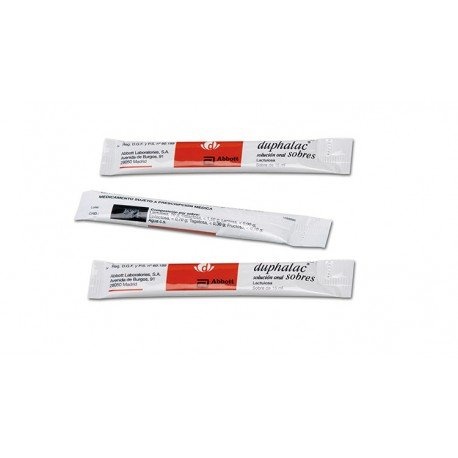
Cada stick de duphalac contiene 10 g de lactulosa.
Aspecto del producto y contenido del envase
duphalac es un líquido transparente, viscoso, incoloro o amarillento parduzco.
Está disponible en sobres monodosis de 15 ml, en envase con lámina de poliéster/aluminio/polietileno. Cada envase contiene 10 o 50 sobres.
Está disponible también en sticks (sobre más alargado) de poliéster/aluminio/polietileno de 15 ml. Cada envase contiene 10 o 50 sticks.
Puede que solamente estén comercializados algunos tamaños de envase.
Titular de la autorización de comercialización y responsable de la fabricación
Titular de la autorización del medicamento:
Cooper Consumer Health B.V.
Verrijn Stuartweg 60,
1112 AX Diemen,
Países Bajos
Responsable de la fabricación:
Abbott Biologicals B.V.
Veerweg 12, Olst, Holanda
Pueden solicitar más información respecto a este medicamento dirigiéndose al representante local del titular de la autorización de comercialización:
Vemedia Pharma Hispania, S.A.
C/ Aragón, 182, 5ª planta
08011 – Barcelona
España
Fecha de la última revisión de este prospecto: abril 2024
La información detallada de este medicamento está disponible en la página Web de la Agencia Española de Medicamentos y Productos Sanitarios (AEMPS) https://www.aemps.es/
- País de registro
- Forma farmacéuticaSOLUCIÓN/SUSPENSIÓN ORAL, 10 g lactulosa
- Código ATCA06AD11
- Precio medio en farmacia3.87 EUR
- Principio activo
- Requiere recetaSí
- Fabricante
- ComposiciónLACTOSA (menos 0,90 g mg), GALACTOSA (menos 1,65 g mg)
- Esta información es de carácter general y no sustituye la consulta con un profesional sanitario.
- Alternativas a DUPHALAC 10 G SOLUCION ORAL EN SOBREForma farmacéutica: SOLUCIÓN/SUSPENSIÓN ORAL, 10 g lactulosa/ 15 mlPrincipio activo: lactulosaFabricante: Cooper Consumer Health B.V.Requiere recetaForma farmacéutica: SOLUCIÓN/SUSPENSIÓN ORAL, 0,67 g lactulosa/mlPrincipio activo: lactulosaFabricante: Lainco S.A.Requiere recetaForma farmacéutica: SOLUCIÓN/SUSPENSIÓN ORAL, 0,67 g lactulosa/ mlPrincipio activo: lactulosaFabricante: Lainco S.A.Requiere receta
Médicos online para DUPHALAC 10 G SOLUCION ORAL EN SOBRE
Comenta la dosis, los posibles efectos secundarios, interacciones, contraindicaciones o la revisión de receta de DUPHALAC 10 G SOLUCION ORAL EN SOBRE, sujeto a valoración médica y a la normativa local.









Obtén una receta de DUPHALAC 10 G SOLUCION ORAL EN SOBRE online
Rellena un formulario de 2 minutos
Cuéntanos tus síntomas, historial y el medicamento que necesitas.
Elige un médico o nosotros te asignamos uno
Escoge un especialista o te conectamos con el próximo médico disponible.
El médico revisa tu caso
Normalmente en 30 minutos. Puede hacerte preguntas adicionales por chat.
Recógela en cualquier farmacia
Receta electrónica enviada a tu correo, válida en toda España.
Preguntas frecuentes
DUPHALAC 10 G SOLUCION ORAL EN SOBRE requiere receta en España. Puedes confirmarlo con un médico online según tu caso.
El principio activo de DUPHALAC 10 G SOLUCION ORAL EN SOBRE es lactulosa. Esta información ayuda a identificar medicamentos con la misma composición pero con diferentes nombres comerciales.
El precio medio en farmacia de DUPHALAC 10 G SOLUCION ORAL EN SOBRE es de aproximadamente 3.87 EUR. Puede variar según el fabricante y la forma farmacéutica.
DUPHALAC 10 G SOLUCION ORAL EN SOBRE es fabricado por Cooper Consumer Health B.V.. La marca y el envase pueden variar según el distribuidor.
Los Médicos de familia, Psiquiatras, Dermatólogos, Cardiólogos, Endocrinólogos, Gastroenterólogos, Neumólogos, Nefrólogos, Reumatólogos, Hematólogos, Infectólogos, Alergólogos, Geriatras, Pediatras, Oncólogos pueden valorar la prescripción de DUPHALAC 10 G SOLUCION ORAL EN SOBRE cuando esté clínicamente indicado. Puedes reservar una videoconsulta para comentar tu caso y las opciones de tratamiento.
España cuenta con una infraestructura sanitaria bien desarrollada en ciudades principales como Madrid, Barcelona, Valencia y Sevilla. Las farmacias están ampliamente disponibles y operan bajo estrictas regulaciones, garantizando el acceso a medicamentos con receta.
Puedes comprar DUPHALAC 10 G SOLUCION ORAL EN SOBRE en Madrid, Barcelona, Sevilla o Valencia en cualquier farmacia local con una receta válida.
Para obtener una receta, puedes utilizar Oladoctor:
Otros medicamentos con el mismo principio activo (lactulosa) incluyen DUPHALAC 667 MG/ML SOLUCION ORAL, LACTULOSA LAINCO 10 g SOLUCION ORAL EN SOBRES EFG, LACTULOSA LAINCO 3,33 g/5 ml SOLUCION ORAL EFG. Pueden tener diferentes nombres comerciales o formulaciones, pero contienen el mismo componente terapéutico. Consulta siempre con un médico antes de cambiar o iniciar un nuevo medicamento.
