



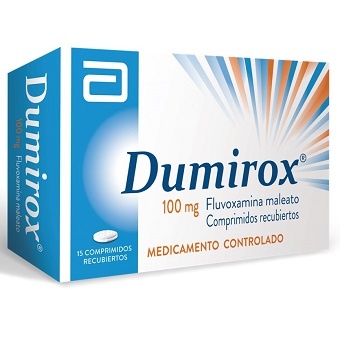
DUMIROX 100 mg Comprimidos Recubiertos Con Película

Revisión de receta online
Un médico revisará tu caso y determinará si la prescripción es médicamente apropiada.

Habla con un médico sobre este medicamento
Comenta tus síntomas y las opciones de tratamiento en una consulta online.



Cómo usar DUMIROX 100 mg COMPRIMIDOS RECUBIERTOS CON PELICULA
Contenido del prospecto
- Introducción
- Qué es Dumirox y para qué se utiliza
- Qué necesita saber antes de empezar a tomar Dumirox
- Cómo tomar Dumirox
- Posibles efectos adversos
- Conservación de Dumirox
- Contenido del envase e información adicional
Introducción
Prospecto: información para el usuario
Dumirox 100 mg comprimidos recubiertos con película
fluvoxamina maleato
Lea todo el prospecto detenidamente antes de empezar a tomar el medicamento
- Conserve este prospecto, ya que puede tener que volver a leerlo.
- Si tiene alguna duda, consulte a su médico o farmacéutico.
- Este medicamento se le ha recetado a usted y no debe dárselo a otras personas aunque tengan los mismos síntomas, ya que puede perjudicarles.
- Si considera que alguno de los efectos adversos que sufre es grave o si aprecia cualquier efecto adverso no mencionado en este prospecto, informe a su médico o farmacéutico
Contenido del prospecto
- Qué es Dumirox y para qué se utiliza
- Qué necesita saber antes de empezar a tomar
- Cómo tomar Dumirox 4. Posibles efectos adversos
- Conservación de Dumirox
- Contenido del envase e información adicional
1. Qué es Dumirox y para qué se utiliza
El principio activo de Dumirox es fluvoxamina; pertenece al grupo de medicamentos denominados antidepresivos inhibidores selectivos de la recaptación de serotonina (ISRS). Es un antidepresivo y se utiliza para tratar la depresión (trastorno depresivo mayor).
Dumirox también puede tratar a las personas que sufran un trastorno obsesivo compulsivo (TOC)

¿No estás seguro de si este medicamento es adecuado para ti?
Comenta tus síntomas y tratamiento con un médico online.
2. Qué necesita saber antes de empezar a tomar Dumirox
No tome Dumirox:
- si es alérgico (hipersensible) a fluvoxamina o a cualquiera de los demás componentes de Dumirox (ver sección 6 “Información adicional”)
- si está siendo tratado con medicamentos denominados inhibidores de la monoaminooxidasa (IMAOs) a veces prescritos para tratar la depresión o la ansiedad, incluyendo linezolid (un antibiótico que es también IMAO).
El tratamiento con fluvoxamina debería empezarse al menos 2 semanas después de dejar de tomar un IMAO irreversible. Sin embargo el tratamiento con fluvoxamina después de dejar ciertos IMAOs reversibles se puede iniciar al día siguiente. En casos excepcionales linezolid (un antibiótico IMAO) puede ser usado con fluvoxamina si el médico le supervisa estrechamente.
Su médico le aconsejará como tomar Dumirox una vez haya dejado de tomar los IMAOs
- si está tomando tizanidina, un medicamento usado con frecuencia como relajante muscular
- si está en período de lactancia
- si está tomando pimozida, un medicamento neuroléptico usado en el trsatsmiento de la esquizofrenia y otras enfermedades psiquiátricas
Si alguna de las circunstancias anteriores se aplica a usted, no tomeDumirox y consulte a su médico
Advertencias y precauciones
Consulte con su médico o farmacéutico antesde tomar el medicamento:
- si ha tenido un ataque de corazón recientemente
- si está embarazada, o cree que pudiera estarlo
- si padece epilepsia
- si tiene historial de problemas de sangrado o si usted toma con regularidad medicamentos que aumentan el riesgo de sangrado, como analgésicos, o si está embarazada (ver «Embarazo»2)
- si padece diabetes
- si está en tratamiento conjunto con terapia electroconvulsiva (TEC)
- si tiene antecedentes de haber padecido manía (sensación de euforia o sobreexcitación)
- si padece insuficiencia hepática o renal
- si tiene presión ocular elevada (glaucoma)
- si tiene menos de 18 años (ver también sección 3”Cómo tomar Dumirox”)
- si está tomando medicamentos que contienen opioides como buprenorfina o buprenorfina / naloxona, ya que estos productos tomados en combinación con Dumirox pueden provocar el síndrome de serotonina, una afección potencialmente mortal (para los síntomas, consulte la sección 4, "Posibles efectos adversos") y "Otros medicamentos y Dumirox".
Si alguna de las circunstancias anteriores se aplica a usted, su médico le indicará si es seguro para usted consulte a su médico si le recomienda iniciar la toma de Dumirox.
En ocasiones, pueden producirse o aumentar las ideas de agitación,no puede sentarse o estarse quieto (acatisia) en las primeras semanas de tratamiento con Dumirox, hasta que se produce el efecto antidepresivo.
Informe inmediatamente a su médico si tiene estos síntomas. Puede ser de ayuda el ajuste de la dosis.
Se ha informado de reacciones cutáneas graves cuando se usa Dumirox. Deje de tomarDumirox y póngase en contacto con su médico de inmediato si desarrolla una erupción o lesiones en las mucosas. Las erupciones graves pueden incluir erupción cutánea, que comienza en las extremidades, generalmente en ambos lados del cuerpo y evolucionando a círculos concéntricos que se asemejan a eritema (eritema multiforme), erupción generalizada con ampollas y descamación de la piel, que ocurre particularmente alrededor del boca, nariz, ojos y genitales (síndrome de Stevens-Johnson), descamación extensa de la piel (más del 30% de la superficie del cuerpo - necrólisis epidérmica tóxica).
Los medicamentos como Dumirox (los llamados ISRS) pueden causar síntomas de disfunción sexual (ver sección 4). En algunos casos, estos síntomas han continuado después de suspender el tratamiento.
Ideas de suicidio y empeoramiento de su depresión o trastorno de ansiedad
Si se encuentra deprimido y/o sufre un trastorno de ansiedad a veces puede tener ideas de autolesión o suicidio. Esto puede incrementarse al iniciar por primera vez el tratamiento antidepresivo, ya que estos medicamentos tardan en hacer su efecto, por lo general a las dos semanas, pero a veces más tiempo.
Es probable que usted piense de esta forma si:
- previamente ha tenido ideas de suicidio o autolesión.
- es un adulto jóven. La información procedente de los ensayos clínicos ha demostrado un aumento en el riesgo de comportamiento suicida en adultos menores de 25 años con trastornos psiquiátricos que fueron tratados con un antidepresivo.
Si tiene ideas de autolesión o suicidio, informe inmediatamente a su médico o vaya directamente a un hospital.
Puede ser de gran ayuda decir a un familiar o amigoque se encuentra usted deprimido o tiene trastorno de ansiedad, y pedirle que lean el prospecto. Puede pedirles su opinión sobre si está empeorando su depresión o ansiedad, o si están preocupados por los cambios de comportamiento que usted tiene.
Informe a su médico inmediatamentesi tiene ideas o experiencias que le producen angustia.
Uso en niños y adolescentes menores de 18 años
Los niños y los adolescentes menores de 18 años no deberían tomar este medicamento, a menos que estén en tratamiento por el trastorno obsesivo compulsivo (TOC). Esto es debido a que Dumirox no se usa para tratar la depresión en personas menores de 18 años.
Cuando ingieren esta clase de medicamento, los pacientes menores de 18 años tienen un mayor riesgo de efectos adversos como intentos de suicidio, ideas de suicidio y hostilidad, tales como agresión, comportamiento de confrontación e irritación.
Si su médico ha prescrito Dumirox a un paciente menor de 18 años para tratar otro trastorno que no sea el trastorno obsesivo compulsivo y desea discutir esta decisión, vuelva a su médico.
Si un paciente menor de 18 años están tomando Dumirox, debe informar a su médico en el caso de que alguno de los síntomas que se han detallado anteriormente progrese o si tiene complicaciones.
No se tiene información con la toma de Dumirox sobre la seguridad a largo plazo en menores de 18 años por lo que se refiere al crecimiento, la madurez y el desarrollo intelectual y de la conducta.
Uso de otros medicamentos
- no empiece a tomar la planta medicinal “Hierba de San Juan” si le han prescrito Dumirox, ya que puede aumentar los efectos adversos. Si ya está tomando la preparación de “Hierba de San Juan” cuando inicie el tratamiento con Dumirox, deje de tomar la preparación de “Hierba de San Juan” y consulte con su médico en la próxima visita.
- si ha estado tomando un medicamento para tratar la depresión o la ansiedad durante las últimas dos semanas o padece esquizofrenia, consulte con su médico o farmacéutico.
Su médico o farmacéutico debería saber si usted está tomando otros medicamentos para tratar la depresión o condiciones psicóticas relacionadas, que contengan lo siguiente:
- benzodiazepinas
- antidepresivos tricíclicos
- neurolépticos o antipsicóticos
- litio
- triptófano
- inhibidores de la monoaminooxidasa (IMAO) tales como la moclobemida
- pimozida
- inhibidores selectivos de la recaptación de serotonina (ISRS) tales como citalopram
Su médico le dirá si es seguro para usted iniciar el tratamiento con Dumirox.
Informe a su médico o farmacéutico si está tomando cualquiera de los medicamentos que se indicana continuación:
- aspirina (ácido acetilsalicílico) o medicamentos similares a aspirina, usados para tratar el dolor y la inflamación (artritis)
- ciclosporina, usado para reducir la actividad del sistema inmune
- metadona, usado para tratar el dolor y el síndrome de abstinencia
- mexiletina, usado para tratar los trastornos del ritmo cardíaco
- fenitoína o carbamazepina, usado para tratar la epilepsia
- propranolol, usado para tratar la presión sanguínea alta y trastornos cardíacos
- ropinirol, para la enfermedad de Parkinson
- un “triptano”, usado para tratar migrañas, tal como sumatriptan
- terfenadina, usado para tratar alergias. Dumirox no debería usarse conjuntamente con terfenadina
- sildenafilo , usado en el tratamiento de la disfunción eréctil
- teofilina, usado para tratar asma y bronquitis
-tramadol (analgésicos)
- buprenorfina o buprenorfina/naloxona
- clopidogrel, warfarina, acenocumarol o cualquier medicamento anticoagulante
Si está usted tomando o ha tomado hace poco cualquiera de los medicamentos de la lista anterior y no ha informado a su médico, vuelva a visitar a su médico y pregúntele lo que debería hacer. Puede que le cambie la dosis o puede necesitar que le den otro medicamento diferente
Informe a su médico o farmacéutico si está tomando o ha tomado recientemente otros medicamentos, incluso los adquiridos sin receta. Esto también incluye a las plantas medicinales.
Toma de Dumirox con los alimentos y bebidas
- no tome bebidas alcohólicas si está tomando este medicamento. El alcohol puede interaccionar con el Dumirox y puede producir somnolencia e inestabilidad.
- si normalmente bebe mucho té, café o bebidas suaves con cafeína, puede tener síntomas tales como manos temblorosas, malestar, frecuencia cardiaca acelerada (palpitaciones), inquietud y dificultad para dormir (insomnio). Si disminuye la cafeína que bebe, estos síntomas pueden desaparecer.
Embarazo y lactancia
Consulte a su médico o farmacéutico antes de utilizar cualquier medicamento.
Embarazo
Solo hay experiencia limitada respecto al uso de fluvoxamina durante el embarazo. No tome Dumirox si está usted embarazada a menos que su médico lo considere absolutamente necesario. Si actualmente está tomando fluvoxamina y está planeando quedarse embarazada, por favor consulte con su médico por si decide que es necesario o apropiado cambiarle la medicación.
Se ha demostrado en estudios con animales que fluvoxamina reduce la calidad del esperma. Teóricamente, esto podría afectar a la fertilidad, pero hasta ahora no se ha observado impacto en la fertilidad humana.
Asegúrese de que su comadrona y/o médico saben que está en tratamiento con fluvoxamina. Si se toma durante el embarazo, en particular en los últimos 3 meses de embarazo, los medicamentos como fluvoxamina pueden aumentar el riesgo de un estado grave en los bebés, llamado hipertensión pulmonar persistente del recién nacido (HPPRN), lo cual hace que el bebé respire más rápido y parezca azulado. Estos síntomas en general empiezan durante las primeras 24 horas después del nacimiento del bebé. Si esto le ocurre a su bebé usted debería informar inmediatamente a su comadrona y/o médico.
No deje el tratamiento con fluvoxamina repentinamente. Si usted ha estado tomando fluvoxamina durante los 3 últimos meses de embarazo, su bebé podría tener otros síntomas al nacer además de tener dificultad en respirar o piel azulada, tales como no ser capaz de dormir o alimentarse adecuadamente, estar muy caliente o frío, sensación de malestar, llorar mucho, músculos anquilosados o hipotónicos, letargia, somnolencia, temblores, ponerse nervioso o ataques. Si su bebé tiene alguno de estos síntomas al nacer consulte a su médico inmediatamente.
Si toma Dumirox en la etapa final del embarazo puede producirse un mayor riesgo de sangrado vaginal abundante poco después del parto, especialmente si tiene antecedentes de alteraciones hemorrágicas. Su médico o matrona deben saber que usted está tomando Dumirox para poderle aconsejar.
Lactancia
Fluvoxamina pasa a la leche materna. Hay riesgo de que tenga efecto en el recién nacido. Por lo tanto, debe comentar con el médico que decidirá si usted debe dejar de amamantar o cesar el tratamiento con fluvoxamina.
Conducción y uso de máquinas
Durante el tratamiento con Dumirox 100 puede que se sienta somnoliento o mareado. No conduzca ni maneje herramientas o máquinas hasta que sepa cómo le afecta el tratamiento con Dumirox 100.
Dumirox contiene sodioEste medicamento contiene menos de 1 mmol de sodio (23 mg) por tableta, es decir, esencialmente "libre de sodio".
3. Cómo tomar Dumirox
Cuanto Dumirox tomar
Tome siemprela cantidad de Dumirox que su médico le haya recetado.
Si no está seguro consulte con su médico o farmacéutico.
Dosis inicial normal para adultos (a partir de 18 años):
Tratamiento de la depresión:
- Iniciar con 50 o 100 mg al día, ingeridos por la noche.
Tratamiento del trastorno obsesivo compulsivo:
- Iniciar con 50 mg al día, con preferencia por la noche.
Si no empieza a encontrarse mejor después de un par de semanas, informe a su médico, quien le aconsejará. Su médico le indicara como aumentar la dosis gradualmente.
La dosis más alta diaria que se recomienda es de 300 mg.
Si su médico le aconseja tomar más de 150 mg al día, no tometoda la dosis a la vez; pregunte a su médico cuando debe ingerir cada toma.
Dosis normal para niños y adolescentes con trastorno obsesivo compulsivo - TOC (a partir de 8 años):
Iniciar con 25 mg (medio comprimido) al día, preferiblemente al acostarse. Su médico puede aumentar la dosis cada 4 – 7 días en incrementos de 25 mg si se toleran hasta alcanzar la dosis eficaz.
La dosis diaria más alta es de 200 mg.
Si su médico le aconseja tomar más de 50 mg al día, no tometoda la dosis a la vez; pregunte a su médico cuando debe ingerir en cada toma. Si la dosis no se divide en partes iguales, la dosis más alta debería tomarse por la noche.
Los niños y adolescentes menores de 18 años no deberían tomareste medicamento para el tratamiento de la depresión. Este medicamento sólodebería prescribirse para niños y adolescentes en caso de trastorno obsesivo compulsivo (TOC).
Cómo tomar Dumirox
Tragar los comprimidos con agua. No losmastique.
Puede partir los comprimidos por la mitad si su médico así se lo aconseja.
Cuándo hace efecto
Dumirox tarda algún tiempo en hacer efecto. Algunos pacientes no se encuentran mejor durante las primeras 2 o 3 semanas de tratamiento.
Tome loscomprimidos hasta que su médico le diga que lo deje.
Aunque se sienta mejor, su médico puede aconsejarle que continúe tomando los comprimidos por algún tiempo más, como mínimo unos seis meses, para asegurar que la medicación ha hecho el efecto por completo.
No interrumpael tratamiento con Dumirox bruscamente.
Usted puede sufrir síntomas de retiradatales como:
- agitación y ansiedad
- confusión
- diarrea
- dificultad para dormir/sueños intensos
- vértigo
- inestabilidad emocional
- dolor de cabeza
- irritabilidad
- nauseas y/o vómitos
- palpitaciones (latidos del corazón más rápidos)
- trastornos sensoriales (tales como sensación de choque eléctrico o trastornos visuales)
- sudoración
- temblores
Para retirar el tratamiento con Dumirox su médico le indicará que reduzca lentamente la dosis durante un número de semanas o meses, esto ayudará a reducir la incidencia de efectos de retirada. La mayoría de personas encuentran que los síntomas al cesar el tratamiento de Dumirox son leves y dejan de producirse durante las dos semanas siguientes. Para algunas personas, estos síntomas pueden ser más graves o continúan durante más tiempo.
Si usted tiene síntomas de retirada cuando deje el tratamiento su médico puede indicarle que deje el tratamiento más lentamente. Si usted tiene efectos de retirada más graves cuando deje de tomar Dumirox, por favor consulte con su médico. Su médico puede aconsejarle tomar otra vez los comprimidos e irlos dejando más lentamente (ver sección 4 “Posibles efectos adversos”).
Si se produce alguno de estos síntomas al retirar el tratamiento, consulte asu médico.
Si toma más Dumirox del que debiera
Si usted o alguien ha tomado más Dumirox de lo que debe (una sobredosis), informe a su médico, vaya directamente al hospital o llame al Servicio de Información Toxicológica, teléfono 91 562 04 20, indicando el medicamento y la cantidad ingerida. Lleve el envase del medicamento con usted.
Los síntomas de sobredosis incluyen, pero no se limitan a, náuseas, vómitos, diarrea y sensación de somnolencia o mareo. Se han comunicado síntomas cardíacos (frecuencia cardíaca lenta o rápida, presión sanguínea baja), complicaciones hepáticas, convulsiones (ataques) y coma.
Si olvidó tomar Dumirox
Si olvidó tomar un comprimido, espere hasta la siguiente dosis. No tome una dosis doble para compensar las dosis olvidadas.
Si tiene cualquier otra duda sobre el uso de este producto, pregunte a su médico o farmacéutico.

¿Has empezado a tomar el medicamento y tienes preguntas?
Comenta tus síntomas y tratamiento con un médico online.
4. Posibles efectos adversos
Al igual que todos los medicamentos, Dumirox puede producir efectos adversos, aunque no todas las personas los sufren. Las frecuencias de los efectos adversos observados se definen como se describe a continuación:
Muy frecuentes | que afecta a más de 1 de cada 10 pacientes |
Frecuentes | que afecta a entre 1 y 10 de cada 100 pacientes |
Poco frecuentes | que afecta a entre 1 y 10 de cada 1000 pacientes |
Raras | que afecta a entre 1 y 10 de cada 10.000 pacientes |
Muy raras | que afecta a menos de 1 por cada 10.000 pacientes |
No conocida | no puede estimarse a partir de los datos disponibles |
Efectos adversos relacionados con este tipo de medicación
En ocasiones, se pueden producir o pueden aumentar ideas de suicidio o autolesióndurante las primeras semanas de tratamiento con Dumirox, hasta que se produzca el efecto antidepresivo.
Informe a su médico inmediatamentesi usted tiene ideas o experiencias angustiosas.
Si tiene varios síntomas al mismo tiempopuede ser que tenga una de las raras condiciones que se describen a continuación:
- Síndrome serotoninérgico: Si tiene sudoración, rigidez muscular o espasmos, inestabilidad, confusión, irritabilidad o agitación extrema.
- Síndrome neuroléptico maligno: Si tiene rigidez muscular, fiebre, confusión y otros síntomas relacionados.
- SIADH: si usted se siente cansado, débil o confuso y tiene los músculos doloridos, entumecidos o incontrolados.
- Reacciones cutáneas graves, como erupciones cutáneas o enrojecimiento graves, que incluyen erupción generalizada, que se inicia en las extremidades en ambas partes del cuerpo y que evolucionan a círculos concéntricos que se asemejan a eritema (eritema multiforme), erupción cutánea generalizada con ampollas y descamación de la piel, que ocurre especialmente alrededor de la boca, nariz, ojos y genitales (síndrome de Stevens-Johnson), descamación extensa de la piel (más del 30% de la superficie del cuerpo - necrólisis epidérmica tóxica). Se desconoce la frecuencia de estos efectos secundarios (no se puede estimar a partir de los datos disponibles).
Dejede tomar Dumirox y consulte con su médico inmediatamente.
Si aparecen hematomas inusuales o ronchas púrpura sobre su piel o si vomita sangre o tiene sangre en las heces, contacte con su médico.
Dejar de tomar fluvoxamina (en especial cuando se hace bruscamente) con frecuencia conduce a síntomas de retirada (ver sección 3 síntomas de retirada).
A veces los pacientes tienen nauseascuando al iniciar el tratamiento con Dumirox éste empieza a tener efecto. Aunque la sensación de nausea es desagradable, debería pasar al poco tiempo si continua tomando los comprimidos tal y como se los han prescrito. Esto puede producirse a las pocas semanas.
Efectos adversos provocados por Dumirox
Efectos adversos frecuentes:
- agitación
- ansiedad
- estreñimiento
- diarrea
- dificultad para dormir
- vértigo
- boca seca
- latido cardiaco más rápido
- somnolencia (letargo)
- malestar
- dolor de cabeza
- indigestión
- pérdida de apetito
- nerviosismo
- dolor de estómago
- sudoración
- temblor
- debilidad muscular (astenia)
- vómitos
Efectos adversos poco frecuentes:
- reacciones cutáneas alérgicas (incluyendo sudoración de la cara, labios o lengua, erupción o picazón)
- confusión
- retraso en la eyaculación
- mareo al levantarse demasiado rápido
- alucinaciones
- falta de coordinación
- dolor muscular o articular
- agresión
Efectos adversos raros:
- convulsiones
- trastornos hepáticos
- manía (sensación de hiperexcitación)
- fotosensibilidad
- flujo de leche inesperado
Efectos adversos muy raros:
- acatisia (agitación)
- gusto anormal
- anorgasmia (no alcanzar el orgasmo)
- en mujeres: alteraciones en la menstruación (sangrado mensual)
- sangrado vaginal abundante poco después del parto (hemorragia posparto), ver “Embarazo” en la sección 2 para más información
- alteraciones de la micción (como necesidad de orinar con frecuencia durante el día y/o la noche, falta de control urinario repentino durante el día y/o la noche, o falta de habilidad urinaria)
- parestesia (hormigueo o entumecimiento)
- incremento de prolactina (una hormona que estimula la producción de leche en madres que están dando el pecho)
- pupilas dilatadas
- cambios en el peso corporal
- glaucoma (aumento de la presión ocular).
Se ha observado un aumento del riesgo de fracturas óseas en pacientes que toman este tipo de medicamentos.
Frecuencia no conocida
- sangrado vaginal abundante poco después del parto (hemorragia posparto), ver «Embarazo»2 en la sección 2 para más información.
Efectos adversos relacionados con el tratamiento de TOC, en niños y adolescentes, no se dan frecuencias
- hipomanía (sensación de euforia y sobreexcitación)
- agitación
- convulsiones
- dificultad en dormir (insomnio)
- falta de energía (astenia)
- hiperactividad (hipercinesia)
- sensación de somnolencia
- indigestión
Comunicación de efectos adversos:
Si experimenta cualquier tipo de efecto adverso, consulte a su médico o farmacéutico, incluso si se trata de posibles efectos adversos que no aparecen en este prospecto. También puede comunicarlos directamente a través del Sistema Español de Farmacovigilancia de Medicamentos de Uso Humano: http://www.notificaram.es. Mediante la comunicación de efectos adversos usted puede contribuir a proporcionar más información sobre la seguridad de este medicamento
5. Conservación de Dumirox
Mantener fuera del alcance y de la vista de los niños.
- No utilice los comprimidos después de la fecha de caducidad que aparece en la caja después de “CAD” o “EXP”. La fecha de caducidad es el último día del mes que se indica.
- No conservar a temperatura superior a 25 ºC.
Los medicamentos no se deben tirar por los desagües ni a la basura. Deposite los envases y los medicamentos que no necesita en el Punto SIGRE de la farmacia. En caso de duda pregunte a su farmacéutico cómo deshacerse de los envases y de los medicamentos que no necesita. De esta forma, ayudará a proteger el medio ambiente.
6. Contenido del envase e información adicional
Composición de Dumirox
El principio activo es fluvoxamina maleato.
Cada comprimido contiene 100 mg de fluvoxamina como maleato.
Los demás componentes son manitol (E421), almidón de maíz sin gluten, almidón pregelatinizado, estearilfumarato sódico, sílice coloidal anhidra, hipromelosa, macrogol 6000, talco y dióxido de titanio (E171).
Aspecto del producto y contenido del envase
Dumirox 100 mg se presenta en forma de comprimidos recubiertos con película, blancos o casi blancos, ovalados y con una marca “313” en los 2 lados separados por la línea divisoria.
Dumirox 100 mg está disponible en envases de 15, 20, 30, 50, 60, 90, 100, 120 y 250 comprimidos.
Puede que solamente estén comercializados algunos tamaños de envases.
Titular de la autorización de comercialización y responsable de la fabricación
Titular
Viatris Healthcare Limited
Damastown Industrial Park
Mulhuddart, Dublín 15
Dublín
Irlanda
Responsable de la fabricación
Mylan Laboratories SAS
Route de Belleville Lieu dit Maillard
01400 Châtillon-sur-Chalaronne
Francia
o
Recipharm Parets, S.L.U.
C/ Ramón y Cajal, 2
08150 - Parets del Vallés (Barcelona)
España
Pueden solicitar más información respecto a este medicamento dirigiéndose al representante local del titular de la autorización de comercialización:
Viatris Pharmaceuticals, S.L.
C/ General Aranaz, 86
28027 - Madrid
España
Este producto farmacéutico está autorizado en los estados miembros del AEE bajo los siguientes nombres:
Austria Floxyfral
Bélgica Floxyfral
Francia Floxyfral
Alemania Fevarin
Grecia Dumyrox
Irlanda Faverin
Italia Dumirox
Luxemburgo Floxyfral
Noruega Fevarin
Portugal Dumyrox
España Dumirox
Suecia Fevarin
Holanda Fevarin
Reino Unido (NI) Faverin
Fecha de última revisión de este prospecto:Abril 2025
La información detallada y actualizada de este medicamento está disponible en la página Web de la Agencia Española de Medicamentos y Productos Sanitarios (AEMPS) https://www.aemps.es/
- País de registro
- Forma farmacéuticaCOMPRIMIDO, 100 mg de maleato de fluvoxamina
- Código ATCN06AB08
- Precio medio en farmacia7.68 EUR
- Principio activo
- Requiere recetaSí
- Fabricante
- ComposiciónMANITOL (E-421) (303 mg mg), FUMARATO DE ESTEARILO Y SODIO (3,5 mg mg)
- Esta información es de carácter general y no sustituye la consulta con un profesional sanitario.
- Alternativas a DUMIROX 100 mg COMPRIMIDOS RECUBIERTOS CON PELICULAForma farmacéutica: COMPRIMIDO, 50 mg de maleato de fluvoxaminaPrincipio activo: fluvoxamineFabricante: Viatris Healthcare LimitedRequiere recetaForma farmacéutica: COMPRIMIDO, 100 mg fluvoxamina maleatoPrincipio activo: fluvoxamineFabricante: Sandoz Farmaceutica S.A.Requiere recetaForma farmacéutica: COMPRIMIDO, 50 mg fluvoxamina maleatoPrincipio activo: fluvoxamineFabricante: Sandoz Farmaceutica S.A.Requiere receta
Médicos online para DUMIROX 100 mg COMPRIMIDOS RECUBIERTOS CON PELICULA
Comenta la dosis, los posibles efectos secundarios, interacciones, contraindicaciones o la revisión de receta de DUMIROX 100 mg COMPRIMIDOS RECUBIERTOS CON PELICULA, sujeto a valoración médica y a la normativa local.







Obtén una receta de DUMIROX 100 mg COMPRIMIDOS RECUBIERTOS CON PELICULA online
Rellena un formulario de 2 minutos
Cuéntanos tus síntomas, historial y el medicamento que necesitas.
Elige un médico o nosotros te asignamos uno
Escoge un especialista o te conectamos con el próximo médico disponible.
El médico revisa tu caso
Normalmente en 30 minutos. Puede hacerte preguntas adicionales por chat.
Recógela en cualquier farmacia
Receta electrónica enviada a tu correo, válida en toda España.
Preguntas frecuentes
DUMIROX 100 mg COMPRIMIDOS RECUBIERTOS CON PELICULA requiere receta en España. Puedes confirmarlo con un médico online según tu caso.
El principio activo de DUMIROX 100 mg COMPRIMIDOS RECUBIERTOS CON PELICULA es fluvoxamine. Esta información ayuda a identificar medicamentos con la misma composición pero con diferentes nombres comerciales.
El precio medio en farmacia de DUMIROX 100 mg COMPRIMIDOS RECUBIERTOS CON PELICULA es de aproximadamente 7.68 EUR. Puede variar según el fabricante y la forma farmacéutica.
DUMIROX 100 mg COMPRIMIDOS RECUBIERTOS CON PELICULA es fabricado por Viatris Healthcare Limited. La marca y el envase pueden variar según el distribuidor.
Los Médicos de familia, Psiquiatras, Dermatólogos, Cardiólogos, Endocrinólogos, Gastroenterólogos, Neumólogos, Nefrólogos, Reumatólogos, Hematólogos, Infectólogos, Alergólogos, Geriatras, Pediatras, Oncólogos pueden valorar la prescripción de DUMIROX 100 mg COMPRIMIDOS RECUBIERTOS CON PELICULA cuando esté clínicamente indicado. Puedes reservar una videoconsulta para comentar tu caso y las opciones de tratamiento.
España cuenta con una infraestructura sanitaria bien desarrollada en ciudades principales como Madrid, Barcelona, Valencia y Sevilla. Las farmacias están ampliamente disponibles y operan bajo estrictas regulaciones, garantizando el acceso a medicamentos con receta.
Puedes comprar DUMIROX 100 mg COMPRIMIDOS RECUBIERTOS CON PELICULA en Madrid, Barcelona, Sevilla o Valencia en cualquier farmacia local con una receta válida.
Para obtener una receta, puedes utilizar Oladoctor:
Otros medicamentos con el mismo principio activo (fluvoxamine) incluyen DUMIROX 50 mg COMPRIMIDOS RECUBIERTOS CON PELICULA, FLUVOXAMINA SANDOZ 100 mg COMPRIMIDOS RECUBIERTOS CON PELICULA EFG, FLUVOXAMINA SANDOZ 50 mg COMPRIMIDOS RECUBIERTOS CON PELICULA EFG. Pueden tener diferentes nombres comerciales o formulaciones, pero contienen el mismo componente terapéutico. Consulta siempre con un médico antes de cambiar o iniciar un nuevo medicamento.
