



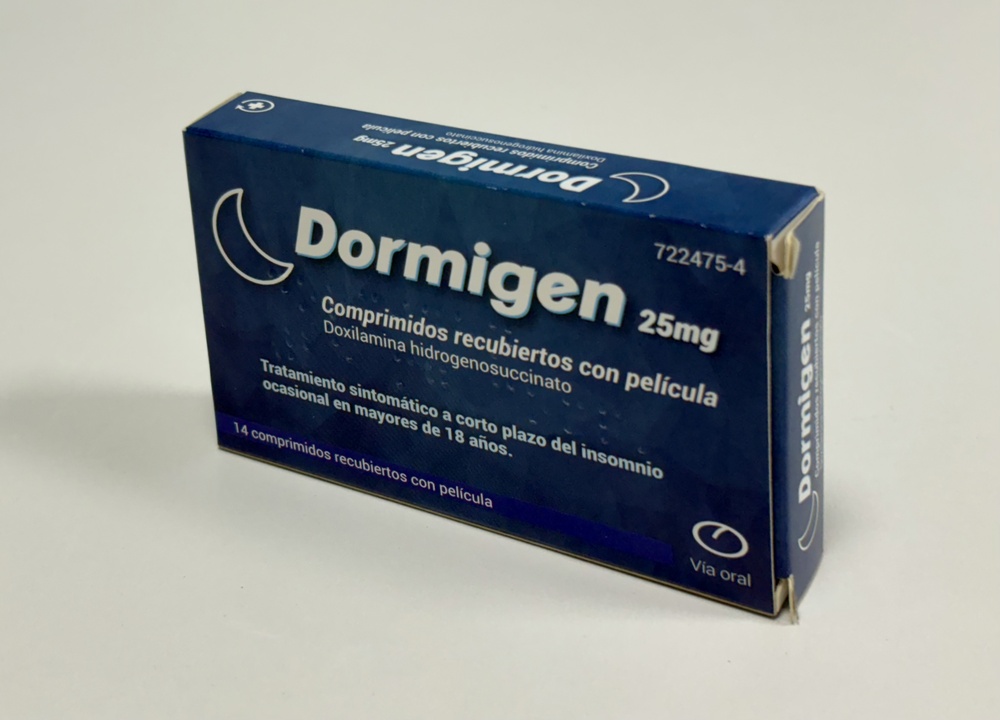
DORMIGEN 25 mg Comprimidos Recubiertos Con Película

Revisión de receta online
Un médico revisará tu caso y determinará si la prescripción es médicamente apropiada.

Habla con un médico sobre este medicamento
Comenta tus síntomas y las opciones de tratamiento en una consulta online.



Cómo usar DORMIGEN 25 MG COMPRIMIDOS RECUBIERTOS CON PELICULA
Contenido del prospecto
- Introducción
- Qué es Dormigen y para qué se utiliza
- Qué necesita saber antes de empezar a tomar Dormigen
- Cómo tomar Dormigen
- Posibles efectos adversos
- Conservación de Dormigen
- Contenido del envase e información adicional
Introducción
Prospecto: Información para el paciente
Dormigen 25 mg comprimidos recubiertos con película
Hidrogenosuccinato de doxilamina
Lea todo el prospecto detenidamente antes de empezar a tomar este medicamento, porque contiene información importante para usted.
Siga exactamente las instrucciones de administración del medicamento contenidas en este prospecto o las indicadas por su médico o farmacéutico.
- Conserve este prospecto, ya que puede tener que volver a leerlo.
- Si necesita consejo o más información, consulte a su farmacéutico.
- Si experimenta efectos adversos, consulte a su médico o farmacéutico, incluso si se trata de efectos adversos que no aparecen en este prospecto. Ver sección 4.
- Debe consultar a un médico si empeora o si no mejora después de 7 días de tratamiento.
Contenido del prospecto
- Qué es Dormigen y para qué se utiliza
- Qué necesita saber antes de empezar a tomar Dormigen
- Cómo tomar Dormigen
- Posibles efectos adversos
- Conservación de Dormigen
- Contenido del envase e información adicional
1. Qué es Dormigen y para qué se utiliza
Es un medicamento que contiene el principio activo hidrogenosuccinato de doxilamina.
La doxilamina pertenece a un grupo de medicamentos llamados antihistamínicos que tiene propiedades sedantes.
Este medicamento está indicado para el tratamiento sintomático a corto plazo del insomnio ocasional en mayores de 18 años.
Debe consultar a un médico si empeora o si no mejora después de 7 días.

¿No estás seguro de si este medicamento es adecuado para ti?
Comenta tus síntomas y tratamiento con un médico online.
2. Qué necesita saber antes de empezar a tomar Dormigen
No tome Dormigen:
- Si es alérgico a la doxilamina o a alguno de los demás componentes de este medicamento (incluidos en la sección 6),
- Si es alérgico a otros antihistamínicos (antialérgicos),
- Si está en periodo de lactancia.
- Si sufre trastornos respiratorios tales como asma, bronquitis crónica (tos persistente que produce esputo y mucosidad) o enfisema pulmonar (dificultad al respirar).
- Si tiene glaucoma (presión alta en el ojo).
- Si padece hipertrofia prostática (aumento anómalo del tamaño de la próstata), bloqueo del cuello vesical (enfermedad de las vías urinarias) o dificultad al orinar.
- Si tiene erosión de la pared del estómago o del comienzo de la pared intestinal u obstrucción piloroduodenal (dificultad al pasar la comida del estómago al intestino).
- Si está tomando inhibidores de la monoaminoxidasa.
- Si está tomando medicamentos tales como antidepresivos, determinados antibióticos, medicamentos que afectan al corazón, como los utilizados para tratar arritmias, ciertos antivíricos y fármacos destinados a tratar infecciones fúngicas, algunos fármacos que reducen el contenido de lípidos (grasas) en la sangre o quinidina (un medicamento que se utiliza para tratar convulsiones).
- Si sufre enfermedad renal o hepática grave.
Advertencias y precauciones
Consulte a su médico o farmacéutico antes de empezar a tomar Dormigen. Debe consultar a un médico antes de empezar a tomar este medicamento si padece:
- alteración leve a moderada de la función del hígado y del riñón, ya que podría ser necesario ajustar la dosis.
- epilepsia (en ocasiones, los antihistamínicos causan hiperexcitabilidad y podrían, por lo tanto, reducir el umbral convulsivo)
- prolongación del intervalo QT (un problema del corazón que provoca un cambio repentino en la frecuencia del latido cardíaco al realizar ejercicio o en situaciones de estrés).
- niveles bajos de potasio en sangre u otras alteraciones electrolíticas,
- enfermedad del corazón y presión arterial alta
Si padece somnolencia durante el día puede ser necesario reducir la dosis o adelantar la toma para asegurar que transcurran al menos 8 horas hasta la hora de despertarse.
- Si está tomando otros medicamentos que produzcan toxicidad en los oídos, como carboplatino o cisplatino (medicamentos para tratar el cáncer), cloroquina (medicamento para el tratamiento o la prevención de la malaria) y algunos antibióticos (medicamentos para tratar infecciones), como eritromicina o aminoglucósidos inyectados, entre otros, doxilamina podría enmascarar los efectos tóxicos de estos fármacos, por lo que debe revisar periódicamente el estado de sus oídos.
- Doxilamina puede agravar los síntomas de deshidratación y el golpe de calor debido a la disminución de la sudoración, especialmente cuando hace calor.
- Debe evitarse la ingesta de bebidas alcohólicas durante el tratamiento.
- Si tiene más de 65 años, puede ser más susceptible a sufrir efectos secundarios. Por este motivo, preste atención a los efectos del tratamiento (ver sección 4).
- Debe evitarse consumir pomelos mientras toma doxilamina.
- Debe evitarse tomar medicamentos como fenitoína, digoxina, warfarina, litio, aminoglucósidos y vancomicina junto con doxilamina, ya que pueden causar una intoxicación aguda.
No debe administrarse doxilamina en periodos de más de 7 días, a menos que el médico lo considere recomendable.
Niños y adolescentes
No se recomienda la administración de Doxilamina Dormigen a menores de 18 años.
Otros medicamentos y Dormigen
Informe a su médico o farmacéutico si está tomando, ha tomado recientemente o pudiera tener que tomar cualquier otro medicamento.
No tome doxilamina conjuntamente con los siguientes medicamentos:
- Inhibidores de la monoaminoxidasa (p. ej., medicamentos utilizados para tratar la depresión, la enfermedad de Parkinson u otras enfermedades, como moclobemida, fenelzina y tranilcipromina, isocarboxazid, linezolid, azul de metileno, procarbazina, rasagilina y selegilina.
- Medicamentos con acción sobre el corazón, tales como los utilizados para el tratamiento de las arritmias (amiodarona), algunos antibióticos macrólidos (claritromicina, eritromicina y telitromicina), ciertos medicamentos usados para reducir los lípidos (grasa) en la sangre (gemfibrozilo), algunos medicamentos utilizados para tratar la depresión (antidepresivos como la fluoxetina, fluvoxamina, paroxetina o bupropión), antivíricos inhibidores de la proteasa (indinavir, ritonavir y telaprevir) y antimicóticos azólicos (fluconazol, ketoconazol e itraconazol).
Debe evitar tomar doxilamina junto con los siguientes medicamentos, ya que pueden potenciar su acción o efectos adversos:
- Adrenalina (epinefrina) (para tratar la presión arterial baja).
- Determinados medicamentos para tratar la malaria o algunos antihistamínicos.
- Algún diurético (medicamentos que aumentan la eliminación de orina).
- Alcohol u otros depresores del sistema nervioso central , p. ej. barbitúricos, hipnóticos, sedantes, otros medicamentos para el sueño o la ansiedad (alprazolam, diazepam y zolpidem), analgésicos de tipo opioide (codeína), medicamentos psiquiátricos (clorpromazina, risperidona, amitriptilina y trazodona) o procarbazina.
- Antihipertensivos (medicamentos para el tratamiento de la presión arterial alta) con efecto sobre el sistema nervioso central tales como guanabenz, clonidina o alfa-metildopa.
- Otros fármacos anticolinérgicos tales como los neurolépticos (medicamentos para el tratamiento de alteraciones mentales), medicamentos para el tratamiento de los espasmos (p.ej., atropina y alcaloides de la belladona) o disopiramida (para el tratamiento de ciertos problemas de corazón).
- Antihistamínicos que se aplican en la piel (como crema, pomada o aerosol de difenhidramina) y escopolamina.
- Medicamentos en que la diferencia entre dosis terapéutica y dosis tóxica es muy pequeña (p. ej., fenitoína, digoxina, warfarina, litio, aminoglucósidos y vancomicina).
Interferencias con pruebas de diagnóstico
La doxilamina puede interferir con las pruebas cutáneas de alergia que utilizan alérgenos. Se recomienda suspender el tratamiento con Dormigen al menos 3 días antes de comenzar dichas pruebas.
Toma de Dormigen con alimentos, bebidas y alcohol
No deben consumirse bebidas alcohólicas durante el tratamiento con doxilamina . Ver sección 3: Cómo tomar Dormigen.
Embarazo, lactancia y fertilidad
Si está embarazada o en periodo de lactancia, cree que podría estar embarazada o tiene intención de quedarse embarazada, consulte a su médico o farmacéutico antes de utilizar este medicamento.
No existen datos adecuados sobre el uso de doxilamina en mujeres embarazadas, por lo que debe evitarse tomar Dormigen durante el embarazo.
Debido a los riesgos que conlleva administrar antihistamínicos a niños pequeños, las mujeres en periodo de lactancia no deben tomar Dormigen.
No se dispone de datos sobre los posibles efectos de Dormigen en la fertilidad de las personas.
Conducción y uso de máquinas:
La influencia de doxilamina sobre la capacidad de conducir y utilizar máquinas es importante. No conduzca ni utilice maquinaria peligrosa mientras toma este medicamento, al menos durante los primeros días de tratamiento hasta que sepa cómo le afecta.
Dormigencontiene lactosa:
Este medicamento contiene lactosa. Si su médico le ha indicado que padece una intolerancia a ciertos azúcares, consulte con él antes de tomar este medicamento.
3. Cómo tomar Dormigen
Siga exactamente las instrucciones de administración de este medicamento contenidas en este prospecto o las indicadas por su médico o farmacéutico. En caso de duda, pregunte a su médico o farmacéutico.
Existen otras presentaciones de doxilamina para adaptarse a todas las dosis.
La dosis recomendada es:
Adultos (mayores de 18 años)
La dosis recomendada es de 1 comprimido (25 mg) al día, administrado 30 minutos antes de acostarse.
Si se produce somnolencia diurna, se recomienda reducir la dosis a 1 comprimido de 12,5 mg al día o adelantar la toma para asegurar que transcurran al menos 8 horas hasta la hora de despertarse.
No tome más de 1 comprimido (25 mg) al día.
Uso en pacientes de edad avanzada
Las personas mayores de 65 años son más propensas a sufrir otras patologías que pueden recomendar una reducción de la dosis. La dosis inicial recomendada es de 1 comprimido de 12,5 mg, administrado 30 minutos antes de acostarse. Se puede aumentar la dosis hasta 25 mg (1 comprimido) si la dosis inicial no alivia suficientemente el insomnio. En caso de aparición de efectos adversos indeseados se aconseja reducir la dosis a 1 comprimido de 12,5 mg al día.Por este motivo, preste atención al efecto que provoca el tratamiento (ver sección 4).
Uso en pacientes con alguna enfermedad del hígado o del riñón
En los pacientes con insuficiencia renal o hepática leve se recomienda reducir la dosis hasta una ingesta diaria máxima de12,5 mg.
Uso en niños y adolescentes
Doxilamina no está recomendado para uso en menores de 18 años, por lo que no debe utilizarse el medicamento en esta población.
Forma de administración
Vía oral.
Los comprimidos deben tomarse 30 minutos antes de acostarse con una cantidad suficiente de líquido (preferiblemente agua).
Doxilamina puede tomarse antes o después de las comidas.
La ranura de los comprimidos sirve únicamente para partir el comprimido si le resulta difícil tragarlo entero, pero no para dividirlo en 2 dosis iguales.
Duración del tratamiento
La duración del tratamiento deberá ser tan corta como sea posible. En general, la duración del tratamiento puede oscilar entre unos días y una semana.
No deberá administrarse durante un periodo superior a 7 días, a menos que el médico le aconseje tomarlo durante más tiempo.
Si toma más Dormigen de la que debe
En caso de sobredosis o ingestión accidental consulte inmediatamente a su médico o farmacéutico o llame al Servicio de Información Toxicológica, teléfono: 91 562 04 20, indicando el medicamento y la cantidad ingerida.
Los síntomas de una intoxicación son: somnolencia, depresión o estimulación del sistema nervioso central, efectos anticolinérgicos (pupilas dilatadas, fiebre, boca seca, disminución del tono intestinal), enrojecimiento, aumento o alteraciones de la frecuencia cardiaca, aumento de la presión arterial, náuseas, vómitos, agitación, alteración del modo de andar, mareos, irritabilidad, sedación, confusión y alucinaciones.
La intoxicación grave puede producir delirio, psicosis, disminución de la presión arterial, convulsiones, disminución de la respiración, pérdida de conciencia y coma, y puede suponer un riesgo para la vida.
Una complicación grave puede ser la rabdomiólisis (una lesión muscular), seguida por fallo renal.
No existe un antídoto específico para la sobredosis de antihistamínicos, por lo que el tratamiento es sintomático y de mantenimiento. Su médico valorará la necesidad de inducir el vómito, realizar un lavado de estómago o recetarle medicamentos para aumentar la presión arterial en caso necesario.
Si olvidó tomar Dormigen
No tome una dosis doble para compensar las dosis olvidadas.
Tome su dosis a la hora normal al día siguiente.
Si interrumpe el tratamiento con Dormigen
Si tiene cualquier otra duda sobre el uso de este medicamento, pregunte a su médico o farmacéutico.

¿Has empezado a tomar el medicamento y tienes preguntas?
Comenta tus síntomas y tratamiento con un médico online.
4. Posibles efectos adversos
Al igual que todos los medicamentos, este medicamento puede producir efectos adversos, aunque no todas las personas los sufran.
Los efectos adversos de la doxilamina son, en general, leves y transitorios, siendo más frecuentes en los primeros días de tratamiento.
Efectos adversos muy frecuentes (pueden afectar a más de 1 de cada 10 personas): somnolencia.
Efectos adversos frecuentes (pueden afectar hasta 1 de cada 10 personas): síntomas tales como boca seca, estreñimiento, visión borrosa, retención de orina, secreción bronquial aumentada, vértigo, mareo, dolor de cabeza, dolor en la zona superior del abdomen, fatiga, insomnio y nerviosismo.
Efectos adversos poco frecuentes (pueden afectar hasta 1 de cada 100 personas): astenia (cansancio), edema periférico (inflamación de brazos y piernas), náuseas, vómitos, diarrea, erupción de la piel, acúfenos (ruido en los oídos), hipotensión ortostática (disminución de la presión arterial debida a cambios de la postura), diplopía (visión doble), dispepsia (trastornos del estómago), sensación de relajación, pesadillas y disnea (dificultades respiratorias).
Efectos adversos raros (pueden afectar hasta 1 de cada 1.000 personas): agitación (especialmente en pacientes de edad avanzada), temblor, convulsiones o problemas sanguíneos tales como anemia hemolítica, trombocitopenia, leucopenia o agranulocitosis (disminución de ciertas células de la sangre).
Efectos adversos de frecuencia no conocida (no puede estimarse a partir de los datos disponibles): malestar general.
Otros efectos adversos que se han producido con el uso de antihistamínicos en general, aunque no se han observado con doxilamina, son los siguientes: arritmia (alteración de la frecuencia del corazón), palpitaciones, reflujo duodenogástrico, función anormal del hígado (ictericia colestásica), intervalo QT del electrocardiograma prolongado (una alteración cardiaca), apetito disminuido, apetito aumentado, mialgia (dolor muscular), coordinación anormal, trastorno extrapiramidal (trastornos del movimiento), parestesia (sensaciones anormales), afectación de las actividades psicomotoras (coordinación sentidos-movimiento), depresión, disminución en la secreción de los bronquios, alopecia (pérdida de pelo), dermatitis alérgica, hiperhidrosis (sudoración excesiva), reacción de fotosensibilidad o hipotensión (presión arterial baja).
La frecuencia y magnitud de los efectos adversos puede verse reducida mediante una disminución de la dosis diaria.
Los mayores de 65 años presentan un mayor riesgo de sufrir reacciones adversas, ya que pueden padecer otras enfermedades o pueden estar tomando otros medicamentos simultáneamente. Estas personas también tienen un mayor riesgo de sufrir una caída.
Si experimenta efectos adversos, consulte a su médico o farmacéutico, incluso si se trata de posibles efectos adversos que no aparecen en este prospecto.
Comunicación de efectos adversos:
Si experimenta cualquier tipo de efecto adverso, consulte a su médico o farmacéutico, incluso si se trata de posibles efectos adversos que no aparecen en este prospecto. También puede comunicarlos directamente a través del Sistema Español de Farmacovigilancia de medicamentos de Uso Humano: https://www.notificaRAM.es. Mediante la comunicación de efectos adversos usted puede contribuir a proporcionar más información sobre la seguridad de este medicamento.
5. Conservación de Dormigen
No requiere condiciones especiales de conservación.
Mantener este medicamento fuera de la vista y del alcance de los niños.
No utilice este medicamento después de la fecha de caducidad que aparece en el envase, después de CAD. La fecha de caducidad es el último día del mes que se indica.
Los medicamentos no se deben tirar por los desagües ni a la basura. Deposite los envases y los medicamentos que no necesita en el Punto SIGRE de la farmacia. En caso de duda, pregunte a su farmacéutico cómo deshacerse de los envases y de los medicamentos que no necesita. De esta forma, ayudará a proteger el medio ambiente.
6. Contenido del envase e información adicional
Composición de Dormigen:
- El principio activo es hidrogenosuccinato de doxilamina. Cada comprimido contiene 25 mg de hidrogenosuccinato de doxilamina.
- Los demás componentes (excipientes) son:
Núcleo: hidrogenofosfato de calcio dihidratado, celulosa microcristalina, carboximetilalmidón sódico tipo A (de patata), sílice coloidal anhidra, estearato magnésico.
Recubrimiento: hipromelosa (E-464), dióxido de titanio (E-171), lactosa monohidrato, macrogol 4000 (E-1521).
Aspecto del producto y contenido del envase:
Dormigen se presenta en forma de comprimidos recubiertos con película. Los comprimidos son blancos, redondos, recubiertos con película y ranurados por una cara. La ranura sirve únicamente para fraccionar el comprimido cuando hay problemas para tragarlo, pero no para dividirlo en 2 dosis iguales.
Cada envase contiene 14 comprimidos.
Titular de la autorización de comercialización y responsable de la fabricación:
Titular de la autorización de comercialización:
Tecnimede España Industria Farmacéutica, S.A.
Avda. de Bruselas, 13, 3º D.
28108 Alcobendas (Madrid)
España
Responsable de la fabricación:
Laoratorios Alcalá Farma, S.L
Avenida de Madrid, 82
28802 Alcalá de Henares (Madrid)
España
Fecha de la revisión de este prospecto: Julio 2018
La información detallada y actualizada de este medicamento está disponible en la página Web de la Agencia Española de Medicamentos y Productos Sanitarios (AEMPS) http://www.aemps.gob.es
- País de registro
- Forma farmacéuticaCOMPRIMIDO, 25 mg
- Código ATCR06AA09
- Principio activo
- Requiere recetaNo
- Fabricante
- Esta información es de carácter general y no sustituye la consulta con un profesional sanitario.
- Alternativas a DORMIGEN 25 MG COMPRIMIDOS RECUBIERTOS CON PELICULAForma farmacéutica: COMPRIMIDO, 12,5 mgPrincipio activo: doxylamineFabricante: Esteve Pharmaceuticals S.A.No requiere recetaForma farmacéutica: COMPRIMIDO, 25 mgPrincipio activo: doxylamineFabricante: Esteve Pharmaceuticals S.A.No requiere recetaForma farmacéutica: COMPRIMIDO, 25 MGPrincipio activo: doxylamineFabricante: Kern Pharma S.L.No requiere receta
Médicos online para DORMIGEN 25 MG COMPRIMIDOS RECUBIERTOS CON PELICULA
Comenta la dosis, los posibles efectos secundarios, interacciones, contraindicaciones o la revisión de receta de DORMIGEN 25 MG COMPRIMIDOS RECUBIERTOS CON PELICULA, sujeto a valoración médica y a la normativa local.









Obtén una receta de DORMIGEN 25 MG COMPRIMIDOS RECUBIERTOS CON PELICULA online
Rellena un formulario de 2 minutos
Cuéntanos tus síntomas, historial y el medicamento que necesitas.
Elige un médico o nosotros te asignamos uno
Escoge un especialista o te conectamos con el próximo médico disponible.
El médico revisa tu caso
Normalmente en 30 minutos. Puede hacerte preguntas adicionales por chat.
Recógela en cualquier farmacia
Receta electrónica enviada a tu correo, válida en toda España.
Preguntas frecuentes
DORMIGEN 25 MG COMPRIMIDOS RECUBIERTOS CON PELICULA no requiere receta en España. Puedes confirmarlo con un médico online según tu caso.
El principio activo de DORMIGEN 25 MG COMPRIMIDOS RECUBIERTOS CON PELICULA es doxylamine. Esta información ayuda a identificar medicamentos con la misma composición pero con diferentes nombres comerciales.
DORMIGEN 25 MG COMPRIMIDOS RECUBIERTOS CON PELICULA es fabricado por Tecnimede España Industria Farmaceutica S.A.. La marca y el envase pueden variar según el distribuidor.
Los Médicos de familia, Psiquiatras, Dermatólogos, Cardiólogos, Endocrinólogos, Gastroenterólogos, Neumólogos, Nefrólogos, Reumatólogos, Hematólogos, Infectólogos, Alergólogos, Geriatras, Pediatras, Oncólogos pueden valorar la prescripción de DORMIGEN 25 MG COMPRIMIDOS RECUBIERTOS CON PELICULA cuando esté clínicamente indicado. Puedes reservar una videoconsulta para comentar tu caso y las opciones de tratamiento.
España cuenta con una infraestructura sanitaria bien desarrollada en ciudades principales como Madrid, Barcelona, Valencia y Sevilla. Las farmacias están ampliamente disponibles y operan bajo estrictas regulaciones, garantizando el acceso a medicamentos con receta.
Puedes comprar DORMIGEN 25 MG COMPRIMIDOS RECUBIERTOS CON PELICULA en Madrid, Barcelona, Sevilla o Valencia en cualquier farmacia local con una receta válida.
Para obtener una receta, puedes utilizar Oladoctor:
Otros medicamentos con el mismo principio activo (doxylamine) incluyen DORMIDINA DOXILAMINA 12,5 mg COMPRIMIDOS RECUBIERTOS CON PELICULA, DORMIDINA DOXILAMINA 25 mg COMPRIMIDOS RECUBIERTOS CON PELICULA, DORMIKERN 25 MG COMPRIMIDOS RECUBIERTOS CON PELICULA. Pueden tener diferentes nombres comerciales o formulaciones, pero contienen el mismo componente terapéutico. Consulta siempre con un médico antes de cambiar o iniciar un nuevo medicamento.
