


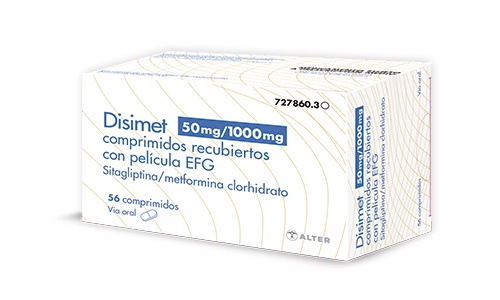
Disimet 50 mg/1000 mg comprimidos recubiertos con película

Revisión de receta online
Un médico revisará tu caso y determinará si la prescripción es médicamente apropiada.

Habla con un médico sobre este medicamento
Comenta tus síntomas y las opciones de tratamiento en una consulta online.



Cómo usar DISIMET 50 MG/1000 MG COMPRIMIDOS RECUBIERTOS CON PELICULA EFG
Contenido del prospecto
- Introducción
- Prospecto: información para el paciente
- Lea todo el prospecto detenidamente antes de empezar a tomar este medicamento, porque contiene información importante para usted.
- Contenido del prospecto
- Qué es Disimet y para qué se utiliza
- Qué necesita saber antes de empezar a tomar Disimet
- Advertencias y precauciones
- Riesgo de acidosis láctica
- Niños y adolescentes
- Otros medicamentos y Disimet
- Toma de Disimet con alcohol
- Conducción y uso de máquinas
- Cómo tomar Disimet
- Si toma más Disimet del que debe
- Si olvidó tomar Disimet
- Si interrumpe el tratamiento con Disimet
- Posibles efectos adversos
- Conservación de Disimet
- Contenido del envase e información adicional
- Aspecto del producto y contenido del envase
- Titular de la autorización de comercialización y responsable de la fabricación
- Fecha de la última revisión de este prospecto:Marzo 2025
Introducción
Prospecto: información para el paciente
Disimet 50 mg/1.000 mg comprimidos recubiertos con película EFG
sitagliptina/metformina clorhidrato

¿No estás seguro de si este medicamento es adecuado para ti?
Comenta tus síntomas y tratamiento con un médico online.
Lea todo el prospecto detenidamente antes de empezar a tomar este medicamento, porque contiene información importante para usted.
- Conserve este prospecto, ya que puede tener que volver a leerlo.
- Si tiene alguna duda, consulte a su médico, farmacéutico o enfermero.
- Este medicamento se le ha recetado solamente a usted, y no debe dárselo a otras personas, aunque tengan los mismos síntomas que usted, ya que puede perjudicarles.
- Si experimenta efectos adversos, consulte a su médico, farmacéutico o enfermero, incluso si se trata de efectos adversos que no aparecen en este prospecto. Ver sección 4.
Contenido del prospecto
- Qué es Disimet y para qué se utiliza
- Qué necesita saber antes de empezar a tomar Disimet
- Cómo tomar Disimet
- Posibles efectos adversos
- Conservación de Disimet
- Contenido del envase e información adicional

¿Has empezado a tomar el medicamento y tienes preguntas?
Comenta tus síntomas y tratamiento con un médico online.
1. Qué es Disimet y para qué se utiliza
Disimet contiene dos medicamentos distintos, llamados sitagliptina y metformina.
- La sitagliptina pertenece a una clase de medicamentos denominados inhibidores de la DPP-4 (inhibidores de la dipeptidil peptidasa-4)
- La metformina pertenece a una clase de medicamentos denominados biguanidas.
Actúan conjuntamente para controlar los niveles de azúcar en la sangre en pacientes adultos con una forma de diabetes llamada “diabetes mellitus tipo 2”. Este medicamento ayuda a aumentar los niveles de insulina producida después de una comida y reduce la cantidad de azúcar producida por su cuerpo.
Junto con la dieta y el ejercicio, este medicamento le ayuda a bajar su nivel de azúcar en la sangre. Este medicamento se puede usar sólo o con ciertos medicamentos para la diabetes (insulina, sulfonilureas o glitazonas).
¿Qué es la diabetes tipo 2?
La diabetes tipo 2 es una enfermedad en la que su cuerpo no produce insulina suficiente y la insulina que produce su cuerpo no funciona tan bien como debería. Su cuerpo puede también producir demasiado azúcar. Cuando esto ocurre, se acumula azúcar (glucosa) en la sangre. Esto puede conducir a problemas médicos graves, como enfermedades que afectan al corazón (cardíacas), enfermedades que afectan al riñón (renales), ceguera y amputaciones.
2. Qué necesita saber antes de empezar a tomar Disimet
No tome Disimet
- si es alérgico a sitagliptina, a metformina o a alguno de los demás componentes de este medicamento (incluidos en la sección 6)
- si tiene una reducción grave de la función renal
- si tiene diabetes no controlada con, por ejemplo, hiperglucemia grave (glucosa alta en sangre), náuseas, vómitos, diarrea, pérdida rápida de peso, acidosis láctica (ver “Riesgo de acidosis láctica” a continuación) o cetoacidosis. La cetoacidosis es un trastorno en el que las sustancias llamadas “cuerpos cetónicos” se acumulan en la sangre, lo que puede conducir a un pre-coma diabético. Los síntomas incluyen dolor de estómago, respiración rápida y profunda, somnolencia o que su aliento desarrolle un aroma afrutado poco habitual
- si tiene una infección grave o está deshidratado
- si le van a hacer una radiografía para la que deben inyectarle un contraste. Necesitará dejar de tomar este medicamento en el momento de la radiografía y durante 2 o más días después, tal como le indique su médico, dependiendo del funcionamiento de sus riñones
- si ha tenido recientemente un ataque al corazón o tiene problemas circulatorios graves, como “shock” o dificultades para respirar
- si tiene problemas de hígado (hepáticos)
- si bebe alcohol en exceso (ya sea cada día o sólo de vez en cuando)
- si se encuentra en periodo de lactancia.
No tome este medicamento si le afecta cualquiera de las circunstancias anteriores y consulte con su médico acerca de otras formas de controlar su diabetes. Si no está seguro, consulte con su médico, farmacéutico o enfermero antes de empezar a tomar este medicamento.
Advertencias y precauciones
Consulte a su médico, farmacéutico o enfermero antes de empezar a tomar Disimet.
Han sido comunicados casos de inflamación del páncreas (pancreatitis) en pacientes tratados con sitagliptina/metformina (ver sección 4).
Si usted observa ampollas en la piel, puede ser un signo de una enfermedad llamada penfigoide bulloso. Es posible que su médico le pida que deje de tomar sitagliptina/metformina.
Riesgo de acidosis láctica
Sitagliptina/metformina puede ocasionar un efecto adverso muy raro, pero muy grave, llamado acidosis láctica, en especial si sus riñones no funcionan de forma adecuada. El riesgo de desarrollar acidosis láctica también se ve aumentado con la diabetes descontrolada, infecciones graves, el ayuno prolongado o la ingesta de alcohol, la deshidratación (ver más información a continuación), problemas en el hígado y cualquier trastorno médico en el que una parte del cuerpo tenga un suministro reducido de oxígeno (como enfermedades agudas y graves del corazón).
Si cualquiera de lo anterior es aplicable a usted, consulte a su médico para obtener más instrucciones.
Deje de tomar este medicamento durante un corto periodo de tiempo si tiene un trastorno que pueda estar asociado con la deshidratación(pérdida significativa de líquidos corporales), como vómitos intensos, diarrea, fiebre, exposición al calor o si bebe menos líquido de lo normal. Consulte con su médico para obtener más instrucciones.
Deje de tomar este medicamento y póngase en contacto con un médico o con el hospital más cercano inmediatamente si experimenta cualquiera de los síntomas que produce la acidosis láctica, ya que este trastorno puede dar lugar a coma.
Los síntomas de la acidosis láctica incluyen:
- vómitos
- dolor de estómago (dolor abdominal)
- calambres musculares
- sensación general de malestar, con un cansancio intenso
- dificultad para respirar
- reducción de la temperatura corporal y de la frecuencia de los latidos del corazón
La acidosis láctica es una urgencia médica y se debe tratar en un hospital.
Consulte a su médico o farmacéutico antes de empezar a tomar este medicamento:
- si padece o ha padecido una enfermedad del páncreas (como pancreatitis)
- si padece o ha padecido cálculos biliares, adicción al alcohol o tiene los niveles en sangre muy altos de triglicéridos (un tipo de grasa). Estas situaciones médicas pueden incrementar su probabilidad de desarrollar pancreatitis (ver sección 4)
- si tiene diabetes tipo 1. Esta enfermedad también puede llamarse diabetes dependiente de insulina
- si tiene o ha tenido una reacción alérgica a la sitagliptina, la metformina o sitagliptina/metformina (ver sección 4)
- si a la vez que sitagliptina/metformina está tomando una sulfonilurea o insulina, otros medicamentos para la diabetes, porque puede sufrir bajadas de los niveles de azúcar en la sangre (hipoglucemia). Puede que su médico considere necesario reducir la dosis de la sulfonilurea o insulina que está tomando
Si necesita someterse a una cirugía mayor debe dejar de tomar sitagliptina/metformina mientras se le realice el procedimiento y durante un tiempo después del mismo. Su médico decidirá cuándo debe interrumpir el tratamiento con sitagliptina/metformina y cuándo reiniciarlo.
Si no está seguro de si le afecta alguna de las circunstancias anteriores, consulte a su médico o farmacéutico antes de empezar a tomar este medicamento.
Durante el tratamiento con sitagliptina/metformina, su médico comprobará la función de sus riñones, al menos una vez al año o de manera más frecuente si usted es una persona de edad avanzada y/o si su función renal está empeorando.
Consulte rápidamente a su médico para que le indique cómo proceder si:
-Se sabe que padece una enfermedad de herencia genética que afecta a las mitocondrias (los componentes que producen energía en el interior de las células), como el síndrome de MELAS (encefalopatía mitocondrial, miopatía, acidosis láctica y episodios similares a ictus) o la diabetes de herencia materna y sordera (MIDD).
-Presenta alguno de los siguientes síntomas tras el inicio del tratamiento con metformina: convulsión, deterioro de las capacidades cognitivas, dificultad con los movimientos corporales, síntomas indicativos de daño nervioso (p. ej., dolor o entumecimiento), migraña y sordera.
Niños y adolescentes
Los niños y adolescentes menores de 18 años no deben usar este medicamento. No se sabe si este medicamento es seguro y eficaz cuando se utiliza en niños y adolescentes menores de 18 años.
Otros medicamentos y Disimet
Si necesita que se le administre en su torrente sanguíneo una inyección de un medio de contraste que contiene yodo, por ejemplo, en el contexto de una radiografía o de una exploración, debe dejar de tomar este medicamento antes de la inyección o en el momento de la misma. Su médico decidirá cuándo debe interrumpir el tratamiento con sitagliptina/metformina y cuándo reiniciarlo.
Informe a su médico o farmacéutico si está tomando, ha tomado recientemente o pudiera tener que tomar cualquier otro medicamento. Puede que necesite análisis más frecuentes de la glucosa en sangre y de la función renal, o puede que su médico tenga que ajustar la dosis de sitagliptina/metformina. Es especialmente importante mencionar lo siguiente:
- medicamentos (tomados por vía oral, inhalación o inyección) utilizados para tratar enfermedades que producen inflamación, como el asma y la artritis (corticosteroides)
- medicamentos que incrementan la producción de orina (diuréticos)
- medicamentos utilizados para tratar el dolor y la inflamación (AINEs e inhibidores de la COX-2, como ibuprofeno y celecoxib)
- ciertos medicamentos para tratar la hipertensión (inhibidores de la ECA y antagonistas del receptor de la angiotensina II)
- medicamentos específicos para el tratamiento del asma bronquial (simpaticomiméticos β)
- agentes de contraste yodados o medicamentos que contengan alcohol
- ciertos medicamentos utilizados para tratar problemas de estómago como cimetidina
- ranolazina, un medicamento utilizado para tratar la angina de pecho
- dolutegravir, un medicamento utilizado para tratar la infección por VIH
- vandetanib, un medicamento utilizado para tratar un tipo específico de cáncer de tiroides (cáncer medular de tiroides)
- digoxina (para tratar el latido cardiaco irregular y otros problemas del corazón). Se puede necesitar comprobar el nivel de digoxina en su sangre si está tomando sitagliptina/metformina.
Toma de Disimet con alcohol
Evite la ingesta excesiva de alcohol mientras toma este medicamento, ya que esto puede incrementar el riesgo de acidosis láctica (ver sección “Advertencias y precauciones”).
Embarazo y lactancia
Si está embarazada o en periodo de lactancia, cree que podría estar embarazada o tiene intención de quedarse embarazada, consulte a su médico o farmacéutico antes de utilizar este medicamento. No debe tomar este medicamento durante el embarazo o si se encuentra en periodo de lactancia. Ver sección 2, No tome Disimet.
Conducción y uso de máquinas
La influencia de este medicamento sobre la capacidad para conducir y utilizar máquinas es nula o insignificante. Sin embargo, se han comunicado casos de mareos y somnolencia durante el tratamiento con sitagliptina, los cuales pueden afectar su capacidad para conducir y usar máquinas.
Tomar este medicamento junto con los medicamentos llamados sulfonilureas o con insulina puede producir hipoglucemia, que puede afectar a su capacidad para conducir y usar máquinas o trabajar sin un punto de apoyo seguro.
Este medicamento contiene menos de 23 mg de sodio (1 mmol) por comprimido; esto es, esencialmente “exento de sodio”.
3. Cómo tomar Disimet
Siga exactamente las instrucciones de administración de este medicamento indicadas por su médico. En caso de duda, consulte de nuevo a su médico o farmacéutico.
- Tome un comprimido:
- dos veces al día por vía oral
- con alimentos para reducir la probabilidad de que sienta molestias en el estómago
- Puede que su médico tenga que aumentar la dosis para controlar los niveles de azúcar en la sangre.
- Si usted tiene una función renal reducida, su médico le puede recetar una dosis menor.
Debe continuar con la dieta recomendada por su médico durante el tratamiento con este medicamento y tener cuidado de que la ingesta de hidratos de carbono se distribuya por igual durante el día.
Es poco probable que el tratamiento solo con este medicamento le produzca una bajada anormal del azúcar en sangre (hipoglucemia). Se puede producir una bajada del azúcar en sangre cuando este medicamento se toma junto con un medicamento que contenga sulfonilurea o con insulina, por lo que, es probable que su médico considere necesario reducir la dosis de su sulfonilurea o insulina.
Si toma más Disimet del que debe
Si toma más de la dosis recetada de este medicamento, póngase en contacto con su médico inmediatamente. Vaya al hospital si usted tiene síntomas de acidosis láctica tales como sensación de frío o malestar, náuseas o vómitos intensos, dolor de estómago, pérdida inexplicable de peso, calambres musculares o respiración agitada (ver sección “Advertencias y precauciones”).
En caso de sobredosis o ingestión accidental, consulte al Servicio de Información Toxicológica. Teléfono 91 562 04 20.
Si olvidó tomar Disimet
Si se le olvida tomar una dosis, tómela tan pronto como se acuerde. Si no se acuerda hasta la hora de su siguiente dosis, sáltese la dosis olvidada y siga con el tratamiento habitual. No tome una dosis doble de este medicamento.
Si interrumpe el tratamiento con Disimet
Siga tomando este medicamento todo el tiempo que le indique su médico, para que le ayude a controlar el nivel de azúcar en la sangre. No debe dejar de tomar este medicamento sin consultar primero con su médico. Si interrumpe el tratamiento con sitagliptina/metformina, puede que su azúcar en sangre aumente de nuevo.
Si tiene cualquier otra duda sobre el uso de este medicamento, pregunte a su médico o farmacéutico.
4. Posibles efectos adversos
Al igual que todos los medicamentos, este medicamento puede producir efectos adversos, aunque no todas las personas los sufran.
DEJE de tomar este medicamento y acuda al médico inmediatamente si nota cualquiera de los siguientes efectos adversos graves:
- Dolor intenso y persistente en el abdomen (zona del estómago) que puede llegar hasta la espalda con o sin náuseas y vómitos, ya que estos pueden ser signos de una inflamación del páncreas (pancreatitis).
Este medicamento puede causar un efecto adverso muy raro (puede afectar hasta 1 de cada 10.000 personas), pero muy grave, llamado acidosis láctica (ver sección “Advertencias y precauciones”). Si esto le ocurre, debe dejar de tomar este medicamento y ponerse en contacto con un médico o el hospital más cercano inmediatamente, ya que la acidosis láctica puede conducir al coma.
Si usted tiene una reacción alérgica grave (frecuencia no conocida), incluyendo erupción cutánea, urticaria, ampollas en la piel/descamación de la piel e hinchazón de la cara, labios, lengua y garganta que puede causar dificultad al respirar o tragar, deje de tomar este medicamento y consulte con su médico inmediatamente. Su médico le prescribirá un medicamento para tratar la reacción alérgica y le cambiará el medicamento para el tratamiento de la diabetes.
Algunos pacientes que tomaban metformina han experimentado los siguientes efectos adversos después de comenzar el tratamiento con sitagliptina:
Frecuentes (pueden afectar hasta 1 de cada 10 personas): nivel bajo de azúcar en sangre, náuseas, gases, vómito
Poco frecuentes (pueden afectar hasta 1 de cada 100 personas): dolor de estómago, diarrea, estreñimiento, somnolencia
Algunos pacientes han experimentado diarrea, náuseas, gases, estreñimiento, dolor de estómago o vómitos al comenzar el tratamiento con la combinación de sitagliptina y metformina (frecuencia clasificada como frecuente).
Algunos pacientes han experimentado los siguientes efectos adversos al tomar este medicamento junto con una sulfonilurea tal como glimepirida:
Muy frecuentes (pueden afectar a más de 1 de cada 10 personas): niveles bajos de azúcar en la sangre Frecuentes: estreñimiento
Algunos pacientes presentaron los siguientes efectos adversos mientras tomaban este medicamento en combinación con pioglitazona:
Frecuentes: hinchazón de manos o piernas
Algunos pacientes presentaron los siguientes efectos adversos mientras tomaban este medicamento en combinación con insulina:
Muy frecuentes: niveles bajos de azúcar en la sangre Poco frecuentes: sequedad de boca, dolor de cabeza
Algunos pacientes han experimentado los siguientes efectos adversos durante los estudios clínicos mientras tomaban sitagliptina sola (uno de los medicamentos que contiene este medicamento) o durante el uso después de la aprobación de sitagliptina/metformina o sitagliptina sola o con otros medicamentos para la diabetes: Frecuentes: niveles bajos de azúcar en la sangre, dolor de cabeza, infección de las vías respiratorias superiores, congestión o mucosidad nasal y dolor de garganta, artrosis, dolor en el brazo o la pierna Poco frecuentes: mareos, estreñimiento, picor
Rara: reducción del número de plaquetas
Frecuencia no conocida: problemas de riñón (que en ocasiones requieren diálisis), vómitos, dolor en las articulaciones, dolor muscular, dolor de espalda, enfermedad intersticial de los pulmones, penfigoide bulloso (un tipo de ampolla en la piel)
Algunos pacientes han experimentado los siguientes efectos adversos después de tomar metformina sola:
Muy frecuentes: náuseas, vómitos, diarrea, dolor de estómago y pérdida del apetito. Estos síntomas pueden aparecer cuando usted empieza a tomar metformina y habitualmente desaparecen Frecuentes: sabor metálico
Muy raros: reducción de los niveles de vitamina B12, hepatitis (un problema del hígado), urticaria, enrojecimiento de la piel (erupción) o picor
Comunicación de efectos adversos
Si experimenta cualquier tipo de efecto adverso, consulte a su médico o farmacéutico, incluso si se trata de posibles efectos adversos que no aparecen en este prospecto. También puede comunicarlos directamente a través del Sistema Español de Farmacovigilancia de Medicamentos de Uso Humano: https://www.notificaram.es. Mediante la comunicación de efectos adversos usted puede contribuir a proporcionar más información sobre la seguridad de este medicamento.
5. Conservación de Disimet
Mantener este medicamento fuera de la vista y del alcance de los niños.
No utilice este medicamento después de la fecha de caducidad que aparece en el blíster y en el envase después de CAD. La fecha de caducidad es el último día del mes que se indica.
Conservar por debajo de 25ºC.
Los medicamentos no se deben tirar por los desagües ni a la basura. Deposite los envases y los medicamentos que no necesita en el Punto SIGRE de la farmacia. En caso de duda pregunte a su farmacéutico cómo deshacerse de los envases y de los medicamentos que no necesita. De esta forma, ayudará a proteger el medio ambiente.
6. Contenido del envase e información adicional
Composición de Disimet
- Los principios activos son sitagliptina y metformina. Cada comprimido contiene sitagliptina hidrocloruro monohidrato equivalente a 50 mg de sitagliptina y 1.000 mg de metformina clorhidrato.
- Los demás componentes son:
Núcleo del comprimido: copolímero de polivinil alcohol y polietilenglicol, laurilsulfato sódico, almidón de maíz pregelatinizado, celulosa microcristalina silicificada y estearil fumarato sódico.
Recubrimiento (OPADRY II 85F18422): alcohol polivinílico parcialmente hidrolizado, macrogol 4000, dióxido de titanio (E171), talco, óxido de hierro amarillo (E172) y óxido de hierro rojo (E172).
Aspecto del producto y contenido del envase
Comprimido recubierto con película, de color rojo, ovalado, biconvexo, ranurado en una de las caras.
La ranura no debe utilizarse para fraccionar el comprimido.
Blísteres PVC/PVDC-aluminio.
Envases de 56 comprimidos recubiertos con película.
Titular de la autorización de comercialización y responsable de la fabricación
Laboratorios Alter, S.A.
C/ Mateo Inurria 30
28036 Madrid
España
Fecha de la última revisión de este prospecto:Marzo 2025
La información detallada y actualizada de este medicamento está disponible en la página Web de la Agencia Española de Medicamentos y Productos Sanitarios (AEMPS) https://www.aemps.gob.es/.
- País de registro
- Forma farmacéuticaCOMPRIMIDO, 50 mg/1000 mg
- Código ATCA10BD07
- Precio medio en farmacia27.32 EUR
- Principio activo
- Requiere recetaSí
- Fabricante
- ComposiciónLAURILSULFATO DE SODIO (6,5 mg mg), FUMARATO DE ESTEARILO Y SODIO (26 mg mg)
- Esta información es de carácter general y no sustituye la consulta con un profesional sanitario.
- Alternativas a DISIMET 50 MG/1000 MG COMPRIMIDOS RECUBIERTOS CON PELICULA EFGForma farmacéutica: COMPRIMIDO, 50/1000 mgPrincipio activo: metformin and sitagliptinFabricante: Merck Sharp & Dohme B.V.Requiere recetaForma farmacéutica: COMPRIMIDO, 50/1000 mgPrincipio activo: metformin and sitagliptinFabricante: Merck Sharp & Dohme B.V.Requiere recetaForma farmacéutica: COMPRIMIDO LIBERACION MODIFICADA, 100 mg/1.000 mgPrincipio activo: metformin and sitagliptinFabricante: Teva Pharma S.L.U.Requiere receta
Médicos online para DISIMET 50 MG/1000 MG COMPRIMIDOS RECUBIERTOS CON PELICULA EFG
Comenta la dosis, los posibles efectos secundarios, interacciones, contraindicaciones o la revisión de receta de DISIMET 50 MG/1000 MG COMPRIMIDOS RECUBIERTOS CON PELICULA EFG, sujeto a valoración médica y a la normativa local.

Preguntas frecuentes
DISIMET 50 MG/1000 MG COMPRIMIDOS RECUBIERTOS CON PELICULA EFG requiere receta en España. Puedes confirmarlo con un médico online según tu caso.
El principio activo de DISIMET 50 MG/1000 MG COMPRIMIDOS RECUBIERTOS CON PELICULA EFG es metformin and sitagliptin. Esta información ayuda a identificar medicamentos con la misma composición pero con diferentes nombres comerciales.
El precio medio en farmacia de DISIMET 50 MG/1000 MG COMPRIMIDOS RECUBIERTOS CON PELICULA EFG es de aproximadamente 27.32 EUR. Puede variar según el fabricante y la forma farmacéutica.
DISIMET 50 MG/1000 MG COMPRIMIDOS RECUBIERTOS CON PELICULA EFG es fabricado por Laboratorios Alter S.A.. La marca y el envase pueden variar según el distribuidor.
Los Médicos de familia, Psiquiatras, Dermatólogos, Cardiólogos, Endocrinólogos, Gastroenterólogos, Neumólogos, Nefrólogos, Reumatólogos, Hematólogos, Infectólogos, Alergólogos, Geriatras, Pediatras, Oncólogos pueden valorar la prescripción de DISIMET 50 MG/1000 MG COMPRIMIDOS RECUBIERTOS CON PELICULA EFG cuando esté clínicamente indicado. Puedes reservar una videoconsulta para comentar tu caso y las opciones de tratamiento.
La receta la emite un médico tras valorar tu estado de salud. En España, DISIMET 50 MG/1000 MG COMPRIMIDOS RECUBIERTOS CON PELICULA EFG se dispensa en las farmacias con esa receta médica. Una consulta online no garantiza su emisión: la decisión corresponde siempre al médico.
Para solicitar una valoración puedes usar Oladoctor:
Otros medicamentos con el mismo principio activo (metformin and sitagliptin) incluyen EFFICIB 50 mg/1000 mg COMPRIMIDOS RECUBIERTOS CON PELICULA, EFFICIB 50 mg/1000 mg COMPRIMIDOS RECUBIERTOS CON PELICULA, ESTEQUEN 100 MG/1.000 MG COMPRIMIDOS DE LIBERACION MODIFICADA. Pueden tener diferentes nombres comerciales o formulaciones, pero contienen el mismo componente terapéutico. Consulta siempre con un médico antes de cambiar o iniciar un nuevo medicamento.
