



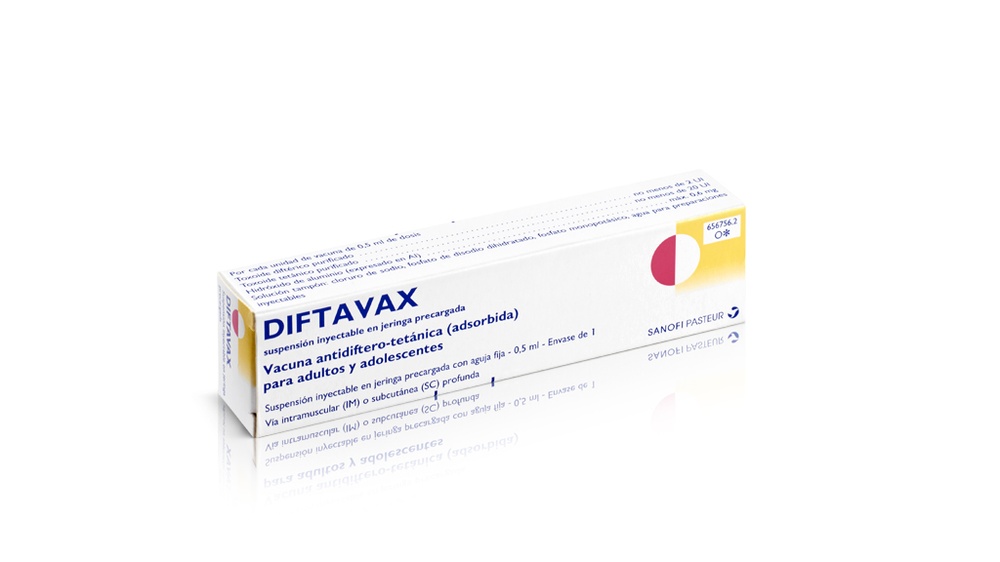
DIFTAVAX 0.5 ml Inyectable

Revisión de receta online
Un médico revisará tu caso y determinará si la prescripción es médicamente apropiada.

Habla con un médico sobre este medicamento
Comenta tus síntomas y las opciones de tratamiento en una consulta online.



Cómo usar DIFTAVAX SUSPENSION INYECTABLE EN JERINGA PRECARGADA
Contenido del prospecto
- Introducción
- Qué es Diftavax y para qué se utiliza
- Qué necesita saber antes de que usted o su hijo usen Diftavax
- Cómo usar Diftavax
- Posibles efectos adversos
- Conservación de Diftavax
- Contenido del envase e información adicional
Introducción
Prospecto: información para el usuario
DIFTAVAX suspensión inyectable en jeringa precargada
Vacuna antidiftero-tetánica (adsorbida) para adultos y adolescentes.
Lea todo el prospecto detenidamente antes de que usted o su hijo sea vacunado porque contiene información importante para usted o para su hijo.
- Conserve este prospecto, ya que puede tener que volver a leerlo.
- Si tiene alguna duda, consulte a su médico o farmacéutico.
- Este medicamento se le ha recetado solamente a usted y no debe dárselo a otras personas, aunque tengan los mismos síntomas, ya que puede perjudicarles.
- Si experimenta efectos adversos, consulte a su médico o farmacéutico incluso si se trata de efectos adversos que no aparecen en este prospecto. Ver sección 4.
Contenido del prospecto
- Qué es Diftavax y para qué se utiliza
- Qué necesita saber antes de que usted o su hijo usen Diftavax
- Cómo usar Diftavax
- Posibles efectos adversos
5 Conservación de Diftavax
- Contenido del envase e información adicional
1. Qué es Diftavax y para qué se utiliza
Diftavax (Td) es una vacuna. Las vacunas se utilizan para proteger frente a enfermedades infecciosas.
Diftavax está indicada en la inmunización activa frente al tétanos y difteria en niños de 7 años de edad en adelante y en adultos, en las siguientes situaciones:
- Para la vacunación primaria en personas no vacunadas previamente frente al tétanos y la difteria.
- Para completar el ciclo primario de vacunación en personas que no completaron el mismo antes de los 7 años.
- Como dosis de recuerdo en los casos en que se haya completado el ciclo de vacunación primaria.
- En el caso de heridas, como prevención frente al tétanos y como dosis de recuerdo frente a la difteria.

¿No estás seguro de si este medicamento es adecuado para ti?
Comenta tus síntomas y tratamiento con un médico online.
2. Qué necesita saber antes de que usted o su hijo usen Diftavax
No use Diftavax:
- si usted/su hijo es alérgico al (a los) principio(s) activo(s) o a alguno de los demás componentes de esta vacuna (incluidos en la sección 6).
- si usted/su hijo ha sufrido reacciones adversas graves tras vacunaciones previas frente al tétanos y/o difteria.
- en los casos de heridas en personas inmunodeficientes. En estos casos solo se deberá administrar la vacuna antitetánica, y no debe acompañarse del componente diftérico. Por tanto, Diftavax no está indicado en estos pacientes.
- en caso de heridas cuando exista una contraindicación absoluta para la vacuna del tétanos. En estos casos deberá administrarse inmunoglobulina antitetánica (2 x 250 U.I. a intervalos de 4 semanas). Por tanto, Diftavax no está indicado en estos pacientes.
- si usted/su hijo padece una enfermedad con fiebre alta, infección aguda o en personas que debido a un historial de exposición pudieran estar en período de incubación de una infección. En estos casos se debe posponer la administración de Diftavax. Sin embargo fiebre moderada o infección leve no contraindica la vacunación.
- no se debe administrar a personas con antecedentes de trombocitopenia (disminución del número de plaquetas en sangre), reacciones alérgicas (de hipersensibilidad) o complicaciones neurológicas después de una vacunación anterior frente al tétanos y/o difteria.
- cuando en el momento de la vacunación presente alguna reacción alérgica o complicación del Sistema Nervioso Central y/o periférico. Su médico valorará el riesgo de la inmunización frente al riesgo de contraer el tétanos o la difteria.
Advertencias y precauciones
No administrar por inyección intravascular: asegurar que la aguja no penetra un vaso sanguíneo.
Consulte a su médico o farmacéutico antes de empezar a usar Diftavax:
- si usted/su hijo ha sido vacunado contra el tétanos y/o difteria en los últimos 5 años. Para prevenir reacciones de hipersensibilidad (alergia), evitar la inyección en los cinco años posteriores a la vacunación en personas que hayan completado un ciclo primario de vacunación y en aquellas que hayan recibido una dosis de refuerzo.
- si usted/su hijo está recibiendo un tratamiento inmunosupresor (anulan la respuesta inmunitaria del organismo) simultáneo. En tales casos, se recomienda que se retrase la vacunación hasta el final del tratamiento o que los niveles protectores del sujeto se comprueben. No obstante se recomienda la vacunación de los sujetos con inmunodepresión crónica tales como infección por VIH (virus de inmunodeficiencia humana) si la enfermedad permite la inducción de respuesta de anticuerpos, e incluso si es limitada.
- si usted/su hijo ha tenido problemas en vacunaciones anteriores como debilidad y entumecimiento de las extremidades (Síndrome de Guillain-Barré) o disminución en el movimiento o la sensibilidad en el brazo y el hombro debido a un problema nervioso (neuritis braquial). En estos casos, la decisión de administrar cualquier vacuna que contenga toxoide tetánico debe basarse en una cuidadosa consideración de los beneficios potenciales y los posibles riesgos, tanto si el calendario de inmunización primaria se ha completado como si no. La vacunación está normalmente justificada cuando el calendario de inmunización primaria esté incompleto (por ejemplo, que hayan recibido menos de tres dosis).
Después de cualquier inyección con aguja, o incluso antes, puede producirse, desfallecimiento. Por lo tanto, informe a su médico o enfermero si usted o su hijo ha sufrido desfallecimiento con alguna inyección previa.
Uso de Diftavaxcon otras vacunas o medicamentos
Informe a su médico o farmacéutico si está utilizando, ha utilizado recientemente o pudiera tener que utilizar cualquier otro medicamento.
No existen evidencias de ninguna interacción con otros medicamentos, ni se han realizado estudios de interacciones con pruebas diagnósticas y/o de laboratorio.
No se ha notificado ninguna contraindicación a la administración de Diftavax durante una sesión de vacunación con otras vacunas habituales.
Embarazo, lactancia y fertilidad
Si está embarazada o en periodo de lactancia, cree que podría estar embarazada o tiene intención de quedarse embarazada, consulte a su médico o farmacéutico antes de utilizar esta vacuna.
Durante numerosos años, las experiencias clínicas no han indicado ninguna clase de influencias nocivas sobre el desarrollo embrionario y/o fetal.
Las mujeres embarazadas no inmunizadas o insuficientemente inmunizadas podrán ser vacunadas durante el segundo y tercer trimestre del embarazo, especialmente en el caso de viajes a países con difteria endémica o en sospechas de exposición.
La lactancia no es una contraindicación.
Conducción y uso de máquinas
No se han realizado estudios de los efectos sobre la capacidad para conducir y utilizar máquinas.
DIFTAVAX, suspensión inyectable en jeringa precargada contiene:
Potasio y sodio
DIFTAVAX contiene menos de 1 mmol de potasio (39 mg) y sodio (23 mg) por dosis, por lo que se considera esencialmente “exento de potasio” y “exento de sodio”.
3. Cómo usar Diftavax
Siga exactamente las instrucciones de administración de esta vacuna indicadas por su médico. En caso de duda, consulte de nuevo a su médico o farmacéutico.
- Para una vacunación primaria se recomienda la siguiente pauta:
1ª dosis en la fecha elegida.
2ª dosis 1-2 meses después de la 1ª dosis
3ª dosis 6-12 meses después de la 2ª dosis
- Completado el ciclo de vacunación primaria se recomienda una dosis única de 0,5 ml como dosis de recuerdo cada cinco a diez años
- En la vacunación asociada a heridas, se tendrá en cuenta que la necesidad de inmunización activa con o sin inmunización pasiva (inmunoglobulina antitetánica), dependerá del tipo de herida y del historial de vacunación del paciente. La inmunoglobulina antitetánica deberá administrarse en un lugar de inyección diferente del utilizado para la vacuna.
HERIDAS MENORES O LIMPIAS
Cuando se sabe que la persona ha completado su ciclo primario de vacunación antitetánica y ha recibido su última dosis de recuerdo en los últimos 10 años, no está recomendado revacunar ni tampoco la utilización de inmunoglobulina antitetánica.
Cuando la persona haya completado su ciclo primario de vacunación pero hayan transcurrido más de 10 años desde la última dosis de recuerdo, se administrará una dosis de la vacuna, y al cabo de 10 años se indicará la dosis de recuerdo correspondiente. En estos casos no es necesaria la administración de inmunoglobulina antitetánica.
En personas que no han completado el ciclo primario de vacunación, o en las personas en las que se desconoce, o es incierto su estado de inmunización, se recomienda vacunar (pauta correspondiente a vacunación primaria). En todos estos casos no es necesaria la administración de inmunoglobulina antitetánica.
Otros tipos de heridas, tales como MAYORES Y SUCIAS
Se procederá siempre a vacunar, salvo que la persona haya completado su ciclo primario de vacunación antitetánica y haya recibido además su última dosis de recuerdo en los últimos 5 años. En personas que no han completado su ciclo primario de vacunación antitetánica o en las que se desconoce, o es incierto su estado de inmunización, además de la vacuna se administrará inmunoglobulina antitetánica.
Forma de administración
El contenido de 0,5 ml debe inyectarse por vía intramuscular. El lugar de inyección recomendado es el área deltoidea – parte superior del brazo (excepto en niños pequeños).
Las personas que padecen diátesis hemorrágica deben ser vacunadas por vía subcutánea profunda.
Nunca debe administrarse por vía intravenosa.
La vacuna no debe administrarse por vía intradérmica.
Este medicamento le será administrado siempre por un profesional sanitario.

¿Has empezado a tomar el medicamento y tienes preguntas?
Comenta tus síntomas y tratamiento con un médico online.
4. Posibles efectos adversos
Al igual que todos los medicamentos, esta vacuna puede producir efectos adversos, aunque no todas las personas los sufran.
Basado en la notificación espontánea, las siguientes reacciones adversas se han notificado durante el uso comercial de Diftavax. Estas reacciones se han notificado con una frecuencia muy rara (hasta uno de cada 10.000 pacientes).
Sistema de clasificación de órganos | Frecuencia | Reacciones adversas |
Trastornos de la sangre y del sistema linfático | Muy Raras | Linfadenopatía (inflamación de los ganglios linfáticos) |
No conocida | Trombocitopenia (disminución del número de plaquetas en sangre) | |
Trastornos del sistema inmunológico | Muy Raras | Reacciones de hipersensibilidad tipo I (reacción alérgica inmediata)/reacción anafiláctica (reacción alérgica de carácter severo) |
Trastornos del sistema nervioso | Muy Raras | Cefalea (dolor de cabeza), malestar |
Trastornos vasculares | Muy Raras | Hipotensión (presión arterial baja) |
Trastornos de la piel y del tejido subcutáneo | Muy Raras | Síntomas similares a los de la alergia, prurito generalizado (picor), urticaria (ronchas rojizas en la piel) o edema (hinchazón), edema facial, angioedema y edema de Quincke (hinchazón de la cara, lengua y tráquea que puede producir gran dificultad para respirar) |
Trastornos musculoesqueléticos y del tejido conjuntivo | Muy Raras | Mialgia (dolor muscular), artralgia (dolor en las articulaciones) |
Trastornos generales y alteraciones en el lugar de administración | Muy Raras | Reacciones en el punto de inyección tales como dolor, erupción, induración (endurecimiento) o edema (hinchazón), los cuales pueden ocurrir en 48 horas y persistir durante uno o dos días. La formación de un nódulo subcutáneo (bulto bajo la piel) puede acompañar a veces a estas reacciones. Raramente se han notificado abscesos asépticos (granos sin pus). La incidencia e intensidad de estos acontecimientos locales pueden estar influidos por el lugar, la vía y el método de administración y el número de dosis recibidas con anterioridad. Pirexia (fiebre pasajera), malestar. |
Trastornos renales y urinarios | No conocida | Insuficiencia renal |
Se han notificado también neuritis braquial (disminución en el movimiento o la sensibilidad en el brazo y el hombro debido a un problema nervioso) y Síndrome de Guillain-Barré (debilidad y entumecimiento de las extremidades) después de la administración de otras vacunas que contienen toxoide tetánico.
Comunicación de efectos adversos
Si experimenta cualquier tipo de efecto adverso, consulte a su médico o farmacéutico, incluso si se trata de posibles efectos adversos que no aparecen en este prospecto. También puede comunicarlos directamente a través del Sistema Español de Farmacovigilancia de Medicamentos de Uso Humano: https://www.notificaRAM.es.
Mediante la comunicación de efectos adversos usted puede contribuir a proporcionar más información sobre la seguridad de este medicamento.
5. Conservación de Diftavax
Conservar en nevera (entre 2°C y 8°C). No congelar.
Mantener este medicamento fuera de la vista y del alcance de los niños.
No utilice este medicamento después de la fecha de caducidad que aparece en el envase después de CAD. La fecha de caducidad es el último día del mes que se indica.
Los medicamentos no se deben tirar por los desagües ni a la basura. Deposite los envases y los medicamentos que no necesita en el Punto SIGRE de la farmacia. En caso de duda pregunte a su farmacéutico como deshacerse de los envases y de los medicamentos que no necesita.
De esta forma, ayudará a proteger el medio ambiente.
6. Contenido del envase e información adicional
Composición de Diftavax
Los principios activos son:
- Toxoide diftérico purificado………………………………………………………no menos de 2 U.I.
- Toxoide tetánico purificado……………………………………………………….no menos de 20 U.I.
- Hidróxido de aluminio (expresado en Al)…………………………………………0,6 mg
Los demás componentes son:
Ácido acético (para ajuste del pH), hidróxido de sodio (para ajuste del pH) y una solución tampón conteniendo cloruro de sodio, fosfato de disodio dihidratado, fosfato monopotásico, ácido clorhídrico (para ajuste del pH), hidróxido de sodio (para ajuste del pH) y agua para preparaciones inyectables.
Aspecto del producto y contenido del envase
Envase con 1 jeringa precargada de 0,5 ml
Titular de la autorización de comercialización y responsable de la fabricación
Titular de la autorización de comercialización:
Sanofi Winthrop Industrie
82 avenue Raspail
94250 Gentilly
Francia
Responsable de la fabricación:
Sanofi Winthrop Industrie
1541 avenue Marcel Mérieux
69280 Marcy l’Etoile
Francia
o
Sanofi Winthrop Industrie
Voie de l’Institut – Parc Industriel
d’Incarville
B.P 101
27100 Val de Reuil
Francia
Representante local
sanofi-aventis, S.A.
C/ Rosselló i Porcel, 21
08016 Barcelona
España
Tel: +34 93 485 94 00
Fecha de la última revisión de este prospecto: Junio 2022
La información detallada de este medicamento está disponible en la página web de la Agencia Española del Medicamento y Productos Sanitarios (AEMPS) http://www.aemps.gob.es/-----------------------------------------------------------------------------------------------------------------------
Esta información está destinada únicamente a profesionales del sector sanitario:
Antes de proceder a la vacunación, se agitará bien la vacuna y se observará visualmente para confirmar que su aspecto es el usual y no contiene ninguna partícula extraña.
La eliminación del medicamento no utilizado y de todos los materiales que hayan estado en contacto con él, se realizará de acuerdo con la normativa local
- País de registro
- Forma farmacéuticaINYECTABLE, 0,5 ml
- Código ATCJ07AM51
- Precio medio en farmacia8.73 EUR
- Principio activo
- Requiere recetaSí
- Fabricante
- ComposiciónCLORURO DE SODIO (c.s.p. 0,5 ml mg)
- Esta información es de carácter general y no sustituye la consulta con un profesional sanitario.
- Alternativas a DIFTAVAX SUSPENSION INYECTABLE EN JERINGA PRECARGADAForma farmacéutica: INYECTABLE, 2 UI / 20 UIPrincipio activo: tetanus toxoid, combinations with diphtheria toxoidFabricante: Aj Vaccines A/SRequiere recetaForma farmacéutica: INYECTABLE, 0,5 ml dosis únicaPrincipio activo: meningococcus B, multicomponent vaccineFabricante: Glaxosmithkline Vaccines S.R.L.Requiere recetaForma farmacéutica: INYECTABLE, 0,5 ml dosis únicaPrincipio activo: meningococcus B, multicomponent vaccineFabricante: Glaxosmithkline Vaccines S.R.L.Requiere receta
Médicos online para DIFTAVAX SUSPENSION INYECTABLE EN JERINGA PRECARGADA
Comenta la dosis, los posibles efectos secundarios, interacciones, contraindicaciones o la revisión de receta de DIFTAVAX SUSPENSION INYECTABLE EN JERINGA PRECARGADA, sujeto a valoración médica y a la normativa local.









Obtén una receta de DIFTAVAX SUSPENSION INYECTABLE EN JERINGA PRECARGADA online
Rellena un formulario de 2 minutos
Cuéntanos tus síntomas, historial y el medicamento que necesitas.
Elige un médico o nosotros te asignamos uno
Escoge un especialista o te conectamos con el próximo médico disponible.
El médico revisa tu caso
Normalmente en 30 minutos. Puede hacerte preguntas adicionales por chat.
Recógela en cualquier farmacia
Receta electrónica enviada a tu correo, válida en toda España.
Preguntas frecuentes
DIFTAVAX SUSPENSION INYECTABLE EN JERINGA PRECARGADA requiere receta en España. Puedes confirmarlo con un médico online según tu caso.
El principio activo de DIFTAVAX SUSPENSION INYECTABLE EN JERINGA PRECARGADA es tetanus toxoid, combinations with diphtheria toxoid. Esta información ayuda a identificar medicamentos con la misma composición pero con diferentes nombres comerciales.
El precio medio en farmacia de DIFTAVAX SUSPENSION INYECTABLE EN JERINGA PRECARGADA es de aproximadamente 8.73 EUR. Puede variar según el fabricante y la forma farmacéutica.
DIFTAVAX SUSPENSION INYECTABLE EN JERINGA PRECARGADA es fabricado por Sanofi Winthrop Industrie. La marca y el envase pueden variar según el distribuidor.
Los Médicos de familia, Psiquiatras, Dermatólogos, Cardiólogos, Endocrinólogos, Gastroenterólogos, Neumólogos, Nefrólogos, Reumatólogos, Hematólogos, Infectólogos, Alergólogos, Geriatras, Pediatras, Oncólogos pueden valorar la prescripción de DIFTAVAX SUSPENSION INYECTABLE EN JERINGA PRECARGADA cuando esté clínicamente indicado. Puedes reservar una videoconsulta para comentar tu caso y las opciones de tratamiento.
España cuenta con una infraestructura sanitaria bien desarrollada en ciudades principales como Madrid, Barcelona, Valencia y Sevilla. Las farmacias están ampliamente disponibles y operan bajo estrictas regulaciones, garantizando el acceso a medicamentos con receta.
Puedes comprar DIFTAVAX SUSPENSION INYECTABLE EN JERINGA PRECARGADA en Madrid, Barcelona, Sevilla o Valencia en cualquier farmacia local con una receta válida.
Para obtener una receta, puedes utilizar Oladoctor:
Otros medicamentos con el mismo principio activo (tetanus toxoid, combinations with diphtheria toxoid) incluyen DITEBOOSTER SUSPENSION INYECTABLE EN JERINGA MONODOSIS PRECARGADA, BEXSERO SUSPENSION INYECTABLE EN JERINGA PRECARGADA, BEXSERO SUSPENSION INYECTABLE EN JERINGA PRECARGADA. Pueden tener diferentes nombres comerciales o formulaciones, pero contienen el mismo componente terapéutico. Consulta siempre con un médico antes de cambiar o iniciar un nuevo medicamento.
