



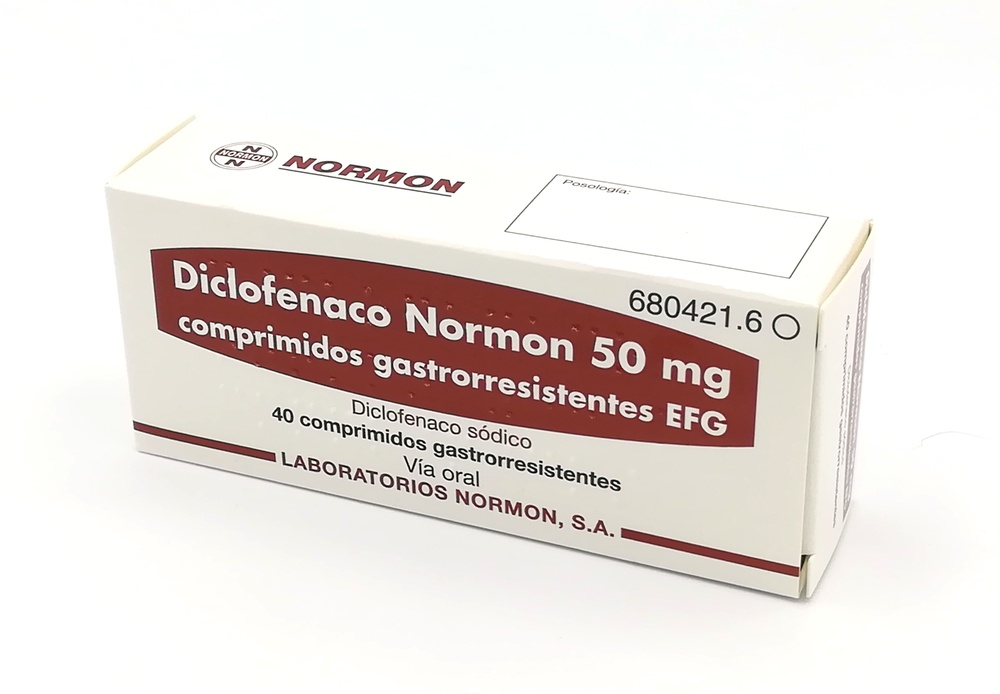
DICLOFENACO 50 mg Comprimidos Gastroresistentes

Revisión de receta online
Un médico revisará tu caso y determinará si la prescripción es médicamente apropiada.

Habla con un médico sobre este medicamento
Comenta tus síntomas y las opciones de tratamiento en una consulta online.



Cómo usar DICLOFENACO NORMON 50 mg COMPRIMIDOS GASTRORRESISTENTES EFG
Contenido del prospecto
- Introducción
- Qué es Diclofenaco Normon y para qué se utiliza
- Qué necesita saber antes de empezar a tomar Diclofenaco Normon
- Cómo tomar Diclofenaco Normon
- Posibles efectos adversos
- Conservación de Diclofenaco Normon
- Contenido del envase e información adicional
Introducción
Prospecto: información para el paciente
Diclofenaco Normon 50 mg comprimidos gastrorresistentes EFG
diclofenaco sódico
Lea todo el prospecto detenidamente antes de empezar a tomar el medicamento.
- Conserve este prospecto, ya que puede tener que volver a leerlo.
- Si tiene alguna duda, consulte a su médico o farmacéutico.
- Este medicamento se le ha recetado a usted y no debe dárselo a otras personas, aunque tengan los mismos síntomas, ya que puede perjudicarles.
- Si considera que alguno de los efectos adversos que sufre es grave o si aprecia cualquier efecto adverso no mencionado en este prospecto, informe a su médico o farmacéutico.
Contenido del prospecto
- Qué es Diclofenaco Normon y para qué se utiliza
- Qué necesita saber antes de empezar a tomar Diclofenaco Normon
- Cómo tomar Diclofenaco Normon
- Posibles efectos adversos
- Conservación de Diclofenaco Normon
- Contenido del envase e información adicional
1. Qué es Diclofenaco Normon y para qué se utiliza
Diclofenaco sódico, principio activo de este medicamento pertenece al grupo de medicamentos denominados antiinflamatorios no esteroideos, utilizados para tratar el dolor y la inflamación.
Este medicamento se utiliza para tratar las siguientes afecciones:
- Enfermedades reumáticas inflamatorias crónicas (artritis reumatoide, espondiloartritis anquilopoyética, artrosis),
- Reumatismo extraarticular,
- Ataques agudos de gota,
- Dolores menstruales,
- Inflamación postraumática.

¿No estás seguro de si este medicamento es adecuado para ti?
Comenta tus síntomas y tratamiento con un médico online.
2. Qué necesita saber antes de empezar a tomar Diclofenaco Normon
Es importante que utilice la dosis más pequeña que alivie o controle el dolor y no debe tomar este medicamento más tiempo del necesario para controlar sus síntomas.
Informe a su médico si se ha sometido recientemente o se va a someter a una intervención quirúrgica del estómago o el intestino antes de tomar Diclofenaco Normon, ya que Diclofenaco Normon puede empeorar a veces la cicatrización de las heridas en el intestino después de una intervención quirúrgica.
No tome Diclofenaco Normon
- si es alérgico (hipersensible) a diclofenaco o a cualquiera de los demás componentes componentes de este medicamento (incluidos en la sección 6).
- cree que puede ser alérgico al diclofenaco sódico, al ácido acetilsalicílico, al ibuprofeno o a cualquier otro AINE, o a alguno de los demás componentes de Diclofenaco Normon. (Se enumeran al final del prospecto.) Los signos de una reacción de hipersensibilidad son hinchazón de la cara y la boca (angioedema), problemas para respirar, dolor de pecho, moqueo, erupción cutánea o cualquier otra reacción alérgica
- si ha tenido anteriormente una hemorragia de estómago o duodeno o ha sufrido, en dos o más ocasiones, una perforación del aparato digestivo mientras tomaba un medicamento antiinflamatorio no esteroideo.
- si padece actualmente o ha padecido en más de una ocasión una úlcera o una hemorragia de estómago o duodeno.
- si sufre enfermedad de Crohn o colitis ulcerosa activas (enfermedades que producen diarrea con o sin sangre y dolor abdominal).
- si padece una enfermedad de riñón grave
- si tiene una enfermedad de hígado grave
- si tiene una enfermedad cardiaca establecida y/o una enfermedad cerebrovascular, por ejemplo, si ha tenido un ataque al corazón, ictus, mini-ictus (TIA) o bloqueos en los vasos sanguíneos del corazón o del cerebro, o una operación para eliminar alguna obstrucción o hacerle un bypass coronario.
- si tiene o ha tenido problemas con la circulación sanguínea (enfermedad arterial periférica)
- si se encuentra en el tercer trimestre del embarazo
- si sufre alteraciones en la coagulación de la sangre
Asegúrese antes de tomar diclofenaco, de que su médico sabe:
- si fuma
- si tiene diabetes
- si tiene angina, coágulos de sangre, tensión arterial alta, colesterol alto o triglicéridos altos
Los efectos adversos se pueden minimizar utilizando la dosis eficaz más baja durante el periodo de tiempo más corto posible.
Tenga especial cuidado con Diclofenaco Normon
- si ha tenido o desarrolla una úlcera, hemorragia o perforación en el estómago o en el duodeno pudiéndose manifestar por un dolor abdominal intenso o persistente y/o por heces de color negro o incluso sin síntomas previos de alerta.
Este riesgo es mayor cuando se utilizan dosis altas y tratamientos prolongados en pacientes con antecedentes de úlcera péptica y en los ancianos. En estos casos su médico considerará la posibilidad de asociar un medicamento protector del estómago.
- si sufre alguna de las siguientes afecciones: asma, enfermedad leve del corazón, enfermedad del hígado o riñón, tensión arterial elevada (hipertensión), trastornos hemorrágicos u otros trastornos de la sangre incluyendo porfiria hepática.
- si está tomando otros medicamentos antiinflamatorios, corticoides, anticoagulantes, o antidepresivos porque aumenta el riesgo de úlcera y/o de sangrado gastrointestinal (ver apartado “Uso de otros medicamentos”).
- si está tomando medicamentos para la tensión o ciclosporina, porque aumenta el riesgo de sufrir daño sobre los riñones (ver apartado “Uso de otros medicamentos”).
Informe a su médico
- si toma simultáneamente medicamentos que alteran la coagulación de la sangre o aumentan el riesgo de úlceras, como anticoagulantes orales o antiagregantes plaquetarios del tipo del ácido acetilsalicílico. También debe comentarle la utilización de otros medicamentos que podrían aumentar el riesgo de dichas hemorragias como los corticoides y los antidepresivos inhibidores selectivos de la recaptación de serotonina.
- si padece la enfermedad de Crohn o una colitis ulcerosa pues los medicamentos del tipo diclofenaco pueden empeorar estas patologías.
- si tiene la tensión arterial alta, niveles elevados de colesterol o de triglicéridos, diabetes o es fumador (factores de riesgo cardiovasculares), su médico deberá revaluar periódicamente si debe continuar su tratamiento con este medicamento, especialmente si lleva más de 4 semanas de tratamiento.
- si tiene insuficiencia hepática, insuficiencia renal o alteraciones en la sangre, tendrá que realizarse análisis de sangre frecuentes durante su tratamiento. Esto permitirá controlar el funcionamiento de su hígado (nivel de transaminasas) o de sus riñones (nivel de creatinina) o de la sangre (niveles de linfocitos, eritrocitos y plaquetas). Con ello su médico podrá decidir interrumpir o cambiarle la dosis de este medicamento.
-si ha sufrido alguna vez una erupción cutánea grave o descamación de la piel, ampollas o llagas en la boca después de tomar Diclofenaco Normon u otros analgésicos.
Pacientes con problemas cardiovasculares
Los medicamentos como diclofenaco se pueden asociar con un aumento del riesgo de sufrir ataques cardíacos (“infarto de miocardio”) o cerebrales, especialmente cuando se emplean en dosis altas y en tratamientos prolongados. No exceda la dosis ni la duración del tratamiento recomendado.
Si usted tiene problemas de corazón, antecedentes de ataques cerebrales o piensa que puede tener riesgo de sufrirlos (por ejemplo tiene la tensión arterial alta, sufre diabetes, tiene aumentado el colesterol o los triglicéridos, o es fumador) y su médico decide tratarle con este medicamento, no debe tomar más de 100 mg al día si el tratamiento dura más de 4 semanas.
Asimismo este tipo de medicamentos pueden producir retención de líquidos, especialmente en pacientes con enfermedad de corazón y/o tensión arterial elevada (hipertensión).
En general, es muy importante tomar la dosis eficaz más baja de este medicamento durante el menor tiempo posible que le alivie el dolor y/o la inflamación para reducir el riesgo de efectos adversos cardiovasculares.
Si nota dolor en el pecho, respiración entrecortada, debilidad o dificultad para hablar mientras esté tomando este medicamento, contacte inmediatamente con su médico.
Uso de otros medicamentos
Informe a su médico o farmacéutico si está utilizando o ha utilizado recientemente otros medicamentos, incluso los adquiridos sin receta.
Ciertos medicamentos pueden interferir con este medicamento; en estos casos puede ser necesario cambiar la dosis o interrumpir el tratamiento con alguno de ellos.
Es importante que informe a su médico si está tomando o ha tomado recientemente alguno de los siguientes medicamentos:
- medicamentos que contienen litio o inhibidores de la recaptación de la serotonina (para tratar algunos tipos de depresión),
- medicamentos que contienen metotrexato (para tratar la artritis reumatoide y el cáncer)
- medicamentos que contienen ciclosporina, tacrolimus (para después de los trasplantes)
- medicamentos que contienen trimetroprim (para prevenir y tratar enfermedades del tracto urinario)
- medicamentos para tratar problemas del corazón (digoxina, antagonistas del calcio tales como verapamilo o isradipino)
- medicamentos utilizados para tratar la diabetes, excepto la insulina
- medicamentos para controlar la tensión arterial (diuréticos, beta bloqueantes e inhibidores de la ECA)
- medicamentos para prevenir coágulos en la sangre
- medicamentos que contienen quinolona o ceftriaxona (para tratar las infecciones
- otros medicamentos del mismo grupo de diclofenaco (antiinflamatorios no esteroideos), como ácido acetilsalicílico o ibuprofeno
- corticoides (medicamentos que reducen la inflamación y la acción del sistema inmunitario)
- medicamentos que contienen voriconazol (un medicamento utilizado en el tratamiento de infecciones por hongos)
- medicamentos que contienen fenitoina (un medicamento utilizado para tratar los ataques epilépticos)
- medicamentos que contienen misoprostol (para tratar las úlceras de estómago)
- medicamentos que contienen colestiramina y colestipol para disminuir los niveles de colesterol en sangre)
- medicamentos que contienen pentazocina (para aliviar los dolores)
Toma deDiclofenaco Normoncon los alimentos y bebidas
Este medicamento se tomará preferentemente antes de las comidas o con el estómago vacío porque se retrasa el inicio del efecto.
La ingesta de bebidas alcohólicas junto con este medicamento puede aumentar su toxicidad.
Uso en niños y adolescentes
No se recomienda el uso de este medicamento en niños y adolescentes menores de 14 años.
Uso pacientes de edad avanzada
Los pacientes de edad avanzada pueden ser más sensibles a los efectos de este medicamento que el resto de adultos. Por ello es especialmente importante que los pacientes de edad avanzada informen inmediatamente al médico de los efectos adversos que les ocurran.
Embarazo y lactancia
Embarazo
Consulte a su médico o farmacéutico antes de utilizar cualquier medicamento.
Debido a que la administración de medicamentos del tipo diclofenaco se ha asociado a un aumento del riesgo de sufrir anomalías congénitas/abortos no se recomienda la administración del mismo durante el primer y segundo trimestre del embarazo salvo que se considere estrictamente necesario y como le indique su médico. En estos casos la dosis y duración se limitará al mínimo posible.
A partir de la semana 20 de embarazo, Diclofenaco Normon puede provocar problemas renales a su feto si se toma durante más de unos días, lo que puede provocar unos niveles bajos del líquido amniótico que rodea al bebé (oligohidramnios). Si necesita tratamiento durante un período superior a unos días, su médico podría recomendar controles adicionales.
En el tercer trimestre la administración de este medicamento está contraindicada. Puede provocar problemas renales y cardíacos a su feto. Puede afectar a su tendencia y la de su bebé a sangrar y retrasar o alargar el parto más de lo esperado.
Para las pacientes en edad fértil se debe tener en cuenta que los medicamentos del tipo diclofenaco se han asociado a una disminución de la capacidad para concebir.
Lactancia
Consulte a su médico o farmacéutico antes de utilizar cualquier medicamento.
Pueden aparecer pequeñas cantidades de diclofenaco en la leche materna, por lo tanto no deberá tomar este medicamento si usted está amamantando.
Conducción y uso de máquinas
La influencia de diclofenaco sobre la capacidad para conducir y utilizar máquinas es nula o insignificante. Sin embargo, los pacientes que experimenten trastornos visuales, mareos, vértigo, somnolencia u otros trastornos del sistema nervioso central, mientras estén en tratamiento con este medicamento deberán evitar conducir vehículos o manejar maquinaria.
Este medicamento contiene lactosa, sodio.
Lactosa
Este medicamento contiene lactosa. Si su médico le ha indicado que padece una intolerancia a ciertos azúcares, consulte con él antes de tomar este medicamento.
Sodio
Este medicamento contiene menos de 23 mg de sodio (1 mmol) por comprimido; esto es, esencialmente “exento de sodio”
3. Cómo tomar Diclofenaco Normon
Siga exactamente las instrucciones de administración de este medicamento indicadas por su médico. Consulte a su médico o farmacéutico si tiene dudas.
Recuerde tomar su medicamento.
Uso en adultos y niños mayores de 14 años
En los casos más leves suelen ser suficientes 2 comprimidos de este medicamento al día. No sobrepase la dosis de 3 comprimidos (150 mg de diclofenaco) al día. La dosis total diaria deberá dividirse en 2 ó 3 tomas fraccionadas.
En los dolores menstruales, la dosis diaria, que deberá ajustarse individualmente, es de 50-200 mg (1 a 4 comprimidos). Se administrará una dosis inicial de 50-100 mg (1 a 2 comprimidos) y si es necesario se aumentará en los siguientes ciclos menstruales. El tratamiento debe iniciarse cuando aparezca el primer síntoma. Dependiendo de su intensidad, se continuará unos días.
Forma de administración
Tome este medicamento preferentemente antes de las comidas o con el estómago vacío (ver apartado “Toma de Diclofenaco Normon con los alimentos y bebidas”).
Los comprimidos se deben ingerir enteros con un vaso de agua u otro líquido, sin dividirlos ni masticarlos.
Si toma más Diclofenaco Normon del que debiera
En caso de sobredosis o ingestión accidental, consulte inmediatamente a su médico o farmacéutico o llame al Servicio de Información Toxicológica. Teléfono 91.562.04.20.
Si olvidó tomar Diclofenaco Normon
No tome una dosis doble para compensar las dosis olvidadas.

¿Has empezado a tomar el medicamento y tienes preguntas?
Comenta tus síntomas y tratamiento con un médico online.
4. Posibles efectos adversos
Al igual que todos los medicamentos, este medicamento puede producir efectos adversos, aunque no todas las personas los sufran. Los efectos adversos que se han notificado con el uso de este medicamento son los siguientes:
Efectos adversos frecuentes (aparecen en al menos 1 de cada 100 pacientes) | |
Trastornos del sistema nervioso | |
| |
Trastornos del oído y del laberinto | |
| |
Trastornos gastrointestinales | |
| |
Trastornos hepatobiliares | |
| |
Trastornos de la piel y del tejido subcutáneo | |
| |
Efectos poco frecuentes (aparecen en al menos 1 de cada 1.000 pacientes): | |
Trastornos cardíacos(a dosis altas durante tratamientos prolongados)
Si estos síntomas aparecen, consulte inmediatamente con su médico | |
Efectos adversos raros (aparecen en al menos 1 de cada 10.000 pacientes): | |
Trastornos del sistema inmunológico | |
Si estos síntomas aparecen, consulte inmediatamente con su médico | |
Trastornos del sistema nervioso | |
| |
Trastornos respiratorios, torácicos y mediastínicos | |
| |
Trastornos gastrointestinales | |
| |
Trastornos hepatobiliares | |
| |
Trastornos de la piel y del tejido subcutáneo | |
| |
Trastornos generales y alteraciones en el lugar de administración | |
| |
Efectos adversos muy raros (aparecen en menos de 1 de cada 10.000 pacientes): | |
Trastornos de la sangre y del sistema linfático | |
Si estos síntomas aparecen, consulte inmediatamente con su médico | |
Trastornos del sistema inmunológico | |
| |
Trastornos psiquiátricos | |
| |
Trastornos del sistema nervioso | |
| |
Trastornos oculares | |
| |
Trastornos del oído y del laberinto | |
| |
Trastornos vasculares | |
| |
Trastornos respiratorios, torácicos y mediastínicos | |
Si estos síntomas aparecen, consulte inmediatamente con su médico | |
Trastornos gastrointestinales | |
| |
Trastornos de la piel y del tejido subcutáneo | |
| |
Trastornos renales y urinarios | |
Si estos síntomas aparecen, consulte inmediatamente con su médico Frecuencia No Conocida (no puede estimarse a partir de los datos disponibles) Reacción alérgica en la piel,que puede incluir manchas redondas u ovaladas de enrojecimiento e hinchazón de la piel, ampollas y picor (erupción fija medicamentosa). También puede producirse un oscurecimiento de la piel en las zonas afectadas, que podría persistir después de la curación. La erupción fija medicamentosa suele reaparecer en el mismo o los mismos sitios si se vuelve a tomar el medicamento. Trastornos Cardiacos Dolor de pecho, que puede ser un signo de una reacción alérgica potencialmente grave llamada Sindrome de Kounis | |
Casos aislados | |
Trastornos hepatobiliares | |
Trastornos gastrointestinales
Si estos síntomas aparecen, consulte inmediatamente con su médico | |
Comunicación de efectos adversos:
Si experimenta cualquier tipo de efecto adverso, consulte a su médico o farmacéutico, incluso si se trata de posibles efectos adversos que no aparecen en este prospecto. También puede comunicarlos directamente a través del Sistema Español de Farmacovigilancia de Medicamentos de Uso Humano: http;//www.notificaram.es. Mediante la comunicación de efectos adversos usted puede contribuir a proporcionar más información sobre la seguridad de este medicamento.
5. Conservación de Diclofenaco Normon
Mantener fuera de la vista y del alcance de los niños.
No conservar a temperatura superior a 30ºC.
No utilice este medicamento después de la fecha de caducidad que aparece en el envase. La fecha de caducidad es el último día del mes que se indica.
Los medicamentos no se deben tirar por los desagües ni a la basura. Deposite los envases y los medicamentos que no necesita en el Punto SIGRE de la farmacia (o cualquier otro sistema de recogida de residuos de medicamentos). En caso de duda pregunte a su farmacéutico cómo deshacerse de los envases y de los medicamentos que no necesita. De esta forma, ayudará a proteger el medio ambiente.
6. Contenido del envase e información adicional
Composición de Diclofenaco Normon
El principio activo es diclofenaco sódico. Cada comprimido contiene 50 mg de diclofenaco sódico.
Los demás componentes son celulosa microcristalina (E-460), lactosa monohidrato, almidón de maíz pregelatinizado, sílice coloidal (E-551), povidona, estearato de magnesio (E-470b), carboximetilalmidón sódico (tipo A) (de patata), talco (E-553b), dióxido de titanio (E-171), macrogol 6000, propilenglicol, copolímero del ácido metacrílico y acrilato de etilo (1:1), óxido de hierro amarillo (E-172).
Aspecto del producto y contenido del envase
Este medicamento se presenta en forma de comprimidos gastrorresistentes de color pardo claro, redondos y biconvexos, en envases de 40 comprimidos.
Titular de la autorización de comercialización y responsable de la fabricación
LABORATORIOS NORMON, S.A.
Ronda de Valdecarrizo, 6 – 28760 Tres Cantos – Madrid (España)
Fecha de la última revisión de este prospecto: Agosto 2025
La información detallada de este medicamento está disponible en la página Web de la Agencia Española de Medicamentos y Productos Sanitarios (AEMPS) http://www.aemps.gob.es/
Puede acceder a la información detallada sobre este medicamento escaneando con su teléfono móvil (smartphone) el código QR incluido en el prospecto y cartonaje. También puede acceder a esta información en la siguiente dirección de internet: https://cima.aemps.es/cima/dochtml/p/62439/P_62439.html
- País de registro
- Forma farmacéuticaCOMPRIMIDO, 50 mg
- Código ATCM01AB05
- Precio medio en farmacia1.65 EUR
- Disponibilidad en farmaciasProblema de suministro reportado
- Principio activo
- Requiere recetaSí
- Fabricante
- ComposiciónCARBOXIMETILALMIDON SODICO (5,3 mg mg), LACTOSA (64,9 mg mg), PROPILENGLICOL (1,62 mg mg)
- Esta información es de carácter general y no sustituye la consulta con un profesional sanitario.
- Alternativas a DICLOFENACO NORMON 50 mg COMPRIMIDOS GASTRORRESISTENTES EFGForma farmacéutica: INYECTABLE, 25 mgPrincipio activo: DiclofenacoFabricante: Ibsa Farmaceutici Italia S.R.L.Requiere recetaForma farmacéutica: INYECTABLE, 50 mgPrincipio activo: DiclofenacoFabricante: Ibsa Farmaceutici Italia S.R.L.Requiere recetaForma farmacéutica: INYECTABLE, 75 mgPrincipio activo: DiclofenacoFabricante: Ibsa Farmaceutici Italia S.R.L.Requiere receta
Médicos online para DICLOFENACO NORMON 50 mg COMPRIMIDOS GASTRORRESISTENTES EFG
Comenta la dosis, los posibles efectos secundarios, interacciones, contraindicaciones o la revisión de receta de DICLOFENACO NORMON 50 mg COMPRIMIDOS GASTRORRESISTENTES EFG, sujeto a valoración médica y a la normativa local.









Obtén una receta de DICLOFENACO NORMON 50 mg COMPRIMIDOS GASTRORRESISTENTES EFG online
Rellena un formulario de 2 minutos
Cuéntanos tus síntomas, historial y el medicamento que necesitas.
Elige un médico o nosotros te asignamos uno
Escoge un especialista o te conectamos con el próximo médico disponible.
El médico revisa tu caso
Normalmente en 30 minutos. Puede hacerte preguntas adicionales por chat.
Recógela en cualquier farmacia
Receta electrónica enviada a tu correo, válida en toda España.
Preguntas frecuentes
DICLOFENACO NORMON 50 mg COMPRIMIDOS GASTRORRESISTENTES EFG requiere receta en España. Puedes confirmarlo con un médico online según tu caso.
El principio activo de DICLOFENACO NORMON 50 mg COMPRIMIDOS GASTRORRESISTENTES EFG es Diclofenaco. Esta información ayuda a identificar medicamentos con la misma composición pero con diferentes nombres comerciales.
El precio medio en farmacia de DICLOFENACO NORMON 50 mg COMPRIMIDOS GASTRORRESISTENTES EFG es de aproximadamente 1.65 EUR. Puede variar según el fabricante y la forma farmacéutica.
DICLOFENACO NORMON 50 mg COMPRIMIDOS GASTRORRESISTENTES EFG es fabricado por Laboratorios Normon S.A.. La marca y el envase pueden variar según el distribuidor.
Los Médicos de familia, Psiquiatras, Dermatólogos, Cardiólogos, Endocrinólogos, Gastroenterólogos, Neumólogos, Nefrólogos, Reumatólogos, Hematólogos, Infectólogos, Alergólogos, Geriatras, Pediatras, Oncólogos pueden valorar la prescripción de DICLOFENACO NORMON 50 mg COMPRIMIDOS GASTRORRESISTENTES EFG cuando esté clínicamente indicado. Puedes reservar una videoconsulta para comentar tu caso y las opciones de tratamiento.
España cuenta con una infraestructura sanitaria bien desarrollada en ciudades principales como Madrid, Barcelona, Valencia y Sevilla. Las farmacias están ampliamente disponibles y operan bajo estrictas regulaciones, garantizando el acceso a medicamentos con receta.
Puedes comprar DICLOFENACO NORMON 50 mg COMPRIMIDOS GASTRORRESISTENTES EFG en Madrid, Barcelona, Sevilla o Valencia en cualquier farmacia local con una receta válida.
Para obtener una receta, puedes utilizar Oladoctor:
Otros medicamentos con el mismo principio activo (Diclofenaco) incluyen AKIS 25 MG SOLUCION INYECTABLE EN JERINGA PRECARGADA, AKIS 50 MG SOLUCION INYECTABLE EN JERINGA PRECARGADA, AKIS 75 MG SOLUCION INYECTABLE EN JERINGA PRECARGADA. Pueden tener diferentes nombres comerciales o formulaciones, pero contienen el mismo componente terapéutico. Consulta siempre con un médico antes de cambiar o iniciar un nuevo medicamento.
