



DAFIRO 10 mg/160 mg Comprimidos Recubiertos Con Pelicula

Revisión de receta online
Un médico revisará tu caso y determinará si la prescripción es médicamente apropiada.

Habla con un médico sobre este medicamento
Comenta tus síntomas y las opciones de tratamiento en una consulta online.



Cómo usar DAFIRO 10 mg/160 mg COMPRIMIDOS RECUBIERTOS CON PELICULA
Contenido del prospecto
- Introducción
- Qué es Dafiro y para qué se utiliza
- Qué necesita saber antes de empezar a tomar Dafiro
- Cómo tomar Dafiro
- Posibles efectos adversos
- Conservación de Dafiro
- Contenido del envase e información adicional
Introducción
Prospecto: información para el usuario
Dafiro 5mg/80mg comprimidos recubiertos con película
Dafiro 5mg/160mg comprimidos recubiertos con película
Dafiro 10mg/160mg comprimidos recubiertos con película
amlodipino/valsartán
Lea todo el prospecto detenidamente antes de empezar a tomar este medicamento, porque contiene información importante para usted.
- Conserve este prospecto, ya que puede tener que volver a leerlo.
- Si tiene alguna duda, consulte a su médico o farmacéutico.
- Este medicamento se le ha recetado solamente a usted, y no debe dárselo a otras personas aunque presenten los mismos síntomas de enfermedad que usted, ya que puede perjudicarles.
- Si experimenta efectos adversos, consulte a su médico o farmacéutico, incluso si se trata de efectos adversos que no aparecen en este prospecto. Ver sección 4.
Contenido del prospecto
- Qué es Dafiro y para qué se utiliza
- Qué necesita saber antes de empezar a tomar Dafiro
- Cómo tomar Dafiro
- Posibles efectos adversos
- Conservación de Dafiro
- Contenido del envase e información adicional
1. Qué es Dafiro y para qué se utiliza
Dafiro comprimidos contiene dos sustancias llamadas amlodipino y valsartán. Ambas sustancias ayudan a controlar la presión arterial elevada.
- Amlodipino pertenece a un grupo de sustancias llamadas «antagonistas de los canales del calcio». Amlodipino evita que el calcio penetre en la pared del vaso sanguíneo, lo que evita el estrechamiento de los vasos sanguíneos.
- Valsartán pertenece a un grupo de sustancias llamadas «antagonistas del receptor de la angiotensina II». La angiotensina II es producida por el cuerpo y hace que los vasos sanguíneos se estrechen, elevando por tanto la presión arterial. Valsartán actúa bloqueando el efecto de la angiotensina II.
Eso significa que ambas sustancias ayudan a evitar el estrechamiento de los vasos sanguíneos. Como resultado, los vasos sanguíneos se relajan y la presión arterial disminuye.
Dafiro se utiliza para tratar la presión arterial elevada en adultos cuya presión arterial no se controla adecuadamente sólo con amlodipino o valsartán.

¿No estás seguro de si este medicamento es adecuado para ti?
Comenta tus síntomas y tratamiento con un médico online.
2. Qué necesita saber antes de empezar a tomar Dafiro
No tome Dafiro
- si es alérgico al amlodipino o a cualquier otro antagonista de los canales del calcio. Esto puede incluir picor, enrojecimiento de la piel o dificultad al respirar.
- si es alérgico al valsartán o a alguno de los demás componentes de este medicamento (incluidos en la sección 6). Si cree que puede ser alérgico, informe a su médico antes de tomar Dafiro.
- si tiene problemas de hígado graves o problemas biliares como cirrosis biliar o colestasis.
- si está embarazada de más de 3 meses. (En cualquier caso, es mejor evitar tomar este medicamento también al inicio de su embarazo, ver sección Embarazo).
- si tiene una disminución grave de la presión arterial (hipotensión).
- si tiene un estrechamiento de la válvula de la aorta (estenosis aórtica) o shock cardiogénico (una situación en la que su corazón no puede suministrar suficiente sangre al cuerpo).
- si padece insuficiencia cardiaca tras un ataque al corazón.
- si tiene diabetes o insuficiencia renal y se lo está tratando con un medicamento para reducir la presión arterial que contiene aliskireno.
No tome Dafiro e informe a su médicosi le afecta alguno de los casos anteriores.
Advertencias y precauciones
Consulte a su médico antes de empezar a tomar Dafiro:
- si ha estado enfermo (con vómitos o diarrea).
- si tiene problemas de hígado o de riñón.
- si ha sido sometido a un trasplante de riñón o si le han dicho que sufre un estrechamiento de las arterias del riñón.
- si tiene una enfermedad que afecta a las glándulas adrenales llamada «hiperaldosteronismo primario».
- si ha sufrido insuficiencia cardiaca o ha tenido un ataque al corazón. Siga las instrucciones de su médico para iniciar cuidadosamente la dosificación. Su médico también puede comprobar su función renal.
- si su médico le ha informado de que sufre un estrechamiento de las válvulas del corazón (lo que se llama «estenosis aórtica o mitral») o de que el grosor de su músculo cardiaco ha aumentado de forma anormal (lo que se llama «cardiomiopatía hipertrófica obstructiva»).
- si ha experimentado hinchazón, en particular en la cara y la garganta, mientras tomaba otros medicamentos (incluidos los inhibidores de la enzima convertidora de angiotensina). Si tiene estos síntomas, deje de tomar Dafiro y contacte inmediatamente con su médico. Nunca debe volver a tomar Dafiro.
- si presenta dolor abdominal, náuseas, vómitos o diarrea después de tomar Dafiro. Su médico decidirá si continuar con el tratamiento. No deje de tomar Dafiro por su cuenta.
- si está tomando alguno de los siguientes medicamentos utilizados para tratar la hipertensión (presión arterial alta):
- un inhibidor de la enzima convertidora de angiotensina (IECA) (por ejemplo enalapril, lisinopril, ramipril), en particular si sufre problemas renales relacionados con la diabetes.
- aliskireno.
Puede que su médico le controle la función renal, la presión arterial y los niveles de electrolitos (por ejemplo, potasio) en la sangre a intervalos regulares.
Ver también la información bajo el encabezado “No tome Dafiro”.
Comunique a su médico antes de tomar Dafiro si le afecta alguno de los casos mencionados.
Niños y adolescentes
No se recomienda el uso de Dafiro en niños ni adolescentes (menores de 18 años).
Otros medicamentos y Dafiro
Informe a su médico o farmacéutico si está utilizando, ha utilizado recientemente o pudiera tener que utilizar cualquier otro medicamento. Puede que su médico deba modificar su dosis y/o tomar otras precauciones. En algunos casos puede tener que dejar de tomar uno de los medicamentos. Esto es aplicable especialmente a los medicamentos que se listan a continuación:
- un IECA o aliskireno (ver también la información bajo los encabezados “No tome Dafiro” y “Advertencias y precauciones”);
- diuréticos (un tipo de medicamentos que aumentan la cantidad de orina);
- litio (un medicamento utilizado para tratar ciertos tipos de depresión);
- diuréticos ahorradores de potasio, suplementos de potasio, sustitutos de la sal que contengan potasio y otras sustancias que puedan aumentar los niveles de potasio;
- cierto tipo de medicamentos para tratar el dolor llamados medicamentos antiinflamatorios no esteroideos (AINEs) o inhibidores selectivos de la ciclooxigenasa-2 (inhibidores de la COX-2). Su médico también puede controlar el funcionamiento de su riñón;
- agentes anticonvulsivos (p. ej. carbamacepina, fenobarbital, fenitoína, fosfenitoína, primidona);
- hierba de San Juan;
- nitroglicerina y otros nitratos, u otras sustancias llamadas «vasodilatadores»;
- medicamentos utilizados para el VIH/SIDA (p. ej. ritonavir, indinavir, nelfinavir);
- medicamentos utilizados para tratar infecciones fúngicas (p. ej. ketoconazol, itraconazol);
- medicamentos utilizados para tratar infecciones bacterianas (tales como rifampicina, eritromicina, claritromicina, telitromicina);
- verapamilo, diltiazem (medicamentos para el corazón);
- simvastatina (un medicamento utilizado para el control de los niveles altos de colesterol);
- dantroleno (en perfusión para las anomalías graves de la temperatura corporal);
- medicamentos utilizados para proteger frente al rechazo en un trasplante (ciclosporina).
Toma de Dafiro con alimentos y bebidas
Las personas que están tomando Dafiro no deben consumir pomelo ni zumo de pomelo. Ello se debe a que el pomelo y el zumo de pomelo pueden dar lugar a un aumento en los niveles en sangre del principio activo amlodipino, que puede causar un aumento imprevisible en los efectos reductores de Dafiro sobre la presión arterial.
Embarazo y lactancia
Embarazo
Debe informar a su médico si está embarazada, si sospecha que pudiera estarlo o si planea quedarse embarazada. Por lo general, su médico le aconsejará que deje de tomar Dafiro antes de quedarse embarazada o tan pronto como se quede embarazada, y le recomendará tomar otro medicamento antihipertensivo en su lugar. No se recomienda utilizar Dafiro al inicio del embarazo (primeros 3 meses) y en ningún caso debe administrarse a partir del tercer mes de embarazo ya que puede causar daños graves a su bebé cuando se administra a partir de ese momento.
Lactancia
Informe a su médico si va a iniciar o está en periodo de lactancia. Se ha demostrado que amlodipino pasa a la leche materna en pequeñas cantidades. No se recomienda administrar Dafiro a mujeres durante este periodo. Su médico puede decidir administrarle un tratamiento que sea más adecuado si quiere dar el pecho, especialmente a recién nacidos o prematuros.
Consulte a su médico o farmacéutico antes de utilizar cualquier medicamento.
Conducción y uso de máquinas
Puede que este medicamento le haga sentir mareado, lo que puede afectar su capacidad de concentración. Por ello, si usted no está seguro de cómo le afectará este medicamento, no conduzca, use máquinas o realice otras actividades que requieran concentración.
3. Cómo tomar Dafiro
Siga exactamente las instrucciones de administración de este medicamento indicadas por su médico. En caso de duda, consulte de nuevo a su médico. Ello le ayudará a obtener los mejores resultados y disminuir el riesgo de efectos adversos.
La dosis normal de Dafiro es un comprimido al día.
- Es preferible tomar el medicamento a la misma hora cada día.
- Trague los comprimidos con un vaso de agua.
- Puede tomar Dafiro con o sin alimentos. No tomar Dafiro con pomelo o zumo de pomelo.
Dependiendo de su respuesta al tratamiento, su médico puede sugerir una dosis mayor o menor.
No supere la dosis prescrita.
Dafiro y personas de edad avanzada (65años o mayores)
Su médico deberá tener precaución cuando le aumente la dosis.
Si tiene cualquier otra duda sobre el uso de este medicamento, pregunte a su médico o farmacéutico.
Si toma más Dafiro del que debe
Si ha tomado demasiados comprimidos de Dafiro, o si alguien más ha tomado sus comprimidos, consulte inmediatamente con un médico. El exceso de líquido puede acumularse en los pulmones (edema pulmonar) causando dificultad para respirar que puede desarrollarse hasta 24-48 horas después de la ingesta.
Si olvidó tomar Dafiro
Si olvida tomar este medicamento, tómelo en cuanto se acuerde. Después tome la siguiente dosis a la hora habitual. Sin embargo, si casi es la hora de la siguiente dosis, no tome la dosis olvidada. No tome una dosis doble para compensar las dosis olvidadas.
Si interrumpe el tratamiento con Dafiro
La interrupción de su tratamiento con Dafiro puede causar que su enfermedad empeore. No deje de tomar su medicamento a no ser que su médico se lo diga.

¿Has empezado a tomar el medicamento y tienes preguntas?
Comenta tus síntomas y tratamiento con un médico online.
4. Posibles efectos adversos
Al igual que todos los medicamentos, Dafiro puede producir efectos adversos, aunque no todas las personas los sufran.
Algunos efectos adversos pueden ser graves y necesitar atención médica inmediata:
Unos pocos pacientes han experimentado estos efectos adversos graves.Si nota alguno de los siguientes, informe a su médico enseguida:
Rara(puede afectar hasta 1 de cada 1.000pacientes): Reacción alérgica con síntomas como erupción cutánea, picor, hinchazón de la cara, labios o lengua, dificultad para respirar, presión arterial baja (sensación de desmayo, aturdimiento).
Muy rara (puede afectar hasta 1 de cada 10.000pacientes):Angioedema intestinal: hinchazón en el intestino que cursa con síntomas como dolor abdominal, náuseas, vómitos y diarrea.
Otros posibles efectos adversos de Dafiro:
Frecuentes(pueden afectar hasta 1 de cada 10pacientes):Gripe; nariz tapada, dolor de garganta y malestar al tragar; dolor de cabeza; hinchazón en los brazos, manos, piernas, tobillos o pies; cansancio; astenia (debilidad); enrojecimiento y calentamiento de la cara y/o cuello.
Poco frecuentes(pueden afectar hasta1 de cada 100pacientes):Mareo; náuseas y dolor abdominal; boca seca; somnolencia, hormigueo o entumecimiento de las manos o los pies; vértigo, latidos rápidos del corazón incluyendo palpitaciones; mareo al levantarse; tos; diarrea; estreñimiento; erupción cutánea, enrojecimiento de la piel; inflamación de las articulaciones, dolor de espalda; dolor en las articulaciones.
Raros(pueden afectar hasta1 de cada 1.000pacientes):Sensación de ansiedad; pitidos en los oídos (tinnitus); desmayo; aumento de la cantidad de orina o sensación urgente de orinar; incapacidad para conseguir o mantener una erección; sensación de pesadez; presión arterial baja con síntomas como mareo, aturdimiento; sudor excesivo; erupción cutánea en todo el cuerpo, picor, espasmos musculares.
Comunique a su médico si le afecta gravemente alguno de los casos mencionados.
Los efectos adversos notificados con amlodipino o valsartán solos y no observados con Dafiro u observados con una mayor frecuencia que con Dafiro:
Amlodipino
Consulte a su médico inmediatamente si experimenta alguno de los siguientes efectos adversos graves, que son muy raros tras tomar este medicamento:
- Silbidos repentinos al respirar (sibilancias repentinas), dolor en el pecho, falta de aliento o dificultad al respirar.
- Hinchazón de los párpados, cara o labios.
- Hinchazón de la lengua y la garganta que causa gran dificultad para respirar.
- Reacciones graves de la piel que incluyen erupción cutánea intensa, habones, enrojecimiento de la piel por todo el cuerpo, picor importante, formación de ampollas, descamación e inflamación de la piel, inflamación de las membranas mucosas (Síndrome de Stevens-Johnson, necrólisis epidérmica tóxica) u otras reacciones alérgicas.
- Ataque al corazón, latido anormal del corazón.
- Inflamación del páncreas que puede causar dolor abdominal grave y dolor de espalda acompañado de gran sensación de malestar.
Se han notificado los siguientes efectos adversos. Si alguno de estos causa problemas o si duran más de una semana, consulte con su médico.
Frecuentes(pueden afectar hasta 1 de cada 10pacientes):Mareo, somnolencia; palpitaciones (sentir los latidos del corazón); sofocos, hinchazón de los tobillos (edema); dolor abdominal, sensación de malestar (náuseas).
Poco frecuentes(pueden afectar hasta1 de cada 100pacientes):Cambios de humor, ansiedad, depresión, somnolencia, temblor, alteraciones del gusto, desmayos, pérdida de sensación de dolor; alteraciones visuales, deterioro visual, zumbidos en los oídos; disminución de la presión arterial; estornudos/secreción nasal causada por la inflamación de la mucosa de la nariz (rinitis); indigestión, vómitos (malestar); caída del cabello, aumento de la sudoración, picor en la piel, decoloración de la piel; trastorno de la micción, aumento de la necesidad de orinar durante la noche, aumento del número de veces de orinar; imposibilidad de obtener una erección, incomodidad o aumento de las mamas en los hombres, dolor, sensación de malestar, dolor en los músculos, calambres musculares; aumento o pérdida de peso.
Raros(pueden afectar hasta1 de cada 1.000pacientes):Confusión.
Muy raros(pueden afectar hasta1 de cada 10.000pacientes):Disminución del número de células blancas de la sangre, disminución de plaquetas de la sangre que puede provocar sangrado fácil o moratones inusuales (daño de los glóbulos rojos); exceso de azúcar en sangre (hiperglucemia); inflamación de las encías, hinchazón abdominal (gastritis); función anormal del hígado, inflamación del hígado (hepatitis), coloración amarillenta de la piel (ictericia), aumento de enzimas hepáticas que pueden tener un efecto en algunas pruebas médicas; aumento de la tensión muscular; inflamación de los vasos sanguíneos a menudo con erupciones en la piel, sensibilidad a la luz; trastornos combinando rigidez, temblor y/o trastornos del movimiento.
Valsartán
Frecuencia no conocida (la frecuencia no puede estimarse a partir de los datos disponibles):Disminución del número de glóbulos rojos, fiebre, dolor de garganta o úlceras en la boca debido a infección; sangrado o hematomas cutáneos espontáneos; aumento del potasio en sangre; resultados anormales de las pruebas de la función hepática; función renal disminuida y función renal gravemente disminuida; hinchazón, principalmente de la cara y garganta; dolor muscular; erupción cutánea, manchas rojas purpúreas; fiebre; picor; reacción alérgica, enfermedad cutánea ampollosa (signo de una enfermedad llamada dermatitis bullosa).
Si experimenta alguno de los casos mencionados, consulte inmediatamente con su médico.
Si experimenta efectos adversos, consulte a su médico o farmacéutico, incluso si se trata de efectos adversos que no aparecen en este prospecto.
Comunicación de efectos adversos
Si experimenta cualquier tipo de efecto adverso, consulte a su médico o farmacéutico, incluso si se trata de posibles efectos adversos que no aparecen en este prospecto. También puede comunicarlos directamente a través del sistema nacional de notificación incluido en el Anexo V. Mediante la comunicación de efectos adversos usted puede contribuir a proporcionar más información sobre la seguridad de este medicamento.
5. Conservación de Dafiro
Mantener este medicamento fuera de la vista y del alcance de los niños.
No utilice este medicamento después de la fecha de caducidad que aparece en la caja y el blister.
No conservar a temperatura superior a 30°C.
Conservar en el embalaje original para protegerlo de la humedad.
No utilice Dafiro si observa que el envase está dañado o muestra signos de manipulación.
6. Contenido del envase e información adicional
Composición de Dafiro
Dafiro 5mg/80mg comprimidos recubiertos con película
Los principios activos de Dafiro son amlodipino (como amlodipino besilato) y valsartán. Cada comprimido contiene 5 mg de amlodipino y 80 mg de valsartán.
Los demás componentes son celulosa microcristalina; crospovidona de (tipo A); sílice coloidal anhidra; estearato de magnesio; hipromelosa (tipo de sustitución 2910 (3 mPa.s)); macrogol 4000; talco, dióxido de titanio (E171); amarillo óxido de hierro (E172).
Dafiro 5mg/160mg comprimidos recubiertos con película
Los principios activos de Dafiro son amlodipino (como amlodipino besilato) y valsartán. Cada comprimido contiene 5 mg de amlodipino y 160 mg de valsartán.
Los demás componentes son celulosa microcristalina, crospovidona de (tipo A); sílice coloidal anhidra; estearato de magnesio; hipromelosa (tipo de sustitución 2910 (3 mPa.s)); macrogol 4000; talco, dióxido de titanio (E171); amarillo óxido de hierro (E172).
Dafiro 10mg/160mg comprimidos recubiertos con película
Los principios activos de Dafiro son amlodipino (como amlodipino besilato) y valsartán. Cada comprimido contiene 10 mg de amlodipino y 160 mg de valsartán.
Los demás componentes son celulosa microcristalina, crospovidona de (tipo A), sílice coloidal anhidra; estearato de magnesio; hipromelosa (tipo de sustitución 2910 (3 mPa.s)); macrogol 4000; talco, dióxido de titanio (E171); amarillo óxido de hierro (E172), rojo óxido de hierro (E172).
Aspecto del producto y contenido del envase
Dafiro 5 mg/80 mg comprimidos son redondos y de color amarillo oscuro con «NVR» en una cara y «NV» en la otra cara. Tamaño aproximado: diámetro 8,20 mm.
Dafiro 5 mg/160 mg comprimidos son ovalados y de color amarillo oscuro con «NVR» en una cara y «ECE» en la otra cara. Tamaño aproximado: 14,2 mm (largo) x 5,7 mm (ancho).
Dafiro 10 mg/160 mg comprimidos son ovalados y de color amarillo claro con «NVR» en una cara y «UIC» en la otra cara. Tamaño aproximado: 14,2 mm (largo) x 5,7 mm (ancho).
Dafiro se halla disponible en envases que contienen 7, 14, 28, 30, 56, 90, 98 ó 280 comprimidos y en envases múltiples que contienen 4 cajas, cada una con 70 comprimidos, o 20 cajas, cada una con 14 comprimidos. Todos los envases están disponibles con blísters estándar; los envases de 56, 98 y 280 comprimidos están además disponibles con blísters perforados unidosis.
Puede que no estén comercializados en su país todos los tamaños de envase.
Titular de la autorización de comercialización
Novartis Europharm Limited
Vista Building
Elm Park, Merrion Road
Dublin 4
Irlanda
Responsable de la fabricación
Novartis Farma S.p.A.
Via Provinciale Schito 131
80058 Torre Annunziata (NA)
Italia
Novartis Farmacéutica S.A.
Gran Via de les Corts Catalanes, 764
08013 Barcelona
España
Novartis Pharma GmbH
Roonstraße 25
D-90429 Nuremberg
Alemania
Novartis Pharma GmbH
Sophie-Germain-Strasse 10
90443 Nürnberg
Alemania
Pueden solicitar más información respecto a este medicamento dirigiéndose al representante local del titular de la autorización de comercialización:
België/Belgique/Belgien Novartis Pharma N.V. Tél/Tel: +32 2 246 16 11 | Lietuva SIA Novartis Baltics Lietuvos filialas Tel: +370 5 269 16 50 |
???????? Novartis Bulgaria EOOD ???.: +359 2 976 98 28 | Luxembourg/Luxemburg Novartis Pharma N.V. Tél/Tel: +32 2 246 16 11 |
Ceská republika Novartis s.r.o. Tel: +420 225 775 111 | Magyarország Novartis Hungária Kft. Pharma Tel.: +36 1 457 65 00 |
Danmark Novartis Healthcare A/S Tlf: +45 39 16 84 00 | Malta Novartis Pharma Services Inc. Tel: +356 2122 2872 |
Deutschland UCB Innere Medizin GmbH & Co. KG Tel: +49 2173 48 4949 | Nederland Novartis Pharma B.V. Tel: +31 26 37 82 111 |
Eesti SIA Novartis Baltics Eesti filiaal Tel: +372 66 30 810 | Norge Novartis Norge AS Tlf: +47 23 05 20 00 |
Ελλ?δα Novartis (Hellas) A.E.B.E. Τηλ: +30 210 281 17 12 | Österreich Novartis Pharma GmbH Tel: +43 1 86 6570 |
España Esteve Pharmaceuticals, S.A. Tel: +34 93 446 60 00 | Polska Novartis Poland Sp. z o.o. Tel.: +48 22 375 4888 |
France Novartis Pharma S.A.S. Tél: +33 1 55 47 66 00 | Portugal Novartis Farma - Produtos Farmacêuticos, S.A. Tel: +351 21 000 8600 |
Hrvatska Novartis Hrvatska d.o.o. Tel. +385 1 6274 220 | România Novartis Pharma Services Romania SRL Tel: +40 21 31299 01 |
Ireland Novartis Ireland Limited Tel: +353 1 260 12 55 | Slovenija Novartis Pharma Services Inc. Tel: +386 1 300 75 50 |
Ísland Vistor hf. Sími: +354 535 7000 | Slovenská republika Novartis Slovakia s.r.o. Tel: +421 2 5542 5439 |
Italia Novartis Farma S.p.A. Tel: +39 02 96 54 1 | Suomi/Finland Novartis Finland Oy Puh/Tel: +358 (0)10 6133 200 |
Κ?προς Novartis Pharma Services Inc. Τηλ: +357 22 690 690 | Sverige Novartis Sverige AB Tel: +46 8 732 32 00 |
Latvija SIA “Novartis Baltics” Tel: +371 67 887 070 | United Kingdom(Northern Ireland) Novartis Ireland Limited Tel: +44 1276 698370 |
Fecha de la última revisión de este prospecto:
Otras fuentes de información
La información detallada de este medicamento está disponible en la página web de la Agencia Europea de Medicamentos: http://www.ema.europa.eu
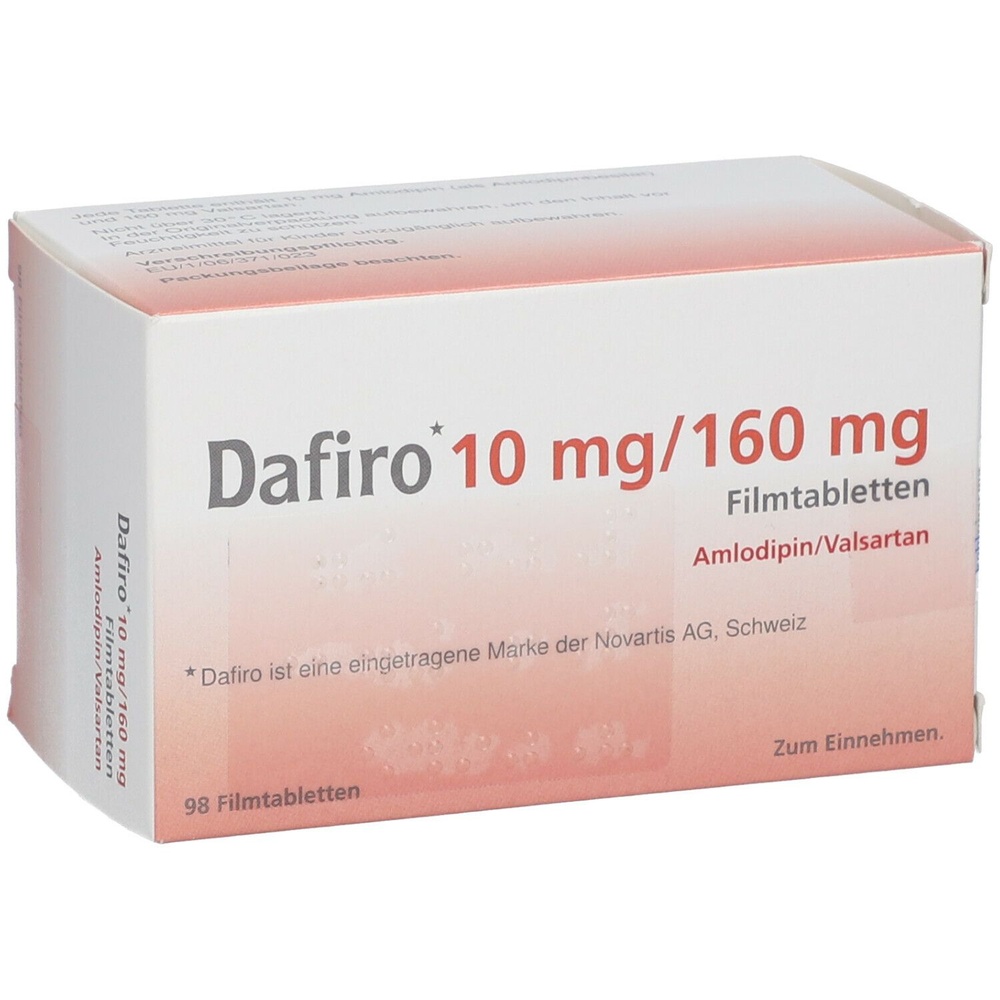
- País de registro
- Forma farmacéuticaCOMPRIMIDO, 160 mg / 10 mg
- Código ATCC09DB01
- Precio medio en farmacia13.27 EUR
- Principio activo
- Requiere recetaSí
- Fabricante
- Esta información es de carácter general y no sustituye la consulta con un profesional sanitario.
- Alternativas a DAFIRO 10 mg/160 mg COMPRIMIDOS RECUBIERTOS CON PELICULAForma farmacéutica: COMPRIMIDO, 10 mg/160 mgPrincipio activo: valsartan and amlodipineFabricante: Aurovitas Spain, S.A.U.Requiere recetaForma farmacéutica: COMPRIMIDO, 5 mg/160 mgPrincipio activo: valsartan and amlodipineFabricante: Aurovitas Spain, S.A.U.Requiere recetaForma farmacéutica: COMPRIMIDO, 10 mg/160 mgPrincipio activo: valsartan and amlodipineFabricante: Laboratorios Cinfa S.A.Requiere receta
Médicos online para DAFIRO 10 mg/160 mg COMPRIMIDOS RECUBIERTOS CON PELICULA
Comenta la dosis, los posibles efectos secundarios, interacciones, contraindicaciones o la revisión de receta de DAFIRO 10 mg/160 mg COMPRIMIDOS RECUBIERTOS CON PELICULA, sujeto a valoración médica y a la normativa local.
Obtén una receta de DAFIRO 10 mg/160 mg COMPRIMIDOS RECUBIERTOS CON PELICULA online
Rellena un formulario de 2 minutos
Cuéntanos tus síntomas, historial y el medicamento que necesitas.
Elige un médico o nosotros te asignamos uno
Escoge un especialista o te conectamos con el próximo médico disponible.
El médico revisa tu caso
Normalmente en 30 minutos. Puede hacerte preguntas adicionales por chat.
Recógela en cualquier farmacia
Receta electrónica enviada a tu correo, válida en toda España.
Preguntas frecuentes
DAFIRO 10 mg/160 mg COMPRIMIDOS RECUBIERTOS CON PELICULA requiere receta en España. Puedes confirmarlo con un médico online según tu caso.
El principio activo de DAFIRO 10 mg/160 mg COMPRIMIDOS RECUBIERTOS CON PELICULA es valsartan and amlodipine. Esta información ayuda a identificar medicamentos con la misma composición pero con diferentes nombres comerciales.
El precio medio en farmacia de DAFIRO 10 mg/160 mg COMPRIMIDOS RECUBIERTOS CON PELICULA es de aproximadamente 13.27 EUR. Puede variar según el fabricante y la forma farmacéutica.
DAFIRO 10 mg/160 mg COMPRIMIDOS RECUBIERTOS CON PELICULA es fabricado por Novartis Europharm Limited. La marca y el envase pueden variar según el distribuidor.
Los Médicos de familia, Psiquiatras, Dermatólogos, Cardiólogos, Endocrinólogos, Gastroenterólogos, Neumólogos, Nefrólogos, Reumatólogos, Hematólogos, Infectólogos, Alergólogos, Geriatras, Pediatras, Oncólogos pueden valorar la prescripción de DAFIRO 10 mg/160 mg COMPRIMIDOS RECUBIERTOS CON PELICULA cuando esté clínicamente indicado. Puedes reservar una videoconsulta para comentar tu caso y las opciones de tratamiento.
España cuenta con una infraestructura sanitaria bien desarrollada en ciudades principales como Madrid, Barcelona, Valencia y Sevilla. Las farmacias están ampliamente disponibles y operan bajo estrictas regulaciones, garantizando el acceso a medicamentos con receta.
Puedes comprar DAFIRO 10 mg/160 mg COMPRIMIDOS RECUBIERTOS CON PELICULA en Madrid, Barcelona, Sevilla o Valencia en cualquier farmacia local con una receta válida.
Para obtener una receta, puedes utilizar Oladoctor:
Otros medicamentos con el mismo principio activo (valsartan and amlodipine) incluyen AMLODIPINO/VALSARTAN AUROVITAS 10 MG/160 MG COMPRIMIDOS RECUBIERTOS CON PELICULA EFG, AMLODIPINO/VALSARTAN AUROVITAS 5 MG/160 MG COMPRIMIDOS RECUBIERTOS CON PELICULA EFG, AMLODIPINO/VALSARTAN CINFAMED 10 mg/160 mg COMPRIMIDOS RECUBIERTOS CON PELICULA EFG. Pueden tener diferentes nombres comerciales o formulaciones, pero contienen el mismo componente terapéutico. Consulta siempre con un médico antes de cambiar o iniciar un nuevo medicamento.
