



DACORTIN 30 mg Comprimidos

Revisión de receta online
Un médico revisará tu caso y determinará si la prescripción es médicamente apropiada.

Habla con un médico sobre este medicamento
Comenta tus síntomas y las opciones de tratamiento en una consulta online.



Cómo usar DACORTIN 30 mg COMPRIMIDOS
Contenido del prospecto
- Introducción
- Qué es Dacortín 30 mg y para qué se utiliza
- Qué necesita saber antes de empezar a tomar Dacortín 30 mg
- Cómo tomar Dacortín 30 mg comprimidos
- Posibles efectos adversos
- Conservación de Dacortín 30 mg comprimidos
- Contenido del envase e información adicional
Introducción
Dacortín 30 mg comprimidos
Prednisona
Lea todo el prospecto detenidamente antes de empezar a tomar este medicamento, porque contiene información importante para usted.
- Conserve este prospecto, ya que puede tener que volver a leerlo.
- Si tiene alguna duda, consulte a su médico o farmacéutico.
- Este medicamento se le ha recetado solamente a usted y no debe dárselo a otras personas, aunque tengan los mismos síntomas que usted, ya que puede perjudicarles.
- Si experimenta efectos adversos, consulte a su médico o farmacéutico, incluso si se trata de efectos adversos que no aparecen en este prospecto. Ver sección 4.
Contenido del prospecto:
- Qué es Dacortín 30 mg y para qué se utiliza
- Qué necesita saber antes de empezar a tomar Dacortín 30 mg
- Cómo tomar Dacortín 30 mg
- Posibles efectos adversos
- Conservación de Dacortín 30 mg
- Contenido del envase e información adicional
1. Qué es Dacortín 30 mg y para qué se utiliza
La prednisona contenida en Dacortín 30 mg es un corticoesteroide (glucocorticoide).
Dacortín 30 mg se utiliza para el tratamiento de sustitución en la insuficiencia adrenal incluyendo entre otras la enfermedad de Addison.
Por su acción antiinflamatoria e inmunosupresora Dacortín 30 mg se utiliza en el tratamiento de:
- enfermedades reumáticas, como artritis reumatoide
- enfermedades autoinmunes del colágeno y de los vasos sanguíneos, como lupus eritematoso sistémico
- enfermedades bronquiales y pulmonares como asma
- enfermedades de la piel, como urticaria aguda y severa y pénfigo
- enfermedades de la sangre, como anemia hemolítica adquirida, púrpura trombocitopénica y otras con implicación tumoral, como leucemia
- junto con medicamentos quimioterápicos o radioterapia
- enfermedades gastrointestinales, como colitis ulcerosa y enfermedad de Crohn
- enfermedades del hígado, como hepatitis crónica activa de origen autoinmune
- enfermedades de los riñones, como síndrome nefrótico
- algunas enfermedades inflamatorias de los ojos, como conjuntivitis alérgica, queratitis, neuritis óptica entre otras.

¿No estás seguro de si este medicamento es adecuado para ti?
Comenta tus síntomas y tratamiento con un médico online.
2. Qué necesita saber antes de empezar a tomar Dacortín 30 mg
No tome Dacortín 30 mg comprimidos:
- si es alérgico a la prednisona, a otros glucocorticoides o a cualquiera de los demás componentes de este medicamento (incluidos en la sección 6)
- si padece úlcera de estómago, gastritis, esofagitis (enfermedades del aparato digestivo)
- si padece infecciones producidas por virus (como el herpes simple ocular, varicela), antes o después de que le hayan administrado una vacuna
Puede que su médico le haya recomendado tomar Dacortín a pesar de que sufra alguna de las siguientes enfermedades y por ello necesite un control regular:
- si padece osteomalacia y osteoporosis (enfermedades de los huesos)
- si padece diabetes grave
- si padece psicosis (trastorno mental) que no está controlado con un tratamiento
- si padece tuberculosis que no esté siendo tratada
- si padece alguna infección producida por bacterias, hongos, amebas o si padece micosis sistémica (infección causada por hongos y diseminada por todo el cuerpo)
- si padece linfomas (un tipo de tumor del sistema linfático) que han aparecido tras una vacunación contra la tuberculosis
- si padece alguna enfermedad psiquiátrica. Consulte con su médico sobre la conveniencia de utilizar este medicamento
- si padece de tensión arterial alta grave
- si padece asistolia (enfermedad del corazón) con edema pulmonar y uremia (síndrome que se caracteriza por un exceso de sustancias nitrogenadas en sangre)
- si padece miastenia grave (enfermedad muscular)
- si padece insuficiencia renal.
Advertencias y precauciones
Consulte a su médico o farmacéutico antes de empezar a tomar Dacortín 30 mg.
El tratamiento con Dacortín 30 mg puede aumentar el riesgo de infecciones ya que puede disminuir las defensas de su organismo pudiendo dar lugar a nuevas infecciones o activando las ya existentes (ej.: tuberculosis o hepatitis B). En infecciones graves o en caso de tuberculosis Dacortín debe ser utilizando únicamente junto con el tratamiento para la infección.
Informe a su médico si sufre cualquier tipo de infección y si se ha vacunado o tiene previsto vacunarse. Si durante el tratamiento aparecen síntomas de enfermedades de inicio agudo como son las enfermedades infecciosas, digestivas o alteraciones psíquicas, acuda a su médico.
Debe evitar el contacto con personas que estén pasando la varicela o el sarampión. Si durante el tratamiento con Dacortín estuviera expuesto a estas infecciones, debe contactar con un médico inmediatamente, incluso si no presentara ningún síntoma.
Este medicamento se administrará con precaución en personas que padezcan úlcera de estómago, colitis ulcerosa (enfermedad del intestino), diverticulitis (enfermedad del intestino) o enteroanastomosis (después de la cirugía) o trastornos mentales.
Si usted sufre osteoporosis su médico puede recomendarle tomar un aporte extra de calcio y vitamina D.
Informe a su médico si sufre alguna enfermedad cardíaca y necesita dosis elevadas de prednisona.
Si usted es diabético, o padece insuficiencia cardíaca y tensión arterial muy alta o glaucoma, su médico le realizará controles de manera regular.
Si se administra este medicamento con fluoroquinolonas (p.ej. ciprofloxacino) aumenta el riesgo de roturas de tendones y tendinitis.
Puede que su médico le aumente la dosis en el caso de que usted padezca alguna situación estresante (infecciones, cirugía, traumatismos, etc.).
En los tratamientos largos su médico le realizará de manera regular controles para evitar complicaciones en los ojos, análisis de sangre, control del crecimiento (en niños y adolescentes) y controlará la función de su eje hipotalámico-hipofisario-suprarrenal.
Póngase en contacto con su médico si presenta visión borrosa u otras alteraciones visuales.
En tratamientos prolongados con Dacortín su médico puede recetarle suplementos de potasio y hacerle disminuir el consumo de sodio (sal).
Consulte a su médico antes de empezar a tomar Dacortín si tiene escleroderma (también denominado esclerosis sistémica, un trastorno autoinmune), porque las dosis diarias iguales o superiores a 15 mg pueden aumentar el riesgo de una complicación grave llamada crisis renal esclerodérmica. Los signos de una crisis renal esclerodérmica son aumento de la presión arterial y disminución de la producción de orina. El médico puede aconsejarle que se controle periódicamente la presión arterial y la orina.
Debe valorarse cuidadosamente la administración de Dacortín a niños y en caso de administrarse debe ser un tratamiento intermitente o alternado.
Cuando se administre a pacientes de edad avanzada su médico controlará con regularidad al paciente. Los pacientes de edad avanzada deben evitar un tratamiento prolongado con este medicamento.
La toma de Dacortín puede dar resultados erróneos en las pruebas cutáneas de los test de alergia (prueba de la tuberculina, parches para alergias, etc.).
Uso en deportistas
Este medicamento contiene prednisona, que puede producir un resultado positivo en las pruebas de control de dopaje.
El tratamiento no debe interrumpirse bruscamente sino de forma gradual. No deje de usar este medicamento sin consultar con su médico (ver sección 3 “Cómo tomar Dacortín”).
Toma de Dacortín 30 mg con otros medicamentos
Informe a su médico si está tomando o ha tomado recientemente otros medicamentos, incluso los adquiridos sin receta.
Algunos medicamentos pueden aumentar los efectos de Dacortín, por lo que su médico le hará controles minuciosos si está tomando estos medicamentos (incluidos algunos para el VIH: ritonavir, cobicistat).
Dacortín puede interferir con los siguientes medicamentos:
- Antiinflamatorios no esteroideos (ej. indometacina, salicilatos)
- Antidiabéticos
- Inductores enzimáticos:
- Carbamazepina, fenitoína, fenobarbital o primidona (medicamentos utilizados para tratar la epilepsia)
- Rifampicina, rifabutina (antibióticos)
- Inhibidores enzimáticos como el ketoconazol (utilizado para las infecciones por hongos)
- Efedrina
- Anticoagulantes orales (como el Sintrom)
- Estrógenos (medicamentos utilizados para las alteraciones hormonales), anticonceptivos orales
- Atropina
- Glucósidos cardíacos (medicamentos utilizados para tratar enfermedades del corazón)
- Diuréticos eliminadores de potasio (medicamentos utilizados para eliminar agua) y laxantes
- Praziquantel (medicamento antiparasitario)
- Algunos medicamentos usados para tratar la hipertensión arterial
- Algunos medicamentos para la malaria
- Sustancias inmunosupresoras (medicamentos utilizados para evitar rechazos)
- Bloqueantes neuromusculares no despolarizantes (medicamentos utilizados sobretodo en la UCI o en el quirófano)
- Hormona de crecimiento
- Protirelina (medicamento que estimula la tiroides)
- Fluoroquinolonas: puede aumentar el riesgo de alteraciones en los tendones.
- Antiácidos
- Salicilatos (medicamentos del tipo de la aspirina)
Interferencia con pruebas de laboratorio: test de alergia pueden estar suprimidos.
Embarazo y lactancia
Si está embarazada o en periodo de lactancia, cree que podría estar embarazada o tiene intención de quedarse embarazada, consulte a su médico o farmacéutico antes de utilizar este medicamento.
Dacortín, al igual que la mayoría de los medicamentos, no se debe administrar durante el embarazo o la lactancia, a menos que su médico lo considere indispensable. Por ello, deberá avisar lo antes posible a su médico en caso de quedar embarazada durante el tratamiento.
Dacortín pasa a la leche materna por lo que se recomienda evitar la lactancia durante el tratamiento, especialmente en los tratamientos largos y cuando se utilizan dosis altas.
Conducción y uso de máquinas
Debe tenerse en cuenta que en tratamientos de larga duración podría disminuirse la agudeza visual. Ello podría afectar negativamente la capacidad para conducir y utilizar maquinaria.
Dacortín 30 mg contiene lactosa
Este medicamento contiene lactosa. Si su médico le ha indicado que padece una intolerancia a ciertos azúcares, consulte con él antes de tomar este medicamento.
3. Cómo tomar Dacortín 30 mg comprimidos
Siga exactamente las instrucciones de administración de este medicamento indicadas por su médico. En caso de duda, consulte de nuevo a su médico o farmacéutico.
Como norma general, la dosis diaria se repartirá en varias tomas después de las comidas y al acostarse. En algunos casos puede tomarse en forma de dosis única por la mañana, todos los días o en días alternos y con una cantidad de líquido suficiente.
Tan pronto como se obtenga una respuesta satisfactoria deberá tomar la dosis general de mantenimiento. Ambas dosis serán determinadas por su médico.
La dosis depende del tipo y severidad de la enfermedad y de la respuesta individual del paciente y en tratamientos prolongados, la dosis de mantenimiento debería ser lo más baja posible.
La dosis inicial será de 20 a 90 mg al día en adultos y de 0,5 a 2 mg al día por cada kg de peso en niños.
La dosis general de mantenimiento será de 5 a 10 mg al día en adultos y de 0,25 a 0,5 mg al día por cada kg de peso en niños. Cuando se utiliza en niños como antiinflamatorio e inmunosupresor, se recomiendan dosis de 0,05 a 2 mg al día por cada kg de peso.
Para suspender el tratamiento, su médico le indicará cómo hacerlo. Para los tratamientos largos se hará una reducción progresiva: en general, se debe reducir la dosis un 10% cada 8-15 días. Para los tratamientos cortos (inferiores a 10 días) no es necesario realizar una reducción progresiva de la dosis.
En ancianos, se aplicará la misma posología que en adultos, teniendo en cuenta las recomendaciones citadas en la sección 2 “Advertencias y precauciones”.
Si toma más Dacortín 30 mg del que debe
En caso de sobredosis o ingestión accidental, consulte inmediatamente a su médico o farmacéutico o llame al Servicio de Información Toxicológica, teléfono 91 562 0420, indicando el medicamento y la cantidad ingerida.
Si olvidó tomar Dacortín 30 mg
No tome una dosis doble para compensar las dosis olvidadas.
Si interrumpe el tratamiento con Dacortín 30 mg
No deje de usar este medicamento sin consultar con su médico.
Si tiene cualquier otra duda sobre el uso de este medicamento, pregunte a su médico o farmacéutico.

¿Has empezado a tomar el medicamento y tienes preguntas?
Comenta tus síntomas y tratamiento con un médico online.
4. Posibles efectos adversos
Al igual que todos los medicamentos, este medicamento puede producir efectos adversos, aunque no todas las personas los sufran.
Los efectos adversos observados son, según su frecuencia de presentación: muy frecuentes (pueden afectar a más de 1 de cada 10 pacientes); frecuentes (pueden afectar hasta uno de cada 10 pacientes); poco frecuentes (pueden afectar hasta uno de cada 100 pacientes); raros (pueden afectar hasta uno de cada 1000 pacientes); muy raros (pueden afectar hasta uno de cada 10.000 pacientes); frecuencia no conocida (no puede estimarse a partir de los datos disponibles).
En la mayor parte de los casos, las reacciones adversas se producen especialmente cuando se utiliza a dosis altas y en tratamientos largos y se detallan a continuación:
Trastornos de la sangre y del sistema linfático: leucocitosis (aumento de leucocitos en la sangre), linfopenia (disminución de los linfocitos en sangre), eosinopenia (disminución de los eosinófilos en sangre), policitemia (aumento de glóbulos rojos en la sangre).
Trastornos endocrinos:signos de hiperactividad adrenal (Síndrome de Cushing, enfermedad provocada por el aumento de la producción de una hormona denominada cortisol); en tratamientos prolongados insuficiencia adrenocortical (enfermedad que se caracteriza por debilidad, sensación de cansancio todo el tiempo, pérdida de apetito y peso).
Trastornos oculares:glaucoma y cataratas. Visión borrosa.
Trastornos gastrointestinales:úlcera de estómago, sangrado intestinal, pancreatitis (inflamación del páncreas).
Trastornos generales y alteraciones en el lugar de administración:retraso en la cicatrización de heridas.
Trastornos inmunológicos:reacciones tipo alérgicas graves, incluyendo arritmias, broncoespasmo, disminución o aumento de la presión arterial, insuficiencia circulatoria, ataque al corazón.
Infecciones e infestaciones: las infecciones existentes pueden agravarse y, pueden aparecer infecciones nuevas difíciles de diagnosticar.
Trastornos del metabolismo y de la nutrición: retención de líquidos (edema), pérdidas de potasio (que pueden producir alteraciones del ritmo cardíaco), aumento de peso, aumento del azúcar en sangre, diabetes mellitus, aumento de los niveles de colesterol y triglicéridos en sangre, aumento del apetito, retraso del crecimiento en niños.
Trastornos cardíacos (frecuencia no conocida):disminución de la frecuencia cardíaca.
Trastornos musculoesqueléticos y del tejido conjuntivo:enfermedades musculares y debilidad muscular, alteraciones del tendón, tendinitis, roturas tendinosas, pérdida de calcio en los huesos, osteoporosis, retraso de crecimiento en los niños.
Trastornos del sistema nervioso:aumento de la presión del cráneo (especialmente en niños), aumento de los espasmos en pacientes epilépticos o aparición de epilepsia.
Trastornos psiquiátricos:psicosis, manía, depresión, alucinaciones, inestabilidad emocional, irritabilidad, aumento de la actividad, euforia, ansiedad, alteraciones del sueño, ideas de suicidio.
Trastornos del aparato reproductor y de la mama: menstruación irregular o ausencia de menstruación, hirsutismo (crecimiento de vello).
Trastornos de la piel y del tejido subcutáneo: acné u otros problemas cutáneos (alergia, morados, estrías), edemas, cambios en el color de la piel, dermatitis alrededor de la boca.
Trastornos vasculares:tensión arterial alta, riesgo aumentado de arteriosclerosis (estrechamiento y endurecimiento de las arterias) y trombosis (formación de coágulos en la sangre), vasculitis, fragilidad capilar.
Trastornos renales y urinarios: crisis renal esclerodérmica en pacientes que ya presentan escleroderma (un trastorno autoinmunitario). Los signos de una crisis renal esclerodérmica son aumento de la presión arterial y disminución de la producción de orina.
Al disminuir rápidamente la dosis después de un tratamiento largo puede causar dolores musculares y articulares.
Si considera que alguno de los efectos adversos que sufre es grave o si aprecia cualquier efecto adverso no mencionado en este prospecto, informe a su médico o farmacéutico.
Comunicación de efectos adversos:
Si experimenta cualquier tipo de efecto adverso, consulte a su médico o farmacéutico, incluso si se trata de posibles efectos adversos que no aparecen en este prospecto. También puede comunicarlos directamente a través del Sistema Español de Farmacovigilancia de medicamentos de Uso Humano: https://www.notificaram.es. Mediante la comunicación de efectos adversos usted puede contribuir a proporcionar más información sobre la seguridad de este medicamento.
5. Conservación de Dacortín 30 mg comprimidos
No se precisan condiciones especiales de conservación.
Mantener Dacortín 30 mg comprimidos fuera de la vista y del alcance de los niños.
No utilice Dacortín 30 mg comprimidos después de la fecha de caducidad que aparece en el envase después de CAD. La fecha de caducidad es el último día del mes que se indica.
Los medicamentos no se deben tirar por los desagües ni a la basura. Deposite los envases y los medicamentos que no necesita en el Punto SIGRE de la farmacia. En caso de duda pregunte a su farmacéutico cómo deshacerse de los envases y de los medicamentos que no necesita. De esta forma, ayudará a proteger el medio ambiente.
6. Contenido del envase e información adicional
Composición de Dacortín 30 mg
- El principio activo es prednisona. Cada comprimido contiene 30 mg de prednisona.
- Los demás componentes son lactosa hidratada, almidón de maíz, povidona, carboximetilalmidón de sodio, talco, estearato de magnesio y agua purificada.
Aspecto del producto y contenido del envase
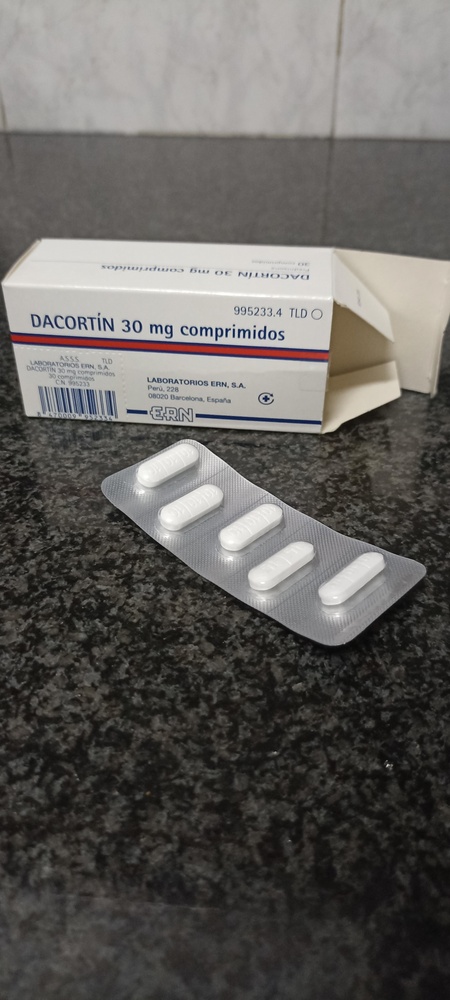
Dacortín 30 mg se presenta en forma de comprimidos oblongos de color blanco. La cara superior presenta una ranura transversal con el número “15” grabado a cada lado de la ranura. La cara inferior contiene dos ranuras que dividen el comprimido en tres partes; cada una de ellas lleva grabado el número “10”. El comprimido se puede dividir en 2 o 3 partes iguales.
Dacortín 30 mg se presenta en envases de 30 o 500 comprimidos en blíster.
Titular de la autorización de comercialización
Laboratorios ERN, S.A.
Perú, 228
08020 Barcelona, España
Responsable de la fabricación
Merck, S.L.
Polígono Merck
08100 Mollet del Vallés (Barcelona),España
o
CYNDEA PHARMA, S.L.
Polígono Industrial Emiliano Revilla Sanz
Avenida de Ágreda, 31 - 42110 Ólvega (Soria)
o
LABORATORIOS ERN, S.A.
Gorgs Lladó, 188
08210 Barberá del Vallés, Barcelona. España
Fecha de la última revisión de este prospecto: 09/2017
La información detallada y actualizada de este medicamento está disponible en la página Web de la Agencia Española de Medicamentos y Productos Sanitarios (AEMPS) http://www.aemps.gob.es/.
- País de registro
- Forma farmacéuticaCOMPRIMIDO, 30 mg prednisona
- Código ATCH02AB07
- Precio medio en farmacia3.76 EUR
- Principio activo
- Requiere recetaSí
- Fabricante
- ComposiciónCARBOXIMETILALMIDON SODICO (14 mg mg), LACTOSA MONOHIDRATO (397 mg mg)
- Esta información es de carácter general y no sustituye la consulta con un profesional sanitario.
- Alternativas a DACORTIN 30 mg COMPRIMIDOSForma farmacéutica: COMPRIMIDO, 2,5 mg prednisonaPrincipio activo: PrednisonaFabricante: Laboratorios Ern S.A.Requiere recetaForma farmacéutica: COMPRIMIDO, 5 mg prednisonaPrincipio activo: PrednisonaFabricante: Laboratorios Ern S.A.Requiere recetaForma farmacéutica: COMPRIMIDO, 10 mg prednisona/comprimidoPrincipio activo: PrednisonaFabricante: Laboratorios Cinfa S.A.Requiere receta
Médicos online para DACORTIN 30 mg COMPRIMIDOS
Comenta la dosis, los posibles efectos secundarios, interacciones, contraindicaciones o la revisión de receta de DACORTIN 30 mg COMPRIMIDOS, sujeto a valoración médica y a la normativa local.

Obtén una receta de DACORTIN 30 mg COMPRIMIDOS online
Rellena un formulario de 2 minutos
Cuéntanos tus síntomas, historial y el medicamento que necesitas.
Elige un médico o nosotros te asignamos uno
Escoge un especialista o te conectamos con el próximo médico disponible.
El médico revisa tu caso
Normalmente en 30 minutos. Puede hacerte preguntas adicionales por chat.
Recógela en cualquier farmacia
Receta electrónica enviada a tu correo, válida en toda España.
Preguntas frecuentes
DACORTIN 30 mg COMPRIMIDOS requiere receta en España. Puedes confirmarlo con un médico online según tu caso.
El principio activo de DACORTIN 30 mg COMPRIMIDOS es Prednisona. Esta información ayuda a identificar medicamentos con la misma composición pero con diferentes nombres comerciales.
El precio medio en farmacia de DACORTIN 30 mg COMPRIMIDOS es de aproximadamente 3.76 EUR. Puede variar según el fabricante y la forma farmacéutica.
DACORTIN 30 mg COMPRIMIDOS es fabricado por Laboratorios Ern S.A.. La marca y el envase pueden variar según el distribuidor.
Los Médicos de familia, Psiquiatras, Dermatólogos, Cardiólogos, Endocrinólogos, Gastroenterólogos, Neumólogos, Nefrólogos, Reumatólogos, Hematólogos, Infectólogos, Alergólogos, Geriatras, Pediatras, Oncólogos pueden valorar la prescripción de DACORTIN 30 mg COMPRIMIDOS cuando esté clínicamente indicado. Puedes reservar una videoconsulta para comentar tu caso y las opciones de tratamiento.
España cuenta con una infraestructura sanitaria bien desarrollada en ciudades principales como Madrid, Barcelona, Valencia y Sevilla. Las farmacias están ampliamente disponibles y operan bajo estrictas regulaciones, garantizando el acceso a medicamentos con receta.
Puedes comprar DACORTIN 30 mg COMPRIMIDOS en Madrid, Barcelona, Sevilla o Valencia en cualquier farmacia local con una receta válida.
Para obtener una receta, puedes utilizar Oladoctor:
Otros medicamentos con el mismo principio activo (Prednisona) incluyen DACORTIN 2,5 mg COMPRIMIDOS, DACORTIN 5 mg COMPRIMIDOS, PREDNISONA CINFA 10 mg COMPRIMIDOS. Pueden tener diferentes nombres comerciales o formulaciones, pero contienen el mismo componente terapéutico. Consulta siempre con un médico antes de cambiar o iniciar un nuevo medicamento.
