



DABIGATRAN ETEXILATO SANDOZ 150 mg CÁPSULAS DURAS

Revisión de receta online
Un médico revisará tu caso y determinará si la prescripción es médicamente apropiada.

Habla con un médico sobre este medicamento
Comenta tus síntomas y las opciones de tratamiento en una consulta online.



Cómo usar DABIGATRAN ETEXILATO SANDOZ 150 MG CAPSULAS DURAS EFG
Contenido del prospecto
- Introducción
- Qué es Dabigatrán etexilato Sandoz y para qué se utiliza
- Qué necesita saber antes de empezar a tomar Dabigatrán etexilato Sandoz
- Cómo tomar Dabigatrán etexilato Sandoz
- Posibles efectos adversos
- Conservación de Dabigatrán etexilato Sandoz
- Contenido del envase e información adicional
Introducción
Prospecto:información para el paciente
Dabigatrán etexilato Sandoz150 mg cápsulas duras EFG
dabigatrán etexilato
Lea todo el prospecto detenidamenteantes de empezar a tomar estemedicamento,porque contiene información importantepara usted
- Conserve este prospecto, ya que puede tener que volver a leerlo.
- Si tiene alguna duda, consulte a su médico o farmacéutico.
- Este medicamento se le ha recetado solamente a usted, y no debe dárselo a otras personas aunque tengan los mismos síntomas que usted, ya que puede perjudicarles.
- Si experimenta efectos adversos, consulte a su médico o farmacéutico, incluso si se trata de efectos adversos que no aparecen en este prospecto. Ver sección 4.
Contenido del prospecto
- Qué es Dabigatrán etexilato Sandoz y para qué se utiliza
- Qué necesita saber antes de empezar a tomar Dabigatrán etexilato Sandoz
- Cómo tomar Dabigatrán etexilato Sandoz
- Posibles efectos adversos
5 Conservación de Dabigatrán etexilato Sandoz
- Contenido del envase e información adicional
1. Qué es Dabigatrán etexilato Sandoz y para qué se utiliza
Dabigatrán etexilato Sandoz contiene el principio activo dabigatrán etexilato y pertenece al grupo de medicamentos denominados anticoagulantes. Funciona bloqueando una sustancia del cuerpo implicada en la formación de coágulos en la sangre.
Dabigatrán etexilato se utiliza en adultos para:
- evitar la formación de coágulos de sangre en el cerebro (ictus) y en otros vasos sanguíneos del cuerpo si usted padece una forma de ritmo cardíaco irregular denominado fibrilación auricular no valvular y presenta al menos un factor de riesgo adicional,
- tratar los coágulos de sangre en las venas de sus piernas y pulmones y para prevenir que vuelvan a aparecer coágulos de sangre en las venas de sus piernas y pulmones.
Dabigatrán etexilato se utiliza en niños para:
- tratar los coágulos de sangre y evitar que se vuelvan a formar coágulos de sangre.

¿No estás seguro de si este medicamento es adecuado para ti?
Comenta tus síntomas y tratamiento con un médico online.
2. Qué necesita saber antes de empezar a tomar Dabigatrán etexilato Sandoz
No tome Dabigatrán etexilato Sandoz
- si es alérgico al dabigatrán etexilato o a alguno de los demás componentes de este medicamento (incluidos en la sección 6),
- si su función renal está muy reducida,
- si actualmente padece hemorragias,
- si tiene alguna enfermedad en un órgano del cuerpo que aumente el riesgo de hemorragias graves (p. ej., úlcera de estómago, lesión o hemorragia cerebral, intervención quirúrgica reciente del cerebro o de los ojos),
- si es propenso a sangrar. Esta tendencia puede ser de nacimiento, de causa desconocida o provocada por otros medicamentos,
- si está tomando medicamentos para prevenir la formación de coágulos en la sangre (p. ej., warfarina, rivaroxabán, apixabán o heparina), excepto cuando esté cambiando de tratamiento anticoagulante, mientras tenga un catéter venoso o arterial y se le administre heparina a través de este catéter para mantenerlo abierto o mientras su latido cardíaco normal se esté restableciendo mediante un procedimiento denominado ablación con catéter para fibrilación auricular,
- si la función de su hígado está gravemente reducida o padece alguna enfermedad del hígado que pueda ser mortal,
- si está tomando ketoconazol oral o itraconazol, medicamentos utilizados en el tratamiento de las infecciones por hongos,
- si está tomando ciclosporina oral, un medicamento utilizado para la prevención del rechazo de órganos después de un trasplante,
- si está tomando dronedarona, un medicamento utilizado para tratar el latido cardíaco anómalo,
- si está tomando un producto de asociación de glecaprevir y pibrentasvir, un medicamento antiviral que se usa para tratar la hepatitis C,
- si se le ha implantado una válvula cardíaca artificial que requiere tratamiento anticoagulante permanente.
Advertencias y precauciones
Consulte a su médico antes de empezar a tomar dabigatrán etexilato. Durante el tratamiento con este medicamento también puede necesitar consultar a su médico si experimenta algún síntoma o si se tiene que someter a cirugía.
Informe a su médicosi padece o ha padecido cualquier trastorno o enfermedad, especialmente cualquiera de los detallados a continuación:
- Si presenta un riesgo aumentado de hemorragia, por ejemplo:
- si recientemente ha padecido hemorragias,
- si se ha sometido a una extracción quirúrgica de tejido (biopsia) en el último mes,
- si ha sufrido una lesión grave (p. ej., una fractura ósea, una lesión en la cabeza o cualquier lesión que haya requerido tratamiento quirúrgico),
- si padece una inflamación del esófago o del estómago,
- si tiene problemas de reflujo del jugo gástrico en el esófago,
- si está recibiendo medicamentos que pueden aumentar el riesgo de hemorragia. Consulte “Otros medicamentos y Dabigatrán etexilato Sandoz” más adelante,
- si está utilizando medicamentos antiinflamatorios como por ejemplo diclofenaco, ibuprofeno o piroxicam,
- si padece una infección en el corazón (endocarditis bacteriana),
- si sabe que tiene el funcionamiento de los riñones disminuido o si sufre deshidratación (los síntomas incluyen sensación de sed y eliminación de pequeñas cantidades de orina de color oscuro [concentrada]/con espuma),
- si es mayor de 75 años,
- si es un paciente adulto y pesa 50 kg o menos,
- solo si se utiliza en niños: si el niño tiene una infección en el cerebro o alrededor de este.
- si ha sufrido un ataque al corazón o si le han diagnosticado enfermedades que aumentan el riesgo de sufrir un ataque al corazón,
- si padece una enfermedad del hígado asociada a cambios en los análisis de sangre. El uso de este medicamento no se recomienda en este caso.
Tenga especial cuidado con Dabigatrán etexilato Sandoz
- si tiene que someterse a una intervención quirúrgica:
En este caso, dabigatrán etexilato se debe interrumpir temporalmente debido a un mayor riesgo de hemorragia durante y poco después de una intervención quirúrgica. Es muy importante que tome dabigatrán etexilato antes y después de la intervención quirúrgica exactamente en los momentos que le haya indicado su médico,
- si una intervención quirúrgica requiere la colocación de un catéter o una inyección en la columna vertebral (p.ej., para anestesia epidural o espinal o para la reducción del dolor):
- es muy importante que tome dabigatrán etexilato antes y después de la intervención quirúrgica exactamente en los momentos que le haya indicado su médico,
- informe a su médico inmediatamente si presenta entumecimiento o debilidad en las piernas o problemas intestinales o en la vejiga después del final de la anestesia, ya que dicha situación requiere una atención urgente.
- si se cae o lesiona durante el tratamiento, especialmente si se golpea la cabeza. Solicite asistencia médica urgente. Puede necesitar que un médico le examine, ya que puede tener un mayor riesgo de sangrado,
- si sabe que padece una enfermedad denominada síndrome antifosfolipídico (un trastorno del sistema inmunitario que aumenta el riesgo de que se formen coágulos de sangre), informe a su médico para que decida si puede ser necesario modificar el tratamiento.
Otros medicamentos y Dabigatrán etexilato Sandoz
Informe a su médico o farmacéutico si está tomando, ha tomado recientemente o pudiera tener que tomar cualquier otro medicamento. En particular, debe informar a su médico antes de tomar dabigatrán etexilato si está tomando alguno de los medicamentos indicados a continuación:
- medicamentos para reducir la coagulación de la sangre (p. ej., warfarina, fenprocumón, acenocumarol, heparina, clopidogrel, prasugrel, ticagrelor, rivaroxabán, ácido acetilsalicílico),
- medicamentos para el tratamiento de infecciones por hongos (p. ej., ketoconazol, itraconazol), salvo si solo se aplican en la piel,
- medicamentos utilizados en el tratamiento del latido anómalo del corazón (p. ej., amiodarona, dronedarona, quinidina, verapamilo). Si está tomando medicamentos que contienen verapamilo, es posible que su médico le indique que utilice una dosis reducida de dabigatrán etexilato según la enfermedad para la que se le haya recetado. Ver sección 3,
- medicamentos para la prevención del rechazo de órganos después de un trasplante (p. ej., tacrólimus, ciclosporina),
- un producto de asociación de glecaprevir y pibrentasvir (un medicamento antiviral que se usa para tratar la hepatitis C),
- medicamentos antiinflamatorios y calmantes del dolor (p. ej., ácido acetilsalicílico, ibuprofeno, diclofenaco),
- hierba de San Juan, una planta medicinal para la depresión,
- medicamentos antidepresivos llamados inhibidores selectivos de la recaptación de serotonina o inhibidores selectivos de la recaptación de serotonina y norepinefrina,
- rifampicina o claritromicina (dos antibióticos),
- medicamentos antivirales para el SIDA (p. ej., ritonavir),
- ciertos medicamentos para el tratamiento de la epilepsia (p. ej., carbamazepina, fenitoína).
Embarazo ylactancia
Si está embarazada o en periodo de lactancia, cree que podría estar embarazada o tiene intención de quedarse embarazada, consulte a su médico antes de utilizar este medicamento.
Se desconocen los efectos de dabigatrán etexilato sobre el embarazo y el feto. No debe utilizar este medicamento si está embarazada a menos que su médico le indique que es seguro hacerlo. Si está en edad fértil debe evitar quedarse embarazada durante el tratamiento con dabigatrán etexilato.
No se recomienda la lactancia natural durante el tratamiento con dabigatrán etexilato.
Conducción y uso de máquinas
Dabigatrán etexilato no tiene efectos conocidos sobre la capacidad para conducir y utilizar máquinas.
Dabigatrán etexilato Sandozcontienesodio
Este medicamento contiene menos de 1 mmol de sodio (23 mg) por cápsula dura; esto es, esencialmente “exento de sodio”.
3. Cómo tomar Dabigatrán etexilato Sandoz
Dabigatrán etexilato cápsulas se puede usar en adultos y niños de 8 años de edad o mayores que sean capaces de tragar las cápsulas enteras. Hay otras formas farmacéuticas apropiadas según la edad para el tratamiento de niños menores de 12 años en cuanto sean capaces de tragar alimentos blandos.
Siga exactamente las instrucciones de administración de este medicamento indicadas por su médico. En caso de duda, consulte de nuevo a su médico.
Tome Dabigatrán etexilato Sandoz según lo recomendado para las siguientes situaciones:
Prevención de la obstrucción vascular cerebral o sistémica por formación de coágulos de sangre desarrollada tras latido anómalo del corazón y tratamiento de los coágulos de sangre en las venas de sus piernas y pulmones, incluyendo la prevención para que no vuelvan a aparecer coágulos de sangre en las venas de sus piernas y pulmones
La dosis recomendada es de 300 mg administrados en forma de una cápsula de 150 mg dos veces al día.
Si tiene 80 años de edad o más, la dosis recomendada es de 220 mg administrados en forma de una cápsula de 110 mg dos veces al día.
Si está usando medicamentos que contienen verapamilo, se le deberá indicar una dosis reducida de dabigatrán etexilato de 220 mg tomados en forma de una cápsula de 110 mg dos veces al día, ya que su riesgo de sangrado puede aumentar.
Si usted tiene un riesgo de sangrado potencialmente mayor, su médico puede decidir prescribirle una dosis de 220 mg administrados en forma de una cápsula de 110 mg dos veces al día.
Puede continuar tomando este medicamento si es necesario restablecer su latido cardíaco normal mediante un procedimiento denominado cardioversión o mediante un procedimiento denominado ablación con catéter para fibrilación auricular.. Tome dabigatrán etexilato tal como le haya indicado su médico.
Si se le ha colocado un dispositivo médico (endoprótesis vascular) en un vaso sanguíneo para mantenerlo abierto en un procedimiento denominado intervención coronaria percutánea con colocación de endoprótesis vascular, puede recibir tratamiento con dabigatrán etexilato una vez que su médico haya decidido que se ha alcanzado un control normal de la coagulación sanguínea. Tome dabigatrán etexilato tal como le haya indicado su médico.
Tratamiento de los coágulos de sangre y prevención de que se vuelvan a formar coágulos de sangre en niños
Dabigatrán etexilato se debe tomar dos veces al día,una dosis por la mañana y una dosis por la noche, aproximadamente a la misma hora todos los días. El intervalo de administración debe ser lo más próximo posible a 12 horas.
La dosis recomendada depende del peso y de la edad. Su médico determinará la dosis correcta. Es posible que su médico le ajuste la dosis durante el tratamiento. Siga usando todos los demás medicamentos a menos que su médico le indique que deje de usar alguno.
La tabla 1 muestra las dosis únicas y las dosis totales diarias de dabigatrán etexilato en miligramos (mg). Las dosis dependen del peso en kilogramos (kg) y de la edad en años del paciente.
Tabla 1: Tabla de posología para dabigatrán etexilato cápsulas
Combinaciones de peso/edad | Dosis única en mg | Dosis total diaria en mg | |
Peso en kg | Edad en años | ||
11 a menos de 13 kg | 8 a menos de 9 años | 75 | 150 |
13 a menos de 16 kg | 8 a menos de 11 años | 110 | 220 |
16 a menos de 21 kg | 8 a menos de 14 años | 110 | 220 |
21 a menos de 26 kg | 8 a menos de 16 años | 150 | 300 |
26 a menos de 31 kg | 8 a menos de 18 años | 150 | 300 |
31 a menos de 41 kg | 8 a menos de 18 años | 185 | 370 |
41 a menos de 51 kg | 8 a menos de 18 años | 220 | 440 |
51 a menos de 61 kg | 8 a menos de 18 años | 260 | 520 |
61 a menos de 71 kg | 8 a menos de 18 años | 300 | 600 |
71 a menos de 81 kg | 8 a menos de 18 años | 300 | 600 |
81 kg o más | 10 a menos de 18 años | 300 | 600 |
Dosis únicas que requieren combinaciones de más de una cápsula:
300 mg: | dos cápsulas de 150 mg o cuatro cápsulas de 75 mg |
260 mg: | una cápsula de 110 mg más una cápsula de 150 mg o una cápsula de 110 mg más dos cápsulas de 75 mg |
220 mg: | dos cápsulas de 110 mg |
185 mg: | una cápsula de 75 mg más una cápsula de 110 mg |
150 mg: | una cápsula de 150 mg o dos cápsulas de 75 mg |
Cómo tomar Dabigatrán etexilato Sandoz
Dabigatrán etexilato se puede tomar con o sin alimentos. La cápsula se debe tragar entera con un vaso de agua, para asegurar la liberación en el estómago. No rompa, mastique, ni vacíe el contenido de la cápsula, ya que esto puede aumentar el riesgo de hemorragia.
Instrucciones para el blíster
- Presionar las cápsulas a través de la lámina del blíster.
Instrucciones para el frasco
- Presionar y girar para abrir.
- Después de extraer la cápsula, ponga de nuevo el tapón en el frasco y cierre bien el frasco inmediatamente después de tomar su dosis.
Cambio del tratamiento anticoagulante
No cambie su tratamiento anticoagulante sin instrucciones específicas de su médico.
Si toma más Dabigatrán etexilato Sandoz del que debe
Tomar demasiada cantidad de este medicamento aumenta el riesgo de hemorragia. Póngase en contacto con su médico inmediatamente si ha tomado demasiadas cápsulas. Hay disponibles opciones de tratamiento específicas.
En caso de sobredosis o ingestión accidental consulte inmediatamente a su médico o farmacéutico o llame al Servicio de Información Toxicológica, teléfono: 91 562 04 20, indicando el medicamento y la cantidad ingerida.
Si olvidó tomar Dabigatrán etexilato Sandoz
Una dosis olvidada se puede tomar hasta 6 horas antes de la próxima dosis.
Se debe omitir una dosis olvidada si el tiempo restante antes de la próxima dosis es inferior a 6 horas.
No tome una dosis doble para compensar las dosis olvidadas.
Si interrumpe el tratamiento con Dabigatrán etexilato Sandoz
Tome dabigatrán etexilato exactamente como le ha sido prescrito. No interrumpa su tratamiento con este medicamento sin consultar primero a su médico, ya que el riesgo de desarrollo de un coágulo de sangre podría ser mayor si interrumpiera el tratamiento demasiado pronto. Póngase en contacto con su médico si presenta indigestión después de tomar dabigatrán etexilato.
Si tiene cualquier otra duda sobre el uso de este medicamento, pregunte a su médico o farmacéutico.

¿Has empezado a tomar el medicamento y tienes preguntas?
Comenta tus síntomas y tratamiento con un médico online.
4. Posibles efectos adversos
Al igual que todos los medicamentos, este medicamento puede producir efectos adversos, aunque no todas las personas los sufran.
Dabigatrán etexilato actúa sobre la coagulación de la sangre; por lo tanto, la mayoría de los efectos adversos están relacionados con signos como cardenales o hemorragias. Se pueden producir episodios de sangrado mayor o grave, que constituyen los efectos adversos más graves y que, independientemente de su localización, pueden producir discapacidad, ser potencialmente mortales o incluso producir la muerte. En algunos casos estos sangrados pueden no ser evidentes.
Si experimenta cualquier episodio de sangrado que no para por sí solo o si experimenta signos de sangrado excesivo (debilidad excepcional, cansancio, palidez, mareo, dolor de cabeza o hinchazón inexplicable), consulte a su médico inmediatamente. Su médico puede decidir mantenerle en estrecha observación o cambiarle el medicamento.
Informe a su médico inmediatamente si experimenta una reacción alérgica grave que le provoca dificultad para respirar o mareo.
Los posibles efectos adversos se detallan a continuación, agrupados según la frecuencia en que se presentan.
Prevención de la obstrucción vascular cerebral o sistémica por formación de coágulos de sangre
desarrollada tras latido anómalo del corazón
Frecuentes(pueden afectar a hasta 1 de cada 10 personas):
- el sangrado puede ser por la nariz, en el estómago o el intestino, del pene/vagina o del tracto urinario (incluyendo sangre en la orina que tiñe la orina de rosa o rojo), o bajo la piel,
- disminución del número de glóbulos rojos en la sangre,
- dolor en el abdomen o dolor de estómago,
- indigestión,
- deposiciones sueltas o líquidas frecuentes,
- sentir ganas de vomitar
Poco frecuentes(pueden afectar a hasta 1 de cada 100 personas):
- sangrado,
- el sangrado puede ser de hemorroides, del recto o en el cerebro,
- formación de hematomas,
- tos con sangre o esputo con manchas de sangre,
- disminución del número de plaquetas en sangre,
- disminución de la cantidad de hemoglobina en la sangre (la sustancia presente en los glóbulos rojos de la sangre),
- reacción alérgica,
- cambio repentino de la piel que afecta al color y al aspecto físico,
- picor,
- úlcera en el estómago o el intestino (incluyendo úlcera en el esófago),
- inflamación del esófago y el estómago,
- reflujo del jugo gástrico al esófago,
- vómitos,
- dificultad para tragar,
- anomalías en las pruebas de función hepática.
Raros(pueden afectar a hasta 1 de cada 1.000 personas):
- el sangrado puede ser en una articulación, en el lugar de una incisión quirúrgica, en una herida, en el lugar de entrada de una inyección o en el lugar de entrada de un catéter en una vena,
- reacción alérgica grave que provoca dificultad para respirar o mareo,
- reacción alérgica grave que provoca hinchazón de la cara o la garganta,
- sarpullido de la piel con bultos rojos oscuros, prominentes y con picor, causados por una reacción alérgica,
- disminución de la proporción de células sanguíneas,
- aumento de enzimas hepáticas,
- coloración amarillenta de la piel o del blanco de los ojos, causada por problemas hepáticos o sanguíneos.
Frecuencia no conocida(la frecuencia no puede estimarse a partir de los datos disponibles):
- dificultad para respirar o respiración sibilante,
- disminución del número o incluso ausencia de leucocitos (los cuales ayudan a combatir las infecciones),
- caída del cabello.
En un ensayo clínico, el índice de ataques al corazón con dabigatrán etexilato fue numéricamente superior que con warfarina. La incidencia global fue baja.
Tratamiento de los coágulos de sangre en las venas de sus piernas y pulmones, incluyendo la prevención para que no vuelvan a aparecer coágulos de sangre en las venas de sus piernas y/o pulmones
Frecuentes(pueden afectar a hasta 1 de cada 10 personas):
- el sangrado puede ser por la nariz, en el estómago o el intestino, del recto, del pene/vagina o del tracto urinario (incluyendo sangre en la orina que tiñe la orina de rosa o rojo), o bajo la piel,
- indigestión.
Poco frecuentes(pueden afectar a hasta 1 de cada 100 personas):
- sangrado,
- el sangrado puede ser en una articulación o en una herida,
- el sangrado puede ser de hemorroides,
- disminución del número de glóbulos rojos en la sangre,
- formación de hematomas,
- tos con sangre o esputo con manchas de sangre,
- reacción alérgica,
- cambio repentino de la piel que afecta al color y al aspecto físico,
- picor,
- úlcera en el estómago o el intestino (incluyendo úlcera en el esófago),
- inflamación del esófago y el estómago,
- reflujo del jugo gástrico al esófago,
- sentir ganas de vomitar,
- vómitos,
- dolor en el abdomen o dolor de estómago,
- deposiciones sueltas o líquidas frecuentes,
- anomalías en las pruebas de función hepática,
- aumento de enzimas hepáticas.
Raros(pueden afectar a hasta 1 de cada 1.000 personas):
- el sangrado puede ser en el lugar de una incisión quirúrgica, o en el lugar de entrada de una inyección, o en el lugar de entrada de un catéter en una vena o desde el cerebro,
- disminución del número de plaquetas en sangre,
- reacción alérgica grave que provoca dificultad para respirar o mareo,
- reacción alérgica grave que provoca hinchazón de la cara o la garganta,
- sarpullido de la piel con bultos rojos oscuros, prominentes y con picor, causados por una reacción alérgica,
- dificultad para tragar.
Frecuencia no conocida(la frecuencia no puede estimarse a partir de los datos disponibles):
- dificultad para respirar o respiración sibilante,
- disminución de la cantidad de hemoglobina en la sangre (la sustancia presente en los glóbulos rojos de la sangre),
- disminución de la proporción de células sanguíneas,
- disminución del número o incluso ausencia de leucocitos (los cuales ayudan a combatir las infecciones),
- coloración amarillenta de la piel o del blanco de los ojos, causada por problemas hepáticos o sanguíneos,
- caída del cabello.
En el programa de ensayos clínicos, el índice de ataques al corazón con dabigatrán etexilato fue superior que con warfarina. La incidencia global fue baja. No se observó ningún desequilibrio en el índice de ataques al corazón en pacientes tratados con dabigatrán en comparación con pacientes tratados con placebo.
Tratamiento de los coágulos de sangre y prevención de que se vuelvan a formar coágulos de sangre en niños
Frecuentes(pueden afectar a hasta 1 de cada 10 personas):
- disminución del número de glóbulos rojos en la sangre,
- disminución del número de plaquetas en sangre,
- sarpullido de la piel con bultos rojos oscuros, prominentes y con picor, causados por una reacción alérgica,
- cambio repentino de la piel que afecta al color y al aspecto físico,
- formación de hematomas,
- hemorragia nasal,
- reflujo del jugo gástrico al esófago,
- vómitos,
- sentir ganas de vomitar,
- deposiciones sueltas o líquidas frecuentes,
- indigestión,
- caída del cabello,
- aumento de enzimas hepáticas.
Poco frecuentes(pueden afectar a hasta 1 de cada 100 personas):
- disminución del número de leucocitos (los cuales ayudan a combatir las infecciones),
- el sangrado puede ser en el estómago o el intestino, del cerebro, del recto, del pene/vagina o del tracto urinario (incluyendo sangre en la orina que tiñe la orina de rosa o rojo), o bajo la piel,
- disminución de la cantidad de hemoglobina en la sangre (la sustancia presente en los glóbulos rojos de la sangre),
- disminución de la proporción de células sanguíneas,
- picor,
- tos con sangre o esputo con manchas de sangre,
- dolor en el abdomen o dolor de estómago,
- inflamación del esófago y el estómago,
- reacción alérgica,
- dificultad para tragar,
- coloración amarillenta de la piel o del blanco de los ojos, causada por problemas hepáticos o sanguíneos.
Frecuencia no conocida(la frecuencia no puede estimarse a partir de los datos disponibles):
- falta de leucocitos (los cuales ayudan a combatir las infecciones),
- reacción alérgica grave que provoca dificultad para respirar o mareo,
- reacción alérgica grave que provoca hinchazón de la cara o la garganta,
- dificultad para respirar o respiración sibilante,
- sangrado,
- el sangrado puede ser en una articulación o en una herida, en una incisión quirúrgica, en el lugar de entrada de una inyección o en el lugar de entrada de un catéter en una vena,
- el sangrado puede ser de hemorroides,
- úlcera en el estómago o el intestino (incluyendo úlcera en el esófago),
- anomalías en las pruebas de función hepática.
Comunicación de efectos adversos
Si experimenta cualquier tipo de efecto adverso, consulte a su médico o farmacéutico, incluso si se trata de posibles efectos adversos que no aparecen en este prospecto. También puede comunicarlos directamente a través del Sistema Español de Farmacovigilancia de medicamentos de Uso Humano: https://www.notificaram.es. Mediante la comunicación de efectos adversos usted puede contribuir a proporcionar más información sobre la seguridad de este medicamento.
5. Conservación de Dabigatrán etexilato Sandoz
Mantener este medicamento fuera de la vista y del alcance de los niños.
No utilice este medicamento después de la fecha de caducidad que aparece en el envase, el blíster o el frasco después de CAD/EXP. La fecha de caducidad es el último día del mes que se indica.
Blíster y frasco
Conservar por debajo de 30ºC.
Frasco
Una vez abierto, el medicamento se debe utilizar en un plazo de 60 días.
Los medicamentos no se deben tirar por los desagües ni a la basura. Deposite los envases y los medicamentos que no necesita en el Punto SIGRE de la farmacia. En caso de duda pregunte a su farmacéutico cómo deshacerse de los envases y de los medicamentos que no necesita. De esta forma, ayudará a proteger el medio ambiente.
6. Contenido del envase e información adicional
Composición de Dabigatrán etexilato Sandoz
- El principio activo es dabigatrán etexilato. Cada cápsula dura contiene 150 mg de dabigatrán etexilato (en forma de mesilato).
- Los demás componentes son:
- contenido de la cápsula: ácido tartárico, hipromelosa (E464), talco, hidroxipropilcelulosa, croscarmelosa sódica, estearato de magnesio.
- recubrimiento de la cápsula: dióxido de titanio (E171) e hipromelosa (E464).
- tinta de impresión negra: goma laca (E904), propilenglicol (E1520), hidróxido de potasio (E525), óxido de hierro negro (E172).
Aspecto del producto y contenido del envase
Cápsula dura.
Cápsula de tamaño "0" con tapa opaca de color blanco con la inscripción "MD" y cuerpo opaco de color blanco con la inscripción "150" en tinta negra, que contiene una mezcla de pellets de color blanco a amarillo claro y un granulado de color amarillo claro.
Dabigatrán etexilato Sandoz está disponible en:
Blíster Opa/Al/desecante PE-Al/PE que contiene 10, 30, 60, 100, 180 y 200 cápsulas duras.
Blíster Opa/Al/desecante PE-Al/PE que contiene 10 x 1, 20 x 1, 30 x 1, 50 x 1, 60 x 1, 100 x 1, 180 x 1 y 200 x 1 cápsulas duras en blísteres unidosis perforados.
Envase múltiple que contiene 3 envases de 60 x 1 cápsulas duras (180 cápsulas duras) en blísteres unidosis perforados Opa/Al/desecante PE-Al/PE.
Envase múltiple que contiene 2 envases de 50 x 1 cápsulas duras (100 cápsulas duras) en blísteres unidosis perforados Opa/Al/desecante PE-Al/PE.
Frasco de polipropileno con tapón de rosca de polipropileno a prueba de niños que contiene desecante. Envases de 60 cápsulas duras (1 frasco), 120 cápsulas duras (2 frascos de 60 cápsulas duras) y 180 cápsulas duras (3 frascos de 60 cápsulas duras).
No ingerir el desecante.
Puede que solamente estén comercializados algunos tamaños de envases.
Titular de la autorización de comercialización y responsable de la fabricación
Titular de la autorización de comercialización
Sandoz Farmacéutica, S.A.
Centro Empresarial Parque Norte
Edificio Roble
C/ Serrano Galvache, 56
28033 Madrid
España
Responsable de la fabricación
Salutas Pharma GmbH
Otto-von-Guericke-Allee 1,
Sachsen-Anhalt
39179 Barleben,
Alemania
ó
Pharmadox Healthcare LTD
KW20A Kordin Industrial Park,
Paola, PLA3000,
Malta
ó
Lek Pharmaceuticals, d.d.
Verovskova Ulica 57,
Ljubljana, 1526,
Eslovenia
Fecha de la última revisión de este prospecto: 09/2024
La información detallada de este medicamento está disponible en la página web de la Agencia Española de Medicamentos y Productos Sanitarios (AEMPS) http://www.aemps.gob.es/
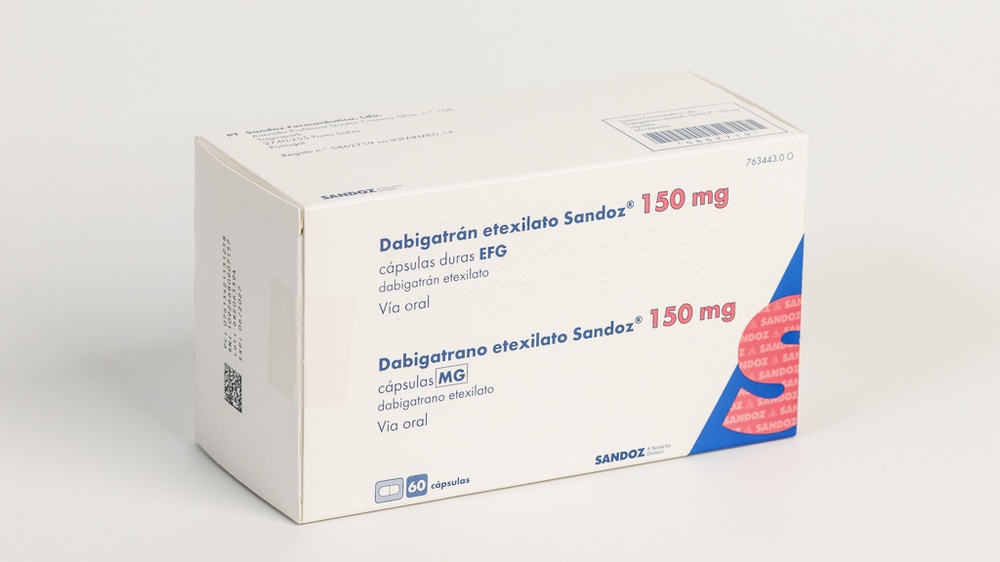
- País de registro
- Forma farmacéuticaCAPSULA, 150 mg
- Código ATCB01AE07
- Precio medio en farmacia45.08 EUR
- Principio activo
- Requiere recetaSí
- Fabricante
- ComposiciónCROSCARMELOSA SODICA (5 mg mg), PROPILENGLICOL (3-7 PORCENTAJE mg), POTASIO, HIDROXIDO DE (E-525) (0,05-0,1 PORCENTAJE mg)
- Esta información es de carácter general y no sustituye la consulta con un profesional sanitario.
- Alternativas a DABIGATRAN ETEXILATO SANDOZ 150 MG CAPSULAS DURAS EFGForma farmacéutica: CAPSULA, 110 mgPrincipio activo: dabigatran etexilateFabricante: Adamed Laboratorios S.L.U.Requiere recetaForma farmacéutica: CAPSULA, 150 mgPrincipio activo: dabigatran etexilateFabricante: Adamed Laboratorios S.L.U.Requiere recetaForma farmacéutica: CAPSULA, 75 mgPrincipio activo: dabigatran etexilateFabricante: Adamed Laboratorios S.L.U.Requiere receta
Médicos online para DABIGATRAN ETEXILATO SANDOZ 150 MG CAPSULAS DURAS EFG
Comenta la dosis, los posibles efectos secundarios, interacciones, contraindicaciones o la revisión de receta de DABIGATRAN ETEXILATO SANDOZ 150 MG CAPSULAS DURAS EFG, sujeto a valoración médica y a la normativa local.









Obtén una receta de DABIGATRAN ETEXILATO SANDOZ 150 MG CAPSULAS DURAS EFG online
Rellena un formulario de 2 minutos
Cuéntanos tus síntomas, historial y el medicamento que necesitas.
Elige un médico o nosotros te asignamos uno
Escoge un especialista o te conectamos con el próximo médico disponible.
El médico revisa tu caso
Normalmente en 30 minutos. Puede hacerte preguntas adicionales por chat.
Recógela en cualquier farmacia
Receta electrónica enviada a tu correo, válida en toda España.
Preguntas frecuentes
DABIGATRAN ETEXILATO SANDOZ 150 MG CAPSULAS DURAS EFG requiere receta en España. Puedes confirmarlo con un médico online según tu caso.
El principio activo de DABIGATRAN ETEXILATO SANDOZ 150 MG CAPSULAS DURAS EFG es dabigatran etexilate. Esta información ayuda a identificar medicamentos con la misma composición pero con diferentes nombres comerciales.
El precio medio en farmacia de DABIGATRAN ETEXILATO SANDOZ 150 MG CAPSULAS DURAS EFG es de aproximadamente 45.08 EUR. Puede variar según el fabricante y la forma farmacéutica.
DABIGATRAN ETEXILATO SANDOZ 150 MG CAPSULAS DURAS EFG es fabricado por Sandoz Farmaceutica S.A.. La marca y el envase pueden variar según el distribuidor.
Los Médicos de familia, Psiquiatras, Dermatólogos, Cardiólogos, Endocrinólogos, Gastroenterólogos, Neumólogos, Nefrólogos, Reumatólogos, Hematólogos, Infectólogos, Alergólogos, Geriatras, Pediatras, Oncólogos pueden valorar la prescripción de DABIGATRAN ETEXILATO SANDOZ 150 MG CAPSULAS DURAS EFG cuando esté clínicamente indicado. Puedes reservar una videoconsulta para comentar tu caso y las opciones de tratamiento.
España cuenta con una infraestructura sanitaria bien desarrollada en ciudades principales como Madrid, Barcelona, Valencia y Sevilla. Las farmacias están ampliamente disponibles y operan bajo estrictas regulaciones, garantizando el acceso a medicamentos con receta.
Puedes comprar DABIGATRAN ETEXILATO SANDOZ 150 MG CAPSULAS DURAS EFG en Madrid, Barcelona, Sevilla o Valencia en cualquier farmacia local con una receta válida.
Para obtener una receta, puedes utilizar Oladoctor:
Otros medicamentos con el mismo principio activo (dabigatran etexilate) incluyen BIGETRA 110 MG CAPSULAS DURAS EFG, BIGETRA 150 MG CAPSULAS DURAS, BIGETRA 75 MG CAPSULAS DURAS EFG. Pueden tener diferentes nombres comerciales o formulaciones, pero contienen el mismo componente terapéutico. Consulta siempre con un médico antes de cambiar o iniciar un nuevo medicamento.
